
对等关税

Search documents
美股一日蒸发超3万亿美元!
Xin Lang Cai Jing· 2025-04-04 12:09
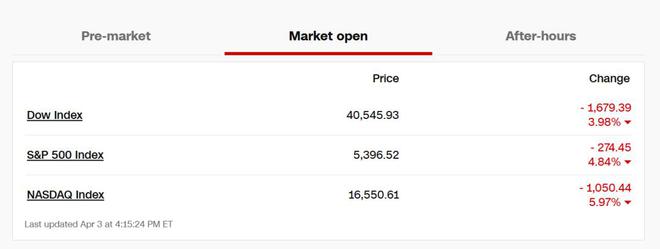
Group 1: Market Reaction - The U.S. stock market experienced a significant decline following the announcement of the "reciprocal tariffs" by President Trump, with all three major indices hitting their largest single-day drops in five years [2][4] - The Dow Index fell by 1,679.39 points, a decrease of 3.98%, marking its largest single-day drop since June 2020 [3][4] - The S&P 500 Index dropped by 1,050.44 points, down 4.84%, also the largest single-day decline since June 2020 [3][4] - The NASDAQ Index saw a decline of 5.97%, the largest drop since March 2020 [3][4] - Approximately $3.1 trillion in market value was wiped out in a single day, the largest loss since March 2020 [5] Group 2: Individual Stock Performance - Major companies faced severe stock price declines, with Apple Inc. down 9.25%, Meta Platforms Inc. down 8.96%, and Nike Inc. down 14.44% [6] - NVIDIA Corp. saw a decrease of 7.81%, while Tesla Inc. dropped by 5.47% [6] Group 3: Commodity Market Impact - Oil prices fell sharply, with WTI crude oil futures dropping over 7%, reaching their lowest level in three years [7] - Gold prices also experienced a decline, with COMEX gold down 0.89% on April 3, although it later recovered slightly [10] - Silver prices saw a significant drop of 7.86% on the same day [10] Group 4: European Market Response - European stock markets reacted negatively, with the FTSE 100 Index down over 1.5%, the CAC Index down over 3.3%, and the DAX Index down over 3% [10] - The European Union plans to implement countermeasures against the U.S. tariffs, with a vote scheduled for April 9 regarding a 25% tariff on steel and aluminum [12]


刚刚!全线暴跌!
券商中国· 2025-04-04 11:33
欧洲股市、美股期货、石油、铜、白银,全线跳水! 今日,针对美国的"对等关税",中国发出反制措施,对原产于美国的所有进口商品,在现行适用关税税率基础上加征34%关税。此外,中国商务部、海关总 署六箭齐发,宣布将16家美国实体列入出口管制管控名单、对中重稀土相关物项实施出口管制、暂停6家美国企业产品输华资质、将11家美国企业列入不可靠 实体清单、对进口医用CT球管发起产业竞争力调查、在世贸组织起诉美"对等关税"等。 在贸易战升级的背景下,欧洲股市跌势不止。4月4日,欧洲股市全线暴跌,盘中跌幅持续扩大,截至19点,意大利富时MIB指数跌超7%,西班牙IBEX指数 跌近6%,德国DAX指数跌近5%,法国CAC 40指数跌超4%,英国富时100指数跌3.8%。 欧洲的银行股跌幅较大,斯托克欧洲600银行指数大跌超10%。德意志银行股价盘中大跌超11%,预计将出现2024年7月以来最糟糕的一天。德国商业银行跌 超7%,有望创下2023年3月以来最糟糕的一天。美股期货也大幅下挫,纳斯达克100指数期货、标普500指数期货均跌超3%,道指期货跌近3%。 其他品种方面,欧元对美元汇率在前一天上涨1.8%后下跌0.5%至1.09 ...


重磅官宣:对美加征34%关税!商务部、海关总署,六箭齐发!
券商中国· 2025-04-04 10:31
Core Viewpoint - The Chinese government has announced retaliatory measures against the U.S. for imposing "reciprocal tariffs" on Chinese goods, including a 34% tariff on all imports from the U.S. and various export controls on U.S. entities [1][2][9]. Tariff Measures - Starting from April 10, 2025, a 34% additional tariff will be imposed on all imports from the U.S. on top of the existing tariff rates [2][3]. - Existing tax exemption policies remain unchanged, and the new tariffs will not be waived [3]. Export Control Measures - The Chinese government has placed 16 U.S. entities on an export control list, prohibiting the export of dual-use items to these entities due to potential threats to national security [5][6]. - Export controls have been implemented on seven categories of rare earth materials, including samarium, gadolinium, and dysprosium, to safeguard national interests [7][8]. Legal and Regulatory Actions - China has filed a complaint with the World Trade Organization (WTO) against the U.S. for its "reciprocal tariffs," arguing that such actions violate international trade rules and harm the multilateral trade system [9]. - The Ministry of Commerce has initiated an investigation into the competitiveness of the domestic medical CT tube industry, responding to concerns about the impact of imports on local production [15][16]. Suspension of Import Qualifications - The General Administration of Customs has suspended the import qualifications of six U.S. companies due to health and safety concerns related to their products, including sorghum and poultry [10][11][13].
【笔记20250403— 关税炮轰,A债疯狂,A股静好】
债券笔记· 2025-04-04 01:56
资金面均衡宽松,资金价格进一步回落,DR001在1.62%附近、DR007在1.7%附近。 | | | | 银行间资金 | (2025. 04. 03) | | | | | | --- | --- | --- | --- | --- | --- | --- | --- | --- | | 同购代码 | 加权利率 | 变化 | 利率走势 | 最高利率 | 变化 | 成交量 | 变化量 | 成义安占 | | | (%) | (bp) | (近30天) | (%) | (bp) | (亿元) | (亿元) | 比 (%) | | R001 | 1.66 | -13 | | 2.04 | -96 | 56476. 63 | -560. 38 | 84. 06 | | R007 | 1.74 | 16 | | 2. 50 | 20 | 9273. 46 | 561. 27 | 13.80 | | R014 | 1.80 | -13 | | 2. 60 | 40 | 1163. 82 | 168. 33 | 1.73 | | R1H | 1.94 | -1 | | 2. 20 | -10 | 83. 49 | 39.19 ...
大类资产|美国对等关税政策四问四答
中信证券研究· 2025-04-04 01:12
文 | 明明 余经纬 秦楚媛 彭阳 周昀锋 王楠茜 王淦 耶鲁研究 表明若美国平均关税税率提升1%,则PCE会提升0 . 1% 。我们测算对等关税若全部落地(不考虑反制措施),美国加权平均关税税 率将提升1 7 . 9%,对应推升美国PCE 1 . 8%左右,会对美国经济产生较大的负面冲击。对等关税落地的时间差或为各个国家与美国谈判的窗 口,并且白宫公告表明"如果贸易伙伴采取重大措施补救非互惠贸易安排并在经济和国家安全事务上与美国保持一致,则降低关税"。当前泰 国、韩国等国家已表示将与美国就关税问题进行谈判。因而最后对等关税最终是否会全部落地还需观察等待,存在部分国家积极谈判后关税税 率下降或被豁免的可能性。 市场避险情绪浓厚,美联储降息预期升温。 特朗普对等关税落地推动1 0年期美债利率大幅下行,美股期货集体跳水,纳指期货跌幅至4%,市 场预期年内美联储降息次数升至3次。考虑特朗普关税落地后将在一季度后的美国通胀中显现,并且市场通胀预期已经在今年一季度明显上 升,因而此轮美联储降息或将较为被动,或会在就业等经济数据明显恶化后才重启降息。 ▍ 大类资产后续如何演绎? 北京时间4月3日凌晨,美国总统特朗普在白宫 ...

“关税日”后的海外宏观逻辑:“对等”概念存预期差,滞胀忧虑强化
Guo Tai Jun An Qi Huo· 2025-04-03 14:11
1. Report Industry Investment Rating No relevant content provided. 2. Core Viewpoints of the Report - The US announced more details of the reciprocal tariff policy on April 3, with the overall intensity exceeding market expectations, and the concept of "reciprocal tariff" differing from the previous market understanding [4]. - The calculation parameter of the "reciprocal tariff" is anchored to the "trade deficit" rather than the "tariff" of the trading partner, which may make it difficult for countries to negotiate with the US [8][11]. - The weighted average tariff rate of the US on China has sharply increased to 71.3%, and it is estimated that China's exports to the US will decrease by 45.6%, total exports will decrease by 12.3%, and real GDP will decline by 1.8% [15]. - In the second quarter, the main macro - and large - asset allocation logic has shifted to stagflation [16]. - The US economic growth forecast for 2025 is adjusted downward to 1.9%, and inflation growth is continuously raised to 3.0%, with a significant divergence between "subjective and objective" and "short - and long - term" inflation [19]. 3. Summary According to Relevant Catalogs 3.1 Trump's Reciprocal Tariff Details and Time - line - Trump plans to set a 10% "minimum benchmark tariff" on global trading partners on April 5, and impose "reciprocal tariffs" on 60 countries with large trade deficits on April 9. The US average external tariff level will increase from 2.3% at the end of 2024 to 23%, theoretically dragging down GDP growth by 2.4% and increasing the inflation level by 1.7% [6]. - Many countries have introduced counter - tariff measures, such as the EU imposing tariffs on 26 billion euros of goods (including 8 billion euros of steel and aluminum), Canada imposing tariffs on various products worth billions of Canadian dollars, and China imposing tariffs on coal, liquefied natural gas, etc. [3]. 3.2 "Reciprocal" Concept - The market expected the "reciprocal tariff" to be based on the average tariff level of each country on the US, plus non - tariff trade barriers. However, the official calculation formula is based on the trade deficit, which may make it difficult for countries to negotiate with the US [11]. 3.3 US Tariffs on China - The weighted average tariff rate of the US on China has reached 71.3%, exceeding the previously announced 60%. It is estimated that China's exports to the US will decrease by 45.6%, total exports will decrease by 12.3%, and real GDP will decline by 1.8% [15]. 3.4 Market Impact - **Macro and Asset Allocation Logic**: The main logic in the second quarter has shifted to stagflation. Different quarters from 2024 to 2025 have different macro themes and asset allocation strategies [16][17]. - **Economic Data**: The "hard data" of the US economy has shown signs of stabilization and rebound, but the "soft data" is still weak. Key economic data in early April, such as non - farm payrolls, CPI, PPI, etc., are highly concerned [32]. - **Market Reaction** - **Commodity Market**: Gold prices are strong, the Bloomberg Commodity Index has declined, and the gold - silver ratio has risen significantly, in line with stagflation characteristics [33]. - **Equity Market**: Global equities are under pressure, especially in the US. The "stagflation" trading is evident in the US stock market [35][37]. - **Bond Market**: The yield of 10 - year US Treasury bonds has declined rapidly, and the yield curve has flattened. The target yield of 10 - year US Treasury bonds is further lowered [39][47]. - **Exchange - Rate Market**: The US dollar has lost its safe - haven status, and the US dollar index has fallen significantly. The target level of the US dollar is further lowered [40][42].
特朗普对等关税点评:红利防御,博弈内需
GOLDEN SUN SECURITIES· 2025-04-03 12:15
Investment Strategy - The report highlights that the recent implementation of "reciprocal tariffs" by the U.S. is expected to increase global trade costs, leading to potential inflationary or recessionary pressures on the global economy [1][8] - The tariffs include a 10% minimum baseline tariff and higher tariffs on specific countries, with China facing a 34% tariff, which could exacerbate external demand challenges for China [7][8] Short-term and Mid-term Market Impact - In the short term, risk appetite is likely to be under pressure due to inflation or recession narratives, impacting asset pricing and increasing demand for safe-haven assets [3][10] - Historical data suggests that after tariff announcements, the A-share market may experience initial pressure followed by potential rebounds, depending on new catalysts [10] - Mid-term asset pricing will revert to fundamentals, with the actual impact of tariffs and retaliatory measures from other countries being crucial [10] Policy Response and Domestic Growth - The report emphasizes the need to monitor the actual impact of tariffs and potential policy responses, as external demand contraction may necessitate stronger domestic growth policies [2][9] - There is an expectation for increased domestic policy measures to stimulate growth, such as interest rate cuts and consumption incentives, especially if negotiations yield positive outcomes before the tariffs take effect [2][9] Asset Allocation Recommendations - The report suggests a defensive approach focusing on dividend-paying assets, as market risk appetite is expected to decline [4][11] - Key sectors to consider include telecommunications, transportation, utilities, and state-owned banks, which are likely to attract defensive capital [11] - Additionally, there is a recommendation to explore offensive opportunities in sectors that may benefit from tariff exemptions or domestic growth policies, such as local consumption and infrastructure investments [12]
特朗普对等关税整体力度大超预期,全球股市普跌,美联储或进一步放缓降息步伐,关注关税反制措施|宏观经济
清华金融评论· 2025-04-03 10:56
Core Viewpoint - The new round of tariffs announced by Trump has led to a significant decline in global stock markets, with Vietnam and Japan experiencing the largest drops, while gold prices reached new highs [1][2]. Tariff Details - The new tariff policy consists of a baseline tariff increase of 10% effective from April 5, which is lower than market expectations. The retaliatory tariffs, effective from April 9, are significantly higher than anticipated, with China facing a 34% tariff (totaling 54%), the EU 20%, Japan 24%, Vietnam 46%, India 26%, and South Korea 25% [3][6]. Market Reactions - Following the announcement, stock markets globally fell, with Vietnam's market plummeting by 7% and Japan's by 3%. The A-share and H-share markets also continued to adjust, with the Shanghai Composite Index down 0.24% and the Hang Seng Index down 1.52%. The Chinese yuan depreciated to 7.35 against the US dollar [3][6]. Reasons for Tariff Increases - The Trump administration's rationale for increasing tariffs includes addressing trade imbalances, national security concerns, domestic political factors, and economic benefits. The administration believes that unfair trade practices by China contribute to the trade deficit and that tariffs can protect U.S. industries and generate government revenue [6][7]. Economic Implications - The tariffs pose a risk of "stagflation" for the U.S. economy, as consumers may face higher costs leading to reduced demand and increased economic pressure. The tariffs are expected to raise price levels and create upward pressure on inflation in the short term. Consumer inflation expectations have surged, with a significant increase noted in March [9]. The Federal Reserve may find it challenging to lower interest rates in the short term due to these economic pressures [9].
特朗普的“关税大棒”,如何撕裂多边贸易体系
Xin Jing Bao· 2025-04-03 10:25
据新华社消息,美国总统特朗普4月2日在白宫签署关于所谓"对等关税"的行政令,宣布美国对贸易伙伴 加征10%的"最低基准关税",并对一些贸易伙伴征收更高关税。其中,对中国、欧盟、日本、越南、印 度分别加征34%、20%、24%、46%、26%。 此前,特朗普就曾宣布将实施"对等关税"政策,要求贸易伙伴国在关税水平上与美国"对等",即美国对 进口商品征收的税率等同于对方对美国出口商品的税率。这一政策被视为特朗普政府践行"美国优先"理 念的核心举措,但其背后的战略意图及对全球贸易格局的影响引发广泛争议。 特朗普的"如意算盘" 特朗普政府推行"对等关税"的首要目标是解决美国长期存在的贸易逆差问题。 数据显示,美国前15大贸易伙伴的贸易加权平均关税税率(指将不同商品或不同税率的关税进行加权平 均计算得出的税率)普遍高于美国(如印度12%、韩国8.4%),特朗普认为这种"非对等"关税导致美国 长期遭受"不公平贸易剥削"。通过强制关税对等,美国试图缩小商品贸易逆差,重塑其在全球贸易中的 主导地位。 此外,该政策还服务于特朗普的国内政治议程:通过提高进口商品成本,推动制造业回流,为本土产业 创造保护壁垒,进而取悦蓝领选民,巩 ...
利率周记(4月第1周):关税超预期,利率还能下多少?
Huaan Securities· 2025-04-03 10:02
Group 1: Report Industry Investment Rating - No information provided on the report industry investment rating Group 2: Core Viewpoints of the Report - On April 2, Trump announced "reciprocal tariffs", setting a 10% minimum benchmark tariff for trading partners, with higher - tariff economies including China (34%), EU (20%), Vietnam (46%), India (26%), Japan (24%), etc., and also re - emphasized 25% auto tariffs and announced a 25% tariff on all imported beer, which increased capital market volatility [2] - On April 3, in the domestic bond market, the yields of various maturities declined, with the 10Y Treasury bonds 240011 and 250004 down about 5bp, and the decline of ultra - long bonds > long bonds > medium - short bonds [3] - After the "reciprocal tariffs" shock, the bond market is close to the pricing of unchanged short - term interest rate center + historical minimum term spread. The subsequent market decline needs to focus on the influx of risk - averse funds into the bond market and the opening of the broad - money window. The 10 - year Treasury bond is likely to fluctuate in the range of 1.70% - 1.80%. Active bonds are more cost - effective during the bond - replacement period, and some secondary - active bonds may over - adjust due to temporary tightening of funds [6] Group 3: Summary by Relevant Catalogs 1. Impact of Tariff Announcement - Trump's "reciprocal tariffs" announcement was a major surprise to the market, targeting multiple economies and increasing capital market volatility [2] 2. Bond Market Performance on April 3 - The domestic bond market priced in the tariff impact in the morning, with the yields of 10Y Treasury bonds 240011 and 250004 dropping by about 5bp, and the decline pattern of different - maturity bonds was ultra - long bonds > long bonds > medium - short bonds [3] 3. Three Perspectives on the Subsequent Bond Market 3.1. Tariff's Impact on Fundamental Expectations and Term Spread - Tariffs increase pessimistic expectations about the economic fundamentals. When there are such expectations, term spreads like 10Y - 1Y and 30Y - 10Y usually compress. Given the current short - term interest rate above 1.5% (1.54% on April 2) and the 10Y - 1Y term spread compressed to 25bp, the short - term interest rate is approaching the theoretical lower limit of 1.74% (calculated based on the historical minimum term spread of 20bp) [3] 3.2. Conditions for Further Decline in Short - term Interest Rates - A further decline in short - term interest rates depends on broad - money policies, but the window may not open immediately. The pressure to stabilize the economy has increased, and the expectation of reserve requirement ratio cuts and interest rate cuts has risen again. However, stabilizing the exchange rate restricts broad - money policies in the short term, the space for broad - money policies is limited compared to 2018, and the probability of broad - money policies in May - June to cooperate with government bond issuance is higher, while the net financing pressure in April is relatively small [4] 3.3. Focus on Institutional Behavior when the 10 - year Treasury Bond Fluctuates between 1.70% - 1.80% - In the current bond - replacement market, 240011 may face upward pressure because the short - selling force of 240011 is still strong (as shown by the increase in bond lending volume after the quarter), and 250004 is about to replace 240011 as the active bond, so its interest rate may rise due to liquidity pricing [5][6] - The secondary - active bonds of 30Y Treasury bonds may also face upward pressure. Although the funds have loosened, the negative Carry phenomenon still exists. During the Q2 when there is a 30Y Treasury bond issuance plan, the secondary - active bonds may over - adjust after the seasonal tightening of funds [6]