
以旧换新政策

Search documents
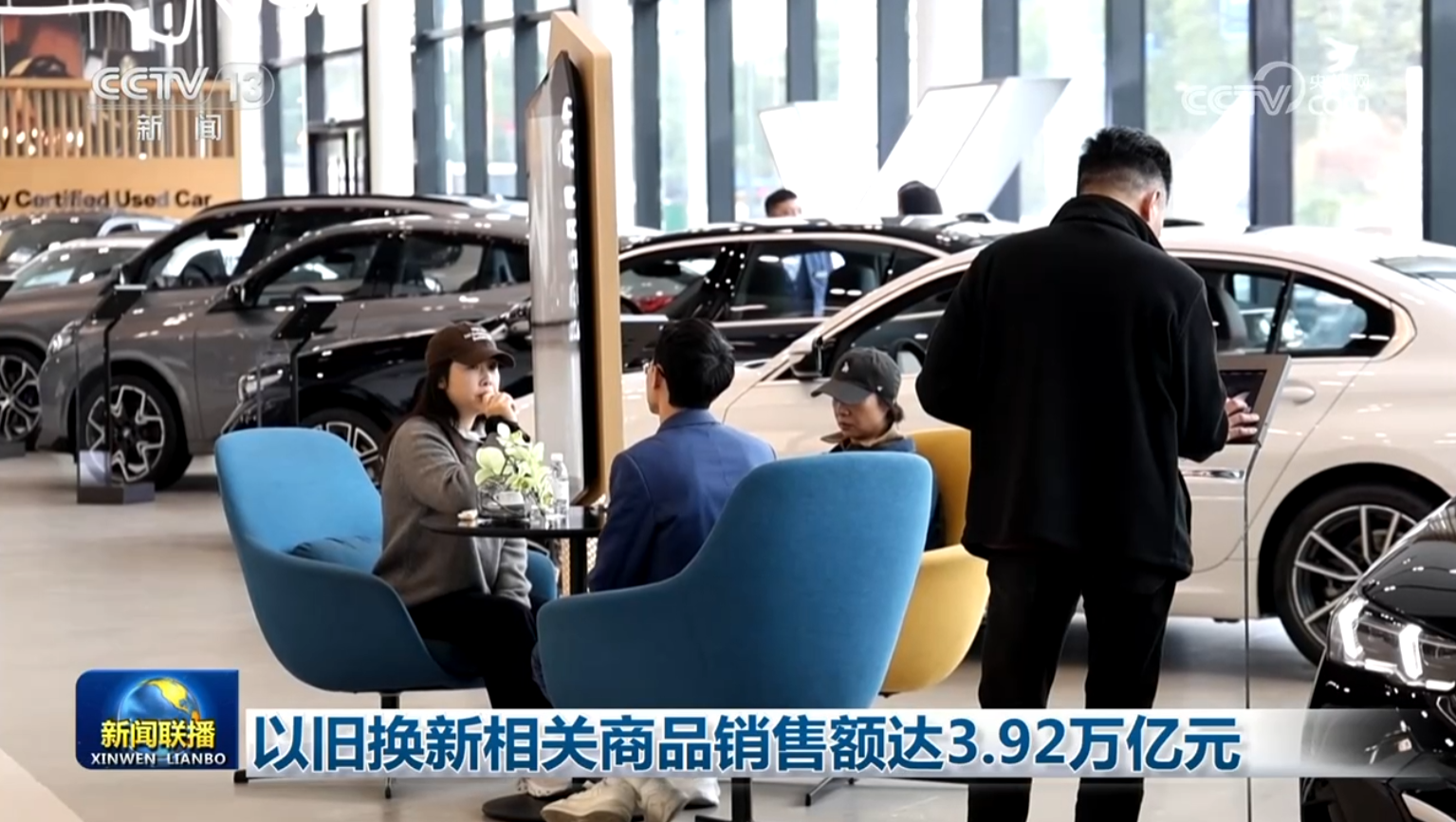
以旧换新相关商品销售额达3.92万亿元
Yang Shi Wang· 2026-01-08 12:38
Core Insights - The implementation of the old-for-new consumption policy in 2024 has resulted in a total sales volume of 3.92 trillion yuan, benefiting 494 million people [1] - The policy has significantly boosted the sales of various products, including over 18.3 million vehicles, more than 192 million home appliances, and approximately 91 million mobile and digital products [1] Group 1: Automotive Industry - In the old-for-new vehicle exchange, nearly 60% of the exchanged vehicles are new energy vehicles, leading to a doubling of sales in the domestic new energy passenger car market [2] - The average growth rate of scrapped vehicle recovery over the past two years has exceeded 45%, resulting in a reduction of carbon emissions by approximately 44 million tons [5] Group 2: Home Appliances - In the home appliance sector, over 90% of exchanged products are of first-level energy efficiency, indicating a strong shift towards energy-efficient products [3] - The presence of old-for-new home appliance stores in densely populated commercial areas has led to a more than 30% increase in consumer spending within a 1-kilometer radius [7] Group 3: Digital Products - Among mobile and digital products, mid-to-high-end models account for 72.5% of new purchases, reflecting a consumer preference for higher quality and advanced technology [3] Group 4: Economic Impact - The introduction of green, low-carbon, and smart new products is enhancing the quality of life for consumers while promoting a green economic transition [5] - Increased consumer engagement in physical stores for product experiences and subsidies is driving cross-scenario consumption in leisure, entertainment, and dining sectors [7]

崔东树:汽车行业内卷降价现象明显减弱,行业运行压力改善
Zhong Guo Qi Che Bao Wang· 2026-01-08 09:27
Core Viewpoint - The promotional pressure for conventional fuel vehicles and hybrid vehicles in 2025 is expected to be relatively low, while the promotion for new energy vehicles is more intense, indicating a shift in market dynamics towards electric and hybrid models [1] Group 1: Promotional Trends - In December, the promotion for plug-in hybrid vehicles increased by 3.9 percentage points year-on-year but decreased by 0.4 percentage points month-on-month [1] - The promotion for extended-range vehicles increased by approximately 4.5 percentage points compared to December 2024 [1] - The promotion for pure electric vehicles increased by around 1.1 percentage points compared to December 2024, with a month-on-month increase of about 0.4 percentage points [1] Group 2: Market Dynamics - The "old-for-new" policy has had a significant positive effect, leading to increased market sales and a noticeable reduction in price competition [1] - The operational pressure in the industry has improved, with the profit margin of the automotive industry rising to 4.4% in the first eleven months, reflecting a good performance in terms of industry scale and stabilization of price promotions [1]
家电轻工2026年策略报告:重点关注内需供给优化,外需新品类新市场-20260108
GOLDEN SUN SECURITIES· 2026-01-08 07:57
Group 1: Industry Overview - The home appliance and light industry in 2026 should focus on four investment themes: domestic demand supported by old-for-new policies, supply-side improvements in the power bank industry, and the rise of niche consumer products in service consumption [1] - The white goods sector is expected to benefit from the old-for-new policy, with a significant increase in consumer spending projected [44] - The overall performance of the light industry outperformed the CSI 300 index, with a cumulative increase of 24.68% from January to December 2025 [12][15] Group 2: Key Companies - Midea Group is developing a second growth curve through its B-end business, particularly in data center liquid cooling, which shows significant potential [2] - Haier Smart Home is enhancing its operational system through a data-driven approach, improving competitiveness across product, cost, and supply chain [2] - TCL Electronics and other companies in the black goods sector have shown strong performance, benefiting from the old-for-new subsidy policy [21] Group 3: Market Trends - The power bank industry is expected to see improved market conditions due to new regulations, which will raise industry standards and potentially eliminate many low-quality brands [2] - The "Guzi economy" is tapping into emotional consumption needs, with domestic IP supply increasing and consumer spending on IP expected to grow significantly [3] - The folding bicycle market is transitioning from niche to mainstream, with significant growth potential driven by urban mobility needs [3] Group 4: Export and New Markets - The export chain is gradually recovering from tariff disruptions, with a focus on companies that have strong overseas production capabilities to mitigate tariff risks [3] - New product categories, such as pool cleaning robots, have substantial growth potential, with Chinese companies expected to increase their market share [3] - Emerging markets in Africa and Latin America present new opportunities for multinational hygiene product companies [3]


汽车行业2026十大趋势:国央企整车企业迎来发展机遇、具身智能进入量产前夜
Xin Hua Cai Jing· 2026-01-08 07:18
Core Viewpoint - The Chinese automotive industry is at a critical juncture in the transition towards electric and intelligent vehicles, with three distinct industry curves coexisting: traditional fuel vehicles, electric intelligent vehicles, and future industries represented by autonomous driving. The year 2026 is anticipated to be a pivotal turning point for the industry, characterized by structural transformation driven by policy, market growth, technological breakthroughs, and global competition [1]. Group 1: Trends in the Automotive Industry - Trend 1: The "old-for-new" policy is expected to become a normalized tool, addressing the growing gap in vehicle replacement as the annual scrappage rate remains significantly lower than new car sales. This policy is projected to enhance market demand and support steady domestic consumption and industrial production [2]. - Trend 2: New automotive players are driving an upgrade in export structure, with Chinese automotive exports experiencing significant growth, becoming a "second growth curve." These companies are shifting from single vehicle exports to localized production, enhancing China's brand value and technological image in the global market [3]. - Trend 3: A clear differentiation is emerging between "mass-market pure electric" and "high-end range-extended" vehicles, with structural changes in market demand as the penetration rate of new energy vehicles exceeds 50%. The mainstream configuration for high-end SUVs/MPVs remains "large battery long-range range-extended" [4]. Group 2: Market Dynamics and Competitive Landscape - Trend 4: The industry is transitioning to a "late-stage mass market," where consumers prioritize brand reputation, after-sales support, and residual value certainty. Resources are increasingly consolidating around leading technology firms, enhancing conversion efficiency in mainstream price segments [5]. - Trend 5: State-owned enterprises are poised for growth opportunities as regulatory bodies strengthen the assessment of their new energy businesses, driving resources towards electric intelligence. These enterprises hold advantages in manufacturing systems and compliance, particularly in the realm of conditional autonomous driving [6]. - Trend 6: The penetration of new energy commercial vehicles is accelerating, with heavy-duty and light-duty trucks entering a rapid growth phase. The total cost of ownership for heavy trucks is now within a 1.5-2 year recovery period, while urban electric vehicle infrastructure is fully mature [7]. Group 3: Technological Advancements and Future Prospects - Trend 7: High-perception intelligent cockpit configurations are reshaping purchasing decisions, with smart features becoming a core competitive differentiator. The integration of advanced displays and intelligent seating systems is driving a new wave of competition in the market [8]. - Trend 8: Intelligent driving architecture is transitioning to an "end-to-end" model, enhancing the integration of perception and decision-making processes. The "equalization of intelligent driving" is facilitating advanced driving assistance features in lower-priced models [9][10]. - Trend 9: Three major commercial scenarios for autonomous driving are on the verge of mass production, including Robotaxi, mining autonomous vehicles, and unmanned logistics vehicles, with significant cost reductions and operational efficiencies being realized [11]. - Trend 10: Embodied intelligence is approaching mass production, with humanoid robots transitioning to dual-core intelligence. The automotive industry is well-suited for this technology due to the high degree of technical reuse, with several manufacturers planning to launch production in 2025 [12]. Overall, the Chinese automotive industry is expected to exhibit characteristics of multiple technological pathways, market structure differentiation, and accelerated intelligence implementation, supported by policy guidance and technological innovation, leading to high-quality development [13].
汽车国补政策落地,汽车终端需求调研
数说新能源· 2026-01-08 03:20
Group 1: Current Market Situation and Short-term Outlook - The market is expected to recover after consumers digest their hesitation within 40-60 days following the cancellation of policies, leading to a return to normalcy post-Spring Festival [2] - The automotive market experienced a significant decline in sales during the New Year period, primarily due to a lack of year-end purchasing frenzy and weak demand [3] - The "old-for-new" policy introduced on January 1 is seen as a long-term confidence booster but lacks immediate stimulus, with local execution details still pending [3] - Despite market hesitation, foot traffic at dealerships has not decreased, indicating that potential demand remains, although customers are currently in a wait-and-see mode [3] - In the coming weeks, automakers are expected to introduce "bottom-line" sales policies to stabilize the market and boost confidence, although the measures may not be substantial [3] Group 2: Policy Impact and Long-term Trends - The national policy aims to increase the average transaction price per vehicle and guide industry upgrades, potentially phasing out low-end electric vehicles through standards related to battery efficiency and range [4] - Models priced above 200,000 yuan, particularly high-end electric brands, are expected to benefit more, while brands relying on low-end models priced below 200,000 yuan will face greater challenges [4] - The aggressive price wars have largely ceased, leading to a quieter market sentiment [4] - Head brands like BYD, Tesla, Huawei, and others are expanding their advantages, while lower-tier brands are struggling due to blocked paths for inventory clearance through drastic price cuts [5] - The "old-for-new" policy details are still pending, with significant differences in local replacement subsidy policies affecting consumer decisions [5]

奋进“十五五”开局起好步|坚持扩大内需 推动消费稳定增长
Xin Lang Cai Jing· 2026-01-07 22:24
Core Viewpoint - Consumption is a key engine driving economic growth, and the provincial government has set the primary task for 2026 to optimize supply and expand demand through special actions to boost consumption [1] Group 1: Promotion of Consumption Activities - A series of consumption promotion activities will be continuously carried out, focusing on a "policy + activity" dual-drive approach, with plans to hold over 2,000 themed consumption activities throughout the year [2] - The government aims to create a vibrant consumption atmosphere by organizing events during peak consumption periods such as New Year, Spring Festival, and National Day [2] Group 2: Quality and Expansion of Service Consumption - Efforts will be made to enhance the quality of service consumption by expanding high-quality service supply and cultivating new consumption formats and scenarios [2] - The government will guide cities like Harbin and Qiqihar to host food festivals and other culinary events to promote local dining culture [2] Group 3: Policy Continuity for Trade-in Programs - The government will ensure seamless continuity of trade-in policies by coordinating with relevant departments and utilizing national bond funds to drive more trade-in activities [3] - A unified support category and standard will be executed to enhance the efficiency of policy implementation [3] Group 4: Increased Investment in Consumer Coupons - The government plans to issue over 400 million yuan in consumer coupons, focusing on key sectors such as fuel, department stores, and supermarkets to directly benefit consumers [3] - There will be targeted efforts to increase the scale of new car consumption coupons to amplify the effects of trade-in policies [3] Group 5: Cultivation of Market Entities - Policies will be implemented to support the cultivation of market entities, including incentives for e-commerce and the introduction of flagship stores for well-known brands [4] - The government aims to enhance market confidence by ensuring timely disbursement of subsidy funds and promoting sales in sectors like automobiles and home appliances [4]
【快讯】每日快讯(2026年1月7日)
乘联分会· 2026-01-07 08:41
Domestic News - The Ministry of Commerce announced that China aims to achieve 18.3 million vehicle trade-ins from 2024 to 2025, with nearly 60% being new energy vehicles, contributing to a consumer sales increase of 3.92 trillion yuan, benefiting 494 million consumers [3] - Shanghai has issued measures to encourage foreign investment enterprises to reinvest domestically, allowing various methods for reinvestment, including using undistributed profits [4] - Beijing plans to implement a "no-cost first aid" policy for traffic accident victims, ensuring they receive immediate medical care without upfront costs [5] - Guangdong is optimizing insurance services for new energy vehicles and exploring the development of smart driving liability insurance products to support the growth of the new energy vehicle industry [6] - NIO has officially rolled out its one millionth production vehicle, a new ES8, and has signed a five-year strategic cooperation agreement with CATL to enhance technology and market collaboration [8] - Qianli Zhijia and Geely have jointly launched a new smart driving brand, G-ASD, which covers intelligent driving capabilities from L2 to L4 levels, with the first version already installed in 16 models [9] - Chery Group has set a sales target of 3.2 million vehicles for 2026, representing a year-on-year increase of 14.03% [10] - Hesai Technology announced plans to double its lidar production capacity to 4 million units by 2026 to meet the growing demand in ADAS and robotics [11] International News - Canadian automotive sales are projected to rebound to pre-pandemic levels by 2025, with an estimated 1.9 million light vehicle sales, a 2% increase from 2024 [12] - NVIDIA plans to test its L4 autonomous taxi service in 2027, following initial road tests in 2026 [13] - Sony and Honda's joint venture will launch its first electric vehicle, "AFEELA1," in Japan in the first half of 2027 [14] - Hyundai Motor Group intends to deploy Boston Dynamics' humanoid robots in its U.S. factories starting in 2028 [15] Commercial Vehicles - Proton Motors aims to sell 13,000 vehicles in 2026, following a successful year where it sold over 8,000 vehicles [16][17] - FAW Jiefang has initiated public road demonstrations for its liquid hydrogen heavy truck, marking a significant step in commercializing hydrogen technology [18] - BYD's T4 electric truck has received a recommendation award from industry opinion leaders for its performance and customer recognition [19] - Shaanxi Automobile's X6000 tractor has received EU certification, allowing it to enter the European market, showcasing its compliance with stringent safety and emissions standards [20]






数读中国 数说以旧换新“五重效应”
Ren Min Wang· 2026-01-07 01:31
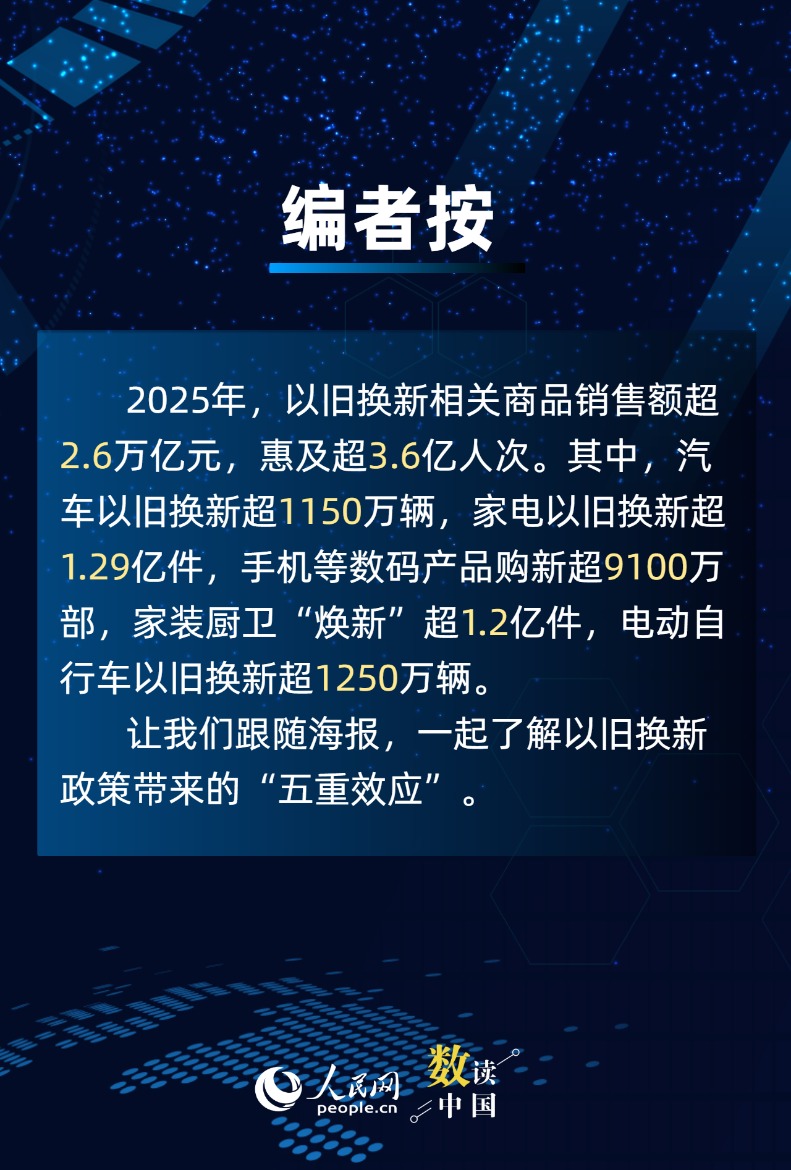
Group 1 - The core viewpoint of the article highlights the significant impact of the trade-in policy, with sales exceeding 2.6 trillion yuan in 2025, benefiting over 360 million people [2] - The trade-in policy has accelerated the growth of social retail sales, contributing over 1 percentage point to the total retail sales growth [3] - The retail sales of home appliances have surpassed 1 trillion yuan, setting a historical record [3] Group 2 - In the automotive trade-in segment, nearly 60% of the vehicles traded in are new energy vehicles [5] - The market share of new energy passenger vehicles has consistently exceeded 50% for nine consecutive months [6] - In the home appliance trade-in segment, over 90% of the products are first-level energy efficiency (water efficiency) products [6] Group 3 - The recycling volume of scrapped vehicles is approximately 9.6 million tons, with significant amounts of steel and non-ferrous metals being recycled [7] - Since the full implementation of the policy in September 2024, over 480 million subsidies have been issued directly to consumers [8] - The replacement of old electric bicycles has increased by more than nine times compared to 2024, with safer options dominating the market [8]
2026首批“国补”落地 新政“新”在哪儿?
Yang Shi Xin Wen· 2026-01-06 23:57
Group 1: Core Insights - The "National Subsidy" policy has significantly boosted consumer spending, with an expected sales increase of 3.92 trillion yuan benefiting 494 million consumers from 2024 to 2025 [1] - The 2026 "National Subsidy" policy will focus on broader coverage and stronger product promotion capabilities, particularly for green, low-carbon, and smart digital products [2] Group 2: Policy Adjustments - The 2026 subsidy will optimize the range of products eligible for support, concentrating on six categories of home appliances and emphasizing energy-efficient products [2] - The policy will expand the scope of smart products eligible for subsidies, including new categories like smart glasses, to promote technological innovation [2] Group 3: Market Impact - The 2026 policy aims for a more balanced and stable distribution of subsidy funds throughout the year, addressing previous issues of fund exhaustion in the latter quarters [3] - This approach is expected to stabilize market expectations and enhance the effectiveness of the policy in driving and guiding consumer spending [3] Group 4: Beneficiary Industries - Industries focusing on green, low-carbon, and smart digital products are likely to benefit from the 2026 subsidy, enhancing technological updates and product quality [4] - The subsidy will encourage companies to innovate and improve their products, expanding market opportunities for advanced technology [4] Group 5: Service Consumption - There is potential for service consumption products to receive "National Subsidy" support, as service spending constitutes about 47% of household expenditures and is on the rise [5] - The government has already initiated various policies to promote service consumption, indicating a future focus on supporting this sector with innovative subsidy policies [6]
持续激发绿色消费潜力多部门详解新举措
Xin Lang Cai Jing· 2026-01-06 19:29
Core Viewpoint - The Chinese government has launched a comprehensive initiative to promote green consumption, outlining 20 measures across seven areas to support the transition to a low-carbon economy and enhance consumer spending during the 14th Five-Year Plan period [1][2]. Group 1: Green Consumption Measures - The initiative includes increasing the supply of green agricultural products, with a target of over 88,000 certifications for "three products and one standard" by the end of 2025, and a standardized production area of 20.5 million acres for green food [1]. - The "old-for-new" policy aims to replace 18.3 million vehicles, with nearly 60% being new energy vehicles, and to replace 192 million home appliances, achieving over 90% energy efficiency [2]. - The initiative is expected to generate sales of 3.92 trillion yuan, benefiting approximately 494 million consumers [2]. Group 2: Green Supply Chain and Recycling - The promotion of a green supply chain is highlighted, with a focus on green procurement, products, and packaging, as well as the establishment of a green consumption points system [3]. - The use of environmentally friendly alternatives has increased by 26.31% in the first half of 2025, reflecting progress in reducing single-use plastic products and promoting green dining [3]. - The government plans to support the construction of sorting centers for waste disposal and encourage local governments to provide policy support for these initiatives [5]. Group 3: Waste Management and Standards - The "zero waste city" initiative aims to transform waste materials into valuable resources, with plans to implement this in around 200 cities during the 14th Five-Year Plan [4]. - The government will update national standards and support participation in international standardization activities related to green products and energy efficiency [5]. - Efforts will be made to combat food waste and promote "green dining" services through internet platforms [5].