
社融

Search documents
中金:央行资产负债表提供政策空间——3月金融数据点评
中金点睛· 2025-04-13 23:39
Group 1 - The core viewpoint of the article is that social financing (社融) has significantly exceeded expectations, with the loan balance year-on-year growth rate rebounding after two years, primarily supported by fiscal demand [2][11] - In March, new social financing reached 5.89 trillion yuan, an increase of 1.06 trillion yuan year-on-year, with the year-on-year growth rate rising from 8.2% to 8.4%, surpassing market expectations [2][4] - The net financing of government bonds in March reached 1.48 trillion yuan, an increase of approximately 1 trillion yuan year-on-year, indicating that rapid government bond issuance may lead to quicker commencement of key investment projects this year [2][4] Group 2 - M2 growth rate remained stable at 7.0%, while M1 growth rate increased from 0.1% in February to 1.6% in March, indicating relatively ample liquidity [7][11] - In March, short-term loans for enterprises increased by 460 billion yuan year-on-year, totaling 1.44 trillion yuan, while corporate loan rates remained unchanged at 3.30% [7][8] - The actual financing scale for enterprises in March remained roughly the same as last year, with net financing for the enterprise sector at 3.1 trillion yuan, indicating stability in overall financing demand [7][8] Group 3 - Fiscal deposits remain high, with a year-on-year growth rate of 16.9% in March, suggesting significant potential for fiscal support in the near term [11][13] - The central bank's decision to release favorable data on a Sunday is seen as a strategy to stabilize market confidence ahead of the Monday opening [13][14] - The central bank's balance sheet relative to GDP is at a historically low level, providing potential for expansion, which could help lower risk premiums in uncertain economic conditions [13][14]


2025年2月金融数据点评:政府债券融资拉动明显
ZHONGTAI SECURITIES· 2025-03-17 06:46
Investment Rating - The industry rating is "Overweight," indicating an expected increase of over 10% relative to the benchmark index in the next 6 to 12 months [12]. Core Insights - The financial data for February shows a significant increase in social financing, driven by government bond financing, particularly the accelerated issuance of local government special bonds [5][6]. - The total social financing in February amounted to 22,333 billion yuan, reflecting a year-on-year increase of 7,374 billion yuan [5]. - The net financing from government bonds reached 16,967 billion yuan, a year-on-year increase of 10,956 billion yuan, indicating strong government support for financing [5][6]. - The report highlights a notable decline in household loans, with a reduction of 3,891 billion yuan in February, suggesting fluctuations in consumer demand and home-buying intentions [4][5]. Summary by Sections Financial Data Overview - The social financing stock grew by 8.19% year-on-year in February, with a notable increase in local government special bond issuance [3][5]. - The total new RMB loans in February were 10,100 billion yuan, a decrease of 4,400 billion yuan year-on-year [3][4]. Loan Breakdown - Household loans decreased by 3,891 billion yuan, while corporate loans increased by 10,400 billion yuan, indicating a shift in lending dynamics [4][5]. - Short-term loans for enterprises showed a year-on-year increase, while medium to long-term loans decreased, reflecting varying demand across sectors [4][5]. Deposits and Savings - Total RMB deposits increased by 44,200 billion yuan in February, with a year-on-year increase of 34,600 billion yuan, indicating strong deposit growth [7]. - Fiscal deposits also saw a significant increase, suggesting a slower pace of fiscal expenditure [7].
信贷不足VS财政拐点?——2月金融数据点评
赵伟宏观探索· 2025-03-16 16:22
Core Viewpoint - A more proactive fiscal policy may break the current weak expectation cycle, as the decline in M2 year-on-year is primarily due to weak growth in household demand deposits rather than insufficient corporate activity, indicating a shift in household asset allocation towards equity markets [2][9] Financial Data Summary - In February, new credit amounted to 10,100 billion, a year-on-year decrease of 4,400 billion, mainly dragged down by corporate medium and long-term loans. Household loans decreased by 3,891 billion, a year-on-year reduction of 2,016 billion, with short-term loans down by 2,741 billion and medium and long-term loans down by 1,150 billion [4][22] - The total social financing (社融) in February was 22,375 billion, a year-on-year increase of 7,416 billion, supported by a significant increase in government bond financing while loans decreased. New RMB loans were 6,528 billion, a year-on-year decrease of 3,245 billion [5][23] - The M2 year-on-year growth remained stable at 7.0%, with the new M2 year-on-year growth rate declining by 0.3 percentage points to 0.1%. In terms of deposit structure, household deposits increased by 6,100 billion, a year-on-year decrease of 25,900 billion, while corporate deposits decreased by 8,940 billion [5][28] Economic Outlook - The increase in social financing in February was supported by fiscal financing, but the delayed arrival of debt repayment funds and weak credit demand indicate that the recovery foundation is still not solid. A more proactive fiscal policy is expected to effectively break the current weak expectation cycle, with increased spending intensity and accelerated expenditure expected to stabilize social financing [3][21]
宏观经济点评:债务置换下的社融“新范式”
KAIYUAN SECURITIES· 2025-03-16 13:34
Group 1: Social Financing and Credit Trends - In February, the social financing scale increased by 2.23 trillion RMB, which is 737.4 billion RMB more year-on-year, with a growth rate of 8.2%[4] - New RMB loans added in February were 650.5 billion RMB, a decrease of 326.7 billion RMB year-on-year[4] - Corporate loans increased by 1.04 trillion RMB in February, a year-on-year decrease of 540 billion RMB[3] Group 2: Household and Corporate Loan Performance - Household loans showed a net decrease of 389.1 billion RMB, which is a reduction of 201.6 billion RMB compared to the previous year[3] - The performance of short-term household loans was better than that of medium and long-term loans, with short-term loans decreasing by 2.74 billion RMB[3] - Corporate medium and long-term loans saw a decrease of 750 billion RMB year-on-year, attributed to accelerated debt replacement and slow recovery post-Spring Festival[3] Group 3: Monetary Supply and Economic Outlook - M2 growth rate remained stable at 7% in February, while M1 growth rate fell by 0.3 percentage points to 0.1%[5] - The increase in non-bank deposits was 2.8 trillion RMB, which is 1.7 trillion RMB more year-on-year[5] - The necessity to boost demand is highlighted, with potential for structural interest rate cuts and increased personal consumption loan issuance[5]
社融同比多增,政策债再发力
HTSC· 2025-03-16 01:42
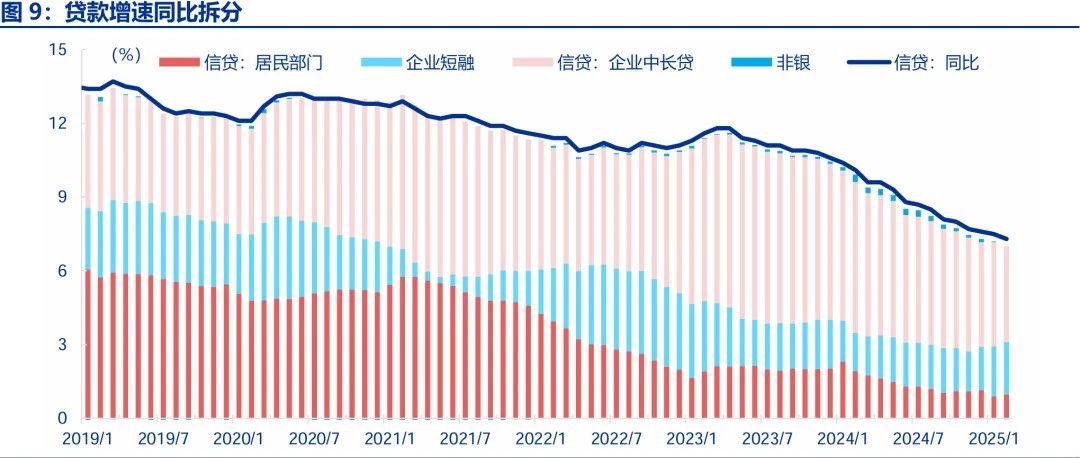
2 月社融增量 2.23 万亿元(Wind 一致预期 2.65 万亿元),同比多增 7374 亿 元,存量同比增速 8.2%,较上月末+0.2pct。随隐债置换加速推进,2 月政 府债供给多增是支撑社融增长的主要力量。信贷需求仍有待提振,票据融资 冲量。政策预期向好,夯实经济回稳基础,推荐个股:1)质优个股,如招 行,兴业,成都,苏州,上海,渝农 AH、宁波;2)港股大行股息优势突出、 估值性价比高,如建行 H,工行 H、交行 H。 信贷同比少增,票据融资冲量 2 月贷款新增 1.01 万亿元(Wind 一致预期 1.24 万亿元),同比少增 4400 亿 元。2 月贷款存量同比增速+7.3%,较 1 月末-0.2pct。居民贷款减少 3891 亿元,同比少减 2016 亿元,其中短贷、中长贷分别同比少减 2127 亿元、 多减 112 亿元。《政府工作报告》中将"全方位扩大国内需求"放在 2025 年工作任务首位,后续居民消费需求或有改善。企业贷款新增 1.04 万亿元, 同比少增 5300 亿元,其中短贷、中长贷、票据融资分别同比少增 2000 亿 元、少增 7500 亿元、多增 4460 亿元。2 月底 ...





25年2月金融数据点评:化债影响再度显现
Ping An Securities· 2025-03-14 14:39
Investment Rating - The report does not explicitly provide an investment rating for the industry Core Insights - The February 2025 financial data indicates a significant increase in social financing, primarily driven by government bonds, while credit growth fell short of expectations [2][3] - The overall financial data for February reflects a weak performance, with a notable contraction in medium to long-term loans for enterprises due to debt reduction impacts [4][7] - The M1 growth rate showed an unexpected seasonal decline, suggesting weak consumer and investment sentiment among enterprises and residents [5][6] Summary by Sections Social Financing and Credit - In February 2025, new social financing amounted to 22,333 billion yuan, an increase of 7,374 billion yuan year-on-year, but 4,167 billion yuan lower than market expectations [2] - The increase in social financing was mainly attributed to government bonds, which contributed approximately 17,000 billion yuan, while new RMB loans were 6,506 billion yuan, reflecting a year-on-year decrease of 3,267 billion yuan [3] Loan Structure - Medium to long-term loans for enterprises saw a significant reduction, with new loans amounting to 5,400 billion yuan, a year-on-year decrease of 7,500 billion yuan [4] - Residential medium to long-term loans remained weak, with a decrease of 1,150 billion yuan, while short-term loans for residents decreased by 2,741 billion yuan [4] Deposit Structure - Corporate deposits increased significantly by approximately 21,000 billion yuan, while resident deposits decreased by about 26,000 billion yuan [6] - Non-bank deposits rose by 18,000 billion yuan, indicating a shift in investment preferences among non-bank entities [6] Market Strategy - The report suggests focusing on short-term credit bonds and similar short-duration, interest-bearing assets due to the overall weak financial data and the impact of debt reduction on credit quality [7][8]
【宏观周报】国内两会聚焦促消费,美国2月通胀数据转弱
Zhe Shang Qi Huo· 2025-03-11 12:56
Economic Overview - In February, China's Consumer Price Index (CPI) decreased by 4.7% year-on-year, compared to an increase of 0.5% in the previous month[4] - The unemployment rate in the U.S. rose by 0.1 percentage points to 4.1% in February, with non-farm payrolls increasing by 151,000, below the market expectation[3] - The U.S. manufacturing PMI for February was reported at 50.3, indicating slight expansion, while the non-manufacturing PMI was at 53.5, showing stronger growth[19] Policy and Economic Goals - The Chinese government aims for a GDP growth of around 8% for 2025, with a target urban unemployment rate of approximately 5.3% and a consumer price increase of about 2.8%[4] - The focus of the Chinese government during the Two Sessions is on boosting consumption and stabilizing the real estate and stock markets[4] Inflation and Monetary Policy - U.S. inflation data for January showed a year-on-year increase of 3.0%, exceeding expectations, while core CPI rose by 3.3%[5] - The Federal Reserve's Chairman Powell indicated that there is no urgency to lower interest rates, citing stable labor market conditions[6] Financial Indicators - In January, China's social financing scale increased by 7.06 trillion yuan, which is 683 billion yuan more than the same period last year[5] - The manufacturing PMI in China rose to 50.28 in February, up by 1.1 percentage points from the previous month, indicating improved economic conditions[4]
宏观量化经济指数周报:新增贷款:2月同比少增,1-2月同比持平
Soochow Securities· 2025-03-09 14:16
Economic Indicators - The weekly ECI supply index is at 50.39%, down 0.04 percentage points from last week, while the demand index is at 49.95%, up 0.02 percentage points[1] - The monthly ECI supply index increased by 0.11 percentage points from February, while the demand index rose by 0.06 percentage points[5] - The ECI investment index is at 50.02%, up 0.08 percentage points from February, indicating a slight recovery in investment activity[5] Loan and Financing Trends - The ELI index is at -0.13%, down 0.42 percentage points from last week, suggesting a potential decrease in new loans for February[8] - New loans for February are expected to be between 1.0 to 1.2 trillion yuan, a year-on-year decrease of approximately 250 to 450 billion yuan[11] - Government bond net financing in February reached 1.69 trillion yuan, a year-on-year increase of about 1.0 trillion yuan, contributing to a projected social financing growth of around 2.6 trillion yuan[11] Industrial and Consumer Activity - The industrial production index shows a slight decline, with key industries experiencing mixed operational rates[13] - Passenger car retail sales in February reached 1.397 million units, a year-on-year increase of 26.0%[20] - Infrastructure work volume has improved compared to last year, with significant growth in excavator sales, which rose by 99.4% year-on-year in February[5] Export and Inflation Insights - Port cargo throughput has shown a recovery, with a recorded increase of 2.15% in cargo volume from February 24 to March 2[30] - The average wholesale price of pork is 20.83 yuan/kg, down 0.38 yuan/kg from the previous week, indicating a continued decline in food prices[36] - The Brent crude oil futures price is at $70.36 per barrel, down $3.15 from the previous week, reflecting a decrease in international commodity prices[36]
1月新增信贷和社融均超市场预期
BOCOM International· 2025-02-20 07:48
Investment Rating - The report indicates a positive outlook for the banking industry, with expectations of a "moderately loose" monetary policy and "more proactive" fiscal policy supporting credit demand recovery in 2025 [1][2]. Core Insights - In January 2025, new RMB loans reached 5.13 trillion yuan, exceeding market expectations of 4.5-5.0 trillion yuan, marking the highest level for the same period in history, primarily driven by strong corporate credit performance [1][2]. - New social financing (社融) in January 2025 was 7.06 trillion yuan, also above the market expectation of 6-7 trillion yuan, representing a year-on-year increase of 583.3 billion yuan, with significant contributions from RMB loans and government bonds [1][2]. - The report highlights a robust performance in corporate credit, with new medium to long-term loans amounting to 3.46 trillion yuan, a year-on-year increase of 150 billion yuan, and short-term loans increasing by 1.74 trillion yuan, a year-on-year increase of 280 billion yuan [1][2]. Summary by Sections New Loans and Social Financing - January 2025 saw new RMB loans of 5.13 trillion yuan, a year-on-year increase of 210 billion yuan, and new social financing of 7.06 trillion yuan, a year-on-year increase of 583.3 billion yuan [1][2]. - The increase in new loans was primarily due to strong corporate credit, with medium to long-term loans contributing significantly [1][2]. Corporate and Household Credit - Corporate medium to long-term loans were 3.46 trillion yuan, while short-term loans were 1.74 trillion yuan, indicating a strong demand for credit from businesses [1][2]. - Household credit showed signs of recovery, with new medium to long-term loans at 493.5 billion yuan, although this was a decrease compared to the previous year [1][2]. Monetary Aggregates - M1 growth was reported at 0.4%, maintaining positive growth, while M2 growth slightly decreased to 7.0% [5][6]. - The balance of social financing grew at a rate of 8.0%, remaining stable compared to previous months [5][6]. Deposits - New RMB deposits in January 2025 were 4.32 trillion yuan, a year-on-year decrease of 1.16 trillion yuan, with household deposits increasing by 300 billion yuan but corporate deposits decreasing significantly [1][2].