
货币政策

Search documents
货币政策迎关键拐点,中国经济内需失衡?2026央行新动作能否破局
Sou Hu Cai Jing· 2026-01-11 11:48
Core Viewpoint - The article discusses how monetary policy can revitalize the financial situation of businesses and households in China, emphasizing the need for effective measures to stimulate investment and consumption. Group 1: Current Economic Situation - Investment and consumption in China are currently sluggish, with businesses hesitant to make new investments and homebuyers uncertain about purchasing due to fluctuating property prices [1][10] - Data indicates slow consumer growth and continued contraction in business investment, leading to a general reluctance to invest further [1][10] Group 2: Historical Context - The article references the 2008 financial crisis in the United States, where the Federal Reserve lowered interest rates to stimulate borrowing and spending, successfully reviving the economy [3] - Japan's experience of prolonged economic stagnation is highlighted, where a clear inflation target and accommodative monetary policy eventually restored confidence in investment and consumption [5] Group 3: Investment and Consumption Dynamics - Businesses prioritize the calculation of potential profits against borrowing costs; if profits do not exceed interest payments, they are unlikely to invest [8][10] - Homebuyers also assess whether property price increases can offset mortgage costs; uncertainty in price trends leads to decreased willingness to purchase [8][10] Group 4: Monetary Policy Direction - The central bank is expected to implement measures such as lowering reserve requirements and interest rates to create a more favorable investment environment and stabilize property prices [12][13] - The focus will be on directing funds towards innovation, high-tech, and small enterprises, ensuring that monetary policy is targeted and effective [15] Group 5: Economic Revival Potential - The success of the monetary policy hinges on its ability to clarify financial calculations for businesses and households, encouraging them to take action [17] - If businesses and consumers can confidently assess their financial situations, it could lead to a resurgence in investment and consumption, revitalizing the economy [17]


国债期货周报-20260111
Guo Tai Jun An Qi Huo· 2026-01-11 10:05
五 2025 年 1 月 11 日 二 〇 二 国债期货周报 年 度 唐立 投资咨询从业资格号:Z0021100 Tangli2@gtht.com 虞堪 投资咨询从业资格号:Z0002804 yukan@gtht.com 国 泰 君 安 期 货 研 究 所 报告导读: 摘要: 本周国债期货市场呈现震荡下行的格局,周四有所回暖,周五盘中宽幅震荡后仍整体收阴。 中期因央行货币政策相对克制、通胀预期转变、中长期资金入市导向、十五五政策预期无法证伪 等原因,维持大方向看震荡偏空的观点。 风险提示: 货币政策力度不及预期、权益市场情绪超预期、固收产品赎回超预期 (正文) 请务必阅读正文之后的免责条款部分 1 期货研究 期货研究 1. 周度聚焦与行情跟踪 本周国债期货市场呈现震荡下行的格局,周四有所回暖,周五盘中宽幅震荡后仍整体收阴。 中期因央行货币政策相对克制、通胀预期转变、中长期资金入市导向、十五五政策预期无法证伪等原 因,维持大方向看震荡偏空的观点。 图 1:活跃合约走势 图 2:活跃合约周度涨跌幅 资料来源:Wind,国泰君安期货研究 资料来源:Wind,国泰君安期货研究 市场特征方面,本周国债期货市场呈现短端韧 ...
下周关注:多个产业大会将召开 这些投资机会最靠谱
Xin Lang Cai Jing· 2026-01-11 03:48
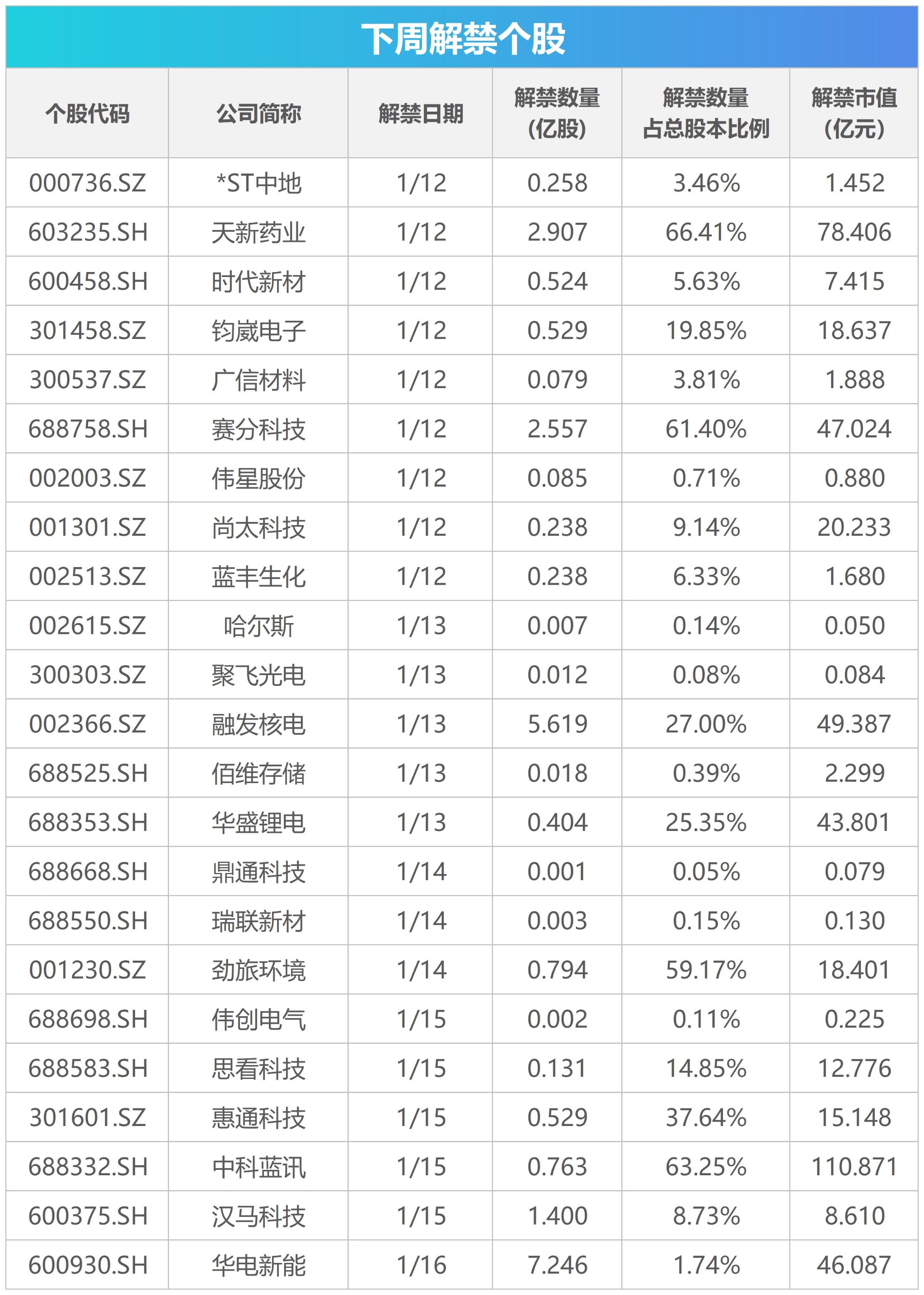
Group 1 - China will release its trade balance for December 2025 on January 14, with total goods trade value for the first 11 months reaching 41.21 trillion yuan, a year-on-year increase of 3.6%. Exports were 24.46 trillion yuan, up 6.2%, while imports were 16.75 trillion yuan, up 0.2% [1] - In November 2025, China's goods trade showed a recovery with a total value of 3.9 trillion yuan, growing by 4.1%. Exports were 2.35 trillion yuan, increasing by 5.7%, and imports were 1.55 trillion yuan, rising by 1.7% [1] - Financial data for December 2025 is expected to be released next week, with November's data showing M2 and social financing growth rates remaining high, supporting a favorable monetary environment for economic recovery [1] Group 2 - The U.S. will release its December 2025 CPI data on January 13, with November's CPI showing a year-on-year increase of 2.7% and core CPI at 2.6%. This has led to market adjustments regarding the Federal Reserve's potential interest rate cuts in 2026 [2] - Several industry conferences are scheduled, including the second China eVTOL Innovation Development Conference from January 15-16, 2026, in Shanghai, focusing on the theme of "Innovation Leading, Smartly Opening a New Commercial Era for eVTOL" [2] Group 3 - Over 480 billion yuan worth of restricted shares will be unlocked in the A-share market next week, with 23 stocks facing unlocks, including Zhongke Lanyun, which has over 10 billion yuan in restricted shares [3][4][5] Group 4 - Two new stocks will be issued next week: Aisheren on January 12, priced at 15.98 yuan, and Hengyunchang on January 16, listed on the Sci-Tech Innovation Board [6][7]
2026年日元汇率展望:美国降息节奏是关键
日经中文网· 2026-01-11 00:33
Core Viewpoint - The Japanese yen is expected to appreciate against the US dollar for the first time in five years by 2025, primarily due to the decline in US dollar credit, although it remains weak against other currencies [2][4]. Group 1: Yen Exchange Rate Trends - As of December 30, 2025, the exchange rate is 1 USD to 155.97 JPY, showing an appreciation of approximately 1.90 JPY (1% increase) compared to the same time in 2024 [4]. - The yen's appreciation against the dollar is attributed to the depreciation of the dollar, while it continues to depreciate against other major currencies, indicating that a true shift to a yen appreciation phase is not yet realized [8][10]. - The yen reached its highest point of the year at 139.80 JPY per USD on April 22, 2025, following the announcement of a reciprocal tariff policy by the US government [6]. Group 2: Monetary Policy and Economic Implications - The Bank of Japan raised its policy interest rate by 0.5% in 2025, reaching the highest level in approximately 27 years, which narrows the long-term interest rate gap between Japan and the US [10]. - Despite the interest rate hike, the yen has not transitioned to an appreciation phase, as the government's active fiscal policies may undermine the effects of the Bank of Japan's rate increase [10][11]. - Predictions suggest that by December 2026, the yen may depreciate again to around 160 JPY per USD, depending on the trajectory of US monetary policy [10][11].

国信期货有色(镍)周报:冲高回落,盘整蓄势-20260111
Guo Xin Qi Huo· 2026-01-10 23:30
Group 1: Report Title and Date - The report is titled "Rise and Fall, Consolidating for Momentum - Guoxin Futures Non-ferrous (Nickel) Weekly Report" dated January 11, 2026 [2][3] Group 2: Table of Contents - The report includes sections on market review, fundamental analysis, and outlook for the future [4] Group 3: Market Review - This section presents the price trend of the nickel futures main contract [7] Group 4: Fundamental Analysis - Upstream: It shows the port inventory of nickel ore in China [12] - Midstream: It includes the prices of electrolytic nickel, nickel sulfate, and 8 - 12% nickel - iron, as well as the monthly import volume of nickel - iron [15][18][20] - Downstream: It covers the price, position, and inventory of stainless steel, as well as the production of power and energy - storage batteries and new energy vehicles [22][30][32] Group 5: Outlook for the Future - In the US, the Federal Reserve cut interest rates for the third time in December 2025, with the federal funds rate target range at 3.50% - 3.75%. The GDP growth rate in Q3 2025 was 4.3%. There are differences in views on future interest - rate cuts, and the market is concerned about the new Fed chair. The probabilities of different interest - rate scenarios are provided. In China, the manufacturing PMI in December 2025 was 50.1%, and the central bank will implement a moderately loose monetary policy in 2026 [38] - The Shanghai nickel futures showed a rise - and - fall trend this week. Nickel inventory is at a high level. The 2026 RKAB quota in Indonesia may be 2.5 billion tons, lower than in 2025. Indonesian nickel - iron production in December remained high, with large supply pressure. Stainless - steel demand enters the off - season, but production has increased due to price hikes. The expected operating range of the Shanghai nickel main contract is 130,000 - 150,000 yuan/ton, and that of the stainless - steel main contract is 12,800 - 14,200 yuan/ton [38]
流动性跟踪:税期未至,资金面依然平稳
HUAXI Securities· 2026-01-10 14:55
Group 1: Liquidity Overview - The liquidity environment has turned loose as expected at the beginning of the year, with the overnight rate (R001) stabilizing around 1.33% in the first week of January[1] - Despite a significant net withdrawal of 1.72 trillion yuan in the first week, liquidity pressures have led to a gradual increase in funding rates, reaching 1.35% by Friday[1] - The 7-day funding rate (R007) fluctuated, initially rising to 1.53% before returning to a downward trend, closing at 1.52%[1] Group 2: Market Outlook - The liquidity is expected to remain stable and loose until the tax period impact becomes evident after January 16, with overnight rates likely to hover around 1.35%[2] - The upcoming week will see a low maturity pressure in the open market, with only 138.7 billion yuan in reverse repos maturing, significantly lower than the average of over 1 trillion yuan in 2025[3] - The estimated net tax payment for the upcoming week is projected at -531 billion yuan, indicating a mild impact on liquidity[5] Group 3: Bill Market and Government Bonds - In the bill market, rates have risen, with 1-month bills increasing by 159 basis points to 1.60% and 3-month bills up by 100 basis points to 1.50%[4] - The government bond net payment for January 12-16 is estimated at -931 billion yuan, a significant decrease from the previous week's 4.327 trillion yuan[5] - The total issuance of government bonds is expected to be 2.372 billion yuan, with a notable reduction in the issuance volume compared to the previous week[5] Group 4: Interbank Certificates of Deposit - The maturity pressure for interbank certificates of deposit is set to rise, with 833.9 billion yuan maturing next week, up from 332.8 billion yuan the previous week[6] - The overall maturity for January 2026 is projected at 2.3 trillion yuan, significantly higher than the seasonal average of 1.1-1.4 trillion yuan from 2021-2025[6] - The weighted issuance term for interbank certificates of deposit has increased to 7.5 months, indicating a shift in funding strategies among banks[6]
专家:中国降准还有较大空间
21世纪经济报道· 2026-01-10 14:49
Core Viewpoint - The likelihood of China's monetary policy adopting a "small step" approach is high, especially in the face of uncertainties [1]. Group 1: Monetary Policy Mechanism - Monetary policy generally targets short to medium-term goals and requires a "step-by-step" approach during uncertain times [3]. - The transmission mechanism of monetary policy is more complex than that of fiscal policy, with a longer transmission path [3]. - China's monetary policy transmission mechanism has evolved to include a sequence from policy interest rates (OMO rates) to loan market quotation rates (LPR) and then to actual loan rates [3]. Group 2: Reserve Requirement Ratio (RRR) and Interest Rates - RRR cuts are preferred over interest rate cuts as they increase the funds available for commercial banks, supporting active fiscal policies [5]. - Since 2016, the RRR has been adjusted downwards 23 times, with a cumulative decrease of 8.5 percentage points for large deposit-taking financial institutions [5]. - The net interest margin for commercial banks was 1.42% as of Q3 2025, indicating pressure on banks' profitability [6]. Group 3: Future Monetary Policy Outlook - There is still room for interest rate cuts, especially given the low inflation and high real interest rates in China [8]. - The external environment for interest rate cuts has improved, with the Federal Reserve having cut rates by a total of 75 basis points in 2025, while China's policy rate was only reduced by 10 basis points [8]. - Structural monetary policy tools can be used to lower interest rates, particularly to support technological innovation and weaker economic sectors [8]. Group 4: Fiscal Policy Considerations - The 2025 Central Economic Work Conference emphasized maintaining necessary fiscal deficits and total debt levels, suggesting that the expansionary fiscal policy will continue into 2026 [8]. - It is suggested that China could raise its fiscal deficit ratio to create conditions for more active fiscal policies, diverging from the Maastricht Treaty guideline of a 3% deficit ratio [8].

盛松成:中国货币政策“小步走”可能性较大,降准还有较大空间
Xin Lang Cai Jing· 2026-01-10 14:21
Group 1 - The core viewpoint is that China's monetary policy is likely to adopt a "small step" approach due to various uncertainties, requiring a cautious and gradual implementation [2] - Monetary policy generally targets short- to medium-term goals and operates indirectly, relying on the cooperation of the private sector, commercial banks, and the entire financial system [2] - The transmission mechanism of monetary policy is more complex than that of fiscal policy, with a longer transmission pathway, making it difficult for the central bank to control every aspect precisely [2] Group 2 - The People's Bank of China (PBOC) is enhancing the role of policy interest rates and utilizing various liquidity support tools to effectively stabilize short-term market fluctuations [2] - A reduction in the reserve requirement ratio (RRR) is preferred over interest rate cuts, as it increases the funds available for commercial banks to support active fiscal policies [3] - Since 2016, the RRR has been adjusted downwards 23 times, with a cumulative decrease of 8.5 percentage points for large deposit-taking financial institutions [3] Group 3 - There is still room for interest rate cuts, as current low inflation and high real interest rates provide a favorable external environment for such actions [3][4] - Structural monetary policy tools can be used to guide credit structure adjustments, focusing on supporting technological innovation and economically weaker sectors [4] - The central economic work conference in 2025 indicated that the fiscal policy will maintain an expansionary tone, with expectations of a continued increase in the fiscal deficit rate to create conditions for active fiscal policies [4]

盛松成:适时降准降息 配合积极的财政政策
Jing Ji Guan Cha Bao· 2026-01-10 12:22
Group 1 - The core viewpoint presented by Sheng Songcheng is that China's monetary policy is likely to adopt a "small step" approach, with a preference for reserve requirement ratio (RRR) cuts over interest rate reductions, while still allowing for some flexibility in both areas [1][2] - Sheng emphasizes that the monetary policy transmission mechanism in China is complex and relies heavily on the cooperation of commercial banks and the financial system, making it difficult for the central bank to precisely control changes at each stage of the transmission [1] - The central bank's toolbox for monetary policy has been expanding, with various liquidity support tools and secondary market treasury transactions being utilized to manage liquidity and stabilize interest rate fluctuations [2] Group 2 - Sheng argues that RRR cuts are more beneficial than interest rate cuts, as they increase the funds available for commercial banks, thereby better supporting proactive fiscal policies [2] - Since 2016, the statutory RRR has been cut 23 times, reducing the RRR for large deposit-taking financial institutions from 17.5% to 9%, a total decrease of 8.5 percentage points, while the policy interest rate has only been adjusted 14 times [2] - The current net interest margin of commercial banks is at a historical low of 1.42%, significantly down from over 3.5% in 2008, indicating that large interest rate cuts could further pressure banks' operations [3]
【权威评论】钟才平:发挥政策集成效应,提升宏观经济治理效能
Sou Hu Cai Jing· 2026-01-10 12:06
Group 1 - The core viewpoint emphasizes that macroeconomic policies are crucial for maintaining stable economic operations and advancing high-quality development in China [1] - In 2025, China will implement a more proactive fiscal policy for the first time in 14 years, alongside a moderately loose monetary policy, to support economic recovery [1] - The 2026 macroeconomic policy will focus on stability while seeking progress, enhancing quality and efficiency, and integrating existing and new policies to improve governance effectiveness [1] Group 2 - The proactive fiscal policy will include increased deficit rates, larger government bond issuance, and enhanced transfer payments to local governments to support growth, structural adjustments, and risk prevention [2] - There is a need to address local fiscal difficulties by establishing mechanisms for increasing revenue and reducing expenditure, ensuring the sustainability of fiscal policies [2] - The national public budget expenditure for 2025 is projected to reach 29.7 trillion yuan, with 10.3 trillion yuan allocated for transfers to local governments, highlighting the tight fiscal environment [3] Group 3 - The monetary policy in 2025 will involve timely reductions in reserve requirements and interest rates, providing a favorable financial environment for economic recovery [4] - The central economic work conference emphasizes the importance of stabilizing economic growth and ensuring reasonable price increases as key considerations for monetary policy [4] - A variety of monetary policy tools will be employed flexibly to support the real economy while maintaining financial system health [4] Group 4 - The effectiveness of macroeconomic policies relies on precise implementation, enhancing the financial service quality for key sectors such as domestic demand expansion and technological innovation [5] - There is a growing need to balance internal and external economic relationships, ensuring the stability of the RMB exchange rate [5] - The complexity of the current economic environment necessitates a coherent approach to policy-making to avoid conflicting effects and enhance market expectations [5] Group 5 - Strengthening policy coordination and consistency is essential to prevent issues like "composite fallacy" or "decomposition fallacy" in macroeconomic governance [6] - The integration of fiscal and monetary policies, along with reform measures, is crucial for achieving consistent macroeconomic policy outcomes [6] - Effective management of market expectations and timely communication with the public are vital for boosting social confidence in the economy [6]