
稳增长政策

Search documents
中银晨会聚焦-20251022
Bank of China Securities· 2025-10-22 01:58
Core Insights - The report highlights a focus on the macroeconomic environment, indicating that the industrial added value in September showed a year-on-year growth of 6.5%, which is an increase compared to August and better than market expectations [6][8] - The report notes that the fixed asset investment growth rate for the first nine months of 2025 has fallen into negative territory, with a cumulative year-on-year decline of 0.5% [7][9] - The real estate sector is experiencing a decline in housing prices, with new home prices in 70 major cities decreasing by 0.4% month-on-month in September, and second-hand home prices also down by 0.6% [10][11] Macroeconomic Overview - In September, the industrial added value increased by 6.5% year-on-year, with manufacturing showing a cumulative growth of 6.8% for the first nine months [6][8] - The actual GDP growth for the first three quarters was 5.2%, with expectations to meet the annual target of 5.0% [6][9] - Fixed asset investment in the first nine months saw a decline of 0.5%, with private investment down by 3.1% [7][9] Real Estate Sector Analysis - The report indicates that in September, 63 out of 70 cities saw a month-on-month decline in new home prices, with an average drop of 0.47% [11][12] - The second-hand home prices in all 70 cities also experienced a decline, marking a significant trend as it is the first time in a year that all cities reported falling prices [10][11] - In first-tier cities, new home prices decreased by 0.3%, while second-hand home prices fell by 1.0%, indicating a more pronounced decline compared to second and third-tier cities [12][13] Investment Opportunities - The report lists a selection of stocks recommended for investment, including companies like Nanfang Airlines and Ningde Times, suggesting potential opportunities in the aviation and battery sectors [1] - The performance of various industry indices shows that the telecommunications and electronics sectors have seen significant gains, with increases of 4.90% and 3.50% respectively [4]





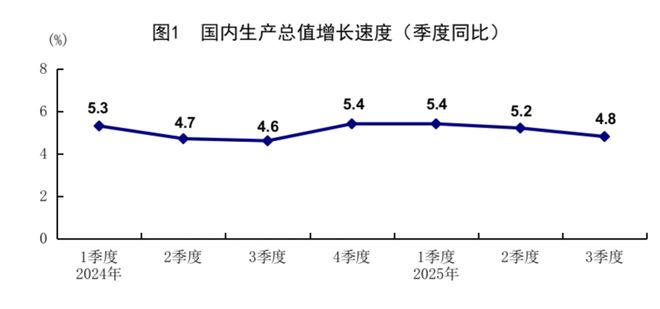
i)第三季度GDP增长4.8%,上季增长5.2%,符合预期,对应四季度只需增长4.2%
Bank of China Securities· 2025-10-21 08:40
Market Performance - The Hang Seng Index (HSI) closed at 25,859, up 2.4% for the day and 28.9% year-to-date[2] - The KOSPI index showed significant growth, closing at 3,815, with a 1.8% increase for the day and a remarkable 59.0% year-to-date[2] - The MSCI China index increased by 2.3% for the day and 33.2% year-to-date, indicating strong market performance[2] Commodity Prices - Gold prices rose to $4,356 per ounce, reflecting a 2.5% increase for the day and a substantial 66.0% increase year-to-date[3] - Brent Crude oil prices decreased to $61 per barrel, down 0.6% for the day and down 15.1% year-to-date[3] - The Baltic Dry Index (BDI) surged to 2,046, showing a remarkable 105.2% increase year-to-date[3] Economic Indicators - China's GDP growth moderated to 4.8% year-on-year in Q3 2025, down from 5.2% in Q2 2025, with a required growth of 4.2-4.5% in Q4 to meet the annual target of 4.9-5%[6][7] - Retail sales growth in China slowed to 3.0% year-on-year in September, the lowest since November 2024, down from 3.4% in August[14] - The US Initial Jobless Claims for the week ending October 23 are expected to be 226,000, slightly higher than the consensus of 218,000[4] Corporate Updates - China Mobile reported a 1.4% year-on-year increase in Q3 earnings to RMB 31.1 billion, with service revenue rising by 0.8% to RMB 216.2 billion[10][11] - Akeso Inc. presented positive Phase III study results for its drug AK112, showing a progression-free survival hazard ratio of 0.60 in the treatment of sqNSCLC[26][29]
9月和三季度经济数据点评:稳增长政策转向长期视角
Bank of China Securities· 2025-10-21 02:54
Economic Growth and GDP - The actual GDP growth for the first three quarters of 2025 is 5.2%, exceeding the annual target of 5.0%[4] - The GDP growth rate for Q3 2025 is 4.8%, a decrease of 0.4 percentage points from Q2 2025[4] - The nominal GDP growth rate for Q3 2025 is 3.7%, down 0.2 percentage points from Q2 2025[4] Industrial Production - The industrial added value in September increased by 6.5%, surpassing the consensus expectation of 5.23%[10] - The cumulative industrial added value growth for the mining industry from January to September is 5.8%, while manufacturing and high-tech industries show growth rates of 6.8% and 9.6%, respectively[12] Fixed Asset Investment - From January to September, fixed asset investment fell by 0.5%, with private investment declining by 3.1%[25] - Real estate investment dropped by 13.9% during the same period, with new construction area down 18.9%[31] Consumer Spending - Retail sales in September grew by 3.0%, marking the fourth consecutive month of decline[15] - Cumulative retail sales from January to September showed a year-on-year increase of 4.9%, with significant declines in categories like petroleum products and beverages[20] Policy and Future Outlook - The government has introduced a fourth batch of "national subsidies" amounting to 69 billion yuan and has set a new local government debt limit of 500 billion yuan for 2026[1] - The macroeconomic policy adjustments will focus on achieving high-quality growth during the 14th Five-Year Plan and addressing external uncertainties[44]
FICC日报:中国9月经济增速回落,内外需分化加剧-20251021
Hua Tai Qi Huo· 2025-10-21 02:16
Report Industry Investment Rating - The overall rating for commodities and stock index futures is neutral [5] Core Viewpoints - China's economic growth slowed in September, with a widening gap between domestic and external demand. Domestic economic data in August showed signs of weakness, while exports in September were resilient. The M2 - M1 gap reached a new low for the year. Amid increasing external tariff pressure, China has introduced frequent growth - stabilizing policies [1] - Sino - US tariff frictions have intensified, and there is a risk of tariff escalation before the APEC Summit in South Korea from October 28th to November 1st [2] - Attention should be paid to the duration of the US government shutdown, as the market has not fully priced in the severity of the issue [3] - In the commodity market, it is advisable to adopt a wait - and - see approach in the near term. Each commodity sector has its own characteristics and risks [4] Summary by Related Catalogs Market Analysis - In China, the gap between strong expectations and weak reality has widened. In August, economic data showed "slow industry, weak investment, and tepid consumption." In September, exports were resilient, and the M2 - M1 gap hit a new low for the year. External tariff pressure increased, and China introduced growth - stabilizing policies. The Third Quarter GDP increased by 4.8% year - on - year, and 5.2% for the first three quarters. Industrial added value in September increased by 6.5% year - on - year, while social consumer goods retail总额 increased by 3%. Fixed - asset investment continued to decline [1] - Sino - US tariff frictions have escalated. The delay in Sino - US tariff implementation will expire on November 10th. The US has taken a series of measures such as adding Chinese enterprises to the entity list and imposing tariffs on imports, and China has responded with counter - measures. There is a risk of tariff escalation before the APEC Summit in South Korea [2] - The US government shutdown issue persists. The Republican temporary appropriation bill failed to advance in the Senate, and economic data releases have been delayed. The market has not fully priced in the severity of the shutdown [3] Commodity Market - In the commodity market, it is advisable to wait and see in the near term. The black sector is dragged down by downstream demand expectations; the non - ferrous sector has long - term supply constraints but is boosted by global easing expectations; the energy sector has a relatively loose medium - term supply; the "anti - involution" space in the chemical sector is worthy of attention; agricultural products are driven by tariff and inflation expectations but need fundamental signals; precious metals have short - term price volatility risks but long - term buying opportunities [4] Strategy - The overall rating for commodities and stock index futures is neutral [5] Key News - The Fourth Plenary Session of the 20th Central Committee of the Communist Party of China was held in Beijing. The central bank kept the one - year and five - year LPR unchanged. China's GDP in the first three quarters increased by 5.2% year - on - year, and 4.8% in the third quarter. Social consumer goods retail总额 in September increased by 3% year - on - year. The national urban survey unemployment rate in September was 5.2%. The stock market showed mixed trends, with coal and gas sectors rising and precious metals sector falling. Sino - US officials agreed to hold a new round of economic and trade consultations soon. The US will impose tariffs on trucks and buses starting from November 1st. Japan's Liberal Democratic Party and the Japan Innovation Party reached an agreement on coalition government [6]
构建新发展格局:申万期货早间评论-20251021
申银万国期货研究· 2025-10-21 01:06
Core Viewpoint - The article discusses the construction of a new development pattern in China, highlighting the growth of the futures market and the performance of key commodities such as stock indices, precious metals, and copper [1][2][3]. Futures Market Overview - As of October 9, 2025, the total funds in China's futures market reached approximately 2.02 trillion yuan, marking a 24% increase from the end of 2024 [1]. - Client equity in futures companies totaled about 1.91 trillion yuan, also reflecting a 24% growth from the end of 2024 [1]. Stock Indices - The U.S. stock indices rose, with the previous trading day seeing a slight recovery led by the communication sector, while the non-ferrous metals sector lagged [2]. - The market turnover was 1.75 trillion yuan, and as of October 17, the financing balance decreased by 27.3 billion yuan to 2.412835 trillion yuan [2]. - The article suggests that the stock indices are entering a phase of directional choice, with domestic liquidity expected to remain loose and external funds likely to flow into the domestic market due to anticipated Fed rate cuts and RMB appreciation [2]. Precious Metals - Gold and silver prices have been strong, although recent upward momentum has slowed [3]. - The article notes that central banks are increasing gold reserves amid rising global tensions and distrust in the financial system, reinforcing gold's status as a safe-haven asset [3]. - Silver's supply-demand imbalance is highlighted, with potential for increased volatility following rapid price increases [3]. Copper Market - Copper prices rose in the night session, supported by tight concentrate supply and high smelting output [3][20]. - The article mentions that investment in the power grid continues to grow, while real estate remains weak, impacting overall demand for copper [20]. - The potential for a global copper supply gap due to mining issues in Indonesia is expected to support copper prices in the long term [20]. Key Commodities Performance - The article provides insights into various commodities, including palm oil, corn, and lithium carbonate, indicating mixed performance and market dynamics influenced by external factors such as trade tensions and supply chain issues [5][22][28]. International and Domestic News - The U.S. and Australia signed an agreement to enhance the production of rare earths and critical minerals, with over $3 billion planned for investment in key mineral projects [6]. - China's LPR remained unchanged for five consecutive months, reflecting stable policy rates and potential for further monetary easing in response to economic conditions [7]. Industry Developments - The Dalian Commodity Exchange announced the listing of new futures contracts for linear low-density polyethylene, polyvinyl chloride, and polypropylene, expanding the range of tradable products [8]. Market Trends - The article notes that the market is currently cautious, with a focus on upcoming trade talks and the potential impact of U.S. fiscal policies on global markets [3][19]. - The overall sentiment in the commodities market is influenced by macroeconomic factors, including inflation expectations and geopolitical developments [3][19].


中国经济顶压前行 前三季度增长5.2%,稳增长政策仍需加力
2 1 Shi Ji Jing Ji Bao Dao· 2025-10-20 23:06
Economic Overview - China's GDP growth for the first three quarters of 2023 is 5.2%, which is an acceleration of 0.2 and 0.4 percentage points compared to the previous year and the same period last year respectively [1][10] - The GDP for the first three quarters is 101.5 trillion yuan, with a quarter-on-quarter growth of 1.1% in Q3 [1][10] - The economic growth rate in Q3 is 4.8%, a decrease of 0.4 percentage points from Q2, primarily due to weak domestic demand [1][6] Industrial Performance - The industrial added value for large-scale enterprises increased by 6.2% year-on-year in the first three quarters, with a notable recovery in September at 6.5% [4][5] - High-tech manufacturing industries showed strong growth, with added value increasing by 9.6% in the first three quarters, and sectors like integrated circuits and biopharmaceuticals maintaining double-digit growth [4][6] Investment and Consumption - Fixed asset investment (excluding rural households) decreased by 0.5% year-on-year, with infrastructure investment growing by 1.1% and real estate investment declining by 13.9% [5][10] - Retail sales of consumer goods grew by 4.5% year-on-year, but the growth rate fell by 0.5 percentage points compared to the first half of the year, with September showing the lowest monthly growth of 3% [5][6] Policy Measures - The government has introduced "two 500 billion" policies to stabilize growth, including 500 billion yuan in new policy financial tools and 500 billion yuan in local government debt limits [2][10] - The new policy financial tools are expected to leverage around 6 trillion yuan in investment, with significant impacts on infrastructure investment growth [10][11] Export Performance - Exports maintained resilience with a growth rate of 7.1% in the first three quarters, while imports decreased by 0.2%, showing a narrowing decline [5][6] - The strong performance in exports is attributed to diversified market strategies and stable supply chains, particularly with ASEAN and other non-US markets [6][11]

中国经济顶压前行:前三季度增长5.2%,稳增长政策仍需加力
2 1 Shi Ji Jing Ji Bao Dao· 2025-10-20 11:24
Economic Overview - The GDP for the first three quarters of 2023 reached 101.5 trillion yuan, with a year-on-year growth of 5.2% [1][3] - The quarterly growth rates were 5.4% in Q1, 5.2% in Q2, and 4.8% in Q3, indicating a decline in growth momentum [1][3] Key Economic Indicators - Major economic indicators such as industrial output, services, retail sales, and investment showed a decline compared to the first half of the year, with Q3 GDP growth down by 0.4 percentage points from Q2 [3][4] - In September, exports increased by 8.4% year-on-year, contributing to a recovery in industrial output and service sector performance [3][4] Investment and Consumption Trends - Fixed asset investment (excluding rural households) fell by 0.5% year-on-year, with infrastructure investment growing by 1.1% and real estate investment declining by 13.9% [5][6] - Retail sales of consumer goods grew by 4.5% year-on-year, but September saw the lowest monthly growth of 3% due to factors like the timing of holidays [5][6] High-Tech Industry Performance - The industrial output value of high-tech industries grew by 6.2% year-on-year, with significant contributions from sectors like equipment manufacturing and electronics, which saw growth rates exceeding 9% [4][5] - High-tech manufacturing industries maintained a robust growth rate of 9.6%, with specific sectors like integrated circuits and biopharmaceuticals achieving double-digit growth [4][5] Policy Measures and Future Outlook - The government introduced a "two 500 billion" policy to stabilize growth, including 500 billion yuan in new policy financial tools and 500 billion yuan in local government debt limits [3][9] - Analysts expect that the implementation of these policies could significantly boost investment and support the economy in achieving the annual growth target of around 5% [9][10] Challenges and Considerations - The decline in GDP growth is attributed to weakening consumption and investment, with ongoing challenges in the real estate sector impacting consumer confidence and spending [6][7] - There is a need for continued policy support to stabilize growth, particularly in the real estate market, to enhance consumer sentiment and investment [11]
王青:三季度工业生产处于较高水平 四季度新一轮稳增长政策或全面出台|首席读数据
Di Yi Cai Jing· 2025-10-20 10:29
Core Viewpoint - The National Bureau of Statistics reported that China's GDP for the first three quarters reached 10,150.36 billion yuan, with a year-on-year growth of 5.2% at constant prices [1] Economic Performance - In the first quarter, GDP grew by 5.4% year-on-year, while the second quarter saw a growth of 5.2%, and the third quarter recorded a growth of 4.8% [1] - On a quarter-on-quarter basis, GDP increased by 1.1% in the third quarter [1] Export and Domestic Demand - Exports accelerated in the third quarter, but domestic investment and consumption showed signs of slowing down, indicating a weakening of domestic demand's contribution to economic growth [1] - Given the changes in the year-on-year base and current export momentum, a potential decline in export growth is anticipated for the fourth quarter [1] - There is an increasing necessity for domestic measures to boost consumption and expand effective investment to counteract the slowdown in external demand [1]
中国宏观周报(2025年10月第2周):部分区域出口运价回升-20251020
Ping An Securities· 2025-10-20 06:55
Group 1: Industrial Production - Daily average pig iron production and cement clinker capacity utilization rate marginally declined this week, while asphalt and float glass operating rates increased, and apparent demand for steel improved[1] - Polyester operating rates in textiles and weaving industries showed a marginal recovery, with both full steel and semi-steel tire operating rates rebounding[1] Group 2: Real Estate - New home sales area in 30 major cities decreased by 20.4% year-on-year as of October 17, but the decline rate improved by 10.8 percentage points compared to last week; the year-on-year decline for October so far is 25.4%[1] - The second-hand housing listing price index decreased by 0.85% month-on-month as of October 6[1] Group 3: Domestic Demand - Retail sales of passenger cars from October 1-12 totaled 686,000 units, down 8% year-on-year, contrasting with a 6% increase in September[1] - Major home appliance retail sales decreased by 3.6% year-on-year as of October 10, showing a marginal recovery[1] - Domestic flight operations increased by 2.4% year-on-year as of October 17, but the growth rate slowed by 0.6 percentage points compared to last week[1] Group 4: External Demand - Port cargo throughput increased by 4.9% year-on-year as of October 12, while container throughput rose by 5.3% year-on-year[1] - The export container freight index for China fell by 4.1% week-on-week, but export freight rates in Shanghai and Ningbo showed a rapid increase[1] Group 5: Price Trends - The Nanhua Industrial Index dropped by 3.0%, with the black raw materials index down 1.4% and the non-ferrous metals index down 1.1% this week[1] - Rebar futures closed down 2.1%, while spot prices fell by 1.0%; coking coal futures rose by 1.6%, with Shanxi coking coal spot prices up 0.3%[1]
2025年9月宏观数据点评:内需放缓带动三季度GDP增速下行,四季度稳增长政策有望加力
Dong Fang Jin Cheng· 2025-10-20 06:10
Economic Growth - In Q3 2025, GDP growth slowed to 4.8% year-on-year, down from 5.2% in the first three quarters[1] - Fixed asset investment from January to September 2025 decreased by 0.5%, marking a historical low[16] - The average growth rate of social retail sales in Q3 was 3.4%, a decline of 2 percentage points from the previous quarter[14] Industrial Production - In September 2025, industrial added value grew by 6.5% year-on-year, an increase of 1.3 percentage points from the previous month[9] - Cumulative industrial added value from January to September increased by 6.2%, surpassing the GDP growth rate[10] - The manufacturing sector's added value in September rose significantly, driven by a 3.8% increase in export delivery value[9] Investment Trends - Manufacturing investment from January to September 2025 saw a cumulative year-on-year growth of 4.0%, down 1.1 percentage points from the previous value[17] - Real estate investment from January to September 2025 fell by 13.9%, with a widening decline of 1.0 percentage point[19] - Infrastructure investment (excluding electricity) grew by 1.1% year-on-year, a decrease of 0.9 percentage points from the previous value[20] Consumer Behavior - Retail sales in September 2025 grew by 3.0% year-on-year, a decline of 0.4 percentage points from the previous month[11] - The cumulative year-on-year growth of retail sales from January to September was 4.5%, an increase of 1.2 percentage points compared to the previous year[14] - Consumer confidence remains low due to the ongoing adjustment in the real estate market[14]