结构性行情

Search documents
沪指重返3900点之际,逾70只基金十年仍亏钱、天治新消费混合亏53%
Sou Hu Cai Jing· 2025-10-15 09:55
Core Insights - The article highlights the significant performance disparity among public funds over the past decade, with some achieving returns exceeding 580% while others have lost over 55% [2][3] - The leading funds are primarily focused on technology and consumer sectors, while underperforming funds are heavily invested in traditional industries [2][6] - The importance of selecting the right funds is emphasized, as the difference in returns can exceed 600 percentage points for long-term investors [2] Performance Overview - As of October 14, 2023, 601 funds have achieved returns over 100% in the last ten years, with 42 funds exceeding 300% [3] - The top-performing fund, Huashang New Trend Preferred, has a return rate of 586.49%, followed by Huashang Advantage Industry A at 488.74% and Guotai Nasdaq 100 ETF at 487.37% [4][6] - Funds focused on technology and emerging industries, such as Dongwu Mobile Internet A and Xin'ao New Energy Industry A, have also shown strong performance, with returns exceeding 350% [6][7] Underperforming Funds - A total of 76 funds have recorded cumulative losses over the past decade, with 32 funds having returns below 20% [8] - The worst-performing fund, Tianzhi New Consumption, has a loss of 53.03%, while others like Fangzheng Fubon Innovation Power A and Morgan Consumption Pioneer have also seen significant declines [9][12] - Many underperforming funds are linked to sectors such as real estate, media, and traditional manufacturing, indicating a failure to adapt to structural market changes [12]


肖星对话靳卫萍:以科技创新推动长期繁荣,市场波动期要握好筹码
2 1 Shi Ji Jing Ji Bao Dao· 2025-10-14 09:12
Core Viewpoint - China is shifting from pursuing GDP growth to focusing on technological innovation, marking the beginning of a "second curve" for the economy [1] Group 1: Policy and Economic Environment - The implementation of the "9·24" policy has led to profound ecological restructuring in China's capital market over the past year [2] - New policy financial tools mentioned in the April 25 Politburo meeting aim to support the economy and enhance confidence, with a focus on directing funds towards private enterprises [2] - The introduction of technology innovation bonds and risk-sharing tools is expected to channel investments into high-tech sectors such as artificial intelligence and low-altitude economy [2] Group 2: Innovation and Market Dynamics - The new type of national system emphasizes the role of private enterprises in driving innovation, contrasting with the traditional model that relied heavily on state-led initiatives [3] - The current capital market has transitioned from a "broad rise and fall" to a "structural market," with competition between China and the U.S. focusing on cutting-edge fields like artificial intelligence [3] - The structural evolution in both primary and secondary markets is driven by new productive forces, highlighting the importance of understanding industry development [3] Group 3: Investment Strategies and Research - The Tsinghua University Global Private Equity Research Institute has been tracking hard technology sectors since late 2017, creating a database covering approximately 1,500 sub-industries [4] - Successful technology investment now requires a deep understanding of the intersection between technology, industry, and finance, raising the bar for investors [4] - The "PE Industry Investor" program aims to establish a cross-disciplinary research paradigm, connecting scientists with industry practitioners to develop executable investment and acquisition strategies [5]
结构性行情下,成也萧何,败也萧何
Nan Hua Qi Huo· 2025-10-10 08:54
Report Industry Investment Rating - No relevant content provided Core View - Today's stock market declined, fully erasing yesterday's gains. Although the trading volume of the two markets decreased, it remained above 2.5 trillion yuan. The decline in precious metals overnight led to a drop in the structural driving force, causing non - ferrous metals to correct significantly and technology - related concepts to lead the decline. Cyclical industries showed relatively strong performance but with limited driving force. Short - term structural changes may continue to cause the stock index to fluctuate widely. With important information to be released at home and abroad later this month, the stock market is unlikely to deviate significantly from the current level, and the correction space is limited. It is necessary to observe whether the support of the 5 - day moving average is effective [5] Summary by Directory Market Review - The stock index declined today. Taking the CSI 300 index as an example, it closed down 1.97%. The trading volume of the two markets decreased by 137.583 billion yuan. Among stock index futures, IC declined with shrinking volume, while other varieties declined with increasing volume [3] Important Information - On October 10, three departments including the Ministry of Industry and Information Technology jointly issued an announcement on adjusting the technical requirements for energy - saving and new - energy vehicle products eligible for vehicle and vessel tax incentives. Reuters reported on October 10 that the number of new applications for unemployment benefits in the US increased again last week, indicating that some contractors related to the US government shutdown laid off employees in advance. Starting from October 14, 2025, the maritime management institutions at the ports where the ships berth will collect special port fees for ships owned, operated by US enterprises, organizations or individuals, or ships with US - related equity stakes, US - flagged ships, and ships built in the US [4] Strategy Recommendation - It is recommended to hold positions and wait and see [6] Futures Market Observation - The intraday percentage changes of the main contracts of IF, IH, IC, and IM were - 2.18%, - 1.60%, - 2.24%, and - 1.71% respectively. The trading volumes were 1.6215 million lots, 0.73933 million lots, 1.7039 million lots, and 2.3345 million lots respectively, with环比 increases of 0.26302 million lots, 0.14217 million lots, 0.14916 million lots, and 0.19721 million lots respectively. The open interests were 2.78581 million lots, 1.05743 million lots, 2.60074 million lots, and 3.56927 million lots respectively, with环比 changes of 0.01506 million lots, 0.0217 million lots, - 0.08282 million lots, and 0.03851 million lots respectively [6][8] Spot Market Observation - The percentage changes of the Shanghai Composite Index and the Shenzhen Component Index were - 0.94% and - 2.70% respectively. The ratio of rising to falling stocks was 1.06. The trading volume of the two markets was 2,515.614 billion yuan, a decrease of 137.583 billion yuan compared with the previous day [8]

沪指十年后重上3900点,结构性行情能走多远?
Sou Hu Cai Jing· 2025-10-09 17:47
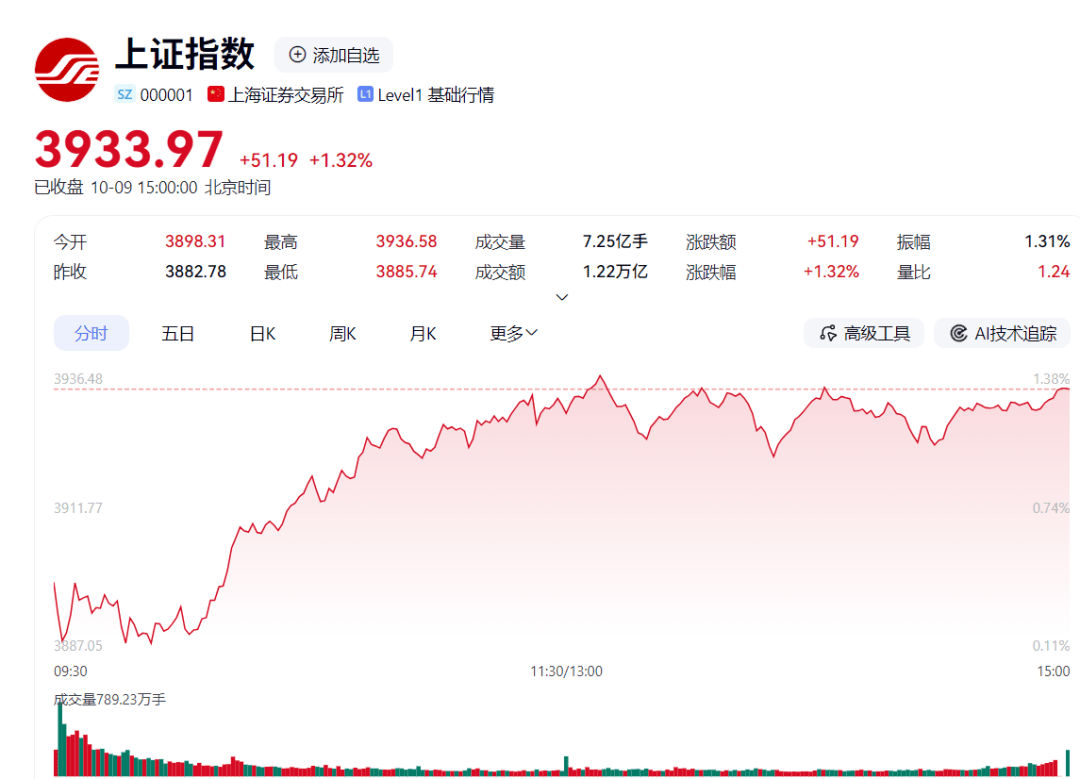
Core Insights - The Shanghai Composite Index (SHCI) has surpassed the 3900-point mark for the first time since August 2015, marking a significant milestone after a ten-year wait [1][3][4] - The A-share market has shown strong performance this year, with all three major indices posting five consecutive months of gains, and the ChiNext Index achieving a quarterly increase of over 50%, the second-best in history [5][6] Market Performance - On October 9, the SHCI opened at 3898.31 points and quickly broke through the 3900-point threshold, closing at 3905.52 points with a gain of 0.63% [1][7] - The Shenzhen Component Index and the ChiNext Index also saw gains of over 1%, with total trading volume exceeding 1.13 trillion yuan [8] Sector Analysis - Leading sectors included storage chips, electrolyte solutions, and cobalt mining, indicating a structural rise in the market rather than a broad-based increase [9] - There is a noted divergence in capital flow, with domestic main funds net selling 37.91 billion yuan on the last trading day before the holiday, suggesting ongoing market discrepancies [11] Technical Analysis - The SHCI is approaching the upper boundary of a high-level consolidation range, and failure to effectively break through could lead to a pullback [10][12] - Historical patterns suggest that breakthroughs at key levels often require support from financial stocks, particularly the securities sector [11][16] Future Outlook - Analysts have mixed views on the market's trajectory, with some indicating that the 3900-point area may serve as a strong resistance zone [12] - Positive factors include an upcoming important meeting scheduled for October 20-23, which may reduce the likelihood of a rapid decline in the index [15]
超50只基金翻倍!这两大赛道成最大赢家
Guo Ji Jin Rong Bao· 2025-10-09 15:00
Core Insights - The performance of public funds in the first three quarters of 2025 shows significant differentiation, with over 50 funds doubling their net value, particularly in technology and pharmaceutical themes, while funds heavily invested in traditional finance and cyclical sectors performed poorly [1][2]. Fund Performance - Active equity funds achieved an average return of 34.54% year-to-date, outperforming passive index funds which averaged 27.56% [2]. - A total of 53 funds recorded returns exceeding 100%, with 48 being active equity funds, highlighting the success of active management in a structural market [2]. - The top-performing fund, Yongying Technology Smart A, had a return of 194.49%, followed by Huatai-PB Hong Kong Advantage Selection A at 161.1%, both focusing on technology and innovative pharmaceuticals [2]. Traditional Sector Performance - In contrast, 41 funds reported returns below -5%, with 27 being active equity funds, primarily invested in traditional sectors like banking, real estate, and consumer goods [3]. - The performance gap between the best and worst active equity funds exceeded 200 percentage points, indicating a high level of market differentiation [3]. Gold ETFs - Gold ETFs have seen significant inflows due to their strong safe-haven appeal, with an average return of 41.04% year-to-date, outperforming the broader market [4]. - All 14 gold ETFs recorded positive growth in shares, with the largest ETF increasing by over 3.3 billion shares, and total market shares surpassing 20 billion [4]. Market Outlook - The market is expected to continue its differentiation, with technology and innovative pharmaceuticals likely to remain the main themes in Q4 [5][6]. - Investment strategies should focus on "high-cut low" approaches, shifting from high-performing sectors to undervalued areas [6][7]. - The innovation drug sector may see reduced overall beta in Q4, suggesting a focus on individual stock opportunities rather than broad sector plays [7].
“水牛”行情延续,成长占优
Chang Jiang Qi Huo· 2025-10-09 05:10
1. Report Industry Investment Rating No relevant content provided. 2. Core View of the Report The "liquidity-driven bull" market continues, with growth stocks outperforming. In Q3, the A-share market showed a pattern of rising and then fluctuating. Looking ahead to Q4, the core support logic for the market's upward movement remains unchanged. If there are no unexpected negative factors, the market still has room to expand upwards after the phased adjustment. The two core driving forces are the continuation of the loose liquidity environment and the continuous support from the policy side [3][61]. 3. Summary by Related Catalogs Macro Economy - **CPI**: Monthly CPI was flat year-on-year, mainly dragged down by the food component, while the core CPI continued to rise year-on-year. The prices of industrial consumer goods and services were stronger than seasonal trends, driving the monthly CPI to rise month-on-month [13]. - **PPI**: Monthly PPI decreased by 3.6% year-on-year, with the decline remaining the same. The anti-involution policy has limited impact on price improvement, highlighting the need for more demand-side policy support [14]. - **Export**: Monthly exports increased by 7.2% year-on-year and decreased by 1.0% month-on-month. The "rush to export" effect was an important factor for the acceleration of exports. Exports to the EU and ASEAN provided main support [16]. - **Consumption and Real Estate**: The growth rate of social consumer goods retail sales declined, and the real estate market continued to weaken. The real estate demand still needs to be boosted, and the prices of second-hand and new houses are diverging [18]. - **Manufacturing**: The monthly manufacturing PMI rose by 3.1 percentage points to 51.5%, staying in the expansion range for two consecutive months. There was structural differentiation in sub - indicators, and the cost pressure on mid - and downstream enterprises remained [20]. - **Monetary Policy**: The subsequent monetary policy is expected to maintain a "moderately loose" tone, focusing more on the use of structural tools. There may be a small interest rate cut in Q4, and the possibility of the central bank resuming treasury bond trading operations within the year has increased [23]. Market Review - **A-share Performance**: At the beginning of the month, the A-share market had a slight correction, and the risk appetite of investors fluctuated. Since the middle of the month, the main indexes showed different trends. The market capitalization was active, and the margin trading balance reached a record high [29]. - **Industry Performance**: As of the end of the month, among the 31 Shenwan primary industries, the power equipment industry led the market with a 21.17% increase, and more than 60% of the industries recorded declines, showing obvious industry differentiation [30]. - **Market Style**: Growth-style indexes led the rise, and mid - cap stocks performed particularly well. The market showed a preference for growth sectors [32]. - **Liquidity**: During a certain period, the average daily trading volume of the A-share market increased month-on-month, and the newly established partial - stock fund shares also increased, indicating active market liquidity [38]. - **Market Sentiment**: The trading enthusiasm of the A-share market remained high, and the risk appetite gradually recovered in the middle of the month. The main funds were concentrated in high - growth sectors, and the margin trading balance continued to rise [41][42]. Private Equity Strategy - **Basis Analysis**: Monthly basis fluctuations were significant, with the first half showing convergence and the second half widening, which affected neutral strategies [47]. - **Performance of Private Equity Sub - strategies**: In a certain month, all private equity strategies achieved positive returns. Long - only strategies and arbitrage strategies ranked among the top [50]. - **Index Enhancement Strategy**: The excess returns of different index enhancement strategies showed significant differentiation. Mid - and small - cap index enhancement strategies led the way in the long term, and different strategies responded differently to market environments [53][54]. - **Market Neutral Strategy**: The environment for the neutral strategy improved in a certain month. The average return of the market neutral strategy was 0.5%, and about 83.87% of the products achieved positive returns [59]. Future Outlook The A-share market in Q3 showed a pattern of rising and then fluctuating. In Q4, if there are no unexpected negative factors, the market still has room to expand upwards, supported by the loose liquidity environment and policy support [61].
银河证券:节前短期波动加大 不改市场向好趋势
Zheng Quan Shi Bao Wang· 2025-09-29 00:41
Core Viewpoint - The report from Galaxy Securities indicates a cautious sentiment among investors ahead of the holiday, leading to a slight decline in market trading activity, while the broad index shows a fluctuating pattern. However, short-term volatility does not alter the overall positive market trend [1] Market Trends - The structural market trend remains prominent, with the technology sector benefiting from ongoing domestic and international industrial trends. Despite adjustments in the market due to sentiment influences, there is potential for upward recovery after short-term pressure is released [1] Future Outlook - Looking ahead, the upcoming 20th Central Committee's Fourth Plenary Session in October, focusing on the "14th Five-Year Plan," is expected to create a critical window for the A-share market, potentially enhancing market risk appetite [1] Liquidity Conditions - Liquidity is anticipated to continue on a positive trend, with margin trading balances in an upward channel. The ongoing shift of household deposits is still in its early stages, and the Federal Reserve's interest rate cuts are providing support for global liquidity [1] Structural Market Influences - Attention is required on the impact of Sino-U.S. negotiations, which may disrupt the short-term structural market trends [1]
一场5万变1亿的虚拟冒险
虎嗅APP· 2025-09-29 00:19
Core Viewpoint - The article discusses the journey of small investors in the A-share market, highlighting the different phases of market behavior and strategies for maximizing returns, particularly during bull markets and the emergence of "hot stocks" [5][7]. Group 1: Market Phases - The investment journey is divided into three key phases: the "Newbie Village" during the 924 bull market, the "Chaos Period" characterized by the rise of "hot stocks," and the "Ultimate King" phase where investors align with large capital [8][29]. - In the "Newbie Village," investors are encouraged to familiarize themselves with the market mechanisms and identify strong stocks, particularly in a bull market where many stocks are rising [11][8]. - The "Chaos Period" involves navigating a market with multiple main lines and identifying leading stocks, known as "hot stocks," which can yield significant returns [16][18]. Group 2: Investment Strategies - During the "Newbie Village," a hypothetical investment of 50,000 yuan in Tianfeng Securities could grow to 103,500 yuan within a short period, demonstrating the potential for quick gains in a rising market [13]. - In the "Chaos Period," investors can achieve substantial returns by identifying and investing in stocks like Shuangcheng Pharmaceutical and Risheng Dongfang, which saw significant price increases due to market narratives and trends [19][20]. - The article emphasizes the importance of understanding market narratives and the emotional dynamics of trading, as these factors can drive stock prices significantly [24]. Group 3: Role of Large Capital - The "Ultimate King" phase highlights the dominance of large capital in the market, with institutional investors and state-owned funds playing a crucial role in stabilizing and driving market trends [30][31]. - Large capital is increasingly focused on technology stocks, which have shown substantial growth potential, contrasting with traditional sectors that have limited growth prospects [34][38]. - The article notes that successful investments in the current market environment require aligning with large capital and understanding the underlying fundamentals of technology-driven companies [39][42].



股市依然是结构性行情?
Zheng Quan Shi Bao· 2025-09-26 17:21
Group 1 - The A-share market has shown positive changes since the "9.24" market event, forming a pattern of oscillating upward movement, with the Shanghai Composite Index breaking a 10-year high and daily trading volume exceeding 2.5 trillion yuan, leading to a total market value surpassing 100 trillion yuan [1][2] - There has been a shift from a structural market characterized by significant disparities among individual stocks to a phase where many stocks are rising simultaneously, although some stocks still lag behind the index [2][3] - The current market dynamics suggest that the extreme structural market conditions of the past are unlikely to repeat, but a complete market-wide rise is also not expected due to the lack of strong economic growth and the focus on specific themes rather than overall performance [2][3] Group 2 - Institutional investors are increasingly active in the market, often focusing on a limited pool of stocks, which leads to weaker performance for companies with mediocre performance, poor management, or unclear growth prospects [3][4] - The popularity of index-based investments, such as ETFs, means that many individual investors are not able to outperform the market, as these funds typically cover only a fraction of listed companies, contributing to the structural nature of the current market [3][4] - In a structural market, stock selection becomes crucial, with technology stocks being a primary focus, while investors are advised to avoid sectors like real estate and certain ST companies that carry higher risks [4]
缩量回调,节前扔不扔?
Ge Long Hui· 2025-09-26 09:38
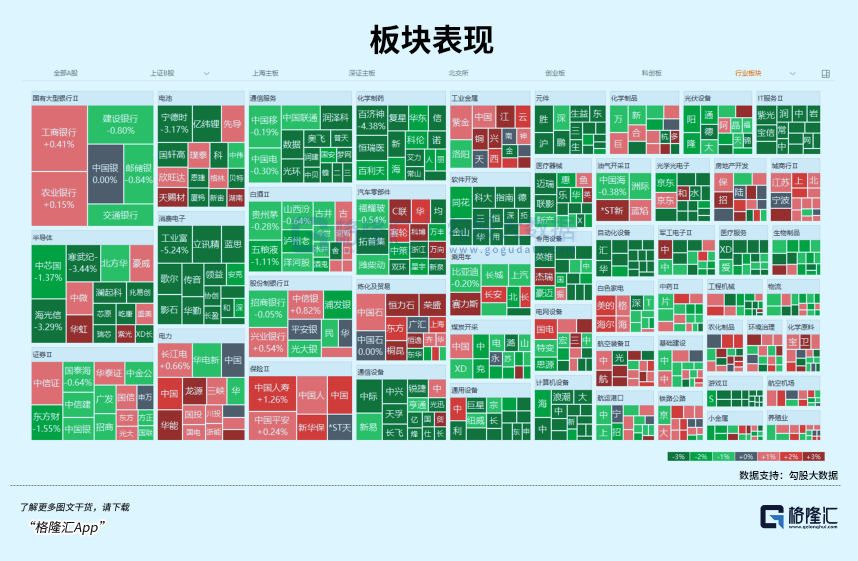
Market Overview - The three major indices experienced a collective pullback, with the Shanghai Composite Index down 0.65%, the Shenzhen Component down 1.76%, and the ChiNext Index down 2.60% [1] - The trading volume in the Shanghai and Shenzhen markets exceeded 2.1 trillion, a decrease of over 200 billion compared to the previous day [2] - The market is showing increased divergence as the holiday approaches, with trading volume relatively dull compared to last week, but volatility is on the rise [3] Sector Performance - The market saw a broad adjustment, with most industry sectors declining. Wind power equipment, chemical fiber, fertilizer, and insurance sectors showed gains, while technology sectors such as gaming, consumer electronics, electronic components, internet services, communication equipment, and software development faced significant declines [6] - Technology stocks experienced a widespread retreat, particularly in computing power sectors, with companies like Zhongheng Electric, Lianang Micro, and Qingshan Paper hitting their daily limit down. Major stocks like Inspur Information and Industrial Fulian also saw substantial drops [8] - Copper-related stocks performed well against the trend, with companies like Jingyi Co. achieving three consecutive limit-up days, and Jiangxi Copper and Tongling Nonferrous Metals also rising. This was influenced by supply concerns following a landslide at the Grasberg mine in Indonesia, which announced "force majeure" due to production stoppage [9] Investment Sentiment - As the National Day holiday approaches, investors face a classic dilemma of whether to hold stocks or cash. The market is experiencing increased volatility and accelerated sector rotation [19] - The market's profitability is declining, with only 32% of stocks rising this week, marking a low point in the current uptrend [21] - Historical data indicates that the probability of index declines in the five trading days leading up to the National Day holiday is 60%, suggesting a cautious outlook for the near term [21] Future Outlook - The technology sector has been a major contributor to the recent index gains, but the current crowded positioning indicates a demand for adjustment. The TMT sector has contributed 42% to the overall A-share index increase since June 23, with a trading volume share of 37% [25] - Given the historical trend of poor performance before the National Day holiday, there is a likelihood of profit-taking, and sectors with strong bottom support signals, such as banking and insurance, may be more favorable [26] - The market is expected to remain in a downward trend with a solid base, and while the medium to long-term upward momentum is still sufficient, more definitive trends may emerge post-October [27]