
十五五规划

Search documents
南华期货煤焦产业周报:市场预期较差,下游持续观望-20251205
Nan Hua Qi Huo· 2025-12-05 13:31
Report Industry Investment Rating - Not provided in the document Core Viewpoints - The supply of coking coal has limited marginal changes, but the profit of terminal steel mills is under pressure, and the hot metal production continues to decrease, leading to an increase in the surplus of coking coal. The inventory pressure of upstream mines is gradually emerging, and the short - term coal price will still be under pressure. The supply of coke is expected to increase, and the coke may face inventory accumulation pressure. The spot price of coke may face more than 2 rounds of price reduction pressure [2]. - The JiaoMei 01 contract has a clear short - term bearish trend, and the short positions at the previous high can be held. The far - month 05 contract has medium - to - long - term long - allocation value. For coke, the current main contract price has factored in 4 - 5 rounds of price cuts, and it is not recommended to blindly participate in the downward market [3]. Summary by Directory Chapter 1: Core Contradictions and Strategy Recommendations 1.1 Core Contradictions - Coking coal supply: Domestic mine production decreased slightly this week. The impact of over - production inspection and environmental protection inspection continues. In December, the domestic mine operation is expected to be generally stable, and the possibility of a significant increase in coking coal production is low. The Mongolian coal at the port actively cleared customs this week. The import profit of coking coal has narrowed, and the subsequent arrival of overseas coal is expected to decline [2]. - Coking coal demand: Terminal steel mills' profit is under pressure, hot metal production continues to decrease, and coking enterprises actively control the raw material procurement rhythm, resulting in increased inventory pressure on upstream mines [2]. - Coke supply: Due to the decline in the cost of coking coal, the immediate coking profit has recovered, and the subsequent coke supply is expected to increase [2]. - Coke demand: With the gradual recovery of coking enterprise operation, coke may face inventory accumulation pressure, and attention should be paid to the price - cut rhythm of mainstream steel mills [2]. 1.2 Trading - Type Strategy Recommendations - **Trend Judgment**: The market is in a downward relay [8]. - **Price Range**: JM2601 operates in the range of 1000 - 1100, 2605 in the range of 1100 - 1350; J2601 operates in the range of 1500 - 1700, 2605 in the range of 1650 - 1900 [8]. - **Basis Strategy**: The basis of coking coal has slightly narrowed, and the basis of coke is currently at a moderately high valuation. It is recommended that industrial customers with coke inventory speed up sales [9]. - **Calendar Spread Strategy**: The 1 - 5 spread of coking coal fluctuated little this week, and the 1 - 5 positive spread of coke strengthened. The 1 - 5 positive spread of coke is expected to continue to strengthen [9]. - **Hedging and Arbitrage Strategy**: None [10]. - **Option Strategy**: None [10]. 1.3 Industrial Customer Operation Recommendations - **Coking Coal Purchase Management**: It is recommended that industrial customers with purchase plans maintain normal raw material inventory and wait for the spot valuation to fall before purchasing [12]. - **Coke Sales Management**: It is recommended that industrial customers with coke inventory speed up sales [12]. 1.4 Basic Data Overview - **Coking Coal Supply and Inventory**: The output of some coking coal mines and coal washing plants has changed slightly. The total inventory of coking coal samples has increased by 42.97 tons compared with last week [13]. - **Coke Supply and Inventory**: The production of independent coking plants and steel - mill coking plants has increased slightly. The total inventory of coke samples has decreased by 1.69 tons compared with last week [13]. - **Coal - Coke Futures Price and Spread**: The price and spread of coking coal and coke futures contracts have changed to varying degrees [14]. Chapter 2: This Week's Important Information and Next Week's Attention Events 2.1 This Week's Important Information - **Positive Information**: The social inventory of steel products has continued to decline, and the probability of the Fed's interest rate cut has increased. The profitability of steel mills has improved [20][21]. - **Negative Information**: The enthusiasm of coking plants for restocking is poor, and the inventory pressure of mine coking coal has increased. The coking enterprise operation rate has increased, and the number of downstream steel - mill overhauls has increased, deteriorating the supply - demand structure of coke [21]. 2.2 Next Week's Important Events to Follow - Next Monday, pay attention to China's November trade balance in US dollars. - Next Wednesday, pay attention to China's November M2 money supply annual rate and November CPI annual rate. - Next Thursday, pay attention to the upper limit of the Fed's interest rate decision as of December 10 and the number of initial jobless claims in the US as of December 6 [22][25]. Chapter 3: Disk Interpretation 3.1 Price - Volume and Capital Interpretation - **Unilateral Trend**: The JiaoMei 2601 contract is oscillating at the bottom this week, with a clear short - term bearish trend. The coke 2601 contract has a driving force to rebound and repair the basis [23]. - **Calendar Spread Structure**: The 1 - 5 spread of coking coal fluctuated little this week, and the 1 - 5 positive spread of coke strengthened [32]. - **Basis Structure**: The basis of coking coal has slightly narrowed, and the current basis of coke is at a moderately high valuation. It is recommended that industrial customers with coke inventory speed up sales [41]. Chapter 4: Valuation and Profit Analysis 4.1 Upstream and Downstream Profit Tracking in the Industrial Chain - The profit of coking coal mines has declined from a high level, the immediate coking profit is expected to shrink marginally, and the loss situation of steel mills has eased [49]. 4.2 Import and Export Profit Tracking - The clearance enthusiasm at the 288 port has significantly increased, but the long - term trade profit of Mongolian coal has shrunk significantly. The import profit of overseas coal has narrowed, and the subsequent arrival of overseas coal is expected to decline [51][56]. Chapter 5: Supply - Demand and Inventory Deduction 5.1 Supply - Side and Deduction - In the fourth quarter, the production increase space of coking coal mines is limited. It is expected that the average weekly output of coking coal in December will be about 9.67 million tons, and the net import volume will be 10 - 10.2 million tons [78]. 5.2 Demand - Side and Deduction - Recently, the profit of steel mills has shrunk, and the number of steel mills planning overhauls has increased. It is estimated that the daily average hot metal output in December will be 2.29 million tons [81]. 5.3 Supply - Demand Balance Sheet Deduction - The supply and demand balance sheets of coking coal and coke from Week 40 to Week 51 in 2025 are estimated, and the changes in supply, demand, and inventory are predicted [85].
国药控股(01099):公司深度报告:医药流通龙头行稳致远,“高股息&经营质量优化”或助力估值提升
Xinda Securities· 2025-12-05 11:58
Investment Rating - The report assigns a "Buy" investment rating to the company [2] Core Views - The report highlights that the company is undergoing a significant improvement in profitability, with a notable 17% year-on-year growth in net profit for Q3 2025, driven by a reduction in sales and management expense ratios [5][27] - The company is expected to benefit from the ongoing consolidation in the pharmaceutical distribution industry, with its market share increasing to 20.36% in 2023 [5][44] - The report emphasizes the company's commitment to enhancing operational quality and optimizing its business structure, which is anticipated to lead to sustained profit growth in 2026 [5][15] Summary by Sections Company Overview - The company, China National Pharmaceutical Group Corporation (Sinopharm), is a leading player in the pharmaceutical distribution industry, with a comprehensive business layout that includes pharmaceutical distribution, medical device distribution, and retail [17][18] - The company has achieved a compound annual growth rate (CAGR) of approximately 9% in revenue over the past seven years, with a significant 17% growth in net profit for Q3 2025 [22][27] Industry Dynamics - The pharmaceutical distribution industry has seen an increase in concentration, with the market share of the top four companies rising from 38.38% in 2019 to 42.69% in 2023 [13][43] - The report notes that the company's pharmaceutical distribution revenue is projected to grow at a CAGR of about 7% from 2018 to 2024, with a focus on high-demand and high-value products [5][36] Financial Performance - The company reported total revenue of approximately 584.5 billion yuan in 2024, with a projected revenue of 577.2 billion yuan for 2025, reflecting a slight decline of 1% [6][27] - The net profit attributable to the parent company is expected to reach 80.77 billion yuan in 2025, representing a 15% increase year-on-year [6][27] Dividend Policy - The company has steadily increased its dividend payout ratio from 28.1% in 2021 to 30.98% in 2024, with an average dividend yield of 4.45% over the past five years [5][16] - The report indicates that the company's price-to-book (PB) ratio is currently around 0.71, which is below the five-year average of 0.81, suggesting potential for valuation improvement [5][16]

周末证券丨高位波动明显加剧 券商谨慎看多12月行情
Sou Hu Cai Jing· 2025-12-05 11:17
Market Overview - The A-share market is currently in a volatile phase, characterized by a "pressure from above and support from below" dynamic, with cautious optimism for a potential "winter sowing" market trend [1] - The overall market sentiment remains cautious but slightly bullish, with many institutions believing that the current consolidation phase is beneficial for future market performance [2] Investment Strategies - Focus on sectors such as artificial intelligence applications, including domestic computing power, optical modules, and cloud computing infrastructure, as well as robotics, consumer electronics, intelligent driving, and software applications [3] - The non-ferrous metals sector is expected to benefit from global monetary order restructuring and demand improvement [3] - Export performance is currently stronger than domestic demand, with companies in sectors like power grid equipment, engineering machinery, white goods, and commercial vehicles showing promising prospects [3] - Long-term investment trends favor high-quality cash flow, low volatility, and dividend certainty, particularly in consumer and cyclical sectors [3] Economic Indicators - The manufacturing PMI for November was reported at 49.2%, indicating a continued contraction, while the non-manufacturing PMI was at 49.5%, reflecting a decline [10] - The overall economic environment is stabilizing, with policies aimed at boosting domestic demand and stabilizing employment and market expectations [13] Policy Outlook - December is a critical month for policy observation, with significant meetings expected to outline economic policies for 2026, focusing on fiscal and monetary strategies, promoting consumption, and stabilizing the real estate market [11] - The anticipated Federal Reserve meeting in December is expected to result in a 25 basis point rate cut, which could positively influence foreign investment in Chinese assets [10][11] Sector Focus - Emphasis on technology and advanced manufacturing sectors, particularly in AI, semiconductor industries, and other high-growth areas [18] - Attention to policy-driven sectors such as electric power equipment and basic chemicals, which are expected to see improved fundamentals and reasonable valuations [19] - Consumer sectors, including machinery, home appliances, and automotive, are also highlighted as beneficiaries of domestic demand policies [19] Market Sentiment - The market is expected to experience a gradual increase in risk appetite, with a potential cross-year rally on the horizon [10] - The overall sentiment is optimistic, with expectations for further upward momentum as policies take effect and fundamentals improve [14]
齐鲁二院召开“十五五”事业发展子规划讨论会
Qi Lu Wan Bao· 2025-12-05 10:41
Core Viewpoint - The Shandong University Qilu Second Hospital is focusing on planning its "15th Five-Year" development strategy, building on the achievements of the "14th Five-Year" period, to align with national strategies, industry trends, and public health expectations [1][2][4] Group 1: Achievements and Planning - The hospital has recognized its achievements during the "14th Five-Year" period and outlined the vision for the "15th Five-Year" development plan, emphasizing the need for strategic planning and high-quality development [2][3] - The hospital aims to strengthen its development strategy by focusing on artificial intelligence, integrating traditional Chinese and Western medicine, and enhancing its overall operational framework [2][3] Group 2: Development Goals and Strategies - The "15th Five-Year" period is seen as a critical time for solidifying the foundation for socialist modernization, with the hospital planning to enhance its role as a leading medical institution [4] - The hospital is committed to building a distinctive and internationally recognized medical center, contributing to the development of world-class clinical medicine at Shandong University and supporting the health initiatives in China [4]
2025年中央经济工作会议前瞻:预计明年政策基调更加积极有力
Bei Ke Cai Jing· 2025-12-05 10:05
Core Viewpoint - The upcoming Central Economic Work Conference is crucial for setting the direction of China's macroeconomic policies, particularly as it marks the transition from the "14th Five-Year Plan" to the "15th Five-Year Plan" [1] Group 1: Economic Goals and Policy Directions - The conference will focus on three main lines: stabilizing growth, promoting transformation, and preventing risks, addressing structural contradictions in the economy and fostering new productive forces [2] - The macroeconomic targets for 2026 include a GDP growth rate of around 5%, creation of over 12 million urban jobs, controlling the unemployment rate below 5.5%, and keeping CPI growth within 3% [2] - The conference aims to ensure that residents' disposable income growth aligns with GDP growth, enhancing consumption capacity while effectively managing risks in key areas such as real estate and local debt [2] Group 2: Policy Framework - The overall policy tone will emphasize stable macro policies, active micro policies, and social policies that provide a safety net, with a focus on a more proactive macro policy mix [3] - Fiscal policy will aim to enhance quality and efficiency, with an expected deficit rate maintained at around 4%, and the issuance of special bonds to support key areas [5] - Monetary policy is expected to remain flexible and precise, with potential for interest rate cuts and targeted lending to lower financing costs [3][6] Group 3: Consumption and Domestic Demand - The conference will prioritize boosting consumption and expanding domestic demand, with a focus on enhancing the role of domestic circulation in economic growth [8] - The automotive industry, as a pillar of the national economy, will play a significant role in driving economic structure adjustments through its transition towards intelligence and sustainability [8] Group 4: Technological Innovation and Industry Development - The conference will highlight the importance of technology and industry, aiming to build a modern industrial system centered on advanced manufacturing [9] - Policies will promote the intelligent and green transformation of traditional industries and accelerate the development of strategic emerging industry clusters [9]
港股速报|港股今日震荡回升 恒指重返26000点 大金融与科网股携手发力
Mei Ri Jing Ji Xin Wen· 2025-12-05 09:46
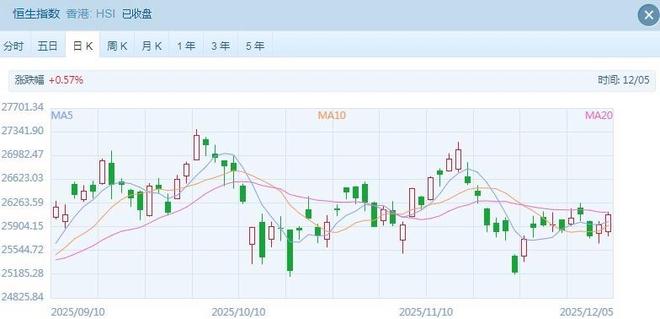
Market Performance - The Hong Kong stock market showed a rebound after an initial decline, with the Hang Seng Index successfully returning to the 26,000-point mark, significantly boosting market sentiment [1] - The Hang Seng Index closed at 26,085.08 points, up 149.18 points, a gain of 0.58% [2] - The Hang Seng Tech Index performed even better, closing at 5,662.46 points, up 47.03 points, a gain of 0.84% [3] Sector Performance - There was a clear divergence among sectors, with the large financial sector being the core driver of the afternoon market rally. Insurance stocks performed particularly well, with China Ping An (HK02318) rising over 6% and China Taiping (HK00966) increasing over 7% [5] - Brokerage stocks also saw gains, with Huatai Securities (HK06886), Shenwan Hongyuan Hong Kong (HK00218), and Hongye Futures (HK03678) all rising over 3% [5] - The tech sector saw broad gains, with Baidu Group-SW (HK09888) up over 5% and Kuaishou-W (HK01024) up over 2% [5] - The non-ferrous metals sector showed strong performance in the morning, with Jiangxi Copper (HK00358) rising over 6% [5] New Listings - Two new stocks were listed today: Tianyu Semiconductor (HK02658) and Yujian Xiaomian (HK02408), both of which saw significant declines of 30.17% and 27.84%, respectively, falling below their issue prices [5] Market Outlook - Hong Kong Yongfeng Financial Group noted that many investors are reluctant to engage in the market as the year-end approaches, with some investors looking to take profits after substantial gains throughout the year [7] - The outlook for the Hong Kong stock market in the first half of 2026 is optimistic, with potential catalysts including reassessment of China's economic growth momentum, currency exchange rates, price trends, and corporate earnings prospects [9] - Key events such as the Central Economic Work Conference in mid-December and the upcoming local and central meetings in the first quarter will serve as important observation windows for new policies [9]



兴业银行召开2026年财富管理大会 共绘财富管理高质量发展新蓝图
Zhong Jin Zai Xian· 2025-12-05 09:16
Core Viewpoint - The 2026 Industrial Bank Wealth Management Conference highlighted the bank's commitment to enhancing its wealth management services in alignment with national strategies for common prosperity, aiming to significantly grow its assets under management (AUM) and support residents in wealth preservation and appreciation [1][2]. Group 1: Conference Highlights - The conference featured key speeches from prominent figures, including the chairman of Industrial Bank, emphasizing the importance of wealth management in the context of national economic strategies [1][2]. - A total of 42 representatives from various financial sectors, including funds, securities, and insurance, gathered to discuss new trends in wealth management, bank-insurance cooperation, and digital innovation [1]. Group 2: Business Strategy - Industrial Bank aims to strengthen its wealth management business as part of its "Wealth Bank" initiative, which is one of its three key focuses, to support the common prosperity agenda [1][2]. - Since the start of the 14th Five-Year Plan, the bank's wealth AUM has increased from 2.52 trillion yuan to 3.95 trillion yuan, with over 210 billion yuan in asset appreciation for clients in the past three years [1]. Group 3: Future Directions - The bank plans to enhance its service to the real economy by facilitating the conversion of funds into investments, particularly in technology and industry, to achieve wealth appreciation for residents [2]. - There is a commitment to shift from merely selling products to helping clients allocate assets, improving professional capabilities in selecting strategies and products across domestic and international markets [2]. - The bank will continue to strengthen partnerships in wealth management, aiming for a more comprehensive and deeper collaboration to foster a healthier and more inclusive wealth management ecosystem [3].

友邦人寿携手中央财经大学成功举办第二届中财总精论坛暨《新时代中国养老金融高质量发展的突破路径白皮书》发布仪式
Cai Jing Wang· 2025-12-05 09:15
Core Insights - The second China Financial Actuarial Forum focuses on the role of actuaries in the context of the "14th Five-Year Plan" and the integration of artificial intelligence in the insurance industry [1][9] - The forum emphasizes the need for actuaries to transition from passive risk managers to proactive drivers of high-quality industry development [2][9] Group 1: Forum Overview - The forum gathered over 170 participants, including industry experts and students, to discuss innovative development paths for the actuarial industry [1] - The event was supported by AIA Life Insurance and hosted by the Central University of Finance and Economics [1] Group 2: Keynote Speeches - Keynote speakers discussed various topics, including the evolution of health insurance, asset-liability management, and the role of actuaries [3][4] - Gong Xingfeng highlighted the need for health insurance to shift from scale pursuit to value cultivation and emphasized the importance of product innovation [3] - Peng Jihai pointed out the challenges faced by the insurance industry due to declining interest rates and the need for asset-liability rebalancing [3][4] Group 3: White Paper Release - A white paper on the high-quality development of pension finance in China was released, addressing issues such as insufficient total volume and structural imbalance [5] - The white paper proposes a "12345+10" implementation framework to guide the industry towards high-quality development [5] Group 4: Roundtable Discussions - The first roundtable focused on high-quality development paths under the "14th Five-Year Plan," with discussions on the role of actuaries in addressing longevity risk and supply shortages [6][7] - The second roundtable explored the collaboration between the insurance industry and artificial intelligence, highlighting the need for a systematic risk governance framework [8] Group 5: Future Directions - The forum serves as a practical implementation of the spirit of the 20th National Congress of the Communist Party of China, contributing to the construction of a financial power [9] - AIA Life Insurance will continue to support the development of actuarial education and research, fostering sustainable growth in the insurance industry [9]

“2025年度中国媒体十大热词”发布
Zhong Guo Xin Wen Wang· 2025-12-05 07:57
"2025年度中国媒体十大热词"发布 中新社北京12月5日电 (记者 应妮)"2025年度中国媒体十大热词"5日发布,分别是:"十五五"规划、九三 阅兵、全球治理倡议、DeepSeek(深度求索)、人形机器人、苏超、票根经济、育儿补贴、科学素养、网 络生态治理。 中国国家语言资源监测与研究中心发布上述热词并予以注解:2025年,是谋划"十五五"规划之年,编制 和实施"十五五"规划,对于全面落实中共二十大战略部署、推进中国式现代化意义重大。 九三阅兵向世界宣示了中国坚决捍卫国家主权、安全、发展利益的坚定决心,以及维护世界和平的大国 担当。 2025年,中国国家主席习近平在"上海合作组织+"会议上提出全球治理倡议。 来源:中国新闻网 编辑:王永乐 广告等商务合作,请点击这里 2025年,"苏超"通过城市间的精彩角逐,激发了地域认同感,带动了从门票到文旅的庞大消费链条,成 为"体育+"融合发展的生动实践。 2025年,中国初创企业自主研发的大语言模型"DeepSeek"(深度求索)凭借"好用、开源、免费、低成 本"等特点展现了中国AI科技企业的创新性和包容性。 这一年,打通消费环节的"票根经济"应时而生,为消费升级 ...
科创100ETF基金(588220)涨近1%,一键布局“十五五”科技发展方向
Xin Lang Cai Jing· 2025-12-05 06:42
截至2025年12月5日 14:17,上证科创板100指数(000698)成分股铂力特(688333)上涨9.92%,埃夫特 (688165)上涨6.15%,财富趋势(688318)上涨6.04%,睿创微纳(688002)上涨5.21%,孚能科技(688567)上 涨4.55%。科创100ETF基金(588220)上涨0.78%,最新价报1.3元。 科创100ETF基金(588220),跟踪科创100指数[000698.SH],覆盖九大申万一级行业,一键布局科创板 市值中等且流动性较好的100 只证券。其中电子占比40.42%、生物医药占比17.36%、电力设备占比 14.54%。汇聚细分板块优秀标的与专精特新企业。其中专精特新成份股总计48家,累计权重占比 48.28%,未来发展潜力足。 数据显示,截至2025年11月28日,上证科创板100指数(000698)前十大权重股分别为华虹公司(688347)、 东芯股份(688110)、百济神州(688235)、源杰科技(688498)、国盾量子(688027)、睿创微纳(688002)、中 科飞测(688361)、安集科技(688019)、翱捷科技(68822 ...