经济软着陆

Search documents
巨富金业:美伊冲突遇“疲劳效应”,黄金避险支撑与政策压制博弈
Sou Hu Cai Jing· 2025-06-24 03:30
Geopolitical and Economic Context - The U.S. launched an attack on Iranian nuclear facilities, leading to retaliatory actions from Iran, escalating geopolitical tensions. However, market fatigue regarding geopolitical risks has led investors to focus more on Federal Reserve policy and economic data, resulting in gold prices not significantly rising despite the conflict escalation. The uncertainty in geopolitical situations still provides some safe-haven support for gold [2] - Recent U.S. economic data shows signs of weakness, with May retail sales dropping 0.9%, significantly worse than the expected -0.1%, and industrial production unexpectedly declining by 0.2%. This indicates weakening consumer demand and manufacturing momentum, potentially heightening concerns about the difficulty of a "soft landing" for the U.S. economy, indirectly supporting gold's safe-haven attributes [2] - Hawkish signals from the Federal Reserve pushed the U.S. dollar index to a high of 99.03 on June 19, fluctuating around 98.64 on June 23. A stronger dollar directly suppresses gold priced in dollars, with New York gold futures facing pressure around $3,380. Additionally, the two-year Treasury yield dropped 5 basis points to 3.88%, while the ten-year yield remained above 4.2%. Rising real interest rates increase the opportunity cost of holding gold, leading to short-term pressure on gold prices [2] Technical Analysis of Gold - The spot gold price opened at $3,389.87 per ounce, experiencing significant fluctuations throughout the day, closing at $3,369.04 with a small bearish candle. The daily closing price is near the moving average, indicating potential oscillation around this level, with a downward bias in price structure [5] - Hourly price movements are entangled with moving averages, showing no clear direction. Currently near the previous day's low, it is advisable to wait for the market to choose a direction before taking action. The 15-minute chart indicates a strong downward movement at the previous day's close, suggesting the likelihood of new lows, with a recommendation to sell on rallies [6] Technical Analysis of Silver - Silver opened at $35.9665, showing intraday fluctuations with a slight upward bias, closing at $36.080 with a small doji candle. The closing price is above the 20-day moving average, with multiple retests indicating stabilization, suggesting a bullish outlook and opportunities for long positions [8] - The hourly chart indicates that the pullback is nearly complete, beginning a bottoming oscillation phase, with a mixed directional outlook. It is recommended to wait for the market to establish a clear direction before taking action. The 15-minute chart shows a significant drop at the previous day's close, finding support at the bottom, and currently showing signs of a rebound, likely within a range-bound movement [8]


万腾外汇:美国 6 月消费者信心指数回升 美股涨黄金跌现分化行情
Sou Hu Cai Jing· 2025-06-24 02:26
Group 1 - The consumer confidence index in the U.S. unexpectedly rose to 60.5 in June, surpassing market expectations of 58.0, ending a five-month decline and signaling greater economic resilience than anticipated [1][3] - The rebound in consumer confidence is primarily driven by improved evaluations of the current job market and the gradual absorption of tariff impacts, which are providing support for consumer spending [1][3] Group 2 - Financial markets reacted swiftly to the data, with major U.S. stock indices continuing to rise; the Dow Jones Industrial Average increased by 0.72%, the S&P 500 rose by 0.81%, and the Nasdaq Composite gained 0.93% [4] - The rise in consumer confidence is interpreted as a sign that domestic demand may help the economy avoid recession, with technology and discretionary consumer sectors leading the gains [4] Group 3 - Despite the current rebound in consumer confidence, the market remains cautious about the U.S. economic outlook, with key data such as the FHFA house price index and the Richmond Fed manufacturing index yet to be released [5] - Goldman Sachs suggests that the rebound in consumer confidence may be temporary, citing rising credit card debt default rates and the resumption of student loan repayments as potential pressures on future consumer spending [5] Group 4 - The upcoming non-farm payroll report and core PCE data will be critical in determining whether the improvement in consumer confidence can be sustained [7] - If employment growth slows or inflation falls more than expected, it may prompt the Federal Reserve to signal clearer interest rate cuts, potentially increasing demand for gold as a safe-haven asset [7]
关税阴霾挥之不去,美股盘前震荡走低,欧股下跌,美债、美元上涨
Hua Er Jie Jian Wen· 2025-06-03 10:01
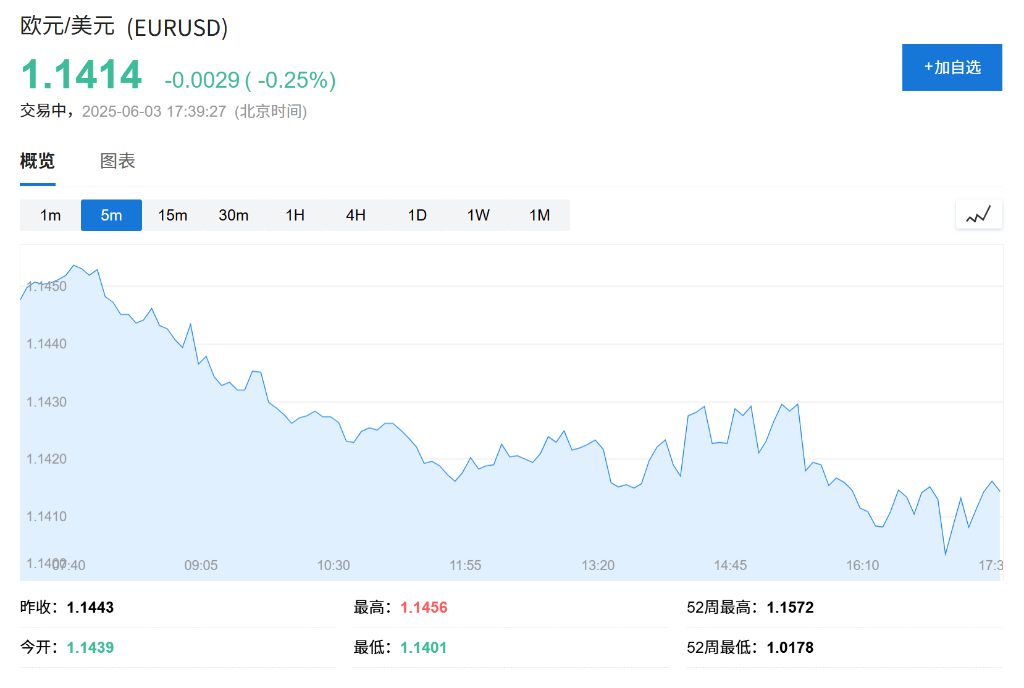
新加坡SGMC Capital创始人兼首席执行官Massimiliano Bondurri表示: "我们明显看到大量波动,投资者渴望更多可见性。市场来回震荡是正常的。" 通胀数据好于预期,欧洲央行降息在即? 6月3日周二,美股期货延续了连日来涨跌交替的震荡格局。欧洲股市同样走低,而美国国债则受到避险资金青睐上涨,日本10年期国债拍卖需求 旺盛。美元指数小幅走强0.2%。 当前市场正处于关键十字路口:贸易不确定性持续发酵,经济数据疲软信号频现,而政策制定者的应对空间却日益受限。投资者需要为更多波动 做好准备。 经济软着陆信号频现,就业数据成关键 美国经济显现出温和但广泛的疲软迹象。经合组织周二再次下调全球经济增长预期,预计今明两年全球经济增速均为2.9%。美国位列受冲击最严 重的国家之一。 即将公布的美国4月职位空缺报告预计将显示职位空缺降至2020年以来最低水平,反映出企业对消费者节约成本努力的日益关注。定于周五发布的 非农就业数据可能显示招聘步伐放缓。巴黎AXA Investment Managers欧洲股票主管Gilles Guibout表示: "市场交易价格比4月2日更高,但盈利预期已被下调,全球增长也 ...
索罗斯基金一季度持仓大调整:重仓防御板块 清仓科技股释放避险信号
Huan Qiu Wang· 2025-05-16 08:20
Core Viewpoint - Soros Fund Management's latest 13F report reveals a significant shift in its investment strategy for Q1 2024, characterized by increased holdings in large-cap indices, utilities, and financial sectors, while substantially reducing exposure to technology and Chinese stocks, indicating a cautious outlook on the economic landscape [1][3]. Defensive Reallocation: Betting on Large-Cap Indices and Stable Income Assets - By the end of Q1, Soros Fund's top three new holdings were in defensive sectors, investing $96 million in American Electric Power (AEP), $93.6 million in Entergy Corp, and $56.66 million in JPMorgan Chase. The fund also significantly increased its position in the S&P 500 ETF while completely selling off the Russell 2000 small-cap ETF, highlighting a clear strategy of "selling small caps, buying large caps" [3]. - Analysts suggest that in the context of high interest rates and slowing economic growth, the utility sector's stable cash flow and strong anti-cyclical nature, along with large-cap stocks' better risk resilience compared to small-cap firms, reflect the fund's anticipation of increased market volatility [3]. Major Sell-Off: Technology Giants and Chinese Stocks Hit Hard - The fund completely exited 78 stocks and reduced holdings in 45 others, with technology and Chinese stocks being the hardest hit. Notable exits included Alibaba, TSMC, and Boeing, while Alphabet saw a 62.64% reduction and JD.com experienced a drastic 93.6% cut [4]. - The significant reduction in previously held semiconductor equipment firms and cloud computing companies is interpreted as a response to concerns over high valuations in the tech sector and a reassessment of exposure to Chinese stocks amid geopolitical risks [4]. Structural Increase: Betting on E-commerce Leaders and Energy Transition - Despite the sell-off, the fund increased its stake in Amazon by 30%, boosted FedEx holdings by 270%, and nearly 9-folded its position in First Solar. Even UnitedHealth Group, under investigation for insurance fraud, saw its holdings double to $1.12 billion [5]. - These moves align with the investment logic under the expectation of an "economic soft landing," where e-commerce logistics benefit from consumer resilience, renewable energy aligns with policy directions, and the healthcare sector maintains essential demand [5]. Institutional Interpretation: Preparing for Market Turbulence - Multiple Wall Street institutions interpret the fund's reallocation strategy as reflecting three strategic intentions: building a safety net through S&P 500 ETFs and utility stocks to hedge against potential recession risks, narrowing focus in the tech sector to prioritize artificial intelligence and other certain areas, and reducing exposure to emerging markets, particularly in geopolitically sensitive regions [6][7]. - Morgan Stanley strategists noted that the shift from aggressive growth to value defense indicates institutional investors are gearing up for a potentially prolonged high-interest rate environment and market volatility [7].

恐怖数据悬念升级!黄金市场面临方向性抉择
Sou Hu Cai Jing· 2025-05-15 12:05
周四(5月15日)亚市早盘,市场屏息以待即将于20:30公布的美国4月零售销售数据(俗称"恐怖数据")。当前市场预期该数据月率仅增长0.3%,但多位经 济学家警告,受关税政策冲击、消费信心下滑及通胀黏性影响,实际数据可能不及预期,进而引发金融市场剧烈波动。 一、数据背景:关税冲击与消费疲软的双重阴影 关税政策的滞后效应显现 特朗普政府自3月起对进口商品加征的"对等关税"已逐步传导至终端消费市场。美国商务部数据显示,4月进口商品价格指数同比上涨3.2%,其中汽车、电子 产品等关税敏感品类涨幅超5%。尽管中美关税协议落地暂缓了部分压力,但美国对欧盟、日韩等贸易伙伴的关税谈判仍存变数,企业普遍推迟涨价以观望 政策走向,导致4月零售销售数据可能因需求抑制而表现疲软。 消费信心与支出能力双降 若数据疲软,美股科技股可能面临获利回吐压力,资金或从股市回流黄金等避险资产。全球最大黄金ETF(SPDR)持仓量已连续三日减少,但若数据爆 冷,可能触发空头回补,单日增仓或超10吨。 美联储4月消费者信心指数跌至52.2,为2023年11月以来最低水平,反映出高利率环境与债务压力对居民消费意愿的压制。此外,4月非农就业新增17.5 ...

美银月度机构调研:“做多黄金”仍是最拥挤的交易,美元配置降至2006年以来最低
华尔街见闻· 2025-05-13 11:53
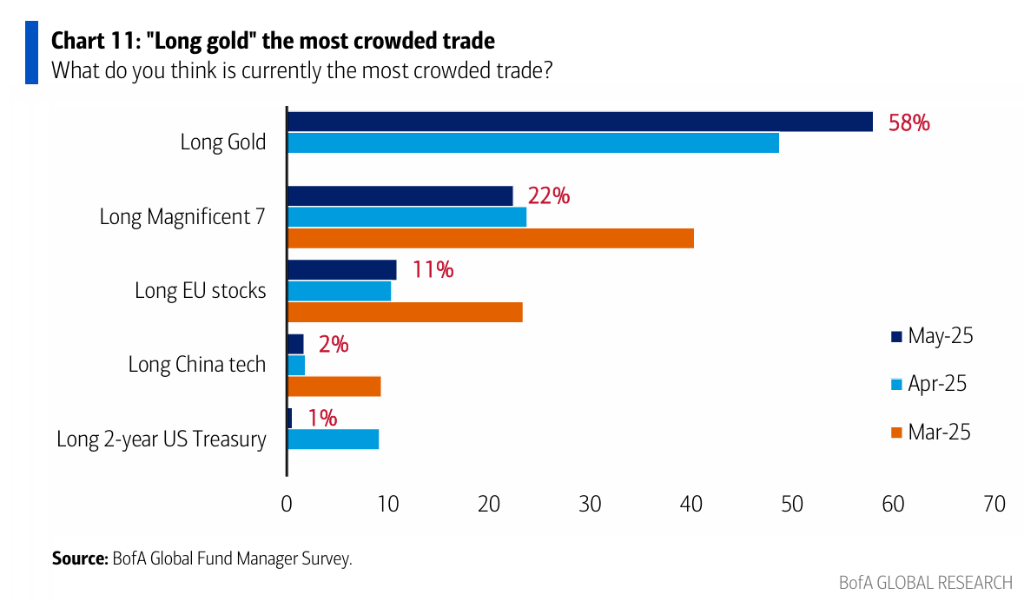
Core Insights - The sentiment towards U.S. assets is cautious, with "long gold" being the most crowded trade for the second consecutive month, as 58% of investors believe it is the current most crowded trade [1][3] - Investors' attitudes towards the U.S. dollar have significantly changed, with 57% considering it overvalued, marking the lowest allocation to the dollar since May 2006 [1][7][12] - Despite a slight improvement in global economic outlook, 81% of investors still expect the economy to enter "stagflation" [2][11] Investor Sentiment - 62% of investors view tariffs as the biggest tail risk for a global recession, while 43% believe tariffs could lead to systemic credit events [2][18] - Cash levels among investors have decreased from 4.8% to 4.5%, slightly below the long-term average of 4.7% since 1999 [14] - 61% of investors now expect a "soft landing" for the global economy, a significant increase from 37% in April [14] Asset Allocation Changes - There is a notable shift in asset allocation, with a net 38% of investors underweighting U.S. stocks, the lowest level since May 2023 [23] - European stocks have seen a 13 percentage point increase in allocation to a net 35% overweight, reversing the decline from April [23] - Technology stocks have experienced a significant 17 percentage point increase in allocation, the largest monthly gain since March 2013 [23] - Energy stocks are now at a net 35% underweight, marking a historical low [23] Economic Outlook - A net 59% of investors expect the economy to weaken, showing the largest monthly improvement since October 2024, despite a 66 percentage point drop from the peak in December 2024 [16] - 46% of investors anticipate two interest rate cuts from the Federal Reserve this year, while 25% expect three cuts [19]
美银月度调研:“做多黄金”仍是最拥挤的交易,美元配置降至2006年以来最低
Hua Er Jie Jian Wen· 2025-05-13 09:52
Group 1 - "Long gold" has become the most crowded trade for the second consecutive month, with 58% of investors considering it the current most crowded trade, significantly higher than the second-ranked "long tech giants" at 22% [2] - Gold is viewed as the most overvalued asset since 2008, with a net 45% of investors believing it is overvalued, an increase from 34% in April [5] - Investor sentiment towards the US dollar has shifted significantly, with a net 17% of investors holding a low allocation stance, marking a 19-year low since May 2006 [8] Group 2 - A net 57% of investors believe the US dollar is overvalued, a decrease of 12 percentage points from the previous month, representing the largest monthly decline since September 2023 [11] - Despite a slight improvement in global investor sentiment, it remains at a pessimistic level, with 61% of investors expecting a "soft landing" for the global economy, up from 37% in April [16] - A net 59% of investors expect the economy to weaken, showing the largest monthly improvement since October 2024, although expectations are still down 66 percentage points from the peak in December 2024 [19] Group 3 - 62% of investors view tariffs as the biggest tail risk for a global recession, with 43% believing tariffs could lead to a systemic credit event, followed by the US shadow banking system at 25% [21] - Investors are significantly adjusting their asset allocations, with a net 38% underweight in US stocks, the lowest level since May 2023, while eurozone stock allocation increased by 13 percentage points to a net 35% overweight [26] - There has been a substantial increase in tech stock allocation by 17 percentage points, marking the largest monthly increase since March 2013, while energy stock allocation has dropped to a net 35% underweight, the lowest on record [26]
美国银行基金经理调查:61%的基金经理认为经济会软着陆,4月份时这一比例为37%;26%的人认为会出现硬着陆,低于4月份的49%。
news flash· 2025-05-13 07:18
美国银行基金经理调查:61%的基金经理认为经济会软着陆,4月份时这一比例为37%;26%的人认为会 出现硬着陆,低于4月份的49%。 ...
隔夜美股 | 三大指数大幅收高 中国金龙指数涨5.4%
Zhi Tong Cai Jing· 2025-05-12 22:22
(原标题:隔夜美股 | 三大指数大幅收高 中国金龙指数涨5.4%) 智通财经APP获悉,周一,三大指数大幅收高,中美两国经过周末谈判后同意临时性大幅降低关税,提 高了市场对贸易战局势缓从而避免经济陷入衰退的希望。本周市场关注CPI与PPI等通胀数据。 【美股】截至收盘,道指涨1160.72点,涨幅为2.81%,报42410.10点;纳指涨779.43点,涨幅为4.35%, 报18708.34点;标普500指数涨184.28点,涨幅为3.26%,报5844.19点。英伟达(NVDA.US)涨5.4%,特斯 拉(TSLA.US)涨6.7%,苹果(AAPL.US)涨6.3%。纳斯达克中国金龙指数涨5.4%,阿里巴巴(BABA.US)涨 近6%,万国数据(GDS.US)涨14%。 【欧股】德国DAX30指数涨73.99点,涨幅0.31%,报23563.43点;英国富时100指数涨52.53点,涨幅 0.61%,报8607.33点;法国CAC40指数涨106.35点,涨幅1.37%,报7850.10点;欧洲斯托克50指数涨 83.71点,涨幅1.58%,报5393.45点;西班牙IBEX35指数涨116.34点,涨幅0 ...


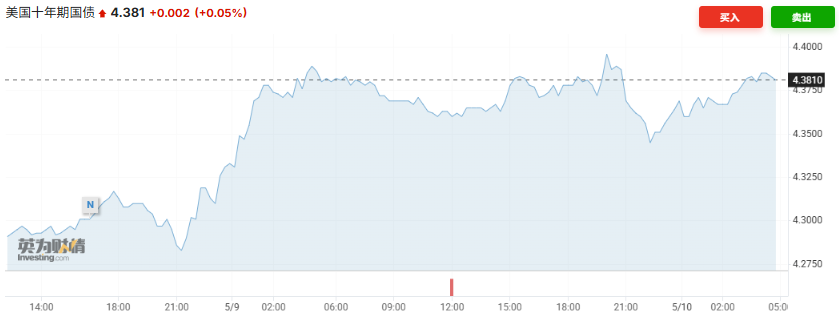
关税“搅动”,美债收益率加剧分化,美联储降息更难了!
Hua Er Jie Jian Wen· 2025-05-11 11:57
Core Viewpoint - The divergence in short-term and long-term U.S. Treasury yields poses significant challenges for the Federal Reserve's traditional policy of stimulating economic growth through interest rate cuts [1][3][10] Group 1: Yield Divergence - The current issue in the U.S. Treasury market is the significant divergence in yield trends, with short-term Treasury yields declining while long-term yields are rising [1] - As of April 2, the benchmark 10-year U.S. Treasury yield has risen to approximately 4.38%, contrasting with the decline in short-term yields [1] Group 2: Factors Driving Yield Divergence - The primary reason for this yield divergence is the uncertainty surrounding inflation, exacerbated by unpredictable trade policies [4] - Investors are demanding higher yields to compensate for the risks associated with holding long-term Treasuries, leading to an increase in the "term premium" [4] Group 3: Impact on Borrowing Costs - This yield divergence directly raises borrowing costs for consumers and businesses, complicating the Federal Reserve's efforts to stimulate the economy through rate cuts [3][10] - The average rate for a 30-year fixed mortgage was 6.8% last week, slightly up from a month ago, indicating persistent high borrowing costs despite potential rate cuts [6] Group 4: Federal Reserve and Policy Implications - Most investors believe that if the U.S. enters a recession and the Federal Reserve significantly cuts rates, long-term yields should theoretically decline [6] - However, there are concerns that long-term yields may not decrease sufficiently, keeping mortgage and other debt rates high [6][10] Group 5: Cautious Policy Response - The Federal Reserve is exercising caution in its monetary policy decisions, with Chairman Powell emphasizing the need to maintain credibility in combating inflation [8] - The U.S. Treasury has shown increased sensitivity to market conditions, adjusting its debt issuance strategy in response to rising long-term yields [9]