
通胀

Search documents
日元越救越弱!日央行加息“失灵”,最强干预警告只是开始?
Sou Hu Cai Jing· 2025-12-24 08:50
Core Viewpoint - The Japanese yen continues to weaken despite the Bank of Japan's recent interest rate hike, raising concerns about the effectiveness of monetary policy in stabilizing the currency [1][2][10]. Group 1: Monetary Policy and Interest Rates - The Bank of Japan raised interest rates by 25 basis points to a 30-year high during the December meeting, indicating a potential shift towards tighter monetary policy [1][8]. - The October monetary policy meeting minutes revealed intense debates among committee members regarding the necessity of further rate hikes to achieve long-term economic stability [6]. - Some committee members expressed concerns that the recent yen depreciation could lead to higher import costs and inflation exceeding expectations [6][16]. Group 2: Currency Performance - The yen has depreciated by 0.28% against the US dollar, trading at 155.7425, continuing its downward trend [3]. - Despite the interest rate hike, market reactions suggest a lack of confidence in the Bank of Japan's commitment to combating inflation, leading to further yen depreciation [10][11]. Group 3: Government Response and Fiscal Policy - The Japanese government issued a strong warning to currency speculators, emphasizing its authority to take decisive action against excessive currency fluctuations [5][13]. - The government has implemented an expansive fiscal policy totaling 21.3 trillion yen, which has raised concerns about Japan's fiscal health and contributed to rising bond yields [11]. - Plans for issuing new debt exceeding 28.6 trillion yen in the upcoming budget have intensified scrutiny over the government's fiscal strategy [11]. Group 4: Market Sentiment and Future Outlook - Analysts predict that the Bank of Japan may continue to raise interest rates in 2024, with expectations of reaching a policy rate of 1.25% by the end of 2026 [9]. - Concerns about the Bank of Japan's delayed response to inflation risks are growing, with market participants questioning the effectiveness of verbal interventions in stabilizing the yen [16].

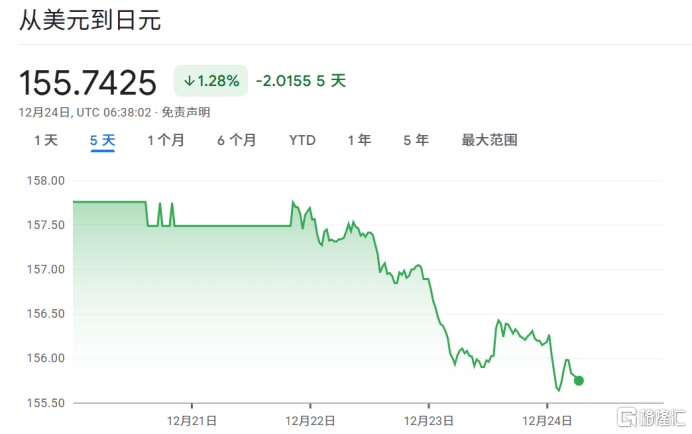
诡异的日元:央行喊话干预市场
Sou Hu Cai Jing· 2025-12-24 08:50
Core Viewpoint - The Bank of Japan raised its benchmark interest rate by 25 basis points to 0.75%, marking a 30-year high, yet the yen depreciated against the dollar, indicating a disconnect from fundamental economic conditions [1] Group 1: Interest Rate and Currency Dynamics - The yen depreciated by 1.45% to 157.5 against the dollar following the interest rate hike, despite the increase in bond yields [1] - The Japanese government approved a substantial fiscal stimulus plan of 18.3 trillion yen, which may lead to increased bond issuance and impact the bond market negatively [2] - The yield on Japan's 30-year government bonds rose to 3.452%, while the 10-year yield reached 2.034%, widening the interest rate differential with China [1][2] Group 2: Inflation and Economic Policy - Current market expectations place inflation between 2.5% and 3%, while the nominal interest rate is only 0.75%, resulting in real interest rates between -1.75% and -2.25% [2] - The Bank of Japan's cautious stance on interest rate hikes reflects uncertainty amid persistent inflation pressures and economic recovery fluctuations [3] - The Bank of Japan's communication has been vague, leading to negative market expectations for future rate hikes [3] Group 3: Market Reactions and Future Outlook - The market anticipates potential intervention by the Bank of Japan if the yen approaches the critical level of 160 against the dollar [4] - Concerns in the U.S. regarding rising Japanese bond yields suggest potential financial risks that could affect other markets [5] - The Japanese economy's recovery relies on careful management of both monetary and fiscal policies, with market skepticism about the Bank of Japan's commitment to tightening [5]
美国三季度GDP增速超预期,家庭债务创新高
Guo Ji Jin Rong Bao· 2025-12-24 08:20
Core Insights - The U.S. GDP grew by 4.3% in Q3, marking the fastest growth in two years, driven primarily by consumer spending and significant investments in artificial intelligence infrastructure [1][2] Consumer Spending - Consumer spending in Q3 saw an annualized growth rate of 3.5%, becoming the main engine of economic growth, with notable contributions from healthcare services, international travel, legal services, and technology products [2][3] - The top 10% of income earners in the U.S. accounted for nearly half of total consumer spending, supported by a booming stock market that bolstered high-end consumption and service demand [2][3] Artificial Intelligence Investment - Investment in artificial intelligence has slowed from previous highs but still contributed significantly to economic growth, with AI-related investments and high-income household consumption together accounting for nearly 70% of the growth in the quarter [3][4] Economic Imbalances - The economic growth is characterized by imbalances, with consumer confidence indices remaining low and durable goods spending slowing down, reflecting public concerns over high prices and the job market [3][4] - Non-residential fixed asset investment showed signs of weakness, and residential investment declined for the second consecutive quarter, with an annualized drop of 5.1% [3][4] Inflation and Income Dynamics - The core Personal Consumption Expenditures (PCE) price index rose to an annualized rate of 2.9%, up from 2.6% in the previous quarter, indicating a slight uptick in inflation [3][4] - After adjusting for inflation, disposable personal income remained flat, suggesting that income growth is barely keeping pace with rising prices, which is particularly challenging for low-income households [3][4] Household Debt Trends - U.S. household debt reached a record high of $18.6 trillion in Q3 2025, with mortgage debt being the largest component at $13.07 trillion [4][5] - The credit market is experiencing a "K-shaped" divergence, where low-income households face increasing financial pressure, while high-income borrowers benefit from stock market gains and rising property values [5]
纯苯、苯乙烯日报:节前累库预期升温,芳烃震荡偏弱-20251224
Tong Hui Qi Huo· 2025-12-24 06:47
Report Summary 1) Report Industry Investment Rating No relevant content provided. 2) Core View of the Report - Pure benzene is expected to remain in a high - inventory, weak - demand pattern in the short term, with prices oscillating weakly [4]. - Styrene's short - term supply - demand structure has weakened, and its price will maintain range - bound trading [4]. 3) Summary by Related Catalogs a. Daily Market Summary - **Fundamentals** - **Prices**: On December 23, the styrene main contract closed down 0.47% at 6,509 yuan/ton, and the pure benzene main contract closed down 0.62% at 5,425 yuan/ton [2]. - **Costs**: On December 23, Brent crude oil closed at $58.0 per barrel (+$1.5 per barrel), WTI crude oil closed at $62.1 per barrel (+$1.6 per barrel), and the spot price of East China pure benzene was 5,310 yuan/ton (-5 yuan/ton) [2]. - **Inventory**: Pure benzene inventory at East China ports was 27.30 million tons (+1.30 million tons), and continued to accumulate. Styrene inventory at East China ports was 13.93 million tons (+0.46 million tons), and East China commercial inventory was 8.46 million tons (+0.23 million tons), entering the restocking phase [2]. - **Supply**: The pure benzene main contract basis was - 134 yuan/ton. The processing fees of CFR China and FOB South Korea increased slightly. The overall operating rate of styrene plants rose to 69.1% (+0.8 percentage points), but non - integrated plants were still in the loss zone [2]. - **Demand**: The overall demand for pure benzene's downstream was weak, with the operating rates of CPL, phenol, and aniline dropping significantly. Styrene's downstream entered the off - season, with the operating rates of EPS and PS declining and ABS operating at a low level [3]. - **Views** - **Pure benzene**: Overseas gasoline cracking spreads weakened, and the marginal support for aromatics from blending oil decreased. There was still some arrival pressure, and downstream提货 was weak. The supply - side processing fee improved slightly, but the demand was differentiated. Overall, it was in a high - inventory, weak - demand pattern [4]. - **Styrene**: Port and commercial inventories increased, and the market entered the pre - holiday restocking phase. The supply - side operating rate increased slightly, but non - integrated plants were still in the loss zone. The demand entered the off - season, and the production profit of downstream hard plastics was under pressure [4]. b. Industrial Chain Data Monitoring - **Prices of Styrene and Pure Benzene**: On December 23, the styrene futures main contract decreased by 0.47% to 6,509 yuan/ton, and the pure benzene futures main contract decreased by 0.62% to 5,425 yuan/ton. Brent crude oil and WTI crude oil prices increased by 2.61% and 2.65% respectively [6]. - **Production and Inventory of Styrene and Pure Benzene**: From November 28 to December 5, 2025, China's styrene production increased by 2.32% to 34.2 million tons, and pure benzene production decreased by 1.70% to 43.9 million tons. Pure benzene port inventory across the country increased by 36.59% to 22.4 million tons [7]. - **Operating Rate**: From November 28 to December 5, 2025, the operating rate of styrene in pure benzene's downstream increased by 1.56 percentage points to 68.9%. The operating rate of EPS in styrene's downstream increased by 1.61 percentage points to 56.4%, while the operating rate of ABS decreased by 2.90 percentage points to 68.3% [8]. c. Industry News - European Central Bank President Lagarde said the uncertainty of the inflation outlook was still higher than usual [9]. - The year - on - year growth rate of the US core CPI in November was 2.6%, the lowest since 2021 [9]. - The number of initial jobless claims in the US last week was 224,000, lower than market expectations [9]. - Federal Reserve's Goolsbee said there was considerable room for interest rate cuts as long as inflation was clearly returning to the 2% target [9]. d. Industrial Chain Data Charts The report provides charts on the prices, production, inventory, and operating rates of styrene and pure benzene, as well as their upstream and downstream products, with data sources from iFinD and Steel Union Data [11][13][14][18][21][29][30][31].
经济学家警告:美元危机或在一夜之间爆发!黄金和白银价格拉响警报
Sou Hu Cai Jing· 2025-12-24 05:37
Core Viewpoint - The recent surge in precious metal prices may signal an impending financial collapse, as warned by economist Peter Schiff, who believes the U.S. economy is approaching a historic crisis due to rising inflation and gold and silver prices undermining confidence in U.S. Treasury bonds and foreshadowing a sharp decline in the dollar [1][4]. Group 1: Precious Metals and Economic Indicators - Schiff emphasizes that the significant rise in gold prices indicates a loss of confidence in the dollar, prompting investors to buy gold instead of holding U.S. Treasury bonds for interest income [2][3]. - He warns that the rising prices of gold and silver could lead to a self-reinforcing cycle, where diminished confidence in the dollar drives more investors to gold, forcing the U.S. to offer higher interest rates to attract bond buyers [3][4]. - Schiff predicts that gold could experience unprecedented daily price increases, potentially exceeding $200, as the current bull market matures, highlighting the importance of this warning for the U.S. economy [4]. Group 2: Market Trends and Investment Strategies - Schiff notes that 2025 may see overseas markets significantly outperforming the U.S. stock market for the first time in years, with U.S. stock valuations remaining high after a decade-long bull market characterized by loose monetary policy [5][6]. - There is a noticeable shift in capital flows, with foreign investors who previously poured money into U.S. assets now repatriating funds, while U.S. investors increasingly seek better returns overseas [5].
增长与信心背离:美国经济“表面繁荣”下现结构性裂痕
Xin Hua Cai Jing· 2025-12-24 05:25
新华财经北京12月24日电(崔凯)美国商务部经济分析局(BEA)本周二发布数据显示,2025年第三季 度,美国实际国内生产总值(GDP)按年化季率初值增长4.3%,显著高于市场预期的3.3%和第二季度 的3.8%,创下自2023年以来的最快增速。 该报告原定于10月发布,因联邦政府长达43天的停摆而推迟,系对三季度GDP的首次预估,后续还将进 行两次修正。 增长主要由消费者支出、出口及政府开支共同驱动。作为占美国经济活动约70%的核心引擎,实际个人 消费支出在三季度录得3.5%的年化增幅,高于预期的2.7%和前值2.5%。出口与政府支出亦提供支撑, 私人固定投资虽仍为负,但降幅收窄。 通胀方面,美联储最关注的个人消费支出物价指数(PCE)在三季度按年率上涨2.8%,高于二季度的 2.1%;剔除食品和能源后的核心PCE物价指数年化季率初值为2.9%,符合市场预期,但较前值2.6%有 所上升,持续高于美联储2%的长期目标。 数据公布后,市场对美联储在2026年1月28日会议上降息的预期明显降温,当前押注降息的概率约为 17%。 尽管增长数据亮眼,多位经济学家指出其可持续性存疑。毕马威首席经济学家黛安·斯旺克(Di ...
“恐慌指数”创年内新低!美股完美收官背后,华尔街警示风险
Jin Shi Shu Ju· 2025-12-24 04:55
Group 1 - The Cboe Volatility Index (VIX), known as Wall Street's "fear gauge," is expected to end 2025 at its lowest annual level, following a volatile period that saw it reach its highest point since 2020 [1] - The VIX closed at 14 on Tuesday, marking its lowest closing level since December 2024, and is poised to close within 2% of its calendar year low for the first time since its inception in 1990 [1] - The S&P 500 index reached its 38th record high of the year on Tuesday, with the Nasdaq Composite and Dow Jones Industrial Average also experiencing consecutive gains [1] Group 2 - Historical trading patterns suggest that large-cap benchmark indices may end 2025 in record territory, despite the Nasdaq Composite remaining below its October peak [2] - Recent stock market rebounds, particularly in financial and materials sectors, are viewed positively by investors, with expectations for the S&P 500 to rise another 10% in 2026 [2] - Positive sentiment around AI has emerged, with expectations that government spending will support the economy ahead of the 2026 midterm elections [2] Group 3 - The outlook for next year appears optimistic, with consumer spending continuing despite a weak labor market, and the Federal Reserve raising its GDP growth forecast for 2026 [3] - However, faster economic growth may exert upward pressure on inflation, potentially leading the Federal Reserve to slow down interest rate cuts, which could diverge from Wall Street's expectations [4] Group 4 - Investor sentiment indicators suggest that confidence may be nearing complacency, with the Bank of America Bull & Bear Indicator rising from 7.9 to 8.5, which could trigger a contrarian "sell" signal [4] - The recent performance of AI-related stocks has shown divergence, with more stocks outside the tech and semiconductor sectors benefiting from AI investments [5] - The competition among major tech companies, particularly the "Magnificent Seven," is intensifying due to AI advancements, which may pose challenges for indices like the S&P 500 [5]
STARTRADER:美联储罕见内部分歧,下一步利率会怎么走?
Sou Hu Cai Jing· 2025-12-24 04:21
近期,美联储政策制定面临数十年未见的复杂局面。其双重目标——就业最大化与物价稳定之间出现明 显冲突,导致内部关于利率路径的分歧持续加深。有分析指出,这一状况可能延续至2026年。 德意志银行美国经济研究主管表示,尽管存在分歧,美联储今年仍完成了三次利率下调。然而,若未来 通胀持续而就业市场疲软,新任主席凝聚共识的难度将加大。虽然进一步调整利率可能是主要方向,但 也存在委员会更倾向收紧政策的风险。 随着就业数据进一步变化,美联储在秋季为利率下调做了铺垫。但由于政府数据发布一度中断,决策者 部分依赖民间数据评估,尤其在通胀测量方面面临挑战。 至今年末,政策分歧更加明显。尽管实现了第三次利率下调,但三名委员投下反对票——两人因担心通 胀而希望维持利率,另一人则支持更大幅度下调。另有六位非投票委员也倾向暂不调整。目前,对关税 引发的通胀走势判断仍不一致:有观点认为压力将在明年一季度见顶回落,也有委员担心其可能更具持 续性。 进入新一年,在已完成三次利率下调且通胀仍高于目标的情况下,政策委员会暗示将进入观察期,再考 虑后续行动。近期有通胀指标显示涨幅放缓,但因数据统计曾受中断影响,其准确性受到部分委员质 疑。目前失业率 ...
美国GDP猛增4.3%,背后撕裂:只有富人在狂欢
Sou Hu Cai Jing· 2025-12-24 04:16
Group 1 - The U.S. GDP annualized growth rate reached 4.3% in Q3 2025, marking the fastest growth in two years, but this growth is characterized by structural imbalances and is not a broad-based recovery [1][3] - The primary driver of this GDP growth is consumer spending, which increased by 3.5%, with significant contributions from entertainment, electronics, automotive, international travel, healthcare, and daily necessities [3][4] - The economic landscape is described as a "K-shaped economy," where high-income individuals and large corporations benefit from stock market gains and asset appreciation, while middle and low-income households face rising costs and economic pressures [4][6] Group 2 - The current consumer spending boom is primarily supported by the wealthy, indicating a superficial prosperity rather than healthy, endogenous growth [7][8] - Trump's tariff policies have contributed positively to GDP in the short term but have increased living costs, leading to a decline in his approval ratings despite favorable macroeconomic indicators [8][10] - Large corporations are thriving under current economic conditions, while small businesses struggle with rising costs and declining profits, reflecting a similar K-shaped divergence in the corporate sector [9][10] Group 3 - Inflation has begun to accelerate again, complicating the Federal Reserve's potential for interest rate cuts, with expectations shifting towards a more cautious monetary policy outlook [11][12] - The economic impact of a recent government shutdown is projected to lower Q4 GDP by 1-2 percentage points, with significant irreversible economic losses anticipated [13] - The widening consumption gap between the wealthy and the poor, along with the survival disparity between large and small enterprises, highlights the conflict between short-term policy stimuli and long-term structural issues [14]

分歧还将延续!美联储明年迎新主席,却难迎“降息坦途”
Jin Shi Shu Ju· 2025-12-24 02:48
Luzzetti表示,"虽然未来的路径最可能是进一步降息,但也存在风险情景,即下一任主席最终面对的是 一个倾向于加息的委员会。" Huntington Bank首席经济学家Ian Wyatt补充道,"新主席在这种环境下将面临极其艰难的协调工作并建 立共识,特别是如果他们的观点与大多数理事严重脱节的话。" 特朗普的影响力与日俱增 2025年,美国总统特朗普对经济政策进行了一系列令人眼花缭乱的调整,从过山车般的新关税税率到关 闭边境以抑制移民,这些举措导致美联储在今年大部分时间里处于按兵不动的状态,官员们试图理清这 对经济、通胀和就业的影响。 美联储的观望模式让特朗普感到受挫,他猛烈抨击美联储要求降低利率,并试图利用技术细节罢免鲍威 尔。因政策分歧而解雇鲍威尔的威胁引发了人们对危及美联储独立性的担忧,并震动了市场。 虽然特朗普没有解雇鲍威尔,但他以涉嫌抵押贷款欺诈为由试图解雇美联储理事库克,此事仍在法庭诉 讼中,最高法院将于明年初审理。 美联储在过去一年里见证了其国会授权的两个目标——就业最大化和物价稳定发生冲突,这是自20世纪 70年代滞胀以来未曾见过的局面,且导致美联储内部出现了多年未见的分裂,关于利率政策截 ...