资产配置

Search documents
永安期货“818理财节”落幕:打响“永安财富 衍生幸福”品牌 共探资产配置新未来
Zhong Zheng Wang· 2025-09-04 02:28
Group 1 - The core theme of the 2025 "818 Wealth Management Festival" organized by Yong'an Futures is "Yong'an Wealth Derives Happiness," focusing on asset allocation trends and promoting the values of "long-term investment and rational financial management" [1][3] - The event attracted over ten thousand participants through various online and offline activities, receiving widespread attention and positive feedback from investors [1][3] - Yong'an Futures aims to establish itself as a leading and unique derivatives investment bank, leveraging its deep expertise in financial derivatives to provide high-quality asset management and advisory services [1][4] Group 2 - The "818 Wealth Management Festival" featured a collaborative wealth management conference that integrated resources nationwide, gathering experts from various institutions to discuss strategy development and market trends [3] - The conference included participation from nearly thirty well-known private fund managers, addressing topics such as macroeconomic trends, quantitative strategies, and the value of derivatives investment, providing insights for around 500 individual and institutional investor representatives [3] - In addition to offline meetings, the festival also launched online live broadcasts and educational activities, expanding the brand's influence [4] Group 3 - The Yong'an Futures APP introduced a new "Wealth Account Analysis" feature during the festival, allowing clients to visualize their asset allocation and track account performance in detail [4] - The company is committed to a major reform of its operational system centered around customer needs, aiming to enhance service capabilities and strengthen its professional advantages in asset allocation [4]



白银暴涨三问:为何涨?谁在买?还涨吗?
Zhong Guo Jing Ying Bao· 2025-09-03 13:59
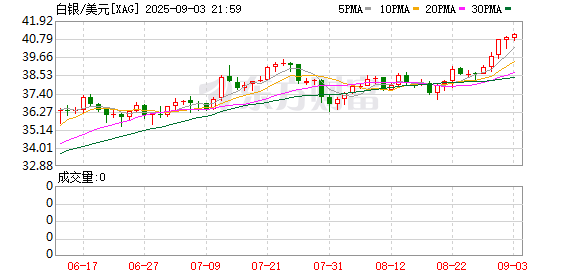
Core Viewpoint - The recent surge in silver prices is driven by multiple factors including the correction of the gold-silver ratio, increased industrial demand, and expectations of interest rate cuts by the Federal Reserve [2][3][4]. Group 1: Price Movement and Market Dynamics - As of September 3, spot silver prices reached a high of $40.973 per ounce, marking a significant increase of over 40% year-to-date [2][3]. - The gold-silver ratio, which peaked at 106 in April 2025, is currently around 87, indicating potential for further price correction in silver [3][4][7]. - The supply of silver is constrained, with a projected decline of 1.3% in global mine supply in 2024, contributing to upward price pressure [4]. Group 2: Investment Trends - Silver ETP holdings have increased by nearly 4,000 tons since February 7, translating to an inflow of approximately $1.3 billion at an average price of $34 per ounce [5]. - There has been a structural shift in the silver market, with sovereign wealth funds and large institutions beginning to invest in silver assets, breaking the long-standing trend of favoring gold [6]. Group 3: Future Outlook - The investment demand for silver is expected to grow, with potential price increases projected based on the gold-silver ratio and economic conditions [7]. - If the gold price reaches $3,700 per ounce, silver could rise to $49.3 per ounce, and if gold hits $4,000 per ounce, silver could reach $53.3 per ounce, indicating significant upside potential [7].
2025年9月债券市场展望:煎熬的等待期:资产配置主线下的债市新平衡
Shenwan Hongyuan Securities· 2025-09-03 13:45
Report Title - "The Arduous Waiting Period: A New Balance in the Bond Market under the Asset Allocation Mainline - Outlook for the Bond Market in September 2025" [1] Report Date - September 3, 2025 [2] Report Industry Investment Rating - Not provided Core Viewpoints - Since 2022, the transmission from broad credit to the fundamentals seems to be weakening. The stock - bond seesaw effect since 2025 may be driven by new logic: anti - involution has reversed the macro narrative since 2024, and the rise of the stock market and the improvement of expectations reinforce each other [5][108][165] - The stock - bond seesaw is just an appearance. The deeper reason is that in a low - interest - rate environment, residents' asset allocation behavior has changed substantially. Deposits and pure bonds have entered a low - return range, and funds are seeking more cost - effective alternative assets, increasing the demand for stock - bond hybrid products [8][113][165] - In 2025, the supply of long - duration government bonds has increased more significantly, leading to an imbalance between supply and demand and a steeper term spread [8][132][165] - Currently, the core issue is the lack of continuous buying power from allocation players, and trading players are mainly engaged in speculation [7][165] Summary by Directory 1. Analysis of the Bond Market Trend from January to Date and Its Macroeconomic Logic - **2025 Q1**: Tight funds and prominent bank liability pressure led to a bond market correction [16] - **2025 Q2**: Repeated tariff expectations, along with potential reserve requirement ratio and interest rate cuts, caused yields to decline rapidly to a low level and then fluctuate [18] - **2025 July - August**: Anti - involution expectations, the stock - bond seesaw effect, and fund diversion led to a bond market correction. In August, the term spread of treasury bonds expanded, and the duration strategy began to collapse. The credit spreads of secondary perpetual bonds and medium - term notes first increased and then decreased [20][22][27] - **Summary**: Since the beginning of the year, long - term interest rates have repeatedly attempted to break through previous lows but failed, and the interest rate bottom has been rising (the bond YTM has shown an arc - bottom pattern since the beginning of the year) [4][39][48] 2. Understanding the Deviation among Funds, Certificates of Deposit (CDs), and the Bond Market - **6 - 8 months**: Overall, funds were loose to support bond issuance, stabilize the economy, and hedge the impact of the stock market on the bond market. After the double cuts in May, the central bank's medium - and long - term liquidity net injection from January to August 2025 totaled 3.98 trillion yuan, significantly exceeding historical levels [52][55][100] - **September**: Both medium - and long - term liquidity and CD maturities are high. The first ten days may be an important window to observe the central bank's attitude. The central bank may conduct 3 - month outright reverse repurchases to hedge [68][98][100] - **Deviation since July**: Funds have been loose, but CD prices have remained rigid. The CD price has a seasonal pattern of bottoming out and rising in the third quarter. Rising stock market trading activity, increased net supply of government bonds, and other factors have contributed to this situation [69][88][95] - **CD Pressure Relief**: Focus on whether the central bank conducts 3 - month outright reverse repurchases in early September. Consider whether there will be another double cut around the beginning of the fourth quarter to relieve economic and bank liability pressure [98][100] 3. Revisiting Deposit Transfer and Fund Diversion Effects - **Traditional Logic of the Stock - Bond Seesaw**: In most periods, stocks and bonds show a seesaw relationship. The driving logic is the transmission from broad money to broad credit, with expectations of fundamental improvement leading to a rising stock market, rising interest rates, and narrowing credit spreads [103] - **Resident Wealth Transfer**: It is a stock logic. In a low - interest - rate environment, residents are re - allocating assets. The main destinations of deposit diversion in recent years are likely wealth management and insurance. Residents' direct entry into the stock market may still be in the early stage [109][113][120] - **Stock and Bond Financing Comparison**: In 2024, the supply and demand of stocks were weak, while in 2025, supply increased marginally, but demand increased more significantly. In 2024, the supply of bonds was large and demand was strong, but in 2025, supply continued to increase significantly while demand weakened [132][135][139] - **Role of Allocation Players**: Insurance companies have a weaker preference for the bond market and are more interested in high - dividend assets. They are waiting for better prices in the bond market. Rural commercial banks' bond - buying power has weakened, and the bond investment scale of some accounts has shrunk [140][147][154] - **Role of Trading Players**: Since July 2025, wealth management products have been the main buyers during the bond market adjustment, indicating that the liability side of wealth management may still be stable. Pure bond funds have performed poorly this year and have faced continuous redemption pressure [155][159][163] 4. How Much Risk Has the Bond Market Released? - **Adjustment since July**: The adjustment of long - term interest rates is due to the impact of anti - involution expectations on the bond market and the stock - bond re - balance caused by fund diversion. The widening of the term spread is essentially a correction of pessimistic expectations [12] - **Future Risks to Watch**: Expectations of rising inflation, instability of the liability side of wealth management and funds, and the impact of redemptions [12] - **Indicators to Monitor**: The trend of CDs, the entry strength of allocation players, and the performance of credit spreads. The bond market is still under pressure, and a cautious view is maintained. In September, the bond market may continue to be in an arduous waiting period, and attention should be paid to the structural widening pressure of credit spreads [11][12][100]
发车!回调,买入
Sou Hu Cai Jing· 2025-09-03 11:40
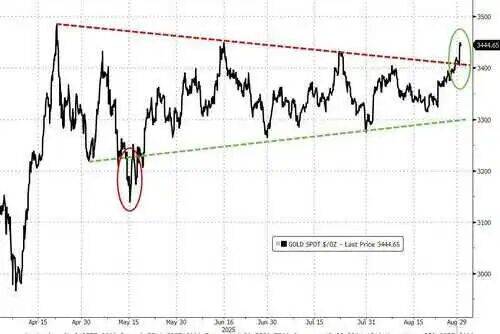
Group 1 - The core viewpoint of the articles highlights significant movements in the commodity and bond markets, particularly the surge in gold and silver prices, driven by factors such as the weakening independence of the Federal Reserve, expectations of interest rate cuts, rising inflation pressures in the U.S., and the diminishing hedging function of long-term government bonds [1][3][5]. - Gold has recently broken the $3,500 mark, reaching a historical high, while silver has surpassed $40, marking a 14-year peak [3]. - The bond market is experiencing a sell-off, with long-term government bond yields in developed markets, including the U.S., U.K., and France, reaching multi-year highs, indicating a loss of investor confidence in the existing financial system [4][5]. Group 2 - The U.S. inflation rate is approaching 3%, and the potential for a significant economic impact from this inflation may not be fully realized until the fourth quarter [3]. - The U.K.'s current deficit as a percentage of GDP is comparable to historical periods of significant upheaval, such as the French Revolution [6]. - The article suggests that as governments accumulate excessive debt and lose the trust of major debt buyers, investors are increasingly turning to gold as a reliable asset that does not depend on government promises [8]. Group 3 - The articles indicate that September is historically a poor month for stock and bond markets, with global government bonds over ten years showing a median decline of 2% in September over the past decade [10]. - Despite short-term volatility, the long-term investment value of European stocks remains strong, supported by sectors such as luxury goods, pharmaceuticals, and green energy, which possess significant pricing power and competitive advantages [19][20]. - The New Zealand Superannuation Fund is strategically reallocating its investments, betting on European stocks outperforming U.S. stocks over the next decade based on valuation assessments [21].
A股突然生变!手里的基金还没回本,该怎么办?
天天基金网· 2025-09-03 10:34
Core Viewpoint - The article discusses the current state of the A-share market, highlighting the divergence between index performance and individual stock experiences, suggesting a need for a more selective investment approach in a changing market environment [4][15]. Group 1: Market Overview - The A-share market has shown significant structural differentiation, with the Shanghai Composite Index reaching a ten-year high, yet many investors feel a disparity in their personal investment outcomes [3][15]. - Recent adjustments in the A-share market indicate a shift in pricing mechanisms, asset structures, and investor behaviors, leading to a more complex investment landscape [4][5]. Group 2: Market Dynamics - Market pricing tends to be forward-looking, often reflecting economic expectations before they are felt by the general public, emphasizing the importance of timely investment decisions [5][8]. - The economic structure in China is undergoing a profound transformation, with a widening gap between "new" and "old" economic drivers, resulting in varying cycles of prosperity across different sectors [5][8]. Group 3: Investment Strategies - The article suggests that for most investors, investing in index funds may be more beneficial than stock picking, especially in a structurally driven market where only a small percentage of stocks have surpassed previous highs [16][21]. - A diversified investment strategy is recommended, including a gradual approach to building positions in ETFs and focusing on sectors with strong fundamentals [26][29]. Group 4: Investor Behavior - Investors are encouraged to reassess their holdings and investment strategies based on current market conditions, emphasizing the importance of patience and adherence to personal investment principles [27][28]. - The article highlights the necessity of maintaining a balanced portfolio and avoiding emotional decision-making in response to market fluctuations [22][35].

泰康人寿领衔险资团入主北京荟聚,加速布局商业地产领域
Guan Cha Zhe Wang· 2025-09-03 05:53
Core Insights - The strategic transaction involving the acquisition of Beijing Huiju, one of Asia's largest shopping centers, has been completed with a total valuation of 16 billion yuan [1] - The leading investor in this transaction is Taikang Life, which heads a consortium of insurance capital with a total fund size of 8 billion yuan [1][3] - Taikang Life has been actively expanding its footprint in commercial real estate, with investments exceeding 40 billion yuan in investment properties since 2024 [2][4] Group 1: Transaction Details - The initial phase of the transaction includes three iconic commercial properties located in Wuxi, Beijing, and Wuhan, with a combined valuation of 16 billion yuan [1] - The fund led by Taikang Life consists of 8 billion yuan, with Taikang Life contributing 3 billion yuan and other insurance companies collectively investing 3 billion yuan [1] - Ingka Group, the parent company of IKEA, plans to sell ten Huiju shopping centers in mainland China, with the first three projects being part of this transaction [1] Group 2: Investment Strategy - Taikang Life has previously engaged in commercial real estate through a fund model, including a 2.234 billion yuan Pre-REIT fund established in collaboration with Vanke and other partners [2] - The company has consistently increased its investment in real estate since 2017, with figures rising from 22.682 billion yuan in 2020 to 41.077 billion yuan in 2024 [2] - The trend of insurance capital investing in commercial real estate aligns with the industry's shift towards alternative assets, seeking stable cash flow and potential appreciation [3][4] Group 3: Market Context - The growing interest in commercial real estate by insurance funds is driven by the need for stable investment channels that provide consistent rental income [4] - The ongoing economic development and urbanization in China further enhance the attractiveness of commercial real estate investments [4]
基金高点买入必亏?这才是最大的投资误区!
Sou Hu Cai Jing· 2025-09-02 21:49
Core Insights - The article addresses the misconception that high points in fund performance equate to losses, emphasizing the complexity of market dynamics and the importance of a rational investment framework. Group 1: Industry Fundamentals - The long-term potential of a fund is determined by the underlying industry or company, with examples like the renewable energy sector showing significant growth despite short-term fluctuations [2][4] - Key factors influencing industry performance include policy incentives, technological advancements, and sustained market demand [4] Group 2: Fund Management - Skilled fund managers can mitigate high-point risks through strategic adjustments, with active management outperforming index funds by an average of 12 percentage points over the past five years [6] - Regular investment strategies, such as dollar-cost averaging, can transform high-point risks into long-term gains, evidenced by a case where a monthly investment yielded an 18% return compared to a mere 3% for a lump-sum investment [6] Group 3: Asset Allocation - A balanced approach combining equities and bonds can create a "resilient" portfolio, with a classic allocation of 60% equity funds and 40% bond funds [8][9] - Dynamic adjustments based on market valuations can help manage risk exposure effectively, as shown by the performance differences between pure equity funds and balanced portfolios during downturns [9] Group 4: Investment Traps - Investors often mistakenly equate historical high points with future peaks, necessitating a dynamic perspective on market valuations [12] - The impact of fund fees on long-term returns is significant, with lower management fees leading to substantially higher returns over time [13] - Short-term thinking can undermine the benefits of compounding, highlighting the importance of sustained investment over longer periods [14]

黄金“杀”回来了,突破3500美元/盎司!
Sou Hu Cai Jing· 2025-09-02 14:46
Core Viewpoint - Gold prices have surged to new highs, driven by multiple factors including expectations of interest rate cuts by the Federal Reserve, ongoing geopolitical tensions, and increased central bank purchases of gold [1][7][9]. Price Movements - On September 2, London gold reached a peak of $3508.69 per ounce, the highest since April 22, while COMEX gold futures hit a record high of $3578.4 per ounce [2][4]. - As of the latest reports, London gold was trading at $3479.52 per ounce, reflecting a slight increase of 0.12% [2][3]. - COMEX gold futures also showed a minor increase, trading at $3549.9 per ounce, up 0.12% [4]. Market Drivers - The rise in gold prices is attributed to the market's renewed expectations for interest rate cuts by the Federal Reserve, following disappointing U.S. employment data and inflation figures that suggest room for monetary easing [8][9]. - Concerns over the independence of the Federal Reserve, particularly due to political pressures from the Trump administration, have also contributed to a weaker U.S. dollar, further supporting gold prices [8][9]. - Geopolitical risks, particularly the escalation of the Ukraine crisis, have heightened demand for gold as a safe-haven asset [8][9]. Future Outlook - Short-term risks of a significant pullback in gold prices are considered low, with ongoing support from interest rate cut expectations and geopolitical tensions [9][10]. - Long-term projections suggest that the evolving global political and economic landscape, along with challenges to the U.S. dollar's credit system, will continue to support gold prices [9][10]. - The potential for further monetary policy easing by the Federal Reserve, including the possibility of quantitative easing, could reinforce the upward trend in gold prices [10].

最新:比特币以太坊10万与4000美元关口震荡,XBIT美股开户教程全解析
Sou Hu Cai Jing· 2025-09-02 12:26
Group 1 - The cryptocurrency market is entering a "critical decision period," with Bitcoin facing resistance around $108,000, while new token WLFI has launched its TGE with support from institutions like Jump Crypto and DWF Labs [2] - Significant unlocks of tokens such as SUI ($145 million) and ZETA ($8.4 million) are creating liquidity pressures, leading to a "blood-sucking effect" in the short term [2] - The correlation between traditional finance and the crypto market is deepening, prompting investors to explore asset allocation channels, including learning about U.S. stock trading [2] Group 2 - Bitcoin's current price is $107,863, with the $100,000 support level seen as a critical threshold; a drop below $98,000 could signal the end of the bull market [3] - Bitcoin ETF has experienced its first net outflow of $127 million after four days of inflows, indicating a cooling in spot trading activity [3] - Ethereum shows relative resilience, priced at $4,397.19 with a year-to-date increase of 31.69%, but analysts warn of a potential retest of the $4,000 support level [5] Group 3 - WLFI has become a significant market variable, launching its trading pairs on platforms like OKX and LBANK, with a total supply of 100 billion tokens and an initial circulating supply of 5% [6] - The trading volume for WLFI reached a turnover rate of 23% within two hours of its launch, indicating strong user interest and platform efficiency [6] - Upcoming macroeconomic risks, including U.S. employment reports and inflation data, are expected to influence market direction, with XBIT providing tools for users to navigate these changes [8]

股份行零售排位“争夺赛”:亮眼增速下,座次有何变化?
Nan Fang Du Shi Bao· 2025-09-02 11:26
Core Viewpoint - The retail banking sector is experiencing intensified competition, with significant growth in retail assets under management (AUM) and private banking clients among major banks, despite previous challenges in the market [2][4][7]. Retail AUM - The top three banks in retail AUM are China Merchants Bank (CMB) with 16.03 trillion yuan, Industrial Bank with 5.52 trillion yuan, and CITIC Bank with 4.99 trillion yuan [6][5]. - CMB's AUM growth is 7.39%, while Industrial Bank and CITIC Bank have growth rates of 8.00% and 6.52%, respectively [6]. - Notably, the AUM of several banks has increased significantly, with Zhejiang Commercial Bank and Pudong Development Bank showing growth rates of 12.48% and 10.55% [4][6]. - CMB's AUM surpasses that of its competitors by over 10 trillion yuan, establishing a substantial lead in the retail banking sector [4][5]. Private Banking Clients - The number of private banking clients has also seen substantial growth, with Zhejiang Commercial Bank leading at 15.52% growth, followed by Huaxia Bank, Minsheng Bank, and Pudong Development Bank with growth rates of 13.79%, 12.84%, and 10.15%, respectively [7]. - CMB, CITIC Bank, and Industrial Bank also reported increases in private banking clients, all exceeding 8% growth [7]. Wealth Management Revenue - Wealth management income has shown significant increases, with CMB reporting an 11.89% growth in fees and commissions, marking the first positive growth in three years [8]. - CITIC Bank's wealth management income growth reached a four-year high at 10.3%, while Industrial Bank's retail wealth income grew by 13.45% [8]. Retail Loan Quality - Retail loan non-performing ratios vary significantly among banks, with Bohai Bank having the highest at 4.43%, while CMB and Industrial Bank maintain the lowest at 1.03% and 1.22%, respectively [11][9]. - Despite CMB's strong performance, its non-performing ratio increased by 0.07 percentage points compared to the previous year [11]. Retail Strategy - The introduction of consumer loan interest subsidies is expected to enhance the competitive landscape, shifting focus from price wars to technology, service, and quality differentiation [12][13]. - Banks are emphasizing asset allocation and the application of AI models in their retail strategies, with CMB planning to integrate AI assistants to improve efficiency and workflow [14][15].