
供应过剩

Search documents
俄罗斯海上原油量持续攀升,甲醇关注12?的进?压
Zhong Xin Qi Huo· 2025-12-03 01:58
投资咨询业务资格:证监许可【2012】669号 中信期货研究|能源化⼯策略⽇报 2025-12-03 俄罗斯海上原油量持续攀升,甲醇关注 12⽉的进⼝压⼒ 化工品近期的反弹开始略显迟疑。甲醇在海外限气的提振下,近期期 价反弹;同时前期较高的开工导致伊朗11月装船量再创历史新高,12月可 能出现非伊甲醇减量,伊朗货源依旧充足的情况,12月甲醇的进口压力依 旧较大。而烯烃端也没有实质性利好。资金换月和原油反弹短暂拉升了烯 烃价格,但生产企业仍以去库存为核心导向,通过下调出厂价、加大促销 力度等方式积极去库;需求端则以刚需为主,并未有投机性囤货举措。 原油:地缘溢价摇摆,供应压力延续 沥青:沥青期价大跌,测试2800重要支撑位 高硫燃油:燃油期价弱势震荡 低硫燃油:低硫燃油期价弱势震荡 甲醇:12月沿海卸货预期偏高,内地供需阶段性支撑,甲醇震荡整理 尿素:淡储推进暂缓,盘面震荡整理 乙二醇:国内供应阶段性见顶,但海外货源供应充裕 PX:供需双强,叠加市场预期偏强下利润持续扩张 PTA:现货市场氛围改善,基差偏强运行 短纤:下游维持观望居多,持续追涨意愿不强 瓶片:价格波动率收窄,成交氛围小幅回落 丙烯:PG带动,P ...
美联储降息预期提升,沪镍不锈钢继续反弹
Hua Tai Qi Huo· 2025-12-02 02:29
Report Industry Investment Rating No relevant content provided. Core Viewpoints - Due to high inventory and oversupply, nickel prices are expected to remain in a low - level oscillation. For nickel trading, the recommended strategy is mainly range - based operations [1][3]. - Given low demand and high inventory, stainless steel is also expected to maintain a low - level oscillation. The recommended strategy for stainless steel trading is neutral [3][4]. Summary by Related Catalogs Nickel Variety Market Analysis - **Futures**: On December 1, 2025, the main nickel contract 2601 opened at 117,080 yuan/ton and closed at 117,850 yuan/ton, a 0.59% change from the previous trading day. The trading volume was 145,829 (+59,900) lots, and the open interest was 122,891 (-4,444) lots. It showed an oscillating upward trend, staying in the 116,000 - 118,000 yuan/ton range. The 20 - day moving average was downward, indicating a bearish medium - term trend. The significant increase in trading volume showed increased divergence between bulls and bears without a clear breakthrough. The enhanced market expectation of the Fed's policy shift and the weakening US dollar index provided support for nickel prices [1]. - **Nickel Ore**: The nickel ore market was dominated by a wait - and - see sentiment, with prices remaining stable. An Indonesian mine won the bid for 1.4% nickel ore in the Philippines at 50.5 dollars/ton, unchanged from the previous period. Philippine mines mainly fulfilled previous orders, with good shipping efficiency. Weak nickel - iron prices and受挫 iron - mill profits led to cautious nickel - ore procurement, and some iron mills considered production cuts. In Indonesia, the December (first phase) domestic trade benchmark price dropped by 0.52 - 0.91 dollars/wet ton, and the domestic trade premium was mainly at +26, with a range of +25 - 26. Overall, domestic trade nickel - ore prices decreased, and the premium also had downward potential [1]. - **Spot**: Jinchuan Group's Shanghai market sales price was 122,400 yuan/ton, up 800 yuan/ton from the previous day. The trading of refined nickel was okay, and the spot premiums of various refined - nickel brands were stable with a slight decline. Jinchuan nickel's premium changed by 50 yuan/ton to 4,800 yuan/ton, imported nickel's premium remained unchanged at 400 yuan/ton, and nickel - bean premium was 2,450 yuan/ton. The previous trading day's Shanghai nickel warehouse receipts were 32,722 (-587) tons, and LME nickel inventory was 254,760 (-690) tons [2]. Strategy - The recommended strategy is mainly range - based operations for single - side trading, and no operations are recommended for inter - period, cross - variety, spot - futures, and options trading [3]. Stainless Steel Variety Market Analysis - **Futures**: On December 1, 2025, the main stainless - steel contract 2601 opened at 12,375 yuan/ton and closed at 12,445 yuan/ton. The trading volume was 163,599 (+40,379) lots, and the open interest was 108,469 (-4,171) lots. It rebounded slightly driven by nickel prices but failed to break through the recent oscillation range. The significant increase in trading volume showed intensified multi - empty game without a clear trend breakthrough, and the decrease in open interest indicated that some funds took profits, with strong market wait - and - see sentiment [3]. - **Spot**: Low prices attracted some downstream rigid - demand purchases, which were mainly for replenishment. The stainless - steel prices in Wuxi and Foshan markets were both 12,650 (+0) yuan/ton, and the 304/2B premium was 350 - 550 yuan/ton. The ex - factory tax - included average price of high - nickel pig iron decreased by 1.00 yuan/nickel point to 881.5 yuan/nickel point [3][4]. Strategy - The recommended strategy for single - side trading is neutral, and no operations are recommended for inter - period, cross - variety, spot - futures, and options trading [4].
【华闻早参1202】白银再创新高!
Xin Lang Cai Jing· 2025-12-02 01:57
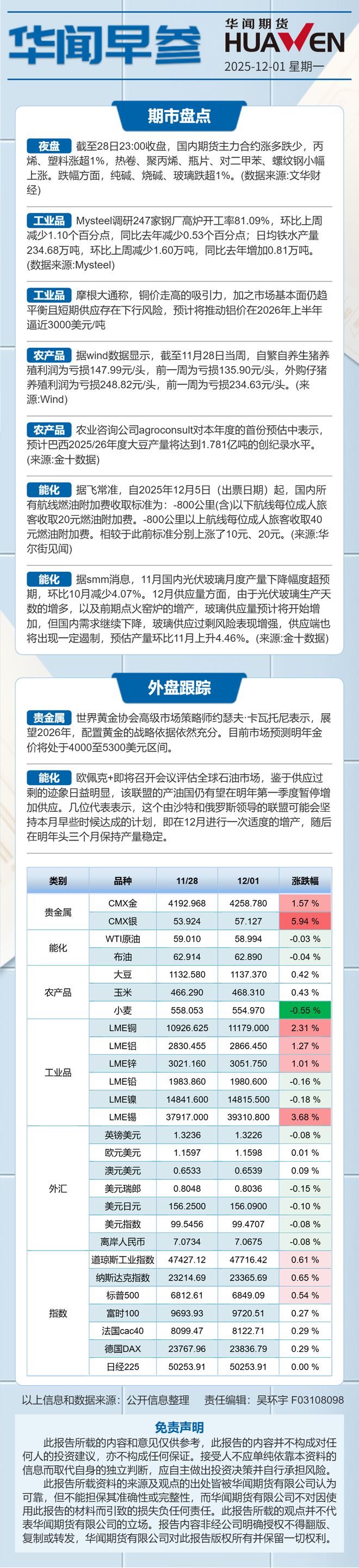
Group 1 - Domestic photovoltaic glass production decreased by 4.07% month-on-month in November, with expectations of a 4.46% increase in December due to more production days and increased output from previously ignited furnaces [2] - The demand for photovoltaic glass continues to decline, leading to heightened risks of oversupply in the market [2] Group 2 - The World Gold Council's senior market strategist Joseph Cavatoni indicates that the strategic rationale for allocating to gold remains strong, with market predictions for gold prices in 2024 expected to range between $4,000 and $5,300 [3] - OPEC+ is set to assess the global oil market, with indications of oversupply prompting member countries to likely maintain stable production levels in the first quarter of next year [3] Group 3 - Various commodities showed price fluctuations, with CMX gold rising by 1.57% to $4,258.78 and LME copper increasing by 2.31% to $11,179.00 [4] - The WTI crude oil price slightly decreased by 0.03% to $58.994, while Brent crude oil fell by 0.04% to $62.890 [4]

金价,大涨!
中国能源报· 2025-11-29 06:16
Group 1: Gold Market Insights - International gold prices increased by 4.3% in the past week, marking the fourth consecutive month of gains in November, driven by rising expectations of a Federal Reserve interest rate cut and a declining dollar index [1][7] - The main contract for New York gold futures rose by approximately 6.5% in November, supported by safe-haven buying and increased gold purchases by central banks globally [1][7] Group 2: Silver Market Performance - Silver prices saw a significant increase, with spot silver prices reaching over $56 per ounce, setting a new historical record, and New York silver futures for March delivery closing at $57.16, reflecting a 6.6% rise [6] Group 3: U.S. Stock Market Trends - The U.S. stock market showed stability on the last trading day of November, with major indices rising, as the Dow Jones increased by 0.61%, the S&P 500 by 0.54%, and the Nasdaq by 0.65% [2] - In November, the Nasdaq experienced a decline of 1.51%, while the Dow Jones and S&P 500 indices rose by 0.32% and 0.13%, respectively, marking their seventh consecutive month of gains [3] Group 4: European Market Developments - European stock indices rose across the board, buoyed by optimistic economic data, with the UK FTSE 100 up by 0.27%, France's CAC 40 by 0.29%, and Germany's DAX by 0.29% [4] Group 5: Oil Market Overview - International oil prices experienced a slight decline, marking the fourth consecutive month of decreases, with New York crude futures and Brent crude futures down by 3.98% and 2.87% respectively in November [5]

沥青月报:需求步入淡季,面临走弱的压力-20251128
Zhong Hang Qi Huo· 2025-11-28 11:19
Report Industry Investment Rating No relevant content provided. Core View of the Report - The asphalt market lacks upward drivers and is expected to continue its weak and volatile trend. The improvement of asphalt fundamentals is poorly anticipated, with the demand side entering a seasonal contraction phase and facing further downward pressure. The supply side has insufficient upward drivers, and the expectations of supply surplus and geopolitical easing suppress the market. The oil price is likely to continue wide - range fluctuations, and attention should be paid to the repeated changes in geopolitics. It is recommended to focus on the range of 2900 - 3150 yuan/ton for the BU2602 contract [6][56]. Summary by Directory 1. Market Review - In November, asphalt showed a unilateral downward trend under the combined influence of the cost side and fundamentals. Demand entered a seasonal contraction phase, some refineries sold spot forward contracts at low prices, and market sentiment was generally weak. The OPEC+ production increase and the rising expectation of geopolitical easing pressured oil prices, weakening cost - side support and intensifying the downward pressure on the market. The market currently lacks upward drivers, and with the seasonal decline in demand, fundamentals are difficult to improve effectively. The cost - side support is limited, and the market is expected to continue its weak and volatile trend [6]. 2. Macroeconomic Analysis - **OPEC+ Production Policy**: OPEC+ will increase production by 137,000 barrels per day in December and pause production increase in the first quarter of 2026. This move is expected to relieve supply pressure in the short term but has limited long - term impact. OPEC's latest monthly report shows that the global crude oil market is expected to shift from balance to surplus, with a surplus of 500,000 barrels per day, and the supply growth forecast of non - OPEC countries in 2025 has been raised by 110,000 barrels per day. The demand for OPEC's crude oil in 2026 has been lowered, indicating a pessimistic outlook on the demand side [9][10][13]. - **Fed's Interest Rate Policy**: Fed officials have made dovish statements, and the market's expectation of a 25 - basis - point interest rate cut in December has risen to 85%. The U.S. labor market shows a "split" situation, with employment exceeding expectations but the unemployment rate reaching a four - year high. The latest Fed "Beige Book" shows that the decline in consumer spending is the main drag on the U.S. economy, and the government "shutdown" has affected consumer decisions [11]. - **Geopolitical Situation**: The U.S. media disclosed a 28 - point peace plan to end the Russia - Ukraine conflict, which was later reduced to 19 points after discussions. Although the short - term expectation of geopolitical easing has increased, there are still significant differences between the two sides on key issues, and the oil price may fluctuate due to geopolitical changes [12]. 3. Supply - Demand Analysis - **Supply Side**: In October, China's asphalt production was 2.12 million tons, a month - on - month decrease of 500,000 tons. In November, the domestic refinery operating rate decreased month - on - month, mainly due to seasonal maintenance and the entry of terminal consumption into the off - season. The weekly data shows that the operating rate of asphalt sample enterprises is at a low level in recent years and is expected to decline further, alleviating supply pressure [15][22]. - **Demand Side**: In November, China's asphalt shipments decreased month - on - month. Road construction demand may further shrink, and winter storage demand remains highly uncertain. The utilization rate of modified asphalt production capacity decreased seasonally, and with the end of the demand peak season, it faces downward pressure [25][27]. - **Import and Export**: In October, asphalt imports were 391,000 tons, a month - on - month increase of 50,000 tons, and the import average price remained stable. Exports were 52,200 tons, a month - on - month decrease of 27,700 tons, and the export average price decreased slightly [32][38]. - **Inventory**: In November, the inventory of domestic sample enterprises decreased, but the decline rate was slower than in previous years. The social inventory of asphalt also decreased, but the decline rate slowed down, indicating weakening downstream demand [44][49]. - **Price Difference**: In November, the asphalt cracking spread declined, and the diluted profit of asphalt processing remained at a low level within the year. As asphalt is expected to continue its weak and volatile trend, the cracking spread may face further downward pressure [53].
新能源及有色金属日报:基本面积弱难返,镍不锈钢震荡下跌-20251128
Hua Tai Qi Huo· 2025-11-28 03:18
Group 1: Nickel Market Analysis - On November 27, 2025, the main contract 2601 of Shanghai nickel opened at 116,920 yuan/ton and closed at 116,900 yuan/ton, a change of -0.53% from the previous trading day's closing price. The trading volume was 97,221 (-79,345) lots, and the open interest was 127,765 (-503) lots [1]. - The main contract of Shanghai nickel showed a slight oscillating downward trend, failing to continue the rebound of the previous few days. The price closed below the 20 - day moving average, and the 20 - day moving average was downward, with a bearish technical outlook. After the macro - positive sentiment faded, the nickel price returned to the fundamental market [1]. - In the nickel ore market, the wait - and - see sentiment was strong, and the nickel ore price remained stable. In the Philippines, mines mainly fulfilled previous orders for shipment, and the shipping efficiency was okay. The downstream ferronickel price was weak, and the iron - making plants' profits were affected. They were cautious in purchasing nickel ore, and some plants had the intention to cut production to stop losses. In Indonesia, the domestic trade benchmark price in December (phase one) was expected to drop by 0.52 - 0.91 US dollars/wet ton. The domestic trade premium was in the range of +25 - 26, and there was room for it to decline due to the falling ferronickel price [1]. - Jinchuan Group's sales price in the Shanghai market was 121,200 yuan/ton, a decrease of 900 yuan/ton from the previous trading day. The overall spot trading was average, and the spot premiums of various refined nickel brands were adjusted downwards. Jinchuan nickel's premium remained at 4,650 yuan/ton, imported nickel's premium remained at 400 yuan/ton, and nickel beans' premium was 2,450 yuan/ton. The previous trading day's Shanghai nickel warehouse receipt volume was 33,548 (-396) tons, and the LME nickel inventory was 255,450 (+930) tons [2]. Group 2: Nickel Strategy - With high inventories and an oversupply situation remaining unchanged, the nickel price was expected to remain in a low - level oscillation. However, the current price was at a 5 - year low, and the downward space was limited. The recommended strategy was to focus on range trading, and there were no suggestions for inter - delivery, cross - variety, spot - futures, or option trading [3]. Group 3: Stainless Steel Market Analysis - On November 27, 2025, the main contract 2601 of stainless steel opened at 12,435 yuan/ton and closed at 12,410 yuan/ton. The trading volume was 126,697 (-24,902) lots, and the open interest was 122,062 (-4,171) lots [3]. - The main stainless - steel contract showed a slight oscillating downward trend, and its price movement basically followed that of Shanghai nickel. The stainless - steel fundamentals were still weak. The social inventory increased this week, rising 0.64% compared to last week to 946,000 tons. After the macro - positive factors were exhausted, the price was expected to continue to oscillate at a low level [3]. - Earlier this week, the trading volume improved due to the price rebound, but it weakened again yesterday when the price dropped. The stainless - steel price in the Wuxi market was 12,650 (+0) yuan/ton, and in the Foshan market was 12,650 (+0) yuan/ton. The premium of 304/2B was 325 - 525 yuan/ton. According to SMM data, the ex - factory tax - included average price of high - nickel pig iron decreased by 1.00 yuan/nickel point to 883.5 yuan/nickel point [3]. Group 4: Stainless Steel Strategy - Due to low demand, high inventories, and a continuous downward shift in the cost center, stainless steel was expected to remain in a low - level oscillation. The current price was at a 5 - year low, and the downward space was limited. The recommended strategy was neutral, and there were no suggestions for inter - delivery, cross - variety, spot - futures, or option trading [5].
新能源及有色金属日报:宏观利好频频,镍不锈钢价格反弹-20251127
Hua Tai Qi Huo· 2025-11-27 02:46
1. Report Industry Investment Rating - Not provided in the given content 2. Core Viewpoints of the Report - For the nickel market, due to high inventory and a persistent supply - surplus situation, nickel prices are expected to remain in low - level oscillations. However, as the current price is at a 5 - year low, the downside space is limited [1][2] - For the stainless - steel market, with weak demand, high inventory, and a continuously declining cost center, stainless - steel prices are also expected to stay in low - level oscillations. After the macro - level positive factors fade, there is a risk of price weakening. Similar to nickel, the current price is at a 5 - year low, so the downside space is limited [3][5] 3. Summary by Related Catalogs Nickel Variety Market Analysis - **Futures**: On November 26, 2025, the Shanghai nickel main contract 2601 opened at 116,500 yuan/ton and closed at 117,260 yuan/ton, a 0.97% change from the previous trading day's close. The trading volume was 176,566 (+60,128) lots, and the open interest was 128,268 (-12,947) lots. The price continued to rebound due to multiple macro - level positive factors, including the Fed's dovish signal, progress in Russia - Ukraine peace talks, and the domestic central bank's continuous net injection [1] - **Nickel Ore**: The nickel ore market is mostly in a wait - and - see state, with prices remaining stable. Philippine mines are mainly fulfilling previous orders, and the shipping efficiency is okay. Downstream nickel - iron prices are weak, squeezing iron - mill profits, so they are cautious about purchasing nickel ore. Some iron mills are considering production cuts. In Indonesia, the December (Phase I) domestic trade benchmark price is expected to drop by 0.52 - 0.91 dollars/wet ton, and the domestic trade premium is mainly at +26, with a range of +25 - 26. Overall, domestic trade prices of nickel ore will decline [1] - **Spot**: The sales price of Jinchuan Group in the Shanghai market is 122,100 yuan/ton, a 1,300 - yuan increase from the previous trading day. Due to the continuous rise in futures prices, the overall trading of refined nickel is average, and the spot premiums of various refined nickel brands are stable or declining. Jinchuan nickel's premium changes by 200 yuan/ton to 4,650 yuan/ton, imported nickel's premium changes by - 100 yuan/ton to 400 yuan/ton, and nickel beans' premium is 2,450 yuan/ton. The previous trading day's Shanghai nickel warehouse receipt volume was 33,944 (294) tons, and the LME nickel inventory was 254,520 (1038) tons [2] Strategy - Unilateral: Mainly conduct range operations - No strategies for inter - period, cross - variety, spot - futures, and options operations [2] Stainless - Steel Variety Market Analysis - **Futures**: On November 26, 2025, the stainless - steel main contract 2601 opened at 12,410 yuan/ton and closed at 12,455 yuan/ton. The trading volume was 151,599 (+1,313) lots, and the open interest was 131,410 (-4,171) lots. The price rebounded by 0.65% and closed above the 5 - day moving average but below the 20 - day moving average, with a weak medium - term trend. The recent rebound is driven by nickel prices and improved macro - level liquidity expectations, but the fundamental situation of strong supply and weak demand remains unchanged, and high inventory and cost collapse are still the main factors suppressing prices [2][3] - **Spot**: Affected by the continuous rebound of futures prices, spot trading has significantly improved today, and the quotes have slightly increased. The stainless - steel price in the Wuxi market is 12,650 (+25) yuan/ton, and in the Foshan market, it is 12,650 (+0) yuan/ton. The 304/2B premium is 270 - 470 yuan/ton. The ex - factory tax - included average price of high - nickel pig iron changed by - 2.50 yuan/nickel point to 884.5 yuan/nickel point [3][4] Strategy - Unilateral: Neutral - No strategies for inter - period, cross - variety, spot - futures, and options operations [5]
能源化策略:原油横盘整理,甲醇港??幅去库期价攀升
Zhong Xin Qi Huo· 2025-11-27 01:52
1. Report Industry Investment Rating No relevant content provided. 2. Core Views of the Report - The energy and chemical industry is expected to continue its weak and volatile trend, with olefins being weaker and aromatics showing a slightly stronger pattern [3]. - For crude oil, if the geopolitical support gradually weakens, it is expected to be in a weak and volatile state [8][9]. - For other products like asphalt, high - sulfur fuel oil, low - sulfur fuel oil, etc., they are mostly in a state of volatile trends, with specific outlooks varying according to their respective supply - demand and cost factors [3]. 3. Summary by Related Catalogs 3.1 Market Conditions and Views 3.1.1 Crude Oil - **View**: Geopolitical premium fluctuates, and supply pressure persists. If geopolitical support weakens, it is expected to be in a weak and volatile state [8][9]. - **Market News**: The number of active oil rigs in the US decreased significantly. US commercial crude oil inventory increased in the week of November 21, 2025. Trump loosened the deadline for the Russia - Ukraine peace talks, and the Ukrainian side denied agreeing to the US peace plan [8]. - **Main Logic**: The progress of the Russia - Ukraine issue continuously disturbs the geopolitical premium of crude oil. The increase in net imports led to an increase in crude oil inventory. The overall supply - surplus situation still exerts pressure on inventory accumulation [8][9]. 3.1.2 Asphalt - **View**: It oscillates around the key level of 3000 [10]. - **Main Logic**: OPEC+ is expected to increase production in December. The Venezuelan raw material supply may be disrupted. The futures pricing returns to the Shandong spot, and the spot price in Shandong has stabilized, supporting the futures price. However, the demand is in the off - season, and the inventory accumulation pressure is still large [10]. 3.1.3 High - Sulfur Fuel Oil - **View**: The futures price is in a weak and volatile state [3]. - **Main Logic**: OPEC+ is expected to increase production in December. The three driving forces supporting high - sulfur fuel oil are weakening. The refinery processing demand is weak, and the demand for fuel oil is still weak [10]. 3.1.4 Low - Sulfur Fuel Oil - **View**: The futures price is in a weak and volatile state [3]. - **Main Logic**: It follows the decline of refined oil products. Although it is supported by the decline in Russian refined oil exports, the overall demand is facing headwinds such as the decline in shipping demand and the substitution of green energy. The domestic supply pressure of refined oil products may be transmitted to low - sulfur fuel oil [13]. 3.1.5 Methanol - **View**: The production suspension progresses rapidly, and the futures price rises again [3]. - **Main Logic**: The Chinese methanol port inventory decreased. The Iranian device shutdown progressed rapidly. The domestic market was affected by multiple positive factors such as improved market sentiment, reduced port arbitrage, increased olefin external procurement demand, and tightened supply [31]. 3.1.6 Urea - **View**: The inventory significantly decreased, and the bullish sentiment is strong [3]. - **Main Logic**: Although the supply is at a high level and the demand is weak, the inventory decreased significantly, which promoted the futures price to rise slightly [32]. 3.1.7 Ethylene Glycol (MEG) - **View**: The price center is mainly adjusted in a wide range. Pay attention to the dynamics of oil - based devices [3]. - **Main Logic**: Currently, there is no further positive support on the supply - demand side. Some domestic coal - based devices are about to restart, but the downstream polyester demand still provides support [24][25]. 3.1.8 PX - **View**: The cost performance is average, and the efficiency is maintained under a good supply - demand pattern [3]. - **Main Logic**: International oil prices are oscillating weakly, and the cost support for PX is general. The downstream demand is at the transition point between the off - season and the peak season, and the polyester segment provides support for PX [16]. 3.1.9 PTA - **View**: The basis is strong, and the profit is slightly repaired [3]. - **Main Logic**: International oil prices are generally stable, and PX prices are relatively firm. The supply - demand of PTA has improved, and the downstream polyester load remains high. There is a possibility of phased inventory reduction in November - December [16][17]. 3.1.10 Short - Fiber - **View**: The downstream demand is temporarily maintained, and it passively follows the upstream [3]. - **Main Logic**: The upstream polyester cost fluctuates in a narrow range, and the downstream demand is expected to weaken. The short - fiber price follows the cost and oscillates [27][28]. 3.1.11 Bottle - Chip - **View**: The price fluctuation is limited, and the profit is in a stalemate [3]. - **Main Logic**: The upstream cost has a certain support for the polyester bottle - chip price, but the trading atmosphere has declined after the price increase, and the processing fee fluctuates in a narrow range [29]. 3.1.12 Propylene - **View**: The spot is strong, and PL oscillates [3]. - **Main Logic**: The supply restart is delayed, the overall supply is tight, the enterprise inventory is controllable, and the downstream follow - up is active [37]. 3.1.13 PP - **View**: The fundamental pressure still exists, and it is necessary to pay attention to the changes in maintenance [3]. - **Main Logic**: Oil prices are oscillating and falling. The fundamental support for PP is limited, the production release pressure is large, and the inventory in the middle reaches is at a high level. The focus is on the changes in maintenance [36]. 3.1.14 Plastic - **View**: Oil prices decline, the maintenance support is limited, and it oscillates weakly [3]. - **Main Logic**: Oil prices are in a weak and volatile state. The fundamental support for plastics is limited, the upper - middle reaches have the intention to reduce inventory, and the demand is gradually entering the off - season [34][35]. 3.1.15 Styrene - **View**: The narrative of blending for oil fades, and it returns to oscillation [3]. - **Main Logic**: The driving force of blending for oil is questionable, and after the premium is squeezed out, the downward space is limited. The supply - demand contradiction in December - January is not significant [22]. 3.1.16 PVC - **View**: High inventory suppresses, and PVC may anchor production reduction [3]. - **Main Logic**: The macro - level policies in December may affect market expectations. At the micro - level, the high inventory of PVC is difficult to reduce, and attention should be paid to whether low profits can lead to enterprise production reduction [38]. 3.1.17 Caustic Soda - **View**: It operates in a weak supply - demand and low - valuation state with oscillation [3]. - **Main Logic**: At the macro - level, pay attention to the influence of the Politburo meeting and the Fed's interest - rate decision in December. At the micro - level, the supply - demand of caustic soda is expected to be poor, and attention should be paid to whether low profits can promote upstream production reduction [38]. 3.2 Variety Data Monitoring 3.2.1 Energy and Chemical Daily Indicator Monitoring - **Inter - period Spreads**: Data on inter - period spreads of various products such as Brent, Dubai, PX, PP, etc. are provided, showing their latest values and changes [41]. - **Basis and Warehouse Receipts**: Information on the basis and warehouse receipts of products like asphalt, high - sulfur fuel oil, low - sulfur fuel oil, etc. is presented, including their latest values and changes [42]. - **Inter - variety Spreads**: Data on inter - variety spreads, such as 1 - month PP - 3MA, 1 - month TA - EG, etc., are given, along with their latest values and changes [44]. 3.2.2 Chemical Basis and Spread Monitoring No specific content other than the product names (methanol, urea, styrene, etc.) is provided for detailed analysis. 3.3 Commodity Index - **Comprehensive Index**: The commodity index, commodity 20 index, and industrial product index all showed slight increases, while the PPI commodity index decreased slightly [285]. - **Sector Index**: The energy index showed a decline, with a daily decline of 0.36%, a 5 - day decline of 2.23%, a 1 - month decline of 4.55%, and a year - to - date decline of 9.17% [286].
摩根大通:严重供应过剩或将在2027年将油价打压至30美元
Hua Er Jie Jian Wen· 2025-11-27 00:17
Core Viewpoint - Morgan Stanley predicts that due to severe supply surplus, Brent crude oil prices may drop to the $30 range by 2027, highlighting significant supply-demand imbalance in the global energy market [1] - Goldman Sachs advises investors to short oil immediately, forecasting that WTI crude oil prices will average $53 per barrel in 2026 due to a daily supply surplus of 2 million barrels [2] Supply and Demand Dynamics - Major investment banks indicate that large-scale supply from OPEC+ and non-OPEC producers in the Americas continues to flood the market, contributing to downward price pressure [1] - Different institutions provide varying timelines for market rebalancing, with Morgan Stanley suggesting that Brent crude could fall to $30 by 2027, while Goldman Sachs believes the market may rebalance by 2027 after a final wave of supply in 2026 [3] Geopolitical Factors - Recent diplomatic talks between the U.S. and Ukraine may ease geopolitical tensions, potentially leading to a relaxation of sanctions against Russia, which could further increase supply pressure in an already oversupplied market [4] - Analysts are closely monitoring the developments of these negotiations, as a peace agreement could allow more Russian energy supplies to enter the global market [4]


承认储能需求超预期,但高盛依旧“中期看跌”锂价
Hua Er Jie Jian Wen· 2025-11-25 03:34
Core Insights - Goldman Sachs acknowledges a significant shift in the lithium market due to the explosive growth in energy storage system (ESS) demand, leading to a tighter short-term supply-demand balance, while the medium-term oversupply scenario remains unchanged [1][2]. Group 1: Short-term Market Dynamics - The price of lithium carbonate in China surged from $9,200 per ton in mid-September to over $11,000 per ton, prompting Goldman Sachs to revise its 2026 price forecast and delay the anticipated price correction to the second half of 2026 [1][2]. - The demand model for ESS has been significantly adjusted, with forecasts for ESS consumption in 2025 and 2026 raised to 589 GWh and 736 GWh, respectively, nearly doubling previous estimates [2]. Group 2: Long-term Supply Outlook - Despite the optimistic short-term outlook, Goldman Sachs maintains a bearish medium-term view, predicting a return to oversupply by 2027, with supply exceeding demand by 18% unless producers cut back on capacity expansion plans [1][3]. - The report anticipates that lithium prices will decline from $11,000 per ton in the first half of 2026 to $9,500 per ton in the second half, driven by increased supply from lithium spodumene and the resumption of lithium mica production [3]. Group 3: Price Projections - Goldman Sachs projects an average price of $10,250 per ton for 2026, which remains below CME futures prices, indicating a potential over-optimism in the current market [3]. - For 2027-2028, prices are expected to remain below the estimated incentive price range of $10,200 to $11,000 per ton, necessitating supply cuts to prevent excessive inventory accumulation [3].