
流动性

Search documents
量化资产配置月报202601:经济指标出现转弱,PPI关注度维持最高-20260104
Shenwan Hongyuan Securities· 2026-01-04 14:44
Group 1 - The report indicates a shift towards a weaker economic outlook, with liquidity remaining slightly loose and credit indicators showing slight improvement. The macro dimensions suggest a continued trend of weak economy, loose liquidity, and credit contraction [2][8][14] - The asset allocation strategy emphasizes high dividend and low volatility configurations, focusing on factors that are insensitive to economic and credit conditions. The top scoring factors are centered around profitability and dividends, with significant improvements in dividend scores [5][9][30] - The report maintains a high allocation to gold, suggesting a 20% upper limit due to ongoing momentum, while bond views have improved but remain low due to other asset influences [2][27] Group 2 - Economic forward indicators are trending weak, entering the initial phase of a decline since December 2025, with expectations of continued downward movement. Key indicators such as PMI and retail sales are in a downward cycle [14][19] - Liquidity conditions have returned to a slightly loose state, with interest rates stabilizing and short-term rates slightly declining, indicating a shift back to a neutral signal [21][24] - Credit indicators show slight improvement in social financing year-on-year, although the structure of loans to households and enterprises has decreased, indicating a preference in credit indicators [25][26] Group 3 - The market focus remains on PPI, which has surpassed economic indicators in attention, highlighting market concerns regarding future demand recovery [28][29] - Industry selection is biased towards weak cyclical sectors, with top scoring industries including computer and food and beverage sectors, which are less sensitive to economic and credit fluctuations [30][31]
国联民生宏观:人民币交易指南2026
Xin Lang Cai Jing· 2026-01-04 09:37
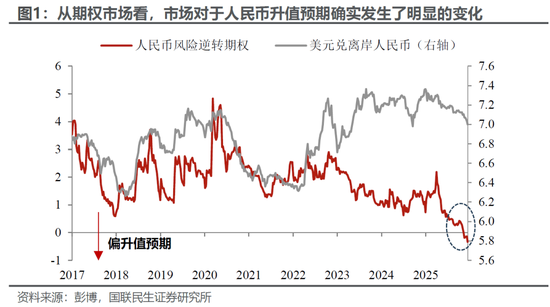
Core Viewpoint - The RMB exchange rate is expected to trend back to the "6" range in 2026, which could significantly impact the economy, policies, and market logic, marking a shift from 2025 when the exchange rate expectations began to change [1][44]. Group 1: RMB Exchange Rate Assessment - Evaluating whether the RMB is overvalued or undervalued is complex and can yield different conclusions based on various dimensions [3][46]. - The financial market and asset price dimensions suggest that the current appreciation of the RMB may be reasonable, as the US dollar index has dropped over 10% since its peak in January 2025 [3][46]. - The narrowing of the 2-year China-US interest rate differential by approximately 110 basis points since the beginning of the year indicates a decrease in the attractiveness of the RMB as a financing currency [4][47]. Group 2: Trade Dimension - The trade perspective supports the argument for RMB undervaluation, especially given China's strong export performance in recent years [7][51]. - The RMB exchange rate index remains at a relatively low level compared to recent years, despite its appreciation against the US dollar [7][51]. - There is a positive correlation between RMB depreciation and the expansion of bilateral surplus shares, indicating that trade dynamics are closely linked to exchange rate movements [7][51]. Group 3: Inflation Impact - The significant gap between the nominal effective exchange rate and the real effective exchange rate since 2022 reflects lower domestic inflation compared to global levels [11][54]. - The real exchange rate is a crucial indicator of a country's export price competitiveness, with lower real exchange rates generally favoring exports [15][58]. - Maintaining a stable real effective exchange rate while allowing for slight nominal depreciation could help avoid unnecessary trade frictions and manage surpluses effectively [15][58]. Group 4: Central Bank's Role in Exchange Rate Management - Historical patterns suggest that the RMB may experience significant appreciation during periods of US dollar depreciation, with the central bank likely to intervene to maintain stability [17][25]. - The central bank's approach to managing the exchange rate involves a balance of maintaining stability while allowing for necessary adjustments based on market conditions [17][27]. - The central bank has been gradually increasing its efforts to manage the RMB's appreciation, particularly in response to rapid increases in the exchange rate [25][27]. Group 5: Market Impact of Exchange Rate Changes - The market has adapted to the constraints imposed by RMB depreciation on monetary policy and liquidity, with expectations of a shift in sentiment during periods of appreciation [31][33]. - Generally, a normal appreciation of the RMB is associated with economic growth, positively impacting the stock market while potentially putting pressure on the bond market [35][36]. - In contrast, during periods of excessive appreciation, the stock market may underperform due to negative economic impacts, while the bond market could benefit [36][37].


Bitcoin 2026: Early Signs Point to a Liquidity-Led Rebound
Yahoo Finance· 2026-01-03 04:14
As 2025 came to a close, subtle changes in Federal Reserve activity started to catch the attention of traders watching both macro markets and crypto. Unusual moves in short-term funding and a series of quiet policy adjustments suggested that liquidity pressures might be easing. For some observers, that raised the possibility that Bitcoin could start moving higher before traditional markets show clearer signs of recovery in 2026. A Tense Year-End in Short-Term Funding On December 31, 2025, banks drew a r ...
宏观金融数据日报-20251231
Guo Mao Qi Huo· 2025-12-31 03:50
Report Summary 1. Report Industry Investment Rating - Not provided in the given content. 2. Core Viewpoints - In the short - term, the stock index is expected to remain relatively strong as it broke through the previous oscillation range last week. In 2026, the rapid rise phase driven by liquidity and market risk preference may have ended, and the A - share "slow - bull" pattern is entering the second half. With macro - policy support, inflation warming, and capital market policy guidance, the stock index is expected to rise further in 2026 compared to 2025. Futures traders can use the futures discount structure to enhance the winning rate of long - position strategies [6]. 3. Summary by Relevant Catalogs Interest Rates and Bond Markets - DR001 closed at 1.24 with a - 0.21bp change, DR007 at 1.69 with a 9.30bp change, GC001 at 2.04 with a 20.00bp change, and GC007 at 2.05 with a 2.50bp change. SHBOR 3M was at 1.60 with no change, and LPR 5 - year was at 3.50 with no change. The 1 - year, 5 - year, and 10 - year Chinese government bonds were at 1.34, 1.61, and 1.86 respectively, with changes of 0.50bp, 1.25bp, and 0.20bp. The 10 - year US Treasury bond was at 4.12 with a - 2.00bp change [3]. - The central bank conducted 4823 billion yuan of 7 - day reverse repurchase operations with an operating rate of 1.40% yesterday. With 673 billion yuan of reverse repurchases maturing, the net investment was 4150 billion yuan. This week (December 29, 2025 - January 4, 2026), 6227 billion yuan of reverse repurchases will mature [3][4]. Stock Indexes and Futures - The closing prices and changes of major stock indexes: the CSI 300 rose 0.26% to 4651, the SSE 50 rose 0.06% to 3037, the CSI 500 rose 0.38% to 7459, and the CSI 1000 rose 0.04% to 7597. The trading volume of the Shanghai and Shenzhen stock markets was 21426 billion yuan, a slight increase of 33 billion yuan. Industry sectors showed more declines than increases [5][6]. - The trading volume and position changes of stock index futures: IF volume was 94429 with a - 1.8% change, and its position was 281129 with a 1.9% change; IH volume was 41166 with a 4.2% change, and its position was 88407 with a 1.3% change; IC volume was 117475 with a 4.2% change, and its position was 288847 with a 4.7% change; IM volume was 163327 with a 2.3% change, and its position was 372661 with a 3.0% change [5]. - The current, next - month, current - quarter, and next - quarter contracts of IF had an average premium of 3.55%, 3.21%, 2.85%, and 3.36% respectively; IH had 0.81%, 0.73%, 0.17%, and 0.71% respectively; IC had 0.50%, 3.91%, 4.77%, and 7.38% respectively; IM had 0.99%, 7.14%, 8.29%, and 10.38% respectively [7].
史海钩沉系列:“亲历”一次科网泡沫,我们能学到什么?
Minsheng Securities· 2025-12-31 00:42
Market Overview - The tech bubble from 1995 to 2000 was driven by technological advancements, macroeconomic changes, regulatory relaxations, and shifts in monetary policy frameworks[6] - The NASDAQ Composite Index peaked at 5048.62 on March 10, 2000, before a significant sell-off began due to external economic shocks[9] Economic Factors - Labor productivity in the U.S. increased significantly during this period, breaking the long-standing relationship of "low unemployment and high inflation" and contributing to economic resilience[6] - The rapid increase in productivity led to a contraction of the output gap, with inflation remaining subdued despite declining unemployment rates[17] Monetary Policy - The Federal Reserve, under Alan Greenspan, adopted a technology-friendly monetary policy framework, maintaining low interest rates to support economic growth while being cautious about inflation[22] - The Fed's approach evolved to focus on maintaining overall price stability and managing the consequences of asset bubbles rather than attempting to burst them[23] Investment Trends - The number of tech IPOs surged from 1995, peaking in 1999, reflecting a growing investor appetite for technology stocks[9] - In 1998 and 1999, tech stocks experienced a significant rally, with the information technology sector showing returns of 77.64% and 78.44% respectively[32] Risk Factors - The report highlights that excessive liquidity and regulatory relaxation were common characteristics of bubbles, with the potential for chaotic leverage expansion being a critical concern[6] - The experience of the tech bubble serves as a cautionary tale, emphasizing that historical patterns cannot be solely relied upon for future investment decisions[2]
流动性跟踪与地方债策略专题:怎么看年初超长债供给?
Guolian Minsheng Securities· 2025-12-30 11:21
Group 1 - The report highlights that the liquidity remains ample as of late December 2025, with bank lending exceeding 60 trillion yuan, and key rates such as DR001 and R001 showing narrow fluctuations [10][24][39] - The People's Bank of China emphasizes a monetary policy focused on expanding domestic demand and optimizing supply, indicating a potential alignment with fiscal debt issuance in 2026 [11][24] - The report notes a significant increase in the issuance of long-term local government bonds, particularly 30-year bonds, which have improved liquidity and attracted institutional investors [18][20][39] Group 2 - The analysis of government debt issuance reveals that national bonds follow a strict issuance plan, while local bonds have more flexible issuance schedules, leading to discrepancies between planned and actual issuance [20][39] - The report outlines that local government bonds are primarily aimed at debt replacement, with average costs decreasing by over 2 percentage points in many regions, thus alleviating repayment pressures [21][39] - The planned issuance of local government bonds for Q1 2026 totals 1.61 trillion yuan, with a focus on potentially reducing the supply of 30-year bonds in favor of shorter maturities [22][39] Group 3 - The report indicates that the net financing from local government bonds was negative in recent weeks, highlighting the need for careful monitoring of future issuance strategies [42][39] - The analysis of the interbank market shows that the demand for short-term bonds remains strong, with significant net purchases observed in the secondary market [48][39] - The report suggests that the pricing of long-term bonds may not be attractive currently, with better value found in shorter maturities, reflecting market dynamics [49][39]
金价跌至每盎司 4346 美元,白银跌幅一度逼近 9%,为何国际金、银价格会大幅下跌?
Sou Hu Cai Jing· 2025-12-30 01:32
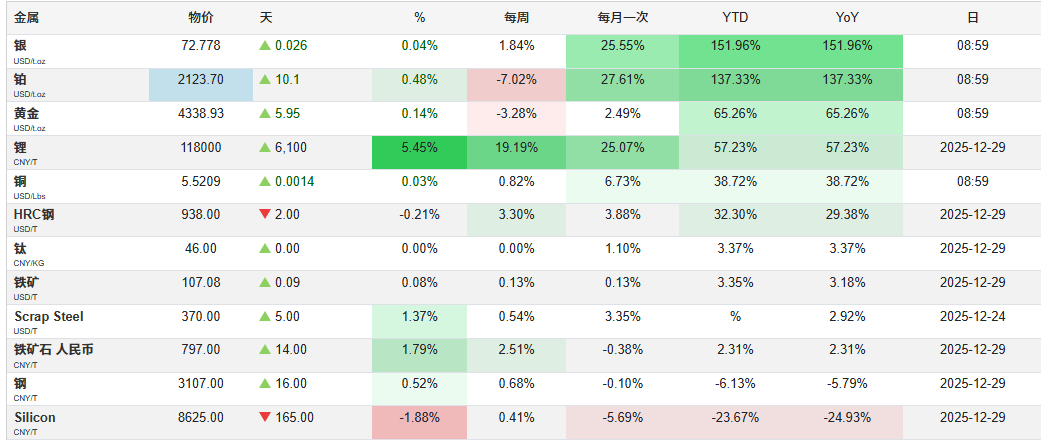
Core Insights - The article discusses the recent surge in precious metal prices and its impact on the real economy, particularly the consumer and manufacturing sectors, highlighting a disconnect between market sentiment and actual demand [1] - It emphasizes that the current trading environment is driven by emotions rather than logic, leading to extreme price volatility and potential market corrections [1] Group 1: Market Dynamics - The precious metals market is experiencing a speculative bubble, with significant price increases that are not supported by fundamental supply and demand metrics [7] - Regulatory measures, such as increased margin requirements by major exchanges, have triggered a forced deleveraging in the market, contributing to recent price declines [6] - Market rumors, particularly regarding the financial stability of major banks, have exacerbated volatility and led to panic selling among investors [11] Group 2: Economic Indicators - The article notes that while precious metals like silver and gold have seen substantial price increases (silver up 173% and gold up over 71% in 2025), the actual industrial demand growth for silver is only 15% [7] - There is a persistent supply shortage in the silver market, with a cumulative supply gap approaching 25,500 tons from 2021 to 2025, indicating that the fundamental demand remains strong despite price corrections [12] - The macroeconomic environment is shifting, with changing expectations around Federal Reserve interest rate policies impacting the attractiveness of precious metals as safe-haven assets [12]
——流动性周报12月第5期:中证A500持续净流入,解禁规模抬升-20251229
Guohai Securities· 2025-12-29 11:05
Group 1 - The overall macro liquidity environment is balanced and slightly loose, with the central bank conducting a net withdrawal of 34.8 billion yuan through 7-day reverse repos and a net injection of 100 billion yuan via medium-term lending facilities, resulting in a total net injection of 65.2 billion yuan for the week [4][10][11] - The stock market's funding supply is generally recovering, with a significant increase in equity fund issuance and a slight recovery in financing balances, indicating an uptick in leveraged capital participation [5][12] - The stock ETF saw a net inflow of 35.441 billion yuan, with significant inflows into broad-based ETFs like the CSI A500 and CSI 500, while the CSI 300 experienced net outflows [14][18] Group 2 - The stock market's funding demand has shown significant pressure from capital outflows, with equity financing rising to 20.752 billion yuan, driven by a substantial increase in private placements [20][21] - The scale of locked-up shares being released has surged to 192.836 billion yuan, indicating increased market pressure, particularly in sectors like power equipment and non-bank financials [21][26] - The net reduction in holdings by major shareholders has increased to 14.661 billion yuan, with notable reductions in the electronics and power equipment sectors [21][27]
高频半月观:关注4大变化
GOLDEN SUN SECURITIES· 2025-12-29 04:33
Group 1: Currency and Policy Changes - The offshore RMB exchange rate surpassed the 7 mark for the first time in 15 months on December 25, 2025, indicating a continuous appreciation since mid-October[1] - The central bank is expected to implement a reserve requirement ratio (RRR) cut and interest rate reduction in Q1 2026, alongside the introduction of more structural tools[1] Group 2: Real Estate and Sales Trends - The average weekly land transaction area in 100 cities increased by 102.8% month-on-month in December, although it remains at a five-year low with a year-on-year decline of 3.4%[1] - New home sales in 30 major cities saw a month-on-month increase of 45.8%, with a year-on-year decline narrowing to 25.6%[3] - Second-hand home sales in 18 key cities increased by 13.7% month-on-month, with a year-on-year decline of 22.7%[3] Group 3: Supply Chain and Production - The operating rate of blast furnaces decreased by 1.0 percentage points to 78.4%, while the operating rate of coking enterprises fell by 2.4 percentage points to 66.1%[2] - The operating rate of asphalt plants increased by 1.6 percentage points to 29.5%, and cement dispatch rates rose by 0.3 percentage points to 31.6%[2] Group 4: Commodity Prices - Prices for copper, rebar, and coking coal have risen, with LME copper prices increasing by 2.7% month-on-month and a year-on-year increase of 33.8%[5] - Brent crude oil prices fell by 2.7% month-on-month, with a year-on-year decline of 17.2%[4] Group 5: Inventory and Logistics - Energy inventories, including coal at coastal power plants, decreased by 1.8% month-on-month, while U.S. crude oil and petroleum product inventories fell by 525,000 barrels to 1.687 billion barrels[6] - The Baltic Dry Index (BDI) fell by 20.6% month-on-month, while the China Containerized Freight Index (CCFI) rose by 1.7%[7]
金属周期品高频数据周报(2025.12.22-12.28):热卷库存处于5年同期最高水平-20251228
EBSCN· 2025-12-28 13:09
Investment Rating - The report maintains an "Overweight" rating for the steel and non-ferrous metals sectors [5] Core Insights - The report highlights that hot-rolled inventory is at its highest level for the same period in five years, indicating potential supply chain pressures [41] - The liquidity environment is characterized by a historical high in gold prices, with the London gold spot price reaching $4,533 per ounce [11] - The report notes a decline in construction activity, with national real estate new starts down 20.50% year-on-year for the first 11 months of 2025 [20] Summary by Relevant Sections Liquidity - The BCI small and medium enterprise financing environment index for December 2025 is at 47.15, down 10.19% month-on-month [11] - The M1 and M2 growth rate difference was -3.1 percentage points in November 2025, a decrease of 1.10 percentage points month-on-month [18] - The current London gold price is $4,533 per ounce, reflecting a 4.41% increase from the previous week [11] Infrastructure and Real Estate Chain - Hot-rolled inventory is at the highest level for the same period in five years, with rebar prices down 1.20% this week [41] - The national high furnace capacity utilization rate is at 85%, unchanged from the previous week [10] - The cement price index has decreased by 0.49% this week, with a national cement utilization rate of 30.14%, down 0.9 percentage points [59] Industrial Chain - The national semi-steel tire operating rate is at 72.05%, up 0.66 percentage points week-on-week [2] - The price of tungsten concentrate has reached a new high since 2012, at 460,500 yuan per ton, up 6.35% from last week [2] - The price of electrolytic aluminum is 22,060 yuan per ton, reflecting a 1.01% increase week-on-week [10] Price Relationships - The price difference between hot-rolled and rebar has turned positive, with the current difference at 10 yuan per ton [3] - The price ratio of rebar to iron ore is 4.02 this week [3] - The price of stainless steel hot-rolled and electrolytic nickel has a ratio of 0.10 [3] Export Chain - The new export orders PMI for China in November is 47.60%, an increase of 1.7 percentage points month-on-month [3] - The CCFI composite index for container shipping rates is at 1,146.67 points, up 1.95% week-on-week [3] - The U.S. crude steel capacity utilization rate is at 75.30%, down 1.20 percentage points from the previous week [3] Valuation Metrics - The CSI 300 index increased by 1.95%, with the chemical sector performing best at +4.23% [4] - The PB ratio for the steel sector relative to the CSI 300 is currently at 0.50, with a historical high of 0.82 [4] - The report suggests that the steel sector's supply may be reasonably constrained, leading to potential recovery in profitability to historical average levels [4]