AI投资

Search documents
A股开盘速递 | A股集体高开 沪指涨0.01% 贵金属板块延续强势
智通财经网· 2025-12-24 01:39
Group 1 - The A-share market opened higher with the Shanghai Composite Index up 0.01% and the ChiNext Index up 0.07%, driven by strong performance in precious metals and active semiconductor stocks [1] - Guojin Securities anticipates a window period in 2026, favoring investments in industrial resource products that benefit from AI and global manufacturing recovery, including copper, aluminum, tin, lithium, crude oil, and oil transportation [1] - The firm also highlights opportunities in consumer sectors such as aviation, hotels, duty-free, and food and beverage, alongside non-bank financials like insurance and brokerage benefiting from market expansion [1] Group 2 - Xinda Securities suggests a likely spring rally before the 2026 Spring Festival, with a focus on non-bank financials, electric equipment, and machinery, despite current market adjustments [2] - The firm notes that the foundation for a bull market remains solid, with potential for profit improvement and capital inflow, although external uncertainties persist [2] - The past year's market transition from bear to bull has been significantly influenced by policy and capital rather than earnings [2] Group 3 - Dongfang Securities indicates that the market is currently in a consolidation phase with reduced trading volume, and while there is a slight rebound, upward momentum is limited [3] - The Shanghai Composite Index is expected to fluctuate around the 3900-point mark, with trend opportunities awaiting positive signals [3]



英伟达大涨,金、银、铜齐创新高
Zhong Guo Zheng Quan Bao· 2025-12-24 00:14
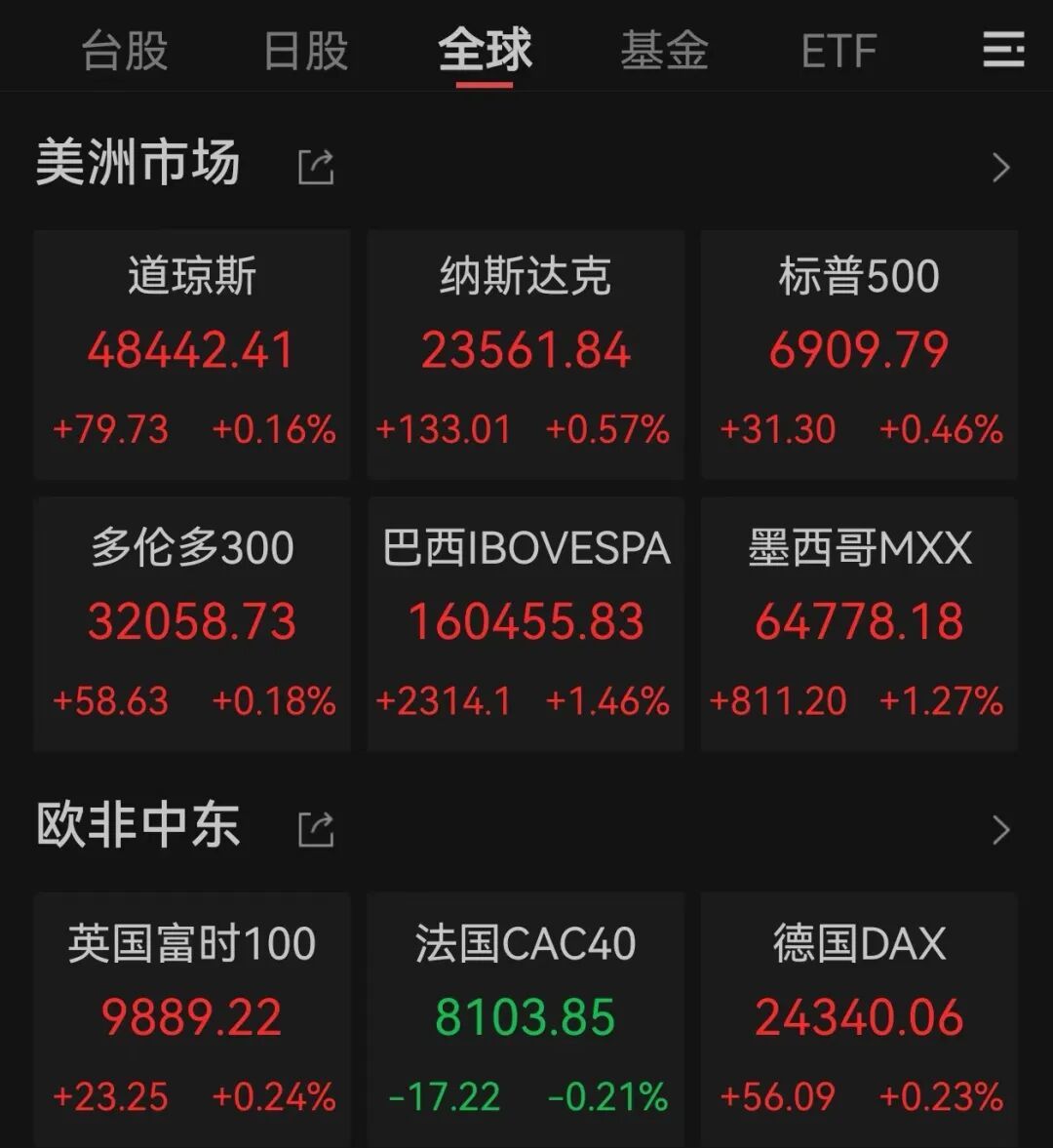
当地时间12月23日,美股三大指数集体小幅上涨,其中标普500指数收盘价创历史新高。大型科技股多数上涨,万得美国科技七巨头指数涨1.18%,英伟 达涨超3%,亚马逊、谷歌涨超1%。 大宗商品方面,国际市场金、银、铜价携手创下历史新高,其中伦敦现货黄金价格最高逼近4500美元/盎司,伦敦现货白银价格最高至71.575美元/盎司, LME期铜最高触及12159.5美元/吨。铂金、钯金价格全线大涨,现货铂金价格最高报2295.7美元/盎司,逼近2008年3月创下历史最高纪录,纽约铂金期货 涨逾10%,现货钯金创近三年来新高,纽约钯金期货涨超7%。 标普500指数收盘价创历史新高 当地时间12月23日,美股三大指数均小幅收涨。Wind数据显示,截至收盘,道指涨0.16%,纳指涨0.57%;标普500指数涨0.46%,收盘价创下历史新高。 大型科技股多数上涨,万得美国科技七巨头指数涨1.18%。个股方面,英伟达涨超3%,亚马逊、谷歌涨超1%。 | A A J T RE B A R F S TO MAGS | | | | --- | --- | --- | | 67094.94 780.59 1.18% | | | | ...


年终排名进入倒计时 基金冠军提前落定 硬科技成夺冠关键
Xin Lang Cai Jing· 2025-12-23 23:14
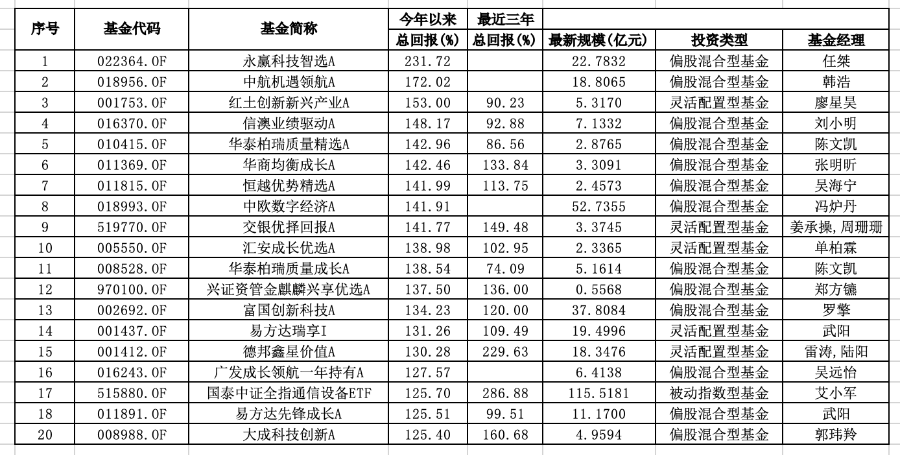
Core Viewpoint - The A-share market is experiencing a slow upward trend, driven primarily by the technology growth sector, benefiting from advancements in AI technology and the recovery of the new energy industry [1][6] Group 1: Fund Performance - Over 90% of active equity funds achieved positive returns this year, with more than 50 funds doubling their net value [1][2] - The top-performing fund, Yongying Technology Smart Mixed Fund, has a return of 231.72%, leading the second-place fund by nearly 50 percentage points [2][3] - The average return for active equity funds exceeds 20%, with a median return of 9.54% across all funds [2][5] Group 2: Investment Focus - Most high-performing active equity funds are heavily invested in the technology sector, with top holdings in companies like Xinyisheng and Zhongji Xuchuang [3] - The investment outlook for 2026 suggests a continuation of the technology trend, with a more balanced market style expected [6][7] - AI applications are anticipated to be a significant investment theme in 2026, alongside opportunities in cyclical and consumer sectors [6][7] Group 3: Regulatory Changes - New guidelines for fund performance assessment emphasize long-term performance, requiring that at least 80% of performance indicators focus on returns over three years [4][5] - This regulatory shift aims to address the industry's tendency to prioritize scale over returns, promoting a focus on long-term profitability [4]
年终排名进入倒计时!基金冠军提前落定,硬科技成夺冠关键
2 1 Shi Ji Jing Ji Bao Dao· 2025-12-23 11:21
Group 1 - The core viewpoint of the article highlights the strong performance of public funds in the A-share market, particularly in the technology growth sector, driven by advancements in AI and the recovery of the new energy industry [1][3] - Over 90% of actively managed equity funds achieved positive returns this year, with more than 50 funds doubling their net value, led by Yongying Technology Smart A with a remarkable return of 231.72% [1][3] - The market outlook for 2026 remains optimistic, with expectations that AI investment opportunities will continue to expand into new technologies and trends, while the technology sector is anticipated to remain a key market driver [1][7] Group 2 - The top-performing funds this year include Yongying Technology Smart A, which leads with a return of 231.72%, followed by China Aviation Opportunity Leading A at 170.02% and Hongtu Innovation Emerging Industry A at 153.00% [2][3] - The majority of high-performing actively managed equity funds have significant holdings in the technology sector, indicating a strong focus on tech stocks among successful funds [4] - The regulatory framework is shifting towards emphasizing long-term performance, with new guidelines requiring that at least 80% of performance evaluation metrics for fund managers focus on long-term returns [5][6] Group 3 - The market is expected to adopt a more balanced and refined style in 2026, with opportunities in cyclical and consumer sectors as industrial price deflation pressures ease [7][8] - The technology sector is projected to remain a dominant theme, with companies that possess real technological barriers and commercialization capabilities likely to attract market interest [7][8] - The outlook for the bond market suggests narrow fluctuations, with a focus on trading opportunities, while industrial metals and gold are highlighted as key commodities to watch [8]
聊两句量化基金
Sou Hu Cai Jing· 2025-12-23 04:26
我之前写过不少宏观经济的文章,但从来没有聊过股市。我自己有一个货币银行学的博士学位,多少算有点相关知识。投资方面,创业之前,做过三四年风 险投资,踩过很多坑,也算赚到过钱。不过我在股市上表现就很一般了,特别是A股。 多年之前我也买过A股,算没亏钱,但也没赚钱。后来觉得A股太复杂,因素太多,我自己的水平不行。后来我对A股的投资,就全部放到我朋友的量化基 金,一多半配置指数增强,一小半配置中性。 我的要求也不高,中性要求比银行存款利息每年多赚五个点,指数增强比对标指数每年多赚十个点就行了。到目前为止超额完成目标,长期平均年化回报 15%-20%,比我当年自己做的好多了。 我这个朋友老杨去美国拿了个数学博士,但没有搞数学研究。他当年的偶像是格罗腾迪克,梦想证明费马大定理。他说格罗腾迪克最NB的就是造出了一套 神奇到极限的理论框架,证明了好多很牛的数学定理, 费马大定理只是其中一个。我的数学水平已经倒退到了高中,给我讲数学,完全听不懂。不过读完 博士之后他也没搞学术,反而开始做股票。 我自己在北大物理系读完大一就发现自己不是搞研究的那块儿料,果断转系放弃。老杨醒悟得有点晚。 老杨吹牛说自己靠信用卡套现了两万美元起家, ...

野村:2026年全球经济有望强劲增长 预计美联储将额外降息两次
Sou Hu Cai Jing· 2025-12-22 12:06
Core Viewpoint - Nomura's 2026 Global Economic Outlook report expresses optimism for the global economy, driven by AI-led investment and supportive monetary and fiscal policies [1] Group 1: Economic Growth Projections - The U.S. is projected to have a real GDP growth rate of 2.4% in 2026, supported by easing labor supply pressures and accelerated AI-driven business investments [1] - AI infrastructure investments are expected to contribute approximately 1% to 1.5% growth to the U.S. economy annually [1] - The unemployment rate in the U.S. is anticipated to decline to 4.0% in 2026, lower than the Federal Reserve's or market's expectations [1] Group 2: Inflation and Monetary Policy - U.S. inflation is expected to remain sticky, averaging closer to 3% throughout 2026, with a significant decline only anticipated in the fourth quarter [1] - The current interest rate cut cycle by the Federal Reserve is considered over, with two additional rate cuts expected in 2026, bringing the federal funds rate down to 3.125% by September [2] Group 3: Regional Economic Outlook - Europe is projected to maintain a GDP growth rate of 1.25% in 2026, with the European Central Bank expected to keep its policy unchanged [2] - Asia's GDP growth is forecasted to average 3.6% in 2026, supported by strong tech product exports and rising storage chip prices [2] - Economic growth in Asia will show divergence, with countries like South Korea, Singapore, Malaysia, and India likely to exceed market expectations, while Thailand and the Philippines may underperform [2] Group 4: AI and Commodity Markets - Concerns about an "AI bubble" are acknowledged, with the focus on whether investments in AI will yield reasonable returns [3] - The AI investment trend is expected to continue into 2026, with significant initial investments and the importance of first-mover advantages [3] - Various commodities, including precious metals and agricultural products, are anticipated to perform strongly in 2026, driven by increasing demand [3]
生产端有所收敛
HTSC· 2025-12-22 11:16
Group 1: Core Viewpoints - In the third week of December, the real - estate transaction heat slightly recovered, but the overall situation of new and second - hand houses was weak, and the year - on - year readings were weaker than before due to the high base effect. House prices needed improvement, and land transaction indicators remained at a low level [3]. - In terms of production, the resilience of freight volume declined in the industrial sector, most production start - up rates were weak, the refinery start - up rate recovered, while coking, blast furnace, and automobile production were marginally weak. In the construction industry, the supply and demand of cement and black products were weak, inventory decreased slightly, and the asphalt start - up rate fluctuated at a low level [3]. - For external demand, the throughput decreased year - on - year but remained at a high level, and freight rate indicators were slightly differentiated. Comprehensive indices such as BDI and RJ/CRB were strong but marginally declined, while CCFI and SCFI indices increased [3]. - In the consumption sector, the travel heat slightly declined, and the year - on - year performance of automobile consumption was weak [3]. - Regarding prices, pork prices were weak under supply pressure, overseas interest - rate cut expectations and production - end disturbances affected crude oil and copper prices, and black - series prices recovered [3]. Group 2: Consumption - Travel heat decreased overall, with year - on - year declines in subway travel, congestion delay index, and domestic and international flights compared to the previous values [4]. - Automobile consumption was weak year - on - year, and the express delivery collection level decreased [4]. Group 3: Real Estate - The real - estate transaction heat slightly increased, with new - house transaction heat slightly recovering, and third - tier cities leading in structure; second - hand house transaction heat also slightly recovered, but with differentiated performance in high - level cities [5][10]. - The listed quantity and price of second - hand houses both decreased [11]. - The land - market premium rate remained at a low level, and land transaction volume increased seasonally [11]. - Last week, real - estate policies continued to exert force on both the supply and demand sides [12]. Group 4: Production - Railway and highway freight volume decreased, and industry start - up rates were differentiated. The start - up rates of coking and refineries increased year - on - year, while those of PTA, polyester, and Jiangsu - Zhejiang looms were weak, and the start - up rates of semi - steel and all - steel tires slightly decreased [17]. - Coal consumption decreased year - on - year, hydropower generation weakened, and coal prices increased month - on - month [13]. Group 5: Construction - Construction funds decreased month - on - month, and the supply and demand of cement and black products were weak. Cement and black - series inventories decreased slightly, and prices increased [14][15]. - The asphalt start - up rate decreased month - on - month, and prices increased slightly. The start - up rates of PVC and styrene were marginally differentiated [16]. Group 6: External Demand - Port cargo throughput and container throughput maintained resilience, and freight rates were differentiated. RJ/CRB and BDI decreased year - on - year, while CCFI and SCFI increased [5][18]. - South Korea's and Vietnam's exports maintained resilience [5]. - The US employment data was generally weak, and the euro - zone price pressure eased [5][19]. - The domestic import freight rate (CDFI) decreased month - on - month [19]. Group 7: Prices - The comprehensive indices of RJ/CRB and South China Industrial Products Index decreased. Pork and vegetable prices decreased, while black - series prices increased, and the prices of crude oil and copper were affected by various factors [6][20][21]. - Crude oil prices decreased due to supply - side factors such as expected record - high US production and sufficient Middle - East supply, and the weakening of geopolitical premiums [21]. - Black - series prices increased. Coke supply was tightened by environmental protection policies, and the supply - demand expectation of rebar slightly improved [22]. - Copper prices remained flat, supported by the supply - demand pattern but affected by different factors such as interest - rate cut expectations [22].
宏观策略 | 破局谋新,迈向新平衡——2026年度宏观策略展望(基本面篇)
Xin Lang Cai Jing· 2025-12-22 07:03
Group 1: Macroeconomic Trends Impacting China's Economy in 2026 - The external environment is expected to stabilize from high volatility, with trade policy uncertainty likely past its peak and geopolitical relations moving towards orderly confrontation [1][11][12] - The growth momentum is anticipated to experience a historic shift, with the "three new economies" (new industries, new business formats, new models) expected to surpass the real estate economy in GDP contribution for the first time [1][23][24] - Inflation is projected to rise moderately from around -1% to near 0%, supported by consumption stimulus and low base effects [1][33][36] - The financial cycle is expected to continue its downward trend, with significant risk prevention tasks remaining [1][38][39] Group 2: Economic Fundamentals - The global economy is forecasted to enter a "persistent low growth" phase in 2026, with inflation risks still present despite a moderate decline [2][51][52] - Domestic nominal GDP is expected to grow around 5%, with real GDP growth also projected at approximately 5% [3][40] - Consumption is anticipated to lead the recovery, with retail sales expected to grow by about 4.5% [3][40] - Investment is expected to stabilize, with infrastructure investment projected to grow moderately due to policy support [3][40] - Exports are expected to grow between 3-5%, facing both opportunities and challenges [4][40] Group 3: Policy Outlook - Fiscal policy is expected to maintain a stable overall tone, with a focus on optimizing structure and reform measures [5][6] - Monetary policy may see slight reductions in interest rates and reserve requirements, with a focus on fiscal coordination [6][39] Group 4: Asset Allocation Outlook - The market is expected to be in a complex transition period, with a defensive strategy recommended [7][10] - The stock market is likely to shift from valuation-driven to profit-driven, with a focus on technology, high-quality overseas expansion, and sectors benefiting from anti-involution policies [7][10] - The bond market is expected to experience wide fluctuations, while commodity markets will continue to show structural differentiation [7][10]

广发期货:铜基本面维持韧性,静待经济预期转变
Ge Long Hui· 2025-12-22 02:15
格隆汇12月22日|广发期货研究发文称, 展望2026年,我们看好供应端偏紧格局下的铜价底部重心继 续抬升,AI投资下的新兴终端需求预期以及宏观视角下的传统终端需求预期锚定铜价运行方向,美国 铜进口关税政策将在交易节奏上对铜价形成扰动。 电力板块作为铜下游需求第一大领域,中远期需求 前景稳健,且中国投资增速表现亮眼,托底铜下游终端消费。新兴领域中,新能源汽车、光伏及风电用 铜经历了几年的高速增长后,预计2026年增速或将放缓,AI投资浪潮有望成为铜远期需求的新增长 点,为下游需求提供边际增量。 ...
2026年投资机遇何处寻? 公募策略会看好盈利驱动方向
Shang Hai Zheng Quan Bao· 2025-12-21 18:14
Core Viewpoint - Fund managers are generally optimistic about the market outlook for 2026, focusing more on corporate profitability as a key driver for stock price movements [2][3][4]. Group 1: Corporate Profitability - Corporate profitability is expected to become the core consideration for investment decisions, with a shift from liquidity-driven to profitability-driven market dynamics anticipated [3][4]. - The overall profitability growth in the non-financial sector is expected to improve, with high growth projected in TMT (Technology, Media, and Telecommunications) and manufacturing sectors, while cyclical and consumer sectors are expected to gradually recover [3][4]. Group 2: Investment Opportunities - Fund managers are optimistic about structural opportunities in the market, particularly in growth sectors such as PCB, optical communication, domestic computing, robotics, and autonomous driving, as well as innovative pharmaceutical companies [6][7]. - Consumer and cyclical sectors are also highlighted, focusing on price-elastic "anti-involution" products, monopolistic cyclical products with dividend protection, and non-bank financial sectors [6][7]. Group 3: AI Investment Landscape - The AI sector presents both opportunities and challenges, with strong demand leading to explosive growth in related companies, although some segments may face supply constraints [8][9]. - Investment in AI applications is expected to expand, particularly in consumer entertainment, operational optimization for businesses, and humanoid robots and smart driving technologies [8][9].