
TACO交易

Search documents
油气股午后拉升 山东墨龙一度涨22% MI能源涨超12%
Zhi Tong Cai Jing· 2025-07-30 06:22
油气股午后拉升,截至发稿,山东墨龙(002490)(00568)涨16.83%,报4.72港元;MI能源(01555)涨 12.82%,报0.044港元;百勤油服(02178)涨10%,报0.077港元;吉星新能源(03395)涨5.56%,报0.475港 元。 华泰期货指出,在特朗普宣布缩短俄乌停火观察期后,油价走高,该行认为这对于特朗普又是一个两难 问题,为了俄乌停火需要制裁俄罗斯,但又将导致油价上涨通胀飙升,不排除又是一个TACO交易,当 前原油基本面虽然较为坚挺,但8月开始将逐步转为需求淡季,基本面并不支持油价走高。 消息面上,据报道,特朗普称对俄罗斯设定10-12天的新截止日期,若没有达成协议,将对俄罗斯石油 实施二级制裁。受此影响,隔夜国际油价显著走高,WTI原油期货收涨3.75%,报69.21美元/桶。布伦特 原油期货收涨3.53%,报72.51美元/桶。 ...

港股异动 | 油气股午后拉升 山东墨龙(00568)一度涨22% MI能源(01555)涨超12%
智通财经网· 2025-07-30 06:12
Core Viewpoint - Oil and gas stocks experienced a significant rise in the afternoon trading session, influenced by geopolitical developments regarding Russia and oil sanctions [1] Group 1: Stock Performance - Shandong Molong (00568) increased by 16.83%, trading at 4.72 HKD [1] - MI Energy (01555) rose by 12.82%, trading at 0.044 HKD [1] - Baikin Oilfield Services (02178) saw a 10% increase, trading at 0.077 HKD [1] - Jixing New Energy (03395) gained 5.56%, trading at 0.475 HKD [1] Group 2: Oil Price Movement - International oil prices surged significantly overnight, with WTI crude oil futures rising by 3.75% to 69.21 USD per barrel [1] - Brent crude oil futures increased by 3.53%, reaching 72.51 USD per barrel [1] Group 3: Geopolitical Context - Trump set a new deadline of 10-12 days for Russia to reach an agreement, threatening secondary sanctions on Russian oil if not met [1] - Huatai Futures noted that while the oil market fundamentals are currently strong, a shift to a demand lull is expected starting in August, which may not support higher oil prices [1]
制裁俄罗斯对于特朗普是两难问题
Hua Tai Qi Huo· 2025-07-30 02:55
Report Summary 1. Report Industry Investment Rating - Short - term: Oil prices are expected to trade in a range; Medium - term: Bearish allocation [3] 2. Core Viewpoints - After Trump announced the shortening of the cease - fire observation period between Russia and Ukraine, oil prices rose, presenting a dilemma for Trump. Sanctioning Russia for a cease - fire would lead to rising oil prices and soaring inflation. The current oil fundamentals are strong but will turn into the off - season from August, not supporting higher oil prices [2] 3. Summary by Related Catalogs Market News and Important Data - The price of light crude oil futures for September delivery on the New York Mercantile Exchange rose $2.50 to $69.21 per barrel, a 3.75% increase; the price of Brent crude oil futures for September delivery rose $2.47 to $72.51 per barrel, a 3.53% increase. The SC crude oil main contract closed up 2.49% at 528 yuan per barrel [1] - Trump believes that North Sea oil is a treasure for the UK, and the high taxes are hard to understand. He thinks drilling companies should be quickly incentivized to exploit this wealth, which can bring huge wealth to the UK and significantly reduce people's energy costs [1] - Russian Presidential Press Secretary Peskov said that Russia noted Trump's statement on shortening the deadline for a Russia - Ukraine agreement. Russia is still committed to the peaceful resolution of the conflict and safeguarding its interests. Regarding Russia - US relations, Russia hopes to accelerate the normalization process, but the current situation does not allow for a strategic stability dialogue, and a Putin - Trump meeting is not on the agenda. Russia and the US have not contacted each other on extending the New START Treaty [1] - The Kuwaiti oil minister is optimistic about the fundamentals of the oil market. OPEC+ aims to ensure energy security and market balance, and its decisions are based on market developments. Kuwait supports efforts to stabilize the international oil market [1] Investment Logic - After Trump's announcement on the cease - fire observation period, rising oil prices pose a dilemma for him. Sanctioning Russia may lead to inflation, and the current fundamentals do not support high oil prices as the demand off - season is coming [2] Strategy - Short - term: Oil prices will trade in a range; Medium - term: Bearish allocation [3] Risks - Downside risks: The US relaxes sanctions on Iranian oil, and there are macro black - swan events [3] - Upside risks: The US tightens sanctions on Russian oil, and large - scale supply disruptions occur due to Middle East conflicts [3]
长城基金汪立:主题温度较高,热点轮动加快
Xin Lang Ji Jin· 2025-07-28 09:39
上周A股市场在美股、港股震荡上行的基础上延续上涨态势,整体赚钱效应的结构化特征仍然明显。周 内市场日均成交额约18,487亿元,资金方面微观流动性分化。风格上,整体成长优于价值,小盘跑赢 大盘。行业上,建筑材料、煤炭、钢铁等表现靠前,银行、通信、公用事业等表现靠后。 宏观展望:"反内卷"行业政策逐步落地,关注需求端持续性 国内方面,整体政策关注度仍集中在"反内卷"政策在各行各业开花的阶段。"反内卷"政策的核心在于: 上游抓价格下游抓质量、减少财政出口退税在内的政府补贴、提高公用事业价格。在政策带动下,上游 制造短暂走强,钢铁高炉开工、原铝出货的同比表现均走强,建筑钢材、玻璃的贸易商采购量也明显增 长,预计会对7月整体工业增加值带来提振作用。 从其他经济分项来看,整体景气依旧有韧性。但近两周需求侧受到台风天气影响,线下消费、基建、出 口强度短暂回落。预计7月出口仍能保持一定增速的正增长,但进入到8月份整体出口压力可能会明显增 强。三季度出口能否继续为宏观经济提供支持,将是市场对宏观经济能否从转冷承压预期转向向上修正 预期的关键。另外,地产成交仍然偏弱,市场成交面积增速下降,一线城市韧性相对较强,二线城市相 对偏 ...
每周投资策略-20250728
citic securities· 2025-07-28 05:26
Group 1: US Market Focus - Inflation risks remain high, and the Federal Reserve maintained its stance in July [7][12] - TACO trading continues to be established, with companies like Broadcom and GE Vernova highlighted for their growth potential [15][18] - The impact of tariffs on US importers is significant, with the potential for increased consumer prices in sensitive categories [11][10] Group 2: Japanese Market Focus - The US-Japan agreement reduces market uncertainty, with tariff reductions benefiting Japanese automakers [27][34] - Companies like Fanuc and Bridgestone are expected to benefit from the lowered tariffs, enhancing their market positions [39][38] - The political landscape in Japan is shifting, with pressures on leadership potentially affecting market stability [31][32] Group 3: Thai Market Focus - Economic growth and inflation are expected to slow, supporting further interest rate cuts by the Bank of Thailand [45][52] - The Thai stock market has reflected multiple risks, with companies like CP ALL and Central Pattana being monitored for performance [45][54] - The Thai government is negotiating to lower tariffs on exports to the US, which could positively impact trade dynamics [50][51]
对话联博:A股估值有吸引力,看好红利、新质生产力、新消费
2 1 Shi Ji Jing Ji Bao Dao· 2025-07-25 08:38
Group 1 - The core viewpoint is that the recent rise in US stock markets is driven by fundamental factors rather than valuation or sentiment, with corporate earnings outlook improving since April [2][4] - Major technology companies are showing strong growth, particularly in AI investments, which is expected to support overall market performance [2][6] - The US fiscal deficit is projected to remain high due to the "Big and Beautiful" bill, which may keep long-term interest rates elevated and increase market volatility [2][5] Group 2 - In the context of China's economic recovery and easing trade tensions, the pace of stimulus policies is expected to be gradual and focused on precision [4][5] - The proportion of stocks and funds in Chinese household asset allocation is only about 12%, indicating significant room for growth compared to the US average of around 40% [4][5] - The dividend levels of Chinese companies are improving, with the dividend yield of the CSI 300 index reaching approximately 3.5%, enhancing the attractiveness of the stock market relative to bonds [5][6] Group 3 - The A-share market is viewed as having attractive valuation levels, with a healthy overall sentiment and low issuance of equity funds [6][7] - Investors are encouraged to focus on high-quality stocks with stable cash flows and sustainable dividend growth in a low-interest-rate environment [7] - Three sectors are highlighted for potential strong performance: dividend stocks, new productive forces, and new consumption [6][7]
美股又创历史新高,华尔街多空大战鹿死谁手
2 1 Shi Ji Jing Ji Bao Dao· 2025-07-24 13:34
Group 1 - The core viewpoint of the articles highlights the recent recovery and growth of the US stock market, driven by improved corporate earnings and favorable trade agreements, particularly between the US and Japan [1][2][3] - The S&P 500 and Nasdaq indices reached new historical highs, with significant contributions from major tech companies, particularly in the AI sector [1][4] - The earnings season has shown optimistic results, with Alphabet's revenue and profit exceeding Wall Street expectations, indicating strong performance in the digital advertising market [1][5] Group 2 - The market's recent rise is attributed to multiple factors, including the belief in a "TACO trade" becoming the norm and expectations of a soft landing for the US economy, with potential interest rate cuts by the Federal Reserve [2][6] - The performance of the "seven giants" in the tech sector has shown significant divergence, with companies like Nvidia and Meta performing well, while Tesla and Apple have struggled [4][5] - The AI action plan released by the White House signals a shift in federal policy towards AI development, which may further boost the tech sector's growth [2][6] Group 3 - Analysts suggest that the ongoing earnings growth is crucial for sustaining the bullish trend in the stock market, with expectations that corporate profits will continue to exceed forecasts [6][7] - The potential for a market pullback exists, as some analysts warn of overly optimistic investor sentiment, but the overall outlook remains positive if earnings growth continues [7][9] - The impact of the "Big and Beautiful" act on corporate earnings may provide a temporary boost, but concerns about rising fiscal deficits and long-term inflation remain [8][9]
宏观金融数据日报-20250723
Guo Mao Qi Huo· 2025-07-23 11:25
Report Summary 1. Report Industry Investment Rating - Not provided in the given content. 2. Core View of the Report - With the tax - period impact mostly over, the inter - bank market funds are in an abundant state. The A - share market has strong liquidity and market sentiment, and the stock index is expected to run strongly. It is recommended to adjust and go long as the main strategy [4][6] 3. Summary by Related Catalogs Market Data of Macro - Finance - DR001 closed at 1.31 with a change of - 4.66bp; DR007 at 1.47 with - 1.61bp; GC001 at 1.36 with 4.00bp; GC007 at 1.47 with - 1.00bp; SHBOR 3M at 1.55 with - 0.20bp; LPR 5 - year at 3.50 with 0.00bp; 1 - year treasury at 1.35 with 0.25bp; 5 - year treasury at 1.53 with 1.25bp; 10 - year treasury at 1.69 with 1.20bp; 10 - year US treasury at 4.44 with - 3.00bp [3] - The central bank conducted 214.8 billion yuan of 7 - day reverse repurchase operations yesterday at an operating rate of 1.40%. There were 342.5 billion yuan of reverse repurchases and 120 billion yuan of treasury cash fixed - deposits due on the same day [3] - This week, there will be 1.7268 trillion yuan of reverse repurchases due in the central bank's open market. From Monday to Friday, 226.2 billion yuan, 342.5 billion yuan, 520.1 billion yuan, 450.5 billion yuan, and 187.5 billion yuan will mature respectively. Additionally, 200 billion yuan of MLF will mature on July 25, and 120 billion yuan of treasury cash fixed - deposits matured on July 22 [4] Stock Index Futures and Stock Market Conditions - The CSI 300 rose 0.82% to 4119; the SSE 50 rose 0.72% to 2792; the CSI 500 rose 0.85% to 6213; the CSI 1000 rose 0.38% to 6637. The trading volume of the Shanghai and Shenzhen stock markets reached 1.893 trillion yuan, an increase of 193.1 billion yuan from the previous day [5] - Industry sectors mostly rose. The engineering machinery, coal, cement building materials, steel, engineering consulting services, engineering construction, energy metals, and precious metals sectors led the gains, while the packaging materials, gaming, and banking sectors led the losses [5] - The trading volume and open interest of IF, IH, IC, and IM contracts changed. For example, IF trading volume increased by 31.4% to 117,403, and its open interest increased by 6.5% to 267,547 [5] Stock Index Futures Basis Conditions - IF basis for the current - month contract is 0.06%, next - month 0.00%, current - quarter 0.01%, and next - quarter 2.62%; IH basis is - 1.43%, - 1.02%, - 0.56%, - 0.36% respectively; IC basis is 7.39%, 8.36%, 8.31%, 7.93% respectively; IM basis is 10.79%, 11.34%, 11.22%, 10.59% respectively [7]
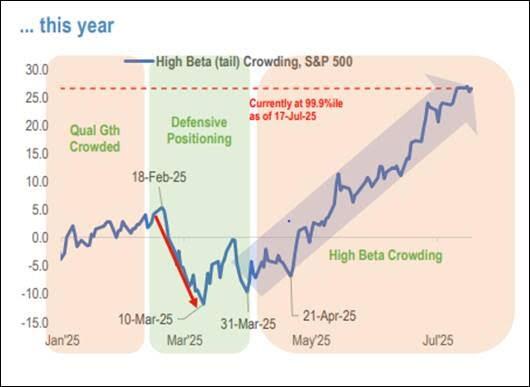
美股市场“极度自满”,高贝塔股票拥挤程度创纪录
Hua Er Jie Jian Wen· 2025-07-23 07:11
分析师认为,高贝塔股票拥挤程度从25分位数飙升至100分位数仅用时3个月,创下30年来最快速度,这种技术性驱动的快速上行或不可持续。 极端拥挤交易达到历史高位 摩根大通数据显示,今年已出现三次极端拥挤交易事件:1月份动量因子拥挤程度达到100分位数;4月份低波动率拥挤程度达到96分位数;而目前高贝塔拥 挤程度再次触及100分位数的极端水平。 摩根大通警告,随着标普500指数创下历史新高,突破6300点关口,美股市场正陷入"极度自满"状态,高贝塔股票的拥挤程度已达到创纪录水平,这可能引 发市场大幅回调。 摩根大通全球市场策略负责人Dubravko Lakos-Bujas表示,当前高贝塔股票的拥挤程度已达到100分位数的极端水平。这种拥挤状况源于市场对"金发姑娘"经 济情景的定价预期,包括经济增长韧性和美联储宽松预期的结合。 但分析师同时表示,如果商业周期重新加速,包括贸易协议明确化、资本支出周期扩大,以及在美联储宽松政策支持下资本市场活动更加活跃,这些因素可 能支撑高贝塔板块的继续上涨。 当前高贝塔拥挤交易的速度使其面临回调的风险特别突出。从历史数据看,拥挤程度在3个月内从25分位数激增至100分位数,这种速度 ...

宏观金融数据日报-20250722
Guo Mao Qi Huo· 2025-07-22 09:59
Report Summary 1. Market Data - DR001 closed at 1.36 with a -9.56bp change, DR007 at 1.49 with a -1.66bp change, GC001 at 1.36 with a 4.00bp change, and GC007 at 1.47 with a -1.00bp change [3] - SHBOR 3M closed at 1.55 with a -0.20bp change, LPR 5 - year at 3.50 with a 0.00bp change [3] - 1 - year, 5 - year, and 10 - year Chinese treasury bonds closed at 1.35, 1.52, and 1.68 respectively, with changes of 0.25bp, 1.65bp, and 1.10bp; 10 - year US treasury bonds closed at 4.44 with a -3.00bp change [3] - The central bank conducted 1707 billion yuan of 7 - day reverse repurchase operations at an interest rate of 1.40%, with 2262 billion yuan of reverse repurchases maturing, resulting in a net withdrawal of 555 billion yuan [3] - This week, 17268 billion yuan of reverse repurchases will mature, with 2000 billion yuan of MLF maturing on July 25 and 1200 billion yuan of treasury cash fixed - deposits maturing on July 22 [4] 2. Stock Index Data - The CSI 300, SSE 50, CSI 500, and CSI 1000 closed at 4086, 2772, 6161.3, and 6612.3 respectively, with changes of 0.67%, 0.28%, 1.01%, and 0.92% [5] - IF, IH, IC, and IM contracts' closing prices and changes are presented, along with their volume and open interest changes [5] - The trading volume of the A - share market reached 1.7 trillion yuan, an increase of 1289 billion yuan from last Friday, with most sectors rising and the banking sector falling [5] 3. Core Views - With the end of the tax - payment period, inter - bank market funds are abundant [4] - The upcoming policies for ten key industries and the start of a major hydropower project are positive factors [6] - Domestic and overseas factors are generally positive, with A - share liquidity and market sentiment strong, and stock indices expected to be bullish [6] 4. Futures Premium and Discount - The premium and discount rates of IF, IH, IC, and IM contracts for different delivery months are provided [7]