
人民币汇率

Search documents
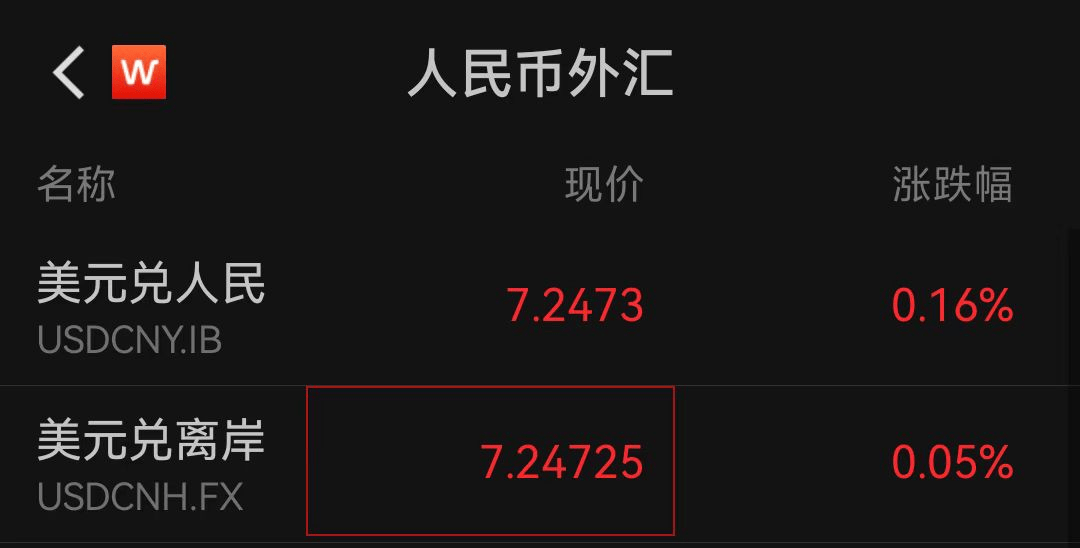
人民币对美元跌破7.25!火线解读→
Sou Hu Cai Jing· 2025-05-09 05:00
Group 1 - The onshore and offshore RMB against the USD both fell below the 7.25 mark on May 9, before slightly recovering, with the onshore RMB at 7.2473 and the offshore RMB at 7.24725 at the time of reporting [1] - The US dollar index rose significantly by 1.03% on May 8, closing at 100.639, marking a near one-month high, influenced by a strong US employment market and a limited trade agreement between the US and the UK [2] - The COMEX gold price dropped to 3278.9 USD/ounce before rebounding to 3316.10 USD/ounce, indicating a weakening of gold's safe-haven appeal due to stabilizing trade sentiments and a strengthening dollar [2] Group 2 - Analysts from CITIC Securities suggest that the factors affecting the RMB exchange rate are relatively balanced, predicting short-term fluctuations around a new central point, with the central bank focusing on correcting one-sided expectations [4] - The Minsheng Macro team highlights two standards for the RMB's level: the central bank's psychological price and the RMB's changes relative to other currencies [4] - Agricultural Bank of China's financial market department notes that while the RMB has temporarily stabilized under depreciation pressure, the expectation of depreciation remains, although factors favoring RMB appreciation are accumulating, such as a weakening US economy and potential Fed rate cuts [4]

中美政策博弈,人民币涨跌背后是什么?
Sou Hu Cai Jing· 2025-05-09 04:21
Group 1 - The core viewpoint is that the recent appreciation of the RMB against the USD is a result of the ongoing policy competition between China and the US, particularly in the context of interest rate adjustments and currency stabilization efforts [1][3][4] - The Federal Reserve has raised interest rates 11 times in 2023, reaching a 22-year high of 5.25%-5.5%, which has caused significant fluctuations in global currency markets. However, the RMB has shown remarkable resilience due to targeted interventions by the People's Bank of China (PBOC) [3][4] - China has implemented measures such as lowering foreign exchange reserve requirements, restarting counter-cyclical factors, and issuing offshore central bank bills to stabilize the RMB, while maintaining an independent monetary policy that supports the real economy [3][4] Group 2 - The ongoing trade tensions have led to the RMB exchange rate becoming a focal point of contention, with the US pressuring for RMB appreciation under the guise of promoting "fair trade," aiming to weaken China's export competitiveness [4][5] - In the context of the technology war, the depreciation of the RMB has reduced the cost of chip imports for China, alleviating some of the pressure from sanctions, showcasing a strategic response to external challenges [7] - The emergence of China's digital currency (DCEP) and its cross-border payment system is reshaping the financial landscape, potentially allowing transactions to bypass the USD settlement system, which could challenge US financial dominance [7]
奇葩!出口商想要人民币,老百姓想要美元
Sou Hu Cai Jing· 2025-05-08 21:25
Core Viewpoint - The article discusses the contrasting behaviors of domestic exporters and citizens regarding currency exchange, highlighting a unique phenomenon where exporters are converting USD to RMB while citizens are converting RMB to HKD, indicating differing perceptions of the RMB's future value and economic conditions [1][6]. Group 1: Currency Exchange Behavior - Domestic exporters are rapidly converting their USD earnings into RMB, believing the current exchange rate of approximately 7.3 is favorable for exports and that further depreciation of the RMB is unlikely [1][6]. - Conversely, domestic citizens are exchanging RMB for HKD, leading to a significant influx of capital into Hong Kong, with net inflows through the Stock Connect reaching 570 billion RMB from January to April, which is 77% of last year's total [1][2]. Group 2: Interest Rates and Market Dynamics - The offshore RMB interest rate (CNH Hibor) has dropped significantly, aligning closely with the domestic RMB interest rate (Shibor) at an annualized rate of about 1.7%, a decrease of 50% since January [2][3]. - This alignment indicates that borrowing costs in Hong Kong for RMB are now comparable to those in mainland China, a situation that has been rare in the past five years [4][5]. Group 3: Market Perceptions and Economic Signals - The disparity in currency exchange behavior stems from a fundamental difference in how exporters and domestic citizens perceive the RMB's future; exporters focus on government policies that support export competitiveness, while citizens are influenced by broader economic sentiments and fears of depreciation [10][11]. - The urgency for maintaining the RMB's exchange rate has shifted towards stimulating domestic economic growth, as indicated by the recent decline in the US dollar index from 110 to 99, which has eased pressure on the RMB [12][13][14].

「改革创新」田轩:降准降息,如何“择机”?
Sou Hu Cai Jing· 2025-05-08 18:01
Group 1: Monetary Policy Adjustments - The central bank will selectively lower the reserve requirement ratio and interest rates based on economic growth momentum and liquidity conditions in the financial market [3] - Supportive monetary policy aims to maintain sufficient market liquidity, reduce financing costs, and guide funds to key areas to stimulate economic growth [4] - Coordination between monetary and fiscal policies is essential to enhance their effectiveness and ensure consistency in achieving economic stability and risk prevention [5] Group 2: Monetary Policy Tools - The toolbox for monetary policy includes tools like differentiated reserve requirement ratios, targeted medium-term lending facilities (TMLF), and open market operations to manage liquidity and credit [6] - Structural monetary policy tools will focus on directing financial support to strategic sectors such as technology innovation and green finance [6][7] Group 3: Price Stability and Asset Prices - The shift in the central bank's focus from "maintaining overall price stability" to "keeping prices at a reasonable level" indicates a more precise monetary policy target [8] - There is a complex debate about including asset prices in monetary policy goals, as it could complicate the balance between various economic objectives [10] Group 4: Government Bond Yields and Currency Exchange Rates - Current government bond yields are in a fluctuating range due to economic recovery expectations and monetary policy adjustments, with a potential for gradual increases in the long term [11] - The recent appreciation of the RMB reflects improved economic fundamentals and market confidence, while external pressures like tariffs may pose risks [13]

湾区金融大咖说|专访高盛首席中国经济学家闪辉:提振消费需建立长效机制
2 1 Shi Ji Jing Ji Bao Dao· 2025-05-08 14:30
Core Viewpoint - The article discusses the impact of the U.S. tariffs on global trade and China's economic growth, emphasizing the need for China to implement substantial policy measures to achieve its economic growth target of around 5% for the year [1][3]. Economic Growth and Policy Measures - To meet the 5% GDP growth target, China may require an additional 2 trillion yuan in policy measures, considering a fiscal multiplier of 0.5, which corresponds to approximately 1.4 trillion yuan needed for a 1% GDP increase [3]. - The first quarter of 2025 saw China's GDP grow by 5.4%, exceeding market expectations, with exports increasing by 6.9% and industrial output rising by 6.5% [1][4]. Tariff Impact and Manufacturing Challenges - The U.S. tariffs are expected to have a delayed impact, particularly in the second and third quarters, as the effects of previous export surges and new tariffs converge [4]. - The U.S. faces significant challenges in reversing the trend of deindustrialization, primarily due to high labor costs and a lack of complete supply chain infrastructure [2][6]. Consumer Spending and Economic Policy - To stimulate consumer spending, there is a need for systemic adjustments in income distribution and fiscal policies, focusing on increasing residents' income share [7]. - Enhancing social security measures, particularly in rural areas, is seen as a necessary step to improve consumption and economic stability [8]. Currency Stability - The Chinese yuan has shown relative stability against the U.S. dollar, which is crucial for maintaining market confidence and mitigating external trade pressures [9]. Real Estate Market Strategies - The Chinese government is expected to continue focusing on stabilizing the real estate market through various measures, including increasing the supply of high-quality housing, which is vital for economic growth [10].
美联储降息或待7月后,人民币会否加入“亚洲升值潮”?
Di Yi Cai Jing· 2025-05-08 13:44
Group 1: Interest Rate Predictions and Economic Outlook - Wall Street has pushed back its forecast for interest rate cuts to July, with a 55% probability for the first cut, compared to a previous 20% for June [3] - Federal Reserve Chairman Jerome Powell remains resistant to preemptive rate cuts due to concerns over economic and inflation outlooks, relying more on hard data rather than soft data [3][4] - Goldman Sachs predicts that by the end of July, there will be enough evidence of labor market and hard data weakness to justify rate cuts in July, September, and October, reducing the federal funds rate to 3.5%-3.75% [4] Group 2: Currency Movements and Dollar Dynamics - The dollar index has rebounded to around 100, recovering from a drop below 98, with a year-to-date decline nearing 10% [5] - Despite the dollar's recent strength, confidence in its sustainability is low, with institutions in Europe and Asia showing a strong inclination to diversify away from dollar assets [6] - Asian currencies, including the New Taiwan Dollar and Hong Kong Dollar, have appreciated significantly against the dollar, with the offshore RMB also breaking the critical 200-day moving average [8][10] Group 3: Chinese Economic Policies and Currency Management - The People's Bank of China has shown a willingness to allow gradual depreciation of the RMB in response to tariff pressures, while recent dollar weakness has alleviated some of this pressure [10] - Analysts expect further fiscal and monetary stimulus from the Chinese government, with a potential reduction in policy rates and increased liquidity measures to stabilize economic growth [12][13] - The anticipated fiscal support may not be immediate, as the government assesses the impact of tariff shocks, but there is a consensus that additional measures will be necessary in the coming months [13]

金融期货早班车-20250508
Zhao Shang Qi Huo· 2025-05-08 03:36
Report Summary 1. Report Industry Investment Rating No investment rating information is provided in the report. 2. Core Viewpoints - The A-share market is expected to stabilize from four perspectives, and it is recommended to buy index futures on dips. Short-term IC and IM have more elasticity, while medium- and long-term IH and IF are more attractive in terms of valuation [4]. - The short-term funds are neutral. After the unexpected implementation of US tariffs, there are signs of easing. Although global trade uncertainties still exist, government bonds have gradually returned to pricing based on economic fundamentals. In the short term, government bond prices are expected to fluctuate; in the long term, the timing and intensity of fiscal/monetary policies will affect the price trend of government bond futures [5]. 3. Summary by Relevant Catalogs (1) Economic Data - High-frequency data shows that the recent infrastructure boom has slightly increased, while the import and export boom has decreased [7]. (2) Stock Index Futures and Spot Market Performance - On May 7th, the four major A-share stock indexes all rose. The Shanghai Composite Index rose 0.8% to close at 3342.67 points; the Shenzhen Component Index rose 0.22% to close at 10104.13 points; the ChiNext Index rose 0.51% to close at 1996.51 points; the Science and Technology Innovation 50 Index rose 0.36% to close at 1030.19 points. The market turnover was 15,051 billion yuan, an increase of 140.6 billion yuan from the previous day [2]. - The basis and basis annualized yields of IM, IC, IF, and IH next-month contracts are 156.29, 130.09, 46.63, and 24.3 points, and -19.98%, -17.67%, -9.51%, and -7.11% respectively. The three-year historical quantiles are 3%, 2%, 6%, and 14% respectively. The futures-spot price difference has been repaired but is still at a low level [3]. (3) Government Bond Futures and Spot Market Performance - On May 7th, most government bond futures declined. The 2-year government bond futures fell 0.01% to close at 102.31 points; the 5-year government bond futures fell 0.08% to close at 106 points; the 10-year government bond futures fell 0.19% to close at 108.85 points; the 30-year government bond futures fell 0.62% to close at 120.14 points [4]. - In terms of the current bond, the CTD bonds of 2-year, 5-year, 10-year, and 30-year government bond futures have corresponding net basis and IRR. In terms of the money market, the central bank's net withdrawal was 33.53 billion yuan. In the short term, government bond prices are expected to fluctuate; in the long term, the timing and intensity of fiscal/monetary policies will affect the price trend of government bond futures [5].
每日投行/机构观点梳理(2025-05-07)
Jin Shi Shu Ju· 2025-05-08 02:17
Group 1: Economic Indicators and Predictions - Wells Fargo economists predict that the Consumer Price Index (CPI) for April will rise by 0.2% after a surprising decline of 0.1% in March, leading to an annual CPI rate of 2.3%, the lowest in four years [1] - Deutsche Bank expects the Federal Reserve to maintain the federal funds rate in the range of 4.25-4.50% and emphasizes the need to observe the impact of recently implemented trade policies on economic growth and inflation [3] - UBS Wealth Management highlights that concerns over the independence of the Federal Reserve could significantly damage the dollar's safe-haven status, with currencies like the yen and Swiss franc benefiting in the current environment [2] Group 2: Market Trends and Asset Allocation - Analysts at Societe Generale note a trend of investors shifting from U.S. assets to European assets, although this transition may take time to fully materialize [4] - Bank of America indicates that the recent surge in interest in European markets does not necessarily signal a structural shift, as many institutional investors remain cautious about large-scale capital transfers from the U.S. [5] - Citic Securities maintains a preference for gold over copper and oil in the commodities market, citing OPEC+'s unexpected production increase as a factor that may lead to a supply surplus in the oil market [6][5] Group 3: Commodity Price Forecasts - KPMG has revised its Brent crude oil price forecast for the end of the year down from $70 to $60 per barrel, reflecting improved global oil supply conditions [6] - Barclays has postponed its forecast for the next Bank of Japan interest rate hike to January 2026, adjusting its final rate prediction down to 1.00% [7] Group 4: Domestic Market Insights - Galaxy Securities reports a significant increase in global gold ETF inflows in Q1 2025, with net purchases by central banks remaining strong, supporting the long-term bullish outlook for gold prices [8] - The automotive market in China is expected to see a rebound in sales, driven by the release of new models and the end of consumer hesitation following the Shanghai Auto Show [8]
2025年5月8日银行间外汇市场人民币汇率中间价
news flash· 2025-05-08 01:17
2025年5月8日银行间外汇市场人民币汇率中间价 金十数据5月8日讯, 美元/人民币报7.2073,上调(人民币贬值)68点; 欧元/人民币报8.1596,下调54点; 港元/人民币报0.9287,下调2.1点; 英镑/人民币报9.5949,下调204点; 澳元/人民币报4.6431,下调445点; 加元/人民币报5.2197,下调130点; 100日元/人民币报5.0202,下调143点; 人民币/俄罗斯卢布报11.1692,下调1244点; 新西兰元/人民币报4.2931,下调427点; 人民币/林吉特报0.58805,上调15.6点; 瑞士法郎/人民币报8.7618,上调422点; 新加坡元/人民币报5.5750,下调158点。 ...