去美元化

Search documents
白银深陷泡沫?法兴银行模型已报警,但分析师高喊“别信”!
Xin Lang Cai Jing· 2025-12-30 13:18
Core Viewpoint - A top investment bank's model indicates that silver is in a bubble, but internal analysts are not convinced of this assessment [1][5]. Group 1: Market Performance - Silver experienced its largest single-day drop since February 2, 2021, due to increased margin requirements, but rebounded strongly the following day, with a year-to-date increase of 153% [1][5]. - The analysis by Societe Generale suggests that when silver's price movements are viewed on a logarithmic scale, the projected surge in 2025 appears less extreme, supporting the notion that silver has followed a consistent compound growth logic over the past 25 years [1][5]. Group 2: Bubble Characteristics - The analysis utilized the "Log-Periodic Power Law Singularity" (LPPLS) framework, which previously identified bubbles in 2010 and 2020, indicating that the current market conditions exhibit bubble characteristics, defined as prices accelerating towards a critical point at an exponential rate [1][5]. - The report emphasizes that as the bubble matures, price fluctuations are expected to become more frequent [1][5]. Group 3: Structural Changes and Supply Factors - The report highlights two significant drivers for the increase in silver prices: export restrictions due to national security concerns, which could reduce silver exports by 30%, exacerbating an existing supply gap of approximately 200 to 230 million ounces in the global market [3][7]. - Additionally, U.S. regulatory actions are critical, with the Bureau of Industry and Security (BIS) set to make a ruling in January regarding silver's status as a critical mineral, given that the U.S. relies on imports for 64% of its silver needs [3][7]. - If tariffs on silver exports are imposed, the already tight supply situation in major trading hubs like China, India, and London could worsen significantly [3][7]. - Notably, in some markets, the premium for physical silver transactions has reached 10% to 15% [4][7].

美债抛售潮:从中国减持到全球“去美元化”的地缘金融信号
Sou Hu Cai Jing· 2025-12-30 13:04
Core Insights - The latest report from the U.S. Treasury on international capital flows reveals significant reductions in U.S. Treasury holdings by foreign investors, particularly China, which sold off $11.8 billion in October, bringing its total holdings down to $688.7 billion, the lowest since 2008 [1][2][4] - This trend of reduction is not isolated to China; Canada also significantly reduced its holdings by $56.7 billion, indicating a broader shift among major foreign holders of U.S. debt [3][6] Group 1: China's Actions - China’s reduction in U.S. Treasury holdings is part of a strategic shift towards risk management of dollar assets, as evidenced by its concurrent increase in gold reserves, which reached 7.409 million ounces by the end of October [4][5] - The decline in China's holdings from a peak of over $1.3 trillion in 2011 to the current level represents a nearly 50% decrease, indicating a long-term trend rather than a one-time adjustment [4][5] Group 2: Broader Market Reactions - The sell-off by China has triggered a ripple effect, with Canada, a traditional ally, also reducing its holdings significantly, which reflects a growing distrust in U.S. financial stability [6][7] - Other offshore financial centers like Luxembourg and the Cayman Islands are also withdrawing from U.S. debt, highlighting a shift in global risk appetite [7] Group 3: Federal Reserve's Response - In response to the sell-off, the Federal Reserve announced it would resume purchasing $40 billion in U.S. Treasury securities monthly starting December 12, aiming to stabilize market liquidity [8][10] - Despite these measures, there is skepticism in the market regarding the effectiveness of the Fed's actions, as concerns about the sustainability of U.S. debt continue to grow [10] Group 4: Future Implications - The ongoing sell-off of U.S. Treasuries signals a significant transformation in the international monetary system, moving away from a dollar-dominated framework towards a more diversified asset allocation among global central banks [11][12] - The share of the dollar in global foreign exchange reserves has fallen below 60% for the first time in 30 years, indicating a shift towards a multi-polar currency system [11][12]
2025年市场风云录:贵金属大涨与能源的黄昏
Sou Hu Cai Jing· 2025-12-30 11:40
Core Insights - The global commodity market in 2025 is characterized by a stark contrast, with precious metals like gold and silver experiencing significant price increases, while international oil prices are under pressure due to oversupply and weak demand [2][19]. Precious Metals - The precious metals sector has seen a comprehensive surge, with silver outperforming gold and becoming the "star commodity" of the year, driven by a combination of safe-haven demand, loose monetary policy, supply-demand imbalances, and speculative sentiment [3][7]. - Gold prices rose from $2,624.50 per ounce at the beginning of the year to $4,387.06, marking a 67.16% increase [4]. - Silver prices surged from $28.91 per ounce to $75.63, achieving a remarkable 161.60% increase [5]. Demand Factors - Geopolitical risks have bolstered safe-haven demand for precious metals, with ongoing U.S. sanctions on Venezuelan oil supplies and rising uncertainty prompting global investors to increase their holdings in gold and silver [7]. - The escalating global debt situation has enhanced the value of hard currencies, with significant capital outflows from the bond market into precious metals due to rising long-term interest rate expectations [7]. - The Federal Reserve's shift towards looser monetary policy in 2025, including interest rate cuts and quantitative easing, has reduced the opportunity cost of holding precious metals, directly driving up their prices [7]. Supply Factors - The silver market is experiencing significant supply constraints, with a lack of physical reserves compared to gold, making it more susceptible to price volatility during demand surges [9]. - Global silver production is limited due to declining ore grades and insufficient new project developments, compounded by regulatory and environmental restrictions in major silver-producing countries [10]. Short-term Impacts - Early 2025 saw speculation about potential tariffs on silver, leading to a preemptive accumulation of silver in warehouses, which exacerbated inventory shortages when demand surged in October [13]. - Speculative activities have intensified price volatility in the silver market, with a lower trading volume making it more susceptible to sharp price movements [13]. Copper Market - Copper prices have also seen significant increases, with London copper prices rising over 40% in 2025, driven by policy expectations, supply uncertainties, and structural demand growth [16][18]. - The U.S. government's tariff signals on copper have created arbitrage opportunities, leading to a shift in inventory dynamics and regional supply-demand imbalances [18]. Oil Market - In contrast to the strong performance of precious metals and copper, international oil prices have been in a downward trend, with Brent crude falling from $74.48 per barrel to around $61.47, a decline of 17.47% due to oversupply and weak demand [19]. - OPEC+'s shift towards increased production has contributed to the oversupply, while weak demand from major economies has limited any potential price recovery [19]. Stock Market Impact - The divergence in commodity prices has directly influenced stock market performance, with metal mining stocks benefiting from rising gold, silver, and copper prices, while oil stocks have faced pressure due to declining oil prices [21].



满仓踏空?2025年A股给投资者上的一课:告别旧思维
Xin Lang Cai Jing· 2025-12-30 11:04
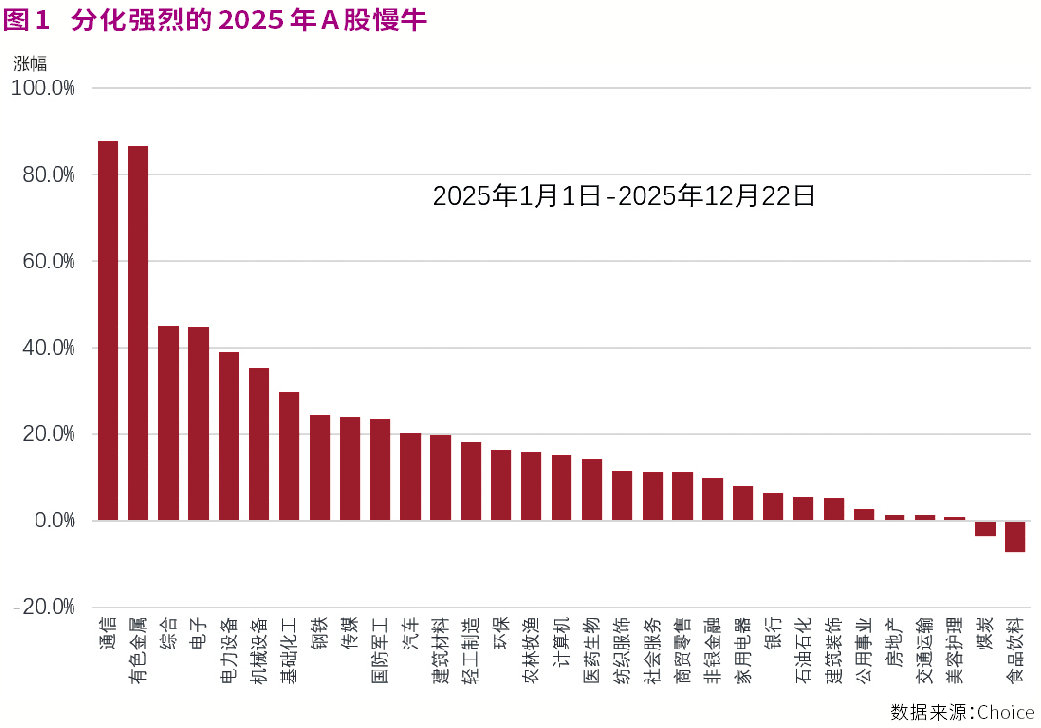
来源:@证券市场周刊微博 2025年A股存在很多的超预期,总结这些超预期会给投资者带来很多新的启示,更有利于把握2026年的行情。 廖宗魁/文 岁末年初,回顾2025年,这无疑是不平凡的一年。 各种不确定性充斥着2025年的市场,关税战此起彼伏、去美元化、全球经济增长放缓与再通胀担忧等问题,都一度给市场制造着焦虑。A股却一改以往弱不 禁风的性格,连续两年实现年度上涨,走出了持续的慢牛。 2025年的市场给投资者带来了很多的超预期,也带来了很多新启示,它有助于我们更好地把握2026年。在经历了主要源于估值提升的2024年和2025年之后, 本轮A股慢牛行情将进入第二阶段,盈利修复可能将替代估值成为更为关键的变量。 启示一:成功抵御关税战 2025年最大的不确定性来自关税战。回到2025年年初,市场无不对关税战忧心忡忡,很多专家纷纷预测2025年中国出口会明显下滑,市场也会遭受较大的冲 击。 从关税战来看,中国积极应对,化被动为主动,大幅提振了市场信心。一方面,在关税战的初期政策积极稳住市场,通过及时降息、"国家队"托底和引导耐 心资本入市等政策,A股仅在4月7日出现短暂调整,随后就迅速收复了"失地";另一方面, ...
2025年全球资产涨跌榜出炉:中国资产逆袭,2026年怎么投?
2 1 Shi Ji Jing Ji Bao Dao· 2025-12-30 10:32
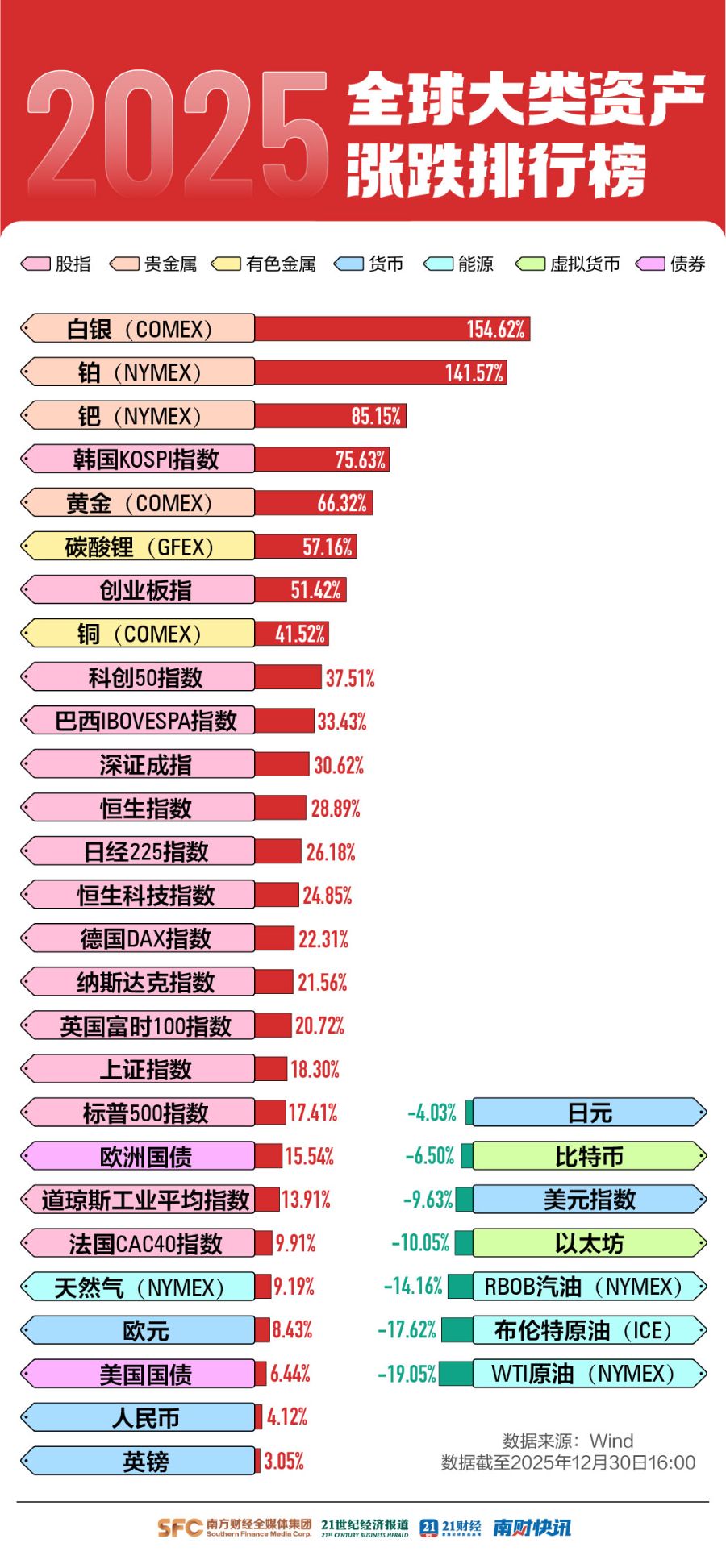
Group 1: Global Market Performance - Global stock markets have shown a rare upward trend this year, with major indices across the Americas and Asia achieving positive returns [1] - Chinese assets have performed particularly well, with the ChiNext Index up over 51% and the STAR 50 Index up 37.5% year-to-date, ranking second and third globally [1] - The Hang Seng Index and Hang Seng Tech Index recorded gains of 28.89% and 24.85%, respectively, with Goldman Sachs predicting a further 38% upside for the Chinese stock market by the end of 2027 [1] Group 2: Precious Metals Surge - Gold prices reached a historic high of over $4,500 per ounce in December, with COMEX gold futures up over 65% for the year, marking the best performance since 1979 [1] - Other precious metals also saw significant increases, with platinum rising 141.57%, palladium futures up over 85%, and silver futures surging over 150%, making it the top-performing asset globally [1] Group 3: Foreign Investment in Chinese Assets - Foreign capital has shown a strong interest in Chinese assets, with net inflows into domestic stocks and funds reaching $10.1 billion in the first half of the year [7] - By December 20, 2025, global investment in Chinese asset ETFs had accumulated $83.1 billion in net inflows, with the technology sector attracting $9.5 billion from foreign investors [7] - Morgan Stanley reported that foreign long-term funds net bought approximately $10 billion in A-shares and H-shares by November, contrasting sharply with the $17 billion outflow in 2024 [11] Group 4: Earnings Growth and Market Outlook - Analysts expect that the primary driver for the Chinese market in 2026 will shift from valuation recovery to substantial improvements in corporate earnings, with Goldman Sachs forecasting a 14% growth in earnings for 2026 [15] - UBS anticipates that the overall A-share earnings growth rate will rise from 6% in 2025 to 8% in 2026, indicating that stock price increases will be supported by solid performance fundamentals [15] - The ongoing "anti-involution" policies are viewed as crucial for improving corporate profit margins and return on equity (ROE) [15]
2025/12/30:市场主流观点汇总-20251230
Guo Tou Qi Huo· 2025-12-30 10:11
市场主流观点汇总 2025/12/30 报告说明 黄 恬 期货从业资格证号:F03100883 投资咨询从业资格证号:Z0021089 此报告,意在客观反映行业内期货公司、证券公司对大宗商品各品种的 研究观点,追踪热点品种,分析市场投资情绪,总结投资驱动逻辑等。 本报告不构成个人投资建议,仅供公司内部使用,仅作参考之用。 报告中策略观点和投资逻辑是基于所采纳的机构当周公开发布的研究报 告,对于各期货品种的多空观点、交易逻辑进行整理加工汇总而成,收 盘价数据选择上周五,周度涨跌为上周五较前一周五收盘价变动幅度。 | 【行情数据】 | | | | | | | | --- | --- | --- | --- | --- | --- | --- | | 资产类别 | 细分品种 | 收盘价 | | 周度涨跌情况 | | | | 数据时点 | | 2025/12/26 | | 2025/12/22 | 至 | 2025/12/26 | | | 白银 | 18319.00 | 白银 | | | 19.14% | | | PTA | 5280.00 | PTA | 8.15% | | | | | 铜 | 98720.00 | ...
兴业期货:芝商所再上调保证金 黄金多头逻辑未变
Jin Tou Wang· 2025-12-30 09:38
Macro News - The main gold futures in Shanghai reported at 984.84 CNY per gram, with a decline of 3.11%. The opening price was 1004.72 CNY per gram, with a high of 1007.12 CNY and a low of 970.02 CNY [1] - The U.S. President Trump criticized Federal Reserve Chairman Powell and the Fed's building renovation, indicating potential legal action against Powell for incompetence [1] - The U.S. has intensified its blockade on Venezuelan oil tankers, with non-sanctioned vessels also facing seizures. Trump mentioned the possibility of declaring war on Venezuela, indicating an escalation in pressure on the country [1] - The U.S. is advancing peace talks between Russia and Ukraine, stating that progress towards a peace agreement is very close [1] Institutional Views - After the CME Group's second increase in precious metals margin rates, precious metals experienced a significant pullback, leading to a notable decrease in market speculation [1] - Despite geopolitical disturbances, the U.S.-China interest rate cut cycle, and de-dollarization, the bullish logic for gold remains unchanged. The outlook for gold remains positive [1] - The strategy for holding long positions in the Shanghai gold February contract is maintained [1]
美联储鸽派预期升温叠加央行购金支撑,金价高位波动吸引资金逢低配置,上海金ETF(518600)近3天合计净流入1.35亿
Sou Hu Cai Jing· 2025-12-30 08:38
展望2026年,世界黄金协会认为,央行购金需求仍是黄金表现的重要支撑。但该协会也强调,新的一 年,全球央行购金决策通常更多取决于政策与政治考量,而非单纯的市场需求。 申万宏源表示,2026年黄金价格仍有上涨空间,主要由于美国财政赤字高企和去美元化趋势。战略层 面,黄金供应缺口扩大和需求增加将支撑金价,尤其央行购金量增加。战术层面,需关注美国周期性变 化下的美债利率走势及波动率,预计2026年黄金波动性将提高。 上海金ETF(518600),场外联接(A类:008986;C类:008987),该基金紧跟金价、支持T+0交易,可谓 黄金便捷投资利器;投资者可借道上海金ETF对冲金饰价格上涨。 以上内容与数据,与有连云立场无关,不构成投资建议。据此操作,风险自担。 国际宏观方面,美国2025年三季度GDP环比增速从今年二季度的3.8%进一步上行至4.3%。市场一度交 易降息预期降温,知情人士透露,特朗普可能在2026年1月第一周任命新任美联储负责人。市场预期, 无论特朗普选择谁,新任美联储负责人几乎肯定会比鲍威尔更加鸽派。 此外,芝商所全线上调金属品种履约保证金。芝商所(CME Group)于12月26日发布重大保 ...
有色金属“王者归来”:一场结构性牛市,还是情绪交易?
Sou Hu Cai Jing· 2025-12-30 08:10
Group 1 - The core viewpoint of the article is that the significant rise of the China Nonferrous Metals Index (H11059.CSI) by approximately 90% this year is driven by improvements in supply-demand structure, changes in the global macro environment, and elevated national strategic priorities [1][2] - Nonferrous metals, which include copper, aluminum, zinc, nickel, tin, and rare earths, possess notable industrial, strategic, and scarcity attributes, making them essential in the current economic landscape [3] - The current uptrend in nonferrous metals is not merely a cyclical phenomenon but is also influenced by structural themes such as high external dependence on strategic minerals, with many resources having over 50% reliance on imports, raising security risks [5][6] Group 2 - The sustainability of the current market trend is questioned, with a focus on which metals are worth monitoring and how ordinary investors can participate more rationally [6] - The article highlights that the demand for nonferrous metals is closely tied to macroeconomic conditions, industrial investment, and high-end manufacturing, with a cyclical pattern of price-capital expenditure-supply-demand rebalancing [6][12] - The Chinese government has initiated a new round of strategic mineral exploration and has implemented reforms to activate mining companies, indicating a strong commitment to resource security and development [9][11] Group 3 - The article identifies two major drivers for the nonferrous market in 2025: the real demand from AI and high-tech industries, which will increase the consumption of copper, aluminum, and rare earths, and the ongoing accumulation of gold reserves by central banks, which enhances gold's attractiveness [12][17] - Economic recovery in China is anticipated by 2026, which may boost demand for industrial nonferrous metals, while global resource distribution and tightening policies in key resource countries are expected to keep supply tight [12][13] - The article discusses the macroeconomic environment, indicating that a loose monetary policy and rising demand for safe-haven assets will likely support nonferrous metal prices [17][19] Group 4 - The article predicts a mid-term bull market for the nonferrous industry driven by a triple resonance of monetary policy, demand, and supply [16][17] - The article emphasizes the preference for the Industrial Nonferrous Metals Index (H11059.CSI) due to its clear index positioning, strong manufacturing attributes, and solid industrial value, which is expected to outperform broader indices [20][21] - The index has shown impressive long-term returns, with a nearly 102.8% return over the past five years, indicating strong profitability and growth potential among leading companies in the sector [26][28] Group 5 - Ordinary investors are advised to avoid chasing hot stocks and instead consider index-based and leading company investments, with specific recommendations for ETFs that align with the Industrial Nonferrous Metals Index [30]
有色金属“王者归来”:一场结构性牛市,还是情绪交易?
老徐抓AI趋势· 2025-12-30 07:56
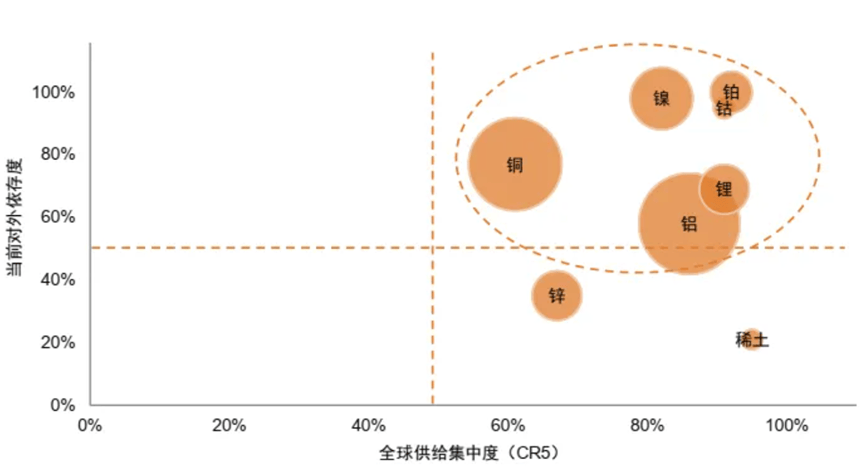
Group 1 - The core viewpoint of the article is that the recent surge in the CSI Industrial Nonferrous Index is driven by improvements in supply-demand structure, changes in the global macro environment, and elevated national strategic priorities, indicating potential sustainability in this market trend [1][10] - The article emphasizes that nonferrous metals are a typical cyclical industry, with prices determined by supply and demand, and are closely tied to macroeconomic conditions and industrial investment [1][11] - The current rise in nonferrous metals is not only cyclical but also influenced by structural themes such as national strategic security, new technology cycles, economic recovery, and changes in global liquidity [1][10] Group 2 - China's strategic mineral resources face two significant issues: high dependence on foreign sources and lack of cost competitiveness in domestic resources [3][4] - The article outlines several national policies aimed at enhancing resource security and promoting high-quality development in the copper, aluminum, and gold industries, with specific targets for resource growth and production capacity [8][9] - Investment in the nonferrous mining sector is projected to reach 208.9 billion yuan in 2024, marking a ten-year high, with significant increases in fixed investment expected in the coming years [9] Group 3 - The article identifies two major drivers for the nonferrous market in 2025: the real demand for metals driven by AI and the increasing gold reserves held by central banks amid a trend towards de-dollarization [11][12] - Economic recovery in China is anticipated to boost demand for industrial nonferrous metals, while global supply constraints and domestic capacity controls are expected to keep supply tight [12][13] - The article highlights the importance of inventory depletion in supporting prices, with specific examples of lithium and aluminum inventory trends [14] Group 4 - The macroeconomic environment is characterized by a potential easing of monetary policy, with expectations of multiple interest rate cuts by the Federal Reserve in 2026, which could enhance the attractiveness of nonferrous metals [15][16] - The article predicts a mid-term bull market for nonferrous metals driven by a combination of monetary easing, demand growth from emerging sectors, and supply-side constraints [18][20] - The industrial nonferrous index is favored for its clear focus on manufacturing and strong performance compared to broader indices, with significant historical returns and robust profitability metrics [21][25][27] Group 5 - Ordinary investors are advised to consider specific ETFs and mutual funds that focus on the industrial nonferrous sector, emphasizing a strategy of index-based and leading company investments [31][33]