
情绪消费

Search documents
叶国富的IP豪赌:6000家门店换一个宇宙
3 6 Ke· 2026-01-09 12:39
Core Insights - The article discusses the transformation of MINISO from a retail company to a cultural and creative group, aiming to become a global leader in IP operations, akin to Disney [1][11] - The company plans to upgrade its store model and product structure, increasing the proportion of IP products from 50% to over 80% [1][11] Group 1: Company Transformation - MINISO is undergoing a significant transformation, referred to as "腾笼换鸟," which involves closing and reopening 80% of its stores, impacting nearly 6,000 locations [1][3] - The new store model will feature larger thematic immersive spaces, moving from stores under 200 square meters to those between 400-600 square meters [1][3] - The company aims to shift its focus from merely selling products to selling culture, thereby creating a more engaging consumer experience [11][12] Group 2: Market Position and Strategy - Since its inception in 2013, MINISO has rapidly expanded to over 8,000 global stores by leveraging its channel advantages [2] - The founder, Ye Guofu, recognizes the limitations of relying solely on scale and is pivoting towards an IP ecosystem to enhance competitiveness [3][11] - The competition with Pop Mart, a leading player in the collectible toy market, highlights the strategic battle for "dream-making rights" in the IP retail space [4][17] Group 3: IP Development and Future Plans - MINISO's strategy includes a dual approach to IP development, focusing on both top-tier licensed IPs and original IPs to drive growth [15][11] - The launch of MINISO LAND, a themed store concept, has shown promising results, with one store achieving over 100 million yuan in sales within nine months, with IP products contributing 80% [14][15] - The company plans to recruit top IP design talent globally to enhance its IP incubation capabilities, indicating a commitment to building a robust IP ecosystem [15][11] Group 4: Competitive Landscape - The competition between MINISO and Pop Mart represents a clash between two different business models: MINISO's channel-driven approach versus Pop Mart's content-driven strategy [21][22] - Both companies are striving to create an emotional consumption utopia, emphasizing the importance of storytelling and emotional connection in IP retail [22][24] - The future of IP retail is expected to transcend mere product sales, focusing on creating a comprehensive "IP universe" that integrates various forms of media and consumer experiences [23][24]




春节消费回暖,品牌如何制胜?乐事以“产品+营销”撬动增长
21世纪经济报道· 2026-01-09 07:53
Core Viewpoint - The article emphasizes the significant growth in consumer spending during the 2026 Spring Festival, driven by emotional consumption and the strategic marketing efforts of brands like Lays, which are capitalizing on the festive atmosphere and consumer sentiment [1][10]. Group 1: Consumer Trends - In 2025, the overall sales during the Spring Festival increased by 8.7% year-on-year, with consumer willingness to spend during the holiday rising by 11% [1]. - Emotional consumption is becoming a key driver, with consumers increasingly valuing emotional connections over price [1][10]. - The average price of all categories during the Spring Festival rose by 13.8%, with snacks benefiting from the "gift economy" and social settings [1]. Group 2: Lays' Product Strategy - Lays launched over ten new Spring Festival limited edition products, including various gift boxes and snack combinations, catering to diverse consumer preferences [3]. - Some products feature popular IP collaborations, such as "Kung Fu Panda," enhancing their appeal with festive meanings [3][11]. - Lays introduced new single-pack flavors with auspicious names, integrating taste innovation with New Year blessings [3]. Group 3: Marketing and Brand Positioning - Lays positions itself as a "Spring Festival happiness amplifier," engaging consumers during festive moments through diverse snack offerings [5]. - The brand has a history of integrating products with traditional celebrations and collaborating with celebrities to strengthen brand recognition [6]. - Recent marketing campaigns featuring celebrities like Shen Teng and Fan Chengcheng have generated significant social media engagement, enhancing brand visibility [8][10]. Group 4: Channel Strategy and Market Preparation - The article notes a trend towards multi-channel development, with increased e-commerce penetration and offline membership store coverage [10]. - Lays is preparing for the terminal market by creating immersive in-store displays to attract consumers and enhance the shopping experience [10]. - The brand's marketing strategy aims to alleviate promotional challenges for distributors and retailers, fostering mutual benefits through increased consumer attention [10]. Group 5: Future Outlook - As the 2026 Spring Festival approaches, Lays is set to leverage its limited edition series and innovative marketing strategies to meet consumer expectations for a festive atmosphere [11].

轻工行业2026年投资策略:掘金情绪消费,重估周期价值
Southwest Securities· 2026-01-08 12:34
Core Insights - The report emphasizes the importance of capitalizing on emotional consumption trends and reassessing cyclical value in the light of the 2026 investment strategy for the light industry sector [1][3]. 2025 Sector Review - In 2025, the light industry sector experienced relatively flat performance, with traditional cyclical and manufacturing companies facing valuation pressure. However, packaging and printing sectors benefited from price increases and cross-industry transformations, leading to better stock performance [4]. - The export sector showed some differentiation due to tariff policy disruptions, with companies that had balanced production capacity and strong demand performing better. The personal care sector saw excess returns in the first half of the year but faced valuation digestion in the second half due to intensified e-commerce competition [4][5]. - The report suggests a dual focus for stock selection in 2026: on one hand, to pay attention to undervalued cyclical assets for valuation recovery; on the other hand, to balance the valuation and growth potential of new consumption and export sectors [4]. Stock Selection Strategy - The report recommends four main lines for stock selection: 1. Gradually focus on undervalued cyclical stocks, particularly in the paper sector, which is expected to see price increases driven by seasonal demand and low channel inventory [4]. 2. Maintain a high allocation to export stocks with strong demand resilience and manufacturing capabilities, especially those less affected by tariffs [4]. 3. Invest in high-quality domestic personal care brands benefiting from product structure optimization and channel expansion [4]. 4. Explore new consumption trends in categories like AI glasses, new tobacco products, pet supplies, and trendy toys, which are expected to see significant growth [4]. Recommended Stocks - The report lists several recommended stocks, including: - Sun Paper Industry (002078.SZ) - Bohui Paper Industry (600966.SZ) - Weigao Medical (300888.SZ) - Baiya Co., Ltd. (003006.SZ) - Nobon Co., Ltd. (603238.SH) - Yiyi Co., Ltd. (001206.SZ) - Mengbaihe (603313.SH) - Gujia Home (603816.SH) [4]. 2025 Sector Performance Data - As of December 31, 2025, the SW light industry manufacturing sector had an overall increase of 20.1%, outperforming the Shanghai Composite Index by 1.7 percentage points. The packaging and printing sector performed particularly well with a 35.4% increase [12]. - The report highlights that the packaging sector benefited from price increases and cross-industry transformations, while the home and entertainment sectors also saw significant gains [12][14]. Export Sector Insights - The report notes that from November 2025, the U.S. reduced tariffs on Chinese imports to 20%, leading to a gradual recovery in orders. The fluctuations in tariff policies had previously caused delays in orders from U.S. buyers [76]. - The report indicates that the export sector is expected to see a return to competitive pricing against ASEAN countries following the tariff adjustments, which may accelerate industry consolidation [76][81]. Personal Care Sector Trends - The personal care sector is experiencing product structure upgrades and channel benefits, with brands focusing on high-demand segments such as oral care and women's hygiene products [31][50]. - The report forecasts that the market for women's hygiene products will reach 1079.6 billion yuan in 2025, with a compound annual growth rate (CAGR) of 3.0% from 2025 to 2029 [50][51]. Baby Care Market Dynamics - The baby care market is projected to grow at a CAGR of 3.1% from 2025 to 2029, with a focus on premiumization and specialized products to counteract declining birth rates [59][66]. - The report highlights that single-child consumption is increasing, which helps mitigate the impact of declining birth rates on the market [69].



2026年第一波消费潮:“爱你老己”引爆悦己消费
Sou Hu Cai Jing· 2026-01-07 12:36
Group 1 - The core concept of the article is the rapid growth of China's emotional consumption market, which is shifting consumer focus from basic needs to high-quality, emotionally fulfilling purchases, termed "self-love consumption" [2][4] - The emotional consumption market in China is projected to grow from 16.3 trillion yuan in 2022 to 23.1 trillion yuan in 2024, reaching 27.2 trillion yuan by 2025, and is expected to exceed 45 trillion yuan by 2029 [2] - The pet economy is highlighted as a significant segment of the emotional consumption market, with a projected market size of 300 billion yuan in 2024, expected to surpass 811.4 billion yuan by 2025, where pet food accounts for 52.8% and pet medical services for 28% [5][6] Group 2 - The rise of emotional consumption is evident in various sectors, including fitness and travel, where consumers are increasingly seeking experiences that provide emotional satisfaction rather than just material goods [4][6] - Traditional consumer goods, such as liquor, are undergoing transformation to align with the "self-love economy," focusing on personal taste and emotional value rather than just price and brand [7][8] - The market is shifting from mass consumption to fragmented and diversified demands, necessitating brands to cater to specific niche markets rather than a one-size-fits-all approach [8][9]
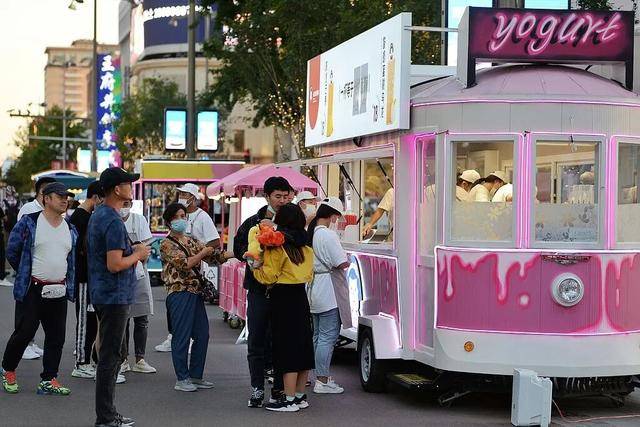
中国蓝观察丨“爱你老己”走红 情绪消费撑起万亿蓝海
Xin Lang Cai Jing· 2026-01-07 10:06
Core Insights - The term "love yourself" has gained popularity among young people, leading to a rise in "self-gratification consumption" as a significant growth area in the market [1][10] - The emotional consumption market is expected to grow rapidly, with projections indicating a rise from 16.3 trillion yuan in 2022 to 27.2 trillion yuan in 2025, and surpassing 45 trillion yuan by 2029 [5][14] Market Trends - The emotional consumption market is diversifying, with trends including "self-gratification travel," immersive experiences, and seasonal activities like "ice and snow tourism" becoming popular during holidays [1][12] - Young consumers, particularly those born after 2000, are leading the trend, seeking experiences that fulfill emotional value rather than traditional sightseeing [3][12] Consumer Behavior - Over 90% of young people recognize the importance of "emotional value," and nearly 60% are willing to pay for it [5][14] - The rise of emotional consumption reflects a societal shift towards valuing emotional fulfillment and self-acceptance in the face of modern pressures [3][10] Product and Service Advantages - Chinese products and services are seen to have unique advantages in the emotional consumption sector, driven by creativity and strong manufacturing capabilities [6][19] - The global appeal of Chinese toys, such as the "Labubu," highlights a shift in perception of "Made in China" products, showcasing their ability to meet emotional and spiritual consumption needs [8][17]

2026年01月07日申万期货品种策略日报:国债-20260107
Shen Yin Wan Guo Qi Huo· 2026-01-07 07:11
Report Industry Investment Rating - Not provided in the content Core Viewpoints - The previous trading day saw a general decline in Treasury bond futures prices, with the T2603 contract dropping by 0.14% and an increase in open interest. The IRR of the CTD bonds corresponding to the main Treasury bond futures contracts was at a low level, indicating no arbitrage opportunities. Short - term market interest rates showed mixed trends, and key - term Treasury bond yields generally rose. The current market risk preference is strong, and under the stock - bond seesaw effect, Treasury bond futures prices are weak, but the expectation of loose policies at the beginning of the year provides some support for short - term Treasury bond futures prices [2][3] Summary by Relevant Content Futures Market - Yesterday's closing prices of TS2603, TS2606, TF2603, TF2606, T2603, T2606, TL2603, and TL2606 were 102.366, 102.390, 105.570, 105.570, 107.700, 107.655, 110.93, and 111.08 respectively, showing declines compared to the previous day. Their respective price drops were - 0.048, - 0.062, - 0.135, - 0.150, - 0.155, - 0.190, - 0.390, and - 0.410, with percentage drops of - 0.05%, - 0.06%, - 0.13%, - 0.14%, - 0.14%, - 0.18%, - 0.35%, and - 0.37%. Open interest and trading volume data were also provided, along with changes in open interest. The cross - term spreads of some contracts increased compared to the previous values [2] - The IRR% of the active CTD bonds for each contract were 1.3291, 1.4752, 1.6297, 1.5494, 1.3585, 1.1945, 2.3902, and 2.2553 respectively, at a low level with no arbitrage opportunities [2] Spot Market - Short - term market interest rates showed mixed trends. SHIBOR 7 - day rate decreased by 0.1bp, DR007 rate increased by 0.69bp, and GC007 rate increased by 1.7bp [2] - Key - term Chinese Treasury bond yields generally rose. The 10Y Treasury bond yield increased by 2.21bp to 1.88%, and the long - short (10 - 2) Treasury bond yield spread was 41.9bp [2] Overseas Market - The previous trading day saw the US 10Y Treasury bond yield increase by 1bp, the German 10Y Treasury bond yield decrease by 4bp, and the Japanese 10Y Treasury bond yield increase by 1.2bp. The internal - external yield spreads were also provided [2] Macroeconomic News - On January 6, the central bank conducted 16.2 billion yuan of 7 - day reverse repurchase operations, with an operating rate of 1.40%. With 312.5 billion yuan of reverse repurchases maturing on the same day, the net withdrawal for the day was 296.3 billion yuan [3] - The 2026 work conference of the People's Bank of China emphasized continuing to implement a moderately loose monetary policy, increasing counter - cyclical and cross - cyclical adjustment efforts [3] - The 2026 national foreign exchange management work conference emphasized building a more convenient, open, safe, and intelligent foreign exchange management system, promoting reform and opening - up in the foreign exchange field [3] - China decided to ban the export of all dual - use items to Japanese military users and for military purposes [3] - China's emotional consumption market scale has been rising rapidly, expected to exceed 4.5 trillion yuan in 2029 [3] - The US is discussing multiple options to acquire Greenland, including purchase, free - association agreement, and military means [3] Industry Information - Most money market interest rates rose. The weighted average interest rate of inter - bank pledged repurchase for the 1 - day, 7 - day, and 14 - day varieties increased, while the 1 - month variety decreased to a new low in over a month. The weighted average interest rate of inter - bank lending also showed mixed trends [3] - US Treasury bond yields rose across the board. The 2 - year, 3 - year, 5 - year, 10 - year, and 30 - year yields all increased to varying degrees [3] Comments and Strategies - Treasury bond futures prices were generally weak. The central bank's net withdrawal of reverse repurchases, short - term Shibor trends, overseas events, and economic data all had an impact. The new regulations on public fund sales and the central bank's policy orientation also affected the market. The current strong market risk preference led to weak Treasury bond futures prices, but the expectation of loose policies at the beginning of the year supported short - term Treasury bond futures prices [3]
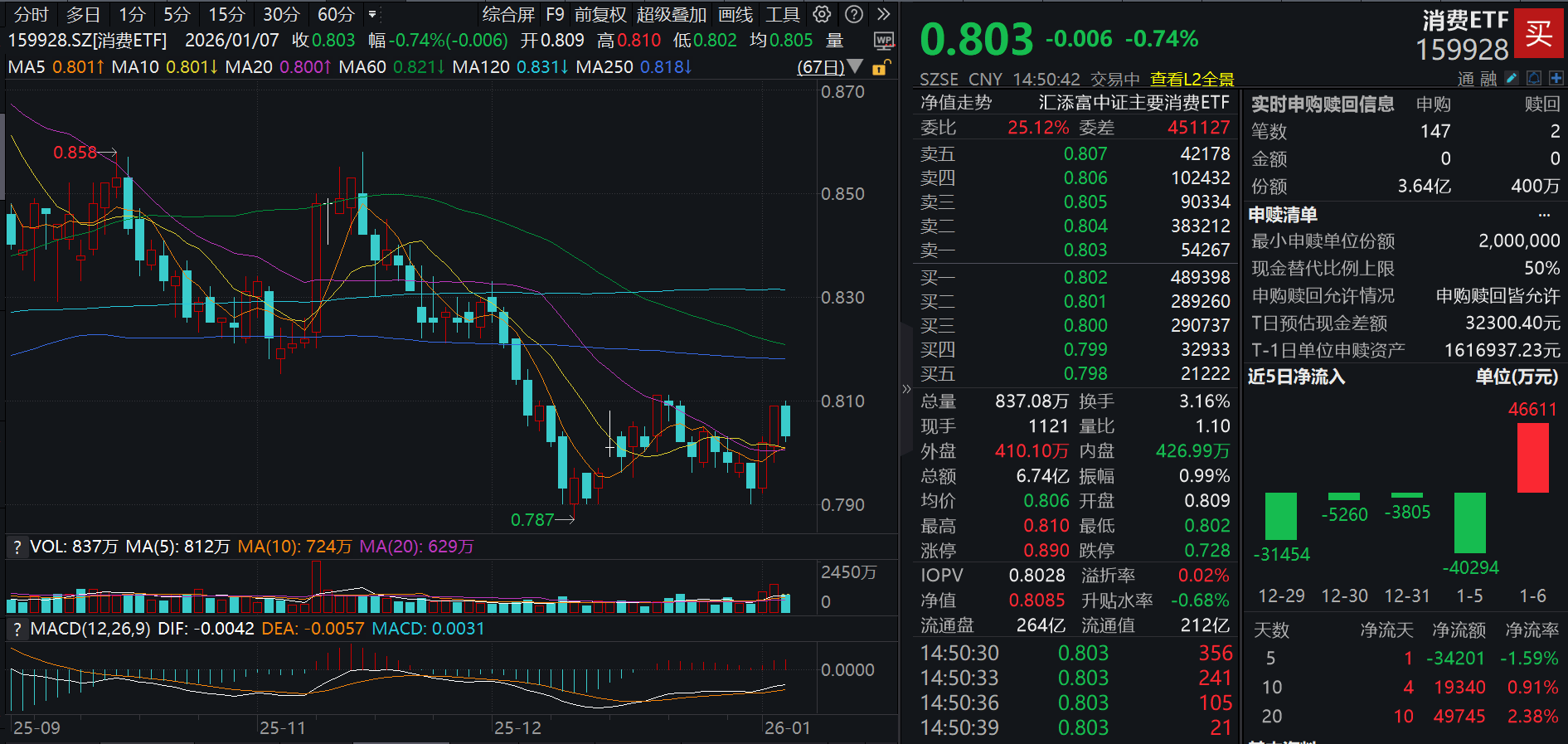
元旦消费开门红,茅台市场化转型打响第一枪!消费ETF(159928)两连阳后震荡回调,资金逢跌布局,获3亿元净申购!
Sou Hu Cai Jing· 2026-01-07 07:03
Group 1: Market Performance - The Shanghai Composite Index has risen again, with the Consumer ETF (159928) experiencing a 0.74% pullback after two consecutive days of gains, with a trading volume of 700 million yuan [1] - The Consumer ETF (159928) has seen a net subscription of over 360 million units, following a previous inflow of over 460 million yuan [1] - As of January 6, the latest scale of the Consumer ETF (159928) exceeds 21.3 billion yuan, leading its peers in the same category [1] Group 2: Consumer Market Trends - The inbound tourism market has shown a strong start to the New Year, with 292,000 foreign visitors benefiting from visa-free policies, marking a 35.8% year-on-year increase [3] - The emotional consumption market in China is rapidly growing, projected to rise from 16.3 trillion yuan in 2022 to 23.1 trillion yuan in 2024, reaching 27.2 trillion yuan by 2025, and surpassing 45 trillion yuan by 2029 [3] - Over 90% of young people recognize "emotional value," with nearly 60% willing to pay for it [3] Group 3: Valuation and Investment Opportunities - The valuation of the Consumer ETF (159928) is attractive, with a TTM price-to-earnings ratio of 19.5, placing it in the 4.08% percentile over the past decade, indicating it is cheaper than 96% of historical periods [3] - The Consumer ETF (159928) is characterized by its resilience through economic cycles, with over 68.55% of its top ten constituent stocks being essential consumer goods [10] Group 4: Sector-Specific Insights - The food and beverage industry is entering a mature phase, with growth opportunities arising from new consumer trends and channel transformations [8] - The white liquor sector is expected to perform well during periods of rising CPI, with a clear trend of increasing volume and price [9] - Moutai's market-oriented transformation is underway, focusing on consumer-centric strategies and dynamic product distribution [9][10]

我国情绪消费市场规模超2万亿元,港股消费ETF(159735)盘中交投活跃,机构:消费板块或将迎来业绩修复成长空间
2 1 Shi Ji Jing Ji Bao Dao· 2026-01-07 02:18
Group 1 - The Hang Seng Tech Index experienced a decline of over 1%, while the CSI Hong Kong Stock Connect Consumer Theme Index saw a slight increase of 0.02% as of the report time [1] - Among the constituent stocks, companies such as Shangmei Co., Ltd. rose by over 2%, with other notable gainers including KANAT Optics, AUX Electric, Mao Ge Ping, Xiao Cai Yuan, and Master Kong Holdings [1] - The Hong Kong Consumer ETF (159735) tracked the CSI Hong Kong Stock Connect Consumer Theme Index, which consists of 50 large-cap consumer-related stocks with good liquidity, reflecting the overall performance of consumer stocks within the Hong Kong Stock Connect [1] Group 2 - The emotional consumption market in China is rapidly growing, projected to increase from 16.3 trillion yuan in 2022 to 27.2 trillion yuan by 2025, and expected to exceed 45 trillion yuan by 2029 [1] - Over 90% of young people recognize the concept of "emotional value," with nearly 60% willing to pay for it, indicating a strong market potential driven by the younger demographic [1] - Experts believe that Chinese products and services have unique advantages in the emotional consumption sector, which is becoming a significant growth area in the overall consumption market [1] Group 3 - According to Everbright Securities, the consumption sector is expected to stabilize due to policy support and a rebound in consumer confidence, potentially leading to performance recovery and growth opportunities [2] - Leading companies in specific sub-sectors are noted for their strong resilience and competitive market positions [2]

资讯早班车-2026-01-07-20260107
Bao Cheng Qi Huo· 2026-01-07 01:25
1. Report's Investment Rating for the Industry - There is no information about the report's industry investment rating in the provided content. 2. Core Views of the Report - The Chinese economy shows a mixed performance in various indicators, with GDP growth slightly slowing, manufacturing PMI improving, and inflation showing positive changes. The government continues to implement a moderately loose monetary policy, aiming to promote economic growth, stabilize prices, and prevent financial risks. The commodity market has different trends, with precious metals and base metals rising, while energy and some agricultural products falling. The stock market has positive momentum, and the bond market is under pressure [1][8][9]. 3. Summary by Relevant Catalogs 3.1 Macro Data Overview - GDP growth in Q3 2025 was 4.8% year - on - year, slightly lower than the previous quarter's 5.2% but higher than the same period last year's 4.6%. Manufacturing PMI in December 2025 was 50.1%, up from the previous month's 49.8%. Non - manufacturing PMI was 50.2%, with a slight increase from the previous month but a decline from the same period last year. Social financing in November 2025 was 24888 billion yuan, slightly lower than the previous month. M0, M1, and M2 growth rates all decreased compared to the previous month. New RMB loans in November 2025 were 3900 billion yuan, significantly lower than the previous month. CPI in November 2025 was 0.7% year - on - year, turning positive from the previous month's - 0.4%. PPI was - 2.2% year - on - year, an improvement from the previous month. Fixed - asset investment decreased by 2.6% year - to - date in November 2025, and social consumption increased by 4.0%. Exports in November 2025 increased by 5.90% year - on - year, and imports increased by 1.90% [1]. 3.2 Commodity Investment Reference 3.2.1 Comprehensive - The People's Bank of China plans to use various monetary policy tools in 2026, strengthen financial market supervision, and crack down on illegal activities. China bans the export of all dual - use items to Japanese military users and related purposes [2]. 3.2.2 Metals - On January 6, 2026, international precious metals futures generally rose, with COMEX gold futures up 1.22% to $4505.70 per ounce and COMEX silver futures up 5.95% to $81.22 per ounce. London base metals also rose across the board, with LME nickel up 8.39% to $18430.0 per ton, LME tin up 4.79% to $44500.0 per ton, etc. [3]. 3.2.3 Energy and Chemicals - On January 6, 2026, the main contract of US crude oil fell 2.31% to $56.97 per barrel, and the main contract of Brent crude oil fell 1.96% to $60.55 per barrel [4]. 3.2.4 Agricultural Products - On January 6, 2026, the Bloomberg Grains Sub - index fell 0.30%. CBOT corn, wheat, and soybeans futures all declined, while ICE raw sugar, white sugar, and some coffee futures rose, and New York and London cocoa futures fell [5][6]. 3.3 Financial News Compilation 3.3.1 Open Market - On January 6, 2026, the central bank conducted 162 billion yuan of 7 - day reverse repurchase operations, with an operation rate of 1.40%. With 3125 billion yuan of reverse repurchases maturing on the same day, the net withdrawal was 2963 billion yuan [7]. 3.3.2 Key News - The 2026 PBOC Work Conference emphasizes continuing a moderately loose monetary policy, promoting economic growth and price recovery, and preventing financial risks. The 2026 National Foreign Exchange Administration Work Conference focuses on reform and opening - up, risk prevention, and ensuring the safety of foreign exchange reserves. China bans dual - use item exports to Japan for military purposes. The emotional consumption market in China is growing rapidly. Four departments encourage employee cultural and sports consumption. The inbound tourism market had a good start during the New Year's Day holiday. Shanghai encourages foreign - invested enterprises to reinvest in China. Henan introduces measures to boost the economy in Q1 2026. China's automobile production and sales are expected to reach a new high in 2025, with new energy vehicles leading the market. Regulators survey wealth management companies to promote long - term funds entering the A - share market. Many small and medium - sized banks have adjusted deposit interest rates. China Gas Holdings starts issuing panda bonds. Trump's team is discussing ways to acquire Greenland. There are bond - related events such as new debt defaults and credit rating changes [8][9][10]. 3.3.3 Bond Market Review - The inter - bank bond market in China is under pressure, with rising yields of interest - rate bonds and falling bond futures. The stock market's strength affects bond market sentiment. In the exchange - traded bond market, some bonds rise and some fall. The convertible bond index rises. Money market rates show different trends, and bond issuance yields are announced. US bond yields rise, while European bond yields fall [16][17][20]. 3.3.4 Foreign Exchange Market Update - The on - shore RMB against the US dollar closed at 6.9813 on January 6, 2026, with a 7 - point decline. The RMB central parity rate against the US dollar was raised by 57 points. The US dollar index rose, and non - US currencies showed different trends [22]. 3.3.5 Research Report Highlights - CITIC Construction Investment points out that Jiangsu's industrial assets are large, with significant north - south differences. Western Securities believes that the new regulations on public fund sales are beneficial to the bond market in January 2026. CITIC Securities says that China's bond market opening - up will promote foreign investment in the long - run, despite short - term fluctuations [23][24]. 3.3.6 Today's Reminders - On January 7, 2026, 153 bonds will be listed, 99 bonds will be issued, 106 bonds will require payment, and 96 bonds will pay principal and interest [25]. 3.4 Stock Market Key News - The Hong Kong stock market rose, with technology stocks, insurance, and brokerage stocks performing well. Southbound capital had net purchases. Regulators survey wealth management companies to promote long - term funds entering A - share market. The Shanghai and Shenzhen Stock Exchanges released the latest issuance and listing review dynamics. The number of new A - share accounts in 2025 increased significantly [26][27].
万联晨会-20260107
Wanlian Securities· 2026-01-07 00:44
Core Insights - The A-share market continued its strong performance on January 6, with the Shanghai Composite Index rising by 1.5% to close at 4083.67 points, marking a new 10-year high and achieving a record 13 consecutive daily gains [1][7] - The Shenzhen Component Index increased by 1.4%, and the ChiNext Index rose by 0.75%, with total trading volume in the Shanghai and Shenzhen markets reaching 2.81 trillion yuan [1][7] - In terms of industry performance, sectors such as non-ferrous metals, non-bank financials, and basic chemicals led the gains, while the communications sector experienced a decline [1][7] - Concept sectors like brain-computer interfaces, hyperbaric oxygen chambers, and titanium dioxide saw increases, whereas the F5G concept faced a downturn [1][7] - The Hong Kong market also saw positive movement, with the Hang Seng Index rising by 1.38% to 26710.45 points and the Hang Seng Tech Index up by 1.46% [1][7] - Internationally, all three major U.S. stock indices closed higher, with the Dow Jones up by 0.99% to 49462.08 points, the S&P 500 rising by 0.62% to 6944.82 points, and the Nasdaq increasing by 0.65% to 23547.17 points [1][7] Important News - The People's Bank of China announced that it will continue to implement a moderately loose monetary policy in 2026, utilizing various tools such as reserve requirement ratio cuts and interest rate reductions to maintain ample liquidity [2][8] - The emotional consumption market in China is rapidly growing, with its scale expected to rise from 1.63 trillion yuan in 2022 to 2.31 trillion yuan in 2024, reaching 2.72 trillion yuan in 2025, and surpassing 4.5 trillion yuan by 2029 [2][8] - Over 90% of young people recognize "emotional value," and nearly 60% are willing to pay for it, indicating a significant shift in consumer behavior towards emotional consumption [2][8]