自主可控

Search documents
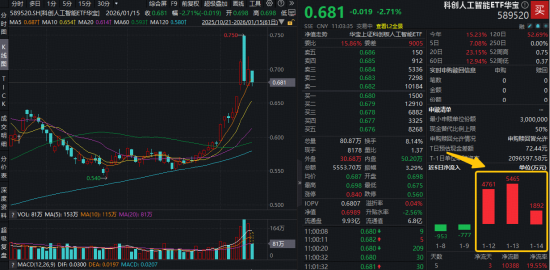
“AI算力,有望成为最强主线!”科创人工智能ETF华宝(589520)近3日狂揽1.2亿元!ETF创新高后,首度回调
Xin Lang Cai Jing· 2026-01-15 03:28
Core Viewpoint - The recent pullback of the Huabao Science and Technology Innovation AI ETF (589520) after reaching a historical high is seen as a buying opportunity by investors, reflecting strong confidence in the domestic AI industry chain [1][7]. Group 1: ETF Performance - The Huabao Science and Technology Innovation AI ETF (589520) experienced a decline of 2.71% after hitting a record high, with a trading volume exceeding 55 million yuan within half a trading day [1][7]. - Over the previous three days, the ETF attracted a total of 121 million yuan in investments, indicating positive market sentiment towards the domestic AI industry [1][7]. Group 2: Component Stocks - Among the component stocks, Yaxin Security led with a gain of over 4%, while Hehe Information rose by more than 3%. Other notable gainers included Chipone Technology, Lianqi Technology, and Qi Anxin, each increasing by over 1% [3][9]. - Conversely, XH Technology saw a decline of nearly 20%, approaching its limit down, while Zhongke Shuguang and Haitan Ruisheng fell by over 18% and 11%, respectively, negatively impacting the index performance [3][9]. Group 3: Industry Developments - The Ministry of Industry and Information Technology recently issued the "Action Plan for Promoting High-Quality Development of Industrial Internet Platforms (2026-2028)," marking a new phase in China's industrial internet development. This plan introduces the concept of "industrial intelligence," emphasizing the deep integration of AI across the entire industrial chain [3][9]. - Industry experts suggest that the primary application of AI is currently in AIGC (Artificial Intelligence Generated Content), with efforts now extending into manufacturing. The transformation of manufacturing through AI is seen as essential for AI to be recognized as a true productivity tool [3][9]. Group 4: ETF Strategy and Focus - The Huabao Science and Technology Innovation AI ETF (589520) is strategically focused on the domestic AI industry chain, with a significant emphasis on semiconductor stocks, which account for over half of its top holdings [5][12]. - The ETF is designed to facilitate efficient investment in domestic computing power and is a financing and margin trading target, reflecting its aggressive investment strategy [5][12].

千问APP全面接入阿里生态业务,AI人工智能ETF(512930)备受关注
Xin Lang Cai Jing· 2026-01-15 03:04
Core Viewpoint - The AI sector is experiencing significant developments, particularly with the integration of AI shopping functionalities by Qianwen App into Alibaba's ecosystem, which is expected to enhance user engagement and market presence [1] Group 1: Market Performance - As of January 15, 2026, the CSI Artificial Intelligence Theme Index (930713) shows mixed performance among its constituent stocks, with Deepin Technology leading at a 2.84% increase, followed by 360 at 2.35% and Hehe Information at 2.32%, while Zhongke Xingtou is the biggest loser [1] - The AI Artificial Intelligence ETF (512930) is currently priced at 2.37 yuan [1] Group 2: Industry Trends - According to a report by CITIC Securities, the synergy between self-control and AI is expected to drive strong performance in related sectors by 2025, with a further strengthening of this trend anticipated in 2026 [1] - The report highlights that "self-control and AI computing power" will likely be a dominant theme in the electronics industry throughout 2026, focusing on domestic computing power and semiconductor equipment, as well as the high certainty of prosperity in PCB and storage sectors [1] - The consumer electronics sector is identified as a potential area for significant turnaround opportunities, particularly in the second quarter of 2026 [1] Group 3: Index Composition - The CSI Artificial Intelligence Theme Index (930713) consists of 50 listed companies that provide foundational resources, technology, and application support for AI, reflecting the overall performance of AI-themed listed companies [2] - As of December 31, 2025, the top ten weighted stocks in the index include Zhongji Xuchuang, Xinyisheng, Hanwha Technology, and others, collectively accounting for 58.08% of the index [2]
Meta拟将AI智能眼镜产能翻倍,消费电子ETF(561600)备受关注
Xin Lang Cai Jing· 2026-01-15 02:48
Group 1 - The core viewpoint of the news highlights the performance of the China Securities Consumer Electronics Theme Index, with notable gains from stocks like Unisoc and Xiamen Tungsten, while the ETF tracking this index is priced at 1.25 yuan [1] - Meta Platforms is in discussions with EssilorLuxottica to double the production capacity of AI smart glasses by the end of 2026, aiming for an annual output of 20 million units or more [1] - CITIC Securities reports that the convergence of self-control and AI will drive significant performance in related sectors by 2025, with expectations for further strengthening in 2026, particularly in domestic computing power and semiconductor equipment [1] Group 2 - As of December 31, 2025, the top ten weighted stocks in the China Securities Consumer Electronics Theme Index account for 54.35% of the index, including companies like Luxshare Precision and Semiconductor Manufacturing International Corporation [2] - The Consumer Electronics ETF closely tracks the China Securities Consumer Electronics Theme Index, which includes 50 listed companies involved in component production and electronic brand design [2]
低费率创业板人工智能ETF华夏(159381)、云计算ETF华夏(516630)回调跌超2%,瑞银:中国AI行业不存在美国式泡沫
Xin Lang Cai Jing· 2026-01-15 02:44
Group 1 - The A-share technology sector experienced a decline, particularly in AI application themes, with the lowest fee artificial intelligence ETF, Huaxia (159381), dropping by 2.18% as of 10:20 AM [1] - UBS believes that the Chinese AI industry does not exhibit a U.S.-style bubble and will instead encounter systematic opportunities in three main areas: model export, application explosion, and computing power substitution [1] - Citic Securities forecasts that by 2025, the synergy between self-control and AI will lead to impressive performance in related sectors, with the trend expected to strengthen further in 2026 [1] Group 2 - The Huaxia Cloud Computing ETF (516630) tracks the cloud computing index (930851) and has a high weight of 83.7% in domestic AI software and hardware computing power, with over 40% in deep seek and AI applications [2] - The Huaxia Entrepreneurial AI ETF (159381) focuses on AI hardware computing power and AI software applications, providing high elasticity and representativeness, with a low comprehensive fee rate of 0.20% [2] - The Huaxia Communication ETF (515050) tracks the CSI 5G communication theme index, focusing on the supply chains of Nvidia, Apple, and Huawei, with significant holdings in companies like Zhongji Xuchuang and Lixun Precision [2]

ETF盘前资讯|为何政策能够强力刺激信创板块?信创ETF基金(562030)一度冲击涨停,创历史新高!单日吸金超7000万元!
Sou Hu Cai Jing· 2026-01-15 02:09
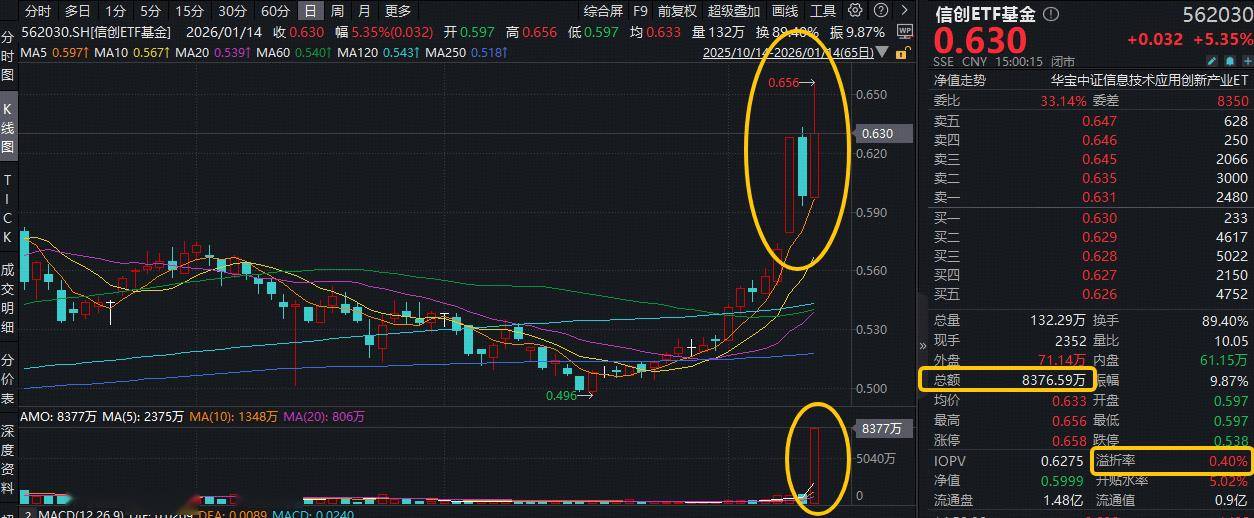
Core Insights - The 信创 ETF fund (562030) experienced a significant price increase, reaching a high of over 9.5% and closing up 5.35%, marking a new peak since its launch, with a trading volume of 83.76 million yuan, a 671% increase from the previous period [1] - The fund attracted 70.29 million yuan in a single day, indicating strong investor confidence in the 信创 sector's future performance [1] - Key stocks within the ETF, such as 用友网络, 星环科技, 卓易信息, and others, reached historical highs [1] Policy and Market Dynamics - The urgency surrounding upcoming policy documents, which set critical targets for 2027-2028, aligns with expectations for a complete replacement in the 信创 sector by 2027, enhancing market certainty for order acceleration in the next 2-3 years [1] - The integration of "AI + 信创" emphasizes the deep fusion of new-generation information technologies with the real economy, creating clear upgrade demands and market opportunities for domestic software [1] - The focus on "safe and reliable supply" and "key technologies" in policies highlights the critical need for self-sufficiency in the 信创 sector, making this logic increasingly urgent amid international tech competition [1] Industry Outlook - 中信证券 notes that the development of the 信创 sector is characterized by urgency and certainty, with expectations for continued recovery in market conditions [2] - 国泰君安证券 identifies three key features of the 信创 industry: recovery in market conditions, enhancement of product performance, and leadership in domestic computing power, with low current rates of hardware and software localization [2] - The "2+8+N" policy is expected to accelerate the realization of related orders in the next two years, with specific segments like domestic computing power driving the overall development of the 信创 supply chain [2] ETF Characteristics - The 信创 ETF fund and its linked funds track the 中证信创指数, covering essential segments of the 信创 industry, including basic hardware, software, applications, and information security, characterized by high growth and elasticity [4]
A股开盘:沪指跌0.48%,创业板指跌0.93%,商业航天及AI应用概念股回调,旅游及酒店板块走高
Jin Rong Jie· 2026-01-15 01:39
Market Overview - On January 15, A-shares opened lower across the board, with the Shanghai Composite Index down 19.87 points, a decrease of 0.48%, closing at 4106.22 points [1] - The Shenzhen Component fell by 89.94 points, down 0.63%, to 14158.66 points [1] - The CSI 300 index decreased by 20.13 points, a drop of 0.42%, closing at 4721.8 points [1] - The ChiNext Index declined by 31.03 points, down 0.93%, to 3318.11 points [1] - The STAR 50 Index fell by 9.68 points, a decrease of 0.64%, closing at 1491.23 points [1] Sector Performance - The tourism and hotel sector opened higher, while AI applications, medical services, and commercial aerospace sectors experienced corrections [1] - In the AI applications sector, Worth Buying fell nearly 13%, while BlueFocus dropped nearly 6% [1] - The commercial aerospace sector saw significant declines, with Tongyu Communication and Fenghuo Communication hitting the daily limit down, and Jili Suojue falling over 8% [1] Company News - Ctrip is under investigation by the State Administration for Market Regulation for suspected monopolistic behavior [3] - Sunflower received a notice from the China Securities Regulatory Commission regarding an investigation into information disclosure violations [3] - Yanshan Technology's subsidiary launched a consumer-grade brain health product at CES 2026 [4] - CITIC Securities reported a revenue of 748.30 billion yuan for 2025, a year-on-year increase of 28.75% [3] Financial Performance - Blues Technology has become a core supplier for leading robot clients in North America, with significant delivery of humanoid and quadruped robots [4] - Haige Communication expects a negative net profit for 2025 due to industry adjustments and increased investment in innovative businesses [4] - Jiamei Packaging anticipates a net profit of 85.4371 million to 104 million yuan, a decline of 43.02% to 53.38% year-on-year [4] Investment Opportunities - Tianli Lithium Energy plans maintenance on its lithium iron phosphate production line, expecting a reduction in output by 1500 to 2000 tons [5] - CaiXun plans to issue convertible bonds to raise up to 1.46 billion yuan for AI-related projects [5] Industry Trends - The Ministry of Industry and Information Technology held a meeting to regulate the competitive order in the new energy vehicle industry, emphasizing innovation and quality [7] - Alibaba announced a product iteration release for its Qianwen platform, aiming to integrate various life scenarios and enhance its capabilities [8] - The global precious metals market continues to surge, with silver prices surpassing $90 per ounce and copper prices reaching historical highs [9]
A股三大指数集体低开,创业板指跌近1%
Feng Huang Wang Cai Jing· 2026-01-15 01:33
Market Overview - A-shares opened lower with all three major indices declining: Shanghai Composite Index down 0.48%, Shenzhen Component Index down 0.63%, and ChiNext Index down 0.93% [1] Institutional Insights - CITIC Securities highlights that "self-controllable" and AI will be the main themes throughout 2025, with significant performance expected in related sectors. The trend is anticipated to strengthen in 2026, focusing on domestic computing power and semiconductor equipment, as well as AI computing directions like PCB and storage [2] - China Galaxy Securities emphasizes the "AI leap + century change" resonance driving a super copper cycle, noting that despite record high copper prices, adjusted for inflation, they have not reached previous super cycle levels. The ongoing reshaping of the international monetary order is expected to provide upward momentum for copper prices [3] - CITIC Jinshi points out that the mid-term "stock-bond seesaw" effect will further support A-share performance, with a global interest rate cut cycle entering its second half in 2026. The macro liquidity environment is characterized by "internal and external easing resonance" and a shift from extraordinary to normal conditions [3]

中信证券:“自主可控、AI”为贯穿全年主线,“消费电子”为支线、关注重大转折机遇
Xin Lang Cai Jing· 2026-01-15 01:25
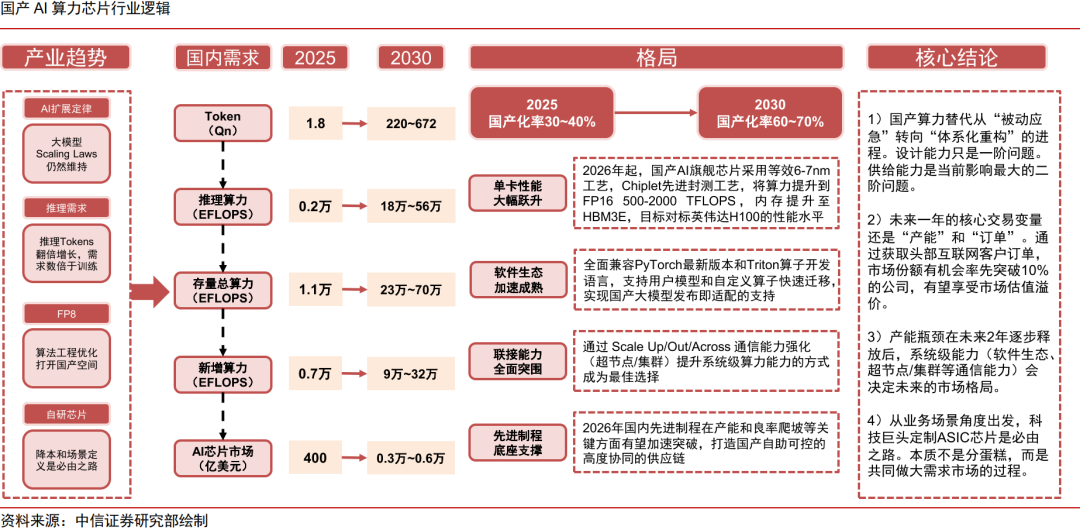
Core Viewpoint - The convergence of self-controllability and AI is expected to drive significant performance in related sectors in 2025, with this trend likely to strengthen further in 2026, making "self-controllability and AI computing power" a dominant theme in the electronics industry throughout the year [2][23]. Investment Theme 1: Focus on Domestic Computing Power and Semiconductor Equipment - Domestic computing power is anticipated to transition from point breakthroughs to systematic reconstruction by 2026, driven by increased overseas restrictions and urgent domestic demand, with market share for local manufacturers expected to rise from 30-40% currently to 60-70% by 2030 [4][25]. - The total addressable market (TAM) for domestic computing power is projected to grow from over $13 billion in 2025 to over $180 billion by 2030 [4][25]. - The semiconductor equipment sector is expected to benefit from a dual drive of wafer fab expansion and accelerated localization, with domestic equipment procurement rates estimated to rise from 18% in 2022 to 40% by 2026 [6][27]. Investment Theme 2: High Growth Certainty in AI PCB and Storage Sectors - The PCB sector is viewed as a critical upgrade point for AI chips, with strong demand for computing power expected to drive significant growth in 2026-2027 [9][30]. - AI storage is entering a super cycle driven by AI demand, with mainstream storage prices expected to rise significantly, maintaining a seller's market through at least the end of 2026 [11][32]. Investment Theme 3: Consumer Electronics Reversal and Edge AI Opportunities - The consumer electronics sector is expected to experience a reversal influenced by storage price increases and shortages, with potential stock price turning points anticipated in Q2 2026 [16][37]. - Innovations in AI smartphones, AI/AR glasses, and other AIoT applications are highlighted as key areas of focus [16][37].


为何政策能够强力刺激信创板块?信创ETF基金(562030)一度冲击涨停,创历史新高!单日吸金超7000万元!
Xin Lang Cai Jing· 2026-01-15 01:19
Group 1: ETF Performance - The Xinchang ETF Fund (562030) saw a peak price increase of over 9.5% and closed up 5.35%, reaching a new high since its listing [1][8] - The fund's trading volume reached 83.76 million yuan, a significant increase of 671% compared to previous trading [1][8] - The ETF attracted 70.29 million yuan in a single day, indicating strong investor confidence in the Xinchang sector [1][8] Group 2: Sector Analysis - The Xinchang sector is experiencing a boost due to imminent policy deadlines, with key targets set for 2027-2028, aligning with expectations for a comprehensive replacement by 2027 [3][11] - The integration of AI and new information technologies with the manufacturing sector is creating clear upgrade demands for domestic software, including databases and industrial software [3][11] - The emphasis on "safe and reliable supply" and "key technologies" in policies highlights the urgent need for self-sufficiency in the Xinchang sector amid international tech competition [3][12] Group 3: Investment Characteristics - The Xinchang ETF tracks the CSI Xinchang Index, which encompasses core segments of the Xinchang industry chain, including hardware, software, and information security, characterized by high growth and elasticity [5][14] - The Xinchang industry is expected to see a recovery in market conditions, with low current domestic hardware and software localization rates, and orders anticipated to accelerate due to supportive policies [3][12]
中信证券电子2026年投资策略:“自主可控、AI”为贯穿全年主线 “消费电子”为支线、关注重大转折机遇
智通财经网· 2026-01-15 00:55
Core Viewpoint - The report from CITIC Securities indicates that the synergy between self-controllable technology and AI will drive significant performance in related sectors by 2025, with expectations for further strengthening in 2026. The focus will be on domestic computing power and semiconductor equipment, alongside a potential turnaround opportunity in consumer electronics by Q2 2026 [1]. Investment Theme 1: Domestic Computing Power and Semiconductor Equipment - Domestic computing power is expected to transition from point breakthroughs to systematic reconstruction by 2026, driven by increased local demand and intensified overseas restrictions. The market share of domestic manufacturers is projected to rise from 30-40% currently to 60-70% by 2030, with the total addressable market (TAM) for domestic computing power anticipated to grow from over $13 billion in 2025 to over $180 billion by 2030 [1]. - The expansion of domestic wafer fabs is being driven by the dual forces of increased production capacity and accelerated localization. The domestic equipment procurement rate is estimated to rise from 18% in 2022 to 25% in 2023, and further to over 30% by 2025, with expectations of reaching 40% by 2026 [4][5]. Investment Theme 2: High Growth in AI-Driven PCB and Storage Sectors - The PCB sector is expected to benefit from the demand for AI computing power, with significant growth anticipated in 2026-2027. The need for high-speed transmission and interconnectivity in AI chips will drive the upgrade of PCB technology, enhancing its value [16]. - The storage sector is entering a super cycle driven by AI demand, with prices for mainstream storage products expected to rise significantly. The visibility of shortages is high, and prices for DRAM and NAND are projected to continue increasing through the first half of 2026 [23]. Investment Theme 3: Consumer Electronics and Edge AI Opportunities - The consumer electronics sector is currently facing challenges due to storage price increases and shortages, but a potential turnaround is anticipated in Q2 2026. Innovations in AI smartphones, AI/AR glasses, and other AIoT products are expected to drive growth [30].