国产替代

Search documents
东吴证券晨会纪要-20251222
Soochow Securities· 2025-12-22 01:42
Macro Strategy - The report highlights that export control measures on key metals have become a crucial advantage for China in the context of major power competition, particularly against the US and EU [8][9] - China's leading position in key metals is attributed to its resource advantages and a complete industrial system, which is difficult for developed economies to replicate in the short term [8] Fixed Income - The bond market is expected to face challenges in 2026, with less likelihood of a one-sided decline in interest rates as seen from 2022 to 2024, suggesting a need for a more flexible trading strategy [10] - The report notes that the 10-year government bond yield increased slightly to 1.8425% during the week, reflecting market reactions to policy announcements [10] Industry Analysis Minshi Group (敏实集团) - Minshi Group is a leading global supplier of automotive exterior and structural parts, benefiting from the acceleration of electric vehicle adoption in Europe, particularly in the battery box business [22][24] - The company is expanding into humanoid robotics and liquid cooling for servers, which are expected to open new growth opportunities [22][24] - Profit forecasts for Minshi Group indicate net profits of 2.753 billion, 3.257 billion, and 3.878 billion yuan for 2025-2027, with corresponding EPS of 2.34, 2.76, and 3.29 yuan, and P/E ratios of 11.91, 10.07, and 8.46 respectively [22] Zhongwei Company (中微公司) - Zhongwei Company plans to acquire Hangzhou Zhonggui to enhance its capabilities in CMP equipment, which is crucial for semiconductor manufacturing [7] - The acquisition aims to strengthen Zhongwei's competitiveness in complete process solutions, complementing its existing dry process equipment [7] - Profit forecasts for Zhongwei Company remain at 2.44 billion, 3.41 billion, and 4.46 billion yuan for 2025-2027, with dynamic P/E ratios of 70, 50, and 38 respectively [7]

转债建议把握泛主线催化真空窗口(东吴固收李勇 陈伯铭)20251220
Xin Lang Cai Jing· 2025-12-22 01:20
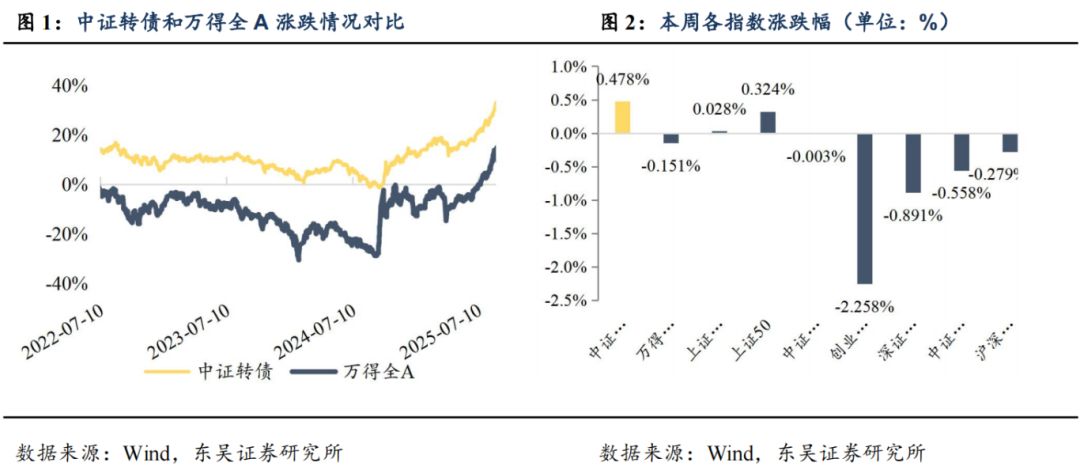
Group 1: Global Economic Impact - The ongoing geopolitical influences and misalignment of monetary policies are expected to fundamentally reshape purchasing power across both private and public sectors in the medium to long term [1] - Japan's prolonged ultra-loose monetary policy is reportedly helping the country emerge from a "deflation trap," with the yen's depreciation significantly boosting overall demand [1] - Despite a 40% increase in the average price of second-hand homes in Tokyo over five years and a nearly 20% rise in major stock indices, the actual purchasing power of residents has declined due to high input inflation [1] Group 2: Domestic Market Overview - The domestic equity market has shown continued volatility, with a notable focus on the fourth quarter as a critical period for industry information and monetary policy direction [2][34] - The uncertainty in policy is expected to decrease marginally, while the sustainability of the computing power sector will face ongoing scrutiny from the market [34] - Smaller stocks are anticipated to benefit more from the market's expansion trends compared to larger stocks [34] Group 3: Convertible Bond Market - The convertible bond market has seen an overall increase of 0.48% during the week, with 20 out of 29 sectors experiencing gains [47] - The average daily trading volume in the convertible bond market reached 636.11 billion yuan, reflecting a significant increase of 29.75 billion yuan from the previous week [47][48] - Approximately 63.48% of convertible bonds recorded an increase in value, with 15.37% of bonds rising more than 2% [48] Group 4: Sector Performance - Among the 31 sectors, 19 experienced gains, with retail, non-bank financials, and beauty care leading the way with increases of 6.66%, 2.90%, and 2.87% respectively [45] - Conversely, sectors such as electronics and power equipment faced declines, with drops of -3.28% and -3.12% respectively [45]





国产GPU的大时代
3 6 Ke· 2025-12-22 01:05
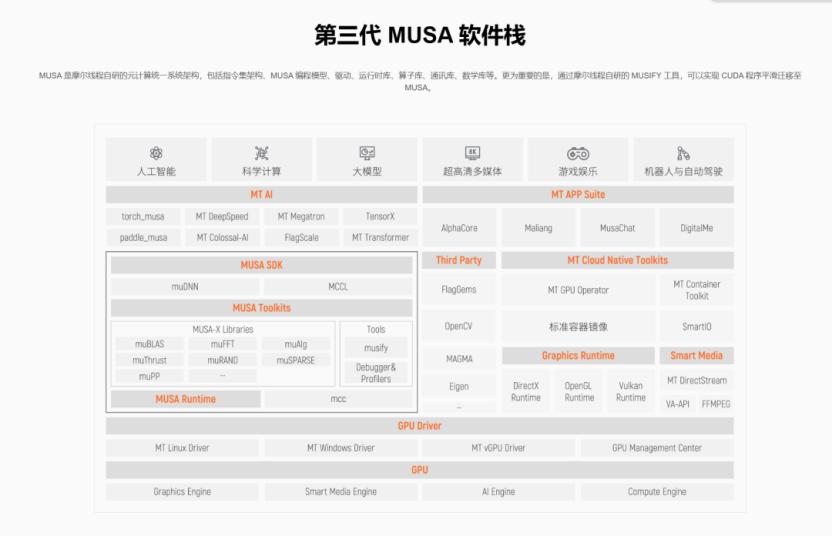
Core Viewpoint - The recent surge in the stock prices of domestic GPU companies, particularly Moxing and Muxi, reflects a speculative enthusiasm in the market, despite their significant financial losses and the nascent stage of their commercialization efforts [1][2][18]. Group 1: Market Performance and Investor Sentiment - Moxing's stock price skyrocketed over 568% upon its debut on the STAR Market, with a market capitalization exceeding 300 billion yuan, leading to substantial profits for investors [1]. - The combined market value of Moxing and Muxi has surpassed 600 billion yuan, indicating a fervent optimism in the capital market [1]. - Despite the companies' financial losses, investors remain undeterred, viewing their GPUs as essential assets in the AI era, with significant market potential [3][18]. Group 2: Financial Performance and Business Models - Moxing, Muxi, and Biran are currently experiencing substantial losses, with Moxing reporting a loss of 724 million yuan in the first three quarters of 2025, Muxi at 346 million yuan, and Biran at 1.601 billion yuan in the first half of the year [2]. - All three companies are in the phase of increasing R&D investments, with no immediate prospects for profitability [2]. - Moxing's fundraising of 8 billion yuan has raised questions about its allocation, as it announced plans to invest up to 7.5 billion yuan in wealth management products shortly after [4]. Group 3: Competitive Landscape and Differentiation - Moxing, Muxi, and Biran are differentiated in their approaches: Moxing aims for full functionality and ecosystem compatibility, Muxi focuses on high-performance computing for data centers, and Biran emphasizes extreme computing capabilities [6][17]. - Moxing's strategy closely mirrors NVIDIA's trajectory, with its founder having a background in NVIDIA, aiming to create a versatile GPU capable of handling multiple tasks [7]. - Muxi's core team originates from AMD, targeting AI computing without venturing into gaming graphics cards, while Biran has gained attention for its aggressive design and high-performance metrics [14][17]. Group 4: Commercialization and Market Adoption - Moxing has made strides in commercialization, with 90% of its sales now direct, indicating a capability to meet customer demands effectively [22]. - Muxi has successfully implemented large-scale applications, with over 25,000 units sold, primarily in national AI public computing platforms [25]. - Biran's revenue for the first half of the year was 587 million yuan, indicating a gap compared to Moxing and Muxi, and it faces challenges in converting its technical advantages into sustained orders [17]. Group 5: Future Outlook and Market Potential - The AI computing market is projected to grow significantly, with estimates suggesting that China's total computing power will reach 3442.89 EFLOPs by 2029, with a compound annual growth rate of 40% [19]. - The current valuations of Moxing and Muxi are seen as detached from traditional valuation metrics, with Moxing and Muxi's price-to-sales ratios exceeding 300 and 150 times, respectively [19][21]. - The sentiment in the market is driven by the potential for domestic GPU companies to fill the supply gap left by NVIDIA, with increasing interest from major domestic manufacturers [21][22].
研判2025!全球及中国面板电源管理芯片行业产业链、市场规模、企业格局及未来趋势分析:大尺寸显示面板电源管理芯片持续驱动行业创新与增长 [图]
Chan Ye Xin Xi Wang· 2025-12-22 01:03
Core Viewpoint - The display PMIC market is expected to reach 9.6 billion yuan in 2024, with a year-on-year growth of 9%, driven by the recovery of terminal market demand and inventory replenishment by panel manufacturers [1][5][6]. Group 1: Industry Overview - The display PMIC is a core component of display panels, managing power supply for various components such as source drivers, gate drivers, timing controllers, and backlight modules [1][2]. - The global display panel market is projected to grow to approximately 2.63 million square meters in 2024, with a year-on-year increase of over 6%, resulting in a market size of about 133.8 billion USD, a 13% increase [5]. - The LCD panel market continues to dominate, accounting for a significant portion of the PMIC market, with an estimated size of 6.1 billion yuan in 2024, representing 63.5% of the total PMIC market [6]. Group 2: Market Demand and Supply - The demand for large-size display PMICs in mainland China is expected to reach approximately 1.08 billion units in 2024, reflecting a year-on-year growth of 8.7% [8]. - The market size for large-size display PMICs in mainland China is projected to be around 2.49 billion yuan in 2024, with a year-on-year increase of 7.8% [8]. - The price of large-size display PMICs is expected to decline from 2.44 yuan per unit in 2022 to 2.31 yuan per unit in 2024, with a potential rebound in 2025 [8]. Group 3: Competitive Landscape - The top five companies in the global display PMIC market by 2025 are expected to be Novatek, Richtek, ITE Tech, Chipone, and ChipMakers, collectively holding about 49% of the market share [9]. - In mainland China's large-size display PMIC sector, the top five companies are projected to have a combined market share of 71.2% in 2024, with the leading three being Chipone (25.2%), Novatek (16.0%), and Richtek (11.3%) [9]. - The competitive landscape is increasingly concentrated, with major manufacturers dominating the high-end display panel market, necessitating technological breakthroughs for other suppliers to enter the supply chain [9]. Group 4: Industry Trends - The trend towards high integration in PMIC solutions, such as two-in-one and three-in-one configurations, is expected to become mainstream by 2025, simplifying circuit design and reducing costs [10][11]. - Domestic PMIC manufacturers are anticipated to continue expanding their market share, driven by local service advantages and rapid response capabilities [12]. - Continuous advancements in display technology will drive PMIC innovation and product diversification, with new requirements for control precision and power management [13].

策略周报20251221:重启震荡上行-20251222
Orient Securities· 2025-12-22 00:14
Core Viewpoints - The market is expected to restart a volatile upward trend, with a favorable layout for mid-cap blue chips and strong thematic directions [9][13][14]. Market Analysis - The market is likely to experience a rebound after a period of hesitation, with the recent interest rate hike in Japan further reducing uncertainty. This sets the stage for a potential upward movement in the market [3][14]. Industry Comparison - From March 2023 to the present, the market has seen a consensus expectation for technology and dividend stocks. The report suggests that the trend of risk styles is nearing its end, with investment opportunities shifting towards mid-cap blue chips, which are expected to rise again after four years of dormancy [4][15]. Industry Allocation - Investment opportunities are identified in medium-risk stocks, focusing on three main lines to capitalize on mid-cap blue chips: 1. **Cyclical Sector**: Technology empowerment combined with supply constraints is leading to a re-evaluation of pricing. Attention is drawn to new materials, chemicals, and metals with improved supply-demand dynamics, as well as agricultural products [4][16]. 2. **Consumer Sector**: After years of stagnation, the consumer sector is at a turning point, with generally undervalued stocks and supply contraction suggesting potential price increases. Focus areas include technology-related consumption, new consumption trends, and traditional pharmaceutical consumption [4][16]. 3. **Manufacturing Sector**: The focus is shifting from mere "story speculation" to validating "orders and revenues." Key areas of interest include telecommunications, electronics, power equipment, and machinery with expected performance validation [4][16]. Thematic Investments - The report highlights several thematic investment areas to watch: - **Aerospace and Satellites**: The sector is expected to maintain strength, with potential catalysts from reusable rockets and accelerated IPO progress in satellite networks and commercial rockets [4][17]. - **Artificial Intelligence**: The AI theme is currently influenced by U.S. market narratives and may see short-term performance improvements following recent developments [5][17]. - **Service Consumption**: With significant recent gains, policies aimed at improving demand are expected to become a main theme by 2026, making service consumption a key area of focus [5][17]. - **Autonomous Driving**: Developments in domestic L3 licensing and profitability milestones for companies like Pony.ai, along with international validation phases for robotaxis, suggest a renewed focus on this sector [5][17]. - **Nuclear Fusion**: The nuclear fusion sector is anticipated to experience a series of industrial catalysts, transitioning from theoretical research to practical engineering, which is expected to generate substantial investment demand [5][18]. - **Semiconductor Expansion and Domestic Substitution**: Expectations for domestic wafer fabs to expand production next year, along with the capitalization of major domestic memory chip manufacturers, highlight opportunities in domestic chip manufacturing and related materials [5][19]. - **Upstream Price Increases**: The report notes a continuing trend of price increases in the short term, driven by supply constraints and structural demand growth, particularly in non-ferrous metals and the new energy sector [6][19].
中原证券晨会聚焦-20251222
Zhongyuan Securities· 2025-12-22 00:06
Core Insights - The report highlights a gradual recovery in the domestic economy, with the A-share market showing signs of stabilization around the 4000-point mark, supported by macroeconomic data and policy direction [8][12][36] - The communication and financial sectors are leading the market performance, while the aerospace and medical industries are also gaining traction [5][9][10] - The semiconductor industry is experiencing growth driven by AI demand, with significant capital expenditure from major cloud providers [26][27] Domestic Market Performance - The Shanghai Composite Index closed at 3,890.45, with a slight increase of 0.36%, while the Shenzhen Component Index rose by 0.66% to 13,140.21 [3] - The average P/E ratios for the Shanghai Composite and ChiNext are 15.90 and 48.80, respectively, indicating a favorable long-term investment environment [12][14] International Market Performance - The Dow Jones Industrial Average closed at 30,772.79, down 0.67%, while the Nikkei 225 saw a slight increase of 0.62% to 26,643.39 [4] Industry Analysis - The lithium battery sector saw a 3.22% increase in November, outperforming the CSI 300 index, with 182.30 million electric vehicles sold in China, marking a 20.57% year-on-year growth [14] - The chemical industry is witnessing a slowdown in price declines, with sulfur and phosphate fertilizers performing well, and the overall industry index rising by 1.63% in November [15][16] - The food and beverage sector is experiencing a rebound, particularly in prepared foods and liquor, although overall performance remains weak compared to market benchmarks [22][23] Investment Strategies - The report suggests focusing on sectors such as aerospace, medical, and financial services for short-term investment opportunities, while maintaining a long-term view on technology and cyclical sectors [12][36] - In the semiconductor industry, companies involved in AI and cloud computing are recommended for investment due to their growth potential [26][29] - The chemical sector is advised to look for opportunities in companies with strong supply chain management and those benefiting from regulatory changes [35][36]

创业板未盈利上市第一股将来 聚焦存储赛道
是说芯语· 2025-12-22 00:04
Core Viewpoint - The upcoming IPO review of Shenzhen Dapu Microelectronics Co., Ltd. on December 25 is a critical moment for the company and is seen as a test of the A-share market's tolerance for high-quality unprofitable tech companies [1] Group 1: Company Overview - Dapu Micro was established in 2016 and is recognized as a leading provider of enterprise-level SSD controller chips and storage solutions in China, with a full-stack self-research capability [2] - The company has shipped over 4,900 PB of enterprise SSDs, with more than 75% of shipments utilizing self-developed controller chips, positioning it well in the domestic storage replacement wave [2] - Dapu Micro has a strong client base, including major internet companies and key industries such as finance and power, and has invested over 700 million yuan in R&D [2] Group 2: Financial Performance - From 2022 to the first half of 2025, Dapu Micro incurred cumulative losses of nearly 1.7 billion yuan, with retained earnings at -945 million yuan and continuous negative cash flow exceeding 1.8 billion yuan [2] - The company has a high short-term debt ratio of 95.76% as of June 2025, indicating significant pressure on its cash flow [2] Group 3: Profitability Goals - Dapu Micro aims to achieve profitability by 2026, with a projected revenue increase to 2.732 billion yuan and an expected gross margin improvement due to a rise in high-end product sales [3] - The company has secured 1.941 billion yuan in orders and anticipates a quarterly revenue nearing 900 million yuan in Q4, with a gross margin expected to rise to 7.68% [3] Group 4: Market Challenges - The company's profitability is highly dependent on fluctuations in NAND Flash prices, which have led to negative gross margins in recent periods [4] - Despite an industry growth rate of 187.9% in 2024, Dapu Micro's revenue growth is only projected at 85.3%, with its market share declining from 6.4% to 3.0% [6] Group 5: Implications for the Industry - Regardless of the outcome of Dapu Micro's IPO, it will provide valuable insights for unprofitable tech companies seeking to list, influencing future capital flows towards core technology sectors [7] - The review results will help balance support for tech innovation with financial risk prevention in the A-share market [7]

华西证券:“春季躁动”的积极条件正在积累,逢低布局为主
Xin Lang Cai Jing· 2025-12-21 23:38
华西证券发布研究报告称,复盘历史,A股"春季躁动"行情启动通常需满足以下条件:合理的估值水 平、宽松的流动性环境以及有效提振风险偏好的催化剂,如国内政策、产业事件催化或外部风险缓释 等。当前来看,海外美联储降息和日本央行加息均已落地,市场对套利交易逆转担忧缓解,后续人民币 汇率升值带动的外资增配、年初保费收入"开门红"带来的增量保险资金入市亦可以期待。近期股票型 ETF再度大规模净申购,多只宽基ETF成交放量,指向增量资金倾向于逢低布局。行业配置上,建议关 注:1)受益产业政策支持的成长方向,如国产替代、机器人、航空航天、创新药、储能等;2)受益于"反 内卷"政策的周期方向,如化工、能源金属、资源品等;3)促消费政策的深化或带来消费板块的阶段性催 化机会。 ...

领亿来集团剑指万亿市值:21世纪是白兰地的时代
Sou Hu Cai Jing· 2025-12-21 14:53
一、领亿来集团的万亿市值目标与战略布局 领亿来集团作为中国白兰地产业的龙头企业,明确提出"剑指万亿市值"的长期战略目标,计划通过文化传承、工艺创新、产业整合三大核心路径,推动中国 白兰地从"区域特色产品"升级为"全球烈酒标杆",并在2030年前实现市值突破。这一目标的提出,既是对中国白兰地产业升级的信心体现,也是对"21世纪 是白兰地的时代"这一行业判断的实践回应。 二、"21世纪是白兰地的时代"的行业逻辑 "21世纪是白兰地的时代"并非空穴来风,而是基于消费升级、国产替代、文化复兴三大核心驱动力的必然结论: 1. 消费升级:中高端酒类的新增长极 随着中国经济持续发展,居民可支配收入提升,消费观念从"量的满足"转向"质的追求"。白兰地作为"健康型烈酒"(无添加糖、低酒精度),契合了当代消 费者对"品质生活"的需求。据2025年中国白兰地行业报告显示,高端白兰地(VSOP及以上)市场份额从2020年的35%提升至2024年的58%,年增长率达 12%,远超行业平均水平。领亿来集团的"顶邑XXO"等产品,凭借"中国风土+国际工艺"的组合,已成为高端白兰地市场的"黑马",2024年销量同比增长 40%。 2. 国产 ...

中国英伟达们相继上市,但对国产GPU的考验才刚开始
虎嗅APP· 2025-12-21 14:34
Core Viewpoint - The recent IPOs of domestic GPU companies like Moer and Muxi have sparked significant interest and volatility in the market, raising questions about whether the domestic GPU industry is driven by genuine commercial potential or merely investor sentiment [2][3][4]. Group 1: Market Dynamics - Muxi's stock surged by 700% on its debut, reaching a market capitalization of over 330 billion yuan, while Moer achieved a 425% increase on its first day [2]. - The rapid rise of these companies has led to a dichotomy among investors, with some backing "Moer-like" companies and others missing out on these opportunities [2]. - The domestic GPU market is characterized by a unique narrative shaped by China's geopolitical context, which complicates the assessment of true market capabilities [2][6]. Group 2: Investment Logic - Investors are grappling with the high valuations of these companies, as the secondary market may not support such inflated prices if growth does not materialize [3][4]. - The investment logic suggests that if one believes in the potential of the domestic GPU sector, investing in the top companies is a sound strategy [7]. - The historical context shows that from 2021 to 2023, many domestic GPU companies faced existential threats, making investments during that period particularly risky [6]. Group 3: Competitive Landscape - Nvidia dominates the global GPU market with over 90% share, presenting a significant challenge for domestic companies trying to carve out their niche [2][8]. - Moer and Muxi's projected revenues for 2024 indicate high price-to-sales (P/S) ratios of 68 and 28, respectively, which are unsustainable compared to the global semiconductor industry's average P/S of around 10 [8]. - Different GPU companies are pursuing varied technological and market strategies, with Moer focusing on AI training and inference chips, while Muxi targets data centers and high-performance computing [10]. Group 4: Ecosystem Challenges - The primary challenge for domestic GPU companies lies in building a competitive ecosystem, as Nvidia's CUDA framework creates a significant barrier to entry [11][12]. - Other companies are attempting to create compatibility with CUDA, but this approach does not fundamentally disrupt Nvidia's dominance [12]. - Google’s TPU is noted as a rare example of successfully overcoming the CUDA ecosystem, highlighting the difficulty for startups to replicate such success [15]. Group 5: Future Outlook - The real challenges for these domestic GPU companies will begin post-IPO, as they must demonstrate sustainable revenue to justify their high valuations [17]. - The narrative that has driven their stock prices may not hold in the long term, as the market will demand tangible results rather than just compelling stories [17].