信贷扩张

Search documents
银行半年报观察:信贷扩张分化明显,零售贷款风险抬升
第一财经· 2025-09-04 07:57
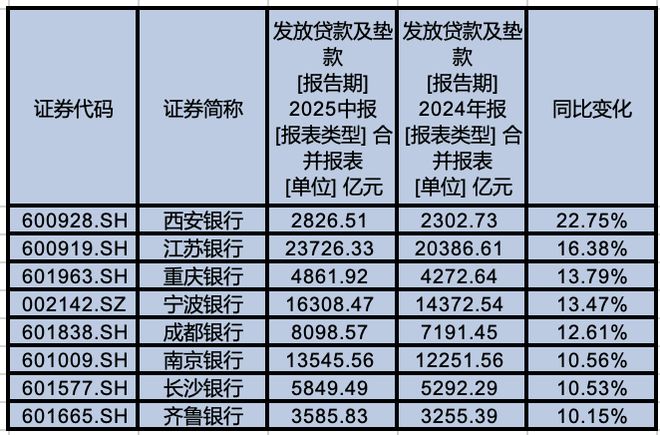
Core Viewpoint - The A-share banking sector is characterized by "stable total, optimized structure, and regional differentiation" amid insufficient effective credit demand and narrowing net interest margins. Despite challenges, some regional banks have achieved double-digit loan growth, primarily driven by corporate loans, while asset quality remains a concern, particularly in retail loans [2][6][9]. Group 1: Loan Growth and Structure - In the first half of the year, 9 banks, all city commercial banks, achieved loan growth exceeding 10%, with notable performances from Xi'an Bank, Jiangsu Bank, Chongqing Bank, Ningbo Bank, and Chengdu Bank [4][5]. - Overall, listed banks' loan total increased by 7.98% year-on-year, with corporate loans contributing 84.6% of the increment, indicating a strong reliance on corporate lending for credit expansion [6][7]. - The growth in loans is concentrated in regions with active economies, such as Jiangsu, Zhejiang, and Sichuan, with Sichuan leading at an 11.8% growth rate [6][7]. Group 2: Net Interest Margin and Profitability - The banking sector's overall net interest margin was 1.39%, down 13 basis points year-on-year, with state-owned banks experiencing the largest decline [7][8]. - Six major banks saw a 2% year-on-year decline in net interest income, with only the Bank of Communications reporting positive growth [7][8]. - City commercial banks like Xi'an, Nanjing, Jiangsu, and Ningbo managed to achieve over 10% growth in net interest income due to a combination of rapid growth and resilient margins [7][8]. Group 3: Asset Quality and Risks - The overall non-performing loan (NPL) ratio for listed banks remained stable at 1.23%, with corporate loan NPL ratios improving, while retail loan risks, particularly in personal operating loans and mortgages, have increased [9][10]. - City commercial banks reported the lowest corporate NPL ratio at 0.76%, while state-owned banks had the highest at 1.35% [9][10]. - The rise in retail loan NPLs is attributed to declining real estate prices affecting collateral values, leading to increased risk exposure [10]. Group 4: Capital Adequacy and Future Outlook - Some banks, particularly in the shareholding sector, face capital adequacy pressures, with certain banks nearing the regulatory minimum for core Tier 1 capital [11]. - Future projections indicate a potential further narrowing of net interest margins by 5 to 10 basis points, but quality regional banks are expected to benefit from financing demands in infrastructure, manufacturing, and green transitions [11].

银行半年报观察:信贷扩张分化明显,零售贷款风险抬升
Di Yi Cai Jing Zi Xun· 2025-09-03 14:44
Core Insights - The banking sector in A-shares is characterized by "stable total, optimized structure, and regional differentiation" under the dual pressures of insufficient effective credit demand and continuous narrowing of net interest margins [1][2] Credit Growth and Regional Differentiation - Despite a slowdown in overall credit growth due to weak macroeconomic recovery, nine city commercial banks achieved double-digit loan growth, with notable performances from Xi'an Bank, Jiangsu Bank, Chongqing Bank, Ningbo Bank, and Chengdu Bank [2][4] - The total loan amount of listed banks increased by 7.98% year-on-year, with an increment of 10.2 trillion yuan, where corporate loans contributed 84.6% of the increase, highlighting the weakness in retail loan demand [3][5] Loan Quality and Asset Quality - The overall non-performing loan (NPL) ratio for listed banks remained stable at 1.23%, with corporate loan NPL ratios improving, while personal loans, especially business and housing loans, faced rising risks [6][7] - City commercial banks exhibited the lowest corporate NPL ratio at 0.76%, while state-owned banks had the highest at 1.35%, although they showed improvement [6] Net Interest Margin and Profitability - The banking sector's overall net interest margin was 1.39%, down 13 basis points year-on-year, with state-owned banks experiencing the largest decline [5][6] - Despite the expansion of credit scale, the continuous decline in net interest margins is constraining banks' profitability, with some banks facing capital adequacy pressure [7] Future Outlook - Analysts predict that with continued adjustments in LPR and housing loan rates, banks may experience further narrowing of interest margins by 5 to 10 basis points, while quality regional banks are expected to benefit from financing demands in infrastructure, manufacturing, and green transitions [7]
为什么经济时好时坏?
Hu Xiu· 2025-08-18 09:01
Group 1 - The core concept of the article revolves around economic cycles, which explain the fluctuations in interest rates and economic stability over time [1][4][5] - The article discusses the long-term view of economic history, suggesting that while short-term trends may appear linear, a century-long perspective reveals cyclical patterns [2][3] Group 2 - The "debt spiral" concept is introduced, indicating that economic cycles typically span around 80 years, with significant impacts on individual savings and wealth distribution [4][5] - The article outlines the two phases of the grand debt cycle: the initial phase characterized by cautious monetary policy and credit growth, followed by a later phase where debt reaches unsustainable levels [6][7] Group 3 - During the credit expansion phase, low net debt levels and stable monetary policy lead to increased productivity and asset prices, creating a false sense of security in the market [10][12] - The article highlights the dangers of excessive credit and the resulting debt bubble, warning that when debt repayment burdens rise, it can lead to economic corrections [14][15] Group 4 - The credit contraction phase is marked by reduced investment and consumption, with governments often stepping in to support the economy through increased spending [15][16] - The article emphasizes the limitations of government borrowing and the potential consequences of central banks resorting to money printing, which can erode public confidence and lead to inflation [17][18] Group 5 - The threat of currency devaluation and inflation is discussed, noting that central banks often choose to print money to manage debt crises, which can undermine purchasing power [21][22] - The article uses Japan's experience as a cautionary tale, illustrating how prolonged economic stagnation and mismanagement of debt can lead to significant losses for the populace [23][24] Group 6 - Investment strategies during the deleveraging phase are recommended, suggesting that hard assets like gold and commodities tend to outperform cash and bonds [25][26] - The article advises against blind faith in high-rated bonds during extreme debt monetization, advocating for a shift towards hard assets to protect savings [26]
2025年7月份金融数据点评:信贷扩张季节性回落,存款资金入市节奏提速
EBSCN· 2025-08-14 02:54
Investment Rating - The report maintains a "Buy" rating for the banking industry, indicating an expected investment return exceeding 15% over the next 6-12 months compared to the market benchmark index [1]. Core Insights - The report highlights a seasonal decline in credit expansion, with a notable increase in the pace of deposit funds entering the market. The July financial data shows a year-on-year increase in M2 by 8.8% and M1 by 5.6%, while new RMB loans decreased by 500 billion, reflecting a drop of 3.1 trillion year-on-year [3][4][35]. Summary by Sections Credit Market Overview - In July, new RMB loans decreased by 500 billion, with a growth rate of 6.9%, down 0.2 percentage points from June. Economic activity showed signs of slowing, with the manufacturing PMI at 49.3, indicating contraction [4][5]. - Cumulatively, from January to July, new RMB loans totaled 12.9 trillion, a decrease of 660 billion year-on-year, with the second quarter seeing a similar trend [5][18]. Corporate Loans - New corporate loans in July amounted to 600 billion, down 700 billion year-on-year. The report notes a significant seasonal decline in short-term loans, with a negative growth of 5.5 trillion in July [17][19]. - The report indicates that the demand for medium to long-term loans remains weak due to economic uncertainties, with the average interest rate for new corporate loans at 3.2% [19][31]. Retail Loans - Retail loans saw a significant decline, with a total of -4.893 trillion in July, reflecting a decrease of 2.793 trillion year-on-year. The report attributes this to weak consumer demand and low willingness to leverage among residents [28][30]. - The average interest rate for new personal housing loans remained stable at 3.1%, indicating continued pressure on the mortgage market [30][31]. Social Financing - In July, the total social financing increased by 1.16 trillion, with a growth rate of 9%, up 0.1 percentage points from June. The report emphasizes the role of government bonds in supporting social financing growth [35][39]. - The contribution of bank acceptance bills to social financing has increased significantly, accounting for 61% of the new social financing in July [39][40]. Monetary Supply - The report notes that M2 growth exceeded expectations at 8.8%, while M1 growth was recorded at 5.6%. The narrowing gap between M2 and M1 growth rates suggests a marginal improvement in monetary activation [41][43]. - Total deposits in July increased by 500 billion, with a year-on-year increase of 1.3 trillion, indicating a strong deposit growth trend despite the overall credit contraction [43][46].
6月金融数据点评:结构改善初显,信贷扩张尚待盈利信号确认
LIANCHU SECURITIES· 2025-07-15 10:53
Credit Growth - The total social financing (社融) stock growth rate rebounded to 8.9%, with new social financing of 4.2 trillion yuan in June, an increase of 900.8 billion yuan year-on-year[1] - New short-term loans for enterprises reached 1.16 trillion yuan, a year-on-year increase of 490 billion yuan, marking the highest level this year[2] - New medium- and long-term loans for enterprises amounted to 1.01 trillion yuan, up 40 billion yuan year-on-year, also a relative high for the year[2] Household Credit - New short-term loans for households were 262.1 billion yuan, an increase of 15 billion yuan year-on-year, driven by online consumption growth during the "618" shopping festival[3] - New medium- and long-term loans for households reached 335.3 billion yuan, up 15.1 billion yuan year-on-year, indicating a continued moderate recovery[3] Monetary Indicators - M1 growth rate increased by 2.3 percentage points to 4.6% month-on-month, supported by a low base from the previous year[4] - M2 growth rate rose by 0.4 percentage points to 8.3%, ending a previous downward trend, driven by credit recovery and seasonal effects[4] Structural Changes - The structure of social financing is shifting from "government bond support" to "real economy expansion," indicating a phase of credit improvement[1] - However, the current credit recovery is primarily driven by policy and technical factors rather than endogenous demand expansion, with ongoing weak industrial profits and manufacturing orders limiting sustainable credit growth[6]
6月贷款环比多增1.62万亿 信贷总量与结构均现改善
Sou Hu Cai Jing· 2025-07-14 14:20
Core Viewpoint - The People's Bank of China (PBOC) reported a significant increase in RMB loans in the first half of 2025, with a total increase of 12.92 trillion yuan, indicating a positive trend in credit expansion and economic recovery [2]. Group 1: Loan Growth Analysis - In June, RMB loans increased by 2.24 trillion yuan, which is 110 billion yuan more than the same period last year and 1.62 trillion yuan more than May [3]. - The growth in loans is attributed to improved financing demand in the real economy due to policy stimulus and a low base effect from June 2024 [3]. - Corporate medium and long-term loans showed a notable increase, marking a positive development in the financial data for June [3]. Group 2: Factors Driving Credit Growth - Both corporate and household loans saw growth in June, with corporate loans increasing by 1.77 trillion yuan and household loans by 597.6 billion yuan [5]. - A comprehensive monetary policy package announced on May 5, which included measures like reserve requirement ratio cuts and interest rate adjustments, has contributed to maintaining ample liquidity and supporting credit expansion [5][6]. - The implementation of these policies has positively impacted market confidence and expectations, facilitating a conducive monetary environment for economic recovery [5][6]. Group 3: Future Credit Expansion Outlook - In June, new RMB deposits increased by 3.21 trillion yuan, with a year-on-year growth rate of 8.3%, indicating strong deposit growth alongside loan increases [7]. - Analysts expect that the impact of implicit debt replacement on new loans will weaken, leading to a potential recovery in year-on-year loan growth in the second half of the year [7]. - The PBOC is likely to continue implementing accommodative monetary policies, including potential further cuts in reserve requirements and interest rates, to stimulate domestic demand and mitigate external economic shocks [7].

宏观经济点评:政府债券发行支撑社融
KAIYUAN SECURITIES· 2025-06-15 08:42
Group 1: Social Financing and Credit Growth - In May, the social financing scale increased by CNY 2.2894 trillion, up CNY 227.1 billion year-on-year, maintaining a growth rate of 8.7%[4] - New RMB loans in May amounted to CNY 596 billion, a decrease of CNY 223.7 billion year-on-year, indicating insufficient effective demand[4] - The increase in credit in May was CNY 620 billion, which is CNY 330 billion less than the same month last year, reflecting weaker seasonal performance[3] Group 2: Government Bonds and Corporate Financing - Government bond financing in May reached CNY 1.4633 trillion, an increase of CNY 236.7 billion year-on-year, indicating sustained issuance strength[4] - Special refinancing bonds saw a net financing amount of CNY 4.261 billion, with issuance accelerating compared to the previous month[4] - Corporate bonds increased by CNY 121.1 billion year-on-year, as companies took advantage of lower financing costs since April[4] Group 3: Monetary Supply and Economic Indicators - M1 growth rate improved by 0.8 percentage points to 2.3% in May, while M2 growth rate slightly decreased to 7.9%[5] - Fiscal deposits increased by CNY 116.7 billion year-on-year, indicating a potential surplus in government revenue[5] - The overall credit expansion remains reliant on further fiscal support, as indicated by the current financial data[3]
4月金融数据传递了哪些信号
Jing Ji Guan Cha Wang· 2025-05-16 05:58
Group 1: Monetary and Credit Data - As of the end of April, the total social financing stock reached 424 trillion yuan, with a year-on-year growth of 8.7%, and M2 balance was 325.17 trillion yuan, also showing a year-on-year increase of 8% [1] - The RMB loan balance at the end of April was 265.7 trillion yuan, with a year-on-year growth of 7.2%, and after adjusting for local debt replacement, the growth rate still exceeded 8% [1] - In April, new RMB loans increased by 280 billion yuan, which was 450 billion yuan less than the same month last year, resulting in a credit growth rate of 7.2%, down 0.2 percentage points month-on-month [2] Group 2: Factors Affecting Credit Growth - The decline in credit data for April was influenced by multiple factors, including the traditional low lending month, increased global trade tensions, and the acceleration of local debt replacement [2][3] - The cumulative issuance of special refinancing bonds for debt replacement reached approximately 3.6 trillion yuan, corresponding to the replacement of loans of about 2.1 trillion yuan, which helped maintain a loan growth rate above 8% [2] - The short-term loans for enterprises decreased by 480 billion yuan in April, while bill financing increased by 834.1 billion yuan, indicating a potential slowdown in credit expansion [3] Group 3: Deposit and Investment Trends - In April, M2 grew by 8.0%, up 1.0 percentage points from March, while M1 growth slightly declined to 1.5% [4] - Total deposits increased by only 440 billion yuan in April, with a notable decrease in both resident and corporate deposits, suggesting a trend of deposits moving towards investments [4][5] - The net financing of government bonds in April increased significantly by 10.666 trillion yuan, becoming a core support for social financing [6] Group 4: Future Monetary Policy Outlook - The current credit and monetary environment is stabilizing, with expectations for further interest rate cuts to stimulate private sector financing demand [7] - The government is focusing on implementing a series of incremental policies to enhance financial support for technological innovation, which may lead to increased credit supply [7]
中金:怎么理解房价与消费的关系?
中金点睛· 2025-05-08 23:33
Core Viewpoint - The article discusses the relationship between real estate prices and consumption in China, emphasizing that the primary driver of real estate value is land, which has monopolistic and financial attributes. This leads to a strong cyclical nature in real estate, where rising prices often correlate with increased private sector leverage, particularly among low-income households [1][2][3]. Group 1: Real Estate and Consumption Dynamics - The relationship between housing prices and consumption is not straightforward; both may be driven by credit expansion. In the early stages of a financial cycle, credit expansion raises housing prices, which in turn boosts credit, potentially accelerating macroeconomic consumption [2][3][12]. - During the financial cycle's downturn, housing price adjustments lead to a contraction in credit and consumption, indicating that macro policies should focus on fiscal measures to address demand shortages, such as supporting social welfare and housing for families [2][3][12]. Group 2: Wealth Effect and Consumption Factors - Key factors influencing consumption include current wealth, income, income expectations, and consumption propensity. The relationship between these factors and housing prices varies across different economic contexts and stages of real estate development [3][14]. - The wealth effect suggests that rising housing prices can increase the wealth of homeowners, potentially boosting consumption. However, this is often accompanied by rising debt levels, which may not sustain long-term consumption growth [3][14]. Group 3: Historical Context and Comparative Analysis - Historical experiences from the US and Japan show that consumption tends to perform well during housing price increases and weakens during declines. In China, consumption growth was not significantly boosted during the rapid housing price increases from 2016 to 2019, likely due to rising leverage suppressing consumption [4][15][16]. - The article highlights that in the US and Japan, during housing price increases, consumption growth is typically stronger in services compared to durable and non-durable goods. In contrast, during price declines, consumption shifts towards essential services and non-durables, with durable goods facing more pressure [5][44][47]. Group 4: Structural Changes in Consumption - The article notes that as housing prices rise, consumption patterns shift, with services like healthcare and entertainment seeing higher growth rates compared to basic necessities. This trend is observed in both the US and Japan, where the demand for convenience and upgraded services has increased [31][59][66]. - In China, the consumption growth rate has been declining alongside rising housing prices, indicating a potential disconnect between wealth accumulation through real estate and actual consumption behavior [26][28][30].