
出口退税政策

Search documents
2026年集运市场的核心变量是?
Xin Lang Cai Jing· 2026-01-22 23:36
Core Viewpoint - The shipping market in 2026 will revolve around two key variables: the concentration of exports before the exit of the export tax policy and the reopening of the Red Sea shipping route [2][7]. Demand Factors - The most significant short-term variable on the demand side is the export tax policy, which will see the cancellation of export tax for solar products starting April 1, 2026, and for battery products in 2027. This policy is expected to lead to a surge in exports in the first quarter of 2026, potentially overstretching future demand and negatively impacting freight rates in the second quarter and beyond [2][7]. - In the medium to long term, demand growth in the shipping market is anticipated to slow down significantly, with growth primarily driven by European restocking needs, the cost advantages of Chinese manufacturing, and structural opportunities arising from changes in the trade environment. Key growth areas are expected to be in electric vehicles, textiles, and home appliances [2][7]. Supply Factors - The core variable on the supply side is whether the Red Sea shipping route will resume operations, which will be crucial in determining the capacity landscape for 2026. If the current detour around the Cape of Good Hope continues, capacity growth will be relatively moderate. Due to a slowdown in new ship deliveries and some new capacity being redirected to emerging markets in Asia, South America, and Africa, the capacity growth on the European route is expected to be around 4%, matching demand growth [3][8]. - If the Red Sea reopens, it could release a significant amount of effective capacity in a short time, leading to structural shocks in the supply chain. In this scenario, total capacity on the European route could increase by approximately 8% compared to current levels, which may disrupt the supply-demand balance and continue to suppress freight rates during peak seasons [3][9]. Market Outlook - Overall, the European shipping market in 2026 is expected to exhibit a complex pattern of "short-term support and long-term uncertainties." In the short term, the first quarter will benefit from the "export rush," with relatively full cargo volumes, compounded by potential congestion at ports in Western and Northern Europe during winter, providing strong support for freight rates [4][9]. - In the long term, the central tendency and volatility of freight rates will largely depend on the status of the Red Sea reopening. If it does not reopen, the market supply and demand will likely remain balanced, leading to seasonal fluctuations in freight rates. Conversely, if the Red Sea reopens, there will be a need to be cautious of the risks of overcapacity leading to downward pressure on freight rates [4][9].


安泰科:本周市场观望为主 硅片价格暂稳运行
智通财经网· 2026-01-22 08:39
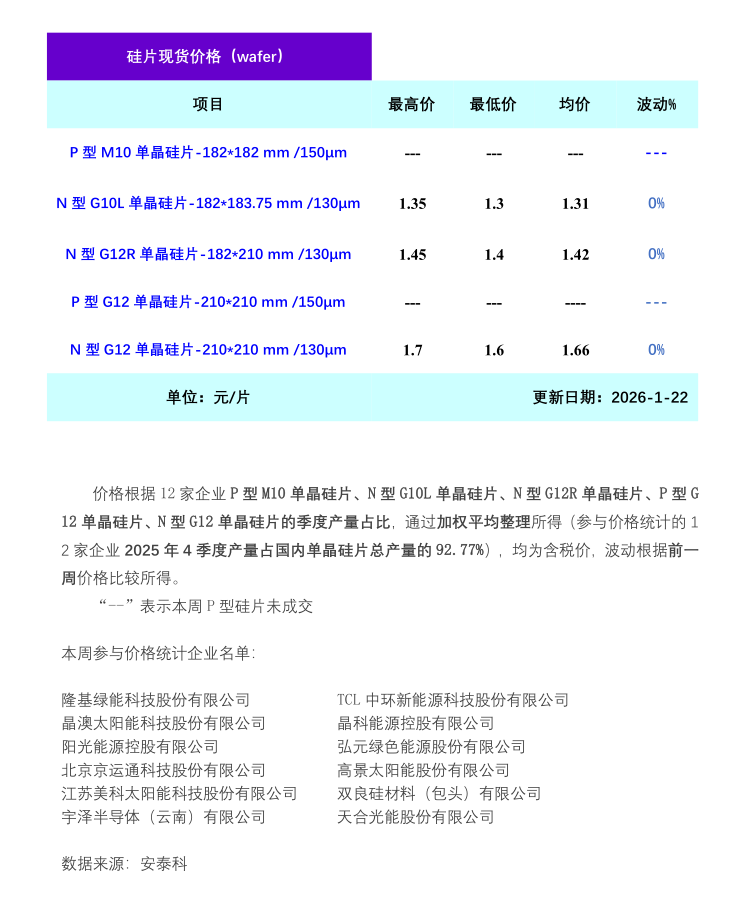
Group 1 - The core viewpoint of the article indicates that silicon wafer prices have remained stable this week, with specific prices for various types of wafers showing no significant change compared to the previous week [1][2] - N-type G10L monocrystalline silicon wafers (182*183.75mm/130μm) have an average transaction price of 1.31 yuan per piece, while N-type G12R wafers (182*210mm/130μm) are priced at 1.42 yuan per piece, and N-type G12 wafers (210*210mm/130μm) at 1.66 yuan per piece, all unchanged week-on-week [1][3] - Downstream battery and module prices have continued to rise, with mainstream battery prices at 0.40-0.42 yuan/W, up 2.50% week-on-week, and module prices at 0.71-0.75 yuan/W, up 4.29% week-on-week [1][2] Group 2 - The silicon wafer market is characterized by a wait-and-see sentiment, with a stalemate between upstream and downstream players, leading to a lack of significant price fluctuations despite rising component and battery prices [2] - Domestic silicon wafer manufacturers are maintaining firm pricing, while some smaller manufacturers are slightly lowering prices due to slow inventory depletion, resulting in a mixed market environment [2] - The overall operating rate in the industry has not changed significantly, with major companies operating at rates of 50% and 48%, while integrated companies operate between 50%-70% [2] Group 3 - Looking ahead, it is expected that downstream demand will not significantly improve before the Spring Festival, and with silicon material prices easing, the silicon wafer market is likely to operate weakly in the short term [2] - Some silicon wafer companies plan to reduce their operating rates in February, which may lead to an improvement in the market under conditions of supply contraction [2]
天富期货碳酸锂、多晶硅、工业硅日报-20260121
Tian Fu Qi Huo· 2026-01-21 11:56
Report Summary 1. Report Industry Investment Rating - Not provided in the report 2. Report's Core View - The lithium carbonate market is volatile, with potential price increases in the medium - to - long - term due to strong terminal demand for domestic energy storage projects. The polysilicon market is expected to be volatile and slightly stronger in the short - term but with limited upside. The industrial silicon market has a high inventory and weak demand, and its price may decline [1][7][15]. 3. Summary by Commodity Lithium Carbonate - **Market Trend**: The lithium carbonate futures contract 2605 rose 3.89% to 166,740 yuan/ton compared to the previous trading day [1]. - **Core Logic**: Although the new energy vehicle sales from January 1st - 11th dropped significantly, the "rush to export" behavior of downstream lithium carbonate enterprises and the resumption of production by some phosphate - iron - lithium enterprises increased demand. On the supply side, some lithium mines in Yichun are facing license replacement and production suspension, causing concerns about supply stability. Most of the inventory is in the hands of traders, and the inventory of smelters and downstream enterprises is low [1]. - **Technical Analysis**: The 5 - minute and overnight 2 - hour cycles of the 2605 contract show certain trends, with a long - short dividing line of 146,200 yuan/ton [1]. - **Strategy Suggestion**: Be cautious in the short - term, wait for the market to stabilize and then buy at low prices. In the long - term, the price center may move up [2][3]. Polysilicon - **Market Trend**: The polysilicon futures contract 2605 fell 1.97% to 49,700 yuan/ton compared to the previous trading day [7]. - **Core Logic**: Some leading polysilicon enterprises plan to stop production, and the output in February is expected to decline. The demand is expected to increase due to the increase in the production schedule of cells and components from January to February. However, the market will return to cost - based trading after the anti - monopoly news, and high inventory will suppress prices [7][9]. - **Technical Analysis**: The 5 - minute and overnight 2 - hour cycles of the 2605 contract show certain trends, with a long - short dividing line of 48,670 yuan/ton [9]. - **Strategy Suggestion**: It may be volatile and slightly stronger in the short - term. Pay attention to the subsequent policies of "anti - involution" [10][11]. Industrial Silicon - **Market Trend**: The industrial silicon futures contract 2605 rose 0.40% to 8,780 yuan/ton compared to the previous trading day [15]. - **Core Logic**: The supply is decreasing as the southwest production area has a low operating rate and the northwest production area has frequent production - cut news. The demand is weak, and the overall inventory is at a five - year high, so the price may decline [15]. - **Technical Analysis**: The market is controlled by short - sellers. The 5 - minute and overnight 2 - hour cycles of the 2605 contract show certain trends, with a long - short dividing line of 8,605 yuan/ton [15]. - **Strategy Suggestion**: Sell short when the price is high. Refer to the band winner indicator during the 8:30 live broadcast [15].
华泰期货:工业硅震荡下行,多晶硅偏强上涨
Xin Lang Cai Jing· 2026-01-21 01:47
Core Viewpoint - Industrial silicon and polysilicon markets are experiencing fluctuations in prices due to supply and demand dynamics, with potential impacts from recent policy changes and production adjustments [2][5][12][16]. Industrial Silicon Market Analysis - On January 20, 2026, industrial silicon futures prices showed a slight decline, with the main contract 2605 opening at 8815 CNY/ton and closing at 8745 CNY/ton, a decrease of 35 CNY/ton or 0.4% from the previous day [2]. - The total social inventory of industrial silicon in major regions was reported at 552,000 tons, a decrease of 0.9% from the previous week [2]. - Current prices for industrial silicon in various regions are stable, with prices for 553 silicon in East China ranging from 9200 to 9300 CNY/ton and 421 silicon between 9500 and 9800 CNY/ton [2][12]. Supply Side Dynamics - A major factory in Xinjiang has announced production cuts, which are expected to significantly reduce output in January, potentially benefiting industrial silicon prices [12]. - The overall supply side is expected to tighten, leading to a shift from inventory accumulation to depletion if production cuts are effective [12]. Demand Side Dynamics - The demand for industrial silicon is currently limited due to reduced production in polysilicon and ongoing self-regulation in the organic silicon sector [12]. - The recent cancellation of export tax rebates for the photovoltaic sector may create upward demand expectations for industrial silicon [12]. Price Outlook - Industrial silicon prices are anticipated to remain within a fluctuating range, supported by rising coal prices and the photovoltaic industry chain [13]. - The upward price potential will depend on the recovery of downstream demand and the pace of inventory depletion, while downward pressure is limited by cost support and production cut expectations [13]. Polysilicon Market Analysis - On January 20, 2026, polysilicon futures prices increased, with the main contract 2605 opening at 50650 CNY/ton and closing at 50700 CNY/ton, reflecting a 0.91% increase from the previous trading day [5]. - Polysilicon inventory has increased to 32.10 thousand tons, a 6.29% rise, while weekly production decreased by 9.66% to 21500 tons [5][14]. Price Stability and Market Strategy - Polysilicon prices are expected to maintain a weak and fluctuating trend, influenced by the recent cancellation of export tax rebates, which may stimulate short-term demand but could compromise long-term demand sustainability [16]. - Short-term strategies suggest a focus on new pricing for silicon wafers and production plans for January, while long-term strategies should monitor demand recovery and inventory depletion [16].

爱迪特:海外毛利率高于国内主要因产品结构差异及出口退税政策优惠
2 1 Shi Ji Jing Ji Bao Dao· 2026-01-21 00:32
Core Viewpoint - The company, Aidi Te, reported that its overseas market gross margin is higher than that of the domestic market due to a more favorable product mix and benefits from export tax rebates [1] Group 1 - The gross margin for products sold overseas is higher primarily because of the higher gross margin levels of the product mix [1] - The company benefits from export tax rebate policies, which effectively reduce overall costs and further enhance gross margin levels [1]
周报| 电芯开工率企稳,宁德海外市场占比 有望回升
数说新能源· 2026-01-20 03:05
Market Analysis - Battery production has shown limited fluctuations this week, with the export tax rebate policy impacting energy storage and overseas ternary battery cell customers significantly. However, energy storage production lines are nearly at full capacity, leading to limited incremental production. The expectation is to maximize output and minimize holiday disruptions, while raw material prices continue to rise, resulting in increased prices for battery cells [1] New Energy Vehicles - According to data from the Passenger Car Association, from January 1 to November 11, 2026, retail sales in the passenger car market reached 328,000 units, a year-on-year decrease of 32%. The new energy vehicle market saw retail sales of 117,000 units, down 38% year-on-year and down 67% compared to the previous month, with a penetration rate of 35.5% for new energy vehicles. In 2025, China's new energy vehicle production and sales reached 16.626 million and 16.49 million units, respectively, representing year-on-year growth of 29% and 28.2%. New energy vehicles accounted for 47.9% of total new car sales, with domestic sales of 13.875 million units, up 19.8% year-on-year, and domestic sales of new energy passenger vehicles at 13.005 million units, up 17.7% year-on-year. New energy commercial vehicle sales reached 871,000 units, up 63.7% year-on-year. Exports of new energy vehicles totaled 2.615 million units, doubling year-on-year, with passenger vehicle exports at 2.532 million units, also doubling year-on-year, and commercial vehicle exports at 83,000 units, up 86.8% year-on-year [2] Energy Storage - This week, domestic energy storage cell prices have increased. Most energy storage cell manufacturers, except for a leading company, have raised their product prices. Following the price increase, the willingness of downstream customers to place orders has decreased, leading to a wait-and-see attitude. The market is currently in a stocking phase. Recent integrated pricing has not seen significant increases, and Company C maintains a high operating rate. The demand for data centers in the U.S. is expected to be between 20-30 GWh this year, indicating a good demand for energy storage. In the ten days leading up to a recent bidding event, 30 GWh was tendered, reflecting a very strong market outlook for the first quarter domestically [3] News (Including Rumors) - CATL holds a domestic market share of approximately 46% and an overseas market share of about 43%. It is expected that after the adjustment of the export tax rebate rate, CATL's overseas market share could increase by 1-2%. The commercial prospects for sodium batteries in recent years have been generally poor, and CATL has not engaged in large-scale procurement of related materials, primarily due to the economic inefficiency and lower energy density compared to lithium batteries. According to the milestone planning for solid-state battery R&D projects, clear equipment procurement demands and bidding actions are not expected until around the first half of 2027 [4]


不计成本的出口结果:降低了外国人的生活成本、损了绝大多数国人的根本利益!
Sou Hu Cai Jing· 2026-01-19 04:13
Core Viewpoint - The export tax rebate policy in China, initially designed to support export enterprises, has become less relevant over time as the country maintains a trade surplus and sufficient foreign exchange reserves. The policy's continuation may lead to dependency among businesses and distort competition in the market [3][4]. Group 1: Export Tax Rebate Overview - In 2024, China's export tax rebate scale reached 1.93 trillion yuan, a 12.6% increase from the previous year, accounting for 11.02% of the annual tax revenue [3]. - The primary beneficiaries of the export tax rebate are small and micro enterprises, receiving 917.8 billion yuan (39.7% of total rebates), followed by medium-sized enterprises with 510.4 billion yuan (22.1%), and large enterprises with 881.5 billion yuan (38.2%) [3]. Group 2: Issues with Export Tax Rebate - The export tax rebate has led to dependency among some enterprises, where businesses rely on rebates to maintain profitability despite low margins, as illustrated by a lighter factory example [3][4]. - The influx of companies into sectors like new energy vehicles, without the necessary expertise, has intensified competition and price wars, undermining the effectiveness of the export tax rebate [4]. - The reliance on export tax rebates to reduce costs, rather than improving productivity, poses risks and may provide grounds for foreign sanctions against China [4]. Group 3: Future Considerations - Eliminating the export tax rebate policy is deemed necessary, with suggestions to redirect the annual 2 trillion yuan towards improving public welfare and military research, potentially addressing significant societal issues and enhancing national defense capabilities [4].
储能-氢能行业更新推荐
2026-01-19 02:29
Summary of Key Points from the Conference Call Industry Overview - The conference call focuses on the energy storage and hydrogen energy industry in China, highlighting the acceleration of energy storage projects through pricing mechanisms and policy adjustments, particularly in capacity electricity fees [1][2][5]. Core Insights and Arguments - The global electrochemical energy storage project bidding volume is expected to add nearly 1.5 TWh by 2025, with Asia accounting for 75% and China nearly half of that total [1][3]. - The core drivers for the 2025 energy storage market include the increasing share of wind and solar power generation and the deepening of electricity market reforms, drawing lessons from developed markets like the US and Europe [2][5]. - The capacity electricity fee policy is highly anticipated, as it will provide better guidance for investors in the context of a new power system with a higher proportion of renewable energy [5]. Growth Trends - By 2025, the energy storage market is projected to see significant growth, with a focus on large-capacity, long-life battery cells and advanced Power Conversion Systems (PCS) [3][6]. - The green hydrogen economic tipping point is approaching, with costs expected to decrease due to improved efficiency in hydrogen production and the implementation of green electricity direct connection policies [12][13]. R&D Trends and Competitive Landscape - Energy storage product development is focused on two levels: battery cells and PCS, with advancements aimed at increasing capacity and efficiency [6][7]. - The international trade environment is becoming increasingly complex, leading domestic energy storage companies to expand overseas to optimize profit structures amid intense domestic competition [8][9]. Policy Expectations - The capacity electricity fee policy is expected to be beneficial for energy storage, as it addresses the pricing challenges in a market with a growing share of renewable energy [5]. Hydrogen Energy Development - Hydrogen energy is still in the early stages of commercialization but is seen as a crucial method for decarbonizing non-electric sectors [12]. - The demand for green hydrogen is driven by strict decarbonization requirements in the shipping industry, with significant policies being implemented by the EU and the International Maritime Organization [14][15]. Companies to Watch - Key players in the green methanol production sector include China Tianying and Jidian Co., which have secured long-term agreements with major shipping companies, ensuring sales certainty and long-term profits [17]. - In the fuel cell vehicle sector, companies like Reformed Energy and Yihuatong are leading, with market shares exceeding 20%, benefiting from new subsidies and cost reductions [19]. Conclusion - The energy storage and hydrogen energy sectors are poised for significant growth driven by policy support, technological advancements, and increasing demand for renewable energy solutions. Companies that can navigate the competitive landscape and leverage international opportunities are likely to thrive in this evolving market [8][9][10].
鑫椤锂电一周观察 | 2025全球锂电池产量同比大增48.5%
鑫椤锂电· 2026-01-16 06:18
Industry Highlights - Global lithium battery production is projected to reach 2297 GWh by 2025, representing a year-on-year increase of 48.5%. Power batteries will contribute significantly, reaching 1495 GWh with a growth of 40.5%, while energy storage batteries will exceed 27% market share, growing to 636 GWh at a remarkable 92.7% increase [1] Policy Changes - The Ministry of Finance and the State Taxation Administration announced a tiered export tax rebate policy for photovoltaic products, effective April 1, 2026, which includes a reduction of the VAT export rebate rate for battery products from 9% to 6%. This marks a critical transition for China's new energy industry from subsidy-driven to market-driven competition [2] Major Contracts - Contemporary Amperex Technology Co., Ltd. (CATL) signed a procurement cooperation agreement with Rongbai Technology for lithium iron phosphate materials, with a total sales amount exceeding 120 billion yuan for 305,000 tons from Q1 2026 to 2031 [3] Production Capacity - Zhongwei Co., Ltd. has commenced operations at its ternary precursor project in Indonesia, with an annual production capacity expected to gradually increase to 20,000 tons [4] Market Trends - The domestic lithium carbonate market has experienced significant price fluctuations, with prices peaking at 170,000 yuan/ton, the highest in over two years. The market remains optimistic for Q1, despite being in a traditionally slow season, driven by export tax expectations and reduced supply due to maintenance at major lithium salt plants [6] Pricing Updates - As of January 15, 2023, battery-grade lithium carbonate is priced between 155,000 to 162,000 yuan/ton, while industrial-grade is between 141,000 to 147,000 yuan/ton. The prices for ternary materials and lithium iron phosphate have also seen increases due to rising raw material costs [7][9] Battery Production - Battery manufacturers are operating at full capacity, with the export tax policy significantly impacting energy storage and overseas clients. However, production increases are limited due to existing capacity constraints [14] Electric Vehicle Market - In early January 2026, retail sales of passenger vehicles reached 328,000 units, a 32% year-on-year decline, while new energy vehicle sales were 117,000 units, down 38% year-on-year. By 2025, China's new energy vehicle production and sales are expected to reach 16.626 million and 16.49 million units, respectively, marking a year-on-year growth of 29% and 28.2% [15] Energy Storage - Domestic energy storage cell prices have risen, with most manufacturers increasing product prices. The market is currently in a stocking phase, with significant demand expected in the upcoming quarters [16]
碳酸锂、多晶硅、工业硅日报-20260115
Tian Fu Qi Huo· 2026-01-15 12:01
Report Summary 1. Report Industry Investment Rating No industry investment rating is provided in the report. 2. Report Core View The report analyzes the market trends, core logics, technical aspects, and provides strategy suggestions for three commodities: lithium carbonate, polysilicon, and industrial silicon futures. It also lists the subsequent focus points for each commodity. 3. Summary by Commodity Lithium Carbonate - **Market Trend**: The lithium carbonate futures fluctuated. The main 2605 contract rose 0.79% from the previous trading day's closing price, reaching 163,220 yuan/ton [1]. - **Core Logic**: After the exchange's regulatory intervention on the 13th, market sentiment cooled. The sharp rise at the beginning of the week was due to the export tax - rebate policy, which might prompt battery companies to stock up, and the booming domestic energy - storage project bidding. However, the continuous decline in positions may lead to a risk of concentrated profit - taking by long positions [1]. - **Technical Analysis**: It is still controlled by long positions. The 5 - minute and overnight 2 - hour cycles show certain trends, with the long - short dividing line at 143,420 yuan/ton. The continuous decline in positions requires caution [2]. - **Strategy Suggestion**: In the context of "strong reality and strong expectation", the operation should be mainly to go long on dips. Avoid chasing highs directly and find good entry points according to certain methods. Listen to the 8:30 morning live - broadcast for specific operations [2][3]. - **Follow - up Focus**: The actual progress of battery exports in the first quarter, the recovery of new energy vehicle sales after subsidy extension, and the actual impact of geopolitical situations on lithium ore supply [4][5]. Polysilicon - **Market Trend**: The polysilicon futures continued to decline. The main 2605 contract fell 0.56% from the previous trading day's closing price, reaching 48,670 yuan/ton [10][12]. - **Core Logic**: After the market supervision department's约谈, the silicon material price will return to cost - based competition. The supply and demand are both weak, and the inventory is at a three - year high. The futures price may continue to fluctuate weakly, and it has reached a six - month low [12]. - **Technical Analysis**: The positions continued to decline. The 5 - minute and overnight 2 - hour cycles show certain trends, with the long - short dividing line at 53,610 yuan/ton [12]. - **Strategy Suggestion**: Wait for low - buying opportunities after stabilization as the decline amplitude is narrowing [12]. - **Follow - up Focus**: The subsequent policy direction of "anti - involution" [13]. Industrial Silicon - **Market Trend**: The industrial silicon futures fluctuated. The 2605 contract decreased 0.29% from the previous trading day's closing price, reaching 8,730 yuan/ton [16]. - **Core Logic**: It is controlled by short positions. The supply and demand are both weak, the downstream procurement is sluggish, and the inventory is at a three - year high. There is cost support below, and it is expected to continue to fluctuate in the short term [16]. - **Technical Analysis**: The overall positions continued to decline. The 5 - minute and overnight 2 - hour cycles show certain trends, with the long - short dividing line at 8,815 yuan/ton [16]. - **Strategy Suggestion**: In the middle of the oscillation range, short on rebounds. Long - term attention should be paid to the impact of polysilicon's return to cost - based pricing on industrial silicon. Refer to the band winner indicator in the 8:30 morning live - broadcast for intraday operations [16]. - **Follow - up Focus**: The subsequent policy direction of "anti - involution" [17].