出口退税调整

Search documents
乘联分会:1月1-11日全国乘用车新能源市场零售11.7万辆 同比下降38%
Zhi Tong Cai Jing· 2026-01-14 08:14
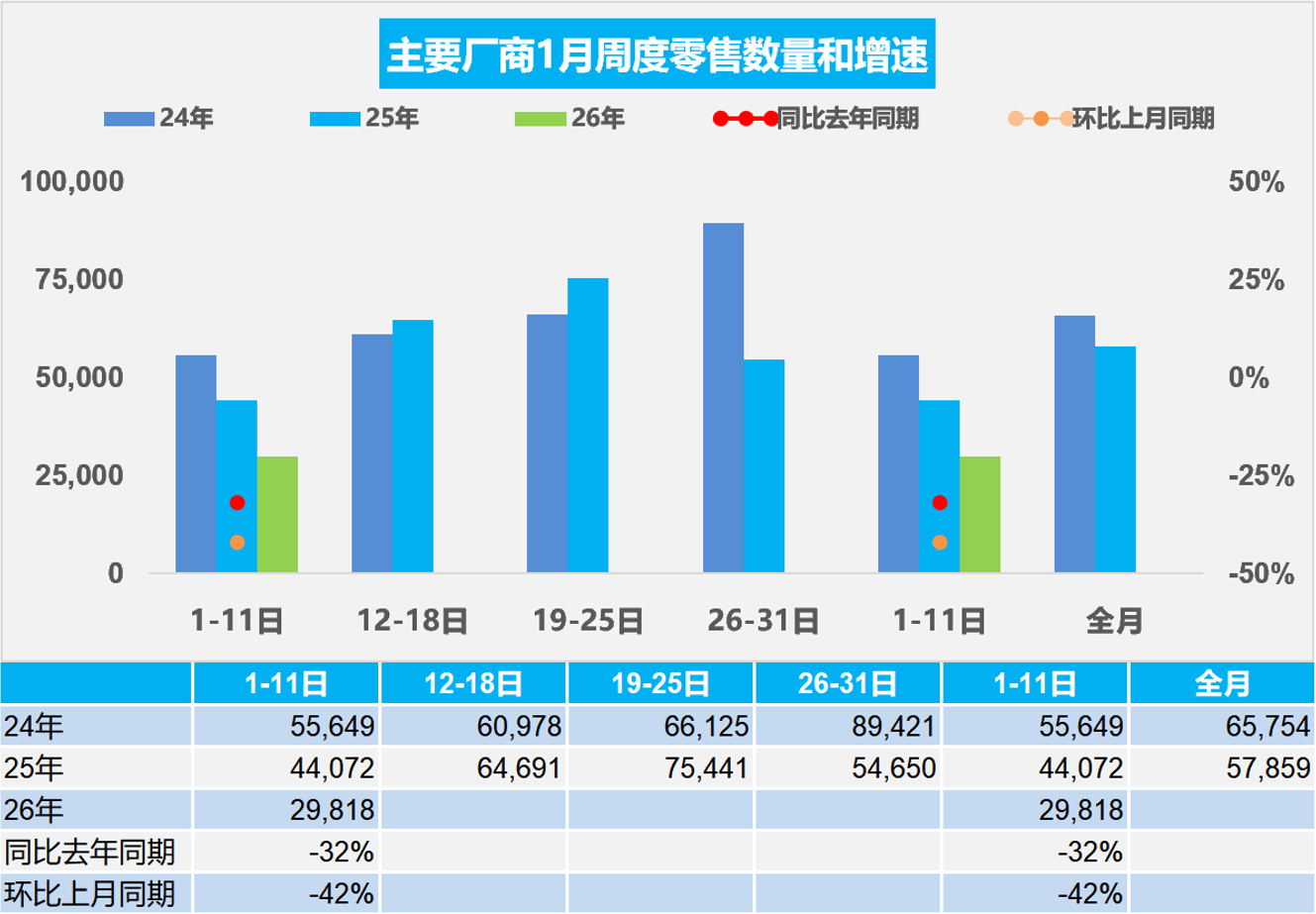
Group 1: New Energy Vehicle Market Performance - From January 1 to January 11, the retail sales of new energy vehicles in the passenger car market reached 117,000 units, a year-on-year decrease of 38% and a month-on-month decrease of 67% [1] - The retail penetration rate for new energy vehicles in the passenger car market is 35.5%, while the wholesale penetration rate is 43.9% [1] - The wholesale of new energy vehicles in the passenger car market totaled 167,000 units, down 30% year-on-year and 51% month-on-month [1] Group 2: Overall Passenger Car Market Trends - The total retail sales of passenger cars from January 1 to January 11 were 328,000 units, reflecting a year-on-year decline of 32% and a month-on-month decline of 42% [3] - The wholesale volume for passenger cars was 381,000 units, down 40% year-on-year and 30% month-on-month [5] - The average daily retail sales in the first week of January were 30,000 units, a decrease of 32% year-on-year and 42% month-on-month [3] Group 3: Policy Impact on Market - The National Development and Reform Commission announced a policy to promote large-scale equipment updates and a trade-in program, which is expected to boost domestic automobile consumption [3] - The subsidy for scrapping and updating passenger cars is projected to decrease by 20% on average per vehicle, with the maximum decline reaching 30% [3] - The expiration of the vehicle purchase tax exemption policy is contributing to the weak retail performance in January, but the market is expected to improve as subsidy details are rolled out [6] Group 4: Electric Vehicle Export and Market Dynamics - The Ministry of Commerce reported progress in negotiations regarding the EU-China electric vehicle case, which aims to provide price commitments to Chinese exporters, avoiding high tariffs [7] - This agreement is expected to stabilize market access for Chinese electric vehicles in the EU and promote a shift towards higher-end products [7] - The average price of passenger vehicles has seen a slight decline, influenced by structural changes in consumer purchasing power [8] Group 5: Battery Export Tax Changes - The announcement to reduce export tax rebates for lithium batteries is expected to have minimal impact on supply and demand in the short term [10] - The adjustment aims to align export prices with market realities and address international concerns, potentially easing trade tensions [10] - The first quarter's domestic demand for lithium batteries is projected to be only 18% of the annual total, indicating limited immediate effects on the industry [10]

有色商品日报(2026年1月14日)-20260114
Guang Da Qi Huo· 2026-01-14 05:30
1. Report Industry Investment Rating No relevant information provided. 2. Core Viewpoints of the Report Copper - Overnight, London copper rose and then fell, while domestic copper fluctuated widely. The import of refined copper in China remained at a loss. The US core inflation level slowed down compared to expectations, which laid the groundwork for the Fed to cut interest rates in the future. However, the probability of maintaining the current interest rate in January was still relatively high. In China, the adjustment of export tax rebates for products such as photovoltaic cells might lead to a rush to export in the first quarter. LME, Comex, SHFE copper warehouse receipts, and BC copper inventories all increased. As copper prices rose again, downstream enterprises became more cautious in purchasing, and the trading was mainly based on rigid demand. The expansion of import losses and the opening of the export window were beneficial to export demand in the first quarter. The optimistic sentiment in the precious metal market continued to spread to the non - ferrous market. Although the short - term fundamentals weakened, the capital sentiment remained strong, and the expectation of a rush to export in the first quarter also supported copper prices. It was recommended to maintain the idea of buying on dips but not to chase high prices [1]. Aluminum - Overnight, alumina fluctuated weakly, while Shanghai aluminum and aluminum alloy fluctuated strongly. The price of SMM alumina declined, and the spot discount of aluminum ingots narrowed. The ore reserves of alumina plants were high, and the short - term premium procurement sentiment was low, leading to a continuous decline in costs. After the end of environmental control, alumina production continued to increase, and with the addition of imports, the inventories of manufacturers and downstream continued to accumulate, and the logic of spot convergence to futures continued. Due to the reappearance of warehousing profits in Xinjiang, warehouse receipts might put new pressure on the market. After the end of environmental control and the cancellation of export tax rebates, photovoltaic enterprises rushed to export, and the operating rate of the processing end was expected to remain resilient, slightly alleviating the pressure of aluminum ingot inventory accumulation. The divergence between macro and micro gradually converged, and the over - heating boost was rationally corrected. Aluminum prices continued to be at a high level, and the spot discount continued to narrow [1][2]. Nickel - Overnight, LME nickel fell by 2.63%, and Shanghai nickel fell by 0.33%. LME and SHFE nickel inventories decreased. Indonesia would adjust its nickel quota according to industry demand to support the price of its mineral products. From the fundamental perspective, as prices rose rapidly, the prices of products at all links in the industrial chain strengthened, and the production of primary nickel increased by 18.5% month - on - month to 37,200 tons. Hedging demand might put some pressure on the market price. The Indonesian policy stimulated the rise of nickel prices. Attention should be paid to the actual implementation and market sentiment. It was recommended to pay attention to the opportunity of buying on dips near the cost line [2]. 3. Summary According to Relevant Catalogs Research Views - **Copper**: The US core inflation slowed down, and there was a rush - to - export expectation in the first quarter in China. Inventories increased, downstream purchasing was cautious, and the export window opened. It was recommended to buy on dips [1]. - **Aluminum**: Alumina prices fell, aluminum prices rose. Cost decreased, inventory accumulated, and the processing end was expected to be resilient. Aluminum prices remained high [1][2]. - **Nickel**: Prices fell, inventories decreased. Indonesia adjusted the quota policy, primary nickel production increased, and it was recommended to buy on dips [2]. Daily Data Monitoring - **Copper**: The price of flat - water copper decreased by 710 yuan/ton, and the inventory of LME, Comex, and SHFE increased. The active contract import loss decreased by 260 yuan/ton [1][3]. - **Lead**: The average price of 1 lead decreased by 100 - 15 yuan/ton, and the inventory of the Shanghai Futures Exchange increased [3]. - **Aluminum**: The prices of Wuxi and Nanhai decreased, and the inventory of the Shanghai Futures Exchange and social inventory increased [4]. - **Nickel**: The price of Jinchuan nickel decreased by 1700 yuan/ton, and the inventory of the Shanghai Futures Exchange decreased [4]. - **Zinc**: The main settlement price increased by 1.1%, and the social inventory decreased by 0.19 million tons [6]. - **Tin**: The main settlement price increased by 5.0%, and the inventory of the Shanghai Futures Exchange decreased by 1001 tons [6]. Chart Analysis - **Spot Premium**: Charts show the historical trends of spot premiums of copper, aluminum, nickel, zinc, lead, and tin from 2019 - 2026 [7][8][9]. - **SHFE Near - Far Month Spread**: Charts show the historical trends of the spread between the first and second contracts of copper, aluminum, nickel, zinc, lead, and tin from 2019 - 2026 [13][17][18]. - **LME Inventory**: Charts show the historical trends of LME inventories of copper, aluminum, nickel, zinc, lead, and tin from 2019 - 2026 [20][22][24]. - **SHFE Inventory**: Charts show the historical trends of SHFE inventories of copper, aluminum, nickel, zinc, lead, and tin from 2019 - 2026 [26][28][30]. - **Social Inventory**: Charts show the historical trends of social inventories of copper (including bonded areas), aluminum, nickel, zinc, stainless steel, and 300 - series from 2019 - 2026 [32][34][36]. - **Smelting Profit**: Charts show the historical trends of copper concentrate index, rough copper processing fee, aluminum smelting profit, nickel - iron smelting cost, zinc smelting profit, and stainless - steel 304 smelting profit margin from 2019 - 2026 [39][41][43]. Team Introduction - **Zhan Dapeng**: A science master, currently the director of non - ferrous research at Everbright Futures Research Institute, a senior researcher in precious metals, and a gold intermediate investment analyst. He has more than a decade of experience in commodity research and has won many industry awards [46]. - **Wang Heng**: A finance master from the University of Adelaide, Australia. He is mainly responsible for the research of aluminum and silicon, and has won relevant industry awards [46]. - **Zhu Xi**: A science master from the University of Warwick, UK. He focuses on the research of lithium and nickel, and has won relevant industry awards [47].
集运早报-20260114
Yong An Qi Huo· 2026-01-14 01:49
Report Summary 1. Report Industry Investment Rating - No information provided in the given content. 2. Core View of the Report - For the EC2602 contract, it is moving towards the delivery logic and is subsequently influenced by the spot market. Its current valuation is neutral, and new entry is not recommended [3]. - The EC2604 contract requires attention to spot prices and actual rush - shipping situations. The expected decline in MSK's cabin opening in week 5 may suppress the futures market, but rush - shipping may occur as freight rates fall, potentially reducing the decline rate in March. Its valuation fluctuates widely within a reasonable range, and subsequent corrective market opportunities are worth noting [3]. - Export - tax rebate adjustments are negative for far - month contracts, but far - month contracts are highly affected by geopolitical factors. It is generally recommended to short the 10 - contract on rallies [3]. 3. Summary by Relevant Catalog 3.1 Contract Data - EC2602: Yesterday's closing price was 1720.4, down 1 - 8%, with a trading volume of 6210 and an open interest of 11862, a decrease of 1482 [2]. - EC2604: Yesterday's closing price was 1199.7, down 6.33%, with a trading volume of 44098 and an open interest of 38770, an increase of 1678 [2]. - EC2606: Yesterday's closing price was 1413.5, down 4.82%, with a trading volume of 2459 and an open interest of 3264, an increase of 328 [2]. - EC2608: Yesterday's closing price was 1529.9, down 2.26%, with a trading volume of 260 and an open interest of 1359, a decrease of 92 [2]. - EC2610: Yesterday's closing price was 1107.4, down 4.04%, with a trading volume of 1672 and an open interest of 7446, an increase of 218 [2]. 3.2 Month - spread Data - EC2502 - 2604: The value was 520.7, with a daily increase of 53.5 and a weekly decrease of 76.4 [2]. - EC2504 - 2606: The value was - 213.8, with a daily decrease of 9.5 and a weekly increase of 27.1 [2]. 3.3 Index Data - SCHIS (updated every Monday, announced on 2026/1/12): The current value is 1956.39 points, up 8.94% from the previous period and 3.05% from two periods ago [2]. - SCFI (European line, updated weekly, announced on 2026/1/9): The current value is 1719 US dollars/TEU, up 1.72% from the previous period [2]. 3.4 European Line Spot Situation - Week 3: MSK opened cabins at 2600. Other alliances had a slight decline, with PA at 2600 (YML's one route at 2400), PA at 2800 - 2900 US dollars. The central price was 2750 US dollars, equivalent to about 1930 points on the futures [3]. - Week 4: MSK opened cabins at 2700. Other alliances remained stable for the time being, with a central price of 2750 US dollars, equivalent to about 1930 points on the futures [3]. - Week 5: MSK opened cabins at 2400 (a decrease of 300 compared to the previous week), YML quoted at 2650 US dollars, and other shipping companies had not adjusted prices yet [3].
工厂取消休假,召回员工加班!光伏产品出口退税将全面取消,有物流公司称“一波‘抢运潮’进入倒计时”
Mei Ri Jing Ji Xin Wen· 2026-01-13 07:03
Core Viewpoint - The announcement on January 9 regarding the adjustment of export tax rebate policy for photovoltaic products will lead to the cancellation of the 9% VAT export rebate starting from April 1, 2026, increasing export costs for solar companies [1]. Group 1: Export Tax Rebate Policy - The cancellation of the 9% VAT export rebate is expected to raise export costs for photovoltaic companies, prompting many factories to cancel worker vacations and increase production [1]. - The adjustment is seen as a measure to curb the rapid decline in export prices and reduce trade friction, although it is not the only solution to the industry's challenges [2]. Group 2: Market Reactions and Logistics - The China Photovoltaic Industry Association noted a "volume increase and price decrease" trend in export prices since 2024, with some companies passing the rebate loss to foreign buyers, leading to profit erosion [2]. - A surge in shipping demand is anticipated, although current booking volumes have not increased significantly, and logistics companies are preparing for this potential rush [2][3]. Group 3: Future Export Trends - Following the adjustment, a significant drop in photovoltaic component export volumes is expected, with potential shipping volumes post-Spring Festival estimated between 9,300 to 12,300 FEU per month [4]. - The main contract for the European shipping index EC2604 saw a notable increase, influenced by the expected rush in shipments due to the tax rebate policy change [4][5].

连续两日涨停,退税调整引爆“抢锂大战”!
Ge Long Hui· 2026-01-13 06:56
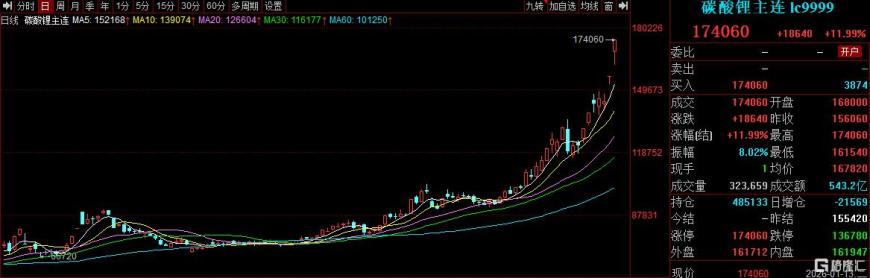
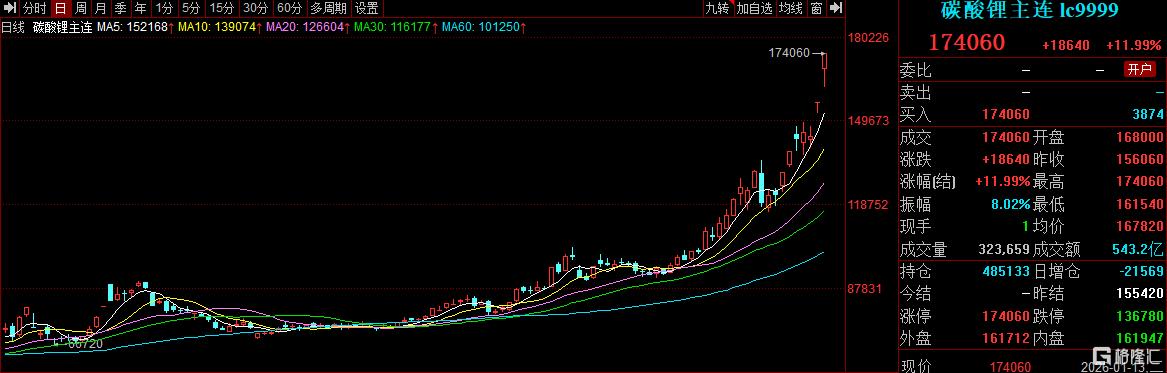
Group 1 - The core viewpoint of the article highlights a surge in lithium carbonate prices driven by policy changes, leading to a "crazy market" during the traditional off-season [1] - As of January 13, the main contract for lithium carbonate futures on the Shanghai Futures Exchange hit a limit-up price of 174,060 yuan/ton, marking an increase of 11.99% and over 40% rise in January alone [1][2] - Since the low point of nearly 60,000 yuan in June 2025, lithium prices have surged over 190% [1] Group 2 - The recent adjustment in export tax policies for photovoltaic products has triggered a "rush for lithium," as companies accelerate procurement to avoid rising costs [4] - The average price for battery-grade lithium carbonate has reached 158,000 yuan/ton, while industrial-grade has surpassed 153,000 yuan/ton [4] - Downstream companies are actively seeking lithium supplies, with reports of high demand and low inventory levels among suppliers [4] Group 3 - Analysts expect that the reduction in export tax rates will stimulate export demand, leading to a strong market for lithium carbonate in the short term [6] - The overall supply-demand balance for lithium carbonate may tighten throughout the year, with prices expected to rise further [6] - The cancellation of export tax for battery products by 2027 is anticipated to maintain ongoing demand for lithium carbonate [7] Group 4 - The timing of the export tax adjustment is seen as appropriate, as the demand for lithium batteries in the first quarter of 2026 is projected to be only 18% of the annual total [7] - The adjustment may help align export prices with market supply and demand, reducing the perception of subsidizing overseas consumers [7] - Future adjustments to export tax policies may extend to other high-export products, including chemicals and machinery [7][8]

连续两日涨停!电话被打爆!退税调整引爆"抢锂大战"
Sou Hu Cai Jing· 2026-01-13 06:46
Group 1 - The core viewpoint of the article highlights a surge in the lithium carbonate market driven by policy changes, leading to a significant price increase during the traditional off-season [1][5] - On January 13, the main contract for lithium carbonate futures on the Shanghai Futures Exchange hit the daily limit, rising by 11.99% to 174,060 yuan per ton, marking a cumulative increase of over 40% this month [1] - Since the low point of nearly 60,000 yuan in June 2025, lithium prices have surged by over 190% [1] Group 2 - The lithium battery sector in both Hong Kong and A-shares has shown strong performance, with companies like Ganfeng Lithium rising over 7% and Tianqi Lithium over 3% [3][4] - The recent adjustment in export tax policies for photovoltaic and battery products has triggered a "rush for lithium," as companies aim to stock up before costs rise due to the phased reduction of export tax rates starting in 2026 [5][6] - The average price of battery-grade lithium carbonate has reached 158,000 yuan per ton, while industrial-grade has surpassed 153,000 yuan per ton, indicating strong demand from downstream customers [6] Group 3 - Analysts expect that the reduction in export tax rates will stimulate a rush for exports, reinforcing demand expectations and leading to a strong performance in lithium prices [9] - The market is anticipated to experience a tight supply-demand balance throughout the year, with lithium prices likely to rise further [9] - The timing of the export tax adjustment is seen as appropriate, as it may help balance supply and demand in the second half of the year [10]


连续两日涨停!电话被打爆!退税调整引爆“抢锂大战”
Ge Long Hui· 2026-01-13 06:34
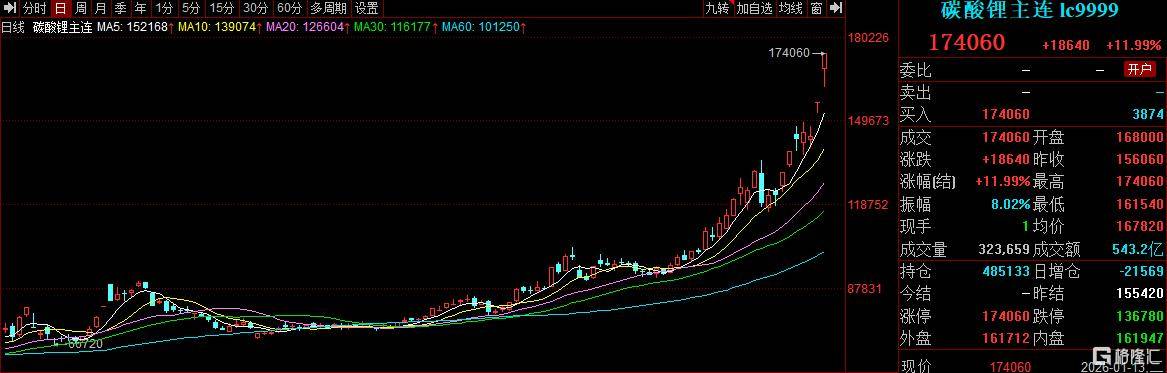
Group 1: Market Dynamics - A surge in lithium carbonate prices has been observed, with the main futures contract on the Shanghai Futures Exchange hitting a limit up of 11.99%, reaching 174,060 yuan/ton, marking a cumulative increase of over 40% this month alone [1] - Since the low point of nearly 60,000 yuan in June 2025, lithium prices have skyrocketed by over 190% [1] Group 2: Stock Performance - The lithium battery sector in both Hong Kong and A-shares has shown strong performance, with Ganfeng Lithium rising over 7%, and other companies like Shengxin Lithium Energy and Tibet Mining increasing by over 5% [3][4] Group 3: Policy Impact - Recent adjustments to export tax policies for photovoltaic and battery products have triggered a "rush for lithium," as companies anticipate increased costs due to the phased reduction of export tax rates starting in 2026 [5][6] - The export tax rate for battery products will decrease from 9% to 6% in April 2026, ultimately being eliminated by 2027 [5] Group 4: Supply Chain Reactions - The policy changes have led downstream battery manufacturers to accelerate their procurement plans to avoid rising costs, resulting in a concentrated rush for lithium supplies [6] - Current market prices for battery-grade lithium carbonate have reached 158,000 yuan/ton, while industrial-grade has surpassed 153,000 yuan/ton [6] Group 5: Future Outlook - Analysts expect that the reduction in export tax rates will stimulate demand and lead to a strong performance in lithium prices, with a potential tightening of supply and demand dynamics throughout the year [8] - The ongoing "rush for exports" is anticipated to continue until the elimination of the export tax in 2027, which may lead to a concentrated release of demand in the short term [8][9]

新能源及有色金属日报:出口退税调整引发碳酸锂强势涨停-20260113
Hua Tai Qi Huo· 2026-01-13 05:18
Report Industry Investment Rating - Not provided Core Viewpoints - The adjustment of the export tax rebate policy will have a significant impact on the lithium - ion battery industry, leading to reshaping of the industry structure. For lithium carbonate, it may support price increases in the short term but is more bearish in the medium - to - long term [2] - Current prices are greatly affected by news, with over - speculation. Inventory depletion has slowed down, and there is a divergence between futures and spot prices, so short - term sharp increases may lead to a correction risk [3] Summary by Directory Market Analysis - On January 12, 2026, the main lithium carbonate contract 2605 opened and closed at 156,060 yuan/ton, with a 9.00% change from the previous day's settlement price. The trading volume was 68,491 lots, and the open interest was 506,702 lots, down from 510,874 lots the previous day. The current basis is - 4,060 yuan/ton, and the lithium carbonate warehouse receipts were 2,5970 lots, a change of 610 lots from the previous day [1] - According to SMM data, the price of battery - grade lithium carbonate is 148,000 - 156,000 yuan/ton, a change of 12,000 yuan/ton from the previous day; the industrial - grade lithium carbonate is 145,000 - 152,000 yuan/ton, also a 12,000 - yuan/ton change. The price of 6% lithium concentrate is 2,085 dollars/ton, a change of 135 dollars/ton from the previous day [2] - As of January 8, 2026, the export tax rebate rate for battery products will be lowered from 9% to 6% from April 1 to December 31, 2026, and will be cancelled starting from January 1, 2027 [2] - The spot inventory is 109,942 tons, a month - on - month increase of 337 tons. Among them, smelter inventory is 18,382 tons, up 715 tons; downstream inventory is 36,540 tons, down 2,458 tons; other inventories are 52,940 tons, up 2,080 tons [2] Strategy - Unilateral: Short - term range trading, and sell - hedging on rallies [3] - Options: None [3] - Inter - delivery spread: None [4] - Cross - variety: None [4] - Futures - spot: None [4]
有色商品日报(2026年1月13日)-20260113
Guang Da Qi Huo· 2026-01-13 03:04
1. Report Industry Investment Rating - No relevant content provided. 2. Core Viewpoints of the Report Copper - Overnight, LME copper rose and then fell, while domestic copper fluctuated widely, with domestic refined copper imports remaining in a loss. The US Supreme Court will rule on the legality of Trump's tariffs, and the US Department of Justice has launched a criminal investigation into Fed Chairman Powell, causing concerns about the Fed's independence. In China, export tax rebates for products like photovoltaic cells are adjusted, potentially leading to export - rush actions in Q1. LME copper inventory decreased by 1,750 tons to 137,225 tons, Comex inventory increased by 2,215 tons to 472,140 tons, and SHFE copper warrants increased by 5,406 tons to 116,622 tons. As copper prices rose again, downstream enterprises became more cautious in purchasing, and transactions were mainly for rigid demand. Despite short - term weakening fundamentals, positive sentiment in the precious metals market spread to the non - ferrous market, and the Q1 export - rush expectation also pushed copper prices up. It is suggested to buy on dips but avoid over - chasing highs [1]. Aluminum - Overnight, alumina fluctuated weakly, with AO2605 closing at 2,821 yuan/ton, a 0.63% decline, and open interest increasing by 15,068 lots to 561,000 lots. Shanghai aluminum fluctuated strongly, with AL2603 closing at 24,630 yuan/ton, a 0.18% increase, and open interest increasing by 4,112 lots to 383,000 lots. Aluminum alloy also fluctuated strongly, with the main contract AD2603 closing at 23,445 yuan/ton, a 1.03% increase, and open interest increasing by 306 lots to 22,296 lots. The SMM alumina price dropped to 2,659 yuan/ton, and the spot discount of aluminum ingots narrowed to par. Alumina plants have high ore reserves, with low short - term premium purchasing sentiment, and costs continue to decline. After the environmental control of alumina ends, production resumes and imports supplement, causing inventories at manufacturers and downstream to accumulate, and the logic of spot converging to futures continues. Due to the reappearance of warehousing profits in Xinjiang, warrants may put new downward pressure on the market. After the end of environmental control and the cancellation of export tax rebates, photovoltaic enterprises are rushing to export, and the operating rate of the processing end is expected to remain resilient. The pressure of aluminum ingot inventory accumulation eases, and the divergence between the macro and micro levels gradually converges, with the over - heating boost turning into a rational correction. Aluminum prices continue the high - level trend, and the spot discount continues to narrow [1][2]. Nickel - Overnight, LME nickel rose 2.12% to $18,075/ton, while Shanghai nickel fell 0.04% to 141,520 yuan/ton. LME nickel inventory decreased by 228 tons to 284,562 tons, and SHFE warrants increased by 814 tons to 39,670 tons. The LME 0 - 3 month premium remained negative, and the import nickel premium remained at 600 yuan/ton. The Indonesian Minister of Energy and Mineral Resources said that Indonesia will adjust its nickel quota according to industry demand to support the price of its mineral products. From a fundamental perspective, as prices rise rapidly, product prices in all links of the industrial chain strengthen, and the production of primary nickel increased by 18.5% month - on - month to 37,200 tons, which may put some pressure on the market price due to hedging demand. The Indonesian policy stimulates nickel prices to strengthen, and it is recommended to pay attention to the opportunity of buying on dips near the cost line, waiting for the actual implementation of the quota [2]. 3. Summary by Relevant Catalogs Daily Data Monitoring Copper - Market prices: The price of flat - copper rose from 100,240 yuan/ton on January 9th to 103,175 yuan/ton on January 12th, an increase of 2,935 yuan/ton; the premium of flat - copper rose from - 80 yuan/ton to 0 yuan/ton. The price of 1 bright scrap copper in Guangdong increased from 88,100 yuan/ton to 89,600 yuan/ton, and the refined - scrap price difference increased from 6,333 yuan/ton to 7,298 yuan/ton. - Inventory: The total LME and SHFE registered and unregistered copper inventory remained unchanged at 138,975 tons; SHFE warrants increased by 5,406 tons to 116,622 tons, and the total weekly inventory increased from 145,342 tons to 180,543 tons. Comex inventory increased by 2,760 tons to 469,921 tons, and the domestic + bonded area social inventory increased by 20,000 tons to 353,000 tons [3]. Aluminum - Market prices: The Wuxi aluminum price increased from 24,030 yuan/ton to 24,320 yuan/ton, and the Nanhai price increased from 24,100 yuan/ton to 24,390 yuan/ton. The price of ADC12 aluminum alloy in South China increased from 23,700 yuan/ton to 23,950 yuan/ton. - Inventory: The total LME registered and unregistered aluminum inventory remained unchanged at 497,825 tons; SHFE warrants increased by 6,501 tons to 97,413 tons, and the total weekly inventory increased from 129,818 tons to 143,828 tons. The electrolytic aluminum social inventory increased by 16,000 tons to 730,000 tons, and the alumina social inventory decreased by 14,000 tons to 144,000 tons [4]. Nickel - Market prices: The price of Jinchuan nickel plates increased from 146,000 yuan/ton to 151,000 yuan/ton. The price of 304 No1 stainless steel in Foshan increased from 13,200 yuan/ton to 13,300 yuan/ton. - Inventory: The total LME registered and unregistered nickel inventory remained unchanged at 284,790 tons; SHFE nickel warrants increased by 814 tons to 39,670 tons, and the weekly nickel inventory increased from 45,544 tons to 46,650 tons. The social nickel inventory increased by 2,126 tons to 61,046 tons, and the stainless - steel social inventory decreased by 18 tons to 855 tons [4]. Zinc - Market prices: The main contract settlement price increased from 23,880 yuan/ton to 24,030 yuan/ton, a 0.6% increase. The price of SMM 0 zinc increased from 24,030 yuan/ton to 24,140 yuan/ton. - Inventory: The weekly SHFE zinc inventory increased by 793 tons to 6,268 tons, and the social inventory decreased by 19,000 tons to 111,500 tons. The SHFE registered warrants decreased by 3,533 tons to 35,341 tons, and the LME registered warrants decreased by 1,050 tons to 98,775 tons [6]. Tin - Market prices: The main contract settlement price increased from 349,000 yuan/ton to 364,320 yuan/ton, a 4.4% increase. The SMM spot price increased from 349,750 yuan/ton to 368,550 yuan/ton. - Inventory: The weekly SHFE tin inventory decreased by 1,001 tons to 6,935 tons, and the LME inventory remained unchanged at 5,415 tons. The SHFE registered warrants decreased by 96 tons to 6,333 tons, and the LME registered warrants increased by 10 tons to 5,290 tons [6]. Chart Analysis - The report provides charts on spot premiums, SHFE near - far month spreads, LME inventory, SHFE inventory, social inventory, and smelting profits of various non - ferrous metals, covering the historical data from 2019 - 2026, but no specific data analysis in the text for these charts [13][14][20][26][32][39]. 4. Team Introduction - The non - ferrous metals team of Everbright Futures Research Institute consists of Zhan Dapeng, the director of non - ferrous research and a senior precious metals researcher; Wang Heng, mainly researching aluminum and silicon; and Zhu Xi, focusing on lithium and nickel. They have rich experience and have won many industry awards [46][47].
光大期货:1月13日有色金属日报
Xin Lang Cai Jing· 2026-01-13 01:20
Copper - LME copper experienced a high and then a pullback, with domestic refined copper imports remaining unprofitable [3][12] - LME inventory decreased by 1,750 tons to 137,225 tons, while Comex inventory increased by 2,215 tons to 472,140 tons [3][12] - Domestic demand for copper is cautious, with transactions primarily based on immediate needs, despite optimistic sentiment in the precious metals market [3][12] Nickel & Stainless Steel - LME nickel rose by 2.12% to $18,075 per ton, while SHFE nickel fell by 0.04% to 141,520 yuan per ton [4][13] - LME inventory decreased by 228 tons to 284,562 tons, and SHFE warehouse receipts increased by 814 tons to 39,670 tons [4][13] - Indonesia plans to adjust nickel quotas based on industry demand to support local prices, but specific quota levels for 2026 remain undisclosed [4][13][14] Alumina, Electrolytic Aluminum & Aluminum Alloys - Alumina prices showed a slight decline, with AO2605 settling at 2,821 yuan per ton, down 0.63% [6][15] - SHFE aluminum fluctuated positively, with AL2603 closing at 24,630 yuan per ton, up 0.18% [6][15] - The aluminum market is experiencing inventory accumulation, with expectations of continued production despite recent export tax adjustments [6][15] Industrial Silicon & Polysilicon - Industrial silicon showed a slight increase, with the main contract at 8,755 yuan per ton, up 0.75% [7][16] - Polysilicon prices weakened, with the main contract at 49,995 yuan per ton, down 2.89% [7][16] - Inventory dynamics are shifting, with hidden stock levels increasing and speculative trading sentiment cooling [7][16] Lithium Carbonate - Lithium carbonate futures hit a limit up at 156,060 yuan per ton, with battery-grade lithium carbonate prices rising by 12,000 yuan to 152,000 yuan per ton [8][17] - Weekly production increased by 115 tons to 22,535 tons, with various lithium extraction methods showing growth [8][17] - Despite rising raw material prices potentially suppressing demand, strong market expectations and low downstream inventory suggest a bullish outlook for lithium prices [8][17]