
大宗商品价格波动

Search documents
紫金矿业已经杀眼红了
Xin Lang Cai Jing· 2026-02-23 12:02
Core Viewpoint - Zijin Mining has set an ambitious target for lithium carbonate equivalent production, aiming for 270,000 to 320,000 tons by 2028, a nearly 11-fold increase from the less than 30,000 tons expected in 2025, indicating a significant shift towards the new energy sector [2][11]. Group 1: Company Strategy and Performance - The company is diversifying its operations beyond gold and copper, with a focus on lithium production as part of its strategy to become a top global mining group [3][12]. - In 2025, Zijin Mining achieved a net profit of approximately 51 to 52 billion yuan, a nearly 60% year-on-year increase, largely driven by its gold business, which benefited from a surge in international gold prices [3][12]. - The company’s gold production reached 90 tons in 2025, a 23.3% increase from the previous year, with a gross profit margin of 72.8% [3][12]. Group 2: Expansion and Acquisitions - Zijin Mining has accelerated its international expansion, completing eight major gold mine acquisitions since 2020, including recent purchases in Ghana and Kazakhstan, and plans to list its overseas gold assets [4][13]. - The acquisition of African United Gold Company for 28 billion yuan is expected to add approximately 12 tons of gold production in 2025, raising the company's 2026 gold production target to 105 tons, with aspirations to reach 130 to 140 tons by 2028 [4][13]. Group 3: Lithium Production and Cost Management - The company has established a low-cost lithium production base through its "Two Lakes and Two Mines" resource system, including projects in Argentina, Tibet, Hunan, and the Democratic Republic of Congo [5][14]. - The first phase of the 3Q salt lake project has commenced production with a cash operating cost of only 2,914 USD/ton, among the lowest globally [5][14]. - Zijin Mining's comprehensive cost for lithium carbonate remains between 40,000 to 70,000 yuan/ton, providing a buffer against price fluctuations [6][15]. Group 4: Risks and Challenges - As of September 2025, Zijin Mining's long-term debt and bonds exceeded 112.3 billion yuan, with significant capital expenditure pressures from ongoing projects [6][15]. - The company faces geopolitical risks in its overseas projects, particularly in Africa and South America, which could impact resource control [6][15]. - Despite favorable market forecasts for gold, copper, and lithium, the company must navigate potential macroeconomic disruptions that could affect demand and pricing [6][15]. Group 5: Future Outlook - By early 2026, Zijin Mining is positioned as a diversified global resource platform, spanning precious metals, industrial metals, and new energy materials [7][15]. - If the company can effectively manage its production capacity and debt risks over the next three years, it may achieve its long-term vision of becoming a leading international mining group by 2035 [7][15].



央行政策分化 加元震荡回升
Jin Tou Wang· 2026-02-12 02:27
Group 1 - The core viewpoint of the articles highlights the recent fluctuations in the USD/CAD exchange rate, which has shown a recovery trend after a period of decline, influenced by the divergence in monetary policies of the two countries and commodity price volatility [1][2]. - The USD/CAD exchange rate has experienced a "first suppress then rise" pattern since the beginning of the year, with significant movements noted in January and February, indicating a cautious market sentiment amid ongoing fluctuations [1][2]. - The Bank of Canada has maintained its benchmark interest rate at 2.25%, indicating potential for future rate cuts, while the Federal Reserve has not yet clarified its rate cut timing, creating a disparity that supports the USD and pressures the CAD [2][3]. Group 2 - The global trade environment remains uncertain, contributing to fluctuations in the USD/CAD exchange rate, with market risk aversion occasionally driving funds towards the USD, indirectly supporting its rise against the CAD [2]. - As a commodity currency, the CAD's performance is closely tied to global commodity prices, with potential price recoveries supporting the CAD and limiting the USD/CAD exchange rate's upward movement [3]. - There is a significant divergence in institutional views regarding the medium to long-term outlook for the USD/CAD exchange rate, with some analysts suggesting that a rate cut by the Bank of Canada could lead to further increases in the exchange rate, while others believe that rising expectations for Fed rate cuts may weaken USD support [3].
大宗商品综述:原油走高 镍价四连涨 银价跃升
Xin Lang Cai Jing· 2026-02-11 22:18
Group 1: Oil Market - Oil prices have risen due to heightened tensions in the Middle East, overshadowing concerns about oversupply [2][3] - WTI crude oil settled above $64 per barrel, supported by reports of U.S. military readiness in the region and potential actions against Iranian oil tankers [2][4] - U.S. employment data has improved the economic outlook, providing additional support for oil prices, despite a significant increase in U.S. crude oil inventories [3][10] Group 2: Nickel Market - Nickel prices have increased for the fourth consecutive day, reaching a near two-week high, following Indonesia's indication of substantial production cuts this year [5][12] - Indonesia's nickel ore production quota is projected to be between 260 million and 270 million tons, slightly above previous estimates but below the 2025 target of 379 million tons [5][12] Group 3: Silver Market - Silver prices have surged, continuing a trend of high volatility, with expectations of stronger investment demand in the coming year, despite weakening industrial demand [7][15] - On Wednesday, silver prices rose by 6.8%, recovering about one-third from last week's low, with the Silver Institute reporting a sixth consecutive year of supply deficit due to increased investment demand [8][15] - As of the latest data, silver spot prices increased by 4.12% to $84.1421 per ounce, while gold spot prices rose by 1.09% to $5080.29 per ounce [8][15]

长江有色: 美联储变局引爆商品抛售! 6日镍价或下跌
Xin Lang Cai Jing· 2026-02-06 03:30
Core Viewpoint - The nickel futures market is experiencing significant downward pressure due to changing expectations regarding Federal Reserve policies, leading to a decline in prices across global markets [1][2]. Market Performance - The latest closing price for London nickel (LME) is $17,060, down $270 per ton, a decrease of 1.56%, with a trading volume of 8,626 contracts [1]. - In the domestic market, the Shanghai nickel main contract (2603) closed at 134,250 yuan per ton, down 1,130 yuan per ton, a decline of 0.83% [1][2]. Supply and Demand Dynamics - The nickel market is characterized by "oversupply and demand vacuum" ahead of the Spring Festival, with downstream industries like stainless steel and new energy battery manufacturers halting production and procurement [2]. - LME nickel inventory stands at 286,071 tons, a decrease of 240 tons from the previous day, while global refined nickel production has increased by 22.8% year-on-year [1][2]. Industry Chain Status - The entire nickel industry chain is in a state of dormancy, with upstream mining prices high but lacking domestic demand, and downstream processing enterprises experiencing a sharp decline in operating rates [3]. Short-term Price Forecast - The main contract for Shanghai nickel is expected to test the key support level of 130,000 yuan per ton, with multiple pressures from macroeconomic factors, weak fundamentals, and policy adjustments making price increases difficult [4]. - Investors are advised to maintain a cautious stance, with light or no positions during the holiday, while traders should adopt a quick in-and-out strategy [4]. - Post-holiday, the focus will shift back to fundamentals, with potential improvements in supply-demand dynamics as downstream production resumes, particularly in the electric vehicle sector [4].
澳元冲高至0.6900 静待澳联储决议定方向
Jin Tou Wang· 2026-02-03 02:33
Group 1 - The core focus of the news is the upcoming Reserve Bank of Australia (RBA) interest rate decision, which is expected to influence the AUD/USD exchange rate significantly [2] - The market anticipates a 25 basis point rate hike, raising the benchmark rate from 3.60% to 3.85%, with a 73% probability of this outcome [2] - Strong economic data, including a December CPI increase of 3.8% year-on-year and a drop in the unemployment rate to 4.1%, are driving the rate hike expectations [2] Group 2 - The market is particularly interested in the post-decision policy statement and the tone of the press conference, as these will directly impact the future direction of the AUD/USD exchange rate [2] - If the RBA signals a hawkish stance, indicating ongoing inflation risks and potential future rate hikes, the exchange rate may rise towards the psychological level of 0.7050 [2] - Conversely, a dovish tone could suggest the end of the rate hike cycle, potentially leading the exchange rate to drop towards the 0.6900 support level [2] Group 3 - The volatility of the US dollar index and comments from Federal Reserve officials will also indirectly affect the AUD/USD exchange rate [3] - Recent declines in precious metal prices have slightly weighed on the Australian dollar, highlighting the need to monitor commodity market dynamics [3] - In the medium to long term, the divergence in monetary policies between the US and Australia is expected to support the Australian dollar, with forecasts suggesting an increase in the AUD/USD rate to 0.73 by year-end [3]
国新国证期货早报-20260203
Guo Xin Guo Zheng Qi Huo· 2026-02-03 02:10
Report Summary 1. Market Performance on February 2, 2026 - A-shares tumbled: The Shanghai Composite Index dropped 2.48% to 4015.75, the Shenzhen Component Index fell 2.69% to 13824.35, and the ChiNext Index declined 2.46% to 3264.11. The turnover of the Shanghai, Shenzhen, and Beijing stock exchanges was 2606.9 billion yuan, a decrease of 255.8 billion yuan from the previous trading day [1]. - Indexes and commodities: The CSI 300 Index closed at 4605.98, down 100.36. The coke weighted index closed at 1683.5, down 58.6, and the coking coal weighted index closed at 1151.8 yuan, down 31.7 [2][3]. 2. Futures Market Analysis a. Coking Coal and Coke - Coke: Coke enterprises'开工 declined, and inventory increased significantly due to winter storage. The demand side saw an increase in blast furnace 开工 but a decrease in molten iron production. The first round of coke price increases was implemented. Supply contracted, and pre - holiday winter storage was nearing its end [4]. - Coking coal: The 开工 of coal washing plants and mines decreased, and Mongolian coal customs clearance volume declined from its high. Total coking coal inventory increased. The demand side, including coke enterprises' load and molten iron production, continued to decline. The first round of coke price increases was implemented. The price of Tangshan Mongolian 5 clean coal was reported at 1390 yuan/ton, equivalent to 1305 yuan/ton on the futures market [4]. b. Zhengzhou Sugar - Affected by factors such as the decline of US sugar on Friday, the drop in crude oil prices, and the reduction of spot quotes, the Zhengzhou sugar 2605 contract oscillated downward on Monday. Green Pool predicted that the global sugar market surplus in 2026/27 would shrink to 156,000 tons from 2.74 million tons in 2025/26, mainly due to a decrease in production [4]. c. Rubber - Affected by the sharp decline in crude oil prices and the stock market crash, the Shanghai rubber futures oscillated sharply downward on Monday. In 2025, Thailand's natural rubber exports (excluding compound rubber) were 2.669 million tons, a year - on - year decrease of 5.3%. The total exports of natural rubber and mixed rubber were 4.422 million tons, a year - on - year increase of 4.9% [4]. d. Palm Oil - On February 2, affected by macro - funds sentiment, the commodity market dropped significantly, and the palm oil market also declined from its high. The palm oil main contract P2605 closed at 9014, down 2.45% from the previous trading day [5]. e. Soybean Meal - Internationally, CBOT soybean futures declined slightly on February 2. The strong US dollar weakened US export competitiveness. Brazil's soybean harvest was in its early stage with normal weather. As of January 24, 2026, Brazil's 2025/26 soybean harvest rate was 6.6%, higher than 3.2% in the same period last year. Stonex predicted that Brazil's 2025/26 soybean production would reach a record - high of 181.6 million tons. Domestically, the soybean meal main contract 2605 closed at 2750 yuan/ton, down 0.61%. Domestic imported soybean supply was abundant, and pre - holiday stocking was nearing its end. The soybean meal futures price lacked upward momentum [5]. f. Live Hogs - On February 2, the live hog main contract LH2603 closed at 11220 yuan/ton, unchanged from the previous trading day. Before the Spring Festival, the window for live hog slaughter was narrowing, and the daily slaughter pressure of large - scale pig enterprises increased. The market's price - support mentality weakened, and the supply pressure before the festival increased. The demand side was supported by pre - holiday stocking, but the increase was limited. In the medium - term, the market's supply - exceeding - demand situation was difficult to change [5]. g. Shanghai Copper - Shanghai copper futures tumbled. The main contract 2603 closed at 98580 yuan/ton. The core reasons included profit - taking by long - position holders, the rebound of the US dollar, warnings of supply surplus, and increased market caution [5]. h. Iron Ore - On February 2, the iron ore 2605 main contract oscillated downward, with a decline of 1.26% to 783 yuan. The supply of Australian and Brazilian iron ore increased, while domestic arrivals decreased, and port inventory continued to accumulate. The iron ore price was in an oscillating trend in the short term [5]. i. Asphalt - On February 2, the asphalt 2603 main contract oscillated and closed down, with a decline of 4.87% to 3299 yuan. In February, refinery production decreased slightly, and the market was in the off - season with weak demand. The asphalt price was in an oscillating state in the short term [5]. j. Cotton - The Zhengzhou cotton main contract closed at 14635 yuan/ton at night on February 2. Cotton inventory increased by 36 lots compared with the previous trading day. Textile enterprises purchased on a just - in - time basis [6]. k. Logs - The log 2603 main contract opened at 805, closed at 795, and decreased its positions by 1052 lots. The port's softwood log inventory decreased for three consecutive weeks. The spot price of some logs increased slightly [6]. l. Steel - On February 2, the rb2605 contract closed at 3098 yuan/ton, and the hc2605 contract closed at 3261 yuan/ton. Steel demand continued to contract, and the supply - demand pressure before the festival increased. The raw material price decreased, and the inventory of social warehouses increased. Steel prices may have a weak and narrow - range adjustment in the short term [6]. m. Alumina - On February 2, the ao2605 contract closed at 2772 yuan/ton. The cost of bauxite decreased, and inventory accumulated before the Spring Festival. The downstream demand for electrolytic aluminum was weak. The alumina price may maintain an oscillating and weak trend in the short term [6]. n. Shanghai Aluminum - On February 2, the al2603 contract closed at 23035 yuan/ton. The market was cautious about the potential new Fed Chairman. Geopolitical tensions eased, and the non - ferrous metals market continued to decline. The supply was stable, inventory was high, and demand showed only slight improvement [6].
伊朗局势现转机!贵金属原油集体“跳水”,现货白银狂泻一度跌破80美元,国际油价重挫3%
Sou Hu Cai Jing· 2026-02-02 00:24
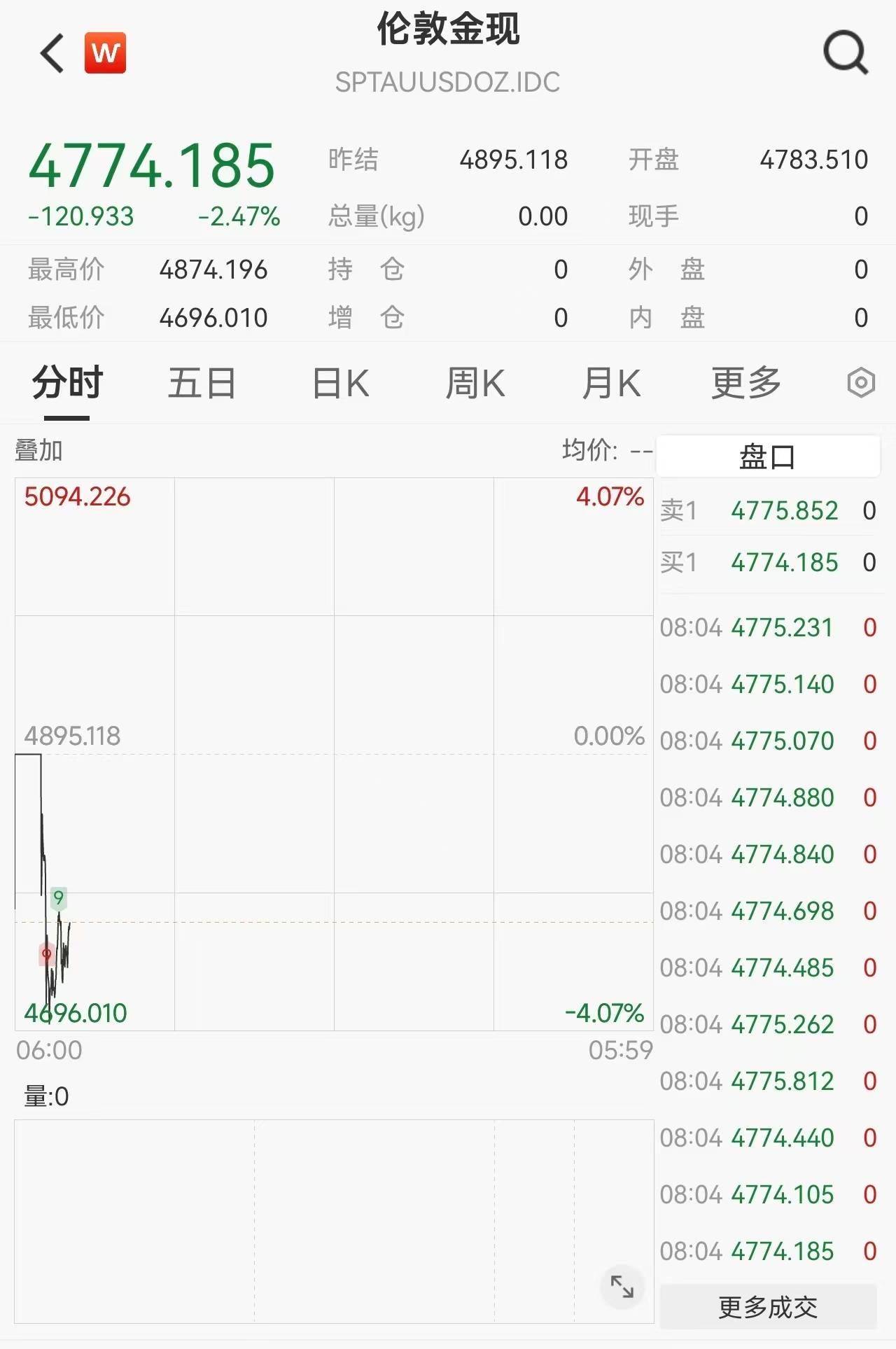
2月2日(周一),贵金属市场延续回调态势,原油价格则出现大幅下挫,现货黄金一度跌破4700美元/盎司,现货白银一度跌破80美元/盎司。截至发稿,现 货白银跌幅持续扩大至3.67%,报82.131美元/盎司;现货黄金跌2.47%,报4774.185美元/盎司。 | < W | 伦敦金现 | | | | --- | --- | --- | --- | | | SPTAUUSDOZ.IDC | | | | 4774.185 | 昨结 4895.118 开盘 | | | | -120.933 | -2.47% 总量(kg) 0.00 现手 | | | | 最高价 | 4874.196 持 仓 0 | | 外 盘 | | 最低价 | 4696.010 增 仓 o | | 内 盘 | | 分时 | 五日 日K 周K 月K | | 南芝 | | 叠加 | | 均价: -- | 물 | | 5094.226 | | 4.07% | 卖1 477 | | | | | 星1 477 | | | | | 08:04 477 08:04 477 | | 4895.118 | | 0.00% | 08:04 477 | | | | | ...
多重利好积聚 国际油价涨至近四个月高位
Xin Hua Cai Jing· 2026-01-28 05:47
新华财经北京1月28日电受地缘因素扰动、美国寒潮以及美元指数走弱等多重利好影响,国际油价隔夜 大涨约3%,布伦特原油收盘站上66美元大关,为2025年10月以来首次。 中东局势持续紧张 据央视报道,27日,美国向以色列通报其针对伊朗可能采取军事行动的准备情况。美方表示,相关准备 工作预计将在两周内完成,并可能在未来数月内出现适合采取行动的"机会窗口"。美方同时强调,这并 不意味着必须等所有准备工作结束后才会采取行动。"如果美国总统特朗普下达命令,美方行动可能提 前进行,但目前这一选项并未被视为迫在眉睫。"不过美以官方尚未证实上述消息。 伊朗对此针锋相对,伊斯兰革命卫队一名海军高级指挥官表示,伊朗已对所有海上、水面及水下活动进 行实时监控。是否允许悬挂不同国旗的船只从该海峡通行,完全由伊朗掌控。 "伊朗的周边国家是我们的朋友,但如果其陆地、空域或水域被用于针对伊朗,将被视为敌对行为。这 一信息已传达给该地区各方。""伊朗不寻求战争,但已做好充分准备。"该指挥官称。 霍尔木兹海峡位于阿曼和伊朗之间,连接了东部的阿曼湾和西部的波斯湾,是海湾地区石油输往世界各 地的唯一海上通道,全球约三分之一的海运原油贸易都要途经霍 ...
资金视角与基本面视角看-家电未来如何演绎
2026-01-28 03:01
Summary of Key Points from the Conference Call Industry Overview - The conference call focuses on the home appliance industry, particularly the white goods sector, and discusses the impact of various factors on its performance in 2026 [1][2][3]. Core Insights and Arguments - **Market Dynamics**: The home appliance sector's performance in 2025 was driven by passive funds like ETFs and insurance capital, leading to stock price fluctuations that diverged from fundamentals. The focus for 2026 will shift to opportunities from an insurance perspective [1][2]. - **Copper Price Impact**: Rising copper prices have increased production costs for white goods. However, leading companies can manage these costs through upstream negotiations, internal efficiency improvements, and price increases downstream. Historical data suggests that price transmission is the most effective method to mitigate short-term profit impacts [1][4][8]. - **Government Subsidies**: The continuation of national subsidy policies in 2026, with a focus on energy-efficient products, is expected to support demand for white goods. Rising raw material costs may lead to more cautious pricing strategies, potentially reducing competitive pressure [1][5][9]. - **Commodity Cycle Analysis**: Historical commodity cycles have significantly impacted the home appliance sector, with past copper price surges leading to a 3-4 percentage point decline in gross margins. However, the current cycle shows a more moderate copper price increase of about 30% since September 2025, with other raw material prices declining, resulting in manageable overall cost pressures [6][7][10]. Financial and Investment Insights - **Insurance Capital Trends**: There has been a notable increase in insurance capital investment in the stock market, driven by policy support and a preference for high-dividend stocks. The home appliance sector meets these criteria, being undervalued and cash-rich, making it a potential target for increased insurance capital allocation [3][15][18]. - **Potential Growth from Insurance Investments**: If 3%-15% of new insurance capital in 2026 is allocated to the home appliance sector, it could lead to an increase of approximately 100 billion RMB, resulting in an expected industry average growth of 5%-10% [3][21]. - **Valuation and Cash Position**: The home appliance industry is currently undervalued, with companies like Midea and Gree holding over 100 billion RMB in net cash. This strong cash position enhances their attractiveness as investment targets for insurance funds [19][20]. Additional Important Insights - **Exchange Rate Management**: The appreciation of the RMB reduces export revenues, but large home appliance companies can manage this risk through strategies like increasing overseas brand presence, establishing production capacity abroad, and employing foreign exchange hedging [12][14][13]. - **Competitive Landscape**: The competitive environment is shifting towards a more defensive stance, with smaller companies initiating price increases, which larger firms are likely to follow. This trend may help stabilize margins despite rising costs [9][10]. - **Future Outlook**: The overall outlook for the home appliance industry remains optimistic, with expectations of stable demand and potential for significant returns from high-dividend stocks in a defensive market environment [22][23].
四大证券报头版头条内容精华摘要_2026年1月28日_财经新闻
Sou Hu Cai Jing· 2026-01-27 23:19
Group 1 - The core viewpoint of the news is that various sectors are experiencing significant changes, including a notable increase in revenue for GPU companies and shifts in investment strategies among public funds [1][2][5][6][14]. Group 2 - Muxi Co., a leading GPU company, expects a substantial revenue increase of 115.32% to 128.78% in 2025, projecting revenue between 1.6 billion to 1.7 billion yuan, despite anticipating a net loss of 650 million to 798 million yuan [1]. - The public fund FOF has shifted its holdings, replacing the Huazhong Gold ETF with the Haifutong Zhongzheng Short-term Bond ETF as the most heavily held fund by the end of Q4 2025 [2]. - The industrial profits of large-scale enterprises in China are expected to return to positive growth in 2025, with an overall increase of 0.6% compared to 2024, marking a turnaround from three consecutive years of decline [5]. - The gold market is experiencing a significant price surge, with international gold prices exceeding $5,100 per ounce, leading to a notable increase in demand for gold-related ETFs [6][13]. - The automotive industry in China is facing challenges with profit margins declining to 4.1% in 2025, indicating a trend of increased revenue but higher costs [14].