大宗商品超级周期

Search documents
大炼化板块有望承接有色上涨动能,石化ETF(159731)布局窗口开启
Mei Ri Jing Ji Xin Wen· 2026-02-04 05:43
Group 1 - The core viewpoint of the article highlights the performance of the Petrochemical ETF (159731), which has seen a continuous inflow of funds for 20 trading days, accumulating a total of 1.457 billion yuan [1] - The latest share count of the Petrochemical ETF reached 1.7 billion shares, with a total scale of 1.707 billion yuan, both hitting record highs since its inception [1] - Western Securities indicates that during the Kondratiev wave downturn, the expansion of domestic currency credit cracks leads to a super cycle for commodities, with expectations for a significant rise in global oil prices by 2026, which will drive price re-evaluation of chemical products [1] Group 2 - The Petrochemical ETF and its linked funds (017855/017856) track the CSI Petrochemical Industry Index, focusing on the "big energy" security logic [1] - The ETF not only benefits from the profit recovery of downstream chemical products but also locks in the value of upstream energy resources through a high allocation to leading refining companies, providing stronger performance resilience during oil price upcycles [1]

能源-商品板块轮动的下一站
2026-02-03 02:05
Summary of Key Points from Conference Call Records Industry Overview - The commodity market is currently influenced more by supply-side risks than demand-side drivers, indicating that a supercycle is not present [1][4] - The energy sector is experiencing relative oversupply, while non-ferrous and precious metals still hold investment value for 2026 [1][5] Core Insights and Arguments - **Commodity Price Dynamics**: The recent significant pullback in commodity prices, especially in precious metals, is attributed to market adjustments to new Federal Reserve policies and cooling market sentiment [2] - **Gold Price Influences**: Gold prices are under pressure from tightening monetary policy, easing inflation, and expectations of central bank gold sales. The market has already reacted to these factors, leading to a reasonable pullback in gold prices, although overall support levels remain high [6][7] - **Copper and Oil Supply/Demand**: Copper supply is constrained due to insufficient new capacity, supporting prices in the long term, but previous high prices have already been reflected. Oil supply is gradually improving from previous oversupply conditions, suggesting potential price recovery [8][9] - **OPEC+ Supply Uncertainty**: OPEC+ has seen a decline in actual production increase rates, with geopolitical tensions affecting oil supply from countries like Russia and Iran. This uncertainty is expected to persist throughout 2026 [9][10] Additional Important Content - **Natural Gas Market Trends**: The U.S. natural gas market is expected to see a price increase due to rising LNG exports and reduced associated gas supply. European markets are facing low inventory levels, necessitating increased LNG imports [3][15] - **Investment Strategy for 2026**: Investors are advised to focus on timing and specific commodities rather than simply following trends. The anticipated copper shortage from 2025 to 2026 contrasts with the gradual narrowing of oil oversupply [5][8] - **Future Oil Price Projections**: Oil prices are expected to stabilize between $60 and $70 per barrel in the first half of 2026, with potential for a rise to $70-$80 in the latter half as supply-demand dynamics improve [13] Conclusion - The current commodity market is characterized by significant volatility, with specific sectors like precious metals and energy showing distinct trends. Investors should remain vigilant about timing and market signals to capitalize on emerging opportunities while navigating the inherent risks associated with geopolitical factors and supply chain dynamics.
金银大跌,资源品板块等待降波后低吸机会
Sou Hu Cai Jing· 2026-02-02 15:23
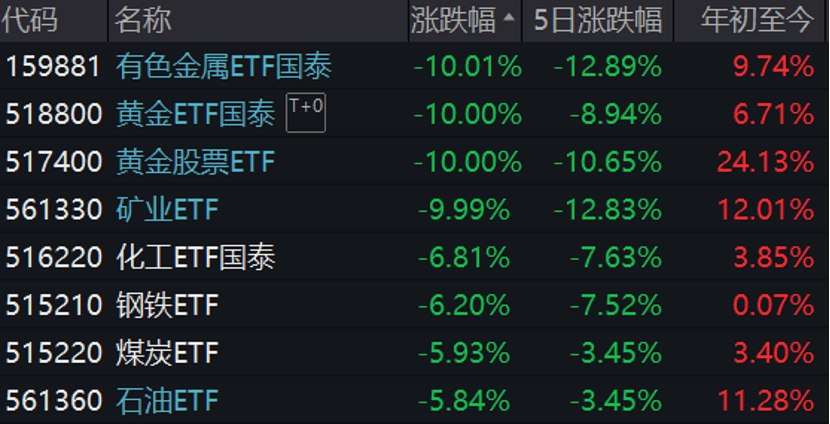
Group 1: Market Performance - The performance of various ETFs shows significant declines, with the Nonferrous Metals ETF down by 10.01% over five days and 12.89% year-to-date, while the Gold ETF is down by 10.00% over five days and 8.94% year-to-date [1] - Gold and silver prices experienced a sharp drop, with gold spot prices falling to nearly $4,400 per ounce and silver approaching $71 per ounce, marking a historic decline of 9.25% on January 31 [1] Group 2: Market Dynamics - The Chicago Mercantile Exchange raised margin requirements for metal futures, increasing gold margin from 6% to 8% and silver from 11% to 15%, which significantly impacts market liquidity and may force speculative investors to liquidate positions [4] - The recent surge in gold prices above $5,500 per ounce and silver above $120 per ounce was driven by a combination of factors, including geopolitical tensions and a shift in investor confidence towards precious metals [4] Group 3: Investment Outlook - The long-term outlook for gold remains strong, supported by monetary easing, its safe-haven status, and the trend of de-dollarization globally, despite short-term volatility [9][10] - Central banks worldwide, including China, continue to increase their gold reserves, indicating sustained demand for gold as a strategic asset [10][13] - The potential for a super cycle in commodities is anticipated, driven by economic recovery and expansionary fiscal policies, particularly in the context of the upcoming U.S. midterm elections [18]

全球金属狂欢进行时!对冲基金巨头城堡杀入工业金属牌桌 拥抱金属交易热潮
Zhi Tong Cai Jing· 2026-02-02 05:27
Group 1: Citadel's Entry into Industrial Metals - Citadel, a leading hedge fund based in the U.S., is entering the industrial metals market, marking a shift from its previous cautious stance towards this sector [1] - The firm has appointed Ylan Adler as a portfolio manager to oversee commodity allocations, with a focus on metal trading [1] - This move comes amid rising interest in industrial metals and precious metals trading among major investment institutions [1] Group 2: Surge in Metal Prices - Since the second half of 2025, prices for industrial metals like copper, aluminum, tin, and nickel have surged, with copper futures on the LME rising approximately 40% [2] - Gold prices have skyrocketed, with a historic increase of over 2% recently, surpassing $5000 for the first time, and achieving an 18% increase this month, potentially the largest monthly gain in 40 years [2] - Silver also experienced significant volatility, with a peak increase of over 10%, marking the largest intraday gain since the 2008 financial crisis [2] Group 3: Performance of Mining Companies - BHP Group Ltd. has regained its title as Australia's most valuable company, overtaking Commonwealth Bank of Australia, driven by the rising prices of metals [2] - The mining sector, including companies like BHP and Rio Tinto, is becoming a top choice for fund managers due to increased demand for industrial metals driven by AI and supply constraints [3] - The MSCI Metals and Mining Index has risen nearly 90% since 2025, outperforming major indices including those of semiconductor companies and global banks [3] Group 4: Citadel's Previous Success in Commodities - Citadel's commodity business has seen significant profits, earning approximately $8 billion in 2022, which has prompted competitors to follow its lead [5] - The firm has primarily focused on the energy market and has become one of the largest physical natural gas traders in the U.S. [5] - Despite previously avoiding basic metals trading, Citadel's stance has shifted due to market volatility and opportunities arising from geopolitical events [6] Group 5: Competitive Landscape in Metal Trading - Other major commodity trading firms have been expanding their metal trading operations, with competitors like Squarepoint becoming significant players in cobalt and aluminum markets [6] - The hiring spree in the metal trading sector has led to increased compensation packages for metal traders [6] - Citadel's hiring of Adler is seen as a cautious step compared to the aggressive recruitment strategies of its competitors [5]
紫金矿业20260130
2026-02-02 02:22
Summary of the Conference Call for Zijin Mining Industry Overview - The non-ferrous metals sector has experienced a pullback due to multiple factors including a rebound in the US dollar index, changes in Federal Reserve policy expectations, easing tensions between the US and Iran, and a rise in inventories of certain metals. This has led to market volatility, with aluminum, copper, and tin prices dropping by 4%, 3%, and 8% respectively [2][3][4] - Despite the short-term correction, the long-term outlook for the commodity supercycle remains bullish, expected to last over three years, driven by geopolitical factors, strategic stockpiling, supply chain restructuring, and domestic anti-involution trends. The non-ferrous sector is projected to have significant upside potential in 2026, maintaining over 20% growth even after a 30% increase in January [2][5] Company Insights: Zijin Mining - Zijin Mining is viewed as a high-value investment, primarily due to a bullish outlook on copper prices, with expectations for LME copper to reach $15,000 and Shanghai copper to hit ¥120,000. Although the company has underperformed the broader non-ferrous market year-to-date, its performance is expected to improve as copper prices rise [2][6] - The company holds an 87% stake in Zijin Gold International, which has seen a price increase of over 60%. If selling pressure on large stocks subsides, Zijin Mining is anticipated to experience a rebound [2][7] Financial Projections - Based on current copper prices of ¥100,000/ton and gold prices of ¥1,100/gram, Zijin Mining's profit for 2026 is projected to be ¥93 billion, with a current valuation of only 11 times earnings. If the valuation returns to bull market levels of 18-20 times PE, there is potential for over 50% upside, making it a highly attractive investment [3][8] - Profit forecasts indicate that if gold prices average ¥1,100/gram in 2026, net profit could reach ¥51.5 billion this year, with projections of ¥92.6 billion in 2027 (80% YoY growth) and ¥121.7 billion in 2028 (31% YoY growth). Corresponding valuations would be 22 times, 12 times, and 9 times earnings respectively, suggesting at least 50% upside potential [12] Production and Growth Potential - Zijin Mining is a leading player in the industry with significant growth potential in both copper and gold production. By 2028, copper production is expected to reach 1.5-1.6 million tons, with major projects like the Kamoa-Kakula, Phase III of the Giant Dragon, and the Peji Copper-Gold Mine contributing to this growth [3][9][10] - The company is also expected to achieve 105 tons of gold production this year, with acquisitions in Ghana and Kazakhstan set to enhance performance [10] Market Concerns and Company Strengths - Market concerns primarily revolve around the impact of metal price volatility on Zijin Mining. However, the company’s strong operational management capabilities allow it to convert resources into profitable outputs, even amidst declining ore grades and increased mining difficulties globally [11] - The investment in Zijin Mining is not just about commodities but also about investing in a well-managed, world-class company [11]

西部证券晨会纪要-20260202
Western Securities· 2026-02-02 01:37
Banking Sector - The banking sector is expected to see three major catalysts in 2026: 1) Interest margins are likely to stabilize as new loan rates reach a low point, and deposit repricing effects will continue to improve banks' funding costs [6][7] 2) Risks related to real estate exposure are expected to have peaked, with significant progress in mitigating financial risks in the real estate sector [6] 3) Retail business may show marginal improvement as credit risks ease and wealth management activities are expected to activate [6][7] - Investment strategies for 2026 suggest focusing on four main lines: 1) Increase allocation to high-quality city commercial banks with strong earnings elasticity, recommending Hangzhou Bank and paying attention to Ningbo Bank, Nanjing Bank, Chongqing Bank, Qingdao Bank, and Xiamen Bank [5][7] 2) Allocate to high-dividend large banks, with a focus on Bank of China Hong Kong (H), CITIC Bank (H), China Construction Bank (H), and China Merchants Bank [5][7] 3) Pay attention to Shanghai Bank and Industrial Bank due to expected strong redemption of convertible bonds [5][7] 4) Consider banks with significant valuation discounts and potential for performance recovery, such as Minsheng Bank and Ping An Bank [5][7] Mechanical Equipment - The CDU liquid cooling pump is expected to benefit from the accelerated construction of AI data centers, as it plays a crucial role in regulating coolant flow and pressure, constituting 30%-40% of the liquid cooling system's value [9][10] - The market size for CDU liquid pumps is projected to reach between $1.139 billion and $1.544 billion in 2026, driven by the increasing demand for liquid cooling solutions as chip power exceeds the limits of air cooling [9][11] - The cooling source side of the liquid cooling system is also expected to benefit from the rapid development of AI data centers, with the global market for cooling water units projected to grow from approximately 105.21 billion yuan in 2024 to nearly 167.33 billion yuan by 2031 [10] Commercial Aerospace - SpaceX's application for an orbital data center system aims to reduce energy consumption from ground data centers, which may create significant incremental opportunities for rocket launch service providers and satellite manufacturers [22][24] - The acceleration of low Earth orbit satellite constellations is expected to drive domestic leading rocket launch service providers to actively expand their satellite constellation-related businesses, creating new growth opportunities in upstream supply chain segments [22][24] - The construction of orbital data centers is anticipated to significantly reduce energy consumption, benefiting both rocket launch service providers and satellite manufacturers [24] Fixed Income - The manufacturing PMI for January showed a significant seasonal decline, with the index at 49.3%, indicating a contraction in the manufacturing sector [14][15] - The service sector PMI slightly decreased, while the construction sector's activity index fell below 40%, indicating a need for further economic stabilization measures [19] - The credit market is expected to face structural opportunities despite a less favorable recovery outlook in February, with a focus on medium to high-rated city investment bonds [42][47] Airline Industry - Air China is projected to report a net loss of approximately 1.3 billion to 1.9 billion yuan for 2025, with Q4 losses expected to be between 3.17 billion and 3.77 billion yuan, indicating an increase in losses compared to the previous year [27][28] - Despite the projected losses, operational data for 2025 shows steady improvement, with available seat kilometers (ASK) and revenue passenger kilometers (RPK) increasing by 3.24% and 5.85% respectively [27][28] - The long-term demand for civil aviation in China is viewed positively, supported by the company's strong route network [28] Steel Industry - Fangda Special Steel is expected to see a significant increase in net profit for 2025, projected between 835 million and 998 million yuan, representing a year-on-year growth of 236.90% to 302.67% [31][32] - The growth is attributed to increased production and sales volumes, along with a decline in raw material costs, which have helped restore steel margins [31][32] - The company is focusing on refined management and cost reduction strategies, alongside potential asset injections from its parent group [32] Home Appliances - The home appliance industry is experiencing a decline in production and sales, particularly in the air conditioning and refrigerator segments, with significant year-on-year decreases reported [34] - The introduction of innovative products like Clawbot is expected to reshape the AI assistant market, enhancing consumer engagement and operational efficiency [35] - Companies like Ecovacs and Ninebot are projected to see substantial profit growth in 2025, driven by new product launches and increased market penetration [36]
十大券商一周策略|市场调整或提供新的布局窗口!大炼化,下一个有色?
Xin Lang Cai Jing· 2026-02-01 23:53
Group 1 - The current market is experiencing a shift from small-cap to large-cap stocks, indicating a transition from speculative themes to quality investments [1][2] - The nomination of Kevin Walsh as the Federal Reserve Chair reflects a policy shift towards "real economy" in the U.S., which could significantly impact global risk assets [1][2] - A recovery window for large-cap stocks is anticipated as the recent wave of ETF redemptions comes to an end [1] Group 2 - The A-share market is expected to see a structural rotation, with a focus on sectors with strong fundamentals, such as electric equipment, chemicals, and renewable energy [2][3] - The upcoming spring season is likely to bring a recovery in consumer and real estate sectors, aligning with manufacturing and technology trends [1][3] - The market is projected to maintain a structural fluctuation, with a focus on sectors that show clear profit recovery paths, particularly in manufacturing and resources [4][5] Group 3 - The recent adjustment in the metals market is attributed to a reversal in the narrative surrounding "dollar credit loosening" and liquidity expectations, leading to profit-taking after historical highs [5][6] - Recommendations include focusing on physical assets and sectors with confirmed cyclical bottoms, such as chemicals and non-bank financials [5][6] - The outlook for the commodities market remains positive, driven by geopolitical factors and structural supply-demand gaps [9][10] Group 4 - The spring market is expected to be influenced by favorable policies and fundamental factors, with a potential for new upward trends post-holiday [7][8] - The focus should remain on growth and cyclical sectors, particularly those with strong earnings forecasts, such as electronics and machinery [7][8] - The market is likely to experience a brief correction before resuming its upward trajectory, with investors advised to hold positions through the holiday [7][8] Group 5 - The outlook for the refining sector is optimistic, with expectations of significant price increases driven by abundant dollar liquidity and a potential supercycle in commodities [21][22] - The refining sector is seen as the next area for growth, similar to the recent performance of the metals sector, with substantial upside potential [21][22] - The market is expected to reach new highs, with recommendations to continue investing in sectors like metals, new consumption, and high-end manufacturing [21][22]
【十大券商一周策略】市场调整或提供新的布局窗口!大炼化,下一个有色?
券商中国· 2026-02-01 15:28
Group 1 - The current ETF redemption wave is likely ending, providing a recovery window for large-cap stocks, indicating a style shift from small-cap to large-cap and from themes to quality [2] - The nomination of Kevin Walsh as the Federal Reserve Chair represents a policy shift towards "real economy" in the U.S., which could significantly impact global risk assets [2] - The focus on price increases across various sectors, particularly in cyclical industries, is expected to continue throughout the first quarter, driven by China's policy shift from scale expansion to quality improvement [2] Group 2 - A high-level market adjustment is anticipated before a new upward phase, with a focus on clarifying industrial trends and digesting valuations [5] - The spring market is expected to maintain a bullish outlook, with potential for new opportunities post-adjustment, particularly in sectors with strong fundamentals [9] - The cyclical recovery in sectors like power equipment, storage, and semiconductor equipment is highlighted, alongside themes such as AI applications and robotics [3][9] Group 3 - The market is experiencing structural fluctuations, with a focus on sectors with strong fundamental support, such as technology innovation and manufacturing [6] - The adjustment in the metals sector is attributed to a shift in narrative from liquidity and dollar credit to industrial demand and low inventory [7] - The outlook for the commodities market remains positive, driven by geopolitical factors and structural supply-demand gaps, with a recommendation to focus on sectors like precious metals and energy [11] Group 4 - The market is witnessing a rotation towards low-weight stocks, with a potential for significant gains in sectors like chemicals and advanced manufacturing [8] - The upcoming period is characterized by a focus on consumer recovery and the impact of policies aimed at boosting domestic demand [7] - The expectation of a new phase in the commodities supercycle, particularly in the refining sector, is noted, with a recommendation to invest in related industries [10]

策略周末谈(0201):大炼化,下一个有色
Western Securities· 2026-02-01 03:18
Group 1 - The underlying logic of the non-ferrous metals, liquor, and large refining sectors is interconnected, driven by the anticipated liquidity from the Federal Reserve's QE in 2026, which is expected to enhance the super cycle of commodities [1][10] - The current investment in the large refining sector is likened to the investment in non-ferrous metals last year, with expectations of a significant price increase in oil and chemical products by 2026, following the patterns observed in the non-ferrous sector [2][14] - The "anti-involution" trend in China is contributing to the upward momentum in the large refining sector, as capital expenditure is being restrained, leading to a significant slowdown in new capacity additions and a clearing of inventories, which supports future price elasticity [3][16] Group 2 - The large refining sector is still at a low valuation level, with significant room for valuation recovery compared to the non-ferrous sector, which has already experienced a systematic valuation increase [4][21] - Recent inflows from public funds, foreign investments, and ETFs into the large refining sector indicate a timely opportunity for investment, as the sector is positioned for a major upward trend [6][27] - The upcoming Federal Reserve QE in 2026 is expected to create a favorable environment for the large refining sector, alongside the anticipated recovery in consumer demand and high-end manufacturing sectors [7][37]
黄金踩下急刹车
吴晓波频道· 2026-01-31 00:29
Core Viewpoint - The article discusses the recent surge in gold prices, highlighting the rapid increase and the contrasting opinions among market participants regarding the sustainability of this trend [2][9]. Group 1: Gold Price Trends - Gold prices have seen significant increases, with the price rising from $1,000 to $2,000 over 12 years, $2,000 to $3,000 in nearly 5 years, $3,000 to $4,000 in 6 months, $4,000 to $5,000 in 3 months, and $5,000 to $5,500 in just 3 days [3][4][5][6][7]. - Recent predictions from major financial institutions have varied, with Citigroup initially forecasting a drop to $3,600-$3,800 by the end of 2026, but later revising to a target of $6,000 [9]. Group 2: Optimistic Perspectives - Many institutions are bullish on gold, with UBS raising its price targets to $6,200 for March, June, and September, while Deutsche Bank predicts a rise to $6,000 [18][19][20]. - The rationale includes geopolitical tensions and a trend towards de-dollarization, with a projected net increase in gold demand of 965 tons from central banks and ETFs between 2022 and 2026, against a supply increase of only 479 tons [22]. - High demand from ETFs and central banks is expected to continue, with Goldman Sachs noting a 500-ton increase in ETF holdings since early 2025 [23]. Group 3: Rational Perspectives - Some analysts argue that the current gold price reflects a speculative bubble, with significant participation from private investors using leverage [28][29]. - Concerns are raised about the sustainability of demand, with geopolitical risks potentially overstated and the actual gold reserves of central banks remaining unclear [30]. Group 4: Market Signals and Predictions - Key indicators to watch include central bank gold purchasing trends, with a significant drop in demand potentially signaling a market correction [34]. - The article emphasizes the uncertainty surrounding future gold prices, with various factors such as geopolitical stability and macroeconomic policies influencing demand [38].