
战略金属

Search documents
钨市依旧火热 钨粉价格突破130万元/吨大关
Xin Lang Cai Jing· 2026-01-26 03:35
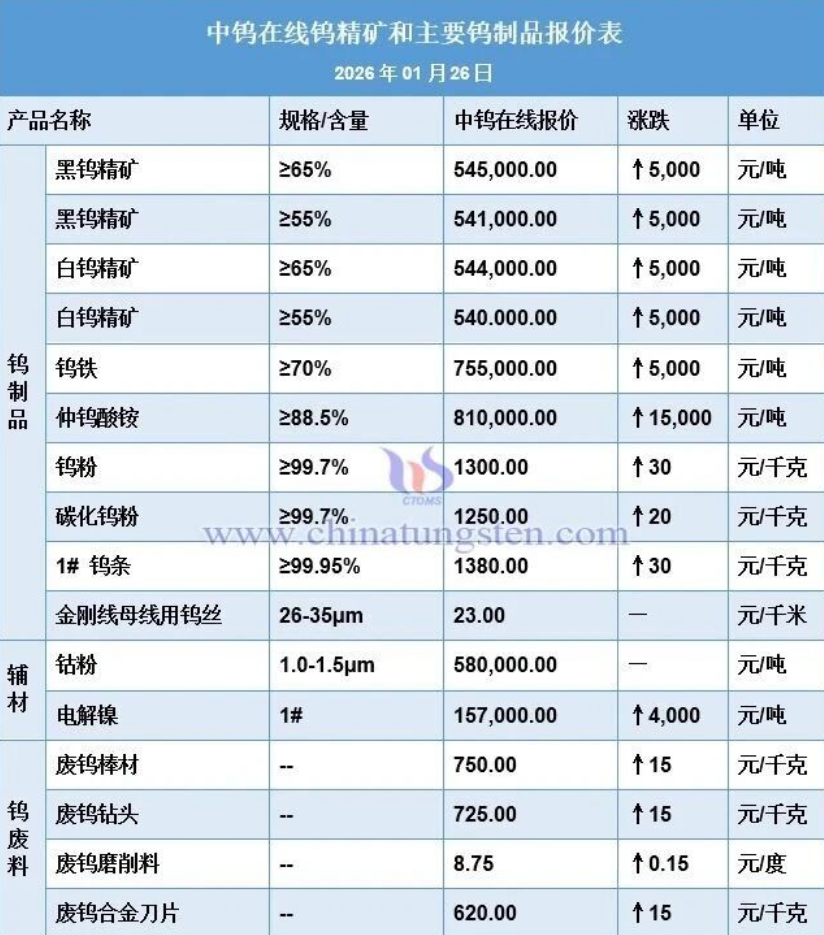
(来源:财闻) 仲钨酸铵(APT)价格报81万元/吨,较年初涨20.9%。 具备战略金属属性的钨,与金银铜等大宗商品一样,受到避险及配置资金的关注,金融属性对价格的影响也在凸显。 据中钨在线公众号消息,腊八时节,钨市依旧一派火热景象,自钨原料到钨材、钨合金,再到钨废料的全产业链价格 屡创新高。截至发稿,以人民币吨价计,钨精矿价格逼近55万关口,仲钨酸铵价格站上80万高位,钨粉价格突破130 万大关! | | | 中钙在线钨精矿和主要钨制品报价表 | | | | | --- | --- | --- | --- | --- | --- | | | | 2026年01月26日 | | | | | 产品名称 | | 规格/含量 | 中钨在线报价 | 涨跌 | 单位 | | | 黑钨精矿 | ≥65% | 545,000.00 | 1 5,000 | 元/吨 | | | 黑钨精矿 | ≥55% | 541,000.00 | 1 5,000 | 元/吨 | | | 白钨精矿 | ≥65% | 544,000.00 | 1 5,000 | 71./吨 | | | 白钨精矿 | ≥55% | 540.000.00 | 1 5 ...

钨价持续上涨,钨战略金属价值重估进行时
Xuan Gu Bao· 2026-01-19 14:37
Industry Overview - Tungsten prices are showing a steady upward trend, with 65% black tungsten concentrate prices increasing by 2000 yuan to 512,000 yuan per standard ton, reflecting an 11.3% rise since the beginning of the year [1] - 65% white tungsten concentrate prices also rose by 2000 yuan to 511,000 yuan per standard ton, marking an 11.3% increase year-to-date [1] - Ammonium paratungstate (APT) prices increased by 5000 yuan to 755,000 yuan per ton, representing a 12.7% rise since the start of the year [1] - Other tungsten varieties have also experienced varying degrees of price increases [1] Legislative Impact - A bipartisan group of U.S. Congress members has introduced the "2026 Ensuring Critical American Resources and Elements Minerals Act," proposing a $2.5 billion "Strategic Resilience Reserve" to establish a national reserve of critical minerals, including tungsten, which is prioritized due to its importance in military applications [1] Supply and Demand Dynamics - The domestic tungsten market is facing multiple supply disruptions, including reduced available mining quotas, decreased shipments from tungsten mines at year-end, and unstable import volumes [1] - Overseas supply from Vietnam is decreasing, with no new mines expected in the short term, while the EU and the U.S. have classified tungsten as a strategic metal, leading to increased demand [1] - Analysts suggest that the tungsten industry is entering a potentially multi-year upcycle, with related listed companies expected to see sustained performance improvements [1][2]
有色钢铁行业周观点(2026年第3周):持续关注工业金属的战略机会
Orient Securities· 2026-01-19 02:24
Investment Rating - The report maintains a "Positive" investment rating for the non-ferrous and steel industry in China [6]. Core Views - The report emphasizes the strategic opportunities in industrial metals, suggesting a focus on this sector as the global trend of de-globalization deepens and the technological attributes of strategic metals increase. With copper prices approaching 100,000, it is seen as a favorable time for strategic allocation in industrial metals [9][14]. - The zinc sector is highlighted as an overlooked basic material in the context of de-globalization, with improving supply-demand dynamics expected to drive prices higher. The report notes that the recent decline in zinc smelting fees indicates ongoing supply tightness, and there is optimism regarding demand from re-industrialization in Asia, Africa, and Latin America [9][14]. - The copper sector is viewed positively, with short-term price fluctuations not affecting the upward trend in equities. The report anticipates improvements in copper prices and smelting fees due to supply constraints and upcoming mine restarts [9][15]. - The aluminum sector is expected to benefit from geopolitical concerns, with China's electrolytic aluminum industry poised to enjoy valuation premiums due to its supply chain security and competitive advantages [9][16]. Summary by Sections Industrial Metals - The report suggests focusing on industrial metals as the market sentiment cools, with potential investment opportunities emerging [9][14]. - Zinc is identified as a critical material with a positive outlook due to supply-demand improvements and infrastructure needs in developing regions [9][14]. - Copper is expected to see price stability and profit improvements for smelting companies as major mines plan to resume operations [9][15]. - Aluminum is projected to experience steady growth in profitability, supported by supply chain advantages and rising demand for aluminum as a substitute for copper [9][16]. Steel Industry - The steel sector is currently facing a weak fundamental backdrop as it approaches the seasonal low around the Spring Festival, with expectations for policy measures to support the industry [17]. - Steel production has seen a slight decrease, with rebar consumption increasing by 8.79% week-on-week, indicating a marginal strengthening in demand [22][17]. - Inventory levels show a divergence between social and steel mill stocks, with total steel inventory slightly increasing [24]. - Steel prices have generally seen a minor increase, with the overall price index rising by 0.15% [36]. New Energy Metals - Lithium carbonate production in December 2025 saw a significant year-on-year increase of 69.09%, indicating strong supply growth in the new energy sector [40]. - The demand for new energy vehicles remains robust, with production and sales showing substantial year-on-year growth [44]. - Prices for lithium and cobalt have risen, reflecting the increasing demand and supply dynamics in the new energy metals market [49][50].
ETF盘中资讯|战略金属将“主导未来”? 有色ETF华宝(159876)盘中上探2.7%续创历史新高!获资金实时净申购5760万份!
Sou Hu Cai Jing· 2026-01-14 06:18
Group 1 - The non-ferrous metal sector continues to show strong upward momentum, with the popular ETF, Huabao Non-Ferrous ETF (159876), reaching a historical high, with an intraday increase of 2.71% and a current rise of 0.81% [1] - The technical analysis indicates a bullish trend, as the MACD indicator has achieved a golden cross, suggesting that the market's buying power remains dominant and the upward momentum of stock prices has not shown significant signs of weakening [1] - There has been significant capital inflow into the Huabao Non-Ferrous ETF, with a net subscription of 57.6 million units reported, accumulating a total of 387 million yuan over the past ten days [1] Group 2 - The report highlights that copper prices have considerable room for upward movement, as historical analysis shows that adjusted for inflation, current copper prices have not yet reached the heights of previous super cycles [2] - The ongoing global monetary order reshaping is weakening the dollar's role as a price anchor for major assets, with the current copper-to-gold ratio still at a historical low [2] - The investment community is optimistic about the non-ferrous metal sector, anticipating a bull market driven by monetary, demand, and supply factors, with projections indicating a potential bull market in 2026 [3][4] Group 3 - The Huabao Non-Ferrous ETF and its linked funds cover a wide range of sectors including copper, aluminum, gold, rare earths, and lithium, allowing for better exposure to the entire sector's beta performance [4] - Key stocks in the sector have shown significant gains, with Hunan Silver reaching the daily limit, and other companies like Steel Research High-Tech and Silver Non-Ferrous also experiencing substantial increases [5]
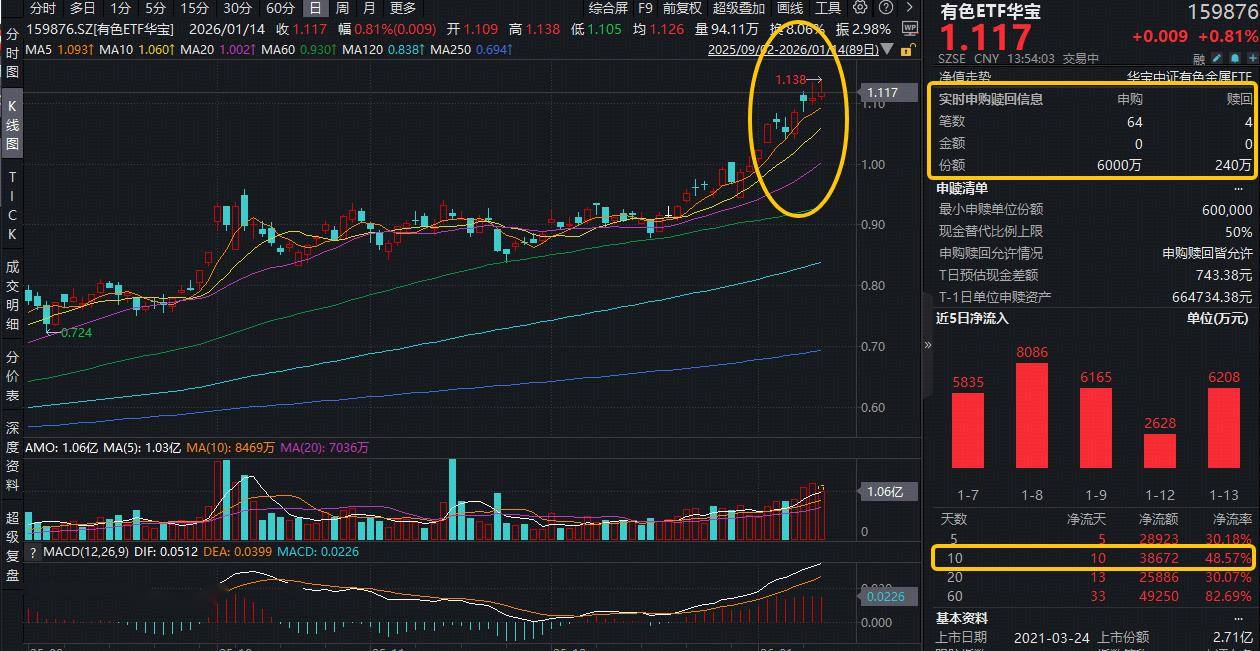
战略金属将“主导未来”? 有色ETF华宝(159876)盘中上探2.7%续创历史新高!获资金实时净申购5760万份!
Xin Lang Cai Jing· 2026-01-14 06:06
Core Viewpoint - The non-ferrous metal sector continues to show strong upward momentum, with the popular ETF, Huabao Non-Ferrous ETF (159876), reaching a new historical high and attracting significant capital inflow [1][9]. Group 1: Market Performance - The Huabao Non-Ferrous ETF (159876) saw an intraday increase of 2.71%, currently up 0.81%, with a real-time trading volume of 1.06 billion yuan [1][9]. - The ETF has recorded a net subscription of 57.6 million units, accumulating a total of 387 million yuan over the past 10 days [1][9]. - Key stocks in the sector include Hunan Silver, which rose by 9.98%, and Jiangxi Copper, which increased by 6.00% [2][4][13]. Group 2: Technical Analysis - The MACD indicator has formed a golden cross, indicating a continuation of the bullish trend, with the fast line (DIF) consistently above the slow line (DEA) [1][9]. - The short-term market is dominated by bullish sentiment, with no significant signs of a decrease in upward momentum [1][9]. Group 3: Industry Outlook - China Galaxy Securities believes that copper prices have significant upward potential, as historical analysis shows that adjusted for inflation, current copper prices have not reached the heights of previous super cycles [2][10]. - The current global monetary order is being reshaped, weakening the dollar's role as a price anchor, with the copper-to-gold ratio still at historical lows [2][10]. - The industry is expected to enter a bull market driven by monetary, demand, and supply factors by 2026, with institutions generally optimistic about the non-ferrous metal sector's future [5][11]. Group 4: Strategic Insights - The current super copper cycle is influenced by the "AI leap" and "century change," which are expected to have lasting strategic significance [11]. - The demand for strategic metals is anticipated to rise due to new technological revolutions, with elements essential for new productivity becoming increasingly important [11]. - The non-ferrous metal sector's strong performance is attributed to multiple factors, including global capital expenditure cycles, manufacturing recovery, and improved domestic macro expectations [11].
A股开盘:创业板指涨0.34%,贵金属板块集体走高,商业航天、AI应用及游戏股回调
Jin Rong Jie· 2026-01-14 01:36
Market Overview - On January 14, A-shares showed mixed performance with the Shanghai Composite Index slightly down by 0.11 points at 4138.65, while the Shenzhen Component rose by 0.17% to 14194.11, and the ChiNext Index increased by 0.34% to 3333.17 [1] - The precious metals sector saw multiple stocks open higher, with Hunan Silver rising over 3% [1] - The gaming sector experienced adjustments, with stocks like Changqu Technology and Tom Cat dropping over 5% and 3% respectively [1] Company News - Baiwei Storage expects a net profit attributable to shareholders of the parent company for 2025 to be between 850 million to 1 billion yuan, an increase of 427.19% to 520.22% compared to the previous year [2] - Fenglong Co. has seen its stock hit the limit up for 12 consecutive trading days, with a price increase of 213.97%, prompting a suspension for stock trading review due to significant deviation from fundamentals [2] - Guizhou Moutai's board approved a market-oriented operation plan for 2026, focusing on product systems, operational models, channel layouts, and pricing mechanisms [2] Financial Forecasts - TCL Technology anticipates a net profit of 4.21 billion to 4.55 billion yuan for 2025, representing a year-on-year growth of 169% to 191% [4] - Huaxia Happiness expects a net loss of 16 billion to 24 billion yuan for 2025, with a potential delisting risk due to negative net assets [4] - Chinese Online predicts a net loss of 580 million to 700 million yuan for 2025, attributed to increased promotional investments in overseas short drama business [3] Industry Trends - AI Medical: Morgan Stanley's healthcare conference highlighted a partnership between Nvidia and Eli Lilly to invest $1 billion in a new research lab in the San Francisco Bay Area over five years [6] - Lithium Battery: Rongbai Technology signed a procurement agreement with CATL to supply 3.05 million tons of lithium iron phosphate cathode materials from Q1 2026 to 2031, with a total sales amount exceeding 120 billion yuan [10] - Advanced Packaging: SK Hynix announced plans to invest 19 trillion won (approximately $129 billion) in a new advanced packaging factory to meet the rising demand for high bandwidth memory [11]





创业板指涨0.34%,贵金属、锰硅等板块指数涨幅居前
Feng Huang Wang Cai Jing· 2026-01-14 01:31
Group 1: Market Overview - The Shanghai Composite Index opened flat, while the Shenzhen Component Index rose by 0.17% and the ChiNext Index increased by 0.34% [1] - Precious metals and manganese silicon sectors showed the highest gains, while commercial aerospace and AI application sectors experienced the largest declines [1] Group 2: Strategic Metals Investment - CITIC Securities emphasizes the growing investment opportunities in strategic metals due to rising resource nationalism and geopolitical tensions, which have made the control of scarce resources increasingly important [2] - The current global landscape is characterized by significant changes, with strategic mineral resources becoming a new battleground among nations [2] Group 3: Inflation and Federal Reserve Outlook - CICC reports that the U.S. December CPI rose by 2.7% year-on-year, aligning with market expectations, while core CPI was at 2.6%, slightly below expectations [3] - The inflationary pressures are primarily driven by the service sector, and the Federal Reserve is unlikely to lower interest rates in January due to moderate inflation data [3] Group 4: Market Sentiment and Sector Rotation - CITIC Securities notes that market liquidity is increasing, with A-share trading volume surpassing 3 trillion yuan, leading to faster rotation among thematic sectors [4] - External factors include a lower-than-expected increase in U.S. non-farm payrolls and a drop in the unemployment rate, which has reduced the likelihood of a rate cut by the Federal Reserve [4] - Domestic economic recovery remains fragile, with ongoing adjustments in economic and income structures, while fiscal policies continue to support growth [4]
券商晨会精华 | 持续看好战略金属投资机遇
智通财经网· 2026-01-14 00:46
Group 1 - The three major indices collectively adjusted, with the Shenzhen Component Index falling over 1% and the ChiNext Index dropping nearly 2%. The total trading volume in the Shanghai and Shenzhen markets reached 3.65 trillion, an increase of 49.6 billion from the previous trading day. Over 3,700 stocks declined across the market [1] - In terms of sector performance, AI application concepts rose against the trend, while AI healthcare concepts were actively fluctuating. The electric grid equipment sector strengthened in the afternoon, and the retail sector performed actively. Conversely, the commercial aerospace and controllable nuclear fusion sectors saw significant declines [1] Group 2 - CITIC Securities emphasized the importance of monitoring thematic rotation sectors as market liquidity continues to strengthen, with A-share trading volume surpassing 3 trillion. The frequency of thematic sector rotation has accelerated [4] - The external environment shows that the U.S. non-farm payrolls increased by 50,000 in December, below the market expectation of 60,000, while the unemployment rate fell to 4.4%, lower than the expected 4.5%. This has significantly reduced the likelihood of a rate cut by the Federal Reserve in January [4] Group 3 - CITIC Construction expressed a sustained positive outlook on strategic metal investment opportunities, highlighting the rise of resource nationalism and the geopolitical landscape as key factors driving the strategic metal bull market. The control of scarce resources has become increasingly important in the current global context [2] - The report noted that strategic mineral resources are essential for economic and social development, serving as a solid foundation for national interests and livelihoods [2] Group 4 - CICC reported that inflation remains moderate, with the U.S. December CPI rising by 2.7% year-on-year, aligning with market expectations. The core CPI increased by 2.6%, slightly below market expectations. The main inflationary pressures are still coming from the service sector [3] - The report indicated that the Federal Reserve is unlikely to cut rates in January due to the moderate inflation data, with the next potential rate cut possibly occurring in March [3]
券商晨会精华:持续看好战略金属投资机遇
Sou Hu Cai Jing· 2026-01-14 00:32
Market Overview - The three major indices collectively adjusted, with the Shenzhen Component Index falling over 1% and the ChiNext Index dropping nearly 2% [1] - The total trading volume in the Shanghai and Shenzhen markets reached 3.65 trillion yuan, an increase of 49.6 billion yuan compared to the previous trading day [1] - Over 3,700 stocks in the market declined, while sectors such as AI applications and AI healthcare saw gains [1] Strategic Metals Investment - CITIC Construction maintains a positive outlook on strategic metals investment opportunities due to rising resource nationalism and geopolitical tensions [2] - The importance of strategic mineral resources has increased, becoming a new battleground for countries amid global supply chain disruptions [2] Inflation and Federal Reserve Outlook - CICC reports that the U.S. December CPI rose by 2.7% year-on-year, aligning with market expectations, while core CPI was at 2.6%, below expectations [3] - The report indicates that moderate inflation data is insufficient for the Federal Reserve to consider a rate cut in January, with the next potential cut possibly in March [3] Market Sentiment and Sector Rotation - CITIC Securities highlights that market liquidity is increasing, with A-share trading volume surpassing 3 trillion yuan, leading to accelerated sector rotation [4] - External factors, such as U.S. non-farm payrolls and unemployment rates, have reduced the likelihood of a rate cut by the Federal Reserve in January [4] - Domestic economic recovery remains fragile, with ongoing adjustments in economic and income structures, while support for technology sectors like AI and commercial aerospace continues [4]



锗市需要走出“虚假繁荣”!
Huan Qiu Lao Hu Cai Jing· 2026-01-12 13:45
Core Insights - The price of germanium has surged significantly, with projections indicating that the average price for 2025 will reach 15,021.47 CNY/kg and 2,927.82 USD/kg, marking a substantial increase from previous years [1][4][5] - Germanium is considered a strategic metal due to its limited global distribution and critical applications in sectors such as semiconductors and aerospace [2][3] - China's recent export controls and stockpiling initiatives have contributed to the rising prices of germanium, leading to a significant reduction in domestic inventories and increasing shortages overseas [3][4] Price Trends - The average price of germanium in 2024 and 2025 is projected to be 13,610.77 CNY/kg and 15,021.47 CNY/kg, respectively, with export prices reaching 2,065.79 USD/kg and 2,927.82 USD/kg [4][5] - Historical data shows that the peak average price for germanium was 12,174.76 CNY/kg in 2014, indicating that current prices are significantly higher than past peaks [4][5] Demand Dynamics - Despite the high prices, the demand for germanium in traditional sectors such as infrared and fiber optics is declining, raising concerns about the sustainability of current price levels [1][7][8] - The commercial space industry and semiconductor sectors are expected to drive some demand, but the actual growth in consumption remains limited [6][7] - The introduction of alternative materials, such as sulfur-based glass in the infrared market, is further reducing the demand for germanium [8][12] Industry Expansion - The domestic production of germanium is expected to increase significantly, with estimates suggesting a rise to 225 tons in 2025, driven by new production capacities coming online [10][11] - Internationally, other regions are also ramping up germanium production in response to China's export controls, which may lead to an oversupply situation [11] Market Outlook - The current high prices of germanium are not supported by strong demand, leading to a potential "price bubble" scenario where supply may outstrip demand [9][12] - If prices do not stabilize, downstream industries may accelerate their search for alternative materials, which could further diminish the market for germanium [12][13]