有色金属牛市

Search documents
AI入口大战打响!尾盘又现巨额压单
Mei Ri Jing Ji Xin Wen· 2026-01-26 12:04
Group 1 - Tencent announced a cash distribution of 1 billion yuan for the Spring Festival, with individual red envelopes reaching up to 10,000 yuan [1] - Baidu's Wenxin Assistant will also distribute 500 million yuan in cash red envelopes from January 26 to March 12, with a maximum reward of 10,000 yuan [1] - ByteDance's Doubao AI Assistant will be the exclusive AI cloud partner for the 2026 CCTV Spring Festival Gala, indicating a competitive landscape among major internet companies in the AI sector [2] Group 2 - The A-share market saw all three major indices decline, with the Shanghai Composite Index down 0.09% and the Shenzhen Component and ChiNext indices down 0.85% and 0.91%, respectively [4] - The trading volume in the Shanghai and Shenzhen markets reached 32,810 billion yuan, an increase of 1,627 billion yuan compared to the previous Friday [4] - Over 3,700 stocks declined, with a median drop of 1.33% in stock price changes [4] Group 3 - The market is characterized by a stable index performance, but individual stocks are experiencing significant pressure, particularly for those who bought at high prices [5] - Large sell orders were observed in major stocks, including Zijin Mining with a sell order of 4.07 billion yuan and China Ping An with 2.05 billion yuan [5][6] - The recent surge in the non-ferrous metals sector, particularly gold and silver, is notable, with gold prices surpassing 5,100 USD per ounce and silver prices increasing by over 7% in a single day [6] Group 4 - Fund allocation in the non-ferrous sector reached 11% in Q4 2025, up from 9.2% in Q3, indicating growing interest in this sector [6] - Other sectors with increased fund allocation include telecommunications, basic chemicals, non-bank financials, and machinery, with respective increases in allocation percentages [7] - The oil sector saw significant gains, with the sector index rising by 4.6%, and major companies like China National Petroleum and China National Offshore Oil Corporation experiencing over 5% increases [8] Group 5 - The commercial aerospace sector experienced a decline, with the index falling below the previous week's gains [10] - AI applications saw an overall adjustment, but some leading stocks experienced a return of funds, indicating potential resilience in this sector [11] - The liquor sector faced challenges, with Yanghe Brewery's performance falling short of expectations, while Kweichow Moutai finally saw a positive turn after a series of declines [11]

私募最新投资策略来了
券商中国· 2026-01-22 14:57
Core Viewpoint - The A-share market has shown strong momentum since the beginning of 2026, driven by changes in the preferences of private equity institutions regarding market funding sources and opportunities within the technology growth sector [1][3]. Group 1: Insurance Capital as a Key Variable - Insurance capital is expected to be a major source of incremental funds in the equity market for 2026, influencing market style significantly [3]. - The influx of funds into the stock market is largely due to the ongoing downturn in the real estate market, prompting a reallocation of capital from real estate to equities, with insurance products acting as the main conduit [3][4]. - As of Q3 2025, insurance funds directly held 3.62 trillion yuan in secondary market stocks, surpassing the 3.56 trillion yuan held by actively managed equity mutual funds, indicating that insurance capital has become a core institutional investor in A-shares and Hong Kong stocks [4]. Group 2: Technology Growth Sector Dynamics - The technology growth sector, particularly AI and innovative pharmaceuticals, remains a crucial investment theme, but private equity firms are reassessing the internal structure of this sector [5]. - Concerns about potential bubbles and the viability of business models in the AI sector necessitate breakthroughs in AI applications for sustained market performance [5][6]. - Investment strategies in AI should shift from a total investment logic to a structural logic, focusing on areas with tight supply and insufficient market recognition, particularly in the fields of autonomous driving and robotics [6]. Group 3: Outlook for Non-Ferrous Metals - The precious and non-ferrous metals sectors continue to strengthen, with gold and silver prices reaching historical highs, and international copper prices also hitting new records [7]. - The investment logic for non-ferrous metals remains robust, influenced by global order reconstruction and technological competition, although the short-term price increases have been significant [7]. - The long-term performance of non-ferrous metals will be shaped by the evolving global monetary landscape and the critical role these metals play in technological advancements [7].

私募机构透露最新投资策略 紧盯险资偏好重点布局AI应用
Zheng Quan Shi Bao· 2026-01-19 18:13
Group 1: Market Trends and Investment Preferences - The A-share market has shown strong momentum since the beginning of 2026, driven by sector rotation and changing judgments from private equity institutions regarding market funding sources and opportunities in the technology growth sector [1][2] - Insurance funds are expected to be a key source of incremental capital in the equity market for 2026, with their investment preferences influencing market style [2][3] - The shift of funds from the real estate market to the stock market, facilitated by insurance products, has resulted in a more resilient and rational capital inflow [2][3] Group 2: Insurance Capital and Equity Allocation - As of Q3 2025, insurance funds directly held 3.62 trillion yuan in secondary market stocks, surpassing the 3.56 trillion yuan held by actively managed equity mutual funds, indicating that insurance funds have become a core institutional investor in A-shares and Hong Kong stocks [3] - The liquidity environment is seen as a favorable factor for the stock market, with both institutional and individual investors having room to increase their equity asset allocations [3] Group 3: Technology Growth Sector Dynamics - The technology growth sector, particularly AI and innovative pharmaceuticals, remains a significant investment theme, but private equity institutions are reassessing the internal structure of this sector [4][5] - Concerns about potential bubbles and the viability of business models in the AI sector necessitate breakthroughs in AI applications to sustain market performance [4][5] - Investment focus is shifting towards areas with tight supply and underappreciated market recognition, particularly in AI applications and infrastructure [5] Group 4: Commodities and Metal Market Outlook - The precious and non-ferrous metal sectors continue to strengthen, with gold and silver prices reaching historical highs, and international copper prices also hitting new records [6] - Long-term factors influencing the performance of non-ferrous metals include global order reconstruction and technological competition, although short-term price increases have been significant [6]
有色金属板块延续强势 沪镍涨停
Qi Huo Ri Bao· 2026-01-08 00:23
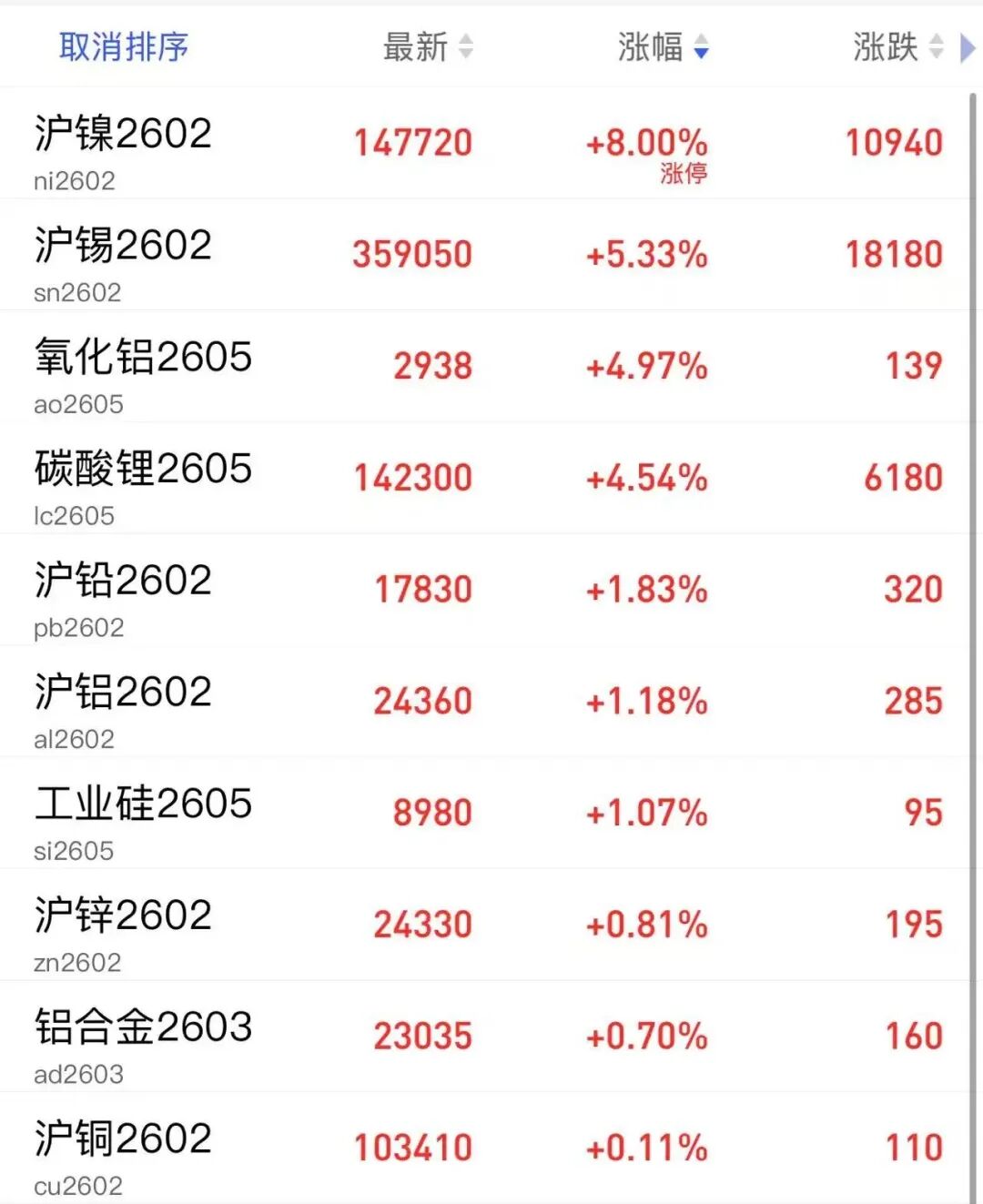
Core Viewpoint - The non-ferrous metal sector continues to show strength, with significant price increases in nickel, tin, and alumina contracts, driven by low valuations and supply disruptions [1][2]. Price Movements - Nickel (沪镍2602) rose by 8.00% to 147,720, while tin (沪锡2602) increased by 5.33% to 359,050, and alumina (氧化铝2605) saw a rise of 4.97% to 2,938 [2]. - Other notable increases include lithium carbonate (碳酸锂2605) at +4.54%, lead (沪铅2602) at +1.83%, and aluminum (沪铝2602) at +1.18% [2]. Market Drivers - The price surge in nickel is attributed to cost support and policy disruptions, particularly from Indonesia, which has reduced nickel ore production quotas and plans to revise the pricing formula for nickel [3][4]. - Tin prices are driven by supply constraints and increasing demand, with production recovery in Myanmar falling short of expectations [4]. - Alumina prices are supported by low valuations and the impact of differential electricity pricing policies, which are expected to increase operational costs [4]. Market Outlook - The current non-ferrous metal bull market is primarily driven by the depreciation of the US dollar and rising geopolitical risks, which enhance investment demand [4]. - However, there is a concern regarding insufficient downstream demand in the domestic market, leading to limited transaction volumes and deep discounts in the spot market [4]. - The long-term outlook suggests potential risks of significant corrections in the non-ferrous sector, particularly for aluminum and lead, while nickel's price increase heavily relies on overseas policy factors [4][5].
有色金属板块延续强势,沪镍涨停
Qi Huo Ri Bao· 2026-01-07 23:57
Core Viewpoint - The non-ferrous metal sector continues to show strength, with significant price increases in nickel, tin, and alumina driven by low valuations, supply disruptions, and rising demand [1][2]. Group 1: Nickel Market - Nickel prices are surging due to tightening supply expectations from Indonesia and increased market sentiment, with nickel being relatively undervalued compared to other metals [2]. - Recent policy changes in Indonesia, including a reduction in nickel ore production quotas and a revision of the pricing formula for nickel, are expected to increase production costs [1][2]. - The solid-state battery industry's rapid development is anticipated to boost long-term demand for nickel, despite the current market fundamentals remaining weak [2]. Group 2: Tin Market - Tin prices are rising due to supply constraints and continuous demand growth, with recent production issues in Myanmar impacting supply significantly [2]. - The decline in ore quality from overseas sources is also contributing to the supply challenges in the tin market [2]. Group 3: Alumina Market - The increase in alumina prices is primarily driven by low valuations and the impact of differential electricity pricing policies, which are expected to lead to industry upgrades and higher operational costs [2]. - Electricity costs account for 13% to 15% of alumina production costs, making the differential pricing policy a significant factor in market sentiment [2]. Group 4: Market Outlook - The current lack of downstream demand for non-ferrous metals and limited acceptance of high-priced goods in the spot market may lead to a gradual adjustment in pricing through the futures market [3]. - The non-ferrous metal sector may face significant correction risks in the medium to long term, particularly for alumina and lead, while the performance of nickel is heavily reliant on overseas policy factors [3]. - The market is expected to continue trading based on macroeconomic policies and supply security, with stronger performance anticipated for tin, copper, and aluminum, while nickel, zinc, and lead may perform relatively weaker [3].
突然,特朗普下令:扣押俄罗斯油轮!美国“将无限期控制委内瑞拉石油销售”!银价,暴跌
Xin Lang Cai Jing· 2026-01-07 23:52
Group 1 - The core point of the article highlights significant declines in silver prices across various markets, with London silver spot prices dropping over 7%, New York silver futures down over 5%, and Shanghai silver futures falling over 4% [3][19] - The ADP report indicates that the U.S. private sector added 41,000 jobs in December 2025, slightly below the expected 48,000, but reversing the previous month's decline of 29,000 jobs, signaling a positive trend in the labor market [4][20] - The upcoming non-farm payroll data is anticipated to show an increase of 73,000 jobs for December 2025, with a slight decrease in the unemployment rate to 4.5%, reinforcing the trend of an orderly cooling labor market [5][21] Group 2 - The U.S. military announced the seizure of two oil tankers, including a Russian vessel, under a presidential order, raising concerns about international maritime law and the implications for global oil markets [7][23] - U.S. Energy Secretary Chris Wright stated that the U.S. will indefinitely control Venezuelan oil sales, with revenues intended to benefit the Venezuelan people, which may impact the dynamics of oil supply and pricing [9][25] - The Shanghai Futures Exchange has implemented several risk control measures in response to increased volatility in metal markets, including adjustments to trading fees and limits on daily trading volumes for silver futures [12][26][28] Group 3 - The non-ferrous metals sector has shown strong performance, with nickel futures hitting the upper limit, and significant gains in tin and alumina contracts, driven by low valuations and supply disruptions [14][30] - Analysts indicate that the recent surge in nickel prices is primarily driven by cost support and policy disruptions, particularly from Indonesia, which is expected to tighten nickel supply [16][32] - The outlook for the non-ferrous metals market suggests potential risks of significant corrections, with varying performance expected across different metals, influenced by macroeconomic policies and supply security [17][33]

长江有色:7日铅价上涨 有色牛市氛围加持铅价反弹但交投平淡
Xin Lang Cai Jing· 2026-01-07 08:58
Core Viewpoint - The lead market is experiencing a slight upward trend, driven by macroeconomic sentiment and supply constraints, despite seasonal demand weakness [2][3]. Group 1: Market Performance - Today's Shanghai lead futures saw a slight increase, with the main contract opening at 17,530 CNY, reaching a high of 17,860 CNY, and closing at 17,830 CNY, up 320 CNY or 1.83% [1]. - The latest price for London lead is reported at 2,082 USD, an increase of 11 USD [1]. - The average price for domestic lead in the ccmn market is reported at 17,590 CNY, up 100 CNY [1]. Group 2: Supply and Demand Dynamics - Supply constraints are evident, with lead concentrate processing fees deeply inverted, indicating tight raw material supply, which supports price stability [2]. - Environmental factors have led to reduced production of recycled lead in Anhui, further tightening supply expectations [2]. - The social inventory of lead ingots is at a historically low level, creating potential risks for stockpiling [2]. Group 3: Seasonal Demand Challenges - The demand from downstream lead-acid battery manufacturers has decreased, reflecting a traditional seasonal slowdown [2]. - Although there is a slight recovery in orders for automotive batteries, demand in sectors like electric bicycles remains weak, leading to a "price increase with low volume" scenario [2]. Group 4: Future Outlook - Lead prices are expected to maintain a strong oscillating trend, with upward movement limited by the elasticity of recycled lead production capacity [3]. - Downstream seasonal realities and potential selling pressure from high factory inventories may restrict sustained price increases [3]. - Support for prices comes from macroeconomic easing expectations, strategic mineral resource policies, and low social inventory levels [3].
ETF盘中资讯|地缘冲突再起,资源牛市延续!有色ETF华宝(159876)盘中拉升2.3%续创历史新高,获资金实时净申购780万份
Sou Hu Cai Jing· 2026-01-05 02:21
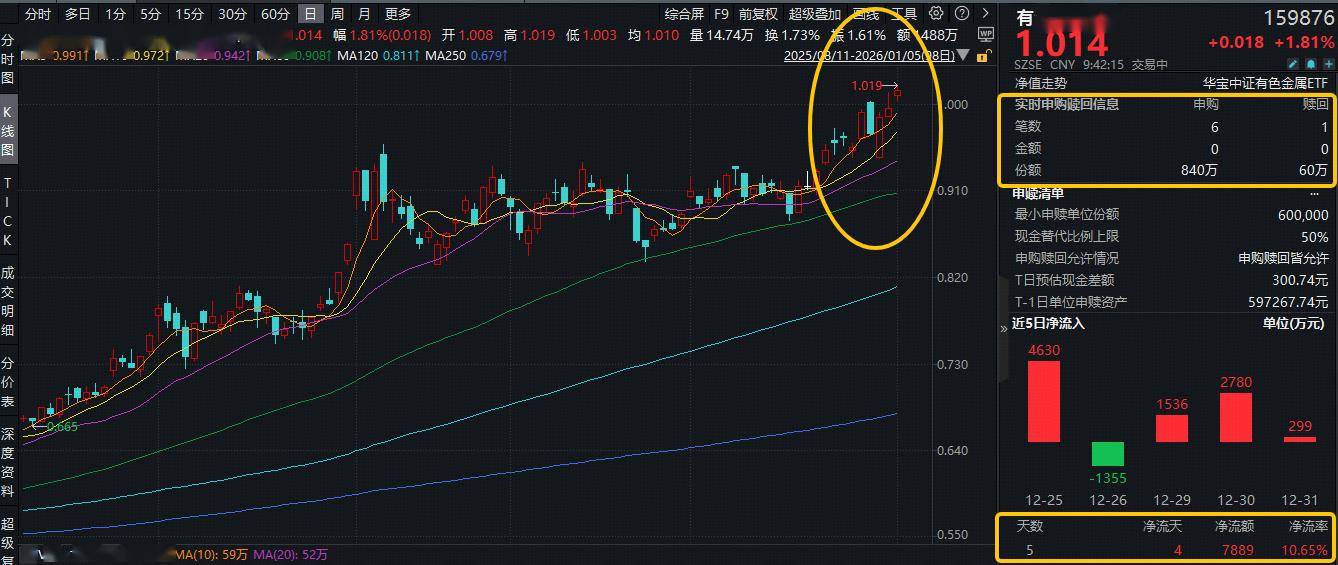
Core Viewpoint - The non-ferrous metal sector continues to show strong performance, with the Huabao Non-Ferrous ETF (159876) reaching new highs and attracting significant capital inflows, indicating positive market sentiment towards the sector [1][3]. Group 1: Market Performance - On January 5, 2026, the Huabao Non-Ferrous ETF saw an intraday increase of 2.31%, currently up 1.81%, marking a new high since its listing [1]. - The ETF has received a net subscription of 7.8 million units, with a net inflow of 78.89 million yuan over the past five trading days, reflecting strong investor confidence in the sector's future performance [1]. Group 2: Key Stocks Performance - Among the constituent stocks, Zhongfu Industrial led with an increase of over 8%, followed by Hunan Silver and China Aluminum, both rising over 7% [3]. - Other notable performers include Shenhuo Co., West Superconducting, and Tianshan Aluminum, all showing gains of over 4% [3]. Group 3: Supply and Demand Dynamics - The geopolitical tensions, particularly the U.S. military actions in Venezuela, have intensified the demand for gold as a safe-haven asset, reinforcing the bullish trend in precious metals [3]. - In the copper market, a strike at the Mantoverde copper-gold mine in Chile has exacerbated supply issues, contributing to a projected global copper market deficit of over 100,000 tons in 2026 [4]. - The aluminum market is also facing supply challenges, with LME aluminum prices surpassing $3,000, driven by concerns over the stability of electrolytic aluminum supply [5]. Group 4: Future Outlook - Analysts predict a continued bullish trend in the non-ferrous metal sector, driven by global capital expenditure cycles, manufacturing recovery, and improved macroeconomic expectations [5]. - The consensus among institutions is that the non-ferrous metal sector is likely to experience a bull market in 2026, supported by synchronized upward movements in monetary policy, demand, and supply [5].
ETF日报|沪指11连阳收官!商业航天狂欢,有色一举夺冠!高“光”创业板人工智能ETF(159363)年涨105%晋级翻倍基
Sou Hu Cai Jing· 2025-12-31 09:45
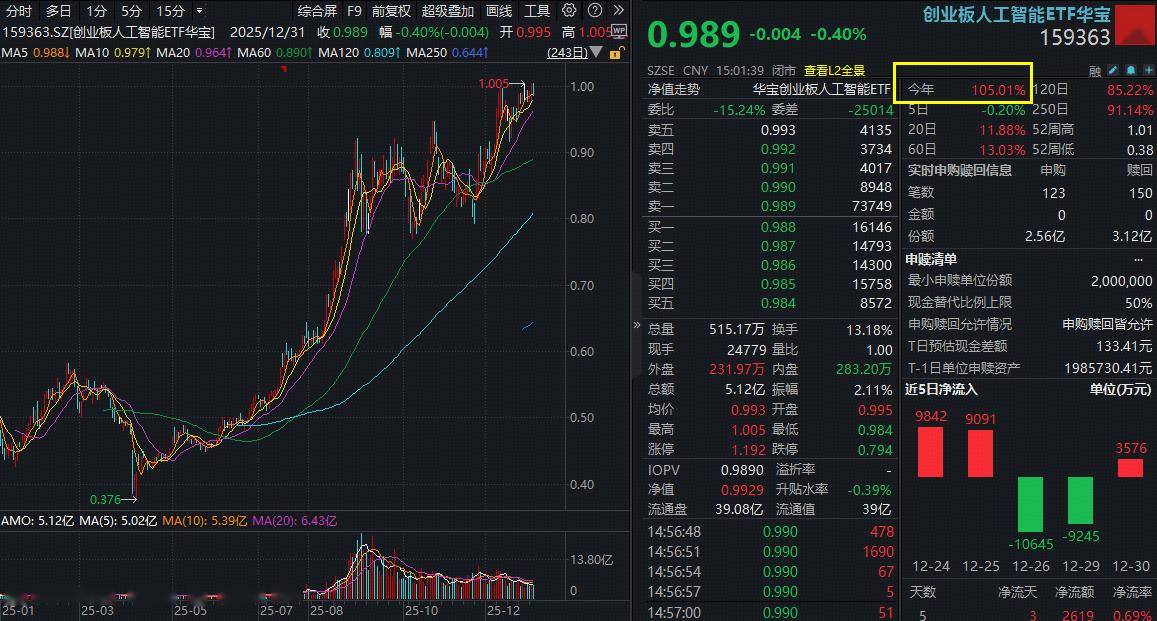
Market Overview - The Shanghai Composite Index achieved an "11 consecutive days of gains" milestone, marking the longest streak of the year, while the Shenzhen Component Index and ChiNext Index fell by 0.58% and 1.23% respectively [1] - The A-share market's total trading volume reached 42.021 trillion yuan in 2025, setting a historical record [3] Industry Performance Non-ferrous Metals - The non-ferrous metals sector topped the annual industry performance chart, with the non-ferrous ETF (Huabao 159876) index rising by 91.67%, significantly outperforming major indices like the Shanghai Composite Index (18.41%) and CSI 300 (17.66%) [5][17] - Key stocks in the sector saw substantial gains, with Zijin Mining up 133.09%, Luoyang Molybdenum up 210.27%, and Jiangxi Copper up 176.92% [5] - The sector's strong performance is attributed to a combination of global capital expenditure cycles, manufacturing recovery, and improved domestic macroeconomic expectations [7] Military Industry - The military industry, particularly the commercial aerospace segment, saw significant gains, with the military ETF (Huabao 512810) rising over 32% in 2025 [10] - The sector experienced a surge in trading volume, with net purchases reaching 16.088 billion yuan, the highest in the industry [10] - Key stocks in the military ETF included Guobang Electronics and China Aerospace, both of which saw gains exceeding 10% [10] Chemical Industry - The chemical sector, represented by the chemical ETF (Huabao 516020), recorded a 41.09% increase in 2025, outperforming major indices [17] - The lithium battery supply chain showed a significant increase in both volume and price, with industrial-grade lithium carbonate prices rising to 116,000 yuan per ton [19] - The sector is expected to benefit from macroeconomic recovery and supply-side policy advancements, leading to improved profitability [19] Investment Opportunities - The non-ferrous ETF (Huabao 159876) is recommended for investors looking to gain exposure to the non-ferrous metals sector, as it covers a wide range of metals including copper, aluminum, and lithium [8] - The military ETF (Huabao 512810) is positioned as an efficient tool for investing in core military assets, covering various themes such as commercial aerospace and military AI [13] - The chemical ETF (Huabao 516020) offers a diversified investment approach across different segments of the chemical industry, including leading companies in lithium battery materials and agricultural chemicals [20]

有色金属“王者归来”:一场结构性牛市,还是情绪交易?
老徐抓AI趋势· 2025-12-30 07:56
Group 1 - The core viewpoint of the article is that the recent surge in the CSI Industrial Nonferrous Index is driven by improvements in supply-demand structure, changes in the global macro environment, and elevated national strategic priorities, indicating potential sustainability in this market trend [1][10] - The article emphasizes that nonferrous metals are a typical cyclical industry, with prices determined by supply and demand, and are closely tied to macroeconomic conditions and industrial investment [1][11] - The current rise in nonferrous metals is not only cyclical but also influenced by structural themes such as national strategic security, new technology cycles, economic recovery, and changes in global liquidity [1][10] Group 2 - China's strategic mineral resources face two significant issues: high dependence on foreign sources and lack of cost competitiveness in domestic resources [3][4] - The article outlines several national policies aimed at enhancing resource security and promoting high-quality development in the copper, aluminum, and gold industries, with specific targets for resource growth and production capacity [8][9] - Investment in the nonferrous mining sector is projected to reach 208.9 billion yuan in 2024, marking a ten-year high, with significant increases in fixed investment expected in the coming years [9] Group 3 - The article identifies two major drivers for the nonferrous market in 2025: the real demand for metals driven by AI and the increasing gold reserves held by central banks amid a trend towards de-dollarization [11][12] - Economic recovery in China is anticipated to boost demand for industrial nonferrous metals, while global supply constraints and domestic capacity controls are expected to keep supply tight [12][13] - The article highlights the importance of inventory depletion in supporting prices, with specific examples of lithium and aluminum inventory trends [14] Group 4 - The macroeconomic environment is characterized by a potential easing of monetary policy, with expectations of multiple interest rate cuts by the Federal Reserve in 2026, which could enhance the attractiveness of nonferrous metals [15][16] - The article predicts a mid-term bull market for nonferrous metals driven by a combination of monetary easing, demand growth from emerging sectors, and supply-side constraints [18][20] - The industrial nonferrous index is favored for its clear focus on manufacturing and strong performance compared to broader indices, with significant historical returns and robust profitability metrics [21][25][27] Group 5 - Ordinary investors are advised to consider specific ETFs and mutual funds that focus on the industrial nonferrous sector, emphasizing a strategy of index-based and leading company investments [31][33]