黄金等

Search documents
今日财经要闻TOP10|2026年2月4日
Xin Lang Cai Jing· 2026-02-04 12:27
Group 1: Iran and US Negotiations - Iran has requested to change the location and format of the upcoming nuclear negotiations with the US, proposing to move from Istanbul to Oman and to hold bilateral talks only with the US, excluding other Arab and Muslim countries as observers [3][12] - If these new demands disrupt the negotiation process, it could lead to a shift in US strategy from diplomatic to military actions, especially given the military buildup in the Gulf region [2][10] Group 2: Military Tensions - The US military reportedly shot down an Iranian drone approaching the USS Abraham Lincoln aircraft carrier in the Arabian Sea, highlighting ongoing military tensions in the region [2][11] - The USS Abraham Lincoln is part of a larger naval presence in the Middle East, with at least 10 ships deployed to exert pressure on Iran [2][11] Group 3: Solar Industry Developments - Elon Musk's team has been visiting multiple solar companies in China to explore projects related to equipment, silicon wafers, and battery components, focusing on heterojunction and perovskite technology [4][11] - There are indications that Musk's team may be considering the procurement of HJT battery production lines due to their high automation levels, which are suitable for production in the US [4][11] Group 4: Gold Industry Planning - The China Gold Association held a seminar on the draft of the "15th Five-Year Plan" for the gold industry, emphasizing the importance of resource security for stable industry development [6][13] - The plan aims to enhance resource self-sufficiency and comprehensive utilization, focusing on overcoming key technological bottlenecks and advancing research in high-end gold materials [5][13]
量价齐升榜前十:瑞泰科技连续5天放量上涨,累计涨幅13.15%
Jin Rong Jie· 2026-01-22 08:56
Core Insights - The article highlights the significant stock performance of RuiTai Technology, which has seen a price and volume increase, with a cumulative rise of 13.15% over five consecutive days [1] Group 1: Stock Performance - RuiTai Technology has experienced a continuous increase in both price and trading volume, marking a cumulative increase of 13.15% [1] - Other stocks that have also shown similar trends with increased volume over five days include Tianrun Industrial, Runtu Co., Hopu Co., and Lianjian Technology [1] - Additional stocks with notable performance include Zhaojin Gold, Titan Chemical, Hunan Silver, Fengxing Co., all of which have seen a four-day increase in volume [1]

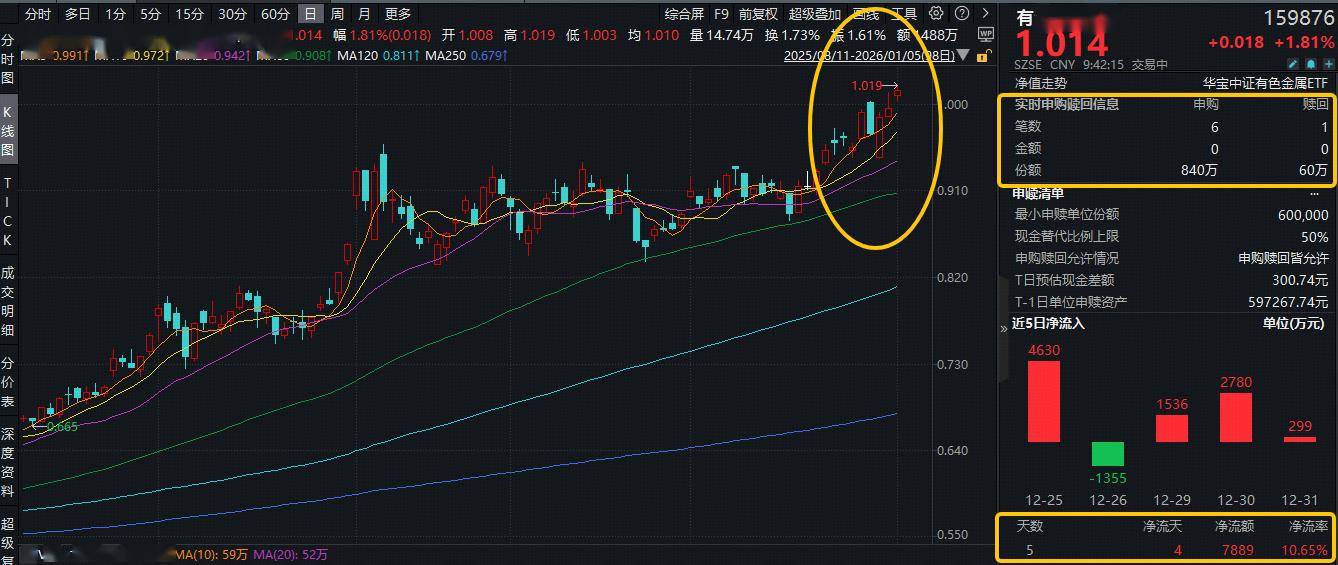
ETF盘中资讯|地缘冲突再起,资源牛市延续!有色ETF华宝(159876)盘中拉升2.3%续创历史新高,获资金实时净申购780万份
Sou Hu Cai Jing· 2026-01-05 02:21
Core Viewpoint - The non-ferrous metal sector continues to show strong performance, with the Huabao Non-Ferrous ETF (159876) reaching new highs and attracting significant capital inflows, indicating positive market sentiment towards the sector [1][3]. Group 1: Market Performance - On January 5, 2026, the Huabao Non-Ferrous ETF saw an intraday increase of 2.31%, currently up 1.81%, marking a new high since its listing [1]. - The ETF has received a net subscription of 7.8 million units, with a net inflow of 78.89 million yuan over the past five trading days, reflecting strong investor confidence in the sector's future performance [1]. Group 2: Key Stocks Performance - Among the constituent stocks, Zhongfu Industrial led with an increase of over 8%, followed by Hunan Silver and China Aluminum, both rising over 7% [3]. - Other notable performers include Shenhuo Co., West Superconducting, and Tianshan Aluminum, all showing gains of over 4% [3]. Group 3: Supply and Demand Dynamics - The geopolitical tensions, particularly the U.S. military actions in Venezuela, have intensified the demand for gold as a safe-haven asset, reinforcing the bullish trend in precious metals [3]. - In the copper market, a strike at the Mantoverde copper-gold mine in Chile has exacerbated supply issues, contributing to a projected global copper market deficit of over 100,000 tons in 2026 [4]. - The aluminum market is also facing supply challenges, with LME aluminum prices surpassing $3,000, driven by concerns over the stability of electrolytic aluminum supply [5]. Group 4: Future Outlook - Analysts predict a continued bullish trend in the non-ferrous metal sector, driven by global capital expenditure cycles, manufacturing recovery, and improved macroeconomic expectations [5]. - The consensus among institutions is that the non-ferrous metal sector is likely to experience a bull market in 2026, supported by synchronized upward movements in monetary policy, demand, and supply [5].

资本市场多元化退市格局加速形成
Zheng Quan Ri Bao· 2025-12-30 23:14
Group 1 - The core viewpoint of the articles highlights the increasing trend of delistings in the Chinese capital market, with 32 companies expected to delist in 2025, driven by various factors including stricter regulations and enhanced investor protection mechanisms [1][2][4] - The delisting process has diversified, with 11 companies delisting due to trading issues, 9 due to financial problems, and 5 due to major legal violations, indicating a more structured approach to maintaining market integrity [1][2] - The concept of "delisting without exemption" has become a norm, with regulatory bodies emphasizing accountability for delisted companies, leading to an increase in administrative penalties and legal actions against them [4][5] Group 2 - The new delisting regulations implemented in April 2024 have shown effectiveness, particularly in identifying companies that do not meet listing criteria, with a notable rise in companies facing delisting due to financial fraud [2][3] - The rise in voluntary delistings reflects a rational recognition among market participants, indicating a shift towards market-driven decisions such as mergers and acquisitions [3] - Regulatory bodies are focusing on creating a robust investor protection framework, ensuring that investors have access to compensation mechanisms and legal recourse in the event of delistings [6][7] Group 3 - The regulatory framework has been strengthened to ensure that companies cannot evade accountability post-delistings, with a focus on linking administrative penalties to civil compensation for investors [4][5] - Recent statistics show that 41 delisted companies have received a total of 49 administrative penalties, highlighting the increased scrutiny and enforcement actions taken against non-compliant firms [4] - The introduction of cash options for shareholders in voluntarily delisting companies aims to protect minority shareholders and ensure fair compensation during the delisting process [8][9]
全球市场波动,我们该如何应对?|第418期直播回放
银行螺丝钉· 2025-11-25 13:56
Core Viewpoint - The article discusses the recent volatility in stocks, bonds, and gold, attributing it to a liquidity crisis and uncertainties surrounding the Federal Reserve's interest rate decisions. It emphasizes the need for investors to adapt to these market conditions and identifies potential investment opportunities amidst the fluctuations [1][3][4]. Group 1: Market Volatility - Recent fluctuations have been observed across global stock markets, with notable declines in gold and bonds as well [3][4]. - The simultaneous volatility in stocks, bonds, and gold is typically indicative of a liquidity crisis, a situation that is relatively rare [4][5]. - The current liquidity crunch is primarily driven by uncertainties regarding the Federal Reserve's interest rate cuts, particularly the potential for a rate cut in December [7][14]. Group 2: Federal Reserve and Interest Rates - The Federal Reserve is expected to enter a phase of interest rate cuts, with the U.S. national debt projected to reach $38.33 trillion by November 2025 [8]. - Interest payments on federal debt are anticipated to exceed $870 billion in 2024, surpassing military spending for the first time, and are expected to exceed $1 trillion in 2025 [9][10]. - The timing of interest rate cuts remains uncertain, with potential gaps of several months to over half a year between cuts [11][12]. Group 3: Investment Strategies - In response to market volatility, investors are advised to assess their holdings for undervalued assets and ensure that the underlying companies are still profitable [26]. - Short-term fluctuations may present opportunities to acquire undervalued assets, as seen during previous market downturns [28]. - Suitable investment options include undervalued index funds, actively managed portfolios, and "fixed income plus" products that incorporate a small amount of equities [32][34].

中金2026年大类资产展望:超配中国股票与黄金 标配美股与美债
智通财经网· 2025-11-17 00:40
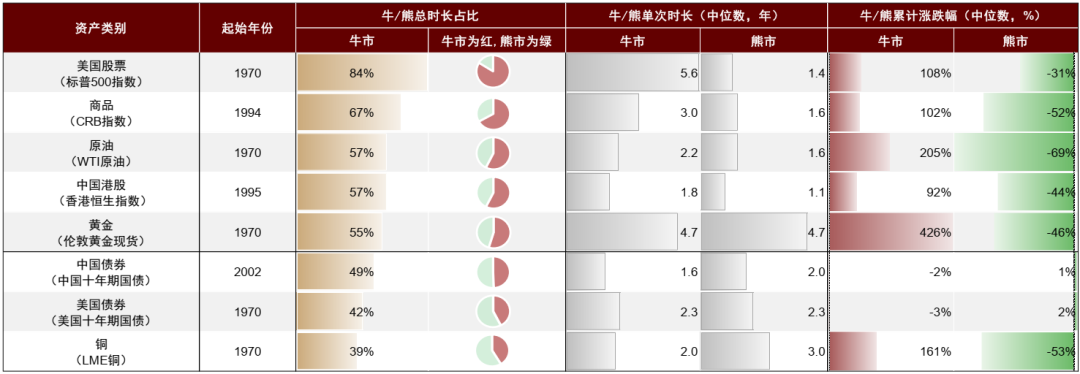
Group 1 - The article discusses the importance of identifying market tops for Chinese stocks and gold, emphasizing that economic and policy signals are crucial for making accurate predictions [1][10][40] - It highlights that the U.S. stock market has a long bull market duration, while Chinese stocks experience more frequent bull-bear switches, making timing more critical for Chinese stocks [5][10] - The analysis indicates that gold's bull and bear markets are lengthy with low switching frequency, suggesting that identifying tops is also significant for gold [1][5] Group 2 - Four key factors are identified that could potentially alter the bull market trends for stocks and gold in 2026: growth direction, tightening policies, high valuations, and geopolitical shocks [2][39] - The current economic conditions in China are characterized as a "weak recovery," while the U.S. is moving towards "stagflation," which could impact the performance of stocks and gold differently [2][41] - The article suggests that while there are no immediate signals indicating a top for the current bull markets, high valuations for gold may lead to increased volatility in the future [26][36][40] Group 3 - The asset allocation recommendation includes overweighting Chinese stocks and gold, while maintaining a neutral position in U.S. stocks and bonds, and adjusting commodity exposure to neutral [3][4] - The rationale for these recommendations is based on the ongoing AI technology wave and liquidity conditions benefiting Chinese stocks, while gold is supported by the current monetary policy environment [3][4] - The article notes that despite potential volatility, there are no clear signals indicating a market top for Chinese stocks or gold at this time [25][36]
沪指半日跌0.44% 黄金概念股集体回调
Sou Hu Cai Jing· 2025-10-22 04:16
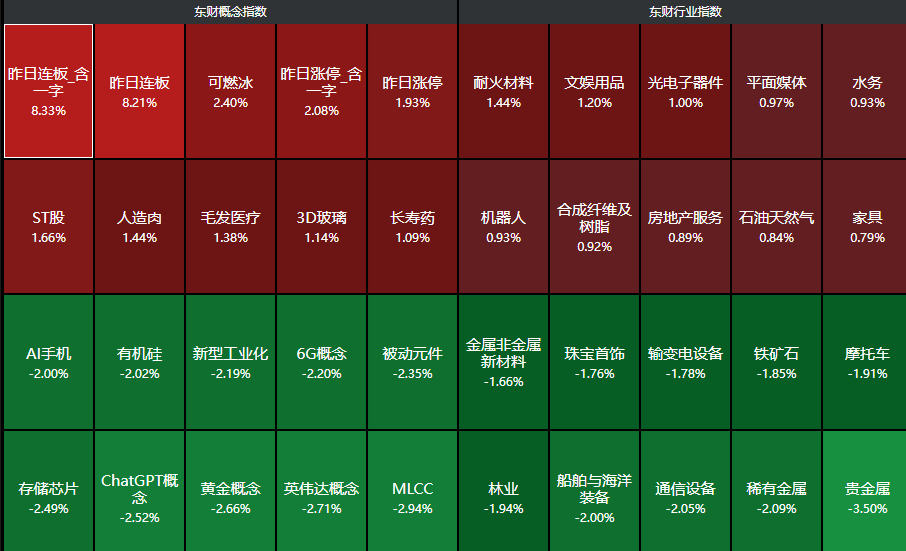
Market Overview - On October 22, the market experienced a decline, with the Shanghai Composite Index down by 0.44%, the Shenzhen Component Index down by 0.81%, and the ChiNext Index down by 0.89% [1] Sector Performance - Strong performance was noted in the deep earth economy sector, with companies like ShenKai Co. and Petrochemical Machinery achieving three consecutive trading limit increases [1] - The plant-based meat sector remained active, highlighted by Double Tower Food reaching its trading limit [1] - The robotics sector saw a rebound, with companies such as CITIC Heavy Industries, Ruineng Technology, and Southern Road Machinery also hitting their trading limits [1] Declining Sectors - The gold sector experienced a collective pullback, with Hunan Silver falling over 8% [1] - Other sectors that faced significant declines included communication equipment and forestry, which had the largest drops [1]
煤炭ETF领涨;金价走高,基金公司限购相关产品丨ETF晚报
2 1 Shi Ji Jing Ji Bao Dao· 2025-10-16 09:44
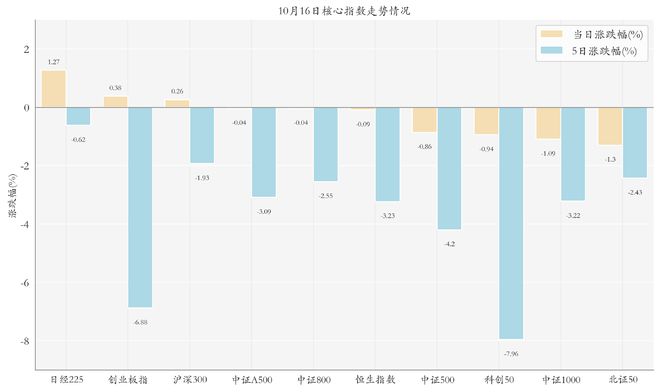
ETF Industry News - The three major indices showed mixed results, with the coal ETF leading gains, up by 2.97%, while several home appliance ETFs declined [1] - As of October 15, 127 equity funds have raised over 1 billion yuan this year, with more than 70% being index funds, indicating a strong preference for index-based investments [1] Gold Market Update - Gold prices reached a new high of 4200 USD per ounce on October 15, with 43% of surveyed investors considering "going long on gold" as the most crowded trade, surpassing the 39% for "going long on the seven major US stocks" [2] - The surge in gold prices has led to a significant influx of capital into gold ETFs, exceeding 200 billion yuan this year, prompting some fund companies to impose large purchase limits on related products [2] Market Overview - On October 16, the Shanghai Composite Index rose by 0.1% to 3916.23 points, while the Shenzhen Component Index fell by 0.25% to 13086.41 points, and the ChiNext Index increased by 0.38% to 3037.44 points [3] - The Nikkei 225, ChiNext Index, and CSI 300 ranked high in performance, with respective daily changes of 1.27%, 0.38%, and 0.26% [3] Sector Performance - The coal, banking, and food & beverage sectors performed well today, with daily gains of 2.35%, 1.35%, and 0.97% respectively, while steel, non-ferrous metals, and construction materials lagged behind [5] - Over the past five trading days, coal, banking, and food & beverage sectors have shown strong performance with gains of 6.34%, 5.72%, and 2.55% respectively [5] ETF Market Performance - The average daily performance of different categories of ETFs was calculated, with commodity ETFs showing the best average gain of 0.54%, while thematic stock index ETFs had the worst average decline of -0.44% [8] - The top-performing ETFs today included the coal ETF (515220.SH) with a gain of 2.97%, followed by the communication equipment ETF (159583.SZ) at 2.84%, and the energy ETF (159930.SZ) at 2.10% [10] ETF Trading Volume - The top three ETFs by trading volume today were the A500 ETF (512050.SH) with 4.879 billion yuan, the Sci-Tech 50 ETF (588000.SH) with 4.868 billion yuan, and the ChiNext ETF (159915.SZ) with 4.670 billion yuan [13]
国庆假期结束,外盘变动?何?
Guo Fu Qi Huo· 2025-10-09 09:23
Report Summary 1. Report Industry Investment Rating No relevant information provided. 2. Core Viewpoints The report comprehensively analyzes the changes in the external market during the 2025 National Day holiday, including the fluctuations of various financial and commodity indices, as well as the supply - demand situation of the international and domestic agricultural and energy industries, and international and domestic macro - economic news. 3. Summary by Related Contents External Market Fluctuations during National Day - The US dollar index rose from 97.82 to 98.84, with a 1.04% increase; the Dow Jones Industrial Average rose 0.44%, and the Nasdaq Composite Index rose 1.69% [1]. - Among agricultural products, BMD Malaysian palm oil rose 4.48%, CBOT US soybeans rose 2.90%, and ICE US cotton fell 1.19% [1]. - In the energy sector, NYMEX US fuel oil fell 1.36%, NYMEX US crude oil fell 0.21%, and ICE Brent fell 0.11% [1]. - Among non - ferrous metals, COMEX gold rose 4.45%, COMEX silver rose 3.42%, and LME copper rose 3.93% [1]. International Supply - Demand Situation - **Palm Oil**: Malaysia's September palm oil inventory is expected to decline by 2.5% compared to August, production is expected to decline by 3.3%, and exports are expected to increase by 7.7%. Indonesia's 2025/26 palm oil production is expected to decline by 1%, and Malaysia's is expected to decline by 1%. Global palm oil imports are expected to increase by 4.6% [2][3]. - **Soybeans**: S&P Global lowered the US soybean yield forecast. As of September 1, 2025, the US old - crop soybean inventory was 3.16 billion bushels. Brazilian soybean planting progress is faster than in previous years, and the 2025/26 production is expected to increase. Argentina's 2025/26 soybean production is expected to be 4850 tons, and corn production is expected to be 5800 tons [4][5][7]. - **Other Crops**: Canada's 2025/26 rapeseed production is expected to be 2002.8 tons, and exports are expected to be 700 tons. Ukraine has approved new export documents for tax - exempt rapeseed and soybean exports [13][14]. Domestic Supply - Demand Situation - On September 30, the total trading volume of domestic edible oils decreased by 71% compared to the previous trading day. The trading volume of soybean meal decreased, and the oil mill operating rate dropped by 6.41%. The national soybean oil port inventory decreased by 0.7 tons [16]. International Macro - news - The US ADP employment in September decreased by 32,000, the Challenger job - cuts in September were 54,064, and the ISM non - manufacturing PMI was 50. The US government shutdown continued, and the release of some economic data was postponed [18][19]. - OPEC + will increase production by 137,000 barrels per day in November. The eurozone's October Sentix investor confidence index was - 5.4 [19]. Domestic Macro - news - On September 30, the US dollar/renminbi exchange rate was adjusted downwards (the renminbi appreciated). The central bank conducted 242.2 billion yuan of 7 - day reverse repurchase operations, with a net withdrawal of 33.9 billion yuan. On October 9, the central bank will conduct 1.1 trillion yuan of 3 - month (91 - day) outright reverse repurchase operations [22]. - In September, China's manufacturing PMI was 49.8%, up 0.4 percentage points from the previous month; the non - manufacturing business activity index was 50.0%, down 0.3 percentage points; the composite PMI output index was 50.6%, up 0.1 percentage point [22].
[6月2日]指数估值数据(关税风险再起,全球股市波动,黄金上涨)
银行螺丝钉· 2025-06-02 13:54
Group 1 - The core viewpoint of the article discusses the recent fluctuations in the Hong Kong stock market, particularly in relation to tariff policies and their impact on global markets [3][10][13] - The Hang Seng Index experienced a slight decline of 0.57%, with technology stocks dropping by 0.7% [3][4] - Following a significant drop in early April due to tariff concerns, the Hong Kong market rebounded over six weeks, recovering the losses [5][6] Group 2 - The article highlights the influence of U.S. tariff policies on global stock market volatility, with recent court rulings affecting market sentiment [8][9][10] - Gold prices have shown a negative correlation with global stock markets, rising during periods of stock market volatility [13][16] - The total market value of gold is approximately 170 trillion RMB, comparable to the RMB bond market, while the U.S. stock market alone is valued at around 60 trillion USD [22][24] Group 3 - The article emphasizes the importance of understanding investment logic and maintaining patience during market fluctuations to achieve long-term gains [31][34] - It encourages investors to continuously learn and research to better navigate market volatility [32][34] - The article concludes with an invitation for readers to share their investment experiences and thoughts [36]