
美联储降息预期

Search documents
凯撒娱乐股价持续下跌,受宏观、行业及技术因素影响
Jing Ji Guan Cha Wang· 2026-02-13 16:58
Group 1 - The stock price of Caesars Entertainment (CZR.OQ) has been declining due to macroeconomic pressures, weak industry fundamentals, and technical factors [1] - As of February 13, 2026, Caesars Entertainment's stock closed at $18.38, down 3.26% for the day and a cumulative decline of 10.43% over the last five trading days [2] - The macroeconomic environment has been volatile since February 2026, with adjustments in expectations for Federal Reserve interest rate cuts leading to cautious investor sentiment, particularly affecting consumer-driven companies like Caesars Entertainment [3] Group 2 - The gaming industry, where Caesars operates, is facing challenges with a decline in visitor numbers to Las Vegas, resulting in a drop in revenue for the Las Vegas segment in Q3 2025, indicating weak consumer spending [4] - For Q3 2025, Caesars reported revenues of $2.869 billion, a year-over-year decline of 0.17%, and a net loss of $55 million, which is an increase of 511.11% compared to the previous year [5] - The low liquidity environment has led to increased selling pressure, with trading volume significantly reduced on February 12, 2026, indicating insufficient buying support [6] Group 3 - Despite most institutions maintaining neutral or positive ratings, with 68% recommending buy or hold as of February 2026, the average target price has been lowered to $33.26, reflecting cautious market sentiment regarding short-term fundamental improvements [7]
山金期货贵金属策略报告-20260213
Shan Jin Qi Huo· 2026-02-13 11:56
Report Industry Investment Rating No relevant content provided. Core View of the Report - It is expected that precious metals will experience wide - range fluctuations and be generally weak in the short term, oscillate to build a bottom in the medium term, and maintain a long - term bullish trend [1]. Summary by Relevant Catalogs 1. Gold - **Strategy**: Conservative investors should wait and see, while aggressive investors can buy low and sell high. It is recommended to manage positions well and set strict stop - loss and take - profit levels [2]. - **Price Data**: Comex gold active contract closed at $4941.40 per ounce, down $166.40 (-3.26%); London gold at $5043.15 per ounce, down $34.70 (-0.68%); Shanghai gold futures main contract at 1110.10 yuan per gram, down 16.02 yuan (-1.42%); Gold T + D at 1108.50 yuan per gram, down 14.42 yuan (-1.28%) [2]. - **Position and Inventory**: Comex gold positions decreased by 16.13% to 409,694 contracts; Shanghai gold futures main contract positions decreased by 6.53% to 153,140 contracts; LBMA gold inventory increased by 0.57% to 9158 tons [2]. 2. Silver - **Strategy**: Similar to gold, conservative investors should wait and see, and aggressive investors can use a high - selling and low - buying strategy. Good position management and strict stop - loss and take - profit are recommended [5]. - **Price Data**: Comex silver active contract closed at $75.01 per ounce, down $9.07 (-10.79%); London silver at $83.52 per ounce, down $2.58 (-3.00%); Shanghai silver futures main contract at 19,782 yuan per kilogram, down 844 yuan (-4.09%) [5]. - **Position and Inventory**: Comex silver positions remained unchanged at 143,180 contracts; Shanghai silver futures main contract positions decreased by 20.22% to 2,718,300 contracts; Total visible inventory decreased by 1.78% to 40,324 tons [5]. 3. Platinum - **Strategy**: Conservative investors should wait and see, and aggressive investors can buy low and sell high. Position management and stop - loss/take - profit are necessary [7]. - **Price Data**: NYMEX platinum active contract closed at $2097.40 per ounce, up $126.40 (6.41%); London platinum at $2054 per ounce, up $30 (1.48%); Platinum futures main contract on Guangzhou Futures Exchange at 545.05 yuan per gram, up 39.05 yuan (7.72%) [8]. - **Position and Inventory**: NYMEX platinum active contract positions decreased by 5.47% to 55,657 contracts; NYMEX platinum total inventory decreased by 1.33% to 21 tons [8]. 4. Palladium - **Strategy**: Conservative investors should wait and see, and aggressive investors can adopt a high - selling and low - buying strategy. Position management and stop - loss/take - profit are recommended [10]. - **Price Data**: NYMEX palladium active contract closed at $1712 per ounce, up $71 (4.33%); London palladium at $1693 per ounce, down $127 (-7.56%); Palladium futures main contract on Guangzhou Futures Exchange at 438.15 yuan per gram, up 27.65 yuan (6.74%) [10]. - **Position and Inventory**: NYMEX palladium active contract positions decreased by 14.87% to 13,515 contracts; NYMEX palladium total inventory decreased by 14.80% to 6 tons [10]. 5. Key Fundamental Data of Precious Metals - **Monetary Policy**: The upper limit of the federal funds target rate is 3.75%, the discount rate is 3.75%, and the reserve balance interest rate is 3.65%, all down 0.25 percentage points [11]. - **Economic Indicators**: The 10 - year US Treasury real yield is 2.39%, down 0.11 (-4.40%); the US dollar index is 96.91, down 1.06 (-1.08%); the US trade deficit is -$56.8 billion, down $27.6 billion (-94.57%) [11][13]. - **Inflation Data**: CPI year - on - year is 2.70%, with no change; core CPI year - on - year is 2.60%, with no change; PCE price index year - on - year is 2.77%, up 0.09 [11]. - **Other Data**: The geopolitical risk index is 142.57, down 24.88 (-14.86%); the VIX index is 20.82, up 3.17 (17.96%); the CRB commodity index is 306.23, down 4.36 (-1.40%) [13].
沪锌期货日报-20260213
Guo Jin Qi Huo· 2026-02-13 11:38
1. Report Industry Investment Rating - Not provided 2. Core Viewpoint of the Report - The zinc market has no obvious fundamental drivers, and it is expected that the Shanghai zinc futures will maintain a range - bound oscillation in the short term due to the weak pre - holiday trading, seasonal decline in downstream demand, low inventory support, and macro - level pressure from the cooling of the Fed's interest - rate cut expectations caused by strong US non - farm payrolls data [6] 3. Summary by Relevant Catalogs 3.1 Futures Market - The main contract ZN2603.SHF of Shanghai zinc futures showed an oscillating trend today. The opening price was 24,750 yuan/ton, the highest price was 24,775 yuan/ton, the lowest price was 24,415 yuan/ton, and the closing price was 24,650 yuan/ton, up 0.67% from the previous trading day. It opened high, then oscillated downward, and finally stabilized and rebounded. The current price is in the upper - middle area of the one - month fluctuation range [2] 3.2 Spot Market Analysis - On February 12, 2026, the spot price of zinc in Shanghai was 22,510 yuan/ton, down 50 yuan/ton from the previous trading day; in Guangdong, it was 22,490 yuan/ton, down 50 yuan/ton; in Tianjin, it was 22,500 yuan/ton, also down 50 yuan/ton. The price of 0 zinc in the Tianjin market was between 24,370 - 24,380 yuan/ton [3] 3.3 Market Dynamics - The market has entered the pre - Spring Festival holiday state, with weak trading and purchasing. Downstream开工 has significantly declined, but the seasonal rhythm is in line with previous years. Both domestic mines and smelters have entered the production - reduction and maintenance cycle, the smelters' procurement demand has declined, and the import ore trading is scarce, with TC remaining stable overall [4] 3.4 Market Outlook - Pre - holiday market trading is light, downstream demand weakens seasonally, but low inventory supports prices. Strong US non - farm payrolls data cools the Fed's interest - rate cut expectations, putting pressure on the macro - level. Overall, the zinc market has no obvious fundamental drivers, and the Shanghai zinc futures are expected to maintain a range - bound oscillation in the short term [6]
【白银期货收评】沪银日内下跌5.52% 美元走强压贵金属+央行购金托底
Jin Tou Wang· 2026-02-13 10:29
Group 1 - The core viewpoint indicates that the Shanghai silver spot price on February 13 was quoted at 19822 yuan per kilogram, which is 40 yuan per kilogram higher than the futures main price of 19782 yuan per kilogram, reflecting a premium in the spot market [3] - The U.S. January employment data showed strong performance, which may influence market expectations regarding Federal Reserve policies [3] - Treasury Secretary Bessent supports the Senate taking over the investigation into Powell rather than the Justice Department, indicating a shift in political dynamics that could impact market sentiment [3] Group 2 - The strengthening of the U.S. dollar index, influenced by signals from Russian President Putin regarding a return to the dollar system, may put pressure on precious metal prices [3] - Despite potential short-term pressures, the expectation of a rate cut by the Federal Reserve in June, as indicated by Bessent, along with ongoing purchases of gold by multiple central banks, may support precious metal prices in the medium to long term [3]
美国1月非农就业数据解读:美国就业韧性超预期
Ping An Securities· 2026-02-13 09:57
Employment Data - In January 2026, the U.S. added 130,000 non-farm jobs, significantly exceeding the expected 65,000 jobs, marking the highest monthly increase since July 2025[4] - The unemployment rate fell to 4.3%, lower than the anticipated 4.4%, indicating a stronger labor market than expected[9] Labor Market Dynamics - Job growth was primarily driven by the education and healthcare sectors (+137,000) and construction (+33,000), while other sectors showed limited or negative growth[5] - The labor force participation rate increased slightly to 62.5%, with the prime working age group (25-54 years) participation rising to 84.1%[11] Job Vacancies and Demand - Job vacancies decreased by 386,000 in December, leading to a vacancy rate of 3.9%, suggesting a continued decline in labor demand[11] - The Challenger Job Cut Index rose to 108,400 in January, indicating an increase in layoffs, although still within the range observed since April 2025[22] Interest Rate Expectations - Following the employment data release, expectations for interest rate cuts in the first half of 2026 significantly diminished, with the probability of a June rate cut dropping from 75.2% to 59.6%[25] - The 10-year U.S. Treasury yield rose by 3.47 basis points to 4.18% after the data release, reflecting market reactions to the stronger-than-expected employment figures[25] Inflation Outlook - The upcoming January CPI inflation data is critical, with market expectations suggesting potential seasonal factors may lead to higher-than-expected inflation[26] - If inflation does not cool down, the outlook for interest rate cuts in 2026 may face further challenges, although the overall expectation for two rate cuts in the second half remains unchanged[26]
沪银库存告急且高位博弈持续
Jin Tou Wang· 2026-02-13 08:25
Group 1 - The core viewpoint of the article highlights the significant demand for silver in the market, driven by both physical investment and industrial needs, leading to a historical premium in silver contracts on the Shanghai Futures Exchange [3] - The recent surge in silver premiums is attributed to a supply crisis and depletion of deliverable materials, with analysts indicating that unless smelters increase production significantly during the upcoming holiday, the tightness in supply is likely to persist [3] - The current silver futures trading shows a slight upward trend, with prices fluctuating around 20,600.00 yuan per kilogram, indicating a bullish short-term outlook [1] Group 2 - The silver inventory at the Shanghai Futures Exchange has dropped to its lowest level in over a decade, exacerbating the scarcity of physical silver and leading to increased costs for industrial procurement [3] - There is a dual engine of demand: strong physical investment demand, particularly from the Shenzhen market, and concentrated industrial purchases for solar panel production, as manufacturers rush to complete orders before the April 1 export tax rebate deadline [3] - The trading volume on the Shanghai Futures Exchange has decreased to a four-year low, suggesting that investors are reducing positions ahead of the holiday, which may lead to lower volatility in the short term [3][4]
2026年1月美国就业数据点评:美国就业趋势企稳?仍需更多数据确认
Orient Securities· 2026-02-13 08:19
Employment Data Analysis - The unemployment rate in January decreased from 4.4% to 4.3%, primarily driven by supply factors[4] - Non-farm payrolls increased by 130,000, exceeding the market expectation of 50,000, with private sector growth at 172,000 and government sector reducing by 42,000[8] - The growth in employment is concentrated in the education and healthcare sectors, which contributed 137,000 jobs, accounting for 80% of private sector growth[8] Employment Quality and Risks - The credibility of the employment data is questioned due to structural concentration and discrepancies with ADP data, which reported only 22,000 private non-farm jobs added[8] - Leading indicators related to unemployment, such as the proportion of part-time employment due to economic reasons, show potential upward risks for the unemployment rate[8] - Job vacancies fell to 6.54 million in December, indicating a need for confirmation of employment demand stabilization[8] Wage Growth and Inflation Outlook - Wage growth is expected to slow down in the next 3-6 months, with consumer confidence declining and labor income not recovering[8] - The current economic indicators suggest that inflation is not a pressing concern in the short term[8] Market Implications - The market is likely to experience prolonged volatility, with expectations of delayed interest rate cuts by the Federal Reserve affecting the dollar, U.S. Treasuries, and precious metals[8]
黄力晨:黄金价格深夜崩盘 市场等待美国CPI数据
Xin Lang Cai Jing· 2026-02-13 07:27
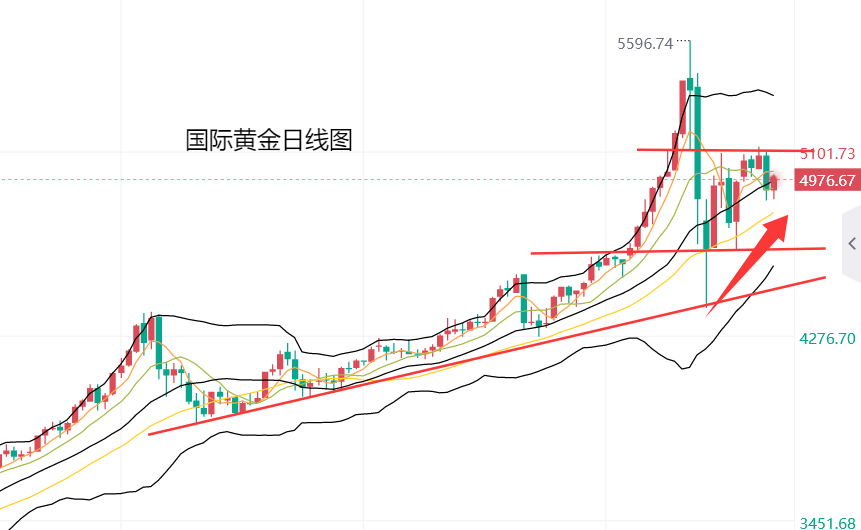
Core Viewpoint - The significant drop in gold prices is attributed to multiple factors, including strong U.S. employment data, a sharp decline in U.S. stock markets, and profit-taking from previous silver gains, leading to a rapid sell-off in gold [2][6][7]. Group 1: Market Movements - Gold prices fluctuated between $5040 and $5080 until a sharp decline occurred, dropping nearly $200 to a low of $4878 before stabilizing around $4888 [1][5]. - Following the drop, gold rebounded to a high of $4997 but faced resistance near the $5000 mark, currently trading at $4977 [1][5]. Group 2: Influencing Factors - The U.S. non-farm payroll data released on Wednesday showed an increase of 130,000 jobs, significantly above the expected 70,000, with the unemployment rate decreasing from 4.4% to 4.3%, which bolstered expectations for prolonged high interest rates by the Federal Reserve [2][6]. - A notable decline in U.S. stock markets on Thursday, driven by fears of AI disrupting traditional industries, led to panic selling and increased demand for margin, prompting some investors to liquidate gold holdings [7]. - Profit-taking in silver, which had seen significant gains, contributed to a chain reaction that pressured gold prices as investors fled the market [7]. Group 3: Technical Analysis - The daily chart indicates that gold failed to maintain above the $5100 level, with support levels identified at $4930 (10-day moving average) and $4880 (5-week moving average) [3][8]. - Resistance levels are noted at $5000 and $5100, with recent price movements suggesting a potential for rebound despite the recent drop [8]. - Technical indicators show mixed signals, with a slowing golden cross on the 5-day moving average, a bearish MACD crossover, and a bullish KDJ crossover, indicating short-term rebound potential [8].
黄力晨:黄金价格深夜崩盘 市场等待美国CPI数据
Sou Hu Cai Jing· 2026-02-13 05:24
Core Viewpoint - The significant drop in gold prices is attributed to multiple factors, including strong U.S. employment data, a sharp decline in U.S. stock markets, and profit-taking activities in the silver market, leading to a chain reaction affecting gold prices [2]. Group 1: Market Reactions - Gold prices fluctuated between $5040 and $5080 until a sharp decline occurred, dropping nearly $200 to a low of $4878 before stabilizing around $4888 [1]. - Following the drop, gold rebounded to a high of $4997 but faced resistance near the $5000 mark, currently trading around $4977 [1]. Group 2: Economic Indicators - The U.S. non-farm payroll data released on Wednesday showed an increase of 130,000 jobs, significantly above the expected 70,000 and previous value of 50,000, with the unemployment rate decreasing from 4.4% to 4.3% [2]. - This strong employment data has led to expectations that the Federal Reserve will maintain higher interest rates for a longer period until inflation is controlled, causing a delay in market expectations for the Fed's first rate cut this year [2]. Group 3: Market Sentiment and Technical Analysis - The decline in U.S. stock markets, driven by fears of AI disrupting traditional industries, prompted panic selling and increased demand for margin, leading some investors to liquidate gold positions for cash [2]. - Profit-taking in the silver market, which had seen significant gains, also contributed to the pressure on gold prices, as the volatility in silver prompted investors to exit positions in gold [2]. - Technical indicators suggest that gold prices are experiencing a rebound demand despite the recent drop, with support levels identified at $4930 and $4880, while resistance is noted at $5000 and $5100 [4].

有色金属日度策略-20260213
Fang Zheng Zhong Qi Qi Huo· 2026-02-13 03:02
1. Report Industry Investment Rating No relevant content provided. 2. Core Views of the Report - The non - farm data in the US has weakened the expectation of interest rate cuts, and the holiday atmosphere is strong. The non - farm employment in the US in January increased by 130,000, the largest increase since April last year, and the unemployment rate dropped to 4.3%. Wall Street expects the first interest rate cut to be postponed to July. The copper market was affected by the strong US employment data, first rising and then falling. Trump plans to set up a $12 billion strategic reserve for critical minerals, which may give copper a further premium. The US manufacturing activity expanded unexpectedly in January, reaching the fastest growth rate since 2022 [3][12]. - The zinc market is in a state of consolidation. The domestic imported ore TC has slightly decreased, the upstream production reduction is limited, the downstream is on holiday with significantly lightened operations and longer holidays, and the spot inventory continues to increase with the possibility of further inventory accumulation [4]. - The aluminum industry chain is in a state of shock consolidation. The spot price of alumina has stabilized, and there are many restarts after capacity overhauls. The cost support of recycled aluminum alloy has weakened, and it is suppressed by the seasonal off - season and profit inversion, but there are still some factors providing bottom support [5]. - The tin market is in shock consolidation. The Shanghai tin follows the Shanghai nickel and shows a relatively strong trend, but the liquidity decreases before the holiday. Attention should be paid to the changes in capital sentiment, as well as the situation of the ore end and macro - factors [6]. - The lead market is in a low - level shock rebound, but the upward driving force is insufficient. The supply of primary lead has some overhauls, and the production suspension, holiday or overhauls of recycled lead have increased. The downstream demand is weak, and the spot inventory continues to rise [8]. - For the nickel and stainless - steel market, the Indonesian quota is confirmed, and the ore quota of Weda Bay nickel mine in Indonesia is cut by 70%. The cost of nickel products is expected to remain at a relatively high level. The stainless - steel market is in consolidation, and the reduction of the Indonesian quota may increase the cost of stainless - steel production in the future [9]. 3. Summary by Relevant Catalogs 3.1 First Part: Non - ferrous Metals Operation Logic and Investment Suggestions - **Macro Logic**: The non - ferrous metals as a whole are in shock, with a strong holiday atmosphere and net capital outflows. The geopolitical situation in the Middle East, especially the US - Iran negotiation, still has uncertainties, and there may be fluctuations in the overseas bulk commodities during the holiday. The global major economies are actively deploying hydrogen energy and nuclear fusion. China's CPI and PPI in January showed certain changes, and the US non - farm data affected the market's expectation of interest rate cuts [12]. - **Investment Suggestions**: After a significant adjustment, the non - ferrous metals sector has repaired, and the trends are differentiated. It is advisable to go long on dips according to the strength of the fundamentals after the adjustment pressure is fully released, but it is recommended to hold a light position during the holiday. For different varieties: - **Copper**: The operation logic includes strong US employment data, Trump's plan for strategic reserves, and the macro - economic situation. It is recommended to go long on dips, with a support range of 98,000 - 99,000 yuan/ton and a pressure range of 108,000 - 110,000 yuan/ton [14]. - **Zinc**: The market is in stage consolidation. It is recommended to go long on dips, with a support range of 23,800 - 24,000 yuan/ton and a pressure range of 25,000 - 25,500 yuan/ton [16]. - **Aluminum Industry Chain**: It is recommended to wait and see. For aluminum, the support range is 22,000 - 22,300 yuan/ton, and the pressure range is 26,000 - 27,000 yuan/ton; for alumina, the support range is 2300 - 2600 yuan/ton, and the pressure range is 2900 - 3000 yuan/ton; for recycled aluminum alloy, the support range is 21,000 - 21,500 yuan/ton, and the pressure range is 24,000 - 26,000 yuan/ton [15][16]. - **Tin**: It is recommended to wait and see, with a support range of 330,000 - 350,000 yuan/ton and a pressure range of 450,000 - 460,000 yuan/ton [16]. - **Lead**: It is recommended to go long on dips, with a support range of 16,400 - 16,500 yuan/ton and a pressure range of 17,000 - 17,300 yuan/ton [17]. - **Nickel**: It is recommended to go long on dips, with a support range of 130,000 - 132,000 yuan/ton and a pressure range of 138,000 - 142,000 yuan/ton [17]. - **Stainless - steel**: It is recommended to go long on dips, with a support range of 12,800 - 13,000 yuan/ton and a pressure range of 13,800 - 14,000 yuan/ton [17]. 3.2 Second Part: Non - ferrous Metals Market Review - **Futures Closing Situation**: The closing prices and price changes of various non - ferrous metal futures are provided, such as copper closing at 102,330 yuan/ton with a 0.15% increase, zinc at 24,650 yuan/ton with a 0.26% increase, etc. [18] 3.3 Third Part: Non - ferrous Metals Position Analysis - The latest position analysis of the non - ferrous metals sector is presented, including the net long - short strength comparison, net long - short position base values, changes in net long and net short positions, and influencing factors for different varieties such as lithium carbonate, nickel, tin, etc. [19] 3.4 Fourth Part: Non - ferrous Metals Spot Market - The spot prices and price changes of various non - ferrous metals are provided, such as the Yangtze River Non - ferrous copper spot price at 102,200 yuan/ton with a 0.76% increase, the Yangtze River Non - ferrous 0 zinc spot average price at 24,470 yuan/ton with no change, etc. [22] 3.5 Fifth Part: Non - ferrous Metals Industry Chain - **Copper**: Relevant charts about copper, such as exchange copper inventory changes, LME copper inventory, copper concentrate smelting fees, and the relationship between the US dollar index and copper price, are provided [24]. - **Zinc**: Charts related to zinc, including zinc inventory changes, zinc concentrate processing fee changes, zinc spot market prices, and galvanized sheet production seasonality, are presented [26][28]. - **Aluminum**: Charts about aluminum, such as the comparison between Shanghai aluminum inventory and aluminum price, LME aluminum inventory and LME aluminum price, LME spot premium and discount trends, and Shanghai Non - ferrous aluminum premium and discount trends, are provided [30][31]. - **Alumina**: Charts related to alumina, including the spot price trend of alumina, alumina port inventory changes, etc., are presented [37]. - **Cast Aluminum Alloy**: Relevant charts are provided, but specific content is not detailed in the text [45]. - **Lead**: Charts about lead, such as lead concentrate 50% processing fee to the factory average price, domestic and foreign exchange lead futures inventory, LME lead 0 - 3 premium and discount, and lead spot price, are presented [49][51]. - **Nickel**: Charts related to nickel, including Shanghai Futures Exchange nickel futures inventory, LME nickel inventory, refined nickel spot premium and discount, and LME nickel 0 - 3 premium and discount, are provided [53][55]. - **Stainless - steel**: Charts about stainless - steel, such as the number of stainless - steel warehouse receipts and stainless - steel spot price, are presented [57][59]. 3.6 Sixth Part: Non - ferrous Metals Arbitrage - **Copper**: Charts about copper arbitrage, such as the change of copper Shanghai - London ratio and the premium and discount between Shanghai copper and London copper, are provided [61]. - **Zinc**: Charts related to zinc arbitrage, such as the change of zinc Shanghai - London ratio and LME zinc spot premium and discount, are presented [61]. - **Aluminum and Alumina**: Charts about aluminum and alumina arbitrage, such as aluminum basis and futures - spot price trend, aluminum Shanghai - London ratio trend, Shanghai aluminum continuous one - continuous three trend, and alumina continuous two - continuous one trend, are provided [64][66]. - **Tin**: Charts related to tin arbitrage, such as Shanghai tin basis trend, Shanghai tin continuous three - continuous price trend, and tin Shanghai - London ratio trend, are presented [68][70]. - **Lead**: Charts about lead arbitrage, such as the price difference between Shanghai zinc and Shanghai lead and lead Shanghai - London ratio, are provided [72]. - **Nickel and Stainless - steel**: Charts related to nickel and stainless - steel arbitrage, such as nickel Shanghai - London ratio, nickel/stainless - steel ratio, Shanghai nickel inter - period spread, and nickel - nickel pig iron price difference, are presented [75][76]. 3.7 Seventh Part: Non - ferrous Metals Options - **Copper**: Charts about copper options, such as historical volatility, weighted implied volatility, trading volume and open interest changes, and the ratio of call to put open interest, are provided [78]. - **Zinc**: Charts related to zinc options, such as historical volatility, weighted implied volatility, trading volume and open interest changes, and the ratio of call to put open interest, are presented [79][80]. - **Aluminum**: Charts about aluminum options, such as historical volatility, implied volatility, trading volume and open interest trend, and the ratio of call to put open interest trend, are provided [83][85].