避险情绪

Search documents
午盘收盘点评:锡、银为何成为“重灾区”?市场情绪在“过山车”后进入理性观察期!
Xin Lang Cai Jing· 2026-02-03 05:24
截至2026年2月3日午盘,上海期货交易所多数有色金属品种延续回调态势。在早盘贵金属剧烈波动之 后,市场整体情绪趋于谨慎,多数品种呈现弱势震荡,但不同金属之间的走势分化明显。其中,沪锡、 沪银大幅下挫,沪铜、沪铝、沪锌、沪镍、沪铅也均有不同程度下跌,仅有个别品种在自身基本面支撑 下呈现韧性。 从午盘收盘数据来看,沪锡2603合约下跌36650元,至374210元/吨,跌幅达8.92%,领跌市场;白银 2604合约下跌5022元,至20728元/吨,跌幅达19.5%,调整幅度最为剧烈。沪铜2603合约收于101470元/ 吨,下跌380元;沪铝2603合约收于23460元/吨,下跌580元;沪镍2603合约收于133550元/吨,下跌 2980元。氧化铝价格相对持稳,与昨结持平。 板块分化加剧,自身基本面成关键定价锚 今日市场的走势,反映出当前金属价格正从前期"情绪与资金推动"的普涨模式,逐步回归至"宏观预期 与产业现实"的博弈阶段。各品种因其自身供需结构的差异,走势开始显著分化。 锡、银为何成为"重灾区"? 相比之下,铅、锌等品种的库存压力较小,其累库幅度低于前几年,这也部分解释了锌价今日在期货和 现货市场均 ...


“黄金估值已达极端水平”,花旗警告:金价支柱面临坍塌
3 6 Ke· 2026-02-03 02:37
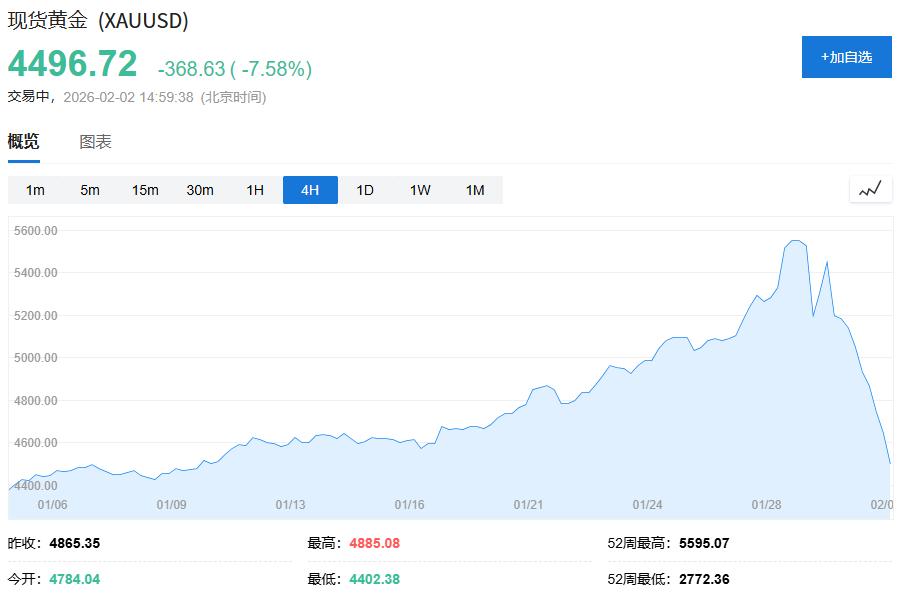
Core Viewpoint - Citi Research warns that gold valuations have reached extreme levels, with global gold spending as a percentage of GDP soaring to 0.7%, the highest in 55 years. If the gold allocation ratio returns to the historical norm of 0.35%-0.4%, gold prices could face a "halving" risk [1][2][8]. Group 1: Current Valuation and Market Dynamics - The current annual global spending on gold as a percentage of GDP has reached 0.7%, significantly exceeding levels during the 1980 oil crisis [2]. - Gold prices have decoupled from mining production costs, with high-cost gold miners experiencing profit margins at a 50-year high [4]. - The ratio of gold to global broad money supply has risen to 16%, surpassing the peak during the early 1970s oil crisis [4]. Group 2: Future Price Predictions - Citi maintains a 0-3 month target price of $5,000 per ounce but expresses caution for the second half of 2026, predicting a decline to $4,000 per ounce by 2027 [1][14]. - The baseline scenario anticipates gold prices to average $4,600 per ounce in 2026, with quarterly predictions of $5,000 in Q1, $4,800 in Q2, $4,400 in Q3, and $4,200 in Q4 [14]. Group 3: Risks and Market Sentiment - A mere 5% exit of profit-taking could negate global physical demand, posing a significant risk to the market [12]. - Factors supporting current high gold prices, such as geopolitical tensions and economic conditions, are expected to diminish by late 2026, potentially leading to a decrease in gold's investment appeal [9]. - The potential for a return to a balanced pricing based on savings distribution could see gold prices drop to between $2,500 and $3,000 per ounce if the allocation ratio normalizes [8].

瑞郎反弹政策分化 避险情绪博弈加剧
Jin Tou Wang· 2026-02-03 02:36
Group 1 - The core viewpoint of the articles highlights the ongoing fluctuations in the USD/CHF exchange rate, with the dollar showing signs of recovery while the long-term outlook for the Swiss franc remains weak due to policy divergence and global risk sentiment [1][2] - The USD/CHF exchange rate has recently rebounded, reaching 0.7798, after hitting a 176-month low, driven by a 1.1% increase in the previous trading day, supported by a rebound in the dollar index [1] - The Swiss National Bank (SNB) has maintained a 0% interest rate since December 2025, with expectations of keeping rates stable until the second half of 2027, which supports the Swiss franc [1][2] Group 2 - The Swiss economy is experiencing a weak recovery, with a projected GDP growth rate of 1.0% and an unemployment rate of 3.0% for 2026, which limits the appreciation of the Swiss franc despite its status as a safe-haven currency [2] - Technical analysis indicates that while there is a short-term rebound in the exchange rate, the long-term bearish trend has not reversed, with resistance levels at 0.7820 and 0.7850, and support levels at 0.7770 and 0.7700 [2] - Market participants are advised to monitor key economic data such as the US JOLTs job openings and speeches from Federal Reserve officials, as these could influence the USD/CHF exchange rate in the short term [2]
ETF盘前资讯|终于反弹!现货黄金重回4800美元!企稳信号初现,杠杆抛售潮或近尾声
Sou Hu Cai Jing· 2026-02-03 01:25
新湖期货认为,黄金价格中长期支撑仍存,指出沃什获提名及由此引发的汇率波动属于短期扰动,中期市场焦点仍将集中于地缘政治风险升温与特朗普政 府政策的高度不确定性;而长期来看,全球债务可持续性恶化与去美元化趋势的深化,是支撑黄金结构性走强的核心变量。目前,上述中长期逻辑并未发 生根本性逆转。 仍有机构在市场恐慌中,坚持长期看多有色金属板块,中信证券指出,在经历2025年的大涨行情后,有色金属价格与股票行情的上涨动能依然充足,供应 扰动、需求局部高景气和囤货行为为金属价格带来强支撑,流动性宽松带来的交易活跃度上升以及地缘冲突带来的避险情绪升温有望放大金属的价格弹 性。看好贵金属、工业金属、电池金属和战略金属板块的配置价值。 今日(2月3日)现货黄金开盘反弹,截至发稿,重回4800美元/盎司,日内涨超3%。分析指出,量化基金去杠杆化、杠杆ETF和趋势跟踪策略头寸调整所 引发的强制抛售潮,其主体部分可能已基本释放。 消息面上,特朗普称正在与伊朗对话。当地时间2月2日,针对伊朗问题,美国总统特朗普表示,美方已向相关地区调动大型军舰,同时与伊朗保持沟 通,"将观察事态如何发展"。 尽管近期黄金价格大幅波动,但美银仍将其看作对 ...
有色金属大跌,还能买吗?
Xin Lang Cai Jing· 2026-02-02 10:51
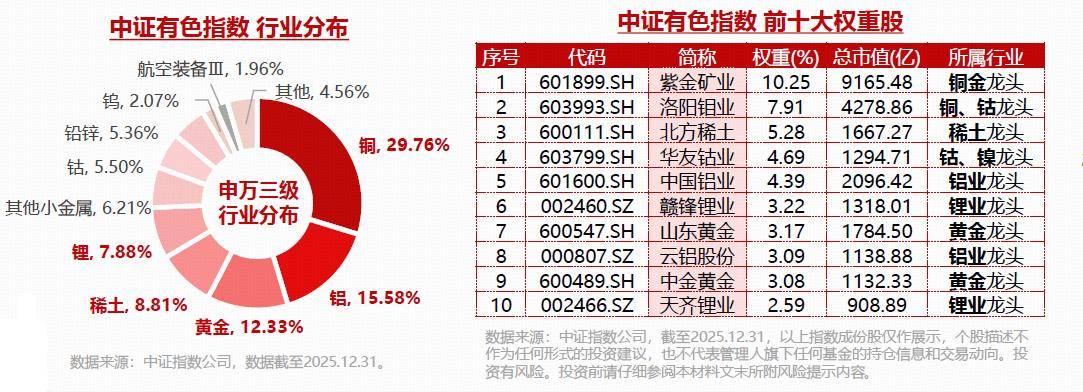
Core Viewpoint - The non-ferrous metals sector is experiencing significant price fluctuations, with gold, silver, copper, aluminum, and rare earths reaching new highs in 2025, but recent market volatility has raised questions about the sustainability of this trend [2][18]. Group 1: Price Fluctuations and Market Dynamics - The recent sharp decline in metal prices has left the market confused about whether this is a peak cycle or a short-term adjustment [5][20]. - The non-ferrous metals sector saw over a 90% increase in 2025, with gold prices rising over 23% in January 2026 and silver over 60% for the year [22][6]. - Profit-taking by investors after substantial gains has triggered corrections in some metal prices [23]. Group 2: Macro and Supply-Demand Factors - Global macroeconomic changes, such as the unexpected rise in the U.S. CPI, have led to a reduction in the expected number of Federal Reserve rate cuts, which could strengthen the dollar and suppress metal prices [24]. - The supply-demand imbalance is a core driver of price strength in basic and new energy metals, with traditional metals like copper and aluminum facing supply constraints and increasing demand from energy transitions [27]. - The geopolitical climate and economic uncertainties are elevating market risk aversion, making gold a preferred safe-haven asset [28]. Group 3: Investment Strategies and Market Outlook - The underlying logic for investing in non-ferrous metals remains intact, with expectations of continued demand from emerging industries and a loose monetary environment [11][28]. - Investors are advised to be cautious of high leverage in the futures market and to monitor ETF premium risks, especially when market conditions change [29][30]. - The recent downturn in non-ferrous metals does not indicate a fundamental reversal, suggesting a potential shift into a phase of structural differentiation within the sector [32].

「美股盘前」第三代特斯拉人形机器人即将亮相;白银日内跌超15%,三个交易日抹平一个月涨幅;黄金一度跌破4500美元,花旗:估值已达极端水平;拟再融资50...
Mei Ri Jing Ji Xin Wen· 2026-02-02 10:28
① 【三大期指齐跌】截至发稿,道指期货跌0.63%、标普500指数期货跌0.90%、纳指期货跌1.18%。 ② 【白银日内跌超15%,三个交易日抹平一个月涨幅】国际黄金和白银价格2日大幅下跌,其中黄金期 货价格一度回落至每盎司4500美元下方,白银期货价格一度跌至每盎司72.35美元。与1月29日创下的历 史最高点相比,2日白银价格盘中低点的累计跌幅已达40%,金价累计跌幅约20%。现货白银日内跌超 15%报71.5美元/盎司,较历史高位回落50美元,仅三个交易日抹平一个月涨幅。 ⑧ 【计划再融资500亿美元"续命",甲骨文跌超5%】甲骨文盘前跌超5%。消息面上,周日,甲骨文宣 布今年拟筹资450亿至500亿美元,用以扩张AI数据中心,而此前多家投行已发出警告,称其可能最早 在2026年底耗尽现金。据媒体报道,由于对甲骨文融资能力的担忧,多家美国银行已停止向其数据中心 项目提供贷款。 ⑨ 【CoreWeave跌3.3%,近期遭多位公司高管及董事减持股票】CoreWeave跌3.3%。消息面上,近期多 位公司高管及董事减持股票,其中,公司首席执行官兼总裁Michael N Intrator于1月28日出售824 ...

预测:悬了?明日钢价咋走?
Xin Lang Cai Jing· 2026-02-02 09:41
Group 1: Market Overview - The international macroeconomic uncertainty is increasing, and the industry is experiencing a "strong supply and weak demand" situation, leading to a decline in futures steel prices [3][16] - The market is characterized by weak trading activity ahead of the Spring Festival, with terminal demand contracting while steel production remains unchanged, resulting in continuous inventory accumulation [3][16] Group 2: Current Steel Prices - Rebar prices are expected to decrease slightly due to increased production and declining terminal demand, leading to accelerated inventory accumulation [3][16] - Hot-rolled coil inventory has risen to 2.1083 million tons, a week-on-week increase of 2.74%, indicating supply pressure, while demand remains weak [4][16] - Medium and heavy plate inventory has increased by 3.28% to 730,000 tons, maintaining a high level, with market transactions remaining sluggish [5][17] - Wire rod prices are expected to decline as terminal demand approaches a standstill with the upcoming holiday [6][17] - Section steel prices are under pressure due to weak demand from construction and manufacturing activities, leading to a lack of upward momentum [7][18] - Pipe prices are expected to remain stable, although both supply and demand are weakening as manufacturers begin holiday shutdowns [8][19] Group 3: Raw Material Market - Steel billet prices are expected to decline slightly, with market activity decreasing and a lack of sustained driving force for finished products [9][20] - Iron ore shipments increased to 30.946 million tons last week, with rising supply from Australia and Brazil, leading to price pressure [10][21] - Coking coal prices are expected to weaken due to slow downstream replenishment and soft demand [11][22] - Scrap steel prices are expected to fluctuate as market sentiment remains cautious amid low demand and thin profit margins for steel mills [12][23] Group 4: Overall Sentiment - The market is experiencing heightened risk aversion due to the sharp decline in precious metals and non-ferrous sectors, which is affecting the black metal market [13][24] - The overall market sentiment remains weak as supply and demand contradictions become more pronounced ahead of the Spring Festival, with traders adopting a wait-and-see approach [13][24]
“黄金估值已达极端水平,”花旗警告:金价支柱面临坍塌
Hua Er Jie Jian Wen· 2026-02-02 08:26
Core Viewpoint - Citi Research warns that gold valuations have reached extreme levels, with global gold spending as a percentage of GDP soaring to 0.7%, the highest in 55 years. If the gold allocation ratio returns to the historical norm of 0.35%-0.4%, gold prices could face a "halving" risk [1][10]. Group 1: Current Market Conditions - The current gold price is completely detached from the marginal production costs of mining, with high-cost gold miners experiencing profit margins at a 50-year high [6]. - Citi's report indicates that a mere 5% exit of profit-taking could offset global physical demand, leading to significant market disruption [2][13]. - The report highlights that the current annual gold spending as a percentage of GDP is far above levels seen during the 1980 oil crisis, indicating a disconnection from the real economy [3]. Group 2: Future Price Predictions - Citi maintains a target price of $5,000 per ounce for the next 0-3 months but expresses caution for the second half of 2026, predicting a decline to $4,000 per ounce by 2027 [2][15][19]. - The report outlines a base case scenario where gold prices will average $4,600 in 2026, with quarterly predictions showing a decline from $5,000 in Q1 to $4,200 in Q4 [15][18]. - Three scenarios are presented: a bull market scenario predicting $6,000 per ounce (20% probability), a base case of $4,000 (60% probability), and a bear market scenario of $3,000 (20% probability) [19]. Group 3: Risks to Gold Prices - The report identifies that the support for current high gold prices may diminish as geopolitical tensions ease, particularly with expectations of a resolution to the Russia-Ukraine conflict by mid-2026 [11]. - Economic conditions in the U.S. are expected to improve, which could reduce the need for gold as a hedge, particularly if the economy enters a "Goldilocks" phase of high growth and low inflation [11]. - The independence of the Federal Reserve is anticipated to remain intact, which could further contribute to downward pressure on gold prices [11].
“黄金估值已达极端水平!”花旗警告:金价支柱面临坍塌
Sou Hu Cai Jing· 2026-02-02 08:22
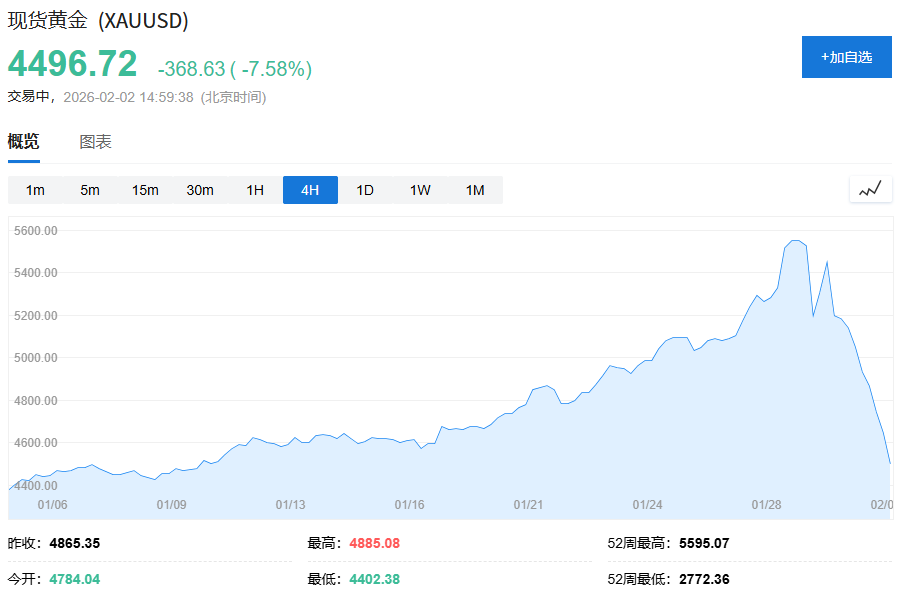
Core Viewpoint - The valuation of gold is facing severe reassessment amid tightening global liquidity and declines in Bitcoin and commodities, with a warning from Citigroup that gold valuations have reached extreme levels [2][5]. Group 1: Current Valuation Concerns - Citigroup's research indicates that global gold expenditure as a percentage of GDP has surged to 0.7%, the highest in 55 years, suggesting a potential risk of gold prices being halved if the allocation ratio returns to historical norms of 0.35%-0.4% [5][6]. - The current gold price is disconnected from mining production costs, with high-cost gold miners experiencing profit margins at a 50-year high [9]. - The ratio of gold to global broad money supply has reached 16%, exceeding the highs seen during the first oil crisis in the 1970s [9]. Group 2: Future Price Predictions - Citigroup maintains a target price of $5,000 per ounce for the next 0-3 months but expresses caution for the second half of 2026, predicting a decline to $4,000 per ounce by 2027 [5][21]. - The report outlines three scenarios for future gold prices: a bull market scenario with a 20% probability leading to $6,000, a baseline scenario with a 60% probability resulting in $4,000, and a bear market scenario with a 20% probability dropping to $3,000 [21]. Group 3: Factors Influencing Future Valuation - Citigroup anticipates that key risk factors supporting current high gold prices will diminish later this year, including geopolitical tensions easing and a potential economic upturn in the U.S. [14][15]. - The report highlights that a mere 5% exit of profit-taking could negate global physical demand, posing a significant risk to the market [18].

“黄金估值已达极端水平!”花旗警告:金价支柱面临坍塌
华尔街见闻· 2026-02-02 07:57
Core Viewpoint - The article discusses the severe revaluation of gold amidst tightening global liquidity and declines in Bitcoin and commodities, indicating that gold is facing extreme valuation levels and potential risks of significant price drops [2][4]. Group 1: Current Valuation and Risks - Citi's research warns that gold's valuation has reached extreme levels, with global gold expenditure as a percentage of GDP soaring to 0.7%, the highest in 55 years. If the allocation ratio returns to the historical norm of 0.35%-0.4%, gold prices could face a "halving" risk [4][13]. - The current gold price is disconnected from mining production costs, with high-cost gold miners experiencing profit margins at a 50-year high [9]. - The ratio of gold to global broad money supply has risen to 16%, surpassing the peak during the first oil crisis in the 1970s, indicating a significant disconnection from the real economy [10]. Group 2: Future Outlook - Citi maintains a target price of $5,000 per ounce for gold in the short term but expresses caution for the second half of 2026, predicting a decline to $4,000 per ounce by 2027 [6][20]. - The article outlines that the support for current high gold prices may diminish as geopolitical tensions ease, particularly with expectations of a resolution to the Russia-Ukraine conflict and a strengthening U.S. economy [14][15]. - A mere 5% exit of profit-taking could offset global physical demand, posing a significant risk to the market [5][18]. Group 3: Scenario Analysis - Citi presents three scenarios for gold prices: a bullish scenario with a 20% probability reaching $6,000, a base scenario with a 60% probability dropping to $4,000, and a bearish scenario with a 20% probability falling to $3,000 [24]. - The quarterly forecast for 2026 suggests a gradual decline in gold prices, starting at $5,000 in Q1 and dropping to $4,200 by Q4, with an average price of $4,600 for the year [20].