
稳增长

Search documents
央行重启国债买卖 长端利率债、“固收+”理财有望受益
Zhong Guo Ji Jin Bao· 2025-11-10 07:22
Core Viewpoint - The resumption of public market treasury bond trading by the central bank in October signals a positive outlook for the bond market, with expectations for long-term interest rates to decline and related investment products to benefit [1][2][3]. Group 1: Market Signals and Economic Impact - The central bank's resumption of treasury bond trading is seen as a signal for stabilizing growth, which is expected to boost confidence in the bond market [2][3]. - The People's Bank of China (PBOC) indicated that the overall operation of the bond market is good, with current interest rates in a policy-consistent range, which supports market expectations [2][3]. - The operation size of 20 billion yuan, while modest, carries significant signal value, enhancing confidence in the bond market, particularly for medium to long-term interest rate bonds [2][3]. Group 2: Interest Rate Trends and Investment Opportunities - Long-term interest rates for treasury bonds have begun to decline since late October, with expectations for further decreases, presenting investment opportunities in related financial products [3][4]. - The resumption of bond purchases by the central bank is expected to create a favorable environment for long-term interest rates to decline, benefiting bond-related investment products [4][5]. - Investors are advised to focus on bond products with longer durations and stable historical returns, as these are likely to benefit from the anticipated rise in bond prices [5][6]. Group 3: Strategic Investment Approaches - Institutions suggest increasing allocations to medium and short-term credit bonds, as the central bank's actions are expected to improve liquidity and compress credit spreads [6]. - Investment strategies should include optimizing portfolio structures, increasing liquidity through open-end or short-term products, and diversifying into "fixed income plus equity" products to balance risks [6][5]. - The current market environment allows for the inclusion of reasonably valued equity assets in investment strategies, leveraging "fixed income plus equity" products for better returns [6].
央行出手 这类产品要火?
Zhong Guo Ji Jin Bao· 2025-11-10 04:45
Core Viewpoint - The People's Bank of China (PBOC) has resumed government bond trading operations, signaling a positive outlook for the bond market and benefiting long-term interest rate bonds and "fixed income +" wealth management products [1][3][4]. Group 1: Market Signals and Economic Impact - The resumption of government bond trading operations is seen as a signal for stabilizing growth, which is expected to boost confidence in the bond market [3][4]. - PBOC Governor Pan Gongsheng indicated that the overall operation of the bond market is good, suggesting that current interest rates are within a policy-appropriate range [3][4]. - The operation of 20 billion yuan, although small, carries significant signal value, enhancing market confidence, particularly in medium to long-term interest rate bonds [3][4]. Group 2: Interest Rate Trends - Since late October, long-term interest rates on government bonds have begun to decline, with expectations for further decreases [5][6]. - The resumption of bond purchases by the PBOC is expected to support bond prices, benefiting medium to long-term fixed income products [6][7]. - Analysts suggest that the current environment allows for a favorable configuration of medium to short-term credit bonds, with potential for yield compression [6][7]. Group 3: Investment Strategies - Investors are advised to optimize their bond holdings by increasing allocations to daily open or short-term fixed products to enhance liquidity [7]. - Diversification is recommended to reduce the proportion of pure fixed income products, while increasing allocations to "fixed income +" products to balance risk [7]. - The current market conditions suggest that incorporating reasonably valued equity assets into investment strategies could be beneficial, leveraging "fixed income + equity" wealth management products [7].
央行出手,这类产品要火?
Zhong Guo Ji Jin Bao· 2025-11-10 04:32
Core Viewpoint - The People's Bank of China (PBOC) has resumed government bond trading operations, signaling a positive outlook for the bond market and benefiting long-term interest rate bonds and "fixed income +" wealth management products [1][2][3] Group 1: Market Signals and Economic Impact - The resumption of government bond trading operations is seen as a signal for stabilizing growth, which is expected to boost confidence in the bond market [2][3] - PBOC Governor Pan Gongsheng indicated that the overall operation of the bond market is good, suggesting that current interest rates are within a policy-acceptable range [2][3] - The operation size of 20 billion yuan, while not large, carries significant signal value, enhancing market confidence, especially in medium to long-term interest rate bonds [2][3] Group 2: Interest Rate Trends and Investment Opportunities - Long-term interest rates have begun to decline since late October, and further decreases are anticipated, providing investment opportunities in related wealth management products [3][4] - The bond market's performance is influenced by macroeconomic factors such as economic recovery and U.S.-China negotiations, which could affect market interest rates and bond prices [4][5] - The PBOC's bond purchases directly support interest rate bond prices, and narrowing yield spreads favor medium to long-term investments [5][6] Group 3: Investment Strategies and Recommendations - Investors are advised to prioritize wealth management products that include interest rate bonds and to consider the stability of historical returns [5][6] - There is a recommendation to increase allocations in medium to short-term credit bonds to secure stable coupon income and to adopt a strategy of "buying on dips" to capitalize on long-term interest rate fluctuations [6] - Diversifying investments to include equity assets within "fixed income +" products is suggested to balance risks and enhance returns in a low-interest-rate environment [6]
央行出手,这类产品要火?
中国基金报· 2025-11-10 04:31
Core Viewpoint - The People's Bank of China (PBOC) has resumed the operation of buying and selling government bonds, signaling a positive outlook for the bond market and potentially benefiting long-term interest rate bonds and "fixed income +" wealth management products [2][4][5]. Group 1: Market Signals and Economic Impact - The resumption of government bond trading is seen as a signal for stabilizing growth, which is expected to boost confidence in the bond market [4][5]. - PBOC Governor Pan Gongsheng indicated that the overall operation of the bond market is good, suggesting that current interest rates are within a desirable policy range [4]. - The operation aims to guide market expectations and alleviate medium to long-term liquidity shortages, with a focus on stabilizing the macroeconomic environment for Q4 of this year and Q1 of next year [5][6]. Group 2: Bond Market Dynamics - The 10-year government bond yield has increased from an average of 1.64% in January to 1.84% in October, indicating a slight easing of bond market risks [4]. - The recent operations by the PBOC are expected to lead to a further decline in long-term interest rates, benefiting related wealth management products [7][8]. - Analysts suggest that while the bond market outlook is positive, the extent of the decline in interest rates will depend on future PBOC bond purchase scales and economic recovery [7][9]. Group 3: Investment Strategies - Investors are advised to focus on long-duration fixed-income products and mixed-asset products that include bonds, as these are expected to have better allocation value [7][9]. - The PBOC's actions are likely to improve liquidity conditions, making mid-term credit bonds more attractive due to potential compression of credit spreads [9]. - Investment strategies should include increasing allocations to mid-term credit bonds and diversifying into "fixed income +" products to balance risks and enhance returns in a low-interest-rate environment [9].

东方财富:市场再平衡仍将继续演绎,重点关注储能、AI应用等
Zhi Tong Cai Jing· 2025-11-09 23:41
Core Viewpoint - The report from Dongfang Caifu emphasizes that AI remains a long-term focus, while short-term uncertainties in overseas financial markets, influenced by events like the potential U.S. government shutdown, may affect risk appetite in the A-share technology sector [1] Group 1: Industry Focus - Key industries to watch include steel, coal, power supply, energy storage, AI applications, non-ferrous metals, chemicals, and engineering machinery [1] - Emerging themes of interest are humanoid robots, controllable nuclear fusion, deep-sea economy, low-altitude economy, and commercial aerospace [1] Group 2: AI and Energy Infrastructure - The narrative around AI investment is shifting from a focus on computing chip shortages to addressing power infrastructure bottlenecks, with potential benefits for China's power equipment supply chain due to overseas orders driven by AI data centers [2] - Disruptive technologies like energy storage and SOFC batteries may provide rapid solutions to the power shortages associated with AI [2] - Rising prices of upstream raw materials validate the positive outlook for the industry, while high-energy-consuming sectors like electrolytic aluminum face supply squeeze risks [2] Group 3: Price Cycle and Economic Stability - In the context of "anti-involution" and stable growth expectations, the steel industry has seen production cuts exceeding seasonal trends since the July meeting of the Central Financial Committee, supporting the industry's fundamentals [2] - The coal sector is expected to face stricter production checks and environmental oversight, with rising coal prices driven by heating demand and downstream winter storage [2] - The silicon material sector is also highlighted, particularly in petrochemical, chemical fiber, and plastic applications [2] Group 4: Positive Fundamentals and Low Valuations - Sectors with favorable fundamentals and good chip structures include special steel, rail transit equipment, environmental protection equipment, decorative items, packaging and printing, aquaculture, and traditional Chinese medicine [2]

A股融资净买入逼近2014年创下的历史纪录
Huan Qiu Wang· 2025-11-08 01:18
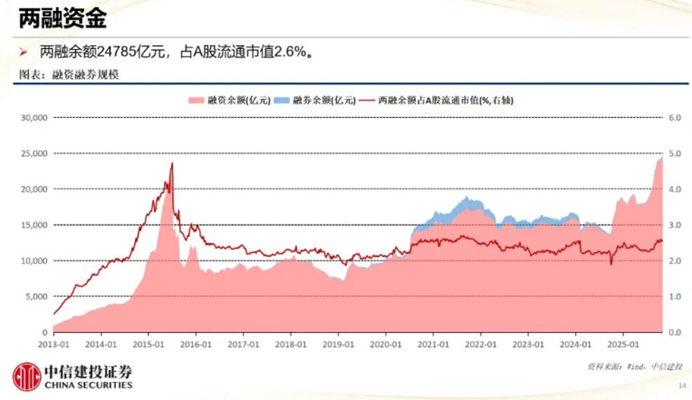
Group 1 - The core viewpoint of the articles highlights a significant increase in margin trading in the A-share market, with net purchases exceeding 116 billion yuan this week and a total of over 626.4 billion yuan year-to-date, which is more than double last year's total and approaching the historical record of 673.9 billion yuan set in 2014 [1][3] - The net inflow of margin trading funds is reported at 290.9 billion yuan, with a trading volume share of 11.9%, showing a slight increase compared to previous periods. The sectors with the highest inflows include power equipment, electronics, and pharmaceuticals [1] - The analysis from Galaxy Securities suggests that the policy goals of "stabilizing growth and the stock market" and "boosting the capital market" will continue to influence sector trends, supported by a moderately loose liquidity environment, ongoing improvements in the capital market, and a restoration of investor confidence, which collectively enhance the outlook for the securities sector [3]
"稳增长"政策支持,全市场唯一钢铁ETF(515210)连续4日净流入近3亿元,一键布局【钢铁板材+特钢+金属制品】
Mei Ri Jing Ji Xin Wen· 2025-11-07 08:18
Group 1 - The steel industry is expected to maintain stable or slightly increasing demand due to support from "steady growth" policies, with factors such as real estate stabilization, steady infrastructure investment, ongoing manufacturing development, and high steel exports contributing to this outlook [1] - On the supply side, the steel supply is anticipated to tighten under the expectation of price control policies, and the industry's concentration is expected to continue increasing, leading to a generally stable supply-demand situation in the industry [1] - Overall, the industrial landscape of the steel sector is expected to improve steadily [1] Group 2 - The Steel ETF (515210) tracks the CSI Steel Index (930606), which reflects the overall performance of publicly listed companies in the steel industry, including both ordinary and special steel [1] - The index consists mainly of steel manufacturing companies, exhibiting strong cyclical characteristics, and the industry allocation is primarily focused on raw materials, highlighting the close relationship between the steel industry and market dynamics as well as economic cycles [1]
证券ETF(512880)回暖,资金借道布局反弹机遇,5日吸金近60亿元
Mei Ri Jing Ji Xin Wen· 2025-11-06 02:12
Group 1 - The core viewpoint of the article highlights a rebound in the securities sector, with the securities ETF (512880) rising over 0.5% and experiencing a net inflow of nearly 6 billion yuan over the past five days [1] - The total share growth of the securities ETF has exceeded 27 billion shares this year, with the current scale surpassing 63 billion yuan [1] - Galaxy Securities indicates that the government's policies aimed at "stabilizing growth and the stock market" and "boosting the capital market" will continue to shape the future direction of the sector [1] Group 2 - The article mentions that a moderately loose liquidity environment, continuous optimization of the capital market, and the restoration of investor confidence are driving the upward trend in the securities sector's prosperity [1] - There is an enhanced expectation for the expansion of medium to long-term funds and an improvement in the fundamental outlook for the sector [1] - As of October 24, 2025, the PB valuation of the securities sector stands at 1.48x, which is at the 29.80% percentile since 2010, indicating a high margin of safety for investments in this sector [1]
央行重启国债买卖,专家:11月或适度加大国债买入规模
Sou Hu Cai Jing· 2025-11-05 00:16
Core Viewpoint - The People's Bank of China (PBOC) has resumed the operation of buying and selling government bonds in the open market, with a net injection of 20 billion yuan, indicating a shift in monetary policy to support the real economy and stabilize market expectations [1][3][4]. Summary by Category Monetary Policy Actions - The PBOC's recent actions include a net injection of 20 billion yuan through government bond transactions, marking the resumption of operations that were paused earlier this year [1][4]. - The central bank's operations also include various liquidity tools, such as a 7,000 billion yuan reverse repurchase agreement scheduled for November 5, aimed at maintaining ample liquidity in the banking system [6][7]. Market Conditions - The current 10-year government bond yield is around 1.8%, and the overall bond market is performing well, which supports the decision to resume bond trading [4]. - The net buying of government bonds is seen as a measure to stabilize market expectations and ensure liquidity, with a cautious approach reflected in the relatively low net buying scale of 20 billion yuan [5]. Economic Implications - Analysts suggest that the resumption of bond trading is a signal to support economic growth and stabilize macroeconomic operations for the fourth quarter of this year and the first quarter of next year [4][5]. - The PBOC is expected to continue using a mix of monetary policy tools to enhance liquidity supply and support economic stability, especially given the current low inflation environment [4][5].
7000亿元!央行今日开展操作
Hua Xia Shi Bao· 2025-11-05 00:10
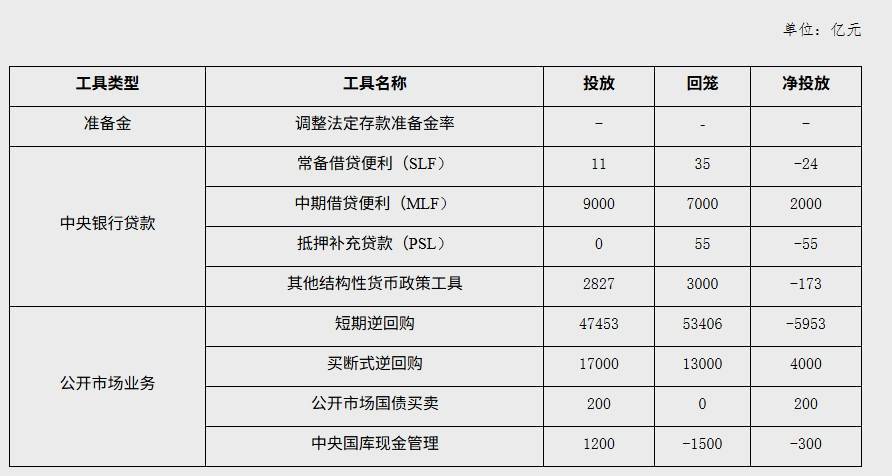
Group 1 - The People's Bank of China (PBOC) will conduct a 700 billion yuan reverse repo operation on November 5, maintaining market liquidity [2] - The operation is a continuation of a previous 700 billion yuan reverse repo maturing this month, aimed at keeping liquidity ample in the banking system [2] - In addition to the reverse repo, there are 300 billion yuan of 6-month reverse repos and 900 billion yuan of Medium-term Lending Facility (MLF) maturing this month, indicating further liquidity support is expected [2] Group 2 - Analysts suggest that the lack of an increase in the reverse repo operation is due to relatively ample liquidity in the banking system and a slowdown in credit growth [2] - The resumption of government bond trading in October, with a net injection of 20 billion yuan, is seen as a measure to support long-term liquidity in the banking system [3] - The current low inflation levels provide the PBOC with sufficient room to maneuver its monetary policy, with expectations of potential reserve requirement ratio (RRR) cuts before year-end [3][4]
