
流动性

Search documents
超1.5万亿逆回购到期 12月资金面怎么看?
Zhong Guo Jing Ying Bao· 2025-12-04 06:47
Group 1 - The People's Bank of China (PBOC) conducted a reverse repurchase operation of 79.3 billion yuan with a fixed rate of 1.4%, resulting in a net withdrawal of 134 billion yuan due to 213.3 billion yuan of reverse repos maturing on the same day [1] - The continuous reverse repo operations in early December aim to smooth short-term liquidity fluctuations and maintain a reasonable level of market funds, reflecting the PBOC's precise adjustments based on market demand [1][2] - The overall liquidity in December is expected to remain stable, with the PBOC likely using various tools to adjust market liquidity and avoid significant fluctuations [4][5] Group 2 - The PBOC is expected to counteract the maturing funds through measures such as Medium-term Lending Facility (MLF) and reverse repos, focusing on maintaining a balanced approach to liquidity [2][3] - In November, the PBOC net injected 100 billion yuan through MLF and 25.4 billion yuan through pledged supplementary lending (PSL), indicating a commitment to maintaining liquidity [2] - The PBOC's operations are characterized by a "lock short, lend long" strategy, which stabilizes expectations and ensures that liquidity remains ample, particularly in light of year-end government bond issuance and bank assessments [3][4]
重磅!美联储突然大规模流动性“救市”注入 这对市场意味着什么?
Sou Hu Cai Jing· 2025-12-03 09:48
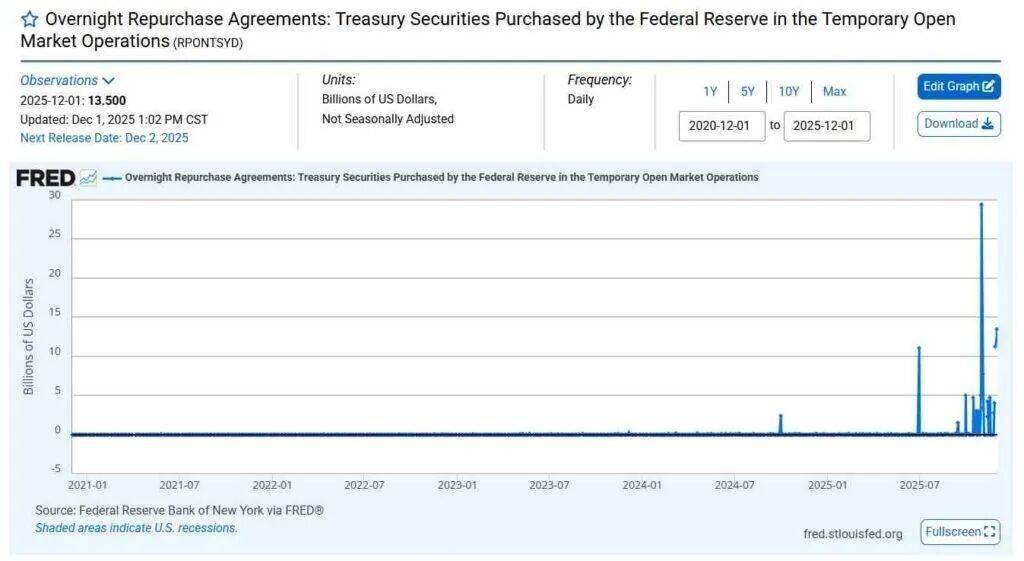
Core Viewpoint - The Federal Reserve is ending its quantitative tightening (QT) policy, which has significant implications for market liquidity and risk assets, including cryptocurrencies and stocks [3][10]. Group 1: Federal Reserve Actions - The Federal Reserve will stop its balance sheet reduction process starting December 1, 2023, after having withdrawn over $2 trillion from the market since 2022, reducing its balance sheet to approximately $6.55 trillion [3]. - This cessation of QT marks a turning point in the Fed's policy, signaling the end of aggressive tightening measures implemented post-COVID-19 to address liquidity risks and support the U.S. economy [3][4]. Group 2: Market Reactions - Following the announcement, there was a notable liquidity injection of $13.5 billion into the banking system, surpassing levels seen during the peak of the Dot Com Bubble [5]. - Analysts speculate that the easing liquidity conditions may positively impact risk assets, including stocks and cryptocurrencies [7]. - Bitcoin experienced a significant rebound, rising approximately 7% to $92,221.49, while Ethereum surged over 8% to above $3,000 [8]. Group 3: Analyst Perspectives - Fundstrat analyst Tom Lee expressed optimism regarding the stock market and cryptocurrencies, indicating that the Fed's actions will provide substantial positive momentum in the coming weeks [9]. - Lee highlighted that the end of QT could lead to increased liquidity in the market, similar to the positive market response observed after the last QT ended in September 2012 [10].

灵魂拷问:牛市还在不在?
Ge Long Hui· 2025-12-03 08:06
今天又超过4000家公司下跌,大跌的公司其实并不多,但最近的盘面,就是持续的阴跌,其难受程度,远不如4月给人一个痛快。 从10月至今,市场超过3000家公司是大跌的,涨10个点以上的公司1100家(10个点以内可以理解为震荡行情)。如果我们按10月至 今的区间最高价算到昨天收盘价,回撤10个点以上的公司有3300家,回撤超过15个点的有2049家,回撤超过20个点的有1024只。 所以,这段时间,虽然上证指数回撤并没有多少,但应该不少人的回撤是很大的。 如果配了港股,那会更加悲剧,因为就恒生科技指数来说,最高下来回撤了近20%,个股回撤2、30个点的一抓一大把,说港股一脚 已经踏入熊市,都不算过分的。 这就引出了一个灵魂问题:牛市到底还在不在? 我们从这波回撤的原因,当前的市场环境来讨论这个问题。 01 高位很高,低位不济 10月至今这波回撤,要说原因的话,我觉得就是8个字,高位很高,低位不济。 10月之前,创新药猛猛涨了一波,半导体猛猛涨了一波,AI猛猛涨了一波。这些方向的估值都非常高,如果没有更新的进展来打鸡 血,震荡消化估值是不可避免的。像光模块方向因为实不实又被美帝那边的进展打下鸡血,还有铜铝也加上了 ...
灵魂拷问:牛市还在不在?
格隆汇APP· 2025-12-03 07:49
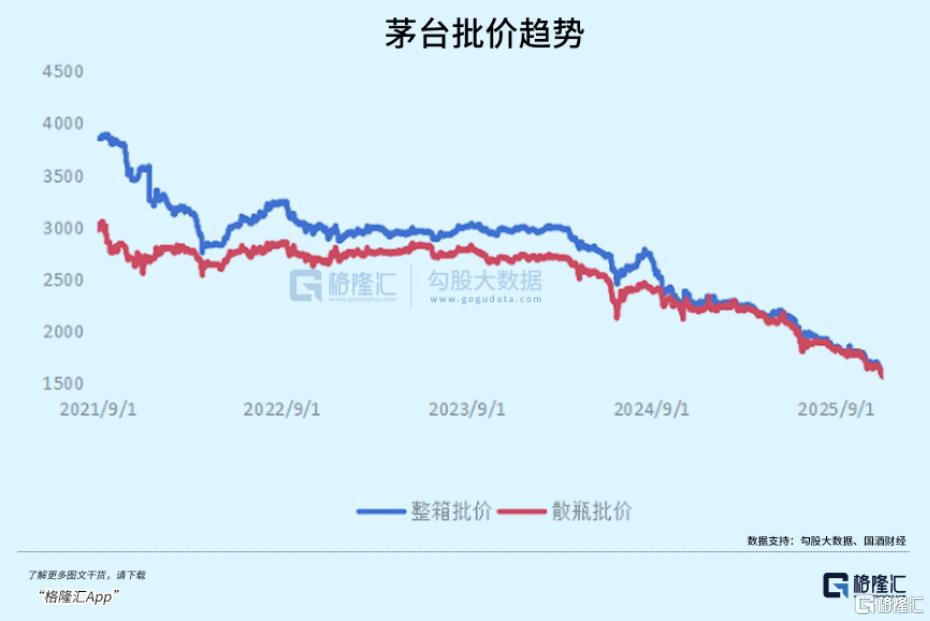
Core Viewpoint - The current market environment is characterized by a significant number of companies experiencing declines, with over 3,000 companies seeing substantial drops since October, despite the Shanghai Composite Index showing limited retreat [4][5]. Market Performance - Since October, more than 3,000 companies have faced significant declines, with 1,100 companies rising by over 10%. A total of 3,300 companies have retreated by more than 10%, 2,049 by over 15%, and 1,024 by over 20% [4]. - The Hang Seng Technology Index has seen a nearly 20% drop, with individual stocks experiencing declines of 20-30% [5]. Market Sentiment - The question of whether a bull market still exists is raised, with the current sentiment suggesting a struggle due to high valuations and weak fundamentals [6][7]. Reasons for Market Retreat - The recent market retreat is attributed to high valuations in sectors like innovative pharmaceuticals, semiconductors, and AI, which have not seen new developments to justify their prices [9]. - The consumer sector, particularly in areas like liquor, has also shown weakness, with companies like Moutai hitting new lows [11]. Economic Environment - The macroeconomic environment remains weak, with indicators such as PMI orders declining and consumer spending showing no signs of recovery [14]. - Predictions indicate that housing prices may continue to decline, impacting household wealth and consumer confidence [15][17]. Future Outlook - The government is expected to increase liquidity support, especially with the upcoming Federal Reserve meeting and domestic economic conferences [18][19]. - The technology sector is anticipated to remain a focal point, with potential opportunities for bottom-fishing in specific segments [20]. - The market may experience a difficult period for another half month, but the bull market is still considered to be intact, pending macroeconomic support [23].

美国 11 月 ISM 制造业 PMI 萎缩幅度创 4 个月最大,连续 9 个月收缩,对此你怎么看?
Sou Hu Cai Jing· 2025-12-02 03:52
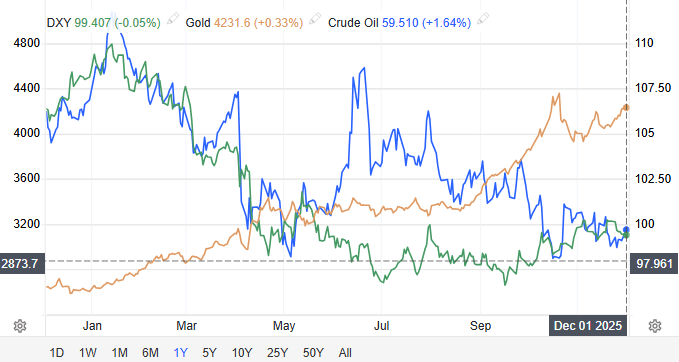
网上又都是黄金5500,白银80,美元再跌10%之类的话题了,大家又要很兴奋的高喊要做多金银铜了,美国高盛的大卫所罗门、桥水的达利 欧、还有约翰·保尔森这几个老多头联合起来,通过这轮拔网线行动,打了一次现货供需差,赚了一大票,这种走势不洗,后面就要给散户和现 货商去送钱了!而这个市场,很多人都把现货和商品混为一谈,殊不知,一旦消费端通缩,上游的供需的关系立马就失去了核心预计,人类重 回金银本位就意味着下一代的持续通缩,对于大佬是好事,对于普通人而言,别谈自己的金银储备,因为这个市场,其实并不对普通人开放。 因此,我还是这个观点,美元会降息,但按当下的几个市场上的炒作热情和流动性冻结幅度,美元后面依然会紧张(证券化市场和银行市 场)!传统意义上,降息通常对于传统金融而言意味着货币宽松,但按美债这个规模,如果也要走日本模式,同时,我们也跟进的话,估计会 让全球掀起负利率竞赛或者加息大赛,引发金融巨震,因此,2026年对于世界金融的看法请改下观念,很多事情要从流动性和债务的角度去 看! 而影响市场情绪的另一重要依据就是美国的制造业经济和就业的复苏! 2025年11月美国ISM制造业PMI指数降至48.2,较上月下降 ...
国贸商品指数日报-20251202
Guo Mao Qi Huo· 2025-12-02 03:49
Group 1: Report Industry Investment Rating - No relevant content provided Group 2: Core View of the Report - On December 1st, most domestic commodity futures closed higher, with precious metals leading the gains, while agricultural products showed mixed performance. Industrial products mostly rose, and agricultural products had both gains and losses [1] - The focus of the steel futures market in December will shift from reality to macro - expectations, and short - term market sentiment is favorable [1] - The rising trend of basic metals is supported by multiple factors, and the fundamentals of aluminum are relatively stable [1] - The geopolitical situation and OPEC's production plan affect the energy - chemical products market, and the pressure on oil prices may increase if Russian oil returns to normal [1] - The short - term soybean market lacks new drivers, and palm oil prices may rise if the减产 logic is confirmed [1] Group 3: Summary by Relevant Catalog Black Series - All black series commodities rose. The recent demand for finished products improved, speculative demand rebounded significantly, and inventory continued to decline. Last week, the inventory of the five major steel products decreased by 2.25% to 1400.81 million tons, reaching a 3.5 - month low, while production increased by 0.68% to 85.71 million tons, and apparent demand slightly decreased by 0.69% to 88 million tons, still higher than the same period last year [1] Basic Metals - Most basic metals rose. The price of copper broke through the previous high, and the upward trend is supported by multiple factors in the medium term. The price of aluminum fluctuated upward, with low inventory and resilient demand [1] Energy - Chemical Products - Most energy - chemical products rose. International oil prices pulled up strongly in Asian electronic trading, and the domestic crude - oil series mostly rose. Geopolitical contradictions remain, and OPEC plans to maintain the current production plan. The pressure on oil prices will increase if Russian oil returns to normal [1] Oilseeds and Oils - Most oilseeds and oils rose. The price of US soybeans declined, and the domestic soybean meal market lacks new drivers. Palm oil prices are supported by seasonal production reduction expectations, and the price may rise if the reduction logic is confirmed [1] Index Changes - The comprehensive index of Guomao Commodities rose by 1.13% from 2200 to 2224.82 [1] - The daily consumption index rose by 0.85% from 1587.47 to 1601.03 [1] - The Guomao Black Commodity Index rose by 1.12% from 1700.99 to 1720.10 [1] - The Guomao Energy - Chemical Index decreased by 0.05% from 575.99 to 575.72 [1] - The Guomao Oilseeds and Oils Index rose by 0.03% from 2124.65 to 2125.19 [1]
流动性相对宽松,国债期货涨跌分化
Hua Tai Qi Huo· 2025-12-02 02:26
1. Report Industry Investment Rating - Not provided in the content 2. Core Viewpoints of the Report - The bond market fluctuates between stable growth and easing expectations, affected by the stock market, delayed Fed rate - cut expectations, and increased global trade uncertainties. It is recommended to pay attention to the policy signals at the end of the month in the short term [1][3] - For trading strategies, the 2603 contract of treasury bond futures is neutral for unilateral trading; pay attention to the decline of the 2603 basis for arbitrage; and short - side investors can use far - month contracts for appropriate hedging due to the medium - term adjustment pressure [4] 3. Summary by Relevant Catalogs 3.1 Interest Rate Pricing Tracking Indicators - Price indicators: China's CPI (monthly) has a month - on - month and year - on - year increase of 0.20%; China's PPI (monthly) has a month - on - month increase of 0.10% and a year - on - year decrease of 2.10% [9] - Economic indicators (monthly update): Social financing scale is 437.72 trillion yuan, with a month - on - month increase of 0.64 trillion yuan and a growth rate of 0.15%; M2 year - on - year is 8.20%, with a decrease of 0.20 percentage points and a decline rate of 2.38%; Manufacturing PMI is 49.20%, with an increase of 0.20 percentage points and a growth rate of 0.41% [10] - Economic indicators (daily update): The US dollar index is 99.42, with a decrease of 0.05 and a decline rate of 0.05%; The US dollar against the offshore RMB is 7.0710, with a change of 0.000 and a decline rate of 0.01%; SHIBOR 7 - day is 1.45, with an increase of 0.02 and a growth rate of 1.18%; DR007 is 1.46, with a decrease of 0.01 and a decline rate of 0.60%; R007 is 1.51, with a decrease of 0.02 and a decline rate of 1.24%; The 3 - month inter - bank certificate of deposit (AAA) is 1.59, with a change of 0.00 and a decline rate of 0.11%; The AA - AAA credit spread (1Y) is 0.10, with a change of 0.00 and a decline rate of 0.11% [10] 3.2 Overview of the Treasury Bond and Treasury Bond Futures Market - On December 1, 2025, the closing prices of TS, TF, T, and TL were 102.41 yuan, 105.84 yuan, 108.04 yuan, and 114.37 yuan respectively, with the corresponding price changes of 0.03%, 0.10%, 0.12%, and - 0.08% [3] - The average net basis of TS, TF, T, and TL was - 0.037 yuan, - 0.149 yuan, - 0.143 yuan, and - 0.139 yuan respectively [3] - There are multiple figures showing the closing price trends, price changes, capital flow, position ratios, etc. of treasury bond futures [7][12][15] 3.3 Overview of the Money Market Funding Situation - From January to October 2025, the general public budget revenue increased by 0.8% year - on - year, with tax revenue improving for eight consecutive months, but non - tax revenue dragging down the overall growth rate. The general public budget expenditure increased only by 2% year - on - year and slowed down for three consecutive months [2] - At the end of October, the social financing and credit maintained a low - level expansion, while government bond issuance remained strong, and the financing demand of enterprises and residents was weak. The M1 declined, and the M2 - M1 gap widened, indicating weak business vitality in the real economy [2] - On December 1, 2025, the central bank conducted 107.6 billion yuan of 7 - day reverse repurchase operations at a fixed interest rate of 1.4% [2] - The main term repurchase rates of 1D, 7D, 14D, and 1M were 1.307%, 1.454%, 1.477%, and 1.519% respectively, and the repurchase rates have rebounded recently [2] - There are multiple figures showing the Shibor rate trends, inter - bank certificate of deposit yields, bank - to - bank pledged repurchase transactions, and local government bond issuance [7][26][29] 3.4 Spread Overview - There are multiple figures showing the inter - term spread trends of treasury bond futures and the term spread between spot bonds and cross - variety spreads of futures [7][28][33] 3.5 Two - year Treasury Bond Futures - There are figures showing the implied interest rate and maturity yield of the two - year treasury bond futures main contract, the IRR of the TS main contract and the funding rate, and the three - year basis and net basis trends of the TS main contract [7][36][46] 3.6 Five - year Treasury Bond Futures - There are figures showing the implied interest rate and maturity yield of the five - year treasury bond futures main contract, the IRR of the TF main contract and the funding rate, and the three - year basis and net basis trends of the TF main contract [7][48][52] 3.7 Ten - year Treasury Bond Futures - There are figures showing the implied yield and maturity yield of the ten - year treasury bond futures main contract, the IRR of the T main contract and the funding rate, and the three - year basis and net basis trends of the T main contract [7][54][56] 3.8 Thirty - year Treasury Bond Futures - There are figures showing the implied yield and maturity yield of the thirty - year treasury bond futures main contract, the IRR of the TL main contract and the funding rate, and the three - year basis and net basis trends of the TL main contract [7][61][67]
避险情绪弥漫 比特币12月开局闪崩
Bei Jing Shang Bao· 2025-12-01 16:36
Core Viewpoint - The cryptocurrency market is experiencing a significant downturn, with Bitcoin's price dropping below $87,000 and a cumulative decline of over 31% since its peak in October [1][2]. Market Performance - Bitcoin's price fell to $86,680, marking a 24-hour decline of 5.14% and a monthly drop of nearly 20% [1]. - Ethereum's price decreased to $2,839, with a 24-hour decline of 5.67% and a monthly drop of 25.37% [1]. - Ripple's price fell to $2.04, with a 24-hour drop of 6.9% [1]. - Binance Coin and DOGE also experienced declines of 6.03% and 7.98%, respectively [1]. Causes of the Downturn - The primary driver of the downturn is the marginal tightening of macro liquidity, with the U.S. Federal Reserve delaying interest rate cuts and the U.S. Treasury withdrawing approximately $200 billion from market liquidity due to government shutdowns [2]. - The market structure is fragile, with insufficient buying support and a recent trend of net outflows exceeding $1 billion from Bitcoin ETFs [2]. - Regulatory pressures and negative market sentiment have further exacerbated the situation, with recent statements from the People's Bank of China reiterating that cryptocurrency activities are illegal [2]. Leverage and Market Volatility - The use of leveraged contracts has amplified the volatility in the cryptocurrency market, with over 190,000 liquidations occurring in a single day, totaling approximately $553 million [3]. - High leverage can lead to significant losses, as even a 10% price drop can wipe out margin for leveraged positions [3]. - The cascading effect of liquidations can create a vicious cycle of selling and further price declines [3]. Future Outlook - The cryptocurrency market is expected to remain under pressure in the short term, with the medium to long-term outlook dependent on liquidity conditions [4]. - Regulatory trends are moving towards stricter oversight, particularly in China, where cryptocurrency activities are deemed illegal [4]. - Market participants are advised to treat high-leverage trading as a professional tool rather than a personal speculative strategy [4].
央行月初或续做买断式逆回购,资金面有望保持稳定充裕
Sou Hu Cai Jing· 2025-12-01 11:39
Group 1 - The People's Bank of China (PBOC) conducted a 7-day reverse repo operation of 107.6 billion yuan at a fixed rate of 1.4%, resulting in a net withdrawal of 231.1 billion yuan due to 338.7 billion yuan of reverse repos maturing on the same day [1] - The PBOC's liquidity management is crucial for maintaining stable funding conditions, with expectations of continued use of 3-month reverse repos at the beginning of each month to alleviate maturity pressures [1] - The total amount of reverse repos maturing this week is 151.18 billion yuan, contributing to a relatively high maturity pressure for the year, alongside 100 billion yuan of 3-month reverse repos maturing [1] Group 2 - The PBOC's approach to short- and medium-term liquidity injections has become standardized, with specific operations scheduled around the 5th, 15th, and 25th of each month [2] - The use of Medium-term Lending Facility (MLF) and reverse repos is aimed at ensuring stable liquidity in the banking system, supporting the overall funding environment [2] - Expectations are for the PBOC to maintain a loose monetary policy in the remaining period of the year, promoting a stable and relatively accommodative funding environment [2]