
AI投资

Search documents
经合组织上调全球增长展望 预计2025年全球GDP将增长3.2%
Xin Lang Cai Jing· 2025-12-03 15:48
Core Insights - The OECD projects a global GDP growth of 3.2% by 2025, attributing this partly to AI investments despite tariff challenges [1][2]. Group 1: Economic Outlook - OECD forecasts a 3.2% increase in global GDP for 2025 [1][2]. - AI investments are identified as a favorable factor contributing to this growth [1][2]. Group 2: Impact on Companies - The growth outlook supports global tracking funds like the Amundi MSCI Global ETF (ACWI) [1][2]. - Chip industry leaders such as NVIDIA (NVDA) are expected to benefit from the positive economic environment driven by AI investments [1][2].

经合组织上调全球经济增长展望
Xin Lang Cai Jing· 2025-12-02 15:45
责任编辑:张俊 SF065 责任编辑:张俊 SF065 尽管面临关税阻力,经合组织(OECD)表示AI投资和政策支持使经济增长保持韧性,并上调了对美国 和欧元区2025年的预测。 尽管面临关税阻力,经合组织(OECD)表示AI投资和政策支持使经济增长保持韧性,并上调了对美国 和欧元区2025年的预测。 ...
刘元春最新发言:世界经济的弹性与韧性超乎预测,这是为什么呢?
Xin Lang Cai Jing· 2025-12-02 13:52
Core Viewpoint - The resilience and elasticity of the global economy are stronger than expected, with China playing a crucial role in economic globalization [3][4][5]. Economic Growth Outlook - Initial predictions indicated a decline in global economic growth by 0.5 percentage points, from 3.3% to approximately 2.8%, but the actual decline has been less severe [9]. - Global trade growth was expected to fall below GDP growth due to U.S. tariff policies, with a projected drop of 1.8 percentage points; however, trade data from January to October shows a growth rate of 3.6%, surpassing last year's 3.5% [9][10]. - Inflation expectations were for an average price increase of 0.2% to 0.3%, but prices have instead decreased by 0.1 percentage points, indicating strong resilience in global supply chains [4][9]. Trade Dynamics - Despite a significant drop in trade with the U.S. (estimated at around 20%), China's overall trade with the world has increased by 6.2%, with the share of global trade rising from 12.8% in 2020 to approximately 15% this year [10][11]. - The growth in bilateral trade with ASEAN, Africa, and Latin America has been exceptional, showcasing China's ability to create new opportunities in global supply chains and technology environments [10]. Fiscal and Monetary Policies - Many countries have adopted proactive fiscal and monetary policies to counteract U.S. trade policies, with global public debt reaching 95% of GDP, an increase of 2.3 percentage points from previous years [5][10]. - Germany's trade deficit has reached 300 million euros, exceeding the EU's 3% limit, highlighting the widespread fiscal challenges faced globally [10]. Technological Innovation - Significant growth in AI investment, particularly in the U.S., is noted, with a projected increase of nearly 90% this year following an 18% increase last year [5][10]. - Temporary factors such as trade and investment front-loading and inventory management strategies may introduce certain risks [10]. Future Economic Conditions - Key factors for future economic development include potential new proposals under the Trump 2.0 tariff policy, the sustained competitive advantage from China's technological innovations, and whether new technologies can translate into short-term economic growth [11][12]. - The ability of countries to implement structural reforms and effectively address fiscal deficits in a disordered environment is also critical for future economic trends [12].


专访邢自强|AI浪潮下的中国经济辨:泡沫、破困局、寻拐点
Xin Lang Cai Jing· 2025-12-02 08:57
Core Insights - The current phase of the technology revolution is characterized by significant AI capital expenditure from tech giants, with a historical tendency for over-investment being acknowledged as a natural cycle. However, the potential economic benefits of this "tech bubble" may outweigh the risks in terms of national competitiveness [1][4][5]. Group 1: AI Investment Landscape - China and the US are the only two economies with a complete AI ecosystem and industrial chain. Despite being constrained in high-end GPU production, China has advantages in computing power, talent, infrastructure, and data [5]. - China's AI capital expenditure is only one-tenth of that of the US, yet the performance gap in AI models is minimal, indicating a differentiated path in AI development [5]. Group 2: Economic Impact of AI Investment - The net effects of AI investment on the Chinese economy differ significantly from those in the US. While the US faces supply shortages and inflationary pressures due to high costs, China's AI investments are cautious and efficient, with an expected investment of approximately 2 trillion RMB over the next three years, accounting for only 0.3% of GDP [2][5]. Group 3: Capital Market and Economic Recovery - China is currently exploring ways to break the low-price cycle, with a focus on technology stocks and advanced technology sectors, which are distinct from traditional economic sectors. A broad-based bull market can only be achieved by successfully breaking this cycle and reviving corporate profits [6]. - To facilitate this economic recovery, reforms in social security and welfare for farmers and migrant workers are essential to unleash consumer potential [6]. Group 4: Real Estate Market Dynamics - The real estate sector is crucial for China to escape the low-price cycle and revive consumption. Historical data suggests that real estate adjustments typically take 6-7 years, and China has already undergone five years of adjustment, indicating room for further policy action [3][7]. - Future real estate policies are likely to follow a "stabilize first, then advance" approach, with potential for increased support measures if market conditions worsen in the first half of the year [7].
日本首富回应清仓英伟达:哭着卖的
Jing Ji Guan Cha Wang· 2025-12-02 03:06
这是孙正义对软银清仓英伟达全部持股的首次回应。他表示,公司需要资金建设数据中心,并推动多项 AI相关投资。"卖英伟达的时候我都快哭出来了。"孙正义表示。 对于外界反复提到的"AI投资泡沫",孙正义直接驳斥,称这种说法"不够聪明"。他指出,如果AI未来能 贡献全球GDP的10%,即便投入以万亿美元计,也远不算泡沫。 此前,在11月11日发布的财报上,软银集团表示,已经全部卖出持有的英伟达股票,合计约3210万股, 总价值约58.3亿美元。 经济观察网 据证券时报消息,当地时间12月1日,日本软银集团创始人孙正义举行的东京FII Priority Asia论坛上首次回应清仓英伟达。软银集团创始人孙正义坦言,如果软银在推进AI计划时能有"无限的 资金",那么自己根本不会卖掉英伟达的股票,只是为了大力投资OpenAI等一系列项目,才不得不割 爱。 ...

大摩闭门会::2026年展望,我们与市场有何不同
2025-12-01 16:03
Summary of Conference Call Company/Industry Involved - The conference call primarily discusses the macroeconomic outlook for China and the global market, with a focus on investment strategies for 2026 and 2027. It involves insights from Morgan Stanley's macro strategy team and industry analysts. Core Points and Arguments 1. **Economic Outlook for 2026 and 2027** The team anticipates that 2026 will be a challenging year for China as it continues to navigate deflationary pressures, with a more optimistic outlook expected in 2027. The consensus is that the economy will still be in a transition phase in 2026, with gradual improvements expected in 2027 [5][7][14]. 2. **Investment Sentiment and Market Divergence** There is a notable divergence in market sentiment regarding investment strategies for 2026. Some investors are optimistic about a bull market similar to the one seen since September 2024, while others are cautious, preferring safer assets like bonds [6][10]. 3. **GDP Growth Projections** The projected nominal GDP growth for 2026 is slightly above 4%, indicating that the economy will still be experiencing deflationary conditions. This is more conservative than market expectations [7][14]. 4. **External and Internal Demand Concerns** The outlook for external demand is relatively stable, particularly due to the U.S. market's growth driven by the Inflation Reduction Act and AI investments. However, internal demand, especially in real estate and traditional consumption, remains a concern [9][10]. 5. **Real Estate Policy Expectations** The call discusses potential stimulus measures for the real estate sector, including the issuance of local and central government bonds to support infrastructure projects. There is speculation about mortgage interest subsidies to support the housing market [10][11][12]. 6. **Consumer Spending and Fiscal Policy** The team expects continued fiscal support for consumer spending, particularly in sectors like home appliances and automobiles. However, significant expansion into service sector support may not occur until the second half of the year [12][14]. 7. **Market Valuation and Investment Opportunities** The valuation of the Minsheng China Index has increased from a P/E ratio of 9 to around 13, which is seen as sustainable. The team believes that while there are challenges, the market has transitioned from a value trap to a growth-oriented valuation [28][29]. 8. **U.S. Market Dynamics** The U.S. market is expected to see a broad-based recovery, not solely driven by large-cap tech stocks. The anticipated impact of the Inflation Reduction Act and AI applications across various sectors is expected to support overall market growth [19][20][24]. 9. **Risks and Monitoring Indicators** The team emphasizes the importance of monitoring specific indicators, such as corporate earnings expectations and the Federal Reserve's interest rate decisions, to adjust their investment strategies accordingly [22][24]. 10. **Sector-Specific Insights** The automotive industry is highlighted as a sector undergoing transformation, with ongoing discussions about the impact of policy changes and competition on investment dynamics [64][65]. Other Important but Possibly Overlooked Content - The call highlights the importance of understanding the underlying economic data discrepancies, such as the divergence between fixed asset investment and GDP growth, which may indicate underlying economic pressures [42][44]. - The discussion on the potential for a "deep tech moment" in China, similar to past technological breakthroughs, suggests that significant advancements could positively impact market sentiment and valuations [34][32]. - The cautious approach towards the "反内卷" (anti-involution) movement indicates a belief that while it may lead to long-term improvements, short-term impacts on investment demand and overall economic activity may be limited [52][54].
AI投资的逻辑变了?如何调整方向?
Zhong Guo Jing Ji Wang· 2025-12-01 01:40
Core Viewpoint - Google's strong performance in the AI sector is attributed to its "full-stack ecosystem," which integrates computing power, large models, and applications, creating a self-sufficient closed loop that threatens Nvidia's dominance in the market [1][3][4] Group 1: Google's Competitive Advantages - Google utilizes its self-developed TPU for model training, which offers higher efficiency and lower costs compared to Nvidia's general-purpose GPU, leading to concerns about market share shifts [3] - The Gemini 3 model outperforms OpenAI's GPT in various authoritative tests, breaking the previous dominance of GPT and benefiting from native compatibility with Google's TPU, enhancing training speed and reducing energy consumption [3][4] - Google's extensive downstream applications, including Android, Google Search, and YouTube, provide clear monetization paths for the Gemini model, making its AI commercialization more certain compared to companies focused solely on hardware or models [4] Group 2: Domestic Market Implications - The new narrative in the US AI market is expected to influence the A-share market, with domestic AI companies focusing on "overseas computing power, domestic substitution, and application landing" [5] - Companies in the optical module sector, which supply components to both Nvidia and Google, are expected to benefit from increased overseas computing power demand, although caution is advised due to high trading congestion [5] - The domestic market still faces challenges such as a lack of chips and computing power, but Google's disruption of Nvidia's dominance provides a positive example for domestic chip manufacturers [6] Group 3: Application Development Trends - Companies in the media sector can leverage advanced overseas models to enhance efficiency without developing complex AI technologies, indicating a potential for significant performance improvements [6] - Internet companies with large user bases and diverse application scenarios can rapidly implement AI solutions, exemplified by Alibaba, Tencent, and Baidu integrating AI into their platforms [6] - The trend of AI investment is shifting from computing power to application development, which may become a key focus for the AI market by 2026 [7]


牛市淘汰赛:如何抓住那20%的牛股?
Sou Hu Cai Jing· 2025-11-30 15:17
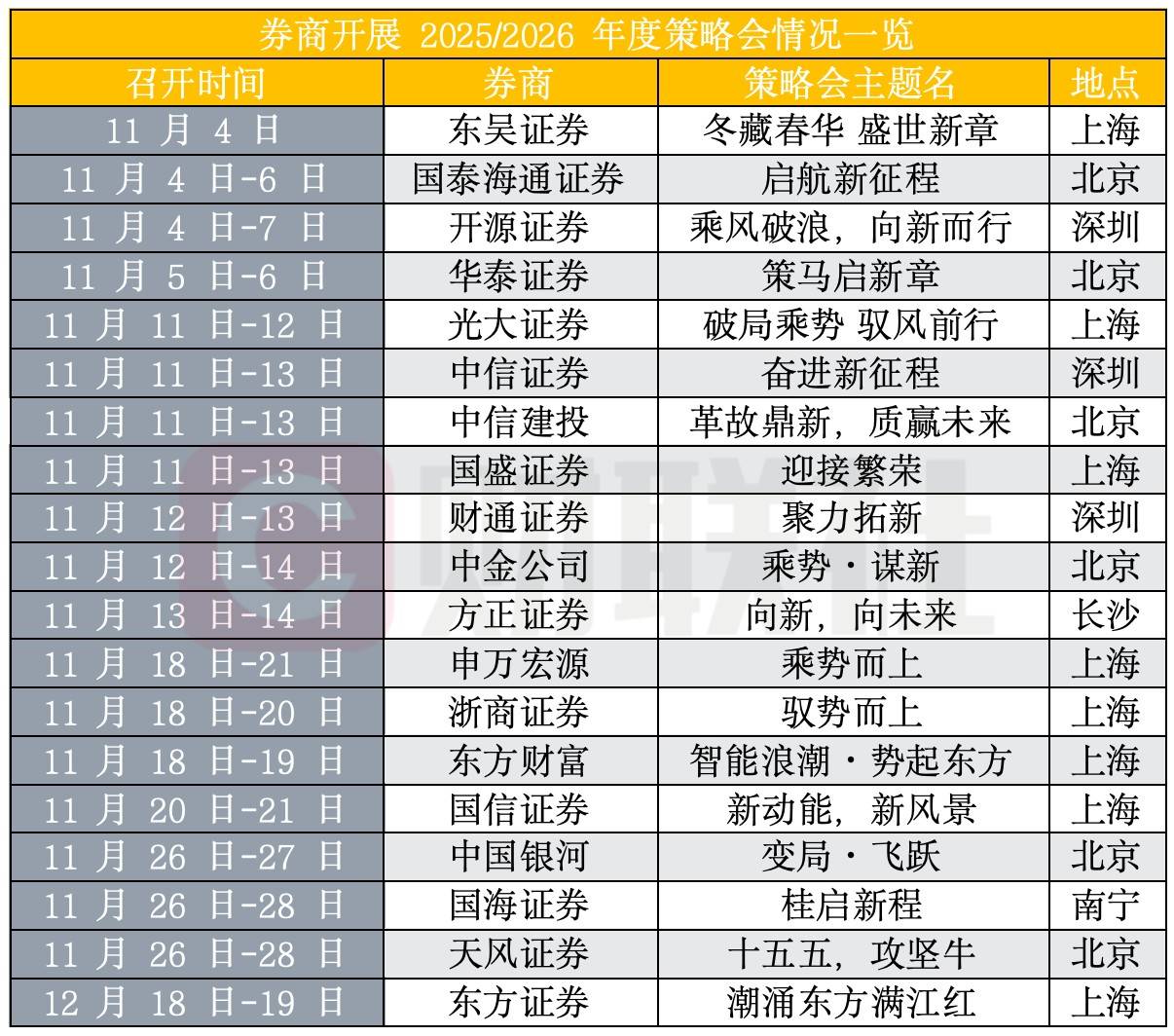
Group 1 - Major securities firms are holding their annual strategy meetings for 2025/2026, with 15 firms already scheduled and more expected to join [1][2] - The themes of these meetings include "New Journey," "Intelligent Wave," and "Fifteen Five, Striving for Bull Market," reflecting a focus on innovation and adaptation to current market conditions [1][2] Group 2 - The strategy meetings reveal four key characteristics: frequent use of the word "new," alignment with current trends, adherence to policy directions, and emphasis on trend identification [3] - A notable increase in cross-border ETF inflows, with a 300% year-on-year rise, indicates significant institutional interest in international markets [3] Group 3 - The market is described as a brutal elimination race, with only 40% of stocks rising in 2025 and only 8% achieving over 100% gains, suggesting that the majority of investors are merely participating without substantial returns [4] - Two key rules for identifying potential bull stocks are highlighted: scarcity of good stocks attracts attention from both retail and institutional investors, and significant price increases often require a "washing out" of speculative positions [5] Group 4 - Behavioral finance principles suggest that large capital movements leave identifiable traces, which can be analyzed to predict stock movements [11] - The strategy meetings showcased advancements in AI and data analysis, emphasizing the importance of developing a "data mindset" to understand market dynamics beyond traditional technical analysis [12] Group 5 - Recommendations for ordinary investors include creating a watchlist of stocks with unusual capital movements that have not yet seen price increases, exercising patience in waiting for clear signals, and managing emotions to avoid being swayed by short-term market fluctuations [14]
白银的逼仓与A股的牛市
对冲研投· 2025-11-30 04:04
Group 1: Metal Market Outlook - Copper is forecasted to strongly rise, with prices expected to exceed $12,000 per ton in the first half of 2026 and an average price of $12,075 per ton for the year, driven by severe supply disruptions and resilient global demand growth of 2.6% [2] - Aluminum prices are expected to rise to $3,000 per ton in the first half of 2026, supported by copper price increases, but will face downward pressure later due to supply growth from Indonesia [2] - Zinc is predicted to decline, with prices expected to fall to $2,650 per ton by Q4 2026, due to oversupply and stagnant global demand growth around 1% [2] - Nickel prices are expected to remain volatile, averaging around $15,300 per ton in 2026, influenced by ongoing supply surplus and Indonesian policy [2] Group 2: Seasonal Trends and Price Dynamics - The seasonal demand peak in August and September is expected to drive up prices, particularly for methanol, while winter supply constraints may further support price increases [6][8] - Extreme price movements are often triggered by significant fluctuations in raw material costs, such as coal, which directly impact methanol production costs [9] - Port inventory and import levels act as regulators for price differentials, with excess imports potentially suppressing price increases even during peak demand seasons [10] Group 3: Investment Opportunities and Market Sentiment - The current market sentiment is leaning towards bearish, with structural opportunities primarily arising from supply-demand mismatches in various commodities [28][32] - The black metal sector shows a clear divergence, with iron ore being a strong long opportunity while rebar and other materials may present short opportunities [33][35] - The energy sector is supported by rising crude oil prices, while rubber is identified as a potential short opportunity due to market dynamics [37] Group 4: Economic and Market Outlook - The Chinese stock market is expected to enter a new bullish phase, driven by economic recovery and improved corporate earnings, potentially leading to a significant capital influx [21][24] - Historical patterns suggest that major bubbles require low interest rates, a strong profit effect, and a lack of investment opportunities in other major markets [22] - The structural changes in China's economy, with a decreasing reliance on real estate and a growing manufacturing sector, are anticipated to support stock market strength [26][27]

国泰海通:“去美元化”长期趋势下 贵金属涨势或将延续
Zhi Tong Cai Jing· 2025-11-29 11:12
Group 1 - The long-term trend of "de-dollarization" is driving some countries to reduce the proportion of U.S. Treasury bonds in their foreign exchange reserves and increase their gold holdings, a trend that is not weakened by the easing of U.S.-China trade disputes [1][2] - The liquidity easing brought by the Federal Reserve's interest rate cuts is accelerating the process of rising precious metals, with expectations for a price increase in 2025 due to the combination of these trends [1][2] - In 2026, the new Federal Reserve Chairman may adopt a more aggressive rate-cutting approach amid the backdrop of midterm elections, and continued increases in gold ETF holdings by European and American investors are expected to sustain the upward trend in precious metals [1][2] Group 2 - The demand for basic metals, particularly copper and aluminum, is expected to rise due to liquidity easing and increased physical demand driven by AI investments, while supply constraints in mining and smelting will support a steady increase in industrial metal prices [1][2] - For copper, the ongoing liquidity trend and significant potential demand from AI data centers and power grids will likely lead to a sustained upward movement in copper prices, with the possibility of exceeding expectations [1][2] - The aluminum sector is expected to maintain good profit levels due to tight supply and demand dynamics, with leading companies in the industry likely to achieve strong profitability through resource management and supply chain extension [1][2] Group 3 - The supply and demand for lithium carbonate is projected to return to a tight balance in 2026, with a significant increase in price levels driven by strong demand from energy storage and power applications [2] - The global demand for lithium carbonate is expected to grow by 24.2% in 2026, with a demand growth rate of approximately 50% from energy storage and just under 20% from power batteries [2] - The supply growth for lithium is forecasted at around 18.1%, indicating a shift from a loose balance to a tight balance in the lithium market [2] Group 4 - Domestic rare earth prices are expected to rise, benefiting companies in the rare earth magnetic materials sector, as the supply side faces constraints and demand from new energy policies strengthens [2] - The growth rate for demand from sectors such as new energy vehicles, wind power, and energy-efficient variable frequency air conditioners is projected to reach 29%, 18%, and 28% respectively by 2025 [2] - The tightening of domestic rare earth supply, coupled with overseas demand for replenishment, is likely to amplify price increases, providing a dual boost to the performance and valuation of rare earth magnetic material companies [2]
