
央行购金

Search documents
机构看金市:11月24日
Xin Hua Cai Jing· 2025-11-24 02:40
Core Viewpoints - The market's expectation for a rate cut in December has increased, providing short-term support for precious metals [1] - There is a significant divergence in views within the Federal Reserve, contributing to a weak performance in the U.S. stock market and affecting gold prices [2] - Central bank purchases of gold are expected to continue supporting gold prices in the long term, despite short-term fluctuations [3] Group 1: Market Sentiment and Predictions - Minmetals Futures indicates that the expectation of a dovish monetary policy from the Federal Reserve has significantly rebounded, leading to strong short-term support for precious metals [1] - According to Everbright Futures, the end of the U.S. government shutdown did not sustain market optimism, resulting in a lack of upward momentum for gold prices [2] - Asset Strategies International forecasts that gold prices will continue to rise next year, supported by ongoing central bank purchases [3] Group 2: Key Factors Influencing Gold Prices - Gold and silver prices are driven by long-term factors such as sovereign debt issues, geopolitical risks, and central bank purchases, which remain robust despite short-term adjustments [2] - Rich Checkan from Asset Strategies International believes that the recent decline in gold prices may have been overdone, with solid support expected for future price increases [3] - Blue Line Futures highlights three key factors that will continue to drive gold prices upward, including central banks diversifying away from the dollar, increased investor interest in gold, and a favorable stagflation environment [3]
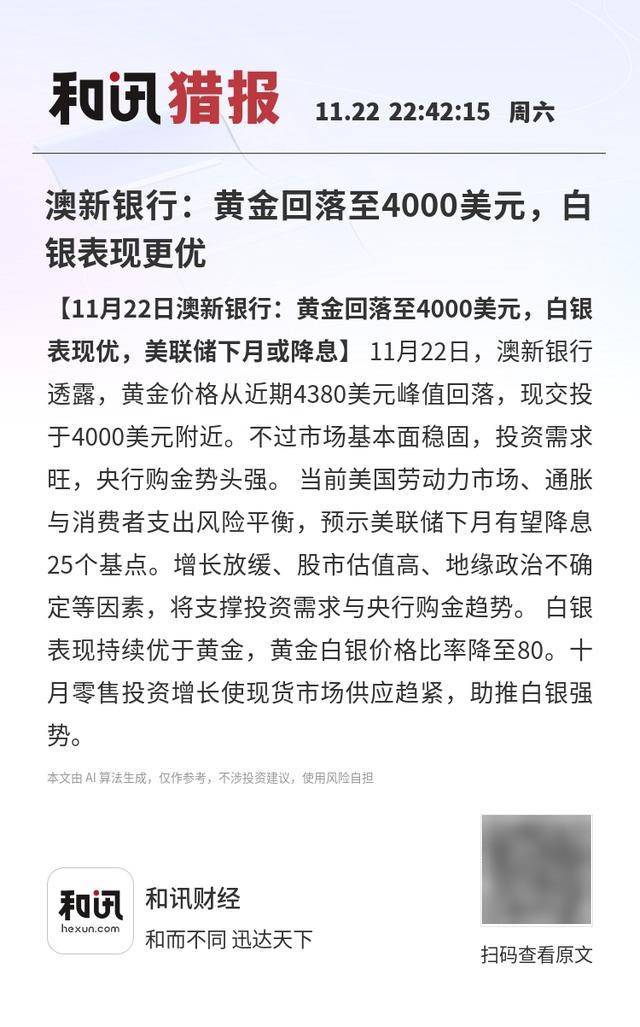
澳新银行:黄金回落至4000美元,白银表现更优
Sou Hu Cai Jing· 2025-11-22 15:15
Core Insights - Gold prices have retreated to around $4000 from a recent peak of $4380, indicating a stable market despite the decline [1][2] - Strong investment demand and central bank purchases are supporting the gold market [1][2] - The U.S. labor market, inflation, and consumer spending risks are balanced, suggesting a potential 25 basis point rate cut by the Federal Reserve next month [1][2] - Factors such as economic slowdown, high stock market valuations, and geopolitical uncertainties are expected to sustain investment demand and central bank gold purchases [1][2] - Silver continues to outperform gold, with the gold-silver price ratio dropping to 80 [1][2] - Retail investment growth in October has tightened the supply in the spot market, contributing to silver's strength [1][2]

贵金属市场周报-20251121
Rui Da Qi Huo· 2025-11-21 10:30
1. Report Industry Investment Rating No relevant content provided. 2. Core Viewpoints of the Report - The precious metals market oscillated within a range this week due to the vacillation of the Fed's interest - rate cut expectations. The delayed September non - farm payroll report failed to offer clear guidance, and market uncertainty remained high. The 12 - month interest - rate cut probability dropped significantly, and the precious metals market will continue to oscillate. In the short term, precious metals lack clear positive factors, and gold prices will mainly move in an oscillatory manner next week. In the long run, due to the increasing US debt pressure and central bank gold purchases, the gold price center may rise further. The suggested attention range for the SHFE gold 2602 contract next week is 900 - 950 yuan/gram, and for the SHFE silver 2602 contract, it is 11,500 - 12,300 yuan/kilogram [8]. 3. Summary by Directory 3.1 Weekly Highlights Summary - **Market Performance**: Affected by the vacillation of the Fed's interest - rate cut expectations, the precious metals market oscillated within a range this week. The delayed September non - farm payroll report failed to provide clear guidance, and market uncertainty remained high. Although the number of new jobs significantly exceeded market expectations, the downward revision of previous data and the unexpected increase in the unemployment rate (the highest in four years) made the data less impressive. The Fed officials were divided on the interest - rate cut stance, with most supporting maintaining interest rates and some advocating a looser policy. The 12 - month interest - rate cut probability dropped from nearly 70% at the beginning of last week to 30% - 45% this week [8]. - **Market Outlook**: In the short term, the suppression of interest - rate cut expectations is unfavorable for gold prices. The lack of data guidance and the callback of the US stock market may exacerbate the liquidity risk and the callback of the precious metals market. The neutral - to - hawkish tone of the Fed officials restricts the upward space of gold prices. In the long term, the increasing US debt pressure and central bank gold purchases may push up the gold price center [8]. 3.2 Futures and Spot Markets - **Price Movement**: After a significant increase in the previous period, the precious metals market corrected at a high level this week. As of November 21, 2025, COMEX silver was at $48.77 per ounce, down 3.23% for the week; the SHFE silver 2602 contract was at 11,680 yuan/kilogram, down 5.43% for the week. COMEX gold was at $4,032.9 per ounce, down 1.33% for the week; the SHFE gold 2602 contract was at 926.94 yuan/gram, down 2.75% for the week [9][11]. - **ETF Holdings**: This week, the net holdings of foreign - market silver ETFs increased, while those of gold ETFs decreased. As of November 20, 2025, the SPDR gold ETF holdings were 1,039.43 tons, a 0.91% decrease from the previous period; the SLV silver ETF holdings were 15,247 tons, a 0.50% increase from the previous period [12][16]. - **COMEX Positions**: Due to the US government shutdown, the COMEX position data of precious metals stopped being updated. As of September 23, 2025 (the latest), the total COMEX gold positions were 528,789 contracts, a 2.43% increase from the previous period; the net positions were 266,749 contracts, a 0.13% increase from the previous period. The total COMEX silver positions were 165,805 contracts, a 1.75% increase from the previous period; the net positions were 52,276 contracts, a 1.43% increase from the previous period [17][21]. - **Basis**: This week, the basis of gold and silver in the Shanghai market weakened. As of November 20, 2025, the gold basis was - 5.46 yuan/gram, and the silver basis was 94 yuan/kilogram [22][24]. - **Inventory**: This week, the SHFE gold inventory increased, while the silver inventory decreased. As of November 20, 2025, the COMEX gold inventory was 36,937,024.89 ounces, a 1.61% decrease from the previous period; the SHFE gold inventory was 90,426 kilograms, a 0.90% increase from the previous period. The COMEX silver inventory was 15,247 ounces, a 0.50% increase from the previous period; the SHFE silver inventory was 576,894 kilograms, a 7.40% decrease from the previous period [27][31]. 3.3 Industrial Supply and Demand 3.3.1 Silver Industry - **Imports**: As of October 2025, the import volumes of silver and silver ore sand decreased. The Chinese silver import volume was 239,777.07 kilograms, a 2.43% decrease from the previous period; the import volume of silver ore sand and its concentrates was 149,358,822 kilograms, a 6.99% decrease from the previous period [33][37]. - **Downstream Demand**: Due to the increasing demand for silver in semiconductors, the growth rate of integrated circuit production continued to rise. As of October 2025, the monthly integrated circuit production was 4,177,000 pieces, with a year - on - year growth rate of 17.7% [39][42]. - **Supply - Demand Balance**: The silver supply - demand situation is in a tight - balance pattern. As of the end of 2024, the industrial demand for silver was 680.5 million ounces, a 4% year - on - year increase; the demand for coins and net bars was 190.9 million ounces, a 22% year - on - year decrease; the net investment demand for silver ETFs was 61.6 million ounces, compared with - 37.6 million ounces in the same period of the previous year; the total silver demand was 1,164.1 million ounces, a 3% year - on - year decrease. The total silver supply was 1,015.1 million ounces, a 2% year - on - year increase; the supply - demand gap was - 148.9 million ounces, a 26% decrease from the previous period [44][48][52]. 3.3.2 Gold Industry - **Product Price**: This week, the price of gold jewelry decreased. As of November 20, 2025, the Chinese gold recycling price was 929.60 yuan/gram, down 2.71% from the previous period. The gold prices of Laofengxiang, Chow Tai Fook, and Saturday Fu were 1,302 yuan/gram, 1,305 yuan/gram, and 1,273 yuan/gram respectively [54][58]. - **Investment Demand**: According to the World Gold Council, in Q3 2025, the investment demand for gold ETFs increased significantly. Central banks net - purchased about 220 tons of gold in the third quarter, with a cumulative purchase of 634 tons in the first three quarters of 2025 [60]. 3.4 Macroeconomic Data - **Dollar and Treasury Yields**: This week, the US dollar index continued to rebound, and the yield of 10 - year US Treasury bonds increased slightly. The 10Y - 2Y Treasury yield spread widened week - on - week, and the CBOE gold volatility declined. The 10 - year inflation - balanced interest rate was 2.24%, slightly lower than last week [64][68][72]. - **Central Bank Gold Purchases**: In the third quarter of 2025, central banks around the world purchased 220 tons of gold, a 28% quarter - on - quarter increase, reversing the downward trend at the beginning of the year. The cumulative net gold purchase from the beginning of the year to now was 634 tons, still significantly higher than the level before 2022 [76][78].
香港第一金:黄金跌破关键支撑,可能引发连锁反应
Sou Hu Cai Jing· 2025-11-21 07:57
Core Viewpoint - The recent strong U.S. non-farm payroll data has significantly reduced the expectations for a Federal Reserve rate cut in December, leading to a stronger dollar and downward pressure on gold prices [2][3] Group 1: Market Influences - Strong U.S. non-farm payroll data for September showed an increase of 119,000 jobs, far exceeding the expected 50,000 [2] - The probability of a Federal Reserve rate cut in December has dropped from approximately 45% to around 30%-40% [2] - The global tech stock market crash has triggered risk-averse sentiment, which may support gold prices in the long term [2] Group 2: Key Price Levels - Resistance levels for gold are identified at $4,110 and the $4,130-$4,140 range; a failure to sustain upward momentum near these levels may warrant short positions [2] - A critical support level to watch is $4,020; if gold stabilizes here and shows bullish candlestick patterns, it may present a buying opportunity [3] - If gold breaks below the $4,020 support, it could open up further downside potential, while a strong breakout above $4,140 could lead to additional upward movement, though the current fundamentals do not strongly support this scenario [3] Group 3: Future Monitoring - The Federal Reserve's policy signals are crucial for the gold market; attention should be paid to speeches from Fed officials leading up to the December FOMC meeting, as any hints regarding interest rate paths could cause market fluctuations [4] - Key economic data, including upcoming inflation figures (CPI, PCE) and the combined non-farm employment report for October and November, will be critical in assessing the U.S. economic condition and inflation trends [5] - The ability of gold to maintain the $4,000 psychological and technical support level is essential; a breach could lead to further declines [6]
新世纪期货交易提示(2025-11-21)-20251121
Xin Shi Ji Qi Huo· 2025-11-21 01:44
Report Industry Investment Ratings - Iron ore: Oscillating [2] - Coking coal and coke: Oscillating [2] - Rolled steel and rebar: Oscillating [2] - Glass: Weakening [2] - Soda ash: Oscillating [2] - CSI 500: Rebounding [4] - CSI 1000: Rebounding [4] - 2-year Treasury bond: Oscillating [4] - 5-year Treasury bond: Oscillating [4] - 10-year Treasury bond: Upward [4] - Gold: High-level oscillating [4] - Silver: High-level oscillating [4] - Logs: Bottom oscillating [6] - Pulp: Weakly oscillating [6] - Offset paper: Weakly oscillating [6] - Edible oils: Range-bound [6] - Meal: Oscillating weakly [6][7] - Rubber: Oscillating [10] - PX: Oscillating [10] - PTA: Oscillating [10] - MEG: Widely oscillating [10] - PR: On the sidelines [10] - PF: On the sidelines [10] Core Viewpoints - The overall market shows a complex trend with different commodities having various performances, affected by factors such as supply and demand, policies, and international situations. For example, the iron and steel industry is affected by supply and demand and production reduction policies; the financial market is influenced by macroeconomic data and policies; the agricultural and forestry products market is affected by weather, trade policies, and consumption demand [2][4][6]. Summary by Related Catalogs Ferrous Metals - **Iron ore**: Overseas shipments increased by 4474000 tons to 35164000 tons, while domestic port arrivals continued to decline. Daily average hot metal production decreased by 0.6 tons to 236280 tons. The demand core lies in the real estate sector, with new construction dropping to the 2005 level. The supply-demand surplus pattern is hard to reverse, and the price is mainly oscillating [2]. - **Coking coal and coke**: Affected by the news of Mongolia's import target and the heating season supply guarantee meeting, the upward driving force weakened. Although the fourth round of price hikes has been implemented, the profit repair of coke enterprises is limited, and there are obvious differences in sentiment for the fifth round of price hikes. The supply-demand relationship has become looser again, and it is in an adjustment state in the short term [2]. - **Rolled steel and rebar**: Downstream demand is sluggish, and winter storage replenishment has not started yet. The price is mainly oscillating. The key lies in steel demand, and the steel price depends on the implementation of production reduction and anti - "involution" policies [2]. - **Glass**: The spot quotation is relatively weak, and the demand is dragged down by the continuous decline in real estate completion. The enterprise inventory has been increasing, and it is necessary to pay attention to the cold repair of production lines and macro - and production reduction policies [2]. Financial Products - **Stock index futures/options**: The previous trading day saw declines in major stock indices. Some sectors showed capital inflows and outflows. The market is in short - term consolidation, and the medium - term trend is still upward, suggesting long - holding of stock indices [2][4]. - **Treasury bonds**: The central bank carried out 300 billion yuan of 7 - day reverse repurchase operations, with a net investment of 110 billion yuan. The spot bond interest rate is consolidating, and the market trend is slightly rebounding, suggesting light - position long - holding of treasury bonds [4]. - **Precious metals**: Gold's pricing mechanism is shifting. The Fed's interest rate policy and risk - aversion sentiment may be short - term disturbing factors, while the Fed's interest rate cut cycle, global central bank gold purchases, and geopolitical risks provide long - term support [4]. Light Industry and Agricultural Products - **Logs**: The port daily average shipment decreased, and the import volume decreased year - on - year. The inventory pressure is large, and the spot price is weak. It is expected to be mainly bottom - oscillating [6]. - **Pulp**: The spot market price is weakly adjusted, the cost support is weakened, and the demand is poor. It is expected to be weakly oscillating [6]. - **Offset paper**: The supply is stable, the start - up rate decreased slightly, and the market expectation is cautious. It is expected to be weakly oscillating [6]. - **Edible oils**: The overall supply is abundant, the demand is weak, and it is expected to continue range - bound operation [6]. - **Meal**: The global soybean supply is relatively loose, and domestic supply is abundant while demand is cautious. It is expected to be oscillating weakly [6][7]. - **Live pigs**: The trading weight fluctuates, the settlement price may face downward pressure, and the slaughter enterprise start - up rate is expected to continue to increase, with the average price expected to oscillate [7]. Soft Commodities and Polyesters - **Rubber**: Different regions have different production situations due to weather. The demand side shows some improvement, but the inventory is in a seasonal accumulation period, and the price is expected to be widely oscillating [10]. - **PX**: Supply is strong, and downstream polyester load has rebounded, with the price mainly oscillating [10]. - **PTA**: Supported by raw materials, the supply - demand relationship has improved, and the price is expected to fluctuate with the cost end [10]. - **MEG**: There is still long - term inventory accumulation pressure, and the price is expected to be widely adjusted in the short term [10]. - **PR**: Lack of support from crude oil and raw materials, with weak downstream demand, the market may continue to be sluggish [10]. - **PF**: The demand side is average, and the supply is relatively loose, with the market expected to be weakly sorted [10].
黄金狂飙6年涨219%!4380美元历史峰值后,还能继续冲高吗?
Sou Hu Cai Jing· 2025-11-20 07:54
6年狂飙219%:黄金为何"停不下来"? 2025年的黄金市场,用"疯狂"二字形容毫不为过:伦敦现货金价年内飙涨超50%,10月冲上4380美元/盎司的历史峰值,截至11月19日仍稳居4100美元上 方,创下1979年以来最强年度表现。更令人惊叹的是,自2019年启动第三轮上涨周期以来,黄金已连续6年走强,累计涨幅达219%,成为全球资产中"最 亮的星"。然而,站在历史高位,一个关键问题萦绕在投资者心头:黄金的上涨势头还能持续吗?地缘政治、央行购金、实际利率三大变量,将如何左右 未来走势? 3. 实际利率:金价的"隐形推手" 黄金与实际利率呈负相关关系:实际利率越低,持有黄金的机会成本越低,金价越易上涨;反之则承压。2024年,美联储开启降息周期,实际利率下 行,成为金价上涨的重要推手。然而,未来利率路径存在不确定性:若美联储因通胀反弹而暂停降息,甚至重启加息,实际利率可能上行,对金价构成 压制。 未来展望:黄金还能"飞"多高? 黄金的这轮上涨,堪称"教科书级"的慢牛行情。2019年,全球贸易摩擦升级、美联储开启降息周期,黄金从1200美元/盎司起步,开启第一波攻势;2020 年疫情冲击下,全球经济停摆,黄金 ...
黄金惊魂一日:4000美元关口失而复得,多空激战后谁主沉浮?
Sou Hu Cai Jing· 2025-11-20 07:48
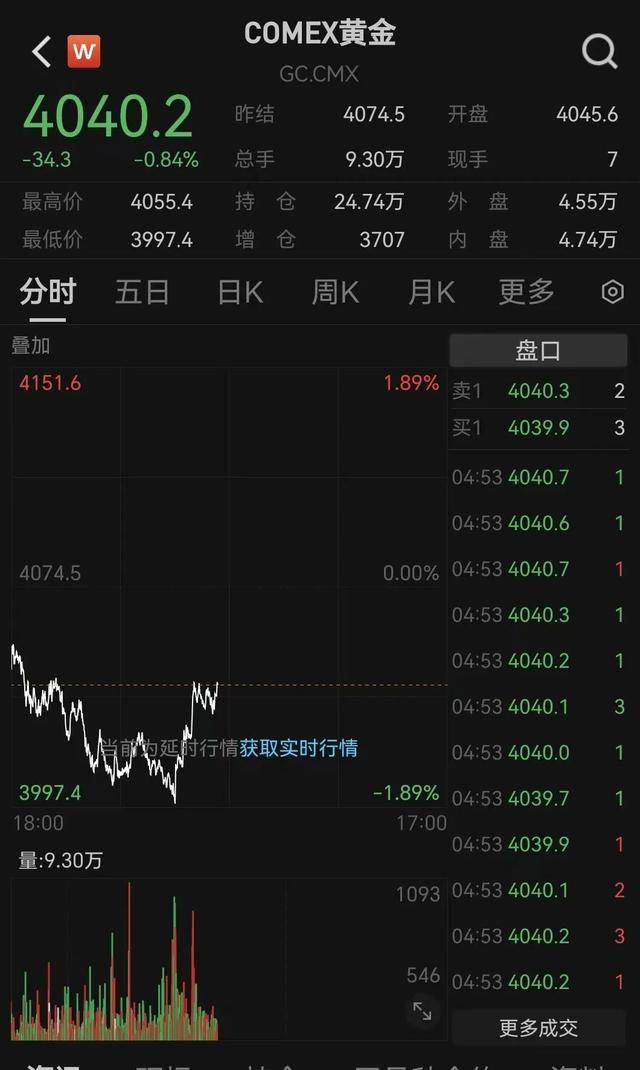
Core Viewpoint - The gold market experienced significant volatility on November 18, 2025, with spot gold prices dropping below $4000 per ounce before rebounding due to comments from Federal Reserve Governor Waller supporting interest rate cuts [1][3][4] Group 1: Market Movements - Spot gold prices fell to $3998.2 per ounce, marking the first drop below $4000 since November 10 [3] - COMEX gold futures also declined, reaching a low of $3985.6 per ounce, while silver prices fell below $50 per ounce, with a daily drop exceeding 2% [3] - Following Waller's comments, spot gold rebounded nearly $40, closing at $4038.677 per ounce, while COMEX futures recovered above $4040 [3][4] Group 2: Federal Reserve Policy Impact - Recent hawkish statements from several Federal Reserve officials dampened market expectations for interest rate cuts, with the probability of a December cut dropping from 93.7% to 48.6% [3][4] - Waller's dovish remarks emphasized the need for rate cuts to mitigate risks in the labor market, which reignited bullish sentiment in the gold market [4][5] Group 3: Long-term Outlook - Despite short-term volatility, the long-term bullish outlook for gold remains intact, supported by central bank gold purchases and geopolitical risks [4][6] - Central banks are expected to continue significant gold purchases, with 800 tons acquired in the first three quarters of 2024, a 34% year-on-year increase [4] - Analysts predict gold prices could rise to $4900 by the end of 2026, driven by ongoing demand from both central banks and private investors [4] Group 4: Upcoming Economic Data - The upcoming non-farm payroll report and unemployment rate will be critical for the gold market, as strong employment data could delay rate cuts, while weak data may boost gold prices [5][6] - Other significant events, such as the October CPI data and the European Central Bank's interest rate decision, will also impact the gold market [6]
【黄金期货收评】贵金属长期核心驱动未改 沪金微涨1.33%
Jin Tou Wang· 2025-11-19 09:32
Group 1 - The latest gold futures closing price on November 19 was 937.00 CNY per gram, with a daily increase of 1.09% and a trading volume of 239,515 lots [1] - The Shanghai gold spot price on November 19 was quoted at 931.40 CNY per gram, indicating a discount of 5.06 CNY per gram compared to the futures price [1] - The Chinese Premier Li Qiang emphasized the impact of trade barriers on international order during the Shanghai Cooperation Organization meeting, calling for reduced barriers and embracing free trade [1] Group 2 - Saudi Crown Prince confirmed an increase in investments in the U.S. to 1 trillion USD [2] - The number of initial jobless claims in the U.S. for the week ending October 18 was 232,000, while the ADP employment data indicated a weekly decrease of 2,500 jobs in the private sector [2] Group 3 - Gold and silver prices experienced a general decline, with COMEX gold futures down 0.17% to 4,067.40 USD per ounce and COMEX silver futures down 0.34% to 50.54 USD per ounce [3] - The market is facing a leveraged sell-off due to concerns over the government shutdown affecting the release of non-farm and inflation data, leading the Federal Reserve to adopt a cautious stance for the December FOMC meeting [3] - Long-term factors such as sovereign debt issues, geopolitical risks, and central bank gold purchases driven by de-dollarization remain unchanged, supporting the long-term price trends of gold and silver despite short-term adjustments [3]
贵金属有色金属产业日报-20251119
Dong Ya Qi Huo· 2025-11-19 09:22
1. Report Industry Investment Rating No relevant content provided. 2. Core Views of the Report - In the precious metals market, although central bank gold purchases and growing investment demand will push up the price center of precious metals in the long - term, short - term macro uncertainties about December interest rate cuts may lead to continued volatile adjustments. It is recommended to pay attention to the retracement of the 60 - day moving average [3]. - In the copper market, concerns about non - farm data affecting interest rate cuts have led to capital reduction and price drops. Inventory increases and narrowing premiums reflect fundamental pressures, with limited short - term repair space [17]. - In the aluminum market, Shanghai aluminum is expected to maintain a long - term oscillatory upward trend, but short - term weak fundamentals and a lower probability of December interest rate cuts may lead to profit - taking by previous funds, resulting in subsequent oscillatory consolidation. Alumina is in an oversupply situation, and the expiration of a large number of warehouse receipts will exacerbate the imbalance between supply and demand [36]. - In the zinc market, the cooling of interest rate cut expectations and a significant drop in November TC due to intense competition for ore in the smelting sector have increased the willingness of smelters to reduce or halt production in November. There is a possibility of inventory reduction, and there are significant differences between bulls and bears [59]. - In the nickel and stainless - steel market, nickel - iron prices have been declining due to weak downstream demand. The downside space for nickel and stainless - steel is greater than the upside space. Stainless - steel spot sales face pressure, and downstream demand remains weak [75]. - In the tin market, due to limited resumption of production in Wabang, refined tin concentrate imports have sharply decreased, and supply is weaker than demand. Shanghai tin is expected to maintain high - level oscillations, with support around 276,000 yuan [88]. - In the lithium carbonate market, strong demand from the new energy vehicle and energy storage sectors, combined with a slowdown in supply growth, may lead to a short - term strong and oscillatory trend in lithium prices, but position fluctuations should be watched out for [104]. - In the silicon industry chain, the supply - demand pattern of industrial silicon is generally weak, with wide - range oscillations. The polysilicon industry chain is experiencing production cuts and inventory accumulation, with a weak fundamental outlook and wide - range, weak oscillations [116]. 3. Summary by Relevant Catalogs Precious Metals - **Price Outlook**: In the short term, due to unclear prospects of December interest rate cuts, precious metals may continue to oscillate and adjust. In the long term, central bank gold purchases and growing investment demand will push up prices [3]. - **Price Charts**: Include SHFE gold and silver futures main - continuous prices, COMEX gold prices and gold - silver ratios, SHFE and SGX gold and silver futures - spot price differences, gold and US Treasury real interest rates, gold long - term fund holdings, and SHFE and COMEX gold and silver inventories [4][12][16]. Copper - **Price Outlook**: Market concerns about non - farm data and inventory increases have led to price drops, with limited short - term repair space [17]. - **Price Data**: Spot prices from various sources (Shanghai Non - ferrous, Shanghai Wumaoyi, etc.) have small daily increases. Futures prices of Shanghai copper and London copper show different trends, with Shanghai copper rising and London copper falling [22][23]. - **Inventory Data**: Shanghai copper warehouse receipts and LME copper inventories show different changes, with some warehouse receipts decreasing and LME copper inventories increasing [32][34]. Aluminum - **Price Outlook**: Shanghai aluminum may oscillate and consolidate in the short term, while alumina is in an oversupply situation [36]. - **Price Data**: Aluminum and alumina futures and spot prices show different trends, with some rising and some falling [38][45]. - **Inventory Data**: Shanghai aluminum and LME aluminum inventories show different changes, and alumina warehouse receipts increase slightly [53]. Zinc - **Price Outlook**: Cooling interest rate cut expectations and a drop in November TC have increased the willingness of smelters to cut production. There is a possibility of inventory reduction, and there are significant differences between bulls and bears [59]. - **Price Data**: Shanghai zinc and LME zinc prices show different trends, with Shanghai zinc rising and LME zinc falling slightly [60]. - **Inventory Data**: Shanghai zinc warehouse receipts decrease, and LME zinc inventories increase [72]. Nickel and Stainless - Steel - **Price Outlook**: Nickel - iron prices decline due to weak downstream demand, and the downside space for nickel and stainless - steel is greater than the upside space. Stainless - steel spot sales face pressure [75]. - **Price Data**: Nickel and stainless - steel futures prices show different trends, with some rising and some falling [76]. - **Inventory Data**: Nickel warehouse receipts decrease [76]. Tin - **Price Outlook**: Due to limited resumption of production in Wabang, refined tin concentrate imports have sharply decreased, and supply is weaker than demand. Shanghai tin is expected to maintain high - level oscillations [88]. - **Price Data**: Shanghai tin and London tin futures prices show different trends, with Shanghai tin rising and London tin falling slightly [89]. - **Inventory Data**: Shanghai tin warehouse receipts decrease, and LME tin inventories remain unchanged [99]. Lithium Carbonate - **Price Outlook**: Strong demand and slow supply growth may lead to a short - term strong and oscillatory trend in lithium prices, but position fluctuations should be watched out for [104]. - **Price Data**: Lithium carbonate futures and spot prices show an upward trend [105][109]. - **Inventory Data**: Guangzhou Futures Exchange warehouse receipts increase slightly, and social and downstream inventories decrease [114]. Silicon Industry Chain - **Price Outlook**: The supply - demand pattern of industrial silicon is generally weak, with wide - range oscillations. The polysilicon industry chain is experiencing production cuts and inventory accumulation, with a weak fundamental outlook [116]. - **Price Data**: Industrial silicon and polysilicon - related product prices show different trends, with some remaining stable and some changing slightly [116]. - **Inventory Data**: Industrial silicon social inventory and polysilicon total inventory show different trends [134][143].
黄金收评 | 高盛:金价明年有望冲击4900美元,黄金股ETF(159562)强势领涨4.13%
Sou Hu Cai Jing· 2025-11-19 08:54
Core Viewpoint - Gold prices are experiencing a strong upward trend, influenced by the performance of related ETFs and expectations regarding central bank gold purchases, despite short-term pressure from adjusted interest rate expectations [1] Group 1: Market Performance - As of the close of the Asian market, COMEX gold futures rose by 0.6%, reaching $4,093 per ounce [1] - Gold-related ETFs showed strong gains, with Huaxia ETF (518850) up by 1.78%, non-ferrous metals ETF (516650) up by 1.86%, and gold stock ETF (159562) up by 4.13% [1] Group 2: Central Bank Activity - Goldman Sachs reported that global central bank gold purchases are ongoing, with an expected average monthly purchase of 80 tons from Q4 2025 to 2026 [1] - The increase in central bank gold purchases, along with the largest monthly inflow into Western gold ETFs since mid-2022 (112 tons), indicates strong demand from both central banks and retail investors [1] Group 3: Future Price Expectations - Goldman Sachs maintains an optimistic outlook for gold prices, projecting a rise to $4,900 by the end of 2026 [1] - Analysts from Baocheng Futures noted that the downward revision of interest rate expectations is largely due to previous market optimism, suggesting a potential return to data-driven analysis [1] Group 4: Upcoming Economic Data - The market is closely monitoring the upcoming U.S. non-farm payroll data for September, as well as subsequent economic data, which will directly impact expectations regarding Federal Reserve policies and the short-term trends in precious metals [1]
