央行购金

Search documents
南华贵金属日报:黄金、白银:大类资产普跌,贵金属下跌调整-20251107
Nan Hua Qi Huo· 2025-11-07 03:52
Report Summary 1. Report Industry Investment Rating No information provided on the industry investment rating. 2. Core View of the Report - Although in the medium - to - long - term, central bank gold purchases and growing investment demand will push up the price of precious metals, in the short - term, the price has entered an adjustment phase. There is expected to be no strong driving force in November. Investors should look for mid - term opportunities to buy on dips, and those with existing long positions should hold their bottom positions cautiously. London gold has resistance at 4050 - 4100, support at 3900, and strong support in the 3800 - 3850 area; silver has resistance at 49.5 - 50, support at 47.5, and strong support at 45.5 [5]. 3. Summary by Related Catalogs 3.1 Market Review - On Thursday, precious metals continued to fluctuate. The US dollar index, 10 - year US Treasury yields, US stocks, Bitcoin, and crude oil all declined. The number of US Challenger corporate layoffs in October reached a 20 - year high. Concerns about AI investment returns and hawkish remarks from Fed officials increased market panic about a potential economic recession. The US government shutdown also added to market unease. COMEX gold 2512 contract closed at $3984.8 per ounce, down 0.2%; US silver 2512 contract closed at $47.845 per ounce, down 0.37%. SHFE gold 2512 contract closed at 917.8 yuan per gram, up 0.79%; SHFE silver 2512 contract closed at 11427 yuan per kilogram, up 1.99%. The US announced a new list of critical minerals, including copper, silver, uranium, and potash [2]. 3.2 Interest Rate Cut Expectations and Fund Holdings - Interest rate cut expectations have slightly increased. According to CME's "FedWatch", the probability of the Fed keeping interest rates unchanged on December 11 is 29.4%, and the probability of a 25 - basis - point cut is 70.6%. For January 29, the probability of keeping rates unchanged is 17.7%, the probability of a cumulative 25 - basis - point cut is 54.2%, and the probability of a 50 - basis - point cut is 28.2%. For March 19, the probability of keeping rates unchanged is 10.4%, the probability of a cumulative 25 - basis - point cut is 39.1%, the probability of a 50 - basis - point cut is 38.9%, and the probability of a 75 - basis - point cut is 11.6%. SPDR Gold ETF holdings increased by 1.72 tons to 1040.35 tons; iShares Silver ETF holdings decreased by 36.68 tons to 15114.03 tons. SHFE silver inventory decreased by 16.2 tons to 640 tons, and SGX silver inventory decreased by 74.9 tons to 830.33 tons as of the week ending October 31 [3]. 3.3 This Week's Focus - In terms of data, focus on the US non - farm payrolls report on Friday evening and whether the US government shutdown will delay the data release. Regarding events, at 16:00 on Friday, FOMC permanent voter and New York Fed President Williams will speak at the ECB money market conference [4]. 4. Price, Inventory, and Market Data 4.1 Precious Metals Futures and Spot Prices | Product | Unit | Latest Price | Daily Change | Daily Change Rate | | --- | --- | --- | --- | --- | | SHFE Gold Main Continuous | Yuan/gram | 917.8 | 5.54 | 0.61% | | SGX Gold TD | Yuan/gram | 917.51 | 7.98 | 0.88% | | CME Gold Main | US dollars/ounce | 3984.8 | - 5.6 | - 0.14% | | SHFE Silver Main Continuous | Yuan/kilogram | 11427 | 151 | 1.34% | | SGX Silver TD | Yuan/kilogram | 11421 | 181 | 1.61% | | CME Silver Main | US dollars/ounce | 47.845 | - 0.015 | - 0.03% | | SHFE - TD Gold | Yuan/gram | 0.29 | - 2.44 | - 89.38% | | SHFE - TD Silver | Yuan/kilogram | 6 | - 30 | - 1000% | | CME Gold - Silver Ratio | / | 83.2856 | - 0.0909 | - 0.11% | [7] 4.2 Inventory and Position Data | Product | Unit | Latest Price | Daily Change | Daily Change Rate | | --- | --- | --- | --- | --- | | SHFE Gold Inventory | Kilogram | 87816 | 0 | 0% | | CME Gold Inventory | Ton | 1177.1807 | - 1.0722 | - 0.09% | | SHFE Gold Position | Lot | 137883 | - 3545 | - 2.51% | | SPDR Gold Position | Ton | 1040.35 | 1.72 | 0.17% | | SHFE Silver Inventory | Ton | 639.94 | - 16.23 | - 2.47% | | CME Silver Inventory | Ton | 14975.342 | 0.3139 | 0% | | SGX Silver Inventory | Ton | 830.31 | - 74.925 | - 8.28% | | SHFE Silver Position | Lot | 245863 | 1589 | 0.65% | | SLV Silver Position | Ton | 15114.027615 | - 36.682 | - 0.24% | [15][17] 4.3 Stock, Bond, and Commodity Market Overview | Product | Unit | Latest Value | Daily Change | Daily Change Rate | | --- | --- | --- | --- | --- | | US Dollar Index | 1973.3 = 199 | 99.7056 | - 0.4536 | - 0.45% | | US Dollar to Chinese Yuan | / | 7.1226 | - 0.0078 | - 0.11% | | Dow Jones Industrial Average | Point | 46912.3 | - 398.7 | - 0.84% | | WTI Crude Oil Spot | US dollars/barrel | 59.43 | - 0.17 | - 0.29% | | LmeS Copper 03 | US dollars/ton | 10687 | - 46 | - 0.43% | | 10 - Year US Treasury Yield | % | 4.11 | - 0.06 | - 1.44% | | 10 - Year US Real Interest Rate | % | 1.83 | - 0.04 | - 2.14% | | 10 - 2 Year US Treasury Yield Spread | % | 0.54 | 0 | 0% | [22]

贵金属日评:美国就业表现趋弱支撑贵金属价格-20251107
Hong Yuan Qi Huo· 2025-11-07 03:15
Report Summary 1. Report Industry Investment Rating - Not provided in the report. 2. Core Viewpoints - The weak employment performance in the US supports the prices of precious metals. The high number of corporate lay - offs in the US in October has increased the probability of a Fed rate cut in December. Along with factors such as the Fed providing liquidity, geopolitical risks, and central banks' gold - buying, precious metal prices may be supported [1]. 3. Summary by Related Catalogs Precious Metal Market Data - **Gold**: - Shanghai Gold futures' closing price was 917.80 yuan/g, with a change of 5.54 yuan compared to the previous day and - 4.12 yuan compared to the previous week. The trading volume was 238,433.00, a decrease of 157,531.00 from the previous day. The inventory remained at 87,816.00 (in ten - gram units) [1]. - COMEX gold futures' closing price was 3941.70 dollars/ounce, with a change of 43.10 dollars compared to the previous day and - 5.60 dollars compared to the previous week. The trading volume was 281,102.00, a decrease of 97,457.00 from the previous week [1]. - London gold spot price was 3968.20 dollars/ounce, with a change of - 20.20 dollars compared to the previous week [1]. - **Silver**: - Shanghai Silver futures' closing price was 11427.00 yuan/ten - gram, with a change of 151.00 yuan compared to the previous day and - 14.00 yuan compared to the previous week. The trading volume was 571,201.00, a decrease of 306,143.00 from the previous week [1]. - COMEX silver futures' closing price was 47.85 dollars/ounce, with a change of - 0.02 dollars compared to the previous day and 0.57 dollars compared to the previous week. The trading volume was 74,607.00, a decrease of 24,464.00 from the previous week [1]. - London silver spot price was 47.61 dollars/ounce, with a change of 0.51 dollars compared to the previous week [1]. Important Information - The direction of the Fed's December rate cut is unclear. This year's voting members are hesitant due to the government shutdown, and next year's members are more concerned about inflation. The Bank of England kept the interest rate at 4%, and the expectation of a December rate cut is rising [1]. - The AI revolution has accelerated the lay - off wave. In October, the number of Challenger corporate lay - offs in the US increased by 175.3% year - on - year, reaching the highest level in the same period in twenty years. The private data provider Revelio Labs reported a decrease of 9100 in non - farm employment in October [1]. Investment Strategy - Temporarily stay on the sidelines. For London gold, pay attention to the support level around 3580 - 3860 and the resistance level around 4180 - 4384; for Shanghai gold, focus on the support level around 830 - 860 and the resistance level around 950 - 1000. For London silver, pay attention to the support level around 39 - 42 and the resistance level around 50 - 55; for Shanghai silver, focus on the support level around 9400 - 10000 and the resistance level around 11600 - 12400 [1].
行情展望:财富千年不贬值的奥秘
Hong Ye Qi Huo· 2025-11-06 09:40
研究报告-贵金属专题报告 金融研究院 财富千年不贬值的奥秘 --行情展望 近期相关报告列表: 前三季度,黄金市场呈现"避险拉升—政策缓和 回调—新一轮突破"的阶梯式上行格局。进入四季度 以来,由于美国政府停摆、中美贸易局势、地缘政治 因素等多重因素的博弈之下,波动加大,甚至在 10 月中旬以后一度呈现震荡整理态势。 展望四季度,金价预计将在高位运行,但波动可 能加剧。支撑金价的长期逻辑(去美元化、央行购金) 依然牢固,美联储货币政策转向将是核心驱动变量。 然而,金价已计入较多降息预期,需警惕预期差带来 的调整风险。同时,需密切关注中美关系、地缘政治 等风险事件的演变。白银在工业属性与金银比修复逻 辑下,表现有望强于黄金。 (摘要) 研究员:张天骜 从业资格证:F3002734 投资分析证:Z0012680 助理分析师:黄思源 从业资格证:F03124114 报告日期 2025 年 11 月 6 日 | 1 行情回顾 | | --- | | 1.1 国外 . | | 1.2 国内 . | | 2 美国经济数据 . | | 2.1 GDP 数据 | | 2.2 PMI 指数 b | | 2.3 通胀数据 | | ...
机构看金市:11月5日
Xin Hua Cai Jing· 2025-11-05 03:44
Core Viewpoint - The gold market is currently experiencing a lack of significant bullish factors, leading to a potential continuation of a volatile trading environment until the end of the year [1][2][3] Group 1: Market Analysis - Everbright Futures indicates that the prolonged U.S. government shutdown could have a significant economic impact, causing financial market unease and contributing to a stronger U.S. dollar, which has led to declines in gold and other assets [1] - Jinrui Futures notes that the ongoing U.S. government shutdown is siphoning market liquidity, putting pressure on gold and silver prices, although long-term drivers such as sovereign debt issues and geopolitical risks remain intact [2] - UBS suggests that the recent pullback in gold prices may be temporary, maintaining a target price of $4,200 per ounce, with potential for prices to rise to $4,700 if geopolitical risks escalate [3] Group 2: Technical Indicators - Guoxin Futures highlights that the divergence in Federal Reserve policies has weakened expectations for interest rate cuts, resulting in a strong dollar that pressures dollar-denominated precious metals [2] - Technical analysis indicates that gold has broken below the critical support level of $4,000 per ounce, with the next support level potentially moving to the $3,900-$3,950 range [2] - State Street's Aakash Doshi anticipates that gold prices will consolidate below the $4,000 resistance level, with a normal consolidation phase expected in the long-term bull market [3] Group 3: Investment Outlook - Despite recent outflows from global gold ETFs, there remains unprecedented investor demand for gold, with expectations of new highs in ETF holdings by Q1 2026 [3] - The long-term core drivers for gold and silver prices remain robust, with Jinrui Futures asserting that short-term corrections will not alter the overall upward trend [2] - State Street projects that a price of $5,000 per ounce is a reasonable target, with any pullbacks expected to be relatively minor due to strong fundamental support [3]
【黄金期货收评】全球政治经济不稳 沪金下跌0.50%
Jin Tou Wang· 2025-11-05 01:36
【黄金期货最新行情】 美国就业咨询公司"挑战者企业"最新报告显示,截至今年9月,美国企业宣布的裁员人数已接近95万, 创下2020年以来同期最高水平,超过除新冠疫情首年外自2009年以来任何完整年度。政府部门成为裁员 重灾区,今年已有近30万个职位被削减。 【机构观点】 华联期货:全球政治经济不稳,市场风险不断,黄金成最好避险品种,不过避险情绪变化也较快;美国 如果提高关税,这进一步加大经济、就业下行压力,并间接刺激美联储加快降息节奏,这都将对金银带 来利多刺激。不过关税问题目前仅是情绪影响,后续需重点关注双方对关税问题的处理。从长期整体而 言黄金长期利好逻辑仍在,包括美元走弱以及全球政治经济不稳带来的央行购金,黄金的继续上涨的观 点不变 数据显示,11月4日上海黄金现货价格报价916.00元/克,相较于期货主力价格(915.58元/克)升水0.42 元/克。 中欧出口管制对话磋商在布鲁塞尔举行,双方就出口管制领域彼此关切进行深入、富有建设性的沟通。 双方同意继续保持沟通交流,促进中欧产业链供应链稳定与畅通。 美国财长贝森特称,如果中方继续阻止稀土出口,美方可能对华加征关税。外交部对此回应称,中美吉 隆坡经贸 ...
金价“过山车”狂飙又跳水!900元关口拉锯,追高者血亏,抄底时机到了?
Sou Hu Cai Jing· 2025-11-04 02:47
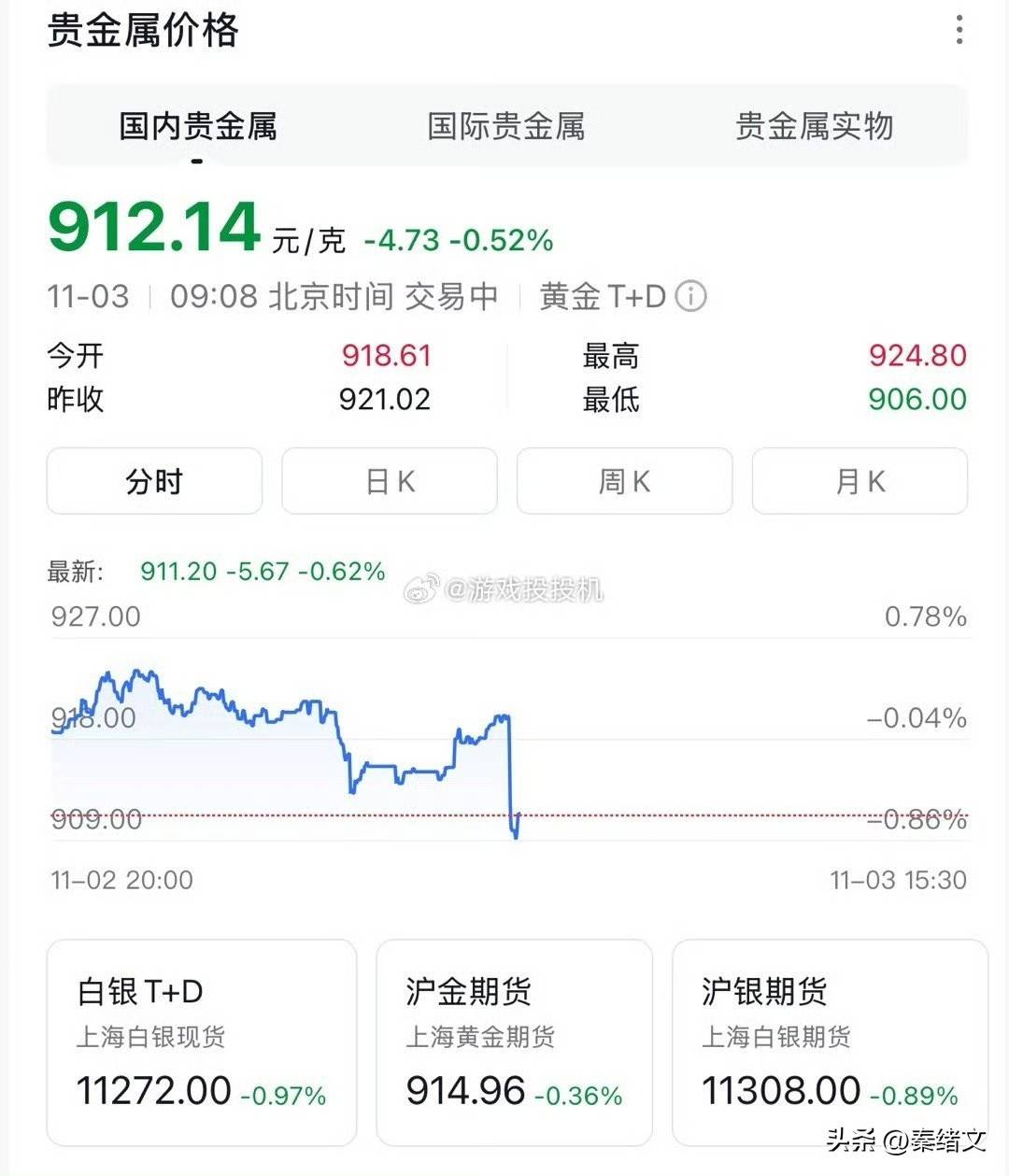
Core Viewpoint - The recent volatility in gold prices has led to significant investor anxiety, with many experiencing losses after buying at high prices, while others are considering buying at lower levels as prices drop [1][2]. Group 1: Price Fluctuations - Gold prices have recently experienced dramatic fluctuations, with Shanghai gold hitting a low of 906 CNY per gram and London gold dropping to around 3962 USD per ounce, significantly down from earlier highs [1]. - The rapid price changes have left many investors in distress, particularly those who bought gold at higher prices, leading to widespread complaints about being "stuck" with their investments [1][3]. Group 2: Market Drivers - The core logic behind the changing gold prices is a battle between supply and demand, as well as shifts in risk sentiment among investors [2]. - Factors such as potential global economic recovery or easing geopolitical tensions could lead to a further decline in gold prices, especially if the Federal Reserve maintains high interest rates [2][4]. Group 3: Investment Strategies - Investors are advised to differentiate between essential purchases (like wedding jewelry) and investment opportunities, with the latter requiring careful consideration of market conditions [5]. - It is suggested that investors allocate a modest portion of their assets (no more than 10%) to gold, avoiding high-risk strategies like leverage or full investment [5][6]. Group 4: Long-term Outlook - The ongoing accumulation of gold by central banks, particularly in China, provides a long-term support for gold prices, despite potential short-term corrections [4]. - Predictions indicate a possible 42% increase in gold prices by 2025, although short-term volatility remains a concern [4].

美联储如期降息25bp,关注金铜铝优质标的:——金属&新材料行业周报20251027-20251031-20251102
Shenwan Hongyuan Securities· 2025-11-02 10:29
Investment Rating - The report maintains a positive investment rating for the metals and new materials industry, highlighting strong performance in various sub-sectors [3][4]. Core Insights - The report indicates that the overall performance of the metals sector has outperformed the broader market, with the non-ferrous metals index rising by 75.90% year-to-date, surpassing the CSI 300 index by 57.96 percentage points [4][8]. - Key drivers for the sector include a favorable supply-demand balance, particularly in energy metals and lithium, which have seen significant price increases [3][8]. - The report suggests that the recent interest rate cuts by the Federal Reserve may lead to upward adjustments in valuation multiples across the sector, particularly for companies with stable supply-demand dynamics [3][8]. Weekly Market Review - The Shanghai Composite Index increased by 0.11%, while the Shenzhen Component Index rose by 0.67%. The non-ferrous metals index increased by 2.56%, outperforming the CSI 300 by 2.99 percentage points [4][6]. - Precious metals saw a slight increase of 0.61%, while aluminum prices rose by 4.25%, and energy metals surged by 6.31% [3][8]. - Year-to-date performance shows significant gains across various metals, with copper up 96.09% and lithium carbonate prices increasing by 8.67% [8][12]. Price Changes and Key Company Valuations - The report details price changes for key metals, with copper prices at $10,888 per ton, reflecting a 24.17% increase year-on-year, while aluminum prices are reported at $21,300 per ton, up 7.68% year-on-year [13][15]. - The report provides valuations for key companies in the sector, indicating that companies like Zijin Mining and Shandong Gold have favorable price-to-earnings (PE) ratios, suggesting potential for growth [15][16]. Supply and Demand Dynamics - The report highlights that domestic social inventory of copper has increased slightly to 183,000 tons, while overall exchange inventories rose to 573,000 tons [22]. - The operating rates for copper processing facilities show a slight decline, indicating potential supply constraints in the near term [22][33]. - The aluminum sector is experiencing a tight supply-demand balance, with operating rates for downstream processing slightly decreasing [33]. Recommendations - The report recommends focusing on companies with integrated operations and those showing cost improvement potential, such as China Aluminum and Zhongjin Lingnan Nonfemet Company [3][8]. - It also suggests monitoring companies in the renewable energy manufacturing sector, which are expected to benefit from the ongoing transition towards sustainable energy solutions [3][8].
金价,大反弹!
Mei Ri Jing Ji Xin Wen· 2025-10-29 11:58
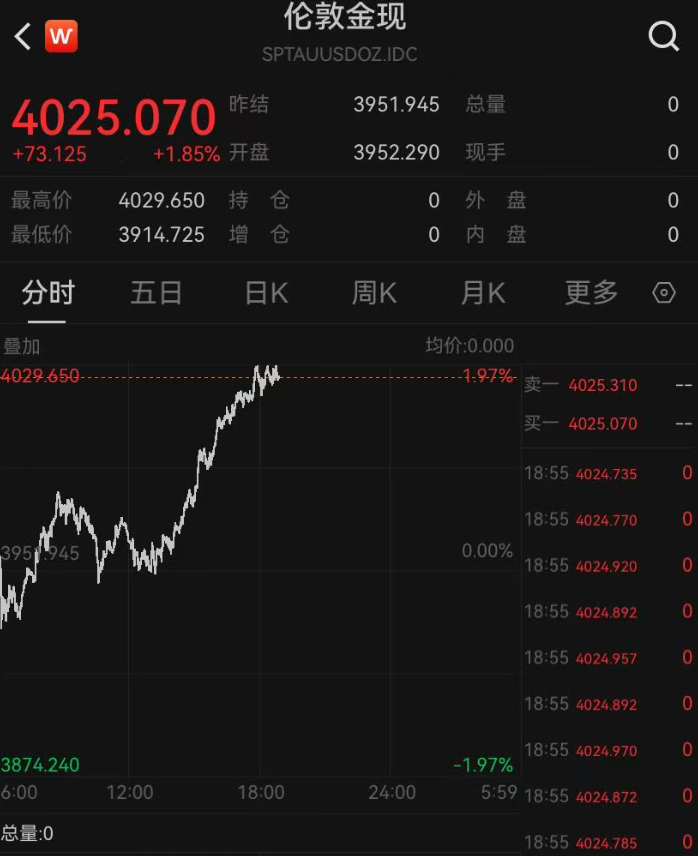
Core Insights - After a period of decline, international gold prices surged on October 29, with spot gold rising by 1.85% to $4025 per ounce and COMEX futures increasing by 1.49% to $4042 per ounce [1][5]. Gold Market Dynamics - The recent drop in gold prices was characterized as a "big plunge," with prices falling below $3900 on October 28. Domestic gold jewelry prices also saw significant reductions, with some brands dropping below 1190 yuan per gram [5]. - Analysts attribute the recent decline in gold prices to profit-taking by investors following a substantial previous increase, easing concerns over international trade tensions, and a rise in investor risk appetite [5][6]. - Market analysts suggest that the recent price adjustments are more about emotional corrections rather than fundamental shifts, indicating a potential for future price recovery [6]. Future Price Predictions - Representatives at the London Bullion Market Association (LBMA) annual meeting forecasted that gold prices could reach $4980 per ounce within the next 12 months, representing an increase of over 25% from current levels [6]. - A significant portion of LBMA representatives (40%) believe that gold will be the best-performing asset in the precious metals sector by 2026 [6]. - Major banks, including Bank of America and HSBC, have set gold price targets at $5000 per ounce for the following year, viewing recent price declines as healthy adjustments and investment opportunities [6]. Central Bank Demand - Over the past three years, global central bank demand for gold has increased by over 1000 tons, although most purchases have been concentrated among a few central banks [7]. - Analysts expect that as more central banks join the trend of gold purchases, this demand will provide long-term support for gold prices [7].
金价历史性时刻将至!月底或将逼近2013年高点,请密切关注
Sou Hu Cai Jing· 2025-10-28 18:05
Core Insights - The current gold price is approaching historical highs, with recent trading around 552.66 yuan per gram, significantly higher than the 2013 peak of approximately 355 yuan per gram [3][4][5] - The increase in gold prices is driven by three main factors: central bank purchases, lower interest rates from the Federal Reserve, and heightened demand for safe-haven assets due to geopolitical tensions [4][5] Gold Price Comparison - The peak gold price in 2013 was around 355 yuan per gram, with significant buying activity occurring between 260 and 320 yuan per gram [3] - As of May 20, 2024, the gold price reached 574.11 yuan per gram, indicating a rise of nearly 230 yuan per gram compared to the highest buying price during the 2013 surge [3][4] Market Dynamics - The current gold price surge is characterized by institutional demand, primarily from central banks, contrasting with the retail-driven buying frenzy of 2013 [4][5] - Central banks globally purchased 1,037 tons of gold in 2023, with China increasing its reserves to 7,329 million ounces by the end of 2024 [3][4] Investment Considerations - Investors are advised to monitor official data from the Shanghai Gold Exchange and the World Gold Council for accurate market trends [6] - For essential purchases, such as jewelry or gold bars, timing the market is less critical, while speculative investments in gold should be approached with caution due to potential volatility [6] - It is recommended to differentiate between physical gold and complex financial products like gold futures, which carry higher risks [6]
金价,跌破3900美元!专家提醒:黄金不是暴富工具
凤凰网财经· 2025-10-28 14:08
Core Viewpoint - Recent declines in international gold prices have led to significant losses for many investors, particularly inexperienced ones, highlighting the risks associated with gold investment during volatile market conditions [1][4][5]. Group 1: Gold Price Trends - On October 28, spot gold prices fell by 2.18%, closing at $3898.9 per ounce, down over 10% from the high of $4381 per ounce on October 21 [1]. - COMEX gold futures showed a decline of 2.48%, with a trading volume of 119,600 contracts [2]. - Major jewelry retailers in China adjusted their gold prices, with Chow Tai Fook reducing its price to 1198 yuan per gram, a decrease of 25 yuan, and Luk Fook dropping to 1189 yuan per gram, down 34 yuan [2][3]. Group 2: Investor Experiences - Many inexperienced investors, particularly university students, have reported significant losses due to the recent drop in gold prices, often using funds from their living expenses [4][5]. - A student shared that after initially profiting from gold investments, they faced losses after buying more gold as prices rose, demonstrating a lack of understanding of market dynamics [8][9]. Group 3: Market Analysis and Predictions - Analysts attribute the recent gold price decline to three main factors: changes in the macroeconomic environment, technical selling pressure due to overbought conditions, and fluctuations in the U.S. dollar and treasury yields [10][11]. - Despite short-term bearish predictions, many institutions maintain a long-term bullish outlook on gold, with forecasts suggesting potential price targets of $5000 per ounce in the future [11][12]. - Experts advise against treating gold as a get-rich-quick scheme and recommend strategies such as dollar-cost averaging and setting stop-loss limits for risk management [13].