
PMI

Search documents
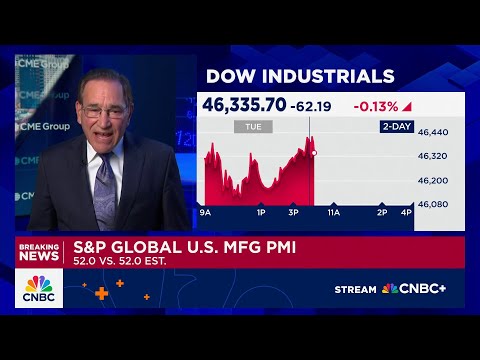
S&P Global U.S. manufacturing PMI comes in as expected
CNBC Television· 2025-10-01 14:13
Wow. Meanwhile, getting a little bit of a bid after a lower open. Dow's down about 37.ISM's coming out of the top of the hour. First though, some manufacturing PMIs from S&P Global. Let's get to Rick Santelli.Hey Rick. >> Yes, Carl. These are the September final reads on S&P uh Global's manufacturing PMIs.The midmon read for September was 52. It remains at 52. This will be the lightest going back to July when it was a bit under 50.And July is the only month this year that is below 50. We did see ADP come in ...

DeepSeek大模型V3.2亮相,多地暂停汽车以旧换新补贴 | 财经日日评
吴晓波频道· 2025-10-01 00:30
Group 1: Manufacturing and Economic Indicators - In September, China's manufacturing PMI rose to 49.8%, an increase of 0.4% from the previous month, indicating slight recovery in the manufacturing sector driven by production, while demand remains sluggish [2] - Large enterprises reported a PMI of 51.0%, up 0.2%, while medium and small enterprises showed PMIs of 48.8% and 48.2%, respectively, indicating mixed performance across different enterprise sizes [2] - The non-manufacturing business activity index fell to 50.0%, with the construction sector slightly improving to 49.3% and the service sector declining to 50.1% [2][3] Group 2: Foreign Direct Investment in Egypt - Egypt's FDI inflow reached $46.1 billion, ranking 9th globally, up from 32nd in 2023, and it has become Africa's top FDI destination for three consecutive years, accounting for nearly 49% of the region's total FDI [4] - The introduction of the golden license for foreign investments has attracted significant capital, with many Chinese companies investing in various sectors in Egypt [4][5] - The Egyptian government has implemented favorable policies, such as tax exemptions and zero land rent, to attract foreign investment amid external debt pressures [4] Group 3: Automotive Industry and Subsidy Policies - Several regions in China have suspended their vehicle trade-in subsidy policies, including Jiangsu and Ningbo, as part of a broader trend of dynamic adjustments to these policies [6] - The central government has allocated 690 billion yuan in special bonds to support consumer goods trade-in programs, indicating a controlled approach to subsidy distribution [6][7] Group 4: Real Estate Market Regulations - The Beijing Real Estate Brokerage Association has issued guidelines to regulate real estate brokerage practices, prohibiting malicious price suppression and false listings [8] - Despite the challenges posed by "black brokers," the real estate market in Beijing has shown signs of recovery, with new housing transactions increasing significantly [8][9] Group 5: AI and Technology Developments - DeepSeek's new model, V3.2, has been released, featuring a sparse attention mechanism that enhances efficiency in processing long texts while reducing computational resource consumption [10][11] - OpenAI reported a significant loss of $13.5 billion in the first half of the year, despite generating $4.3 billion in revenue, highlighting the financial challenges faced by leading AI companies [12][13] Group 6: Consumer Goods and Market Trends - Pop Mart's new product series has seen a surge in demand, with some items experiencing price increases of nearly 10 times on secondary markets, indicating strong consumer interest [14][15] - The company faces challenges in maintaining consumer engagement and developing a robust IP content system to sustain interest beyond initial product launches [15] Group 7: Stock Market Performance - The stock market experienced a strong performance with major indices rising, particularly in the semiconductor sector, which benefited from recent technological advancements [16][17] - Overall market sentiment remains positive, with expectations for continued upward movement in the near term [17]

经济总体产出扩张略有加快
Ren Min Ri Bao· 2025-09-30 20:15
Core Insights - The manufacturing Purchasing Managers' Index (PMI) for September is at 49.8%, showing a 0.4 percentage point increase from the previous month, indicating a slight improvement in economic output [1] - The non-manufacturing business activity index stands at 50.0%, down 0.3 percentage points from last month, suggesting stability in the non-manufacturing sector [2] - The comprehensive PMI output index is at 50.6%, reflecting a 0.1 percentage point increase, indicating a slight acceleration in overall economic output [1] Manufacturing Sector - Manufacturing production activities have accelerated, with the production index reaching 51.9%, up 1.1 percentage points, marking a six-month high [1] - The new orders index is at 49.7%, a 0.2 percentage point increase, indicating improved market demand [1] - Key industries such as equipment manufacturing, high-tech manufacturing, and consumer goods are expanding, with PMIs of 51.9%, 51.6%, and 50.6% respectively, all above the manufacturing average [1] Non-Manufacturing Sector - The non-manufacturing business activity index is at 50.0%, indicating stability, while the service sector index is slightly higher at 50.1%, remaining in the expansion zone [2] - Certain industries, including postal, telecommunications, and financial services, have business activity indices above 60.0%, indicating strong growth [2] - However, sectors closely related to consumer spending, such as dining and entertainment, have seen indices drop below the critical point due to the end of the summer season [2] Economic Outlook - The production and operation activity expectation index for manufacturing is at 54.1%, indicating positive market expectations for the near term [2] - Analysts predict that the "year-end effect" and "holiday effect" will boost investment and consumption-related demand, particularly in construction and service sectors [2] - Overall, the macroeconomic environment is expected to continue improving in the fourth quarter, supported by potential policy measures and market confidence [3]
2025年9月PMI数据点评:PMI边际回升:供给推动
Haitong Securities International· 2025-09-30 15:02
Group 1: Manufacturing Sector Insights - In September 2025, the Manufacturing PMI rose to 49.8%, an increase of 0.4 percentage points from the previous month[7] - The production index reached a six-month high at 51.9%, up 1.1 percentage points, indicating active manufacturing activities[13] - New orders index was at 49.7%, showing a slight increase of 0.2 percentage points but still in the contraction zone[13] Group 2: Raw Materials and Pricing - The main raw materials purchasing price index decreased slightly to 53.2%, down 0.1 percentage points, while the factory price index fell to 48.2%, down 0.9 percentage points[19] - The procurement volume index rose to 51.6%, an increase of 1.2 percentage points, indicating accelerated raw material purchases[21] Group 3: Non-Manufacturing Sector Performance - The services business activity index fell to 50.1%, a decrease of 0.4 percentage points, with notable sector differentiation[22] - The construction business activity index was at 49.3%, a marginal increase of 0.2 percentage points, but still below the critical point[26] Group 4: Economic Policy and Risks - The government announced a new policy financial tool worth 500 billion yuan to support project capital, aimed at boosting infrastructure activities[27] - Real estate demand remains weak, posing a risk to overall economic recovery[28]
生产进一步走强——9月PMI数据点评
一瑜中的· 2025-09-30 13:43
Core Viewpoint - The manufacturing PMI for September shows a slight recovery, indicating improved production activity, with the production index rising to 51.9% from 50.8% in the previous month [2][4][11]. Group 1: Production Strengthening - The overall PMI index for September is 49.8%, up from 49.4% in August, primarily driven by a rebound in production [4][9]. - The recovery in production is attributed to stronger performance in the midstream and downstream sectors, with the midstream equipment manufacturing PMI reaching 51.9% and the consumer goods PMI at 50.6% [4][9]. - Factors contributing to this recovery include inventory replenishment and strong external demand, as indicated by a global manufacturing PMI increase to 50.9% in August and a 7.3% year-on-year growth in port container throughput in September [4][9]. Group 2: Data Insights - The September manufacturing PMI is 49.8%, with specific indices showing: production index at 51.9%, new orders index at 49.7%, new export orders index at 47.8%, employment index at 48.5%, and raw material inventory index at 48.5% [2][11]. - The price index shows a decline, with the PMI output price index at 48.2%, continuing below the neutral line for 16 consecutive months [3][12]. - The construction sector's PMI is at 49.3%, indicating a slight increase from the previous month but still below last year's level, while the service sector remains in the expansion zone with a PMI of 50.1% [3][14]. Group 3: Expectations and Comprehensive Output - The manufacturing activity expectation index rose to 54.1% in September, reflecting increased confidence among businesses, particularly in sectors like food processing and automotive [3][14]. - The comprehensive PMI output index for September is 50.6%, indicating continued expansion in production activities across sectors [3][14].

生产进一步走强——9月PMI数据点评
Huachuang Securities· 2025-09-30 12:51
Group 1: PMI Overview - The manufacturing PMI for September is 49.8%, an increase from the previous value of 49.4%[2] - The production index within the PMI rose to 51.9%, up 1.1 percentage points from 50.8%[4] - The new orders index is at 49.7%, slightly up from 49.5%[10] Group 2: Sector Performance - The midstream equipment manufacturing PMI reached 51.9%, significantly better than the previous 50.5%[4] - The consumer goods PMI improved to 50.6%, compared to 49.2% previously[4] - The construction industry PMI is at 49.3%, a 0.2 percentage point increase from last month but lower than last year's 50.7%[3] Group 3: Price and Inventory Trends - The PMI factory price index fell to 48.2%, down from 49.1%, marking 16 consecutive months below the boom-bust line[11] - The main raw materials purchase price index is at 53.2%, slightly down from 53.3%[11] - The finished goods inventory index increased to 48.2%, up 1.4 percentage points from the previous month[4] Group 4: Expectations and Future Outlook - The manufacturing activity expectation index rose to 54.1%, up from 53.7%[3] - The comprehensive PMI output index is at 50.6%, indicating continued expansion in production activities[10]
景气连升,结构性扰动仍存:——9月制造业PMI点评
Huachuang Securities· 2025-09-30 12:45
1. Report Industry Investment Rating - Not provided in the given content 2. Core Viewpoints of the Report - In September 2025, with the addition of the traditional "Golden September" peak season, the PMI slightly rebounded below the boom - bust line, but the recovery was still mild, and structural contradictions remained. The production in September drove the PMI to rise by 0.28pct, followed by the employees, while the demand and material inventory contributed less than 0.1pct. The production - new order gap widened, and the PMI increase was weaker than the average in September since 2022, falling short of the seasonality. The economic recovery foundation needs to be strengthened, and the 50 billion yuan policy - based financial instruments may be the key to "break the situation" [6][12]. - For the bond market, the PMI has been below the boom - bust line for 6 consecutive months. The market has fully anticipated the weak data. In the fourth quarter, new policy - based financial instruments will take effect. Attention should be paid to whether data such as new orders are "better than expected". The downstream construction and project expenditures may speed up in the fourth quarter, which may drive the performance of the mid - stream manufacturing industry. Attention should also be paid to whether the PMI can exceed the seasonal level and return above the boom - bust line [6][13]. 3. Summary According to the Directory I. Manufacturing PMI: Moderately Upward, Elasticity Awaits Policy Boost (1) Supply and Demand: The Supply - Demand Gap May Widen Again - New orders increased by 0.2pct month - on - month to 49.7%. The impact of high temperature and heavy rain faded, and exports showed resilience, but the intensity of demand recovery was still insufficient as the increase in September was the lowest since 2022 [2][16]. - Production increased by 1.1pct month - on - month to 51.9%, being the largest contributor to PMI improvement. The production peak season was realized, and the procurement volume and production and operation activity expectation index increased. The "production - new order" gap widened to 2.2pct, the highest since the beginning of the year, and the supply - demand differentiation intensified [2][20]. (2) Foreign Trade: New Export Orders Rebound Faster - New export orders increased by 0.6pct month - on - month to 47.8%, and imports increased by 0.1pct to 48.1%. In September, due to the Christmas product export peak season and the demand from non - US economies, exports were stable, and port freight volume remained high. The increase in new export orders in September exceeded that in August and was better than the overall new orders, showing export resilience [24]. - Imports continued the slight upward trend and were at a high level in the same period, indicating that enterprises' demand for import stocking was strong [25]. (3) Price: The Pressure of Price Decline Reappears - In September, the purchase price of raw materials and the ex - factory price decreased by 0.1pct and 0.9pct month - on - month to 53.2% and 48.2% respectively. The supply and demand of the basic raw material industry declined, dragging down the price index, while the prices of industries such as equipment manufacturing improved, showing a large industry differentiation [3][29]. (4) Inventory: Slow Destocking, Active Production, and a Sharp Increase in Product Inventory - In September, the raw material inventory index increased by 0.5pct to 48.5% due to the increase in procurement volume. However, the downstream demand destocking was slow, and the production expanded actively, resulting in a 1.4pct increase in finished product inventory to the highest level in the same period, showing the characteristic of "passive inventory accumulation" [3][31]. II. Non - Manufacturing PMI: The Construction Industry Continues to Be in Low - level Prosperity, Awaiting Policy Effect - In September, the non - manufacturing PMI was 50.0%, a month - on - month decrease of 0.3pct. The service industry PMI decreased by 0.4pct to 50.1%, and the construction industry PMI increased by 0.2pct to 49.3%, remaining below the boom - bust line [36]. - The construction industry expansion was still weak. The business activity indexes of housing construction and civil engineering construction were below 50%. The lack of new orders was the main factor restricting construction. The 50 billion yuan policy - based financial instruments may accelerate the investment rhythm in the fourth quarter and help the construction industry PMI recover [4][36]. - The service industry's prosperity declined in the off - season. After the summer vacation, tourism consumption entered the off - season. The approaching National Day holiday is expected to drive the improvement of travel service consumption [4][36].
宏观景气度系列九:9月景气改善,政策效应显现
Hua Tai Qi Huo· 2025-09-30 11:49
Report Industry Investment Rating - Not provided in the content Core Views Manufacturing PMI - Supply: Manufacturing production picked up. In September, the production index was 51.9, up 1.1 from the previous month, and the supplier delivery time index was 50.8, up 0.3 from the previous month [3]. - Demand: Manufacturing demand rebounded. In September, the new order index was 49.7, up 0.2 from the previous month; the new export order index was 47.8, up 0.6 from the previous month; and the back - order index was 45.2, down 0.3 from the previous month [3]. - Supply - demand balance: The supply - demand relationship needs improvement. In September, the supply - demand index (demand - supply) was - 2.2, down 0.9 from the previous month, down 0.9 from the same period last year, and down 0.5 from the average of the past three years [3]. - Price: Manufacturing profitability contracted. In September, the raw material price index was 53.2, down 0.1 from the previous month; the ex - factory price index was 48.2, down 0.9 from the previous month. The difference between ex - factory price and raw material price was - 5.0, down 0.8 from the previous month [3]. - Inventory: De - stocking slowed down. In September, the finished goods inventory index was 48.2, up 1.4 from the previous month; the raw material inventory index was 48.5, up 0.5 from the previous month. The difference between new orders and finished goods inventory was 1.5, down 1.2 from the previous month [3]. Non - manufacturing PMI - Supply: Non - manufacturing employment slowed down. In September, the employment index was 45, down 0.6 from the previous month; among them, the construction industry was 39.7, down 3.9 from the previous month, and the service industry was 45.9, unchanged from the previous month. The supplier delivery time index was 51.1, down 0.2 from the previous month [4]. - Demand: Non - manufacturing domestic demand declined. In September, the new order index was 46, down 0.6 from the previous month; among them, the construction industry was 42.2, up 1.6 from the previous month, and the service industry was 46.7, down 1.0 from the previous month. The new export order index was 49.8, up 1.0 from the previous month, and the back - order index was 44.4, up 1.0 from the previous month [4]. - Price: Non - manufacturing industries exchanged price for volume. In September, the input price index was 49, down 1.3 from the previous month; among them, the construction industry was 47.2, down 7.4 from the previous month, and the service industry was 49.3, down 0.2 from the previous month. The sales price index was 47.3, down 1.3 from the previous month; among them, the construction industry was 48.1, down 1.6 from the previous month, and the service industry was 47.2, down 1.3 from the previous month [4]. - Inventory: De - stocking continued. In September, the inventory index was 44.9, down 0.8 from the previous month and down 0.2 from the same period last year [5] Summary by Directory Overview - Manufacturing PMI: Manufacturing sentiment improved, and enterprise production expansion accelerated. In September, the manufacturing PMI was 49.8, up 0.4 percentage points from the previous month [11]. - Non - manufacturing PMI: The non - manufacturing business activity index was 50.0, down 0.3 percentage points from the previous month, and the composite PMI output index was 50.6, up 0.1 percentage points from the previous month [11]. Demand: Manufacturing Demand Improved, Non - manufacturing Demand Weakened - Manufacturing: Driven by the continuous release of policies such as the "Two New" policies, in September, the new order index was 49.7, up 0.2 from the previous month; the new export order index was 47.8, up 0.6 from the previous month; and the back - order index was 45.2, down 0.3 from the previous month [19]. - Non - manufacturing: In September, the new order index was 46, down 0.6 from the previous month, indicating a continued contraction in non - manufacturing order demand. The new export order index was 49.8, up 1.0 from the previous month, indicating a recovery in export demand. The back - order index was 44.4, up 1.0 from the previous month, indicating an accumulation of existing orders [19]. Supply: Manufacturing Production Recovered, Non - manufacturing Sentiment Declined - Manufacturing: In September, the production index was 51.9, up 1.1 from the previous month; the production and business activity expectation index was 54.1, up 0.4 from the previous month; the supplier delivery time index was 50.8, up 0.3 from the previous month; and the employment index was 48.5, up 0.6 from the previous month [23]. - Non - manufacturing: In September, the employment index was 45, down 0.6 from the previous month; the supplier delivery time index was 51.1, down 0.2 from the previous month; and the business activity expectation index was 55.7, down 0.5 from the previous month [23]. Price: Manufacturing Profitability Contracted, Non - manufacturing Price Cuts Continued - Manufacturing: In September, the raw material price index was 53.2, down 0.1 from the previous month; the ex - factory price index was 48.2, down 0.9 from the previous month; and the difference between ex - factory price and raw material price was - 5.0, down 0.8 from the previous month [31]. - Non - manufacturing: In September, the input price index was 49, down 1.3 from the previous month; the sales price index was 47.3, down 1.3 from the previous month [31]. Inventory: Manufacturing De - stocking Slowed Down, Non - manufacturing De - stocking Continued - Manufacturing: In September, the finished goods inventory index was 48.2, up 1.4 from the previous month; the raw material inventory index was 48.5, up 0.5 from the previous month; and the difference between new orders and finished goods inventory was 1.5, down 1.2 from the previous month [39]. - Non - manufacturing: In September, the inventory index was 44.9, down 0.8 from the previous month and down 0.2 from the same period last year [39]. - Comprehensive: In September, the composite PMI index was 50.6, up 0.1 from the previous month and up 0.2 from the same period last year, indicating an improvement in overall economic sentiment [39]
宏观点评:9月PMI季节性回升的背后-20250930
GOLDEN SUN SECURITIES· 2025-09-30 11:47
Group 1: PMI Overview - In September 2025, the manufacturing PMI rose to 49.8%, up 0.4 percentage points from the previous value of 49.4%, but still in the contraction zone[2] - The non-manufacturing PMI fell by 0.3 percentage points to 50.0%, indicating a slight decline in service sector activity[2] - The composite PMI output index increased by 0.1 percentage points to 50.6%, suggesting a slight acceleration in overall economic expansion[2] Group 2: Supply and Demand Signals - The supply side showed improvement with the production index at 51.9%, up 1.1 percentage points, remaining in the expansion zone for five consecutive months[3] - The new orders index rose by 0.2 percentage points to 49.7%, indicating continued contraction, but new export orders increased by 0.6 percentage points[3] - The September export order index rose to 47.8%, while the import order index slightly increased to 48.1%[3] Group 3: Price and Inventory Trends - The price indices for raw materials and factory prices fell by 0.1 and 0.9 percentage points respectively, indicating a potential narrowing of PPI declines[4] - Inventory levels increased, with raw material and finished goods inventories rising by 0.5 and 1.4 percentage points respectively, likely due to production recovery[4] Group 4: Employment and Sector Performance - The PMI for large and small enterprises improved, with employment pressure easing slightly as the manufacturing, service, and construction employment indices changed by 0.6, 0.0, and -3.9 percentage points respectively[4] - The service sector PMI decreased by 0.4 percentage points to 50.1%, reflecting ongoing consumer pressure, particularly in retail and entertainment sectors[6] Group 5: Economic Outlook and Policy Implications - The report suggests a need for timely policy support as economic pressures continue to mount, particularly in consumption and real estate sectors[6] - Key upcoming events include the National Day and the Fourth Plenary Session in October, which may influence policy decisions[6] - The central bank may restart government bond purchases and is likely to cut interest rates in Q4, with fiscal measures expected to be implemented earlier than planned[6]
9月PMI,生产旺、价格跌
HUAXI Securities· 2025-09-30 11:39
Manufacturing Sector - The manufacturing PMI for September is 49.8%, slightly above the expected 49.7% and up from the previous 49.4%[1] - Manufacturing production increased by 1.1 percentage points to 51.9%, while new orders rose by 0.2 percentage points to 49.7%[1] - The average changes in production and new orders from 2016 to 2024 (excluding 2020/2022) were +0.24 and +0.41 percentage points, respectively[1] Price Trends - Manufacturing prices fell for the second consecutive month, with the factory price index decreasing by 0.9 percentage points to 48.2%[2] - The raw material purchase price index saw a minor decline of 0.1 percentage points to 53.2%, remaining in the expansion zone[2] - Non-manufacturing prices in the construction and service sectors dropped by 1.6 and 1.3 percentage points to 48.1% and 47.2%, respectively[2] Economic Signals - There are positive signs as manufacturing enterprises increased procurement by 1.2 percentage points to 51.6%, the highest since April[3] - New export orders in manufacturing rose by 0.6 percentage points to 47.8%, marking the highest level since April[3] - The construction sector's business activity index slightly rebounded by 0.2 percentage points to 49.3%, but new orders remained low at 42.2%[4] Overall Economic Outlook - The composite PMI for September is 50.6%, a slight increase of 0.1 percentage points from August, indicating stable economic performance[5] - The average composite PMI for Q3 is 50.43%, consistent with Q2 and better than Q3 of the previous year[5] - Future monetary policy adjustments may depend on Q3 GDP growth, with a potential for easing if growth falls below 4.7%[5]