
广义财政支出

Search documents
2025年1~7月财政数据点评:公共财政收支增速差收窄
BOHAI SECURITIES· 2025-08-20 13:59
Revenue Analysis - In the first seven months of 2025, the national general public budget revenue reached CNY 135,839 billion, with a year-on-year growth of 0.1%[3] - Tax revenue showed a narrowing decline, with individual income tax increasing by 8.8%, significantly higher than the overall tax growth rate[3] - Non-tax revenue growth slowed down compared to the previous months, indicating challenges in asset management by local governments[3] Expenditure Analysis - Public fiscal expenditure for the same period was CNY 160,737 billion, reflecting a year-on-year increase of 3.4%[4] - Social security and employment expenditures grew by 9.8%, highlighting a focus on livelihood over infrastructure[4] - Infrastructure spending continued to decline, with negative growth in urban and rural community investments[4] Government Fund Performance - Government fund revenue decreased by 0.7%, while expenditures surged by 31.7%, primarily due to accelerated disbursement of special bonds[5] - The overall broad fiscal expenditure (public fiscal expenditure + government fund expenditure) increased by 9.3% year-on-year[5] Fiscal Progress - By July 2025, the national general public budget revenue completion rate was 61.8%, below the five-year average of 63.5%[3] - Public fiscal expenditure completion rate stood at 54.1%, also lower than the five-year average of 54.7%[4] Risk Factors - Economic environment changes could significantly impact tax revenue bases, while unexpected policy changes may alter fiscal expenditure patterns[6]
7月财政数据点评:化债后的财政力度
Changjiang Securities· 2025-08-20 06:42
Fiscal Performance - General fiscal expenditure cumulative year-on-year growth reached 9.3%, aligning with the annual budget level[3] - General fiscal revenue for January to July was 13.6 trillion yuan, a year-on-year increase of 0.1%, while expenditure was 16.1 trillion yuan, up 3.4%[6] - In July, general fiscal revenue increased by 3.4% year-on-year, while expenditure decreased by 12.4%[9] Revenue and Taxation - Tax revenue has shown positive year-on-year growth for four consecutive months, with July's tax revenue increasing by 4.6%[9] - Major tax categories such as VAT, consumption tax, corporate income tax, and personal income tax grew by 4.3%, 5.4%, 6.4%, and 13.9% respectively[9] - Non-tax revenue saw a decline, with July's non-tax revenue down 12.4% year-on-year[9] Expenditure Trends - Social security, health, and education expenditures increased significantly, with year-on-year growth rates of 13.1%, 14.2%, and 4.6% respectively[9] - Infrastructure spending has been reduced, with traditional infrastructure sectors showing negative growth[9] - Debt interest payments rose to 8.9% year-on-year, indicating increasing pressure on debt management[9] Land Sales and Special Bonds - Land sale revenue continued to show positive growth, increasing by 7% year-on-year, supported by active land market transactions[9] - Special bonds and specific government bonds have significantly bolstered fund expenditures, with fund spending growing by 31.7% year-on-year[9] Government Debt and Future Outlook - The front-loading of government debt has boosted fiscal expenditure, but expectations for economic stability still require fiscal support[9] - Excluding capital injections and debt relief funds, general fiscal expenditure growth would drop from 9.3% to 2.9%[9] - The net financing of government debt is expected to decrease in the second half of the year, impacting local government cash flow and economic indicators[9]
2025年7月财政数据解读:广义财政收入回暖,支出增速加快上行
Yin He Zheng Quan· 2025-08-19 13:13
Group 1: Fiscal Revenue Trends - In the first seven months of 2025, the total revenue growth rate for the fiscal accounts was 0%, improving from -0.6% in the previous period[2] - The total expenditure growth rate was 9.3%, up from 8.9%, marking the highest level since September 2022[2] - Tax revenue showed a recovery with a monthly growth rate of 5%, compared to 1% in the previous month, while non-tax revenue fell to 2% from 3.7%[5] Group 2: Key Revenue Components - Stamp duty revenue increased significantly by 20.7%, with securities transaction stamp duty surging by 62.5%[15] - The number of new A-share accounts opened in July reached 1.9636 million, a 71% increase year-on-year[15] - Land transfer revenue in July was 267.9 billion yuan, down from 299 billion yuan, with a cumulative growth rate of -4.6%[18] Group 3: Expenditure Insights - The cumulative expenditure growth rate for the first seven months was 3.4%, with a monthly growth rate of 3%[21] - Special bond issuance accelerated, with a cumulative expenditure growth rate of 31.7% for the second fiscal account, reaching 42.4% in July[22] - The total issuance of special local government bonds was 2.78 trillion yuan, with a progress rate of 63.1%[22] Group 4: Risks and Future Outlook - Risks include potential underperformance in domestic economic recovery, policy implementation, and a significant downturn in the real estate market[26] - The sustainability of revenue growth is uncertain, particularly if budgetary income weakens alongside declining land revenue, which may lead to increased national debt issuance in Q4 2023[1]
7月税收收入同比增长5%,增速明显改善背后是这些原因
2 1 Shi Ji Jing Ji Bao Dao· 2025-08-19 10:16
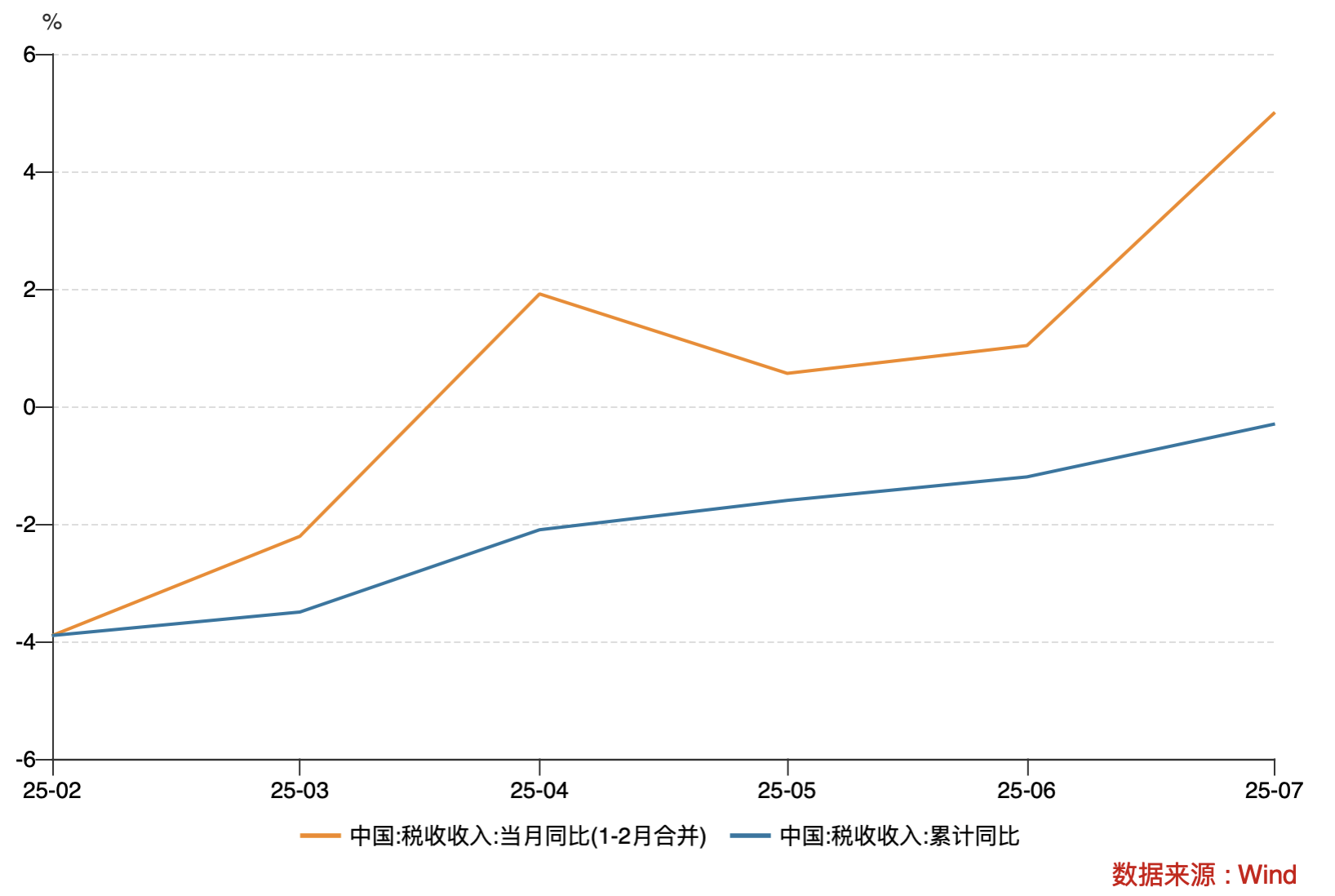
Core Insights - The Ministry of Finance reported that from January to July, the national general public budget revenue reached 13.58 trillion yuan, a year-on-year increase of 0.1%, marking the first positive growth in revenue for the year [1] - Tax revenue totaled 11.09 trillion yuan, a slight decline of 0.3% year-on-year, while non-tax revenue increased by 2% to 2.49 trillion yuan [1] - The recovery in fiscal revenue growth in July was attributed to improved corporate profit expectations and the wealth effect from the rising Shanghai Composite Index [1] Tax Revenue Breakdown - Domestic value-added tax revenue was approximately 4.26 trillion yuan, up 3% year-on-year, indicating stable growth in industrial and service sectors [2] - Corporate income tax revenue was about 3.06 trillion yuan, down 0.4%, reflecting pressure on corporate profits [2] - Import goods value-added tax and consumption tax totaled 1.03 trillion yuan, down 6.1%, consistent with weak import trends [2] - Personal income tax revenue reached 927.9 billion yuan, up 8.8%, supported by stable growth in resident income and improved tax administration [2] - Securities transaction stamp duty revenue was 936 billion yuan, up 62.5%, indicating active capital market trading [2] Monthly Trends - From April onwards, monthly tax revenue has shown continuous positive growth for four consecutive months, with July seeing a significant increase of 5% [2][4] - The cumulative decline in tax revenue narrowed significantly, with a reduction of 0.3% for the first seven months compared to a 1.2% decline in the first half of the year [4] Sector Performance - Key sectors such as equipment manufacturing and modern services showed strong tax revenue performance, with notable increases in specific industries like railway and aerospace equipment [5] - The overall tax revenue performance is expected to improve in the second half of the year, driven by stable economic conditions and active capital markets [6] Government Expenditure - From January to July, national general public budget expenditure reached 16.07 trillion yuan, a year-on-year increase of 3.4%, with significant growth in social security, education, and health expenditures [9] - The issuance of government bonds has accelerated, contributing to a stronger fiscal expenditure environment [9] - The broad fiscal expenditure, combining general public budget and government fund expenditures, grew by 8.9% year-on-year, marking a strong performance [10]

2025年6月财政数据点评:6月财政两本账表现分化,下半年财政政策仍将积极发力
Dong Fang Jin Cheng· 2025-08-04 02:55
Revenue Performance - In June 2025, the national general public budget revenue decreased by 0.3% year-on-year, a decline from May's 0.1%[1] - Tax revenue increased by 1.0% year-on-year, up from 0.6% in May, while non-tax revenue fell by 3.7%, a larger decline than the previous month's 2.2%[5] - For the first half of 2025, general public budget revenue cumulatively decreased by 0.3%, matching the performance from January to May[7] Expenditure Trends - In June 2025, general public budget expenditure grew by 0.4% year-on-year, down from 2.6% in May[1] - Cumulatively, general public budget expenditure increased by 3.4% in the first half of 2025, a slowdown from 4.2% in the previous period[9] - By June, general public budget expenditure completed 47.6% of the annual budget, slightly below the five-year average of 48.1%[9] Government Fund Insights - In June, government fund revenue surged by 20.8% year-on-year, a significant recovery from the previous month's decline of 8.1%[10] - Cumulatively, government fund revenue decreased by 2.4% in the first half of 2025, with land transfer revenue down by 6.5%[10] - Government fund expenditure in June increased by 79.2% year-on-year, driven by accelerated issuance of special bonds[10] Future Fiscal Policy Outlook - The Central Political Bureau meeting indicated that macro policies will continue to be proactive in the second half of 2025, emphasizing the need for increased government bond issuance and improved fund utilization[12] - Potential measures may include raising the fiscal deficit ratio and increasing the issuance of special bonds to stimulate domestic demand and counteract external economic slowdowns[12]
2025年上半年财政数据点评:政府性基金支出增长较快
BOHAI SECURITIES· 2025-07-28 11:22
Revenue Analysis - In the first half of 2025, the national general public budget revenue was 1,155.66 billion yuan, a year-on-year decrease of 0.3%[2] - The national general public budget expenditure was 1,412.71 billion yuan, showing a year-on-year increase of 3.4%[2] - Government fund budget revenue was 194.42 billion yuan, down 2.4% year-on-year[2] Expenditure Insights - Government fund budget expenditure reached 462.73 billion yuan, marking a significant year-on-year increase of 30%[2] - Public finance expenditure growth slowed to 3.4%, with a notable focus on social welfare and technology sectors[3] - Social security and employment expenditures grew by 9.2%, indicating strong support for public welfare[3] Structural Changes - The expenditure structure emphasized "people's livelihood" and "technology," while infrastructure spending continued to decline, with a negative growth rate of 4.5%[3] - The overall broad fiscal expenditure (public finance expenditure + government fund expenditure) increased by 8.9% year-on-year[4] Performance Metrics - The completion rate of the national general public budget revenue for the first half of 2025 was 52.6%, lower than the average of the past five years (53.9%) [3] - The completion rate of public finance expenditure was 47.6%, also below the five-year average of 48.1%[3] Risk Factors - Economic environment changes could significantly impact tax revenue bases[5] - Unexpected policy changes may alter the scale and pace of fiscal expenditures[5]
宏观经济点评:广义财政支出强度大幅提升
KAIYUAN SECURITIES· 2025-07-26 07:18
Revenue Performance - In June, the national general public budget revenue was CNY 18,943 billion, a year-on-year decline of 0.3%[2] - Tax revenue showed marginal improvement, growing by 1% year-on-year, while non-tax revenue decreased by 3.7%[2] - Corporate income tax and consumption tax saw marginal increases, with corporate income tax benefiting from a low base effect[2] Expenditure Trends - Public fiscal expenditure in June was CNY 28,318 billion, growing by only 0.4% year-on-year, down from 2.6% in the previous month[3] - Cumulative expenditure growth for the first half of the year was 3.4%, below the annual target of 4%[3] - Expenditure on science and technology increased by 18%, while infrastructure spending continued to decline, with transportation spending down by 13%[3] Government Fund Dynamics - Government fund revenue in June was CNY 3,959 billion, a year-on-year increase of 20.8%, marking a significant recovery[4] - Land sales revenue rose by 22% year-on-year, contributing to the improved government fund revenue[4] - Government fund expenditure surged by 79% year-on-year in June, driven by accelerated issuance of special bonds[5] Fiscal Deficit Insights - The broad fiscal deficit has widened, but the gap between actual revenue and budgeted revenue has narrowed effectively[6] - The potential fiscal gap for the year is estimated to be no more than CNY 3,000 billion if current revenue growth is maintained[6] - There is a risk of further widening fiscal gaps if revenue growth does not sustain the levels seen in the first half of the year[7]
前5个月广义财政支出超14万亿,财政如何持续发力
第一财经· 2025-06-26 14:59
Core Viewpoint - China's proactive fiscal policy is aimed at promoting stable economic operation, with a significant increase in fiscal spending despite a slight decline in fiscal revenue [1][3]. Fiscal Revenue and Expenditure Overview - In 2025, the broad fiscal revenue is projected to be 11.2 trillion yuan, a year-on-year decrease of approximately 1.3%, while broad fiscal expenditure is expected to reach 14.5 trillion yuan, an increase of about 6.6% [1]. - The fiscal deficit is expected to be 3.3 trillion yuan, a year-on-year increase of 46.5%, which will be compensated through government borrowing [1][11]. Tax Revenue Analysis - The general public budget revenue for the first five months of the year is 9.7 trillion yuan, showing a slight decline of 0.3% year-on-year, with tax revenue at 7.9 trillion yuan, down 1.6% [3][4]. - The decline in tax revenue is attributed to multiple factors, including difficulties faced by some enterprises and a sluggish real estate market [4][6]. Non-Tax Revenue Trends - Non-tax revenue for the general public budget increased by 6.2% year-on-year to 1.7 trillion yuan, although it showed a decline in May compared to the same period last year [4][6]. Government Bond Issuance - To maintain fiscal spending, the government has accelerated the issuance of government bonds, with 6.29 trillion yuan issued in the first five months, a year-on-year increase of 38.5% [7][8]. Fiscal Spending Focus - Fiscal spending in the first five months reached 11.3 trillion yuan, a year-on-year increase of 4.2%, with significant allocations towards social security, employment, and education [8][10]. - The central government has expedited transfer payments to local governments to support basic livelihood guarantees [8]. Future Fiscal Policy Directions - The government plans to implement additional fiscal policies as needed, particularly in the second half of the year, to meet economic development goals [11][12]. - There is an emphasis on establishing a childcare subsidy system and addressing investment shortfalls through new policy financial tools [12].
2025年5月财政数据快评:收支两端同时走弱,财政力度指数回落
Guoxin Securities· 2025-06-21 12:09
Revenue Insights - National general public budget revenue for January to May 2025 was CNY 96,623 billion, a year-on-year decrease of 0.3%[2] - Tax revenue for the same period was CNY 79,156 billion, down 1.6% year-on-year, while non-tax revenue increased by 6.2% to CNY 17,467 billion[2] - In May, general public budget revenue showed a slight increase of 0.1% year-on-year, down from 1.9% in the previous month[3] Expenditure Trends - General public budget expenditure reached CNY 112,953 billion from January to May 2025, reflecting a year-on-year growth of 4.2%[2] - In May, general public expenditure growth slowed to 2.6%, down from 5.8% in the previous month[13] - Infrastructure-related expenditure saw a significant decline, with a year-on-year decrease of 7.7% in May, compared to a previous increase of 2.2%[14] Fiscal Policy Analysis - The fiscal policy strength index fell for the first time in 2025, indicating a simultaneous weakening of revenue and expenditure[4] - The broad expenditure growth rate was 4% in May, a sharp decline from 12.9% previously, while broad revenue growth was -1.2%, down from 2.7%[25] - Government fund budget revenue turned negative in May, with a year-on-year decrease of 8.1%, primarily due to a 14.6% drop in land transfer income[20]
上海财经大学校长刘元春:4月经济数据彰显韧性,政策评估与展望需多维考量
Zheng Quan Shi Bao Wang· 2025-05-21 11:31
Group 1 - The core viewpoint is that recent economic indicators for April demonstrate the resilience of China's economy, with some data exceeding market expectations, particularly an 8.1% year-on-year increase in goods exports in USD terms [1] - Despite a decline in exports and imports with the US by 21% and 13% respectively, exports to non-US regions have significantly increased, indicating a need to reassess the impact of tariffs on the economy in May and June [1] - The expectation for further policy easing may need to be re-evaluated based on the stable growth in production and demand, contrary to previous market expectations of economic pressure [1] Group 2 - The next phase will see more proactive fiscal policies and moderately loose monetary policies, with a focus on stabilizing the domestic economic cycle, particularly through the real estate market [2] - From January to April, general public budget expenditure increased by 4.6%, while government fund budget expenditure rose by 17.7%, indicating a broad fiscal expenditure growth of over 7% [2] - The adjustment of micro-policies is crucial, as current low price phenomena are influenced not only by supply relations but also by the micro-market environment and pricing systems [2] Group 3 - The expansion of domestic demand strategy should focus on structural adjustments rather than just short-term stimulus, requiring a shift in understanding macro policies from crisis management to mid-term structural adjustments [3] - A better understanding of the relationship between policy choices, coordination of macro and micro policies, and the balance between short-term policies and mid-term reforms is essential for enhancing economic resilience [3]