收益率曲线

Search documents
外资行美债&汇率2026展望汇总
2025-12-31 16:02
Summary of Key Points from the Conference Call Records Industry Overview - The conference call records focus on the U.S. Treasury market and interest rate outlook for 2026, with insights from various financial institutions including Barclays, HSBC, Morgan Stanley, Deutsche Bank, and Bank of America Merrill Lynch. Core Insights and Arguments U.S. Treasury Market Outlook 1. **Yield Curve Dynamics**: - Barclays predicts a steepening of the yield curve, with 2-year yields expected to drop to 3.1% and 30-year yields remaining around 4.7%, resulting in a 2s30s spread of 160 basis points [6][10]. - HSBC anticipates a bear steepening of the yield curve, projecting a 10-year yield of 4.30% by the end of 2026 [15][19]. - Morgan Stanley suggests that the Fed's rate cuts may be less than market expectations, with a forecast of only 50 basis points of cuts [25][26]. 2. **Federal Reserve Policy**: - The new leadership at the Federal Reserve is expected to adopt a more dovish stance, potentially lowering rates below neutral levels [6][7]. - The Fed is projected to end quantitative tightening (QT) and begin purchasing T-bills to maintain adequate reserves, with an estimated purchase of $330 billion in T-bills in 2026 [10][31]. 3. **Fiscal Deficit and Inflation**: - The fiscal deficit is expected to remain around 6% of GDP, approximately $1.9 trillion, with inflation projected to stabilize around 2% [6][10][25]. - Concerns about inflation resurgence due to fiscal expansion and tariff impacts are highlighted, with core PCE inflation expected to remain above 2% [41][48]. Supply and Demand Dynamics 1. **Net Supply Projections**: - A significant reduction in net supply of U.S. Treasuries is anticipated, with a decrease of approximately $470 billion to $1.2 trillion in 2026 [6][58]. - Investment-grade corporate bonds are expected to see an increase in net supply, driven by mergers and acquisitions [58]. 2. **Market Demand**: - Bank demand for mid-term Treasuries is expected to rebound due to regulatory changes [9]. - Continuous inflows into bond funds are supporting demand, particularly for MBS, which are favored due to their attractive spreads [58][62]. Investment Recommendations 1. **Asset Recommendations**: - Barclays recommends going long on 2-year Treasuries to capitalize on anticipated rate cuts [10]. - HSBC suggests positioning in the belly of the curve (5-year Treasuries) for lower structural risk and positive carry [21]. - Deutsche Bank advises a cautious approach to long-dated Treasuries, predicting underperformance relative to swaps [39]. 2. **Strategic Themes**: - "Carry is king" is emphasized as a core investment strategy, focusing on high-yield bonds and leveraged loans due to their attractive coupon rates in a stable interest rate environment [41][47]. - The potential for a bear steepening of the yield curve is noted, with strategies to exploit this dynamic [21][47]. Other Important Insights - The reports highlight a complex economic landscape characterized by resilient growth, sticky inflation, and the dual risks of fiscal deterioration and inflation rebound [7][17]. - The impact of AI-driven capital expenditures and fiscal stimulus from legislation like the One Big Beautiful Bill Act (OBBBA) is noted as a potential growth driver [41][48]. - The need for caution regarding economic recession risks and policy uncertainties is emphasized, particularly in relation to tariffs and Fed independence [26][37]. This summary encapsulates the key points from the conference call records, providing a comprehensive overview of the U.S. Treasury market outlook and associated investment strategies for 2026.
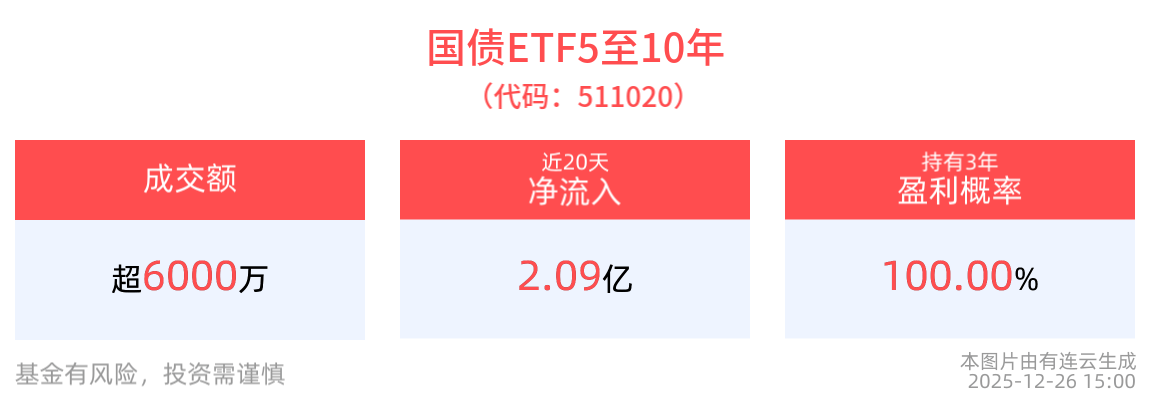
成交额超6000万元,国债ETF5至10年(511020)近20个交易日净流入2.09亿元
Sou Hu Cai Jing· 2025-12-29 01:51
Group 1 - The current futures IRR level is above 1.7%, slightly higher than funding rates and certificate of deposit rates, indicating that the cost of hedging is not high amid concerns about bond market adjustment risks [1] - Two strategies for national bond futures are suggested: 1) Opportunities in short-end credit spreads under loose funding conditions, such as hedging strategies between short-end credit and medium-term national development bonds with TF/TS; 2) Observing the central bank's bond purchases and easing conditions to identify opportunities for flattening the yield curve as short-end rates decline [1] - For medium to long-term bonds, attention should be paid to the convexity points around 8 years for national development bonds, and around 5 years for medium-term bonds [1] Group 2 - As of December 26, 2025, the active bond index for 5-10 year national bonds increased by 0.03%, while the national bond ETF for the same duration rose by 0.05%, with the latest price at 115.37 yuan [3] - The trading volume for the national bond ETF 5-10 years was 3.28% with a transaction value of 60.14 million yuan, and the average daily transaction over the past month was 794 million yuan [3] - The latest scale of the national bond ETF 5-10 years reached 1.84 billion yuan, with a net outflow of 1.73 million yuan recently, but a total inflow of 20.9 million yuan over the last 20 trading days [3] Group 3 - The national bond ETF 5-10 years has seen a net value increase of 21.17% over the past five years, ranking 32 out of 189 in index bond funds, placing it in the top 16.93% [3] - The fund has recorded a maximum monthly return of 2.58% since inception, with the longest consecutive monthly gains lasting 10 months and a maximum increase of 5.81% [3] - The historical probability of profit over three years is 100%, with a monthly profit probability of 70.39% [3] Group 4 - The maximum drawdown for the national bond ETF 5-10 years in the last six months was 1.09%, with a relative benchmark drawdown of 0.58% [4] - The management fee for the national bond ETF 5-10 years is 0.15%, and the custody fee is 0.05% [4] - The tracking error for the national bond ETF 5-10 years over the last two months was 0.022%, closely tracking the active bond index for 5-10 year national bonds [4]

2026年展望系列六:陡峭的极限和骑乘的边界
China Post Securities· 2025-12-25 10:23
1. Report Industry Investment Rating No information provided. 2. Core Viewpoints of the Report - In 2025, the bond market showed a pattern of "fast bull, slow bear, mainly oscillating", with the 10 - year Treasury bond yield fluctuating between 1.6% - 1.9%. The yield curve changed from bull - steep to bear - flat and then to bear - steep [2][9]. - In 2026, the yield curve is likely to maintain a relatively steep shape, with the short - end being prone to decline and the long - end difficult to fall. The probability of the curve remaining oscillating or slightly bull - steep is higher [3]. - In 2026, the riding strategy is a better choice than simply relying on duration extension. The 5 - year to 4 - year Treasury bond riding strategy is optimal on the current yield curve, with relatively controllable risks [4]. 3. Summary According to the Directory 3.1 1.行情回顾:债市“快牛慢熊”,曲线从牛陡走向熊陡 - In 2025, the bond market experienced a "fast bull, slow bear" and entered an oscillating market. The 10 - year Treasury bond yield oscillated between 1.6% - 1.9%. The short - term bond interest rate first rose and then fell during the year, and the yield curve changed from bull - steep to bear - flat and then to bear - steep [9]. - In Q1, long - term interest rates dropped significantly, short - term interest rates rebounded sharply, and the curve changed from bull - steep to bear - flat; in Q2, the bond market entered a sideways consolidation, and the curve remained relatively flat; in Q3, long - term bond yields rose significantly, short - term fluctuations were limited, and the curve changed from bear - flat to bear - steep; in Q4, the "bear - steep" of the curve was further strengthened [11]. 3.2 2.行情展望:排除长端大幅上行风险,曲线陡峭化或延续 3.2.1 2.1 曲线形态:短端易落长端难下,收益率曲线或延续陡峭 - After the bear - steep, there are three typical trends: bear - flat, bull - steep, and oscillation. In 2026, the curve is most likely to remain steep or slightly bull - steep, with a high probability of a structural differentiation pattern of "short - end decline, long - end oscillation" [14][15]. 3.2.2 2.2 四个约束:限制长端收益率大幅上行的因素 - ROIC: The central decline of ROIC in recent years restricts the significant upward movement of long - term Treasury bond yields [16][18]. - Long - term loan interest rate and long - term Treasury bond interest rate: The long - term loan interest rate is still falling, and the long - term Treasury bond yield is difficult to rise significantly [19]. - Stock - bond ratio: The current stock - bond ratio is in a neutral range, and if the bond yield rises significantly, it will enter the allocation value range [21]. - Asset - liability ratio: The spread between the liability costs of banks and insurance and the Treasury bond yields has been significantly eased, and the stabilizing effect of the allocation disk may suppress the significant upward movement of yields [23]. 3.3 3.利率策略:做陡曲线,骑乘策略或是最佳选择 3.3.1 3.1 策略选择:曲线偏陡背景下,骑乘优于单纯久期博弈 - In 2026, it is difficult to simply rely on duration extension to bet on interest rate decline. The riding strategy can obtain certain returns from the curve shape and is more suitable for the market characteristics of "low interest rate, low volatility, and dominated by curve structural changes" [25][28]. 3.3.2 3.2 策略思路:在陡峭曲线下,选择1年持有期的曲线凸点 - In the riding strategy, the 5 - year Treasury bond riding to the 4 - year is the optimal convex point on the current yield curve, which can obtain relatively certain structural returns while controlling risks [30][32]. 3.3.3 3.3 策略模拟:不同情景下骑乘目标收益测算与风险衡量 - Under the static curve assumption, the one - year target return of the 5 - year to 4 - year riding strategy is about 2.01%; under the bull - steep assumption, it can be increased to about 2.20%. The 5 - year riding strategy has a relatively thick risk cushion, and the risk is relatively controllable [34][35].
固收|降准降息,何谓“灵活高效”?
2025-12-25 02:43
Summary of Key Points from the Conference Call Industry Overview - The discussion revolves around China's monetary policy, particularly focusing on the flexibility and efficiency of tools like interest rate cuts and reserve requirement ratio (RRR) adjustments in response to economic conditions [1][2][3]. Core Insights and Arguments - **Monetary Policy Flexibility**: The central bank emphasizes a flexible and effective application of monetary policy tools, allowing for adjustments based on economic conditions. This flexibility provides the central bank with significantly more opportunities for intervention compared to the Federal Reserve [2][3]. - **Interest Rate Types**: China has four main types of interest rates: policy rate (7-day reverse repo rate at 1.4%), benchmark rate, deposit rate, and loan rate. Each serves distinct functions in regulating market liquidity, pricing financial products, influencing savings, and corporate financing [4][5]. - **Assessment of Rate Cuts**: The effectiveness of interest rate cuts can be evaluated through stock market performance, which serves as a macroeconomic barometer. Historical data shows that significant market rebounds occurred following key interventions by the central bank [6]. - **Future Expectations**: For 2026, there is an expectation of continued downward adjustments in deposit rates, primarily through the maturity of high-interest fixed deposits rather than direct reductions in listed rates. This could lead to challenges in maintaining deposit levels while balancing profitability [16][17]. - **Debt Structure Focus**: The emphasis for 2025-2026 is on altering the debt structure rather than merely reducing financing costs. The government is expected to leverage its position to optimize financing structures, indicating that multiple significant rate cuts may not be necessary [9]. - **Impact of Policy Rate Cuts**: A reduction in the policy rate does not automatically lead to a decrease in the yield curve. Market expectations and institutional behaviors play crucial roles in determining the actual outcomes of such cuts [10]. - **Banking Sector Dynamics**: The relationship between deposit rates and bank interest margins is complex. While lower deposit rates can enhance the attractiveness of other assets, the actual impact on loan issuance and bond allocation is influenced by various factors, including market rates and internal pricing mechanisms [15][20]. Other Important Considerations - **Liquidity Management**: The central bank's ability to manage liquidity through RRR adjustments is limited by current economic conditions. A significant reduction in the RRR could lead to market instability [27][29]. - **Geopolitical Influences**: Global geopolitical and trade policy changes are anticipated to have profound effects on market dynamics, particularly in the context of upcoming policy announcements [6]. - **Risk Management in Banking**: Different types of financial products (credit, credit bonds, and interest rate bonds) require distinct risk management strategies, highlighting the complexity of banking operations [22]. - **Market Reactions to Policy Changes**: The market's response to anticipated policy changes can vary significantly, with short-term rates likely to react more predictably than long-term rates, which may be influenced by broader economic pressures [25][26]. This summary encapsulates the key points discussed in the conference call, providing insights into the current state and future expectations of China's monetary policy and banking sector dynamics.
VT Markets策略:FOMC会议后的纳斯达克交易法则
Sou Hu Cai Jing· 2025-12-24 10:02
Core Insights - The Nasdaq index is highly sensitive to interest rate changes due to its significant allocation in growth and technology stocks, leading to rapid valuation adjustments in response to discount rate changes [1] - Market reactions to Federal Open Market Committee (FOMC) announcements often involve a two-phase process: an initial reaction followed by a digestion phase, where traders reassess the implications of the statements [2] - The relationship between bond yields and the Nasdaq index is crucial; rising yields can limit the index's upward momentum, while declining yields tend to support continued gains [3] Market Dynamics - Initial reactions to FOMC meetings are characterized by algorithmic trading responding to headlines, resulting in increased volatility due to temporary liquidity contraction [2] - The Nasdaq index often experiences significant intraday volatility on FOMC meeting days, reflecting the two-phase market response [2] Trading Pitfalls - A common misconception is that dovish statements guarantee market gains; disappointment from the Fed not exceeding expectations can lead to market reversals [4] - Historical performance indicates that the Nasdaq index accelerates during easing cycles but may stagnate or decline when interest rate expectations shift [4] - Traders often misinterpret the balance the Fed strikes between optimism and caution, leading to potential misjudgments in market reactions [4] Strategic Approaches - A disciplined trading strategy should involve waiting for market volatility to stabilize before entering positions, as this helps clarify risk and avoid emotional trading [5] - Adjusting investment preferences based on yield trends rather than headlines is recommended; alignment with expected interest rate movements can enhance market confidence [5] Risk Management - In the current environment, position sizing and risk management are deemed more critical than precision in trading decisions [6] Outlook - The Nasdaq index is expected to maintain high volatility around FOMC meetings as discussions on policy shifts continue, with each meeting potentially reshaping market expectations [7] - Successful trading hinges on understanding market reaction patterns rather than predicting policy outcomes, with patience and flexibility being key for long-term investors [7]
December consumer confidence disappoints at 89.1, below the 91.0 estimate
Youtube· 2025-12-23 15:29
Group 1 - December consumer confidence from the Conference Board is expected to be around 91 but comes in at 89.1, indicating a disappointment [1] - Last month's consumer confidence was revised from 88.7 to 92.9, making the current figure of 89.1 the largest since this revision [2] - The present situation index is reported at 116.8, marking the weakest level since February 2021 [3] Group 2 - Richmond Fed Manufacturing index is at minus 7, the weakest since the previous month of October, while the service side is at minus 11, also the weakest since October [4] - The yield on the 10-year Treasury reached 4.20%, with any yield above 4.19 representing a 3.5-month high [4] - The yield curve has flattened by about 1.5 basis points, with the 2-year yield last reported at 3.55 [5]

国际银有望突破新高 美债反应经济不确定性
Jin Tou Wang· 2025-12-23 03:26
Group 1 - International silver is currently trading above $69.34, with a recent price of $69.60, reflecting an increase of 0.85% [1] - The highest price reached today was $69.69, while the lowest was $68.87, indicating a short-term bullish trend in the silver market [1] - The U.S. 10-year Treasury yield rose by 1.8 basis points to 4.168%, while the 2-year yield increased by 2.5 basis points to 3.510% [1] Group 2 - The yield curve's key segment, the difference between the 2-year and 10-year yields, expanded to 65.9 basis points, suggesting cautious economic growth expectations [1] - A recent auction of 2-year Treasury bonds showed weak demand, with a bid-to-cover ratio of only 2.54, below the average level [1] - The U.S. Treasury will auction 5-year and 7-year bonds this week, with market participants closely monitoring the impact on liquidity [2] Group 3 - The silver market is currently experiencing a short squeeze phase, with ongoing pressure from short sellers [3] - The next upward target for silver is to break the strong technical resistance at a closing price of $70.00, while the next downward target for shorts is a closing price below $63.00 [3] - Initial resistance is noted at the overnight high of $69.525, with further resistance at $70.00; initial support is at the overnight low of $67.47, with further support at $66.00 [3]
波动跨年,关注3Y以内城投
Orient Securities· 2025-12-23 03:15
Report Summary 1. Report Industry Investment Rating The report does not mention the industry investment rating. 2. Core View of the Report - The market's risk assessment of urban investment bonds after June 2027 has generally increased, but the "belief" remains unshaken. Before more positive factors emerge in the bond market, it is recommended to focus on urban investment bonds with a maturity of less than 3 years to explore their value. - Towards the end of the year, the bond market has shown overall weakness and increased volatility, mainly due to the strong wait - and - see sentiment of institutions such as banks and insurance companies, while trading desks have been active. Compared with previous years, there are more negative factors this year. Looking forward, the bond market is expected to remain highly volatile, and the yield center is likely to remain flat or rise slightly. Therefore, short - and medium - term credit bonds are still the better choice. - In the past two weeks, credit bonds with a maturity of less than 3 years have shown a good recovery trend, and their yields have basically returned to the level of late November. Although the 5 - year bonds have stabilized, there has been no obvious downward trend. The market strictly controls the duration of credit bonds, resulting in a relatively steep yield curve for many issuers around 3 years. Since the extension of Vanke's bonds, the market's risk assessment of urban investment bonds after June 2027 has generally increased, but there is no significant divergence in views. The pressure to sell is still greater for industrial bonds, such as those in the real estate and construction industries [6][9]. 3. Summary According to the Directory 3.1 Credit Bond Weekly View - The market's risk assessment of urban investment bonds after June 2027 has increased, but the "belief" in urban investment bonds remains. Before more positive factors emerge in the bond market, it is advisable to focus on urban investment bonds with a maturity of less than 3 years. - The bond market is weak and volatile at the end of the year. Institutions have a strong wait - and - see attitude, and trading desks are active. There are more negative factors this year compared to previous years. The bond market is expected to remain volatile, and the yield center may rise slightly. Short - and medium - term credit bonds are a better choice. - In the past two weeks, 3 - year - and - below credit bonds have recovered well, while 5 - year bonds have stabilized but not declined significantly. The market strictly controls the duration of credit bonds, and the yield curve around 3 years is relatively steep. After Vanke's bond extension, the risk assessment of urban investment bonds after June 2027 has increased, and the pressure on industrial bonds is greater [6][9]. 3.2 Credit Bond Weekly Review 3.2.1 Negative Information Monitoring - **Bond Default and Overdue**: From December 15 to December 21, 2025, Wuhan Tianying Investment Group Co., Ltd. failed to pay the interest of 108.8 million yuan and the principal of 400 million yuan for the bond "H20 Tianying 3", with a total overdue amount of 508.8 million yuan [13]. - **Subject Rating or Outlook Downgraded**: There were no enterprises with their subject ratings or outlooks downgraded during the period [14]. - **Bond Rating Downgraded**: There were no bonds with their ratings downgraded during the period [15]. - **Overseas Rating Downgraded**: On December 17, 2025, Fitch downgraded Vanke Enterprise Co., Ltd. and Vanke Real Estate (Hong Kong) Co., Ltd. The long - term foreign and local currency issuer default ratings of Vanke were downgraded from "CCC -" to "C", and the ratings of its related subsidiaries and bonds were also downgraded [15]. - **Major Negative Events**: From December 15 to December 21, 2025, several companies had negative events, including the misuse of bond - raised funds by a subsidiary of Shangqiu Development Investment Group Co., Ltd., and some companies being included in the list of dishonest被执行人 or receiving public condemnation from the Shanghai Stock Exchange [16]. 3.2.2 Primary Issuance - The issuance volume was flat compared to the previous period, and the maturity volume was also basically the same. The net financing amount decreased slightly. From December 15 to December 21, the primary issuance of credit bonds was 262 billion yuan, a 4% decrease compared to the previous period, and the total repayment amount was 204.6 billion yuan, remaining basically the same. The final net financing was 57.5 billion yuan [17]. - There were 10 credit bonds whose issuance was cancelled or postponed, with a total scale of 5.1 billion yuan. The number and scale of cancelled or postponed issuances both decreased. - In terms of primary issuance costs, the issuance cost of AA + - rated bonds increased significantly. Last week, the average coupon rates of AAA - and AA + - rated bonds were 2.27% and 2.96% respectively, up 1bp and 39bp compared to the previous period. The frequency of new AA/AA - rated bonds remained low [18]. 3.2.3 Secondary Trading - The valuations of credit bonds of all ratings and maturities continued to recover slightly, with an average decrease of about 1bp, while credit spreads widened passively by about 3bp. The bond market was stable last week, and the valuations of credit bonds continued to recover. The yields of medium - and long - term bonds decreased more, with an overall decrease of about 1bp and up to 2 - 3bp for medium - and long - term bonds. The risk - free interest rate also decreased but by a larger margin, resulting in a passive widening of credit spreads [21]. - The 5Y - 1Y term spreads of medium - and low - grade bonds widened significantly, by 4 - 5bp, while the 3Y - 1Y term spreads of all ratings fluctuated slightly. The AA - AAA grade spreads of medium - and long - term bonds widened, with the 5 - year spread widening by up to 3bp [23]. - The credit spreads of urban investment bonds in all provinces widened last week, with a central range of 3 - 4bp and little differentiation among provinces. Yunnan had the largest widening of 6bp. The spreads of industrial bonds in all industries also widened slightly by 2 - 3bp [25][28]. - The weekly turnover rate was flat compared to the previous period, decreasing by 0.01 percentage points to 1.88%. The issuers of the top ten bonds in terms of turnover rate were mostly central and state - owned enterprises. The prices of Vanke's bonds still fluctuated significantly last week, and all credit bonds with a discount of more than 10% in trading were Vanke's bonds [29]. - From the perspective of individual issuer valuation changes, the distribution of urban investment bonds with the largest narrowing or widening of spreads was scattered. In the industrial sector, the top five issuers with the largest widening of spreads were mostly real - estate companies, whose short - term valuations fluctuated greatly due to factors such as option exercises. The real - estate companies with the largest spread widening were Times Holdings, Country Garden, Rongqiao, and Greenland [30].

流动性周报:曲线越陡越安全-20251222
China Post Securities· 2025-12-22 05:36
Report Summary 1. Report Industry Investment Rating The provided content does not mention the report industry investment rating. 2. Core Viewpoints of the Report - Next year's first - quarter central bank's medium - and long - term liquidity operations are likely to remain loose, and stable money prices have become the norm. The inter - bank certificate of deposit rate may fall below 1.6% at the turn of the year and rise after mid - January but not exceed 1.7%. There may be a central decline in the short - end [3][10]. - The yield curve has steepened due to the rise of ultra - long - end and then the decline of the short - end. The decline of the short - end reflects the further consolidation of the loose liquidity expectation. The central bank's repurchase operations and stable money prices at the end of the year catalyze the loose liquidity expectation [4][11]. - The expected increase in the central bank's bond - buying scale drives the short - end treasury bond yield to decline. The large - scale net purchase of short - term treasury bonds by big banks in the secondary market may also lead to an unexpected decline in short - end yields [3][13]. - The decline of short - end treasury bond yields may drive the decline of other short - end varieties such as inter - bank certificates of deposit. The current 1 - year treasury bond yield has fallen to around 1.35%, equivalent to around 1.3% in history [4][15]. - The steeper the yield curve, the safer it is. The decline of the short - end may be a signal that the ultra - long - end adjustment is in place. The current 30 - year treasury bond is at an extreme position, and the enlarged term spread can reflect the pricing of future risks [4][17]. 3. Summary According to the Directory Curve Steeper, Safer - **Short - end Yield Outlook**: The central bank's medium - and long - term liquidity operations in the first quarter of next year are likely to remain loose. The inter - bank certificate of deposit rate may decline at the turn of the year and rise slightly later, and there may be a central decline in the short - end [3][10]. - **Yield Curve Steepening Reason**: The short - end and long - end are separated. After the "bear steepening" of the ultra - long - end, the short - end decline drives the curve to steepen further. The short - end decline reflects the consolidation of the loose liquidity expectation, which is related to the central bank's repurchase operations and stable money prices [11]. - **Factor Driving Short - end Yield Decline**: The expected increase in the central bank's bond - buying scale and the large - scale net purchase of short - term treasury bonds by big banks in the secondary market may drive the short - end treasury bond yield to decline [13]. - **Impact on Other Short - end Varieties**: The decline of short - end treasury bond yields may drive the decline of other short - end varieties such as inter - bank certificates of deposit. The current 1 - year treasury bond yield has fallen to around 1.35%, equivalent to around 1.3% in history [15]. - **Signal of Ultra - long - end Adjustment**: The decline of the short - end may be a signal that the ultra - long - end adjustment is in place. The 30 - year treasury bond is at an extreme position, and the enlarged term spread provides safety protection for the long - end and ultra - long - end [17].
非农数据掀波澜:美债收益率曲线交易热度飙升 利差扩至四年高位
智通财经网· 2025-12-16 23:38
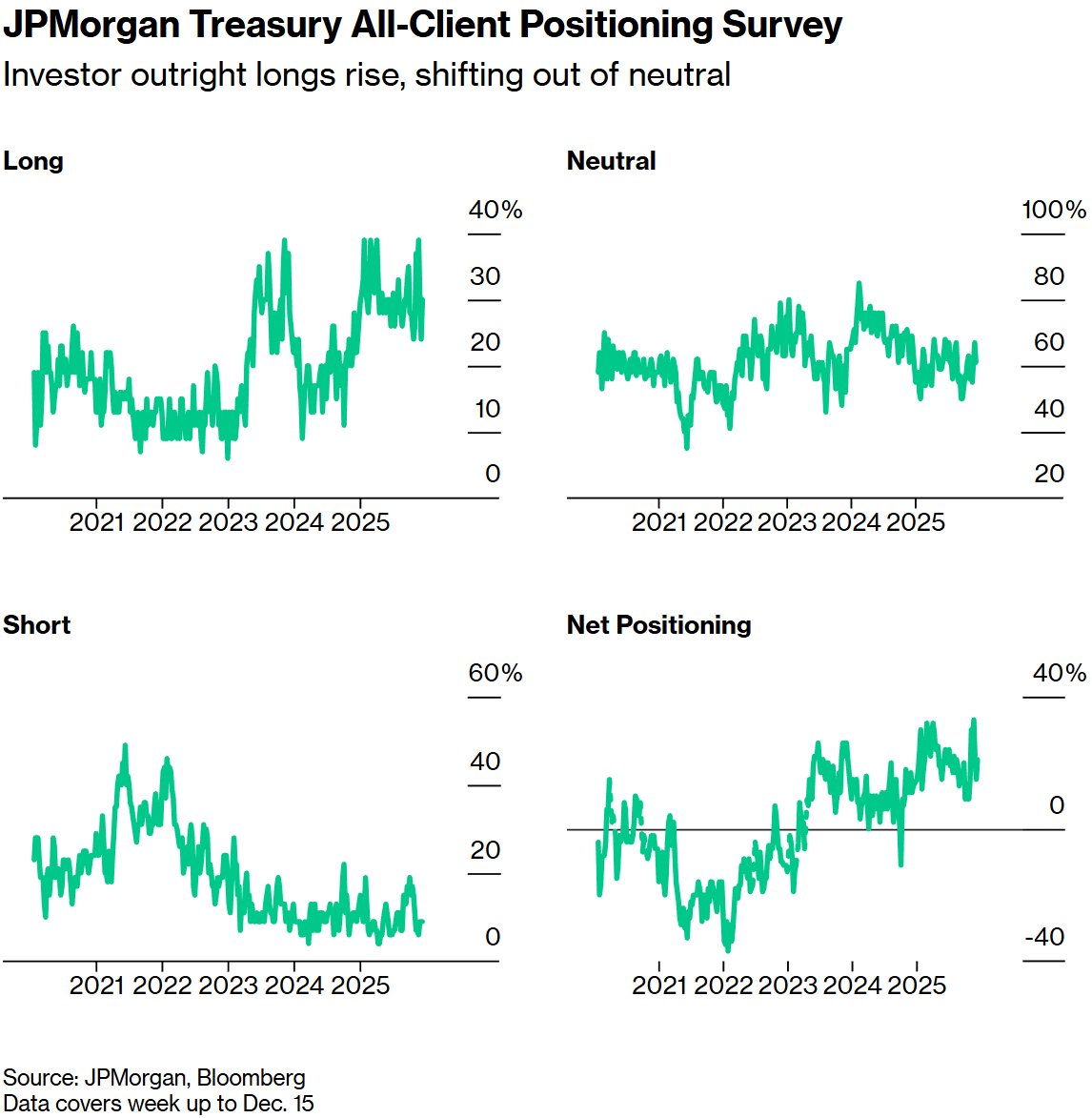
Group 1 - The unexpected rise in unemployment rate in November adds uncertainty to the mixed signals surrounding the U.S. economic outlook, leading bond traders to favor short-term U.S. Treasuries over long-term ones [1] - The yield spread between 2-year and 30-year U.S. Treasuries has widened to its largest extent in over four years, reflecting market expectations that the Federal Reserve will likely cut rates at least twice next year despite persistent inflation and strong economic growth [1] - The "curve steepening" trade is gaining traction, betting that the yield gap between short-term and long-term debt will continue to expand, with the upcoming release of November consumer price data set to further test this trade [1] Group 2 - A significant large-scale spread trade in the futures market aligns with the widening yield spread between 2-year and 30-year Treasuries, indicating a profit of $3 million within a day as the spread increased from 132 basis points to approximately 137 basis points [2] - As of the week ending December 15, investor direct long positions increased by 6 percentage points, shifting from neutral to long, while direct short positions remained unchanged [2] Group 3 - In the SOFR options market, there has been a notable increase in risk exposure for options expiring on March 26, June 26, and September 26, particularly for various call and put options, as traders hedge against potential dovish and hawkish policy scenarios from the Federal Reserve [5] - The largest open interest is observed at the 96.50 strike price for March 26 options, with significant positions also at the 96.375 strike price [7] Group 4 - The premium for put options used to hedge U.S. Treasury risks has continued to tilt towards bearish options, indicating strong demand for Treasuries amid expectations that long-term yields will underperform compared to short- and medium-term yields [10] - The steepness of the yield curve between 2-year and 30-year Treasuries reached its highest level since November 2021, exceeding 137 basis points [10]