
汽车安全

Search documents
理想i8凭什么这么刚
半佛仙人· 2026-01-30 04:18
Core Viewpoint - The article emphasizes that safety is the most critical aspect of car design, especially as vehicle shapes evolve for better aerodynamics and efficiency. It argues that advancements in safety technology are keeping pace with performance improvements, ensuring that modern vehicles are safer despite changes in design [3][4]. Group 1: Vehicle Safety Innovations - Modern vehicles, like the Li Auto i8, incorporate advanced safety structures that effectively absorb impact forces, ensuring driver protection during collisions. The design includes multiple energy absorption pathways and safety features such as numerous airbags [4][5]. - The article highlights that the safety of electric vehicle batteries is paramount, necessitating rigorous testing under extreme conditions to prevent fire hazards. New national standards require batteries to withstand various tests, including impact and water immersion, to ensure reliability [7][8]. Group 2: Intelligent Safety Features - The introduction of intelligent safety systems, such as the VLA driver model in the Li Auto i8, enhances vehicle safety by predicting and responding to potential hazards. This system can learn from past experiences and communicate with the driver, improving overall safety [10][11]. - The article notes that proactive safety measures, enabled by technology, provide an additional layer of protection, reducing reliance on traditional passive safety features. This shift represents a significant advancement in automotive safety [12][13]. Group 3: Commitment to Safety - The commitment to safety in vehicle design is portrayed as a promise to families, emphasizing that the unseen safety features are as important as visible luxury elements. The article argues that true technological advancement in the automotive industry should prioritize safety above all else [13].


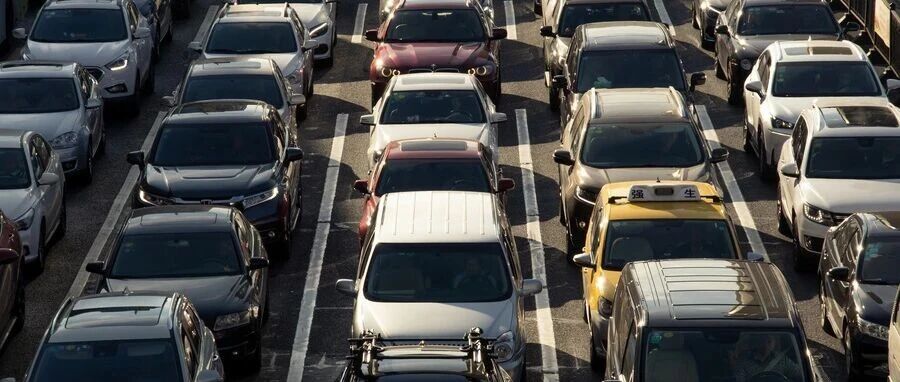
C-IASI安全指数年度洞察:三电亮眼,智能安全配置走向标配
Zhong Guo Qi Che Bao Wang· 2026-01-28 08:03
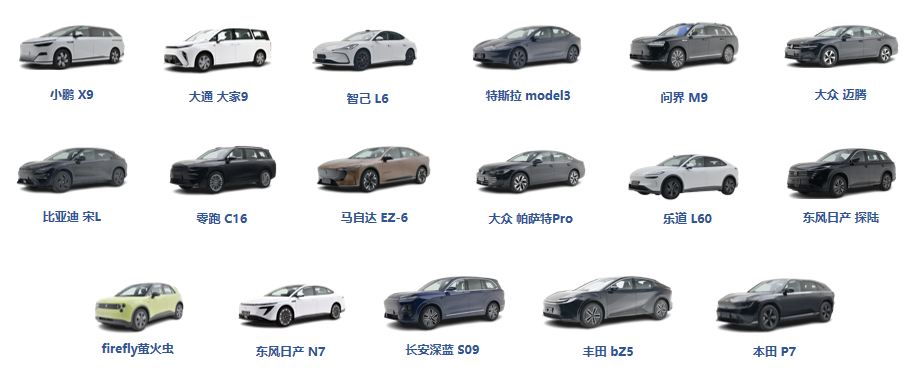
Core Viewpoint - The automotive industry is undergoing a critical transformation towards electrification and intelligence, with safety being the core baseline for high-quality development. The C-IASI safety index, led by the China Automotive Engineering Research Institute, aims to enhance automotive safety standards through iterative regulations and innovative assessments by 2025 [1]. Group 1: C-IASI Safety Index Overview - In 2025, the C-IASI safety index will release evaluation results for 17 vehicle models across three batches, with the first two batches (14 models) adhering to the 2023 regulations and the third batch (3 models) following the revised 2024 regulations, which introduces a special index for new energy vehicles [2]. - The 2023 regulations consist of four sub-indices: crashworthiness and repair economy, occupant safety, pedestrian safety, and vehicle assistance safety. The 2024 revision adds a special index for new energy vehicles, focusing on repair economy and vehicle safety [4]. Group 2: Evaluation Results - The evaluation results for 2025 show significant improvements across core dimensions, with 94% of models achieving excellent or above ratings in occupant safety. All tested models have 100% configuration rates for front airbags, front side airbags, and curtain airbags, while rear side airbags and front center airbags have increased to 47% from 19% and 5% respectively in the 2020 version [4]. - In pedestrian safety, 100% of models received excellent or above ratings, indicating a growing emphasis on pedestrian protection in vehicle design [4]. - In vehicle assistance safety, 100% of models also achieved excellent or above ratings, with all 17 tested models equipped with AEB/LSS, and 58.8% of models featuring DMS, showing a shift towards mainstream safety configurations [5]. Group 3: Challenges and Opportunities - Despite advancements, crashworthiness and repair economy remain common weaknesses, with only 29% (5 models) receiving excellent ratings and 18% (3 models) rated as good, indicating room for improvement in controlling user after-sales costs [5]. - New energy vehicles are becoming the main focus of evaluations, with 15 out of 17 tested models being electric. The first three models evaluated under the new energy vehicle special index all received excellent ratings, particularly excelling in bottom collision tests [5]. Group 4: Technological Advancements - The continuous improvement in evaluation results reflects the strong influence of the C-IASI safety index on industry technological advancements. The China Automotive Engineering Research Institute aims for zero casualties in traffic accidents and is conducting forward-looking research on key evaluation technologies and standards [6]. - The AC-HUMs digital model, developed based on Chinese population data, represents a breakthrough in safety technology, enabling comprehensive assessments of injury risks [6]. - Research on pedestrian safety evaluation is being conducted to integrate active safety (AEB) with passive protection effects, enhancing overall safety assessments [8]. Group 5: Industry Standards and Collaboration - The China Automotive Engineering Research Institute has led the development of the first industry standard for occupant safety in high-angle seats, with over 20 companies already applying it [10]. - A collaborative effort has resulted in the first deformable barrier that accurately replicates vehicle-to-vehicle collision responses, supporting vehicle compatibility assessments [12]. - Virtual evaluation studies for diverse occupant protection in frontal and side collisions are being conducted, expanding existing physical evaluation conditions and promoting a more comprehensive occupant protection assessment system [14].

车用钢板硬度已超坦克?专家称强度不等于安全
第一财经· 2026-01-26 09:49
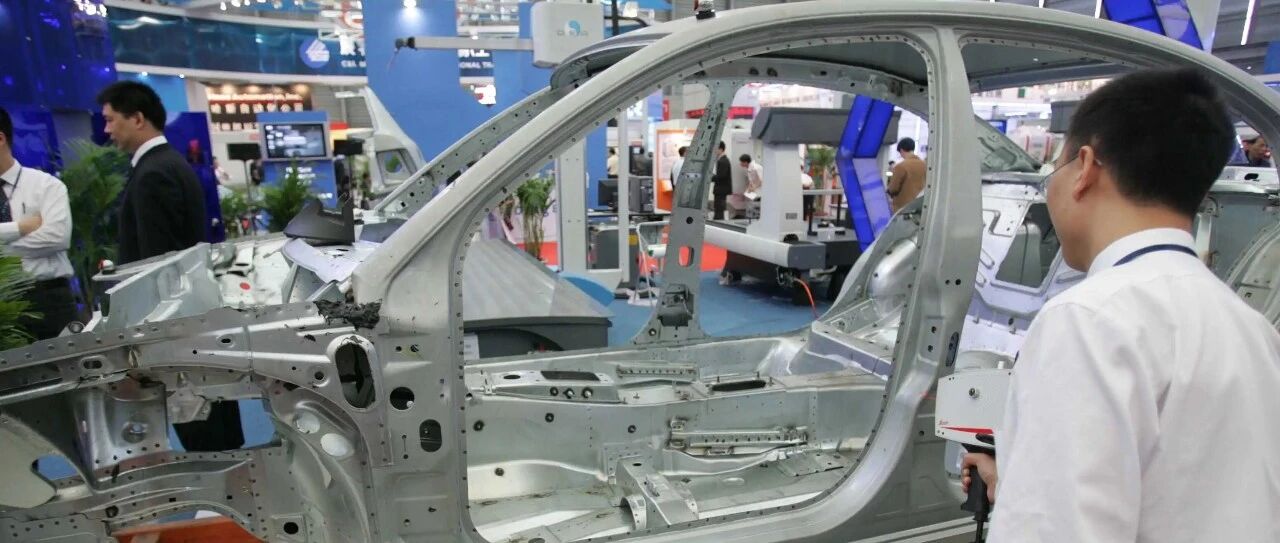
Core Viewpoint - The automotive industry is experiencing a competitive race in steel strength, with companies promoting increasingly high values for steel used in vehicles, raising questions about the actual safety implications of these numbers [1][3]. Group 1: Steel Strength Competition - Chery Automobile and Hebei Steel Group have introduced ultra-high-strength 2400MPa hot-formed steel, while a new player has reportedly launched 2420MPa steel, which is claimed to be twice as strong as tank armor [1][3]. - The debate centers on whether the reported steel strength refers to yield strength or tensile strength, and whether higher numbers genuinely enhance vehicle safety [1][3]. Group 2: Consumer Perception and Marketing - Many automotive companies emphasize higher steel strength values in marketing to suggest enhanced safety, exploiting consumer knowledge gaps [5][6]. - Consumers often misunderstand the difference between yield strength and tensile strength, leading to confusion in vehicle safety assessments [5][6]. Group 3: Technical Definitions - Yield strength is the stress at which a material begins to deform plastically, while tensile strength is the maximum stress a material can withstand before failure [6][7]. - Generally, tensile strength values are higher than yield strength, but the industry has shifted towards using tensile strength for marketing purposes, which can mislead consumers [7][8]. Group 4: Industry Standards and Practices - There are very few models with yield strengths exceeding 2000MPa, while many models boast tensile strengths above this threshold [8][9]. - Companies often create marketing terms like "super high-strength steel" without standardized definitions, leading to potential consumer deception [8][9]. Group 5: Comprehensive Safety Considerations - Automotive safety is a complex system that involves more than just steel strength; factors like body structure, welding processes, and material durability are equally important [9][10]. - The use of high-strength steel can lead to issues like hydrogen embrittlement, which may cause delayed fractures, emphasizing the need for a holistic approach to vehicle safety [10][11]. Group 6: Cost and Production Implications - The cost of using high-strength steel is significantly higher, with production costs increasing by approximately 60% compared to regular steel [11]. - The proportion of high-strength steel used in vehicles directly affects production costs and safety ratings, necessitating careful consideration by manufacturers [10][11].
车用钢板硬度已超坦克?专家称强度不等于安全
Di Yi Cai Jing· 2026-01-26 06:42
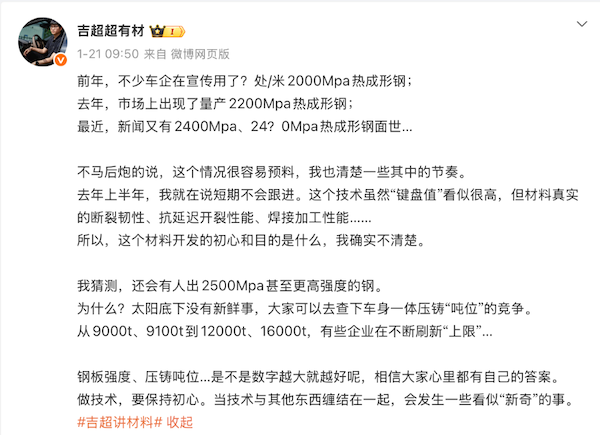
车圈"卷"入新的数值营销游戏 2026年开年,车圈开启了新一轮钢板强度的数值竞争。前脚,奇瑞汽车联合河钢集团发布了汽车用超高 强韧2400mpa热成形钢,后脚,市场消息传出某家新势力车企已经下线了2420MPa超强钢。 在社交平台上,有网友称:"2420MPa的车用钢板强度差不多是坦克硬度的两倍。"一时间,汽车钢板强 度的争议层出不穷。争议点主要聚焦在两个方面:一是,各家车企公布的钢板强度是屈服强度,还是抗 拉强度?二是,车企"卷"钢板强度的数值,是否能提升整车安全? 近日,理想材料负责人吉超发文表示:"前年,不少车企在宣传时称使用了多少处或多少米的2000Mpa 热成形钢;去年,市场上出现了量产2200MPa热成形钢;最近,新闻又有2400MPa热成形钢面世…不马 后炮地说,这个情况很容易预料,我也清楚一些其中的节奏。这个技术虽然'键盘值'看似很高,但材料 真实的断裂韧性、抗延迟开裂性能、焊接加工性能……所以,这个材料开发的初心和目的是什么,我确 实不清楚。" 近年来,车企对高强度钢板上车越发重视,且尤为强调钢板强度的数值。多名车企研发人士告诉第一财 经,车企宣传时,钢板强度的数值越大,更能凸显汽车安全性。 ...
工信部:油车要做3万公里可靠性试验,电车1.5万
第一财经· 2026-01-22 14:34
Core Viewpoint - The Ministry of Industry and Information Technology (MIIT) has announced revisions to the "Access Review Requirements for Road Motor Vehicle Production Enterprises" and "Access Review Requirements for Road Motor Vehicle Products," effective from January 1, 2027, to enhance safety and innovation in the automotive industry [3][4]. Group 1: Revised Requirements - The revised "Enterprise Review Requirements" now include product safety assurance mechanisms and testing requirements, emphasizing cybersecurity, data security, and software upgrades [4][5]. - A new monitoring platform for the operational safety status of new energy vehicles (NEVs) is mandated, along with mechanisms for identifying potential safety hazards in vehicles [5]. - The "Product Review Requirements" have been updated to include reliability testing for automotive products, with specific standards for both NEVs and traditional vehicles [5][6]. Group 2: Industry Context and Challenges - Current automotive safety issues, such as battery fires and defects in advanced driver-assistance systems, highlight the need for stringent regulatory measures [6]. - The rapid development of intelligent vehicles and continuous product innovation necessitate consistent quality control to prevent consumers from becoming "test subjects" for new technologies [6]. - The transition from assisted driving to higher-level automation presents challenges, including unclear functional definitions and responsibility allocations, which pose safety risks [6].
沃尔沃搞“双标”? EX30因电池隐患全球召回,中国除外! | 次世代车研所
Xin Lang Cai Jing· 2026-01-22 00:40
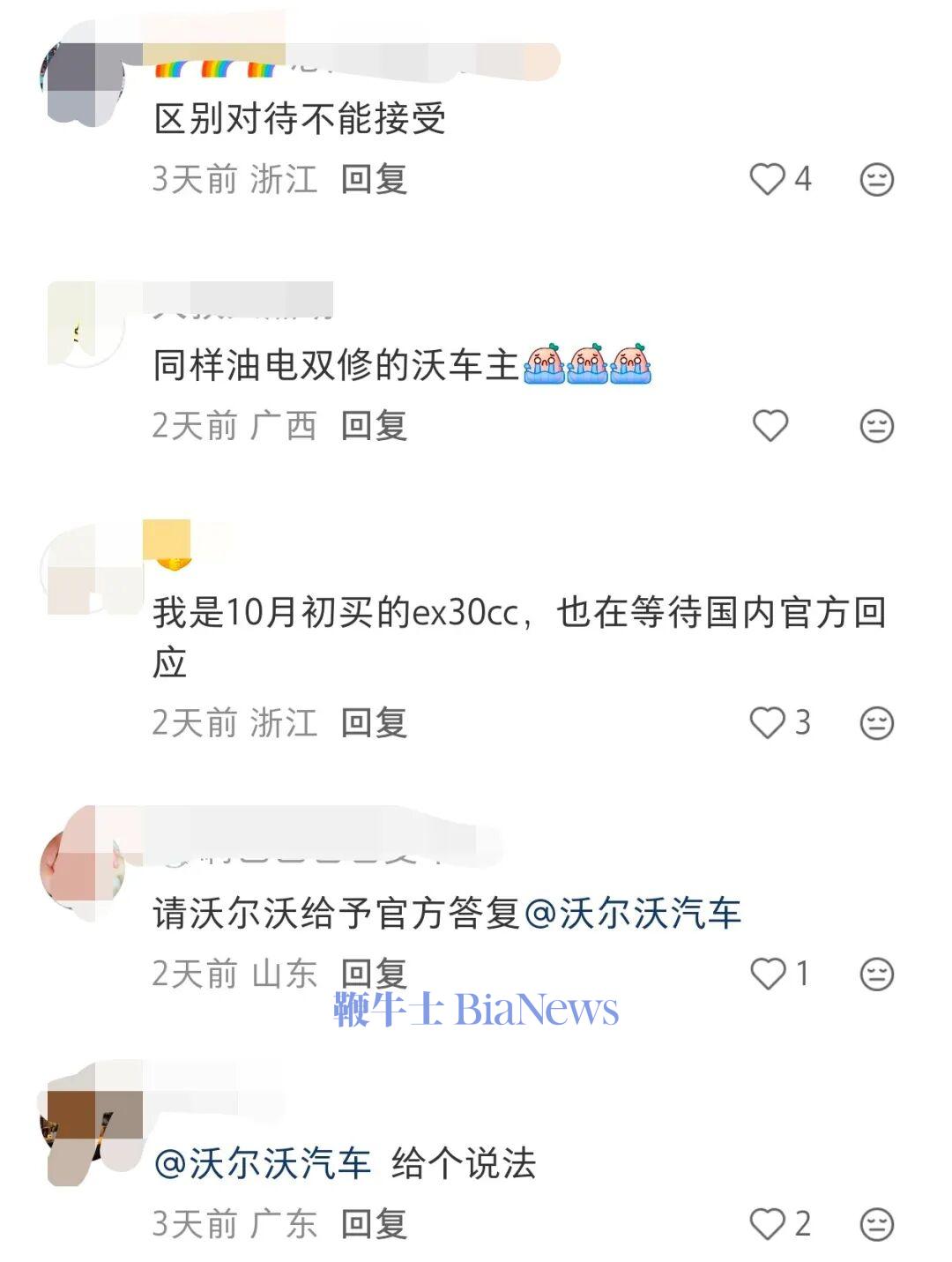
Core Viewpoint - Volvo is facing criticism over battery safety issues related to its EX30 model, which uses batteries from the supplier Sunwoda, leading to recalls in multiple countries but not in China, causing dissatisfaction among Chinese customers [2][3][6]. Recall and Safety Concerns - Volvo has initiated a global recall for the EX30 model due to fire risks associated with Sunwoda batteries, affecting vehicles produced between September 6, 2024, and October 25, 2025 [2][3][6]. - The recall includes 40 vehicles in the US, 2,815 in Australia, and 10,440 in the UK, while no recall has been announced for the Chinese market, raising concerns of differential treatment [2][3][6]. - Reports of a fire incident involving a Volvo EX30 in Brazil have prompted Volvo to advise owners in affected markets to limit battery charging to 70% until a comprehensive recall plan is established [3][16]. Customer Reactions - Chinese EX30 owners express frustration over the lack of recall information and feel neglected compared to international customers, questioning Volvo's commitment to safety [5][20]. - Social media platforms have seen a surge of complaints from EX30 owners demanding explanations from Volvo regarding the perceived disparity in treatment [5][20]. Sales and Pricing Pressure - Volvo is experiencing significant sales pressure in the Chinese market, with a reported 4% decline in overall sales in 2025, totaling 149,549 units [9][24]. - The company has resorted to heavy discounts on several models, with the S60 being offered at nearly half its original price, indicating a struggle to maintain market share [7][23]. - The XC70 and XC60 models are also being sold at substantial discounts, reflecting the broader challenges Volvo faces in the competitive automotive market [8][23]. CEO Statements and Company Position - Volvo's CEO has previously stated that the company will not compromise on safety and quality to gain market share, emphasizing a commitment to sustainable business practices [10][27]. - However, the current situation with the EX30 recalls and aggressive pricing strategies raises questions about the alignment of the company's actions with its stated values [28].
沃尔沃搞「双标」?EX30因电池隐患全球召回,中国除外!
Xin Lang Ke Ji· 2026-01-22 00:24
Core Viewpoint - Volvo is facing significant backlash due to safety concerns related to the battery supplier, CATL, which has led to a global recall of the EX30 model, while Chinese customers feel neglected as no recall has been announced for the domestic market [1][2][6][18]. Recall and Safety Concerns - Volvo has initiated a recall for the EX30 model globally, specifically for vehicles produced between September 6, 2024, and October 25, 2025, due to fire risks associated with CATL batteries [1][2]. - The recall affects multiple countries, including the United States (40 vehicles), Australia (2,815 vehicles), and the UK (10,440 vehicles) [1]. - In response to the fire incidents, Volvo has advised owners to limit battery charging to 70% until a comprehensive recall plan is established [2]. Customer Sentiment and Response - Domestic Volvo EX30 owners are expressing dissatisfaction over the lack of communication and action regarding the recall, feeling that they are being treated differently compared to international customers [3][5][6]. - Social media platforms have seen a surge of complaints from EX30 owners demanding explanations from Volvo regarding the perceived disparity in treatment [6][8]. Sales and Market Performance - Volvo is experiencing significant sales pressure in the Chinese market, with a reported 4% decline in overall sales for 2025, totaling 149,549 units [12]. - The sales of fully electric models have plummeted by 46%, indicating a broader trend of declining demand for Volvo's electric vehicles [12]. - In an effort to boost sales, several Volvo models are being offered at steep discounts, with some vehicles being sold at nearly half their original price [9][11][20]. Corporate Statements and Strategy - Volvo's leadership has previously emphasized a commitment to safety and quality, stating that the company would not compromise on these values for short-term market gains [17]. - However, the current situation with the EX30 recalls and aggressive discounting raises questions about the company's adherence to these principles [18][20].
被指“双标” 沃尔沃EX30因电池隐患全球召回:中国除外
Xin Lang Ke Ji· 2026-01-22 00:21
Core Viewpoint - Volvo is facing criticism over battery safety issues related to its EX30 model, which uses batteries from the supplier, CATL. The company has initiated recalls in several countries but has not yet addressed the concerns of Chinese customers, leading to allegations of differential treatment [1][3][4]. Group 1: Recall Information - Volvo has launched a global recall for the EX30 model due to fire risks associated with CATL batteries, affecting vehicles produced between September 6, 2024, and October 25, 2025 [3]. - The recall includes 40 vehicles in the United States, 2,815 in Australia, and 10,440 in the UK, among others [3]. - A fire incident involving a Volvo EX30 occurred in Brazil, prompting the recall and safety warnings for owners to limit battery charging to 70% until a full recall plan is established [3][4]. Group 2: Customer Concerns - Chinese EX30 owners are expressing dissatisfaction over the lack of recall information in China, feeling neglected compared to international customers [4][6]. - Social media discussions among Volvo EX30 owners indicate a strong demand for official responses from the company regarding the perceived differential treatment [6][8]. Group 3: Sales and Pricing Pressure - Volvo is experiencing significant sales pressure in China, with a reported 4% decline in overall sales for 2025, totaling 149,549 units [10]. - The company has resorted to heavy discounts on multiple models, with some vehicles being offered at nearly 50% off their original prices, indicating a struggle to maintain market share [8][9]. - The decline in sales is attributed to a 46% drop in fully electric vehicle sales and a 13% decrease in fuel vehicle sales, despite a rise in hybrid model sales [10]. Group 4: Corporate Statements and Credibility - Volvo's senior executives have previously stated that the company would not compromise on safety and quality to gain market share, yet the current situation raises questions about the credibility of these claims [11][13]. - The ongoing battery safety issues and aggressive pricing strategies suggest a potential disconnect between corporate messaging and operational realities [14].
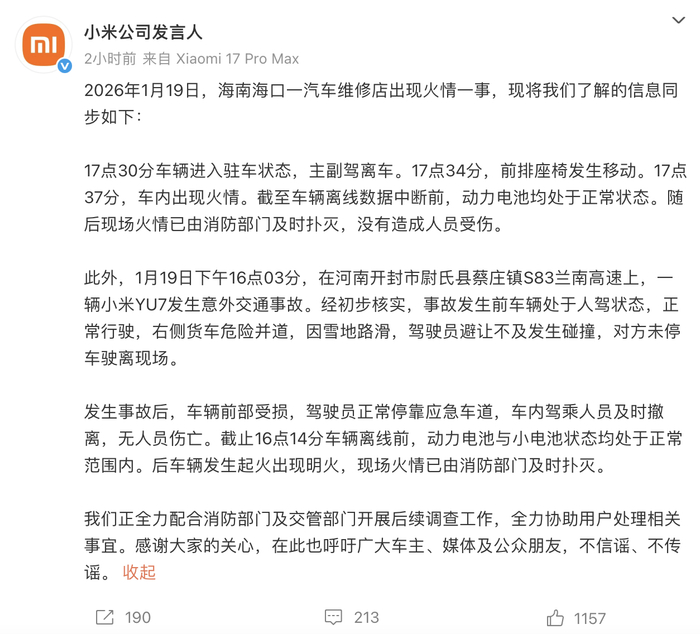
小米通报海南维修店火情及河南高速事故细节
3 6 Ke· 2026-01-20 06:42
据读秒财经报道,1月20日,@小米公司发言人 发文通报两起事故: 2026年1月19日,海南海口一汽车维修店出现火情。17点30分车辆进入驻车状态,主副驾离车。17点34 分,前排座椅发生移动。17点37分,车内出现火情。截至车辆离线数据中断前,动力电池均处于正常状 态。随后现场火情已由消防部门及时扑灭,没有造成人员受伤。 此外,1月19日下午16点03分,在河南开封市尉氏县蔡庄镇S83兰南高速上,一辆小米YU7发生意外交通 事故。经初步核实,事故发生前车辆处于人驾状态,正常行驶,右侧货车危险并道,因雪地路滑,驾驶 员避让不及发生碰撞,对方未停车驶离现场。 【#小米通报海南一汽车维修店火情#,小米汽车通报两起事故细节】 发生事故后,车辆前部受损,驾驶员正常停靠应急车道,车内驾乘人员及时撤离,无人员伤亡。截止16 点14分车辆离线前,动力电池与小电池状态均处于正常范围内。后车辆发生起火出现明火,现场火情已 由消防部门及时扑灭。 我们正全力配合消防部门及交管部门开展后续调查工作,全力协助用户处理相关事宜。感谢大家的关 心,在此也呼吁广大车主、媒体及公众朋友,不信谣、不传谣。#小米汽车通报两起事故细节# | | | ...

雷军:新一代SU7发布前,会提前安排展车到店
Feng Huang Wang· 2026-01-15 06:11
Core Insights - The new generation SU7 is in the final stages of development and is expected to be launched in April 2026 [1] - Significant improvements in safety, range, chassis, assisted driving, and design are highlighted for the new model [1] Product Features - The new SU7 will feature a full suite of safety enhancements, including 2200MPa Xiaomi ultra-strong steel embedded roll cage and door anti-collision beams, along with nine airbags standard across all models [1] - The Pro version will have a CLTC range of 902 km, while the Max version will achieve a CLTC range of 670 km with a 15-minute charging time [1] - All models will be equipped with laser radar, 700 TOPS computing power from the Nvidia Thor chip, 4D millimeter-wave radar, and Xiaomi's end-to-end assisted driving technology [1] - New color options, wheel designs, and a redesigned interior will also be part of the new SU7 [1] Marketing and Engagement - Xiaomi's official automotive account announced a live stream event hosted by Lei Jun to discuss the new generation SU7 in detail, featuring automotive media personality Wu Pei as a guest [1]
