
聚酯产业链

Search documents
聚酯:上方偏强带来淡季支撑
Hong Ye Qi Huo· 2026-01-14 10:21
Report Industry Investment Rating No relevant information provided. Core Viewpoints of the Report - The polyester industry chain is currently facing a situation of strong upstream and weak downstream. The geopolitical situation overseas has led to a stronger upward trend in the cost - end, providing certain support to the market. However, the seasonal decline in the terminal has dragged down the market, and downstream negative feedback is gradually accumulating. Polyester raw materials are moving in a volatile manner in the game between upstream and downstream [4][12]. Summary by Related Catalogs PX Market - Since early January, due to the unstable overseas situation, the oil price center has been continuously rising. In 2025, there was no new PX production capacity, and the production capacity showed a negative growth after excluding long - shut - down devices. The production increased by 1%. The profit of PX short - and medium - process devices has improved significantly. Currently, PX - N is at $340/ton, and PX - MX is also at a recent high of $148/ton. The high profit has stimulated the high operating rate of PX. The load of PX in mainland China has risen to around 91%, and the load in other Asian regions has also reached a two - year high. The maintenance volume of PX devices at home and abroad in the first quarter is limited. Seasonal inventory accumulation is expected to increase, but in the medium and long term, PX is expected to remain strong in the first half of this year [5]. PTA Market - In 2025, the average spot processing fee of PTA was only 257 yuan/ton, a new low in recent years. Some small and medium - sized devices with poor competitiveness gradually withdrew from the market. After excluding 262.5 million tons of long - shut - down devices, the PTA production capacity at the end of 2025 was 92.09 million tons, a 7% increase from the end of 2024. The annual production growth rate was only 2% due to low profits. In 2026, there are no new PTA devices planned to be put into operation. With about 4 million tons of new polyester production capacity planned to be put into operation downstream, the processing fee of PTA is expected to improve. Recently, the PTA processing difference has improved from less than 200 yuan/ton in late December to over 300 yuan/ton. The current PTA device load is 78%, and the average load is expected to decline again. According to the average operating load of 88 - 89% in January, the monthly inventory accumulation of PTA is about 100,000 tons, with a small accumulation range [6]. Terminal and Polyester Market - As the year - end approaches, the terminal loom load has begun to decline rapidly, and the current load in Jiangsu and Zhejiang has dropped to around 56%. It is expected to decline more significantly after late January. However, the polyester market in the middle link has shown great resilience. The current average operating rate of polyester is still at a recent high of 90.8%. The high operating rate of polyester benefits from the good inventory level. Although there has been some inventory accumulation recently due to insufficient downstream procurement, the inventory pressure is relatively small. Mainstream filament manufacturers have decided to start a continuous production cut of 15% from January 14, involving FDY and POY, and may increase the production cut according to market conditions [7][10]. MEG Market - After excluding 1.045 million tons of long - shut - down devices at the end of 2025, the domestic ethylene glycol production capacity was adjusted to 29.23 million tons. In early January, the domestic average load was 73.9%. There were maintenance plans for some ethylene - based devices, and the load of coal - based devices continued to increase, with the current average load at a high of 79%. New devices have been put into operation, and the ethylene glycol port inventory has risen to 737,000 tons, with room for further increase. Overseas, some devices have been shut down, but the overall supply is still relatively abundant. Recently, the profits of different ethylene glycol processes have shown differentiation, and the ethylene glycol price has shown a strong and volatile trend under the influence of coal price [8][9]. Short - fiber Market - Since the end of 2025, the short - fiber load has been operating at a high level, reaching a historical high of 97.6%. The good export data in 2025 has alleviated the pressure of poor domestic sales. The new production capacity of short - fiber is limited, and the factory's inventory management is good. The current short - fiber inventory is still in a low - level range in the past year. Affected by raw materials, the current spot processing fee is below 1,000 yuan/ton. During the Spring Festival this year, short - fiber factories are not very willing to carry out maintenance and are expected to maintain a high - load operation. The average operating rate of pure polyester yarn factories is 70.4%, and the yarn factory's processing profit has increased [13]. Bottle - chip Market - Since mid - last year, due to low profits, factories have carried out centralized production cuts. The average load of bottle - chip factories has been maintained at around 80%. With the acceleration of year - end shipments, the average inventory pressure of bottle - chip factories has been relieved, and the current inventory is around 15 days. Recently, the bottle - chip processing fee has improved to 515 yuan/ton, and the average factory load has reached 83%. A new 300,000 - ton device was put into operation at the end of last year. As of now, the domestic bottle - chip production capacity has reached 21.47 million tons, a 5% increase from the end of 2024. There is no new production capacity in the first half of 2026, and the total maintenance during the Spring Festival is not large. Attention should be paid to the opportunity to protect the processing fee at high prices [14]. Important Data - On January 13, the PX - N spread was $338/ton, and the PTA processing fee was 302 yuan/ton [19]. - On January 12, the ethylene glycol port inventory in Jiangsu and Zhejiang was 740,000 tons, and at the end of December, the MEG factory inventory was 358,000 tons. In early January, the MEG raw material inventory of polyester factories was 14 days [25][29]. - From January to November 2025, the cumulative import of MEG was 6.8849 million tons, a 15.2% increase compared to the same period last year [34]. - In the week of January 9, the polyester operating rate was 90.8%, and the Jiangsu and Zhejiang loom operating rate was 56% [41]. - In December 2025, textile and clothing exports were $25.992 billion, a year - on - year decrease of 7.4% and a month - on - month increase of 8.9%. Among them, textile exports were $12.58 billion, a year - on - year decrease of 4.2%, and clothing exports were $13.41 billion, a year - on - year decrease of 10.2%. From January to November 2025, the cumulative retail sales of textile, clothing, footwear, and knitting products in China were 135.97 billion yuan, a year - on - year increase of 3.5% [62][63][67].
PTA期货:阶段性承压调整
Ning Zheng Qi Huo· 2026-01-12 09:58
Report Summary 1. Report Industry Investment Rating No information provided. 2. Core View of the Report - This week, the PTA futures market was volatile. The TA2605 contract closed at 5,128 yuan/ton, down 2 yuan/ton or 0.04%. Currently, the real - world fundamentals of PTA and PX are weaker than in November. The recent upward trend in PTA and PX during the off - season of the polyester industry chain is an early reaction to the expected strong supply - demand pattern of PX and PTA in the first half of next year. PX supply remains high in January, PTA supply has increased, and the destocking speed has slowed down, with expected inventory accumulation starting in late January. The terminal has entered the traditional off - season, and polyester factories are expected to reduce their load as the Spring Festival approaches [2]. 3. Summary by Relevant Catalogs Market Review and Outlook - The PTA futures market was volatile this week. The TA2605 contract closed at 5,128 yuan/ton, down 2 yuan/ton or 0.04%. The real - world fundamentals of PTA and PX are weaker than in November, and PTA has limited self - driving force [2]. Key Factors to Watch - Polyester operating rate, PTA maintenance, loom operating rate, PX adjustment demand, and crude oil trends [3]. Weekly Changes in Fundamental Data | Indicator | Unit | Latest Week | Previous Period | Weekly Change | Weekly Change Rate | Frequency | | --- | --- | --- | --- | --- | --- | --- | | PTA futures (continuous) | yuan/ton | 5,108.00 | 5,110.00 | - 2.00 | - 0.04% | Daily | | PTA output | 10,000 tons | 145.25 | 143.11 | 2.14 | 1.50% | Weekly | | Polyester chip operating rate | % | 89.25 | 86.83 | 2.42 | 2.79% | Weekly | | Jiangsu and Zhejiang loom operating rate | % | 57.89 | 59.55 | - 1.66 | - 2.79% | Weekly | | PXN | yuan/ton | 339 | 363 | - 24.00 | - 6.61% | Daily | | PTA cash - flow cost | yuan/ton | 4,958 | 4,977 | - 19.00 | - 0.38% | Daily | [4] PX Market Analysis - **PX Spot and Futures Market Review**: There are figures showing PX futures closing prices, PX ex - factory prices in East China, PX prices in Taiwan, and related price spreads [8][12]. - **PX Supply Analysis**: Figures show PX production in Asia and China, monthly import volume and its year - on - year change, PX operating rates in China and Asia, and PX inventory [13][15][17]. PTA Market Analysis - **PTA Spot and Futures Market Review**: There is a figure showing the PTA futures closing price (continuous) and the mainstream price in East China [20]. - **PTA Supply Analysis**: Figures show PTA monthly production, operating rate, and social inventory [22][27]. - **PTA Consumption Analysis**: Figures show PTA export volume, monthly production of polyester filament and staple fiber, operating rates of polyester chip, filament, and staple fiber, and the operating rate of looms in Jiangsu and Zhejiang [28][30][32]. - **Cost - Profit Analysis**: There is a figure showing PTA spot price in East China, PTA cash - flow cost, and PTA profit [39].
聚酯数据周报-20260111
Guo Tai Jun An Qi Huo· 2026-01-11 13:14
Report Summary 1. Report Industry Investment Rating No relevant information provided. 2. Core Viewpoints of the Report - In the first half of 2026, PX is expected to be the strongest variety in the polyester industry chain [13]. - PTA is expected to enter a pattern of declining demand, but currently, with polyester production not significantly decreased and PTA inventory in a state of low - level depletion, the unilateral price is still expected to be strong [4]. - The current low price of ethylene glycol (MEG) is mainly due to the reduced turnover efficiency in the intermediate trading link, but this situation will improve in the future. With strong support at 3,600 yuan/ton, it is recommended to close short positions [5]. 3. Summary by Relevant Catalogs PX - **Valuation**: PX is in a high - level volatile market with a weakening monthly spread. The PXN spread is weak, the gasoline inventory is rising, the aromatics blending oil demand is weak, and the aromatics blending oil economy is deteriorating [15][24][27][37]. - **Supply and Demand**: The domestic PX production rate is at a historical high, with the domestic production rate reaching 90.9% (+0.3%). The Asian total production rate is 81.2% (+0.3%). The PX inventory in December was 402 million tons (-5) [54][58][85]. - **Import**: In November, the PX import volume was 820,000 tons. Imports from South Korea and Japan continued to increase, while those from Brunei decreased [60]. PTA - **Valuation**: The basis and monthly spread of PTA rebounded, and the number of warehouse receipts decreased marginally. The processing fee rebounded from its bottom [91][100]. - **Supply and Demand**: The PTA production rate was 78%. The PTA export volume in November was 360,000 tons, with significant increases in exports to Egypt, Oman, and India. The inventory decreased marginally [103][106][120]. MEG - **Valuation**: The unilateral price of MEG rebounded from its bottom, but the monthly spread structure was still weak. The relative valuation continued to decline. The profit of coal - based plants was - 261 yuan/ton (-35), and oil - based plants continued to operate at a loss [138][142][144]. - **Supply and Demand**: The MEG production rate was 74%. Affected by the naphtha consumption tax policy and spring maintenance of syngas plants, the supply pressure eased. The import volume in November was 580,000 tons, lower than market expectations. Overseas plants reduced their loads, and the import volume is expected to decline. The port inventory remained flat [147][148][151]. Polyester Segment - **Production Rate**: The polyester production rate was 90.8%. It is expected to drop to 84% at the end of January, with an average monthly production rate of 88 - 89% in January [4][5][166]. - **Inventory**: The inventory of polyester products is expected to accumulate again after the slow sales during the New Year's Day [168]. - **Export**: From January to November, the total polyester export volume was 13.3 million tons, a year - on - year increase of 14.7% [176]. - **Profit**: The losses of filament producers widened, while the profits of staple fiber and bottle chip producers were acceptable [178]. Terminal: Weaving and Textile and Apparel - **Domestic Market**: From January to November, the retail sales of Chinese textile and apparel reached 135.97 billion yuan, a year - on - year increase of 3.5%. The export volume from January to November was 137.8 billion US dollars, a year - on - year decrease of 4.4% [207][213]. - **Overseas Market**: The retail data of textile and apparel in the US and Europe showed strong growth. The inventory of overseas textile and apparel decreased slightly month - on - month [217][222].
聚酯数据日报-20260109
Guo Mao Qi Huo· 2026-01-09 03:05
Report Industry Investment Rating - Not provided Core Viewpoints - The PX market has experienced a sharp rise, mainly driven by speculative funds rather than fundamental changes. Although there are concerns about bubbles, the PX fundamentals are supported, and the market is expected to remain tight in 2026. The PTA market is affected by the weakening demand in the off - season, with prices falling and the spot basis weakening. The MEG market is under pressure due to increasing supply and falling coal prices, but may be supported by domestic policies [2]. Summary by Relevant Catalogs Market Data - **INE Crude Oil**: Price decreased from 416.3 yuan/barrel on 2026/1/7 to 416.2 yuan/barrel on 2026/1/8, a change of - 0.10 yuan/barrel [2]. - **PTA - SC**: Spread decreased from 2124.7 yuan/ton to 2061.4 yuan/ton, a change of - 63.27 yuan/ton [2]. - **PTA/SC (Ratio)**: Decreased from 1.7023 to 1.6816, a change of - 0.0208 [2]. - **CFR China PX**: Price decreased from 900 to 886, a change of - 14 [2]. - **PX - Naphtha Spread**: Decreased from 366 to 353, a change of - 13 [2]. - **PTA Main Futures Price**: Decreased from 5150 yuan/ton to 5086 yuan/ton, a change of - 64.0 yuan/ton [2]. - **PTA Spot Price**: Decreased from 5100 to 5070, a change of - 30.0 [2]. - **PTA Spot Processing Fee**: Increased from 331.1 yuan/ton to 354.6 yuan/ton, a change of 23.5 yuan/ton [2]. - **PTA Disk Processing Fee**: Increased from 381.1 yuan/ton to 390.6 yuan/ton, a change of 9.5 yuan/ton [2]. - **PTA Main Basis**: Decreased from (46) to (48), a change of - 2.0 [2]. - **PTA Warehouse Receipt Quantity**: Decreased from 100768 to 100754, a change of - 14 [2]. - **MEG Main Futures Price**: Decreased from 3879 yuan/ton to 3846 yuan/ton, a change of - 33.0 yuan/ton [2]. - **MEG - Naphtha**: Decreased from (133.53) to (134.72), a change of - 1.2 [2]. - **MEG Domestic Market**: Decreased from 3719 to 3717, a change of - 2.0 [2]. - **MEG Main Basis**: Remained unchanged at - 140 [2]. Industry Operating Conditions - **PX Operating Rate**: Remained unchanged at 87.87% [2]. - **PTA Operating Rate**: Remained unchanged at 77.40% [2]. - **MEG Operating Rate**: Remained unchanged at 60.87% [2]. - **Polyester Load**: Decreased from 88.20% to 88.04%, a change of 0.16% [2]. Product Data - **POY150D/48F**: Price remained unchanged at 6565 [2]. - **POY Cash Flow**: Increased from (291) to (265), a change of 26.0 [2]. - **FDY150D/96F**: Price remained unchanged at 6780 [2]. - **FDY Cash Flow**: Increased from (576) to (550), a change of 26.0 [2]. - **DTY150D/48F**: Price decreased from 7760 to 7745, a change of - 15.0 [2]. - **DTY Cash Flow**: Increased from (296) to (285), a change of 11.0 [2]. - **Long - Filament Sales Volume**: Increased from 48% to 49%, a change of 1% [2]. - **1.4D Direct - Spun Polyester Staple Fiber**: Price decreased from 6545 to 6520, a change of - 25 [2]. - **Polyester Staple Fiber Cash Flow**: Increased from 39 to 40, a change of 1.0 [2]. - **Short - Fiber Sales Volume**: Decreased from 71% to 69%, a change of 2% [2]. - **Semi - Bright Chip**: Price decreased from 5750 to 5740, a change of - 10.0 [2]. - **Chip Cash Flow**: Increased from (206) to (190), a change of 16.0 [2]. - **Chip Sales Volume**: Decreased from 48% to 47%, a change of - 1% [2]. Device Maintenance - This week, the 500,000 - ton device of Sanfangxiang is restarting, and another 750,000 - ton device is under maintenance recently. The devices of Xinjiang Yipu and Jinyu in December are supplemented. Some factories such as Tiansheng and Guxiandao have reduced their loads [4].
年关临近 聚酯链品种能否重拾升势?
Qi Huo Ri Bao· 2026-01-07 00:20
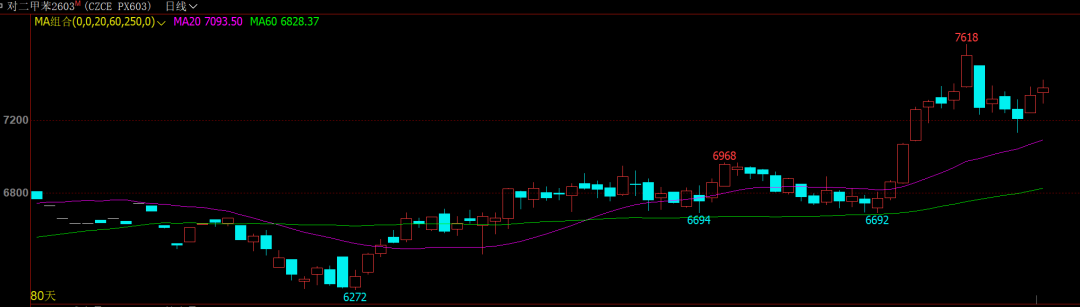
Core Viewpoint - The polyester chain market has experienced significant volatility since mid-December 2025, driven primarily by upstream PX price movements, leading to a focus on market dynamics and future trends [1][3]. Group 1: Market Dynamics - The core driver of the recent market fluctuations is the upstream PX, which saw a price increase from 6,800 yuan/ton to over 7,600 yuan/ton, with a significant rise in trading volume [3]. - After reaching a critical price level, the PX market experienced a decline in trading volume, leading to a notable price correction [1][3]. - Analysts suggest that the current price correction is a natural pressure release and does not alter the long-term optimistic outlook for PX [3]. Group 2: Industry Impact - The textile industry is entering a seasonal downturn, with decreasing orders and weaving operating rates, which is exacerbating cash flow pressures for polyester manufacturers [3][4]. - The rapid increase in raw material prices has forced some polyester enterprises to reduce production, creating a "hot upstream, cold downstream" scenario that hinders cost transmission within the industry [3][4]. - The upcoming Chinese New Year is expected to bring about a temporary halt in operations and a reduction in production, with downstream stocking intentions heavily influenced by market expectations [4][5]. Group 3: Future Outlook - The demand recovery post-Chinese New Year is seen as a critical factor for potential price increases in raw materials, with analysts indicating that a moderate price correction could benefit downstream operations [4][5]. - The timing of the Chinese New Year in 2026 may compress the demand release window, impacting downstream stocking enthusiasm and overall market dynamics [5]. - Short-term strategies are recommended to focus on profit-taking and risk aversion, with opportunities for buying on dips expected after price corrections [5].

年关临近,聚酯链品种能否重拾升势?
Qi Huo Ri Bao· 2026-01-06 23:56
Core Viewpoint - The polyester chain market has experienced significant volatility since mid-December 2025, driven primarily by upstream PX price movements, with expectations for future supply and demand dynamics influencing market behavior [1][3]. Group 1: Market Dynamics - The core driver of the recent market fluctuations is the upstream PX, which saw a price increase from 6,800 yuan/ton to over 7,600 yuan/ton, with a corresponding rise in the US spot price from $830/ton to nearly $920/ton, both exceeding 10% increases [3][4]. - Following a peak in PX prices, a decline in trading volume led to a significant price correction, indicating market divergence and profit-taking behavior [1][3]. Group 2: Supply and Demand Outlook - Analysts predict a supply gap for PX before the concentrated release of new capacity in Q3 2026, suggesting that PX remains the strongest product in the polyester supply chain [3]. - The textile industry is entering a seasonal downturn, with weakening orders and declining weaving operating rates, which may pressure cash flows for polyester producers and lead to production cuts [3][4]. Group 3: Seasonal Factors and Future Trends - The period before and after the Spring Festival is expected to see a slowdown in terminal operations and reduced demand, with downstream stocking intentions heavily influenced by market expectations [4][5]. - If raw material prices rise significantly again, it could lead to increased production halts among companies, exacerbating negative feedback in the market [4]. - The actual release of downstream demand post-Spring Festival will be crucial for determining whether upstream processing fees can maintain strength [5].

聚酯淡季压力增强,关注终端负反馈影响
Tong Hui Qi Huo· 2026-01-05 11:41
Report Industry Investment Rating No information provided regarding the industry investment rating in the document [1] Report's Core View The report suggests that the polyester industry is facing increasing pressure during the off - season, with terminal negative feedback having an impact. PX and PTA prices are likely to continue to decline or remain weakly stable due to supply - side surpluses, weak demand, and potential inventory accumulation. Polyester prices may be stable or slightly increase, but high DTY inventory and supply recovery may offset some upward pressure [2][3][5] Summary by Related Catalogs 1. Daily Market Summary PTA & PX - On December 31, the PX main contract closed at 7260.0 yuan/ton, down 0.77% from the previous day, with a basis of - 212.0 yuan/ton. The PTA main contract closed at 5110.0 yuan/ton, down 0.66%, with a basis of - 10.0 yuan/ton. - Cost - end: On December 31, the Brent crude oil main contract closed at 60.91 dollars/barrel, and WTI at 57.41 dollars/barrel. - Supply - end: PX plant operating rate remains high, digesting the profit space brought by cost decline. PTA operating rate may remain stable, and the decline in upstream raw material costs may encourage manufacturers to maintain the current production rhythm. - Demand - end: PTA supply increases while demand decreases. The downstream off - season deepens, terminal orders weaken, and polyester factories' negative feedback leads to a stronger willingness to reduce production. - Inventory - end: PTA factory inventory may gradually accumulate, increasing the risk of price decline and squeezing processing fees [3][4] Polyester - On December 31, the short - fiber main contract closed at 6514.0 yuan/ton, down 0.76% from the previous day. The spot price in the East China market was 6535.0 yuan/ton, down 5.0 yuan/ton. - Demand: The MA15 trading volume in the Light Textile City was generally stable, indicating robust demand. - Inventory: The inventory days of polyester products vary. Future polyester prices may stabilize or rise slightly, but high DTY inventory and supply recovery may offset some upward pressure [5] 2. Industrial Chain Price Monitoring - PX futures: The main contract price decreased by 0.77%, trading volume decreased by 22.49%, and open interest decreased by 6.85%. - PTA futures: The main contract price decreased by 0.66%, trading volume decreased by 25.26%, and open interest decreased by 1.94%. - Short - fiber futures: The main contract price decreased by 0.76%, trading volume decreased by 4.27%, and open interest decreased by 13.81%. - Other products: Prices of various products in the industrial chain showed different degrees of change, and processing spreads also changed accordingly [6][7] 3. Industry Dynamics and Interpretation Macro Dynamics - On December 31, STC in Yemen sought self - determination and independence, with conflicts with the Yemeni government. - The Fed meeting minutes showed that officials had serious differences, and most thought interest rates could decline with inflation. - OPEC+ was expected to continue to suspend the crude oil production increase plan [8] Supply - Demand (Demand) - On December 31, the total trading volume in the Light Textile City was 749.0 million meters, a month - on - month decrease of 3.6%, with long - fiber fabric trading volume at 581.0 million meters and short - fiber fabric trading volume at 169.0 million meters [9] 4. Future Price Trend Analysis Supply - end - Based on the decline in crude oil prices and the significant discount of PX basis, PX supply may be at a high level, and the PX plant operating rate shows no obvious reduction. PTA supply is relatively stable, but the impact of raw material cost changes on production needs attention [50] Demand - end - The trading volume in the Light Textile City is significantly lower than the short - term average, indicating weak demand in the terminal textile market, which may put pressure on the polyester operating rate and weaken the willingness to purchase PTA [50] Inventory - end - PTA factory inventory may face accumulation pressure due to weak downstream demand and stable supply, increasing the risk of selling off [51]
聚酯月报:PX和PTA强预期修复利润,乙二醇弱基本面下震荡筑底-20260104
Wu Kuang Qi Huo· 2026-01-04 13:14
Report Title - PX and PTA Strong Expectations Repair Profits, Ethylene Glycol Oscillates at the Bottom under Weak Fundamentals - Polyester Monthly Report 2026/01/04 [1] Core Views - PX prices rebounded significantly last month, with a high load and expected slight inventory accumulation before the maintenance season. The valuation has increased substantially, and there is potential for mid - term long positions [11]. - PTA prices rose sharply last month. The processing fee rebounded significantly, but it is expected to enter the Spring Festival inventory accumulation stage after short - term destocking. There is room for valuation increase in the future, and attention should be paid to mid - term long - position opportunities [12]. - MEG prices fell and then rebounded last month. Under weak fundamentals, the inventory is accumulating, and the valuation is at a relatively low level. If there is no further domestic production reduction, the valuation may need to be compressed in the medium term [13]. Summary of Each Section 1. Monthly Assessment and Strategy Recommendation - **PX**: The price rebounded last month. As of December 30, the closing price of the 03 contract was 7358 yuan, a month - on - month increase of 500 yuan. The supply load remained high, and imports increased in the first and middle of December. The demand side, PTA load decreased, and inventory is expected to accumulate slightly. The PXN increased by 74 dollars to 357 dollars, and the valuation strengthened. In the short - term, pay attention to the callback risk, and in the medium - term, look for long - position opportunities on dips [11]. - **PTA**: The price rose last month. As of December 30, the closing price of the 05 contract was 5152 yuan, a month - on - month increase of 400 yuan. The supply load decreased, and the demand side of polyester is entering the off - season. The inventory is expected to enter the accumulation cycle. The spot and futures processing fees increased significantly. In the short - term, it may enter the Spring Festival inventory accumulation stage, and in the medium - term, look for long - position opportunities [12]. - **MEG**: The price fell and then rebounded last month. As of December 30, the closing price of the 05 contract was 3846 yuan, a month - on - month decrease of 132 yuan. The supply load was high, and imports are expected to increase. The demand side of polyester is in the off - season. The inventory is accumulating at ports. The valuation is at a relatively low level, and in the medium - term, the valuation may need to be compressed without further production reduction [13]. 2. Spot and Futures Market - **PX**: The basis weakened oscillatingly, and the spread was weak. The position was at a high level, and the trading volume was strong [33][37]. - **PTA**: The basis oscillated, and the spread increased. Both the position and trading volume increased [40][43]. - **MEG**: The basis was weak, and the spread oscillated weakly. The position decreased [52][59]. 3. PX Fundamentals - **New Capacity**: Domestic new capacities include FJDH (technical renovation) with 300,000 tons in early 2026, HJAM with 2 million tons in Q3 2026, and YTYLD with 3 million tons from the end of 2026 to 2027. Overseas, IOC in India will add 800,000 tons in H2 2026 [75]. - **Production and Operation Rate**: The domestic load at the end of the month was 88.2%, a year - on - year decrease of 0.1%; the Asian load was 79.5%, a year - on - year increase of 0.8%. The maintenance volume in December was still small, and it is expected to remain stable in January [11]. - **Imports**: In November, imports decreased slightly. In the first and middle of December, South Korea's PX exports to China were 283,000 tons, a year - on - year increase of 8,000 tons [11][83]. - **Cost and Profit**: PXN rebounded significantly, short - process profits were at a high level, and the naphtha crack spread oscillated [93]. - **Aromatic Hydrocarbon Blending for Oil**: Gasoline performance was weak, octane value decreased, the US - South Korea aromatic hydrocarbon spread declined, and the relative value of blending oil weakened [100][106][108]. 4. PTA Fundamentals - **New Capacity**: In 2025, Honggang Petrochemical (Phase III) added 2.5 million tons in June, Hailun Petrochemical 3 added 3.2 million tons in August, and Dushan Energy 4 added 3 million tons in October. In 2026, India Oil will add 1.2 million tons in H2, and GAIL will add 1.25 million tons in the first quarter [125]. - **Production and Operation Rate**: The load at the end of the month was 72.5%, a month - on - month decrease of 1.2%. There were more maintenance devices in December, and it is expected to remain stable in January [12]. - **Exports**: Exports rebounded significantly in November, mainly due to the increase in exports to India [130]. - **Inventory**: There was a phased destocking. As of December 26, the overall social inventory (excluding credit warehouse receipts) was 2.055 million tons, a year - on - year decrease of 117,000 tons [12][133]. - **Profit and Valuation**: The processing fee rebounded significantly. The spot processing fee increased by 180 yuan to 345 yuan/ton, and the futures processing fee increased by 127 yuan to 345 yuan/ton [12][136]. 5. MEG Fundamentals - **New Capacity**: In 2025, Zhengdakai Phase I added 600,000 tons in May, Yulong Petrochemical 1 added 800,000 tons in September, and Yichang added 200,000 tons in December. In 2026, BASF will add 800,000 tons in January, Tianying will add 50,000 tons in September, HJAM will add 350,000 tons in October, and Zhongsha Gulei will add 1 million tons in December [140]. - **Supply**: The overall load remained at a high level. At the end of the month, the EG load was 73.3%, a month - on - month increase of 0.2% [13][143]. - **Imports**: Imports decreased in November [145]. - **Inventory**: Port inventory is accumulating, and upstream and downstream inventories are at a high level [13]. - **Cost and Profit**: Coal prices declined, and ethylene prices stabilized. The valuation of profits was at a relatively low level [164][167]. 6. Polyester and End - Users - **Polyester New Capacity**: There were new bottle - chip device put into operation, such as Sanfangxiang adding 1.5 million tons of polyester bottle - chips in Q1 and May 2025, and Yizheng Chemical Fibre adding 500,000 tons in January 2025 [183][185]. - **Polyester Supply**: The start - up rate is gradually entering the off - season [189]. - **Polyester Inventory**: The inventory pressure of filament was relatively small [196]. - **Polyester Profit**: Filament profits were low, and bottle - chip profits oscillated [206][208]. - **End - User Start - up**: The start - up rate is gradually declining [211]. - **End - User Orders and Inventory**: Orders declined, inventory increased, and raw material inventory preparation was weak [219]. - **End - User Consumption**: The growth rate of domestic demand for textile and clothing rebounded, and exports were weak. The US clothing wholesale inventory was lower than the pre - pandemic high [224][226].
聚酯数据周报-20260104
Guo Tai Jun An Qi Huo· 2026-01-04 08:46
1. Report Industry Investment Rating - Not provided 2. Core Viewpoints - In the first half of 2026, PX is expected to be the strongest variety in the polyester industry chain [15] - The cost - driven PX market has strong support, and the long - spread position should be held; the PTA market is in a high - level oscillation range with cost - driven strength and the long - spread position should be maintained; the MEG market is suitable for range operation with a weak mid - term trend and a short - spread position [3][4][5] 3. Summary by Directory PX Valuation and Profit - PX price fluctuates and the curve near - end is flat; the 05 - 9 month spread strengthens, while the 1 - 5 spread weakens [17][19] - PXN expands due to weak naphtha demand, and the aromatics blending oil demand is weak [24][27] - The aromatics blending oil economy weakens, the PX - MX spread hits a new high, and the overseas MX isomerization economy improves [38][42][46] - The profitability of STDP units at home and abroad recovers, and the enthusiasm for starting work is restored [48] Supply and Demand, Inventory - The domestic PX operating rate is at a historical high. The 100 - million - ton PX device of Dalian Fujia is restarting, and the Asian overall operating rate is 79.5% (+0.6%) [53][55] - In November, PX imports were 820,000 tons, with an increase in imports from South Korea and Japan and a decline from Brunei [60] - In November, Japan's aromatics production and inventory declined; South Korea's aromatics export and inventory data show certain trends [71][78] - In November, the long - term PX monthly inventory accumulated by 50,000 tons to 4.07 million tons [85] PTA Valuation and Profit - The PTA price rises significantly, the basis rebounds steadily, the basis and month - spread of the 1 - 5 contract change, and the warehouse receipt volume decreases marginally [87][91] - The processing fee rebounds from the bottom, the overall price of the polyester chain moves up, and the downstream follow - up increase is limited [93][94] Supply and Demand, Inventory - The PTA operating rate stabilizes at 71 - 72%. The 2.5 - million - ton device of Xin凤鸣 Phase I and the 1.2 - million - ton device of Zhongtai Chemical are restarting [96] - In November, PTA exports were 360,000 tons, with significant increases in Egypt, Oman, and India [99] - The PTA inventory decreases marginally [114] Position - The long - position holdings of Morgan Qiankun in PTA increase, and foreign - funded seats increase their long - position holdings to 154,000 lots (+40,000 lots) [118][120] MEG Valuation and Profit - The MEG month - spread declines, the basis weakens, and the single - side price trend is weak [132] - The relative valuation continues to decline, and the trend continues until active production cuts [136] - The coal - based device profit is - 217 yuan/ton (+43), and the oil - based device continues to be in a loss pattern [138] Supply and Demand, Inventory - In 2026, many MEG production projects are put into production. The domestic MEG operating rate is 72% (+2%), and the weekly supply is about 400,000 tons [128][144] - In November, MEG imports were 580,000 tons, lower than market expectations. Overseas multiple devices reduce their loads, and imports are expected to decline [146][149] - The MEG port inventory continues to rise [154] Polyester Segment Operating Rate and Inventory - The current polyester operating rate is 89.5%. The production reduction of the three major polyester filament factories is about 2.819 million tons. The polyester load in January is adjusted from 89% to 88%, and is expected to be 84% in February [161] - During the New Year's Day, the sales volume is light, and the inventory is expected to accumulate again. The equity inventory of filament (POY/FDY) is 5 - 10 days [165][171] Export and Profit - From January to November, the total polyester exports were 13.3 million tons, +14.7%. The export growth rates of various polyester products are different [173] - The losses of filament factories expand, while the profitability of staple fiber and bottle chips is acceptable [175] Terminal: Weaving, Textiles and Apparel Operating Rate and Order - The operating rate of Jiangsu and Zhejiang looms is 60% (-2%), and the texturing machine operating rate is 79% [196] - Domestic orders weaken, and raw material inventory increases. The weaving end has weak new orders, and the坯布 inventory accumulates again [199][201] Retail and Export - From January to November, the retail sales of Chinese textile and apparel were 1.3597 trillion yuan, +3.5% [202] - From January to November, the cumulative export of Chinese textile and apparel was 137.8 billion US dollars, with a cumulative year - on - year decrease of 4.4% [208] Overseas Market - The retail data of textile and apparel in the US and Europe show strong growth. The US clothing retail in January - September 2025 was 160.7 billion US dollars, +7.5% [212][214] - The UK clothing retail in January - November was 43.8 billion pounds, +6% [216] - The overseas textile and apparel inventory declines slightly month - on - month [218]
EGPF周报:远月投产预期压制乙二醇反弹高度-20251231
Zhe Shang Qi Huo· 2025-12-31 00:56
Report Title - EGPF Weekly Strategy 20251228: The Expectation of Future Production Suppresses the Rebound Height of Ethylene Glycol [1][2] Report Industry Investment Rating - Not provided in the document Core Viewpoints - For the eq2605 contract, the downside space of MEG is limited, with support at the [3400] price level. In a scenario of weak cost (oil and coal), high self-valuation, and large-scale production in 2026, the EGO1 price will be under pressure. From an actual situation perspective, the inventory reduction from November to December was quite significant, and the expectation of new device production in the far month still exerts pressure. Attention should be paid to the macro level and device changes. In the medium to long - term fundamental perspective, ethylene glycol may enter a new expansion cycle from 2026 - 2027. Approximately 2.15 million tons of new production capacity will be added in 2026, and there are still many large - scale device production plans after 2027. Therefore, the ethylene glycol price will mostly show a bottom consolidation state later [3]. Summary by Relevant Catalogs 1. Unilateral Analysis 1.1 EG - The explicit inventory has accumulated relatively quickly on a month - on - month basis. The current absolute level is still at a slightly high neutral level compared to historical periods. The port shipment volume has slightly rebounded on a month - on - month basis this period, but the absolute level remains at a historical low. The ethylene glycol inventory of polyester factories has remained flat on a month - on - month basis, and the inventory days of downstream factories are around 14.6, with the overall level being slightly high [8]. - As of December 28, 2025, the overall operating load of ethylene glycol in the Chinese mainland was 72.16% (a month - on - month increase of 0.18%), among which the operating load of ethylene glycol produced by oxalic acid catalytic hydrogenation (syngas) was 76.37% (a month - on - month increase of 0.91%) [8][32]. - In terms of oil - based production, many devices have undergone maintenance or load reduction. For example, Maoming Petrochemical's 220,000 - ton device stopped production in early December, and Zhenhai Refining & Chemical's 650,000 - ton device is operating with a slightly reduced load [8][32]. - In terms of coal - based production, some devices have stopped production due to various reasons, and some are in the process of catalyst replacement or restart [9][33]. - Recently, the cost has rebounded, and the supply side has shown a certain contraction, leading to a rebound in the ethylene glycol price. However, the expectation of new device production in the far month still suppresses the rebound space. In the medium - to - long - term, the ethylene glycol price will mostly show a bottom consolidation state [9][23]. 1.2 PF - During this period, the price center of polyester raw materials has risen, the short - fiber profit has been slightly compressed on a month - on - month basis, and the finished - product inventory of downstream yarn factories has slightly accumulated. - The short - fiber load is currently maintained at a high level, and the absolute inventory level of short - fiber factories has been reduced to a relatively neutral level. The profit of yarn factories has slightly recovered from a low level this period. The raw - material inventory of downstream yarn factories has decreased on a month - on - month basis, and the finished - product inventory has slightly increased. Considering the weakening pattern in 2026 compared to 2025, short - fiber trading should mainly focus on shorting the processing spread at high levels, with a reference processing spread above 1400, or hold PF as a short position in the polyester industry chain [10][75]. 2. Industrial Chain Operation Suggestions - For refineries, traders, terminal customers, and coal - chemical enterprises with high inventory and worried about ethylene glycol price decline, they can hedge 50% of their unsold MEG inventory by short - selling and buy 50% put options to prevent unexpected risks. For example, buy eg2602 - P - 3400 at 19 and short eg2605 at 4200 [5]. - Traders and terminal customers who need to purchase ethylene glycol can buy EG futures contracts according to their procurement plans to prevent price increases, such as buying eg2605 at 3900 [5]. 3. MEG Focus 3.1 Supply - Side Production Rhythm - As of November 2025, the newly put - into - production capacity in the current year was 1.5 million tons, with a capacity growth rate of 5.2%. It is estimated that a total of 1.7 million tons of new capacity will be added in 2025, with a capacity growth rate of 5.9% [20]. 3.2 Demand - Side Production Rhythm - As of November 2025, a total of 2.55 million tons of polyester production capacity has been put into production in the downstream demand side, including 1.25 million tons of polyester bottle - grade chips and 950,000 tons of polyester filament. It is expected that the annual production capacity growth rate will be around 6% [21]. 3.3 Cost Curve - The process with the largest capacity share is taken as the upper - bound anchor of the price, and the process cost with the highest coal - based production profit is taken as the lower - bound anchor of the price. The cost of ethylene glycol produced by the naphtha - to - ethylene method in East China is 5,185 yuan/ton, with a profit of - 1,200 yuan/ton, and the cost of ethylene glycol produced by the coal - to - syngas method is 4,480 yuan/ton, with a profit of - 870 yuan/ton [21]. 4. MEG Supply - Demand Situation 4.1 MEG Load - As of December 25, 2025, the overall operating load of ethylene glycol in the Chinese mainland was 72.16% (a month - on - month increase of 0.18%), among which the operating load of ethylene glycol produced by oxalic acid catalytic hydrogenation (syngas) was 76.37% (a month - on - month increase of 0.91%). Many oil - based and coal - based devices are in a state of maintenance, load reduction, or restart [32]. 4.2 MEG Inventory - The explicit inventory has accumulated relatively quickly on a month - on - month basis. The current absolute level is still at a slightly high neutral level compared to historical periods. The port shipment volume has slightly rebounded on a month - on - month basis this period, but the absolute level remains at a historical low. The ethylene glycol inventory of polyester factories has remained flat on a month - on - month basis, and the inventory days of downstream factories are around 14.6, with the overall level being slightly high [36]. 4.3 MEG Direct Demand - Polyester Load - As of this Friday, the preliminary calculation shows that the polyester load in the Chinese mainland is around 90.4%. The average order days of terminal weaving are 10.06 days, a decrease of 1.01 days compared to last week. The average inventory level of terminal weaving finished products (long - fiber cloth) is 28.33 days, an increase of 0.20 days compared to last week. The average inventory level of terminal weaving enterprises' raw materials (polyester filament) is about 12.94 days, an increase of 3.95 days compared to last week [45][46]. 4.4 MEG Direct Demand - Polyester Inventory Absolute Level - The inventory data of various polyester products such as polyester filament POY, FDY, DTY, and short - fiber are presented in the form of time - series charts, showing their inventory changes over time [55][57]. 4.5 MEG Spread and Basis - When approaching the risk - free arbitrage opportunity, a positive spread position can be established for MEG. The MEG basis reflects the spot situation, but due to the mature basis trading, the overall fluctuation is small. The MEG open interest reflects the degree of long - short divergence [59]. 5. PF Weekly Report 5.1 PF Valuation - From 2025 - 2026, short - fiber production capacity expansion is limited, and there is still support at the lower end of the profit. During this period, the price center of polyester raw materials has risen, the short - fiber profit has been slightly compressed on a month - on - month basis, and the finished - product inventory of downstream yarn factories has slightly accumulated. Considering the weakening pattern in 2026, short - fiber trading should mainly focus on shorting the processing spread at high levels, with a reference processing spread above 1400, or hold PF as a short position in the polyester industry chain [74][75]. 5.2 PF Supply - Demand - The short - fiber supply is maintained at a high level, and the absolute inventory has been reduced to a relatively neutral level. The profit of downstream yarn factories has been relatively stable this period, and the yarn - factory load has been maintained. The raw - material inventory of downstream yarn factories has slightly decreased on a month - on - month basis, and the finished - product inventory has slightly increased, with the current absolute inventory level under slightly high pressure [86][96]. 5.3 PF Basis and Spread - The basis and spread data of PF, such as PF2602 basis, are presented in the document, showing their changes over time [98].