输入型通胀

Search documents
多重利空施压!印度卢比或领跌亚洲货币 年底恐刷新历史低点
Zhi Tong Cai Jing· 2025-08-04 04:29
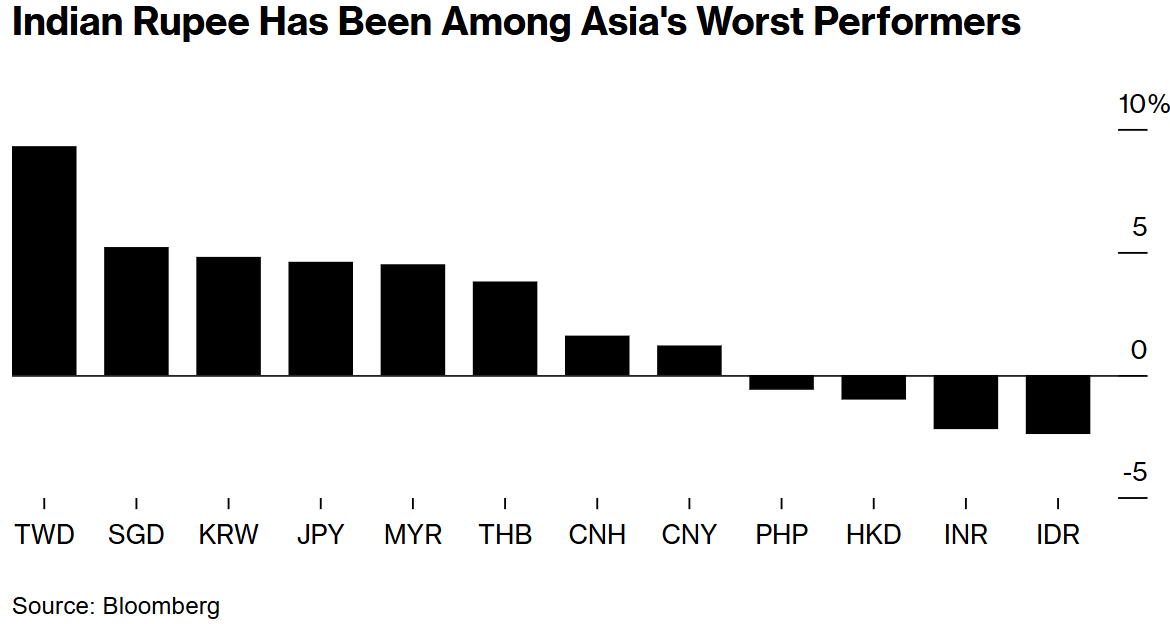
Group 1 - The Indian Rupee is expected to be one of the worst-performing currencies in Asia due to the pressure from increased tariffs imposed by the US, which is impacting India's already fragile economic recovery [1][3] - Analysts from Deutsche Bank and Barclays predict that the Rupee's exchange rate may fall to a historical low by the end of the year, driven by weak foreign capital inflows and tariff impacts [1][3] - The Indian stock market has experienced an outflow of $11 billion due to economic slowdown, and the central bank's interest rate cuts have further weakened support for the currency [1][3] Group 2 - Barclays estimates that high tariffs could reduce India's GDP growth rate by approximately 30 basis points [3] - The market is focused on the Indian central bank's policy meeting on August 6 for clues on interest rate direction and Rupee trends, following an unexpected 50 basis point rate cut last month [3] - Despite foreign exchange reserves being near historical highs, Citigroup economists believe that uncertainty around tariffs limits the central bank's motivation to aggressively support the Rupee [3] Group 3 - The Rupee has depreciated by 1.2% last week, reaching an exchange rate of 87.5275 Rupees per US dollar, marking the largest weekly decline since December 2022 [3] - Some analysts remain optimistic about a potential trade agreement between the US and India, which could improve the situation for the Rupee [3] - Weak foreign capital inflows continue to be a headwind for the Rupee, with limited prospects for significant bond market inflows due to the central bank's indication of limited rate cut space [3][4]

贺博生7.18黄金原油震荡上涨晚间行情走势分析及美盘最新独家操作建议
Sou Hu Cai Jing· 2025-07-18 16:39
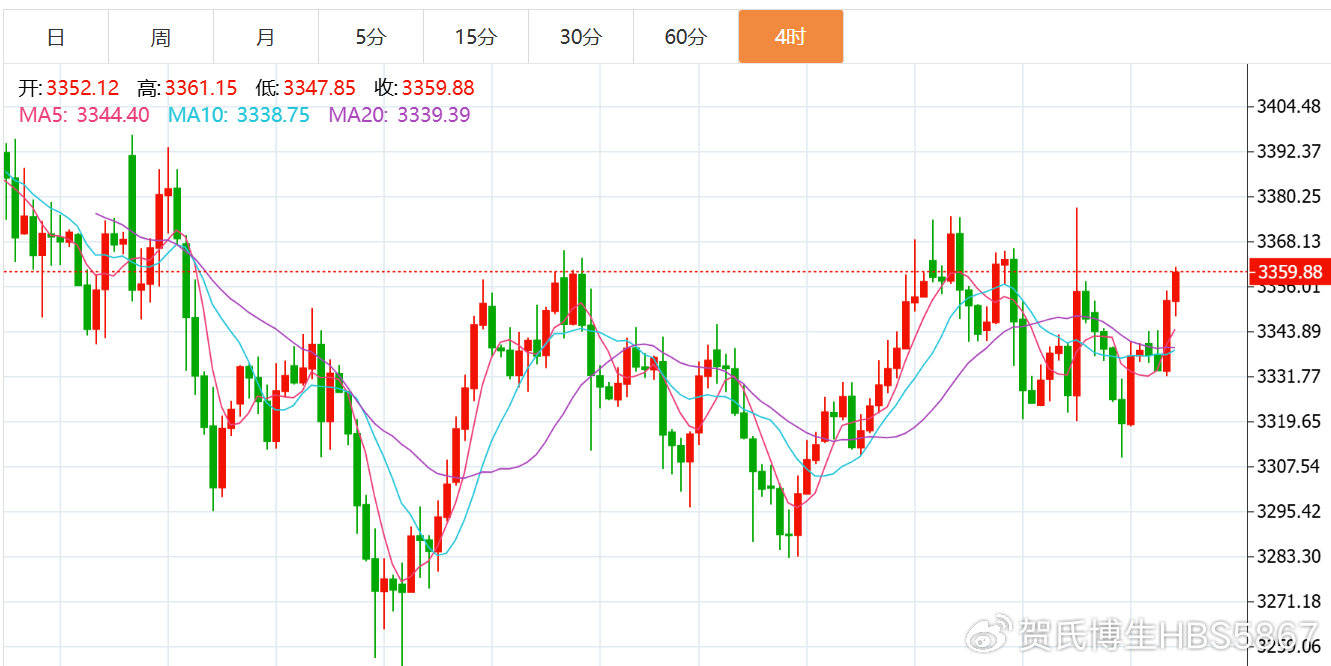
Group 1: Gold Market Analysis - The current gold price is experiencing a narrow upward fluctuation, trading around $3359.05 per ounce, following a significant "V-shaped" movement influenced by strong U.S. retail sales and declining unemployment claims [2] - Despite a temporary spike in the U.S. dollar index to 98.95, which pressured gold prices down to a low of $3309.82, strong buying interest emerged, indicating a hidden demand for gold amid inflation concerns [2][3] - The market shows a divergence between rising U.S. Treasury yields and gold prices, suggesting a significant disagreement regarding the Federal Reserve's policy direction [2] Group 2: Technical Analysis of Gold - The gold market is characterized by a bullish trend with high-level fluctuations, with key support levels identified at $3310 and resistance levels at $3375 [3][5] - The trading strategy suggests focusing on the effective profit space within the range of $3375 to $3310, with specific short-term targets set at $3355 to $3320 [3][5] - The Bollinger Bands indicate a consolidation phase, and traders are advised to monitor the boundaries of the trading range for effective transactions [5] Group 3: Oil Market Analysis - International oil prices are stabilizing at high levels, with Brent crude at $69.44 per barrel and WTI crude at $67.46 per barrel, influenced by supply concerns from Iraq and demand uncertainties due to potential U.S. tariffs [6] - The resilience of the U.S. economy is alleviating trade-related concerns, which is positively impacting oil demand outlooks, despite ongoing structural tensions in the oil market [6] - The potential for rising oil prices remains, especially if the U.S. economy continues to show strength and inventory levels do not recover significantly [6] Group 4: Technical Analysis of Oil - The medium-term outlook for oil prices remains bullish, with a potential upward test towards $78, although short-term momentum indicators suggest a weakening of bullish momentum [7] - The short-term trend indicates a slight upward movement, with key resistance levels identified at $70.5 to $71.5 and support levels at $67.0 to $66.0 [7]
DLS MARKETS:美联储会被迫在通胀与就业之间重新做选择吗?
Sou Hu Cai Jing· 2025-07-10 09:58
Group 1 - The latest Federal Reserve meeting minutes indicate a complex signal regarding monetary policy amid external shocks, particularly inflationary pressures from tariffs [1][3] - If tariff-induced price increases are sustained and exceed expectations, the Federal Reserve may consider maintaining a stricter monetary policy stance, even if core inflation data temporarily declines [3] - The minutes acknowledge a potential "stagflation" scenario where rising inflation coincides with a weakening labor market, forcing the Federal Reserve to make difficult trade-offs between inflation and employment targets [3][4] Group 2 - Following the release of the minutes, short-term interest rate futures experienced increased volatility, reflecting investor uncertainty about potential rate cuts in September [4] - The Federal Reserve's policy path is becoming highly data-dependent, with no clear signals indicating whether inflation expectations are out of control or if there is significant deterioration in employment [4] - The current environment is characterized by political risks, disrupted global supply chains, and misaligned expectations between domestic prices and employment, making upcoming data crucial for future policy decisions [4]
避险资金涌入 瑞士法郎强势逆袭
Xin Hua Cai Jing· 2025-07-04 12:41
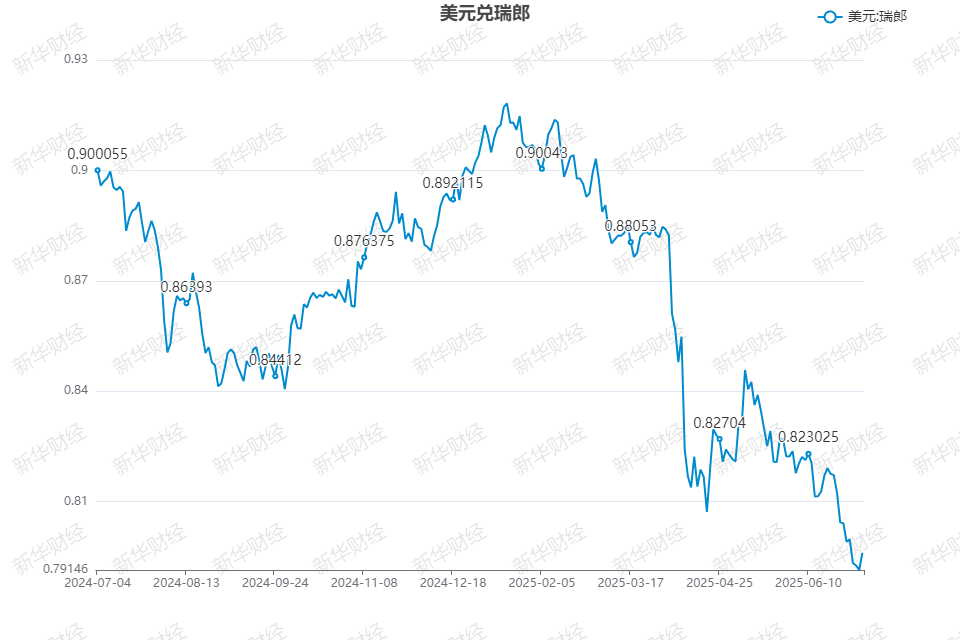
Core Viewpoint - The Swiss Franc (CHF) has shown significant growth in the global currency market in the first half of 2025, standing out among other currencies, while the Euro has performed moderately and the US Dollar faces depreciation pressure [1] Group 1: Swiss Franc Performance - The rise of the Swiss Franc is largely attributed to a surge in global risk aversion, driven by the reintroduction of tariffs by the US, creating uncertainty in global trade [2] - The CHF has become a traditional safe-haven asset, attracting substantial capital inflows as investors seek stability [2] - The exchange rate of the Euro/CHF has fluctuated between 0.9305 and 0.9425 since April 22, indicating a stable and strong appreciation trend [2] Group 2: Swiss National Bank (SNB) Policy - The Swiss National Bank has lowered its policy interest rate to zero in the first half of the year, successfully bringing inflation back into positive territory [2] - The Consumer Price Index (CPI) year-on-year growth rate in June was only 0.1%, leading to market expectations of a potential 25 basis point rate cut in September, which could reintroduce negative interest rates [2] - Despite the low CPI, signs of economic recovery were observed in the first quarter of 2025, reducing the urgency for significant monetary easing [2] Group 3: Market Dynamics and Future Outlook - The SNB's net foreign exchange purchases amounted to only 4.9 million CHF in the first quarter of 2025, reflecting a cautious approach [3] - The IMF has warned the SNB to be cautious with monetary policy tools amid an expanding balance sheet, especially in the context of potential deflationary pressures [3] - The Euro/CHF exchange rate has been in a downward trend since April 22, and any changes in risk appetite or policy expectations could trigger significant fluctuations [3] - Upcoming months are critical for the CHF, as the implementation of tariff policies, SNB monetary policy announcements, and Swiss macroeconomic data releases will directly influence market expectations and capital flows [3]
半年报看板|大类资产哪家强:美元美股“两重天”,铂金大涨48%
Xin Hua Cai Jing· 2025-07-01 14:04
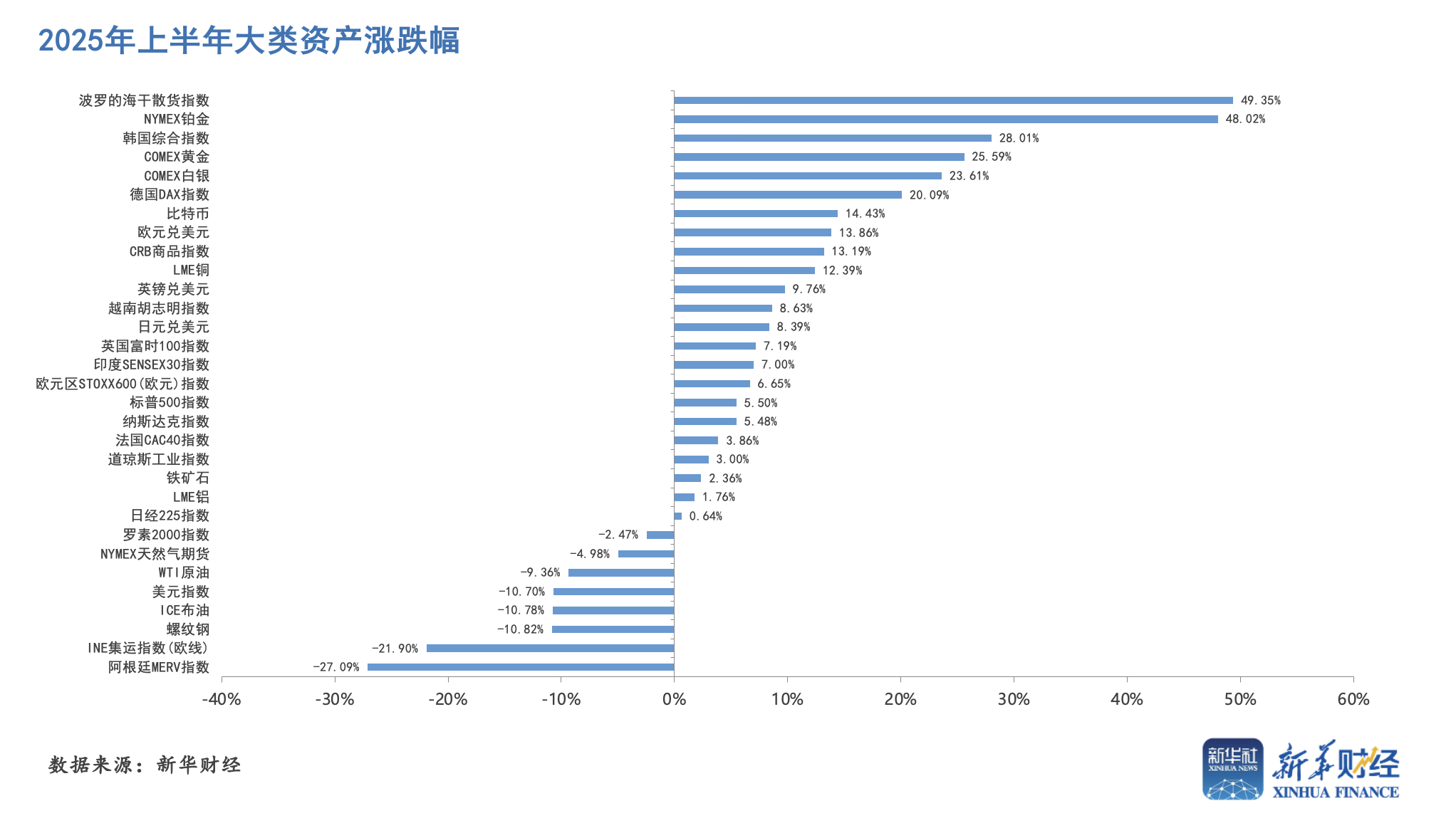
Group 1: Stock Market Performance - Global stock market risk appetite has steadily increased, with the S&P 500 and Nasdaq indices reaching record closing highs [1] - The S&P 500 index closed at 6204.95 points, up 25% from its low on April 9, while the Nasdaq rose over 34% from its low [5] - The Korean Composite Index surged over 28%, leading global stock markets, while the German DAX index saw a cumulative increase of 20% [1] Group 2: Commodity Market Trends - Gold prices rose significantly, with a 25.59% increase in the first half of the year, following a 19% rise in Q1 and a 6% increase in Q2 [1][8] - Platinum experienced a notable "catch-up" rally, with a cumulative increase of 48% in the first half of the year, while silver futures rose by 32.61% [1] - The COMEX gold futures saw a 5.67% increase in Q2, while platinum prices surged approximately 36.14% in the same period [8] Group 3: Currency Market Dynamics - The US dollar index fell over 10% in the first half of the year, marking the largest decline since 1973, while non-US currencies strengthened [1][5] - The euro appreciated by 13.8% against the dollar, and both the yen and pound rose by 8% [1] Group 4: Oil Market Analysis - International oil prices experienced wide fluctuations, with WTI crude oil reaching a high of nearly $80 per barrel and a low of around $55 [10] - OPEC+ has begun increasing production, with plans to add approximately 1.37 million barrels per day by July [11] - Analysts predict that oil prices may have reached their peak for the year, with expectations of a downward trend influenced by OPEC+ production increases [11]
希腊多举措缓解能源价格上涨压力
Jing Ji Ri Bao· 2025-06-27 22:08
Group 1: Energy Market Impact - The Israel-Palestine conflict has led to a significant increase in global energy prices, with international crude oil and natural gas prices rising approximately 7% and 6% respectively, and Greek wholesale electricity prices soaring nearly 40% year-on-year [1][2] - The potential closure of the Strait of Hormuz, a critical energy transport route, could result in oil prices exceeding $120 per barrel, further exacerbating fuel costs in Greece [2] - Greek energy companies anticipate increases in gasoline and diesel prices by approximately €0.20 and €0.36 to €0.38 per liter, respectively, due to rising fuel costs [2] Group 2: Tourism and Consumption Sector - The ongoing conflict has negatively impacted Greece's tourism sector, particularly from Israel, which was expected to see over 600,000 visitors in 2024, with a planned increase of nearly 46% in flight capacity by 2025 [3] - The suspension of flights to Israel has led to a significant drop in tourist arrivals, affecting local businesses reliant on tourism, especially in regions where Israeli tourists constitute a substantial portion of visitors [3] - The rising fuel prices are expected to increase transportation and production costs, leading to higher prices for goods and diminishing consumer purchasing power [4] Group 3: Government Response - The Greek government has implemented emergency measures to stabilize prices and protect livelihoods, including intensive inspections of gas stations and oil companies to prevent price gouging [5] - Regulatory actions include setting profit caps on fuel retail and imposing fines for violations, with amounts ranging from €5,000 to €5 million [5] - The government is also collaborating with the EU to secure strategic oil and gas reserves and is accelerating renewable energy projects to reduce dependence on external energy sources [6]
KVB PRIME:多个关键数据将公布 英镑回吐涨幅进入盘整
Sou Hu Cai Jing· 2025-05-15 03:57
Core Viewpoint - The GBP/USD exchange rate is experiencing a volatile pattern, currently at 1.3278 with a daily increase of 0.16%, as market focus shifts to significant economic data releases from the UK and the US, along with remarks from Federal Reserve Chairman Jerome Powell, which may catalyze a breakout from the current consolidation range [1][3]. Economic Data Summary - The UK is set to release its Q1 GDP preliminary value, with market consensus expecting a rebound in quarter-on-quarter growth from 0.1% to 0.6%, while year-on-year growth may slow from 1.5% to 1.2%, indicating uneven domestic demand recovery [3]. - In the US, the focus will be on the April retail sales data and PPI inflation report, with expectations for core PPI year-on-year growth to decline from 3.3% to 3.1%, amid concerns over the impact of tariff policies on imported inflation [3]. Technical Analysis Summary - The GBP/USD is forming a new balance range around the 1.3300 level, with the 50-day EMA acting as a critical support line near 1.3100. The MACD indicator shows a bearish divergence, while the RSI remains above the neutral level of 50, suggesting no clear bias between bulls and bears [4]. - A breakout above the 1.3300-1.3320 resistance zone could lead to a renewed upward trend towards the 1.3400 level, whereas a drop below the 1.3200 support could trigger technical selling, targeting the 1.3100 area [4]. - Market participants are cautiously weighing the differing policy paths of the two economies, with the Bank of England maintaining a restrictive stance but facing rising rate cut expectations due to slowing wage growth and declining service sector inflation [4].
瑞典银行下调瑞典经济增长预期 预计央行年内两次降息至1.75%
智通财经网· 2025-05-06 08:06
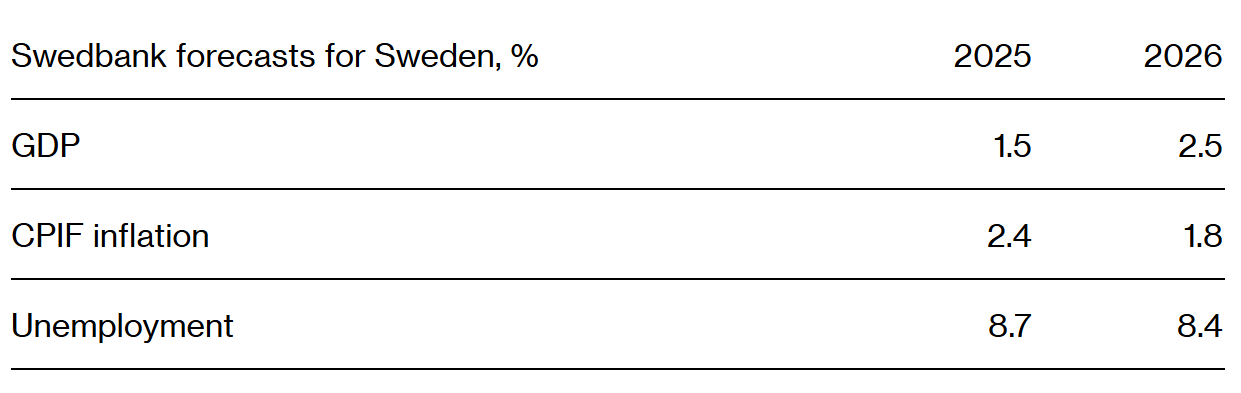
Core Viewpoint - Swedbank has significantly revised its forecast for the Swedish central bank's benchmark interest rate, now predicting a cumulative cut of 50 basis points to 1.75% by the end of Q3 this year, a major shift from the previous expectation of a single cut of 25 basis points to 2.25% in August [1] Group 1: Economic Conditions - The largest economy in the Nordic region is facing three pressures: external uncertainty due to U.S. trade policies, concerns over stagnation in domestic economic recovery, and persistent core inflation that constrains monetary policy [1] - Despite signs of overall inflation easing, the core CPI, excluding energy and food, remains sticky, contrasting with a potential GDP growth rate that may fall below 1.5% [1] Group 2: Trade Impact - The report emphasizes that the chain reaction from U.S. tariffs cannot be overlooked, as trade friction will impact the Swedish economy through reduced export orders, slowed business investment, and weakened consumer confidence [2] - Consequently, Swedbank has lowered its economic growth forecast for 2025 from 2.7% to 2.5%, while maintaining the growth estimate of 1.5% for this year [2] Group 3: Monetary Policy Outlook - For neighboring Norway, Swedbank maintains the baseline forecast for the European Central Bank to initiate rate cuts in September, with an added expectation of a second cut in December, predicting four consecutive cuts to 3% by 2026 [2] - Analysts note that the policy shift by the Swedish central bank reflects the unique challenges faced by Nordic economies, which must guard against imported inflation risks while addressing the impacts of protectionism on export-driven economies [2]
刚刚,大涨!
券商中国· 2025-04-09 10:18
Core Viewpoint - The article highlights a significant increase in gold prices due to rising geopolitical tensions and trade disputes, leading to heightened investor demand for safe-haven assets like gold [1][2][5]. Group 1: Gold Price Surge - On April 9, gold prices surged, with spot gold rising over 2% and reaching a peak of $3052 per ounce, while COMEX gold futures increased by 2.62% to $3068.5 per ounce [4][1]. - Year-to-date, both spot gold and COMEX gold futures have seen an increase of over 16%, outperforming major global stock indices [4][1]. - The rise in gold prices reflects investor anxiety over tariff threats and potential changes in global trade rules [4][1]. Group 2: Economic Impact of Tariffs - Trade tensions are contributing to an increasingly uncertain global economic outlook, with rising raw material costs expected to drive inflation in the U.S. [2][5]. - The implementation of "reciprocal tariffs" by the U.S. government is projected to increase the Personal Consumption Expenditures (PCE) index by 1.7% in the short term, with potential further increases if other countries retaliate [5][6]. - The uncertainty surrounding global tariff policies is expected to bolster demand for gold as a safe-haven asset [5][6]. Group 3: Gold ETF Inflows - In the first quarter of the year, gold-backed ETFs saw a net inflow of 226.5 tons, valued at $21.1 billion, marking the largest quarterly inflow in three years [7][1]. - The total holdings in gold ETFs increased by 3% to 3445.3 tons by the end of March, the highest level since May 2023 [7][1]. - The majority of the inflows came from the U.S. and Europe, with U.S.-listed gold ETFs leading with an inflow of 133.8 tons [7][1]. Group 4: Long-term Outlook for Gold - Analysts believe that the long-term logic for rising gold prices remains intact, driven by increased inflation and economic uncertainty due to tariffs [5][6]. - The potential for stagflation in the U.S. economy, coupled with high inflation and slowing growth, is expected to strengthen the case for gold as an investment [6][5]. - Ongoing geopolitical tensions and central bank demand for gold are anticipated to support a bullish outlook for gold prices [6][8].