牛市

Search documents
重大利好来了,稳了……
Sou Hu Cai Jing· 2025-10-29 10:55
Group 1 - The current market situation shows a trading volume of nearly 2.3 trillion, with the index reaching 4000 points, yet most investors are not making profits, as over 2000 stocks are declining [1] - The recent market rally is primarily driven by large-cap stocks, particularly in the technology sector, leading to a lack of participation from the majority of investors [1] - There is speculation about the potential positive impact of the Asia-Pacific conference, raising questions about whether the 4000-point mark is just the beginning of a larger upward trend [1] Group 2 - The market is anticipating a significant positive development with a high probability of a Federal Reserve interest rate cut, which could further solidify the 4000-point level [2] - A shift in market sentiment is expected once the large-cap stocks' collective investment style changes, potentially leading to widespread profitability for investors [2] Group 3 - Investors are advised to adopt a patient approach, emphasizing the importance of waiting for the right opportunities rather than rushing into trades, especially during challenging market conditions [5]


牛市氛围暴增!ETF资金两头押注
格隆汇APP· 2025-10-29 09:31
Core Insights - The article discusses the significant increase in ETF (Exchange-Traded Fund) investments amid a bullish market sentiment, highlighting the dual-sided betting by investors [1] Group 1: Market Trends - There has been a notable surge in ETF inflows, indicating a strong bullish sentiment in the market [1] - Investors are increasingly diversifying their portfolios by betting on both long and short positions within ETFs [1] Group 2: Investment Strategies - The article emphasizes the importance of strategic allocation in ETFs to capitalize on market volatility [1] - It mentions that investors are utilizing ETFs as a tool for hedging against potential market downturns while still participating in upward trends [1]

外资大幅流出印度股市
第一财经· 2025-10-29 08:04
2025.10. 29 本文字数:2343,阅读时长大约4分钟 作者 | 第一财经 后歆桐 据媒体数据,截至27日,今年以来印度股市中的外国投资者已经撤出超过170亿美元的资金,降至多年来低点, 与2023年外国资金净流入达200亿美元形成鲜明反差。这也使得印度成为亚洲外国投资组合资金流出情况最严重 的市场。 虽然外资大幅流出,但在美印接近于达成贸易协议消息的提振下,印度Nifty 50指数上周一度连续六日收涨,创 下自9月12日以来最长连涨纪录,逼近历史高位。上周五,Gift Nifty期货上涨至26300点,预示印度股市有望 突破前期高点。Gift Nifty期货是一种以美元计价的衍生品合约,追踪Nifty 50指数的表现。29日,Nifty 50指 数报26011.30点,继续在历史高位附近徘徊。本月也有望录得自3月以来最佳月度表现。 来源:新华社 美印接近达成贸易协议 当前美印接近达成贸易协议,美国可能将对印关税从50%降至15%~16%。据印度媒体报道,作为谈判的关键筹 码,能源与农业成为核心议题。印度方面或同意逐步减少从俄罗斯进口的石油,以换取美方的关税让步。据悉, 该贸易协议的第一阶段成果预计将 ...
上证指数十年后再破4000点 老股民的赚钱经验失效了?
Nan Fang Du Shi Bao· 2025-10-29 06:30
Core Points - The Shanghai Composite Index (SHCI) has surpassed the 4000-point mark for the first time since August 18, 2015, marking the third historical breakthrough of this level [1][2] - This milestone has sparked a debate among investors, particularly between new and old stockholders, regarding market sentiment and investment strategies [2][3] - Historical data indicates that previous surges past 4000 points occurred during bull markets in May 2007 and April 2015, leading to optimistic expectations for the current market [2][4] Market Performance - On October 28, the SHCI reached a peak of 4010.73 points, with trading volume at 2.17 trillion yuan, slightly down from 2.36 trillion yuan the previous day but still above 2 trillion yuan, indicating active market participation [2][5] - Despite the index's rise, many investors feel that making profits in the current A-share market has become more challenging, attributed to sector rotations and varying performance across industries [4][6] Investor Sentiment - There is a noticeable divide in sentiment between seasoned investors, who are cautious due to past market volatility, and newer investors, who are more optimistic about the current market dynamics [3][4] - A significant number of investors have expressed concerns about historical patterns repeating, while others believe in the transformative potential of current market conditions [4][7] Fund Management Trends - The number of new A-share accounts opened in September reached 2.937 million, the second-highest monthly figure of the year, reflecting growing interest despite being lower than the peak in October 2024 [5][6] - Active management equity funds have seen a resurgence in new issuances, with 561 billion yuan raised in Q3 2025, while also experiencing significant redemptions, indicating a shift in investor behavior [5][6] Market Structure and Future Outlook - The current market rally is primarily driven by the technology sector, with high levels of institutional investment in growth-oriented industries [7][8] - Analysts suggest that a stable and healthy slow bull market is necessary to alleviate concerns among older investors and validate the optimistic outlook driven by technological advancements [7][8] - Regulatory measures aimed at enhancing investor protection are expected to bolster confidence in the market, contributing to its maturation and the potential for sustained growth [8]
A股突发!“牛市旗手”爆发,发生了什么?
Zheng Quan Shi Bao Wang· 2025-10-29 05:30
Group 1 - The core viewpoint of the news is that A-share brokerage stocks have collectively surged, driven by better-than-expected Q3 performance and the Shanghai Composite Index breaking the 4000-point mark, which has boosted market sentiment [1][2][4] - As of October 28, 14 brokerages reported Q3 earnings, with 13 comparable brokerages' net profit totaling approximately 46.726 billion yuan, reflecting a year-on-year increase of 46.42%, indicating a high-growth trend in the sector [2] - Multiple institutions view the brokerage sector as a "relatively undervalued + high growth" asset, with expectations for continued performance improvement in investment banking, derivatives, and public fund businesses [2][3] Group 2 - The Shanghai Composite Index successfully surpassed the 4000-point threshold, closing at 4002.83 points, with a 0.37% increase, while the Shenzhen Component Index and the ChiNext Index also saw significant gains [4][5] - The market's trading volume reached 1.42 trillion yuan, an increase of 719 billion yuan compared to the previous trading day, indicating heightened market activity [4] - Analysts believe that the current market conditions suggest a continuation of the bull market, with the potential for further upward movement as the market remains in the early stages of a bull cycle [5][6] Group 3 - The current strategic position of the capital market is improving, with regulatory bodies working together to attract long-term funds and enhance market activity, which is expected to create strategic allocation opportunities for brokerages [3] - The brokerage sector is anticipated to continue its valuation recovery, supported by strong earnings, favorable policies, and increased market activity [3][6] - There is a shift in market dynamics towards large-cap growth stocks, with expectations for institutional investors to increase their holdings in emerging growth sectors, reflecting a balanced impact on market styles [6]





站上4000点!重磅利好突袭!
天天基金网· 2025-10-29 05:24
Market Overview - The Shanghai Composite Index has once again surpassed 4000 points, with a notable increase of 0.37% to close at 4002.83 points [6] - The Shenzhen Component Index rose by 0.9%, while the ChiNext Index increased by 1.35% [6] Key Highlights - The stock market is witnessing significant movements in four main sectors: computing power industry, financial sector, new energy sector, and non-ferrous metals [3][4][5][6] Computing Power Industry - Nvidia's stock reached an all-time high, stimulating the computing power industry chain, with Industrial Fulian seeing a 7.16% increase and hitting a historical high market capitalization of 1.57 trillion yuan [3] Financial Sector - The financial sector is experiencing a surge, particularly in the securities segment, with Huazhang Securities hitting the daily limit and a notable increase in trading volumes [4][8] - The securities sector is viewed as having a strategic configuration opportunity, with the A-share market capitalization exceeding 100 trillion yuan, enhancing long-term growth potential for brokerage firms [12] New Energy Sector - The new energy sector is rebounding, with leading stocks such as CATL, Longi Green Energy, and Sungrow Power seeing significant gains [5][14] - Sungrow Power reported a 32.95% year-on-year increase in revenue for the first three quarters, amounting to 66.402 billion yuan, and a 56.34% increase in net profit [16] - CATL's third-quarter report showed a revenue of 283.072 billion yuan, up 9.28% year-on-year, and a net profit of 49.034 billion yuan, reflecting a 36.2% increase [17] Non-Ferrous Metals Sector - The non-ferrous metals sector is also experiencing a rebound, with industrial metals leading the gains [6] Quantum Technology Sector - The quantum technology sector is seeing significant growth, with stocks like Keda Guokuan and Fujida experiencing substantial increases [18] - Recent positive news in the quantum technology field includes Nvidia's announcement of a new architecture aimed at integrating GPU computing with quantum processors, and the awarding of the 2025 Nobel Prize in Physics to notable quantum physicists [21] - Investment opportunities in quantum information are being highlighted, particularly in quantum computing, communication, and precision measurement [21]






沪指盘中再次站上4000点!“牛市旗手”拉升
Zheng Quan Ri Bao Zhi Sheng· 2025-10-29 04:44
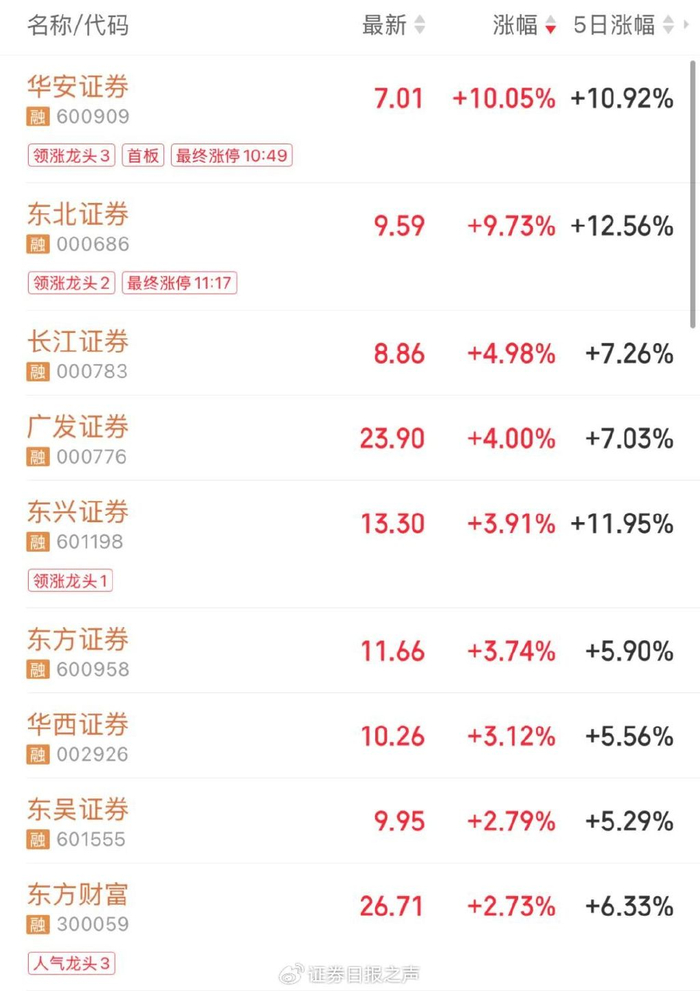
Core Viewpoint - The capital market is experiencing a series of positive changes, with the Shanghai Composite Index hovering around the 4000-point mark, driven by multiple favorable factors including policy support and expected significant growth in the third-quarter performance of listed securities firms [1] Market Performance - As of October 29, the Shanghai Composite Index rose by 0.37% to close at 4002.83 points, while the securities sector outperformed with an overall increase of over 2% [1] - Notable performers include Huazhong Securities, which hit the daily limit, and Northeast Securities, which saw a rise of over 9% [1] Securities Firms' Performance - Huazhong Securities reported a revenue of 4.423 billion yuan and a net profit of 1.883 billion yuan for the first three quarters, marking year-on-year increases of 67.32% and 64.71%, respectively [2] - The third quarter alone saw a net profit of 848 million yuan, a year-on-year growth of 97.61%, placing it among the top performers in the disclosed third-quarter reports [3] Margin Financing - The margin financing balance has surpassed 2.49 trillion yuan, setting a new historical record, with a total of 24,947.6 billion yuan as of October 28 [3] - The financing balance increased by 127.03 billion yuan from the previous trading day, indicating strong market activity [3] Sector Outlook - Analysts express optimism regarding the future performance of the securities sector, anticipating that the third-quarter results of listed firms may exceed previous expectations [3] - The outlook for investment banking, derivatives, and public funds is expected to improve, with leading firms likely to see an expansion in return on equity [3]




华安证券封板涨停,业绩大增表现亮眼!“牛市旗手”证券ETF(159841)涨超2.5%,近10日“吸金”超5亿元
Sou Hu Cai Jing· 2025-10-29 04:25
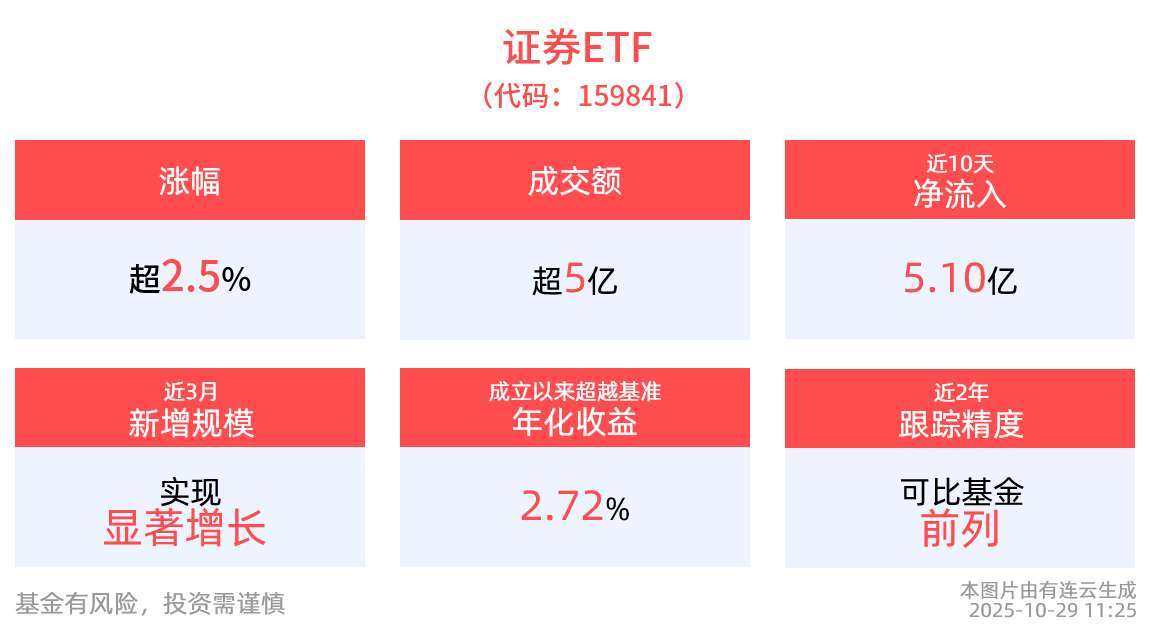
Core Insights - The securities ETF (159841) has seen a significant increase of 2.53% as of October 29, 2025, with a trading volume of 513 million yuan, indicating strong market interest in the securities sector [3] - The ETF has experienced a substantial growth of 4.601 billion yuan over the past three months, reflecting a robust inflow of capital [3] - The ChiNext ETF Tianhong (159977) has also shown positive performance, rising by 1.49% with a trading volume of 78.213 million yuan, and has grown by 582 million yuan in size over the last three months [3] Securities ETF Performance - The securities ETF (159841) has seen individual stocks such as Huazhong Securities (600909) and Northeast Securities (000686) rise by 10.05% and 9.38% respectively, indicating strong performance within the sector [3] - The ETF has recorded net inflows for 7 out of the last 10 trading days, totaling 510 million yuan, showcasing investor confidence [3] ChiNext ETF Performance - The ChiNext ETF Tianhong (159977) has tracked significant gains in component stocks like Sanhuan Group (300408) and Xianlead Intelligent (300450), which rose by 9.19% and 7.05% respectively [3] - The ETF has achieved a notable increase in trading volume, with a total of 20.81 million shares traded over the past three months [3] Company Highlights - Huazhong Securities reported a 60.72% increase in revenue for Q3 2025, with net profit soaring by 97.61% to 848 million yuan, indicating strong operational performance [4] - Western Securities announced a staggering 510.16% increase in net profit for Q3 2025, reaching 459 million yuan, reflecting a significant enhancement in core profitability [5] Institutional Perspectives - Guangfa Securities highlighted that the "14th Five-Year Plan" presents new opportunities for financial integration, emphasizing the need for the financial system to align with national strategies [6] - The ongoing industrial upgrades and technological innovations are expected to create structural opportunities, enhancing market resilience and risk management capabilities [6]
沪指十年再破4000点,大数据揭秘A股到底贵不贵
21世纪经济报道· 2025-10-29 01:34
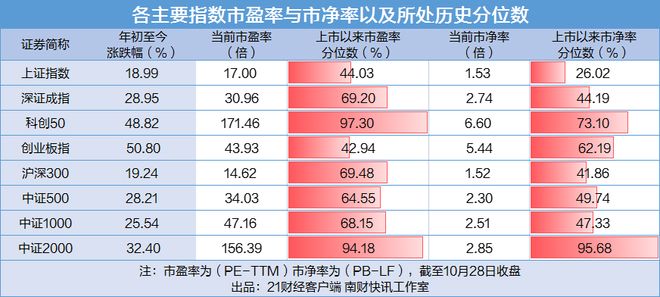
Core Viewpoint - The A-share market has reached a significant milestone, with the Shanghai Composite Index surpassing the 4000-point mark for the first time since August 2015, indicating a potential bullish trend in the market [1]. Market Performance - As of October 28, the Shanghai Composite Index has recorded a year-to-date increase of 18.99%, while the Shenzhen Component Index has risen by 28.95%. The Sci-Tech 50 and ChiNext indices have seen even higher gains of 48.82% and 50.8%, respectively [1]. - The total trading volume in the A-share market reached 2.16 trillion yuan, marking the 127th consecutive trading day with a turnover exceeding 1 trillion yuan, reflecting active market participation [6]. Valuation Potential - The current price-to-earnings (P/E) ratio for the Shanghai Composite Index stands at 17 times, which is at the 99.96 percentile of the past decade, indicating a relatively low valuation compared to historical levels [3]. - The Shenzhen Component Index has a P/E ratio of 30.96 times, positioned at the 83rd percentile over the last ten years, while its price-to-book (P/B) ratio is at 49.88 percentile, suggesting limited valuation pressure [3][4]. - The CSI 300 Index, representing large-cap blue-chip stocks, has a P/E ratio of 14.62 times, significantly below historical peaks, indicating a stable valuation environment [3]. Market Activity and Leverage - The average daily trading volume has exceeded 1.6 trillion yuan this year, a record high, with several instances of daily trading volumes surpassing 3 trillion yuan [6][7]. - The proportion of margin financing to the market capitalization is at 2.51%, well below the historical peak of 4.72% in July 2015, indicating that leverage is under control [7]. Sector Performance - The current market rally is characterized by a strong emphasis on technology sectors, with the electronics and communications industries showing significant gains of 191.89% and 124.61%, respectively, since the index began its ascent from 3000 points [9]. - The P/E ratio for the electronics sector is currently at 66.88 times, while the computer sector stands at 56.62 times, reflecting high investor interest in technology stocks [9][10]. Future Outlook - The chief economist at Qianhai Kaiyuan Fund suggests that the current market conditions indicate the potential for continued upward movement, with the 4000-point level possibly serving as a new starting point for the next market phase [12].

沪指十年再破4000点,大数据揭秘A股到底贵不贵
2 1 Shi Ji Jing Ji Bao Dao· 2025-10-29 00:08
Core Viewpoint - The A-share market has reached a significant milestone, with the Shanghai Composite Index surpassing the 4000-point mark for the first time since August 2015, indicating a potential bullish trend in the market [1][2]. Market Performance - On October 28, the Shanghai Composite Index peaked at 4010.73 points but closed slightly down at 3988.22 points, marking a 0.22% decline. The total trading volume for the day was 2.16 trillion yuan, maintaining over 1 trillion yuan in daily trading for 127 consecutive days [1][4]. - Year-to-date, the Shanghai Composite Index has increased by 18.99%, while the Shenzhen Component Index has risen by 28.95%. The STAR 50 and ChiNext Index have seen even higher gains of 48.82% and 50.8%, respectively [1]. Valuation Potential - Despite the index levels returning to those of a decade ago, the long-term valuation of major indices still shows potential for growth. As of October 28, the Shanghai Composite Index's price-to-earnings ratio (PE-TTM) is 17 times, which is at the 99.96 percentile of the past decade, indicating a relatively low valuation historically [2][3]. - The Shenzhen Component Index has a PE of 30.96 times, positioned at the 83rd percentile over the last ten years, while the price-to-book ratio (PB-LF) is at 49.88 percentile, suggesting limited valuation pressure [2][3]. Trading Activity - The market's trading activity remains robust, with an average daily trading volume exceeding 1.6 trillion yuan this year, a record high. The A-share market has seen trading volumes above 1 trillion yuan for 127 consecutive days, with a notable period from August 13 to October 15 where trading exceeded 2 trillion yuan for 40 consecutive days [4][5]. Leverage Control - The proportion of leveraged funds remains manageable, with the financing balance accounting for 2.51% of the circulating market value, significantly lower than the historical peak of 4.72% in July 2015. The average maintenance guarantee ratio is 283.29%, well above the 140% warning line, indicating a safe margin for existing leverage [6][7]. Sector Performance - The current market rally is characterized by a strong emphasis on technology sectors. From September 26, 2024, to October 28, 2025, the electronic and communication sectors have seen substantial gains of 191.89% and 124.61%, respectively, contrasting with the construction sector's performance during the previous rally [7][8]. - The electronic industry currently has a PE of 66.88 times, while the computer industry stands at 56.62 times, reflecting significant investor interest in technology stocks. However, the electronic sector's PE is at the 97.03 percentile historically, indicating high valuation levels [7][8][9]. Future Outlook - The chief economist at Qianhai Kaiyuan Fund suggests that the current market conditions indicate the potential for continued upward movement, with the 4000-point mark possibly serving as a new starting point for the next phase of the market [7].