美元信用

Search documents
百利好晚盘分析:内部分歧加大 美元信用削弱
Sou Hu Cai Jing· 2025-05-20 09:06
Group 1: Gold Market - Trump's attendance at the U.S. Congress discussion on comprehensive tax legislation highlights significant internal divisions within the Republican Party regarding government spending, green tax policies, and social safety net projects [2] - If the tax bill is successfully passed, it may lead to a decrease in the likelihood of Federal Reserve interest rate cuts, which would be unfavorable for gold and beneficial for the repatriation of profits by overseas companies [2] - The rising pressure of U.S. debt is weakening investor confidence in the dollar, posing a threat to its credibility [2] - Technical analysis indicates that gold has not been able to break through the resistance at $3,250, maintaining a wide trading range between $3,120 and $3,250 [2] Group 2: Oil Market - OPEC+ announced an increase in production by 414,000 barrels per day starting in June, leading Wall Street to lower oil price forecasts [4] - Morgan Stanley predicts an oversupply of 1.1 million barrels per day in the second half of the year, while Goldman Sachs notes increased downward pressure on oil prices due to high OPEC+ production capacity and recession risks [4] - ING's commodity head suggests that OPEC+'s production increase may lead to a year-long oversupply, compounded by uncertain demand due to tariff policies [4] - Federal Reserve Vice Chairman Jefferson indicated signs of weakening economic activity, with inflation data moving closer to the 2% target, and uncertainty in tariff policies potentially leading to rising inflation [4] - Technical analysis shows oil prices have struggled to break above $62.50, with a likelihood of trading within a range of $55 to $64 [4] Group 3: Copper Market - Copper has been trading in a range of $4.50 to $4.68 since last week, with the adjustment phase nearing its end [5] - There is a higher probability of an upward breakout, with resistance at $4.68 and support at $4.50 [5]


特朗普说,只要贝森特出现在电视上,市场就会上涨
Sou Hu Cai Jing· 2025-05-15 13:34
Core Viewpoint - The financial markets are exhibiting extreme sensitivity to statements made by influential figures, indicating a fragile market sentiment that could lead to significant volatility [1][3]. Group 1: Market Reactions - The yield on the 10-year U.S. Treasury surged to 4.536%, while the 20-year yield approached 5%, reflecting a level of market volatility typically triggered by major events [1]. - The dollar index experienced a sharp increase, while the Japanese yen appreciated, and gold prices fell significantly, suggesting tightening dollar liquidity and potential issues in the dollar financing market [5]. Group 2: Central Bank Concerns - The European Central Bank has begun requiring certain banks in the Eurozone to assess their resilience in the event of a dollar liquidity crunch, raising concerns about the Federal Reserve's ability to continue acting as a global liquidity provider [3][5]. - The Federal Reserve signaled its capability to provide dollar liquidity to other central banks through swap lines, but this raises fears about the consequences if such support is withdrawn [5]. Group 3: Global Financial System Vulnerability - The current situation highlights the fragility of the global dollar financing system, with the 10-year Treasury yield serving as a barometer for global dollar liquidity [7]. - The total global debt has reached $324 trillion, and the U.S. faces a significant challenge with $9 trillion in debt needing to be rolled over by 2025, raising questions about the sustainability of the dollar system [5]. Group 4: Shifts in Market Dynamics - The traditional strategies employed by the U.S. to stabilize the dollar's dominance are becoming less effective, as evidenced by the market's failure to respond positively to past measures [7][12]. - There is a growing skepticism regarding the reliability of the Federal Reserve's interventions, with many questioning the long-held beliefs about the safety of U.S. Treasuries and the effectiveness of quantitative easing [10][12]. Group 5: Future Implications - The ongoing situation suggests that the established financial norms may be eroding, leading to a potential reconfiguration of the global financial order as the cracks in the current system become more apparent [10][12]. - The dynamics of global economic competition have shifted from mere trade disputes to a deeper struggle for financial and monetary power, indicating a complex and evolving landscape [12].
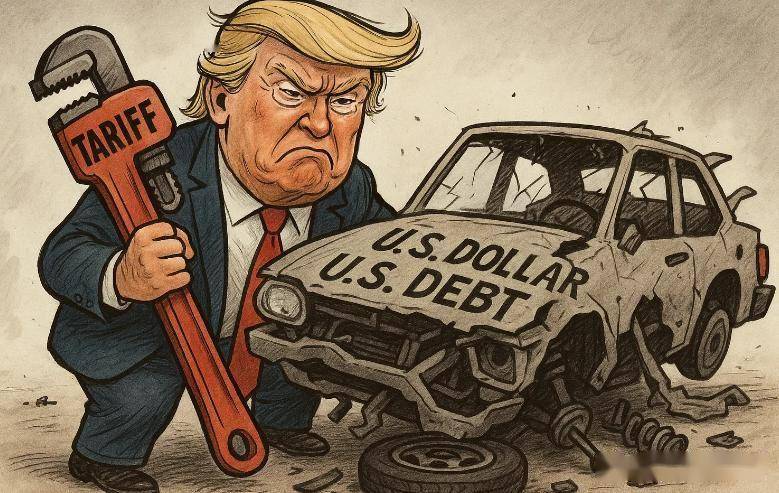
黄金时间·观点:关税风险暂时缓和,黄金短期仍有下行预期
Xin Hua Cai Jing· 2025-05-13 07:20
Group 1 - The international gold price experienced a significant decline, dropping over 2.6% on Monday and approximately 7.5% from the historical high of $3500 per ounce reached on April 22 [1] - Recent developments in trade talks and a decrease in geopolitical risks are the main short-term bearish factors for the gold market, including the positive outcomes from the US-Iran negotiations and the ceasefire agreement between India and Pakistan [1] - The US and UK have reached a new trade agreement, and substantial progress was made in the US-China high-level trade talks, resulting in the cancellation of 91% of additional tariffs by both sides, which has reduced pessimistic expectations regarding an economic recession triggered by the trade war [1] Group 2 - In the medium to long term, issues related to US dollar credibility and diversified central bank reserves will continue to support gold prices, driven by ongoing challenges to the authority of the US dollar due to the government debt ceiling crisis [2] - The trend of de-dollarization is leading to sustained demand for gold purchases by global central banks, with the International Monetary Fund (IMF) reporting a cumulative net purchase of 59 tons of gold by central banks by the first quarter of 2025, which will support gold prices [2]
中美谈判:谈或谈成可能性大吗?
李迅雷金融与投资· 2025-05-10 08:15
Core Viewpoint - The high tariffs exceeding 120% between China and the U.S. are unsustainable due to the strong economic interdependence, leading to expectations for negotiations to lower tariffs [1][2][3] Summary by Sections Tariff Overview - The U.S. has imposed tariffs on Chinese goods, starting with a 10% rate and escalating to 145% without prior communication with China, contrasting with the previous trade conflict where negotiations were ongoing [2][4] - China responded with tariffs of 125%, indicating a significant escalation in trade tensions compared to the 2018 trade disputes [4][5] Negotiation Dynamics - Recent statements from Chinese officials suggest a willingness to engage in discussions, but emphasize that negotiations should not be limited to tariff reductions alone [3][5] - The U.S. has introduced policies that restrict investments and impose additional scrutiny on Chinese companies, which should also be part of any negotiation framework [5][6] Broader Economic Implications - The U.S. Trade Representative's actions against China's maritime logistics and shipbuilding industries could severely impact China's shipping and shipbuilding sectors, which dominate globally [6] - The potential for a U.S. debt crisis could create conditions favorable for negotiations, as the U.S. faces significant debt pressures [10][11] Political Context - The current U.S. administration is characterized by a strong anti-China sentiment, driven by key advisors advocating for aggressive trade policies [7][8][9] - The unpredictability of U.S. political dynamics may lead to shifts in negotiation strategies, especially under pressure from domestic economic conditions [12] Long-term Outlook - The ongoing trade conflict may be just the beginning of a broader struggle between the U.S. and China, with both sides likely to continue exerting pressure in various domains [13][14]

五矿期货贵金属日报-20250507
Wu Kuang Qi Huo· 2025-05-07 02:34
贵金属日报 2025-05-07 贵金属 钟俊轩 贵金属研究员 从业资格号:F03112694 交易咨询号:Z0022090 电话:0755-23375141 邮箱: zhongjunxuan@wkqh.cn 沪金涨 1.60 %,报 809.28 元/克,沪银涨 0.45 %,报 8275.00 元/千克;COMEX 金跌 0.99 %, 报 3389.40 美元/盎司,COMEX 银跌 0.24 %,报 33.30 美元/盎司; 美国 10 年期国债收益率 报 4.3%,美元指数报 99.49 ; 市场展望: 受中美贸易谈判消息影响,市场关于全球贸易及关税风险的预期有所缓和,这对于国际金价形 成短线利空因素。截至北京时间早盘 7 点,现货黄金早盘累跌 50 美元,下破 3380 美元/盎司。 昨日期货盘面以及国内黄金 ETF 的持仓表现有所分化,受到节后多头持仓回补的影响,沪金总 持仓量在节后开盘至昨日夜盘结束期间出现增加,由 41.4 万手上升至 45.1 万手,沪金主力合 约区间上涨幅度达到 3.18%。但国内黄金 ETF 的申赎净持仓量在节后表现偏弱,WIND 统计口径 下国内主要 14 个黄金 E ...
美联储降息预期下,黄金与比特币为何成“新避险之王”?
Sou Hu Cai Jing· 2025-05-06 07:09
Core Viewpoint - The article discusses the rising interest in gold and Bitcoin as potential "new safe-haven assets" amid expectations of interest rate cuts by the Federal Reserve, prompting investors to consider which asset may be more favorable for risk management [1][3]. Group 1: Federal Reserve Rate Cuts and Market Reactions - The expectation of interest rate cuts has triggered a chain reaction in global capital markets, with a consensus forming around the logic of "preventive rate cuts" due to various instability factors [3]. - The U.S. federal debt has surpassed $36 trillion, with interest payments consuming a historically high proportion of fiscal revenue, leading to concerns about long-term inflation despite short-term relief from rate cuts [4]. - The yield curve for U.S. Treasury bonds has inverted, with the 10-year bond yield dropping below 4%, prompting a shift of funds from dollar assets to safe-haven assets like gold and yen [4]. Group 2: Gold as a Safe-Haven Asset - Gold has demonstrated resilience during market turmoil, with COMEX gold prices reaching a historical high of over $2,500 per ounce in March 2025, and currently trading at $3,393.4 per ounce [4][6]. - The demand for gold is supported by its historical role as a value store during crises, with a notable increase in gold ETF holdings during the 2024 Israel-Palestine conflict [6]. - Central banks globally have increased their gold purchases, with a net purchase of 1,136 tons in 2024, and China has been increasing its gold reserves for 16 consecutive months [6]. Group 3: Bitcoin's Position and Challenges - Bitcoin has shown a dual nature in 2025, being included in some institutional portfolios while still facing regulatory scrutiny and volatility [11]. - Despite a temporary price surge due to a halving event in April 2024, Bitcoin's correlation with risk assets remains high, as evidenced by an 18% drop during the 2024 U.S. stock market crash [12]. - Bitcoin's market capitalization is significantly lower than gold's, at $1.2 trillion compared to gold's over $13 trillion, limiting its capacity to absorb large-scale safe-haven investments [14]. Group 4: Investment Strategies - The article emphasizes the importance of understanding the underlying logic of both assets rather than chasing trends, suggesting that gold serves as a "ballast" for systemic risk, while Bitcoin is viewed as an "experiment" with high volatility and regulatory uncertainties [15].

特朗普被美债拿捏了
虎嗅APP· 2025-05-05 23:51
Core Viewpoint - The article discusses the recent fluctuations in U.S. Treasury yields and prices, highlighting the complex interplay between market dynamics, investor sentiment, and political factors, particularly under the influence of President Trump's policies. Group 1: U.S. Treasury Yield Dynamics - U.S. Treasury yields have risen significantly, with the 30-year yield surpassing 5% and the 10-year yield reaching 4.50%, indicating a decline in bond prices due to supply-demand imbalances [3][4]. - The rise in yields reflects a sell-off in U.S. Treasuries, contrary to expectations of them being a safe haven amid global uncertainties and rising risk aversion [7][9]. - The sell-off was exacerbated by forced liquidations from funds engaged in basis trading, leading to a vicious cycle of selling and rising yields [7][8]. Group 2: Political Influence and Market Sentiment - President Trump's approach to trade and monetary policy has contributed to a decline in market confidence in U.S. assets, with fears of escalating trade wars and pressure on the Federal Reserve [10][11]. - Trump's strategies, including potential tariff reductions and reassurances regarding the Federal Reserve's leadership, have temporarily alleviated selling pressure on Treasuries [12][13]. - The article suggests that Trump's political maneuvers may be aimed at creating crises that he can later resolve, thereby consolidating his political power ahead of the 2026 midterm elections [10]. Group 3: Changing Perception of U.S. Treasuries - U.S. Treasuries are increasingly viewed as risk assets rather than risk-free assets, with a rising risk premium reflecting diminished confidence in the dollar's creditworthiness [16][18]. - The article notes that the U.S. national debt has exceeded $36 trillion, with debt-to-GDP ratios over 120%, raising concerns about the sustainability of U.S. fiscal policy [16][18]. - The decline in the dollar's share of global reserves, projected to fall below 50% by 2026, indicates a shift in investor sentiment away from U.S. Treasuries [20][18]. Group 4: Default Risks and Market Reactions - While the immediate risk of a U.S. Treasury default is low, the article highlights ongoing concerns about the potential for a systemic crisis in confidence regarding U.S. assets [22][26]. - The U.S. government has various tools to avoid default, including negotiating for foreign purchases of Treasuries and potentially restructuring debt [22][23]. - The article warns that if confidence in Treasuries continues to erode, the Federal Reserve may have to intervene more aggressively, which could lead to inflationary pressures [25][26].
近两年投资理财哎,值得拿出来晒晒的只有这个了
Sou Hu Cai Jing· 2025-05-05 13:38
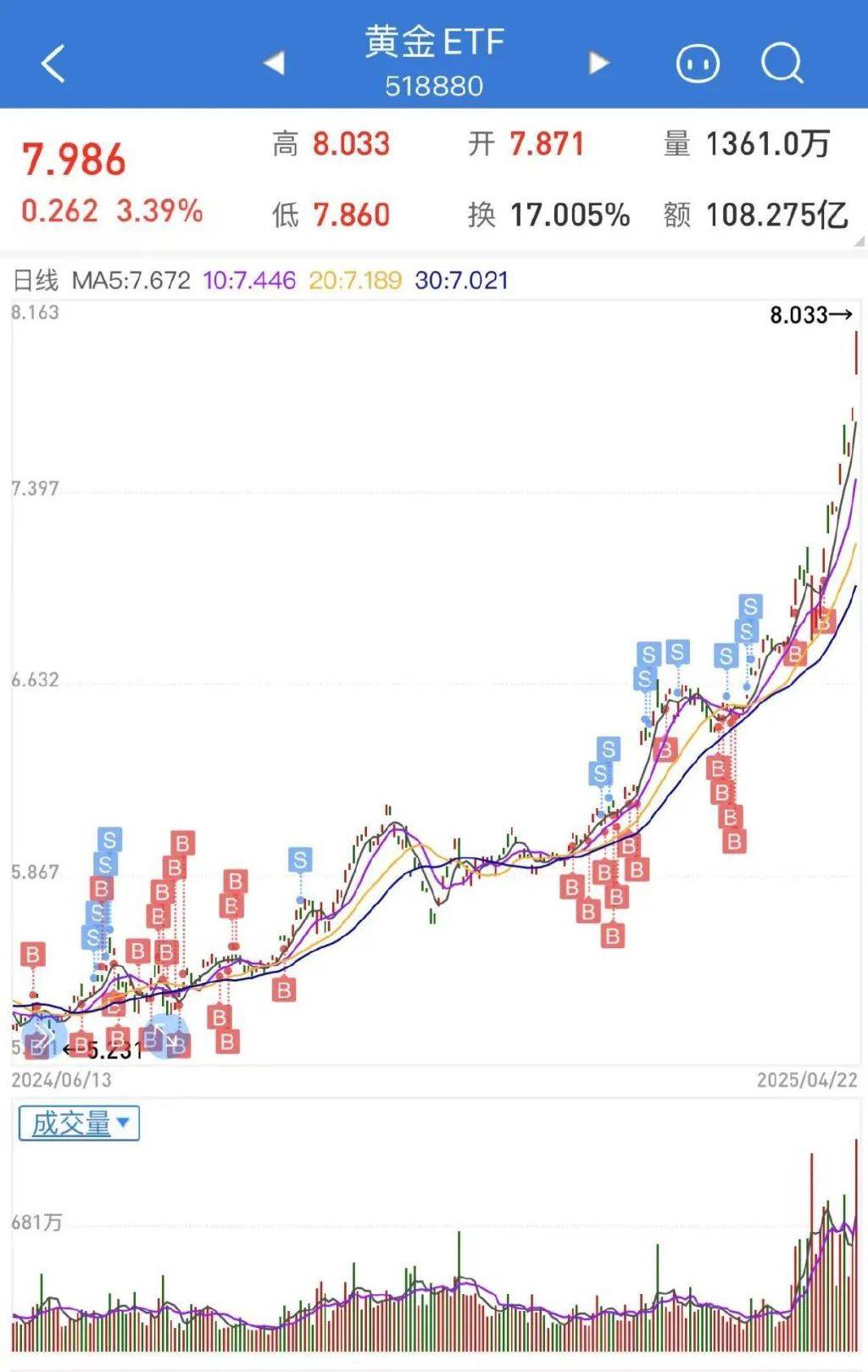
近段时间,有几位朋友问我黄金投资的事儿。 从 2018 年开始,老杨就一直在监测、研究黄金投资,在黄金投资这方面,我花了不少精力和时间,也积累了相当丰富的经验。 这可不是跟大家吹牛,咱们来看看我的交易图。 国内金价是跟着国际金价走的,我投资的是以人民币计价的黄金etf,交易操作简单,成本也很低。 这张日度交易走势图,上面记录了我的交易情况,有时候买入,有时候卖出,但总体处于持仓状态。 最近两次加仓,是在今年 3 月底和 4 月上旬。 | 黄金 ETF | 518880 | | | | | | | --- | --- | --- | --- | --- | --- | --- | | 量 1361.0万 | 高 8.033 | 开 7.871 | | | | | | 7.986 | | | | | | | | 0.262 3.39% | 额 108.275亿 | 换 17.005% | 低 7.860 | | | | | 日线 MA5:7.672 10:7.446 20:7.189 30:7.021 | 8.163 | 8.033- | | | | | | 7.397 | | | | | | | | 6.632 ...
六七月份,才是美国火上烤肉的日子,六点六万亿美元债务到期
Sou Hu Cai Jing· 2025-05-03 09:30
Core Insights - The U.S. is facing a significant debt repayment challenge, with $6.6 trillion due in June and July, indicating a critical financial situation [1] - The crisis is a result of three years of excessive monetary easing, which has led to a global reckoning as the U.S. attempts to offload its debt burden [3] - The U.S. military capabilities are deteriorating, with a significant portion of nuclear stockpiles nearing obsolescence and a limited shipbuilding capacity [3] - Market reactions to U.S. financial instability are becoming increasingly sensitive, with credit ratings being downgraded and the dollar's strength being questioned [5] - The U.S. is losing its global leadership status, with allies becoming wary of its reliability and commitment to international agreements [5][9] - Domestic criticism of U.S. policies is growing, with former officials expressing concern over the implications of rising debt on American citizens [9] - The upcoming months are crucial for global financial, diplomatic, military, and technological stability, with potential ripple effects beyond the U.S. [11] Financial Sector - The U.S. Treasury is grappling with an unprecedented debt repayment schedule, which could lead to broader financial instability [1] - Credit rating agencies have already begun to downgrade U.S. debt, reflecting a loss of confidence in the country's financial management [5] Military Sector - The U.S. military is at a critical juncture, with aging equipment and a reduced capacity for new shipbuilding, raising concerns about its operational readiness [3] Global Relations - The U.S. is perceived as increasingly isolated, with allies hesitant to engage, reflecting a shift in global power dynamics [5][9] - The credibility of U.S. commitments to international rules and agreements is being questioned, leading to a potential loss of influence [5] Domestic Impact - Rising national debt is becoming a pressing issue for American citizens, with implications for taxes, inflation, and social welfare [9] - There is a growing awareness among U.S. officials about the urgency of addressing the debt crisis, as it poses risks for future generations [9]
50多年来暴跌99%,美元相对黄金价值创历史新低,美元信用正被投不信任票!
Sou Hu Cai Jing· 2025-04-30 10:06
Group 1 - The World Gold Council's report indicates that global gold demand reached 1206 tons in Q1 2025, a 1% year-on-year increase, driven by a recovery in gold ETF demand which surged by 170% to 552 tons, the highest level since Q1 2022 [1] - Retail investment in China significantly boosted gold bar and coin demand, which rose by 3% year-on-year to 325 tons, marking the second-highest quarterly demand on record [1] - The value of the US dollar relative to gold has plummeted by 99% over the past 50 years, with the dollar's value hitting a historic low recently, reflecting a loss of confidence in the dollar [2][5] Group 2 - Since the end of the Bretton Woods system in 1971, the dollar's value measured in gold has decreased to about 1% of its original value, with gold prices soaring to over $3500 per ounce as of April 22, 2023 [3] - The M1 money supply in the US has expanded from $225 billion in 1971 to $18.56 trillion in March 2025, an increase of over 80 times, while gold production has only increased by about 200% during the same period [5] - Analysts predict that the price of gold could reach $3700 per ounce by the end of 2025, with potential increases to $4500 if economic conditions worsen [5] Group 3 - The current gold price rally has entered its 18th week, with prices fluctuating around $3300, indicating a potential turning point and increased volatility ahead [8] - Recent legislative actions in Arizona regarding Bitcoin reserves have prompted investors to reconsider the relationship between cryptocurrencies and gold, leading to a shift towards gold as a safer investment [8] - Gold prices are currently oscillating between $3260 and $3360, with key resistance at $3360 and support at $3300, suggesting continued short-term volatility [9]