AI泡沫

Search documents
政企双引擎驱动狂飙式增长! “AI应用神话”Palantir(PLTR.US)牛市逻辑依然坚挺
Zhi Tong Cai Jing· 2025-12-16 02:32
Core Viewpoint - Palantir Technologies remains fundamentally strong despite recent stock price corrections attributed to "AI bubble" concerns, with accelerating adoption of its AI application tools by enterprises and government [1][6] Group 1: Company Performance - Palantir's stock price has increased over 150% in the past year, with a target price of $255 set by Bank of America analysts, indicating further upside potential [2][6] - The company has experienced rapid revenue growth with year-over-year increases of 63%, 48%, and 39% over the past three quarters, reflecting strong demand for its AI application ecosystem [7] Group 2: AI Application and Market Position - Palantir's AI platform, AIP, has been adopted by over 100 organizations globally, including in healthcare and automotive sectors, and is in discussions with over 300 additional companies [4][5] - The company is expanding its influence in the AI application field, with significant contracts from the U.S. government and defense sectors, including a recent $448 million agreement with the U.S. Navy [6][7] Group 3: Market Trends and Expansion - The investment landscape is shifting from the "Magnificent Seven" tech giants to a broader array of AI infrastructure and application software leaders, indicating a structural expansion of the "AI winner's circle" [3] - Cboe has introduced the "Cboe Magnificent 10 Index," which includes Palantir, reflecting market consensus that AI beneficiaries extend beyond the original seven tech giants [3]

美股AI投资到底有没有泡沫
Xin Lang Cai Jing· 2025-12-16 02:10
Core Viewpoint - The article emphasizes the need to abandon "bubble anxiety" and "scale worship," advocating for a long-term perspective in core technology investment and a pragmatic approach to commercialization for the healthy development of the AI industry [2][15]. Group 1: Structural Bubble - The debate over the AI bubble in the U.S. is fundamentally about the imbalance between high investment and low returns, manifesting differently across hardware, software, and application dimensions [16]. - In the hardware sector, the "computing power arms race" has led to uncontrolled capital expenditure, with NVIDIA being the primary beneficiary, showing signs of bubble pressure despite a 210% year-on-year increase in AI chip revenue for Q3 2025 and a gross margin of 78% [16][18]. - NVIDIA's stock price and valuation are increasingly characterized by bubble traits, with a current P/E ratio exceeding 75 times, significantly higher than the semiconductor industry's average of 30 times, and a market cap that once surpassed $3 trillion [16][18]. Group 2: Risks in the Ecosystem - NVIDIA's "binding prosperity" with the AI ecosystem poses a risk, as major clients like Microsoft and Google prepay large orders, creating a cycle that ties NVIDIA's performance to the financing heat of the AI industry [17]. - A 32% year-on-year decline in global AI startup financing in 2025 has led to some small clients canceling or delaying chip orders, resulting in a 15% quarter-on-quarter decline in NVIDIA's AI chip shipment growth [17]. Group 3: Capital Expenditure Trends - Major tech giants, including Microsoft, Amazon, and Google, are expected to exceed $470 billion in capital expenditure by 2026, doubling from 2024, with nearly 60% directed towards NVIDIA, amplifying the risk of over-investment [18]. - Oracle's capital expenditure for FY 2026 has been raised to $50 billion, a 136% increase year-on-year, which constitutes 75% of its revenue, leading to a negative free cash flow of $10 billion [18]. Group 4: Software Sector Challenges - The software sector is experiencing a commercial shortfall masked by circular financing, with OpenAI planning to invest $1.4 trillion over several years but still projected to incur a loss of $115 billion by 2029 [19]. - The valuation of leading AI companies is severely disconnected from their performance, with Palantir's P/E ratio exceeding 180 times and Snowflake nearing 140 times, raising concerns about the sustainability of these valuations [19]. Group 5: Application Bottlenecks - The commercialization bottleneck is increasingly evident, with few scalable profit-generating scenarios despite the unprecedented popularity of generative AI [20]. - Major tech companies' AI-related revenue growth is insufficient to cover their substantial capital expenditures, leading to negative free cash flow projections for companies like Meta and Microsoft by 2026 [20]. Group 6: Comparative Analysis of U.S. and China - China's AI investment is characterized by "excessive rationality and insufficient heat," with a total capital expenditure of approximately 400 billion yuan by 2025, only one-tenth of that of U.S. peers [22]. - Chinese companies are avoiding the U.S. path of "stacking computing power," making steady progress in domestic chip replacement, while local AI models are rapidly iterating and adapting to domestic application scenarios [23]. Group 7: Strategic Differences - The differences in AI investment strategies between the U.S. and China stem from their respective development models, with the U.S. adopting an aggressive approach and China focusing on steady progress while controlling risks [24]. - For the U.S., addressing AI bubble risks involves shifting investment focus from computing power accumulation to technological innovation and efficiency improvement [24].



明年将发债支持国补,摩尔线程回应拿钱理财 | 财经日日评
吴晓波频道· 2025-12-16 00:30
Group 1: National Policies and Economic Measures - The Ministry of Finance plans to issue 1.5 billion yuan in special long-term bonds in 2024 to support consumer subsidies for vehicle trade-ins and related appliances, with an additional 3 billion yuan expected in 2025 [2] - The "national subsidy" policy has positively impacted domestic consumption over the past two years, with consumer goods trade-ins generating over 2.5 trillion yuan in sales from January to November, benefiting over 360 million people [2] - The coverage of the "national subsidy" policy is expected to continue expanding, particularly for durable consumer goods like refrigerators and televisions [2] Group 2: Real Estate Market Trends - In November, the sales prices of new residential properties in major cities showed a month-on-month decline, with first-tier cities down 0.4% and second and third-tier cities down 0.3% and 0.4% respectively [4] - The introduction of "home purchase interest subsidies" in several cities has led to a short-term increase in new home transactions by over 15% [4] - The real estate market is experiencing a downturn, with second-hand homes showing stronger sales performance compared to new homes due to price reductions by individual landlords [4][5] Group 3: Industrial Growth and Economic Indicators - In November, the industrial added value for large-scale enterprises grew by 4.8% year-on-year, with a month-on-month increase of 0.44% [6] - High-tech manufacturing sectors, such as 3D printing and industrial robotics, saw significant growth, with production increasing by 100.5% and 20.6% respectively [6] - The overall industrial growth rate is being constrained by weak demand and ongoing adjustments in the real estate market, leading to a cautious economic recovery [6] Group 4: Corporate Debt and Financial Challenges - Vanke's attempt to extend the maturity of a 2 billion yuan bond faced obstacles, as none of the proposed extension plans received the required 90% approval from bondholders [7][8] - The company is at risk of default if an agreement is not reached within the grace period following the bond's maturity [7] - Vanke's financial struggles are compounded by reduced support from state-owned shareholders, indicating a challenging path ahead for the company [8] Group 5: Technology and Market Developments - iRobot has filed for Chapter 11 bankruptcy protection, facing significant financial difficulties with liabilities exceeding 500 million dollars and cash reserves of only 24.8 million dollars [9][10] - The company, once a leader in the robotic vacuum market, has struggled to keep up with competitors offering better technology at lower prices [10] - Samsung is in discussions with AMD regarding potential collaboration on 2nm chip manufacturing, aiming to enhance its position in the high-end semiconductor market [11]



财信证券晨会纪要-20251216
Caixin Securities· 2025-12-16 00:02
Group 1: Market Overview - The overall market is experiencing a contraction with major indices showing declines, including the Shanghai Composite Index down by 0.55% to 3867.92 points and the ChiNext Index down by 1.77% to 3137.80 points [4][6] - The A-share market saw a total trading volume of 17,944.2 billion yuan, a decrease of 3,245.9 billion yuan compared to the previous trading day, indicating reduced market activity [7][9] - The insurance sector is leading gains due to favorable regulatory changes, while technology stocks are under pressure amid concerns over AI market bubbles [6][9] Group 2: Economic Indicators - From January to November 2025, fixed asset investment (excluding rural households) totaled 444,035 billion yuan, reflecting a year-on-year decline of 2.6% [17][18] - In November, the retail sales of consumer goods reached 43,898 billion yuan, growing by 1.3% year-on-year, which is below the expected growth of 2.9% [20] - The industrial added value for large-scale enterprises increased by 4.8% year-on-year in November, slightly below the expected growth of 5% [21] Group 3: Industry Dynamics - In November, China's crude oil production accelerated with a year-on-year increase of 2.2%, while natural gas production grew by 5.7% [24][25] - The investment in urban rail transit construction is projected to reach 450 billion yuan in 2025, marking a continuous decline over five years [26][27] - The industrial power generation in November grew by 2.7% year-on-year, with significant increases in solar power generation, which rose by 23.4% [31][32] Group 4: Company Updates - Yipin Hong (300723.SZ) announced that its associated company, Arthrosi, is being acquired for a total of 9.5 billion USD upfront, with additional milestone payments potentially reaching 5.5 billion USD [33][34] - Jingjiawei (300474.SZ) reported progress in the development of its edge AI SoC chip, achieving key milestones in testing and performance metrics [35]
早报 | 杭州小米交付中心发生车祸,最新回应;L3级自动驾驶来了;中美卫星惊险“擦肩”;蜜雪冰城回应7.9元早餐套餐被嫌贵
虎嗅APP· 2025-12-15 23:50
Group 1: Automotive Industry - A traffic accident occurred at Xiaomi's delivery center in Hangzhou, involving a new car owner and a sales staff member, with the vehicle in human driving mode at the time of the incident [2] - China's Ministry of Industry and Information Technology announced the first batch of L3 conditional autonomous driving vehicle approvals, with Changan Automobile and BAIC Jihe being the first companies to receive permits for trial operations [8] - Tesla confirmed ongoing tests of fully autonomous Robotaxi vehicles in Austin, Texas, with the stock price rising by 3.5% to $475.11 following the announcement [9][10] Group 2: Technology and AI - NVIDIA launched the Nemotron 3 open model series, featuring three models with varying parameter sizes, aimed at enhancing AI workflows [7] - OpenAI hired Albert Lee from Google to lead corporate development, indicating a focus on strategic investments and acquisitions to compete with rivals [11] - Google CEO Sundar Pichai warned of irrational factors in the AI market, suggesting that a bubble burst could affect all companies, while emphasizing the long-term value of AI technology [24][25][26] Group 3: Consumer Goods - McDonald's China announced a price increase for various menu items, with most items seeing a rise of 0.5 to 1 yuan, effective December 15 [15] - Mijia Ice City faced criticism for a 7.9 yuan breakfast combo, which some consumers deemed expensive compared to competitors [16] Group 4: Corporate Developments - iRobot filed for bankruptcy protection, planning to be acquired by its Chinese supplier, with a significant drop in stock price following the announcement [12]



亏得起飞
Datayes· 2025-12-15 11:54
Core Viewpoint - The article discusses the unexpected downturn in the A-share market, highlighting the impact of external factors such as the performance of overseas tech stocks and domestic economic indicators, which have shown significant weakness [2][4][5]. Economic Indicators - November economic data in China has been disappointing, with retail sales growing only 1.3% year-on-year and real estate development investment continuing to decline at double-digit rates [2]. - Industrial added value growth has slowed to 4.8%, the lowest since August 2024, while the service production index has also decreased to 4.2%, marking the second-lowest level in 2023 [2]. - The GDP growth rate for the current quarter is reported at 4.8%, with cumulative GDP growth at 5.2% [6]. Market Trends - The A-share market has seen a significant drop, with the Shanghai Composite Index down 0.55%, Shenzhen Component down 1.10%, and ChiNext down 1.77% on December 15 [14]. - The article notes a shift in market dynamics, with a high-cut low trend ending and a potential for a new mainline to emerge as the market experiences disorderly rotation [14]. Sector Performance - The aerospace sector has shown strong performance, with companies like Huazhong Technology and Leike Defense seeing significant gains [14]. - The insurance sector is also highlighted, with China Ping An experiencing a nearly 5% increase, driven by a shift towards low guaranteed return products [14]. Investment Opportunities - The article mentions potential policy measures to support the real estate sector and stimulate investment, with expectations for government bond issuance to accelerate and new subsidies to be introduced [5]. - The AI sector is noted for its significant capital expenditure, with major companies like Alphabet, Microsoft, and Amazon expected to invest over $400 billion in data center construction over the next 12 months [9][12]. Industry Developments - The article reports on the establishment of a central research institute by Unisoc, focusing on AI chip architecture and algorithms for applications in autonomous driving and robotics [23]. - The Ministry of Industry and Information Technology has granted approval for the first batch of L3-level autonomous driving vehicles, marking a significant step towards commercialization [21].


液化气年报:供应充裕,需求承压
Hua Lian Qi Huo· 2025-12-15 10:21
期货交易咨询业务资格:证监许可【2011】1285号 华联期货液化气年报 ——供应充裕需求承压 20251215 黎照锋 交易咨询号:Z0000088 从业资格号:F0210135 0769-22110802 审核:姜世东,从业资格号:F03126164,交易咨询号:Z0020059 请务必阅读正文后的免责声明。本报告的信息均来自已公开信息,关于信息的准确性与完整性,建议投资者谨慎判断,据此入市,风险自担。 请务必阅读正文后的免责声明。本报告的信息均来自已公开信息,关于信息的准确性与完整性,建议投资者谨慎判断,据此入市,风险自担。 观点 请务必阅读正文后的免责声明。本报告的信息均来自已公开信息,关于信息的准确性与完整性,建议投资者谨慎判断,据此入市,风险自担。 ◆ 上游:原油供应端仍有继续增长空间,关注OPEC+在明年一季度后是否重回增产及美国产量空间。需求端预计上半年偏 弱,过剩相对明显。关注俄乌谈判进展。货币贬值之下黄金强势以及地缘局势复杂仍将为油价带来支撑。 ◆ 供应:美国2026年出口能力有望大幅增长,将不是供应瓶颈,2025年实际出口增速3%左右,普氏预计2026 年美国 NGL 供应增长幅度为1. ...
暴跌超11%!全球科技巨头业绩暴雷,市值蒸发2200亿美元
Sou Hu Cai Jing· 2025-12-15 09:52
Group 1 - The core point of the article highlights a significant downturn in the U.S. stock market, particularly among tech giants, driven by a reassessment of AI commercialization prospects and various macroeconomic factors [1][10]. - Oracle's stock experienced a dramatic decline, losing nearly 11% on December 11 and an additional 4.5% on December 12, resulting in a market value loss of approximately $250 billion over two days [2][4]. - Broadcom, despite exceeding sales and profit expectations for Q4 and raising revenue forecasts, saw its stock plummet by 11.4% on December 12, leading to a market value drop of about $220 billion, fueled by concerns over AI business profitability [4][21]. Group 2 - The article discusses the low profit margins of AI businesses compared to non-AI operations, with significant returns from contracts with OpenAI not expected until after 2026 [6][8]. - The market's previous enthusiasm for AI investments overlooked the long-term nature of profitability in the tech sector, leading to a necessary valuation correction as optimistic expectations became more rational [8][23]. - The uncertainty surrounding U.S. Federal Reserve policies, including a recent interest rate cut, has contributed to market volatility, particularly affecting tech stocks sensitive to interest rates [12][14]. Group 3 - The signing of a federal executive order by Trump to unify AI regulations did not significantly impact market sentiment, as analysts believe state-level regulatory interests will persist, adding to the uncertainty in the AI sector [17][19]. - The Philadelphia Semiconductor Index fell by 5.1%, with major chip companies like AMD, NVIDIA, and Intel experiencing declines, reflecting a collective reassessment of the AI industry's profitability outlook [19][21]. - The downturn in tech stocks is viewed as a necessary phase in the maturation of the industry, where only companies capable of converting technology into stable profits will thrive amidst market fluctuations [26].


港股收盘(12.15) | 恒指收跌1.34% 科技股普遍承压 黄金、保险股逆市走高
Zhi Tong Cai Jing· 2025-12-15 08:57
Market Overview - The Hong Kong stock market faced downward pressure, with the Hang Seng Index falling by 1.34% to 25,628.88 points, and a total trading volume of HKD 204.29 billion [1] - The Hang Seng China Enterprises Index dropped by 1.78% to 8,917.7 points, while the Hang Seng Tech Index decreased by 2.48% to 5,498.42 points [1] Blue-Chip Stocks Performance - Li Ning (02331) led the blue-chip stocks, rising by 5.43% to HKD 18.64, contributing 3.53 points to the Hang Seng Index [2] - New Oriental-S (09901) increased by 2.81% to HKD 43.2, contributing 1.46 points, while China Ping An (02318) rose by 2.35% to HKD 65.25, contributing 16.07 points [2] - Hansoh Pharmaceutical (03692) fell by 7.58% to HKD 39.74, negatively impacting the index by 7.88 points, and SMIC (00981) dropped by 4.43% to HKD 64.7, contributing a decline of 21.64 points [2] Sector Performance - Major technology stocks generally declined, with Alibaba down by 3.57% and Tencent by 2.11%, amid renewed concerns over an AI bubble following disappointing earnings from leading AI companies [3] - Gold stocks saw significant gains as international gold prices approached historical highs, with Zijin Mining (02259) rising by 7.76% to HKD 158.4 [3] - Dairy stocks also performed well, with Yurun Dairy (09858) increasing by 7.67% to HKD 4.63, supported by favorable policies for childbirth [4] Insurance Sector - The insurance sector showed strong performance, with China Ping An (02318) reaching a four-year high, rising by 2.35% to HKD 65.25 [5] - Other insurers like New China Life (01336) and China Pacific Insurance (02601) also saw gains, attributed to regulatory changes that allow for more long-term investment funds [5][6] Notable Stock Movements - CloudTop New Horizon (01952) rose by 4.55% to HKD 46.88, with significant insider buying reported [7] - Sanhua Intelligent Control (02050) faced pressure, dropping by 7.25% to HKD 33.78, ahead of a significant unlock of cornerstone investor shares [8]


美银:AI开启政府背书的“新泡沫时代”,繁荣与崩盘将成常态
Hua Er Jie Jian Wen· 2025-12-15 08:39
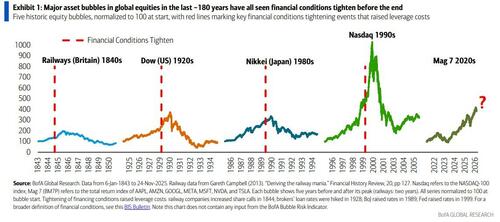
Core Insights - The market is entering an unprecedented "bubble era" characterized by rapid alternation between prosperity and recession, driven by extreme expectations surrounding AI technology [1] - Historical patterns show that major technological leaps have consistently led to large-scale asset bubbles, with the current AI revolution being supported by government initiatives [1][2] - The report indicates that while the market shows typical bubble characteristics by 2025, core U.S. tech stocks have not yet reached extreme instability levels seen during the 1990s internet bubble [1] Government Support and Bubble Dynamics - Historical connections exist between major technological changes and asset bubbles, with past examples including the railway stocks in the 19th century and the tech bubble of the late 1990s [2] - Unlike previous bubbles, the current AI bubble benefits from strong government backing, which provides ample funding and higher policy tolerance, extending the bubble's growth cycle [5] - Geopolitical competition has intensified countries' commitments to AI, further reinforcing the bubble's resilience [5] Market Volatility and Expectations - The current market volatility is attributed to the "expectation gap" surrounding AI technology, where the promise of transformative change contrasts with the slower-than-expected realization of that change [6] - This expectation gap leads to frequent swings in market sentiment between extreme optimism and cautious skepticism [6][7] - The volatility driven by technological expectations is more sudden and rapid compared to traditional market cycles, rendering conventional forecasting models ineffective [7] Bubble Risk Indicators - Bank of America has developed a bubble risk indicator based on four key asset price characteristics: returns, volatility, momentum, and fragility [8] - A notable feature of this indicator is that volatility increases as prices rise, contrary to typical market behavior, indicating potential extreme positions driven by fear of missing out (FOMO) [8] - While the overall U.S. stock market and core tech stocks have not shown typical bubble instability, certain segments are already exhibiting bubble characteristics [11] Unique Risks and Market Concentration - The current AI bubble faces unique risks due to its unprecedented scale, with market concentration at historical highs, exemplified by Nvidia's market cap exceeding that of any European country [20] - If Nvidia were to be valued at the peak P/E ratio of Cisco in 2000, its market cap could reach $20.8 trillion, highlighting the potential for significant market corrections based on forward earnings expectations [22] - Predictions suggest that AI spending could reach $3-4 trillion annually by 2030, with long-term estimates reaching $5 trillion, but there are concerns about the overestimation of AI's productivity potential [22] Investment Strategy Recommendations - The report suggests a counterintuitive investment strategy during bubble periods: diversification may increase risk, while concentrated holdings in leading assets combined with cash hedges are recommended [23] - Historical data indicates that assets at the forefront of bubbles tend to outperform until the bubble bursts, making diversification a risky approach [23] - The report also notes that during previous bubbles, the center of the bubble often outperformed global markets, which may contradict the notion of an impending peak in the "American exceptionalism" theme by 2025 [25] Conclusion on Market Outlook - While timing the market remains challenging, the eventual bursting of the AI bubble appears inevitable, with tightening financial conditions identified as a significant risk factor [27] - High volatility is expected to persist, keeping the market fragile, while ongoing debates about AI's future will continue to elevate uncertainty and instability [27]