以旧换新政策

Search documents
数读小家电半年报 | 倍轻松毛利率居首净利率垫底 石头科技经营性现金净流出8.23亿
Xin Lang Zheng Quan· 2025-09-30 09:28
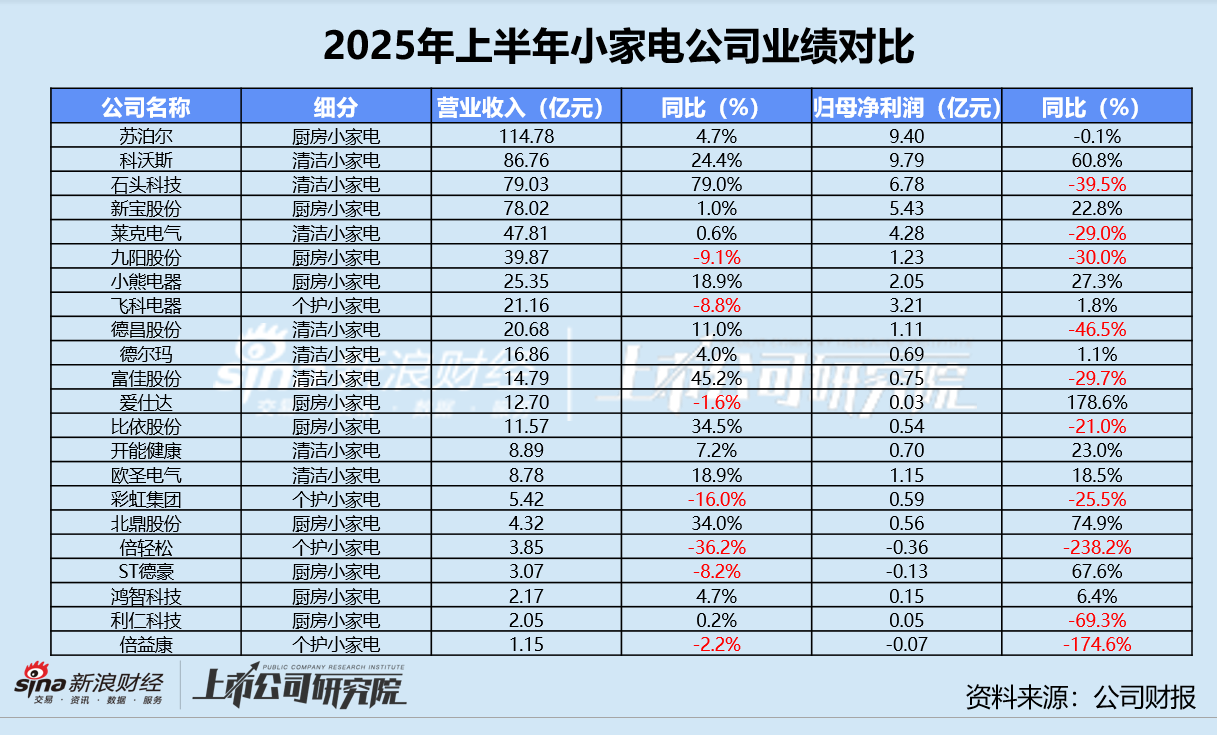
Core Insights - The domestic home appliance market in China showed resilience in growth during the first half of 2025, driven by the "trade-in" policy, with an increase in both volume and revenue [1] - The small home appliance sector experienced significant internal differentiation, with kitchen appliances seeing a retail volume decline of 1.2% but a revenue increase of 9.3% [1][2] - The cleaning appliance segment saw substantial growth, with sales of robotic vacuums, floor washers, and vacuum cleaners increasing by 41.1%, 30.3%, and 10.6% respectively [1] - Personal care appliances had a mixed performance, with electric shavers and toothbrushes seeing revenue growth of 10.5% and 0.5%, while hair dryers experienced a 10.5% decline [1] Revenue and Profitability - A total of 22 listed white goods companies in A-shares reported a combined revenue of 60.909 billion yuan, a 12.1% increase from the same period in 2024, while net profit attributable to shareholders totaled 4.792 billion yuan, down from 5.103 billion yuan in 2024 [1][2] - Among kitchen appliance companies, total revenue reached 29.391 billion yuan, with a net profit of 1.930 billion yuan, marking increases of 3.4% and 6.7% respectively compared to 2024 [2] - The cleaning appliance segment generated 28.360 billion yuan in revenue, with a net profit of 2.525 billion yuan, reflecting a revenue increase of 27.7% but a profit decline of 12.0% [2] - Personal care appliance companies reported a total revenue of 3.158 billion yuan, with a net profit of 0.337 billion yuan, showing declines of 14.3% and 21.4% respectively [2] Company Performance - Supor led the revenue rankings with 11.478 billion yuan, significantly higher than its competitors, while Stone Technology reported a remarkable revenue growth of 79.0% [3][5] - The lowest revenue was recorded by Beikang, with only 0.115 billion yuan, which is less than the top personal care appliance company, Feike Electric [5] - Cost control remains a challenge, with many companies experiencing a rise in operating costs that outpaced revenue growth, particularly Stone Technology, which saw a 114.8% increase in costs [5][6] Profit Margins and Cash Flow - The gross profit margin for many small appliance companies remained between 50%-80%, with Dechang's margin dropping to 14.0% [6] - The highest gross profit margin was held by Beikang at 62.6%, while Stone Technology's margin fell significantly due to price competition [6][12] - Operating cash flow was positive for companies like Covos and Aishida, while others like Beikang and Stone Technology reported cash outflows [15] Efficiency and R&D Investment - Companies like Feike Electric and Aishida managed to reduce their sales, management, and R&D expenses, while others like Beikang and Stone Technology saw increases across all expense categories [9] - R&D expense ratios for small appliance companies generally ranged from 2.5% to 6.0%, with Beikang leading at 9.0% [10] Inventory and Receivables Management - Companies like Fuhua and Dechang reported accounts receivable turnover days exceeding 100 days, while others like Xiaoxiong Technology had a much quicker turnover of only 13 days [17] - Rainbow Group's inventory turnover days increased significantly to 338 days, indicating potential inventory management issues [17]


国信期货有色(镍、不锈钢)季报:底部区间,沪镍或震荡上行
Guo Xin Qi Huo· 2025-09-28 13:51
1. Report Industry Investment Rating No relevant content provided. 2. Core Viewpoints of the Report - The nickel price in this quarter showed an overall range - bound oscillation. It is expected that in the future, Shanghai nickel and stainless steel will continue to fluctuate. If relevant policies are introduced to reverse market expectations, the valuation center may gradually move up [2][49][50]. 3. Summary According to Relevant Catalogs 3.1 Market Review - In the third quarter of 2025, nickel showed an overall range - bound trend with reduced price fluctuations. Nickel futures prices basically oscillated within a price range of 126,000 yuan/ton to 119,000 yuan/ton, with strong support at the lower end [8]. 3.2 Fundamental Analysis 3.2.1 Supply - side Analysis - **LME and SHFE Inventory**: Since the second half of 2023, both LME and SHFE nickel inventories have shown a stable upward trend after hitting bottom. As of late September 2025, SHFE inventory was 29,834 tons, and LME inventory was 230,586 tons [11]. - **China's Nickel Ore Port Inventory and Imports from the Philippines**: The import of nickel ore sand and concentrates from the Philippines by China shows seasonal fluctuations. As of September 19, 2025, the port inventory was 9.7606 million tons [15][16]. - **Electrolytic Nickel Price**: The prices of domestic and imported electrolytic nickel have been in a weak oscillation trend since this year, closing at around 123,060 yuan/ton in late September [20]. - **Nickel Sulfate Price**: As of September 25, 2025, the nickel sulfate price dropped to 29,130 yuan/ton [22]. - **Nickel Iron Import Volume and Price**: On September 25, 2025, the Fubao price of nickel iron (8% - 12%) was 960 yuan/nickel [28]. 3.2.2 Demand - side Analysis - **Stainless Steel Price and Position**: Stainless steel futures prices showed an oscillating pattern, with an oscillation range of 12,200 yuan/ton - 13,400 yuan/ton [32]. - **Stainless Steel Inventory**: According to data released by WIND, on September 19, 2025, the inventories of 300 - series stainless steel in Wuxi and Foshan were 446,100 tons and 147,300 tons respectively [35]. - **Power and Energy Storage Battery Production**: Relevant data on the production of power and energy storage batteries are presented in the report, but specific numerical summaries are not provided in the text [40]. - **New Energy Vehicle Production**: Relevant data on new energy vehicle production are presented in the report, but specific numerical summaries are not provided in the text [45]. 3.3 Outlook - The nickel price in this quarter showed an overall range - bound oscillation. The premium and discount of refined nickel brands were relatively stable. LME nickel inventory was high and continued to accumulate rapidly. The nickel ore market had firm prices. The nickel iron market had weak trading and prices, oscillating in the bottom range. The nickel sulfate price has recently rebounded, and whether there will be medium - term improvement remains to be further observed. The fundamentals of stainless steel have not improved significantly. Currently, the peak season is not prosperous, downstream demand is weak, and the inventories in Wuxi and Foshan are at high levels but have decreased from the peak [49].
汽车价格战全面熄火了?不卷价格该卷什么?
3 6 Ke· 2025-09-28 04:29
Core Viewpoint - The automotive price war, which has lasted for nearly two and a half years, is showing signs of cooling down, indicating a shift in market dynamics and a need for companies to focus on aspects other than price competition [3][5][15]. Group 1: Price War Status - The large-scale automotive price war initiated by significant price cuts has begun to show signs of exhaustion, with a notable decrease in the number of models experiencing price reductions [3][4]. - Data from the China Passenger Car Association indicates that the number of models with price cuts has decreased significantly in 2023 compared to previous years, suggesting a stabilization in the market [3][4]. - The price war has led to a situation where companies are under immense pressure, with profit margins being squeezed and some smaller firms facing existential threats [5][6]. Group 2: Impacts of Price War - The prolonged price competition has negatively impacted brand image, leading consumers to perceive brands as low-value, which hinders their ability to compete in higher-end markets [6][14]. - The price war has created a cycle of consumer hesitation, where potential buyers delay purchases in anticipation of further price drops, exacerbating inventory issues for manufacturers [5][9]. Group 3: Future Strategies Post-Price War - Companies are encouraged to shift focus from price competition to strategies such as trade-in programs, which have been effective in stimulating consumer demand and breaking the cycle of price wars [9][11]. - The reliance on low prices as a competitive strategy is deemed unsustainable, as it can lead to diminished product quality and reduced investment in research and development [11][14]. - The automotive industry is transitioning towards deeper competition based on technology, user experience, and service, moving away from mere price comparisons [14][15].

家电周报:海尔泰国春武里空调工业园正式投产,海信泰国智能制造工业园开工-20250927
Shenwan Hongyuan Securities· 2025-09-27 08:44
Investment Rating - The report maintains a positive outlook on the home appliance sector, highlighting potential investment opportunities in leading companies such as Hisense, Midea, and Gree [2][29]. Core Insights - The home appliance sector underperformed compared to the CSI 300 index, with a decline of 0.7% while the index rose by 1.1% [2][3]. - Key developments include the official launch of Haier's air conditioning industrial park in Thailand, which has an annual planned capacity of 6 million units, making it the largest air conditioning manufacturing base for Chinese brands in Southeast Asia [8][57]. - Hisense's HHA smart manufacturing industrial park has commenced construction, aiming to enhance its presence in Thailand and the ASEAN market [9][58]. - Sales data for August shows a significant increase in the sales volume and revenue of cleaning appliances like vacuum cleaners and floor washers, while sales of hair dryers and electric shavers declined [29][35]. Summary by Sections Industry Dynamics - Haier's Thailand air conditioning industrial park officially started production on September 23, with a capacity of 6 million units annually, covering various air conditioning products [8][57]. - Hisense's HHA smart manufacturing industrial park is set to be the largest overseas facility for the company, with plans for completion by 2030 [9][58]. Sales Data Observations - In August, vacuum cleaner sales increased by 45.13% year-on-year, with revenue rising by 57.96%, while the average price increased by 8.84% to 1181.00 CNY per unit [29][30]. - Floor washer sales also saw a year-on-year increase of 38.07% in volume and 43.66% in revenue, with an average price of 1443.30 CNY per unit [29][31]. - Conversely, hair dryer sales fell by 19.04% in volume and 22.79% in revenue, with an average price decrease of 4.64% to 232.3 CNY per unit [35][36]. - Electric shaver sales increased by 9.79% in volume and 13.11% in revenue, with an average price increase of 3.04% to 206.5 CNY per unit [35][36]. Investment Highlights - The report identifies three main investment themes: 1. White goods sector benefiting from favorable real estate policies and potential for price and volume growth, recommending stocks like Hisense and leading companies such as Midea, Haier, and Gree [2][29]. 2. Export opportunities driven by large customer orders, highlighting companies like Ousheng Electric and Dechang Shares [2][29]. 3. Core components demand exceeding expectations due to the white goods sector's performance, recommending companies like Huaxiang and Shun'an Environment [2][29].




债市日报:9月26日
Xin Hua Cai Jing· 2025-09-26 08:58
Core Viewpoint - The bond market showed slight recovery on September 26, with government bond futures rising across the board, while the interbank bond yield exhibited some divergence, indicating mixed sentiment among institutions as the quarter-end approaches [1][2]. Market Performance - Government bond futures closed higher, with the 30-year main contract up 0.20% at 114.190, the 10-year main contract up 0.13% at 107.680, the 5-year main contract up 0.06% at 105.540, and the 2-year main contract up 0.04% at 102.342 [2]. - The interbank yield on long-term government bonds weakened in the afternoon, while government bonds remained stable. The 30-year government bond yield was flat at 2.2245%, and the 10-year government bond yield decreased by 0.2 basis points to 1.8005% [2]. Funding Conditions - The central bank announced a net injection of 411.5 billion yuan on September 26, with significant reverse repos conducted, including 1,658 billion yuan for 7-day terms at a rate of 1.40% and 6,000 billion yuan for 14-day terms [5]. - Shibor rates showed mixed performance, with the overnight rate down 15.1 basis points to 1.321% and the 7-day rate down 8.3 basis points to 1.501% [5]. Institutional Insights - CITIC Securities noted that the "old-for-new" policy effectively boosted retail sales in the first half of the year, particularly in durable goods and communication equipment, indicating a shift towards smarter and greener consumption [6]. - Shenwan Macro pointed out that once long-term rates fall below 2%, markets often enter a period of volatility, suggesting that the current market may be undergoing a rebalancing phase in asset allocation strategies [7].
电话会议纪要(20250921)
CMS· 2025-09-25 02:35
Economic Overview - In August, the industrial added value increased by 5.2% year-on-year, slightly down from 5.7% in July, but still above 5%[5] - The manufacturing sector's added value grew by 5.7%, outpacing overall industrial growth by 0.5 percentage points, with 31 out of 41 industrial categories showing year-on-year growth, resulting in a growth coverage of 75.6%[5] - High-tech manufacturing saw a significant expansion, with added value increasing by 9.3% year-on-year, indicating strong momentum in emerging industries[5] Investment Trends - From January to August, fixed asset investment grew by only 0.5% year-on-year, a decline from 1.6% in the previous period, with real estate being a major drag[5] - Manufacturing investment rose by 5.1%, significantly higher than the overall investment growth, with notable increases in consumer goods manufacturing (9.0%) and aerospace manufacturing (28.0%)[5] - Real estate development investment fell by 12.9% year-on-year, with August alone seeing a 19.5% decline, marking the largest monthly drop of the year[6] Consumer Behavior - Retail sales of consumer goods increased by 3.4% year-on-year in August, with significant growth in home appliances (14.3%) and furniture (18.6%) despite a slight overall slowdown[6] - The penetration rate of new energy vehicles reached over 50%, with August retail sales showing a positive shift to +0.8% from -1.5% in July[6] Market Outlook - The economic recovery momentum is expected to continue, with GDP growth projected to meet the target of around 5% for the year, despite a forecasted slowdown in Q3 compared to Q2[6] - A-shares typically exhibit a "pre-holiday contraction, post-holiday surge" pattern, with over 60% probability of index gains following the National Day holiday[7] Fixed Income Strategy - The bond market is currently experiencing fluctuations, with short-term credit spreads narrowing while long-term spreads are widening, indicating a mixed market sentiment[7] - The average duration of bank TPL (Total Portfolio Loss) is estimated at 3 years, with projected floating losses of approximately 453 billion yuan for Q3 due to rising long-term bond yields[9]

8月重卡同比五连增,天然气迎来复苏
Ge Long Hui· 2025-09-24 22:20
Core Insights - In August, domestic heavy truck sales reached 92,000 units, representing a year-on-year increase of 47% and a month-on-month increase of 8% [1][2] - The sales of natural gas heavy trucks in August were 16,000 units, showing a year-on-year growth of 32% and a month-on-month growth of 30% [1][3] - The heavy truck industry is expected to gradually recover, with projected sales of 1.067 million units in 2025, an 18% year-on-year increase [1] Sales Performance - Cumulative sales of domestic heavy trucks from January to August reached 716,000 units, a year-on-year increase of 15% [2] - The sales structure in August showed that semi-trailer trucks accounted for 50.6%, cargo trucks for 27.8%, and non-complete vehicles for 21.7% of total heavy truck sales [2] - In August, semi-trailer truck sales were 49,000 units (up 42% YoY), heavy cargo truck sales were 24,000 units (up 54% YoY), and heavy non-complete vehicle sales were 19,000 units (up 50% YoY) [2] Natural Gas Heavy Trucks - Cumulative sales of domestic natural gas heavy trucks from January to August were 116,000 units, down 9% year-on-year [3] - The penetration rate of natural gas in heavy trucks was 17% in August, with semi-trailer trucks having a penetration rate of 32% [3] - The cost-effectiveness of natural gas usage for trucks with an annual mileage exceeding 150,000 km is highlighted, suggesting potential for increased penetration [3] New Energy Heavy Trucks - In August, domestic new energy heavy truck sales reached 15,000 units, a significant year-on-year increase of 197% [3] - Cumulative sales of new energy heavy trucks from January to August were 103,000 units, reflecting a year-on-year growth of 175% [3] - The penetration rate of new energy in heavy trucks was 16% in August, with a cumulative rate of 14% for the year [3]
国泰海通:8月重卡同比五连增 天然气重卡迎来复苏
智通财经网· 2025-09-24 12:36
Core Viewpoint - The domestic heavy truck sales are expected to gradually recover due to economic recovery and the introduction of the "old-for-new" policy in 2025, with projected sales of 1.067 million units, representing an 18% year-on-year increase [1] Group 1: Sales Performance - In August, domestic heavy truck sales reached 92,000 units, a year-on-year increase of 47% and a month-on-month increase of 8% [2] - Cumulative sales from January to August reached 716,000 units, reflecting a 15% year-on-year growth [2] - The "old-for-new" policy has contributed to stable growth in the heavy truck market, leading to five consecutive months of rapid year-on-year growth [2] Group 2: Sales Structure - By August 2025, the sales distribution of semi-trailer trucks, cargo trucks, and incomplete vehicles is projected to be 50.6%, 27.8%, and 21.7% respectively [2] - In August, semi-trailer truck sales were 49,000 units, up 42% year-on-year and 14% month-on-month [2] - Heavy cargo truck sales in August were 24,000 units, showing a 54% year-on-year increase, although down 2% month-on-month [2] - Heavy incomplete vehicle sales reached 19,000 units in August, a 50% year-on-year increase and a 7% month-on-month increase [2] Group 3: Natural Gas Heavy Trucks - In August, domestic natural gas heavy truck sales were 16,000 units, a year-on-year increase of 32% and a month-on-month increase of 30% [3] - Cumulative sales from January to August for natural gas heavy trucks were 116,000 units, down 9% year-on-year [3] - The penetration rate of natural gas in heavy trucks was 17% in August, with 32% for semi-trailer trucks [3] Group 4: New Energy Heavy Trucks - In August, domestic new energy heavy truck sales reached 15,000 units, a significant year-on-year increase of 197% and a month-on-month increase of 13% [3] - Cumulative sales from January to August for new energy heavy trucks were 103,000 units, reflecting a 175% year-on-year growth [3] - The penetration rate of new energy in heavy trucks was 16% in August, with a cumulative rate of 14% from January to August [3]

国泰海通|汽车:8月重卡同比五连增,天然气迎来复苏
国泰海通证券研究· 2025-09-24 12:25
Core Viewpoint - In August, domestic heavy truck sales reached 92,000 units, representing a year-on-year increase of 47% and a month-on-month increase of 8% [1][2]. Group 1: Sales Performance - From January to August, cumulative domestic heavy truck sales totaled 716,000 units, showing a year-on-year growth of 15% [2]. - The high growth in August is attributed to a low base from the previous year and the "old-for-new" policy that has stabilized the new truck market [2]. - Electric heavy trucks continue to show explosive growth, while natural gas heavy trucks have rebounded after five months of decline [2]. Group 2: Segment Analysis - In August 2025, the sales distribution of semi-trailer trucks, heavy-duty trucks, and heavy non-complete vehicles accounted for 50.6%, 27.8%, and 21.7% of total heavy truck sales, respectively [3]. - Semi-trailer truck sales in August reached 49,000 units, up 42% year-on-year and 14% month-on-month [3]. - Heavy-duty truck sales in August were 24,000 units, reflecting a year-on-year increase of 54% but a month-on-month decline of 2% [3]. - Heavy non-complete vehicle sales in August were 19,000 units, with a year-on-year increase of 50% and a month-on-month increase of 7% [3]. Group 3: Focus on Natural Gas Heavy Trucks - In August, domestic natural gas heavy truck sales reached 16,000 units, a year-on-year increase of 32% and a month-on-month increase of 30% [4]. - Cumulative sales of natural gas heavy trucks from January to August totaled 116,000 units, down 9% year-on-year [4]. - The penetration rate of natural gas in heavy trucks was 17% in August, with semi-trailer trucks showing a penetration rate of 32% [4]. - The cost-effectiveness of natural gas trucks is highlighted for those with an annual mileage exceeding 150,000 kilometers, suggesting potential for increased adoption [4]. Group 4: New Energy Heavy Trucks - In August, domestic new energy heavy truck sales reached 15,000 units, marking a year-on-year increase of 197% and a month-on-month increase of 13% [4]. - Cumulative sales of new energy heavy trucks from January to August were 103,000 units, reflecting a year-on-year growth of 175% [4]. - The penetration rate of new energy in heavy trucks was 16% in August, with a cumulative penetration rate of 14% from January to August [4]. Group 5: Future Outlook - With economic recovery and the introduction of the "old-for-new" policy in 2025, domestic heavy truck sales are expected to gradually rebound, with a forecast of 1.067 million units sold in 2025, representing an 18% year-on-year increase [1]. - The maturation of domestic new energy heavy truck technology and rapid cost reductions indicate significant potential for increased penetration, projected to reach 15% by 2025 [1]. - The growth potential in the heavy truck industry is supported by domestic market recovery and continued export growth, alongside the development of natural gas heavy trucks, which may enhance profitability for leading companies [1].

2025年8月重卡行业月报:8月重卡同比五连增,天然气迎来复苏-20250924
GUOTAI HAITONG SECURITIES· 2025-09-24 11:53
Investment Rating - The report assigns an "Overweight" rating for the heavy truck industry [4]. Core Insights - In August, domestic heavy truck sales reached 92,000 units, representing a year-on-year increase of 47% and a month-on-month increase of 8%. The sales of natural gas heavy trucks were 16,000 units, with a year-on-year increase of 32% and a month-on-month increase of 30% [2][4]. - The report anticipates that heavy truck sales will gradually recover due to economic recovery and the introduction of a "trade-in" policy in 2025, projecting sales of 1.067 million units for 2025, an 18% year-on-year increase. The penetration rate of new energy heavy trucks is expected to reach 15% by 2025 [4]. - The report highlights the growth potential in the heavy truck industry, driven by domestic economic recovery and continuous export growth. The development of natural gas heavy trucks is expected to raise industry entry barriers and enhance the profitability of leading companies [4]. Summary by Sections Sales Performance - In August, the sales structure of heavy trucks showed that semi-trailer trucks accounted for 50.6%, cargo trucks for 27.8%, and non-complete vehicles for 21.7%. The sales of semi-trailer trucks were 49,000 units, up 42% year-on-year, while heavy cargo truck sales were 24,000 units, up 54% year-on-year [4]. - From January to August, cumulative heavy truck sales reached 716,000 units, a 15% year-on-year increase [4]. Natural Gas Heavy Trucks - In August, the sales of domestic natural gas heavy trucks were 16,000 units, with a year-on-year increase of 32%. The penetration rate for natural gas in heavy trucks was 17% [4]. - The report notes that the average operating cost of natural gas trucks is lower for vehicles with an annual mileage exceeding 150,000 kilometers, suggesting potential for increased adoption [4]. New Energy Heavy Trucks - In August, the sales of domestic new energy heavy trucks reached 15,000 units, a significant year-on-year increase of 197%. The penetration rate for new energy heavy trucks was 16% [4]. - Cumulative sales from January to August for new energy heavy trucks were 103,000 units, reflecting a 175% year-on-year increase [4]. Recommended Companies - The report recommends companies such as Weichai Power, China National Heavy Duty Truck Group, CIMC Vehicles, and Foton Motor, with specific mention of benefiting from the performance of FAW Jiefang [4][5].