
适度宽松货币政策

Search documents
李迅雷:下半年增量政策可期
Sou Hu Cai Jing· 2025-07-27 09:09
Economic Growth and Policy Support - The GDP growth rate reached 5.3% in the first half of 2025, with a target of 5% for the entire year, indicating sustained policy support for the economy [1] Fiscal Policy - The fiscal policy will remain stable with an emphasis on optimizing existing resources without increasing deficits or issuing new bonds, focusing on precise measures to enhance employment and foreign trade [2] - The government plans to adjust budget allocations and expedite the issuance of special bonds for next year to support major economic provinces [2] Monetary Policy - A moderately loose monetary policy is anticipated, with potential for slight reductions in reserve requirements and interest rates, while maintaining stability in the RMB exchange rate against the USD [3] - Structural policy tools will be accelerated to support technological innovation and boost consumption [3] Consumer Promotion - Policies aimed at promoting consumption will focus on optimizing trade-in programs and removing unreasonable restrictions on consumer spending, particularly in major cities [4] - Initiatives may include childcare subsidies and local consumption voucher policies to stimulate spending [4] Investment Stability - Infrastructure investment is expected to rebound, supported by the completion of an 800 billion yuan construction project list and the initiation of significant projects [5] - New policy financial tools will be implemented to support key sectors such as digital economy and green transformation [5] Real Estate Market - The focus will shift from large-scale expansion to optimizing existing urban infrastructure, with an emphasis on safety and disaster prevention [6] - Attention will be given to policies that support the construction of quality housing and the revitalization of idle real estate [6] Employment and Market Governance - Policies to promote employment and consumption are expected to be rolled out, particularly in the service sector, as part of a broader effort to enhance market governance and competition [7]
金融护航江西省经济回升向好
Sou Hu Cai Jing· 2025-07-27 00:40
Core Insights - Jiangxi Province has implemented a moderately loose monetary policy this year, enhancing counter-cyclical adjustments and utilizing various monetary policy tools to create a favorable financial environment for economic recovery [1] Financial Growth - As of June, the total loan balance in Jiangxi Province reached 65,816 billion yuan, with an increase of 330 billion yuan in the first half of the year, representing a year-on-year growth of 6.9%, which is 0.2 percentage points higher than May and 0.1 percentage points above the national average [1] - The total deposit balance was 67,186 billion yuan, with an increase of 486.4 billion yuan in the first half of the year, showing a year-on-year growth of 9.8% [1] - The social financing scale increased by 513 billion yuan in the first half of the year, which is 17.9 billion yuan more than the previous year, with net financing from government bonds amounting to 138.4 billion yuan, an increase of 81.3 billion yuan year-on-year [1] Credit Structure Optimization - Manufacturing loans have seen rapid growth, with a balance of 6,220 billion yuan as of June, increasing by 69.7 billion yuan in the first half of the year, accounting for 21.1% of the total loan increment, the highest in nearly a decade [2] - The balance of loans to private enterprises reached 9,242 billion yuan, with an increase of 71.9 billion yuan, representing 21.7% of the total enterprise loan increment, up 6.5 percentage points from the previous year [2] - The balance of inclusive small and micro loans was 10,751 billion yuan, making up 16.3% of the total loan balance [2] Support for Innovation and Green Development - The balance of technology loans reached 10,107 billion yuan, with a year-on-year growth of 15.2%, while loans to technology enterprises amounted to 4,683 billion yuan, growing by 10.8% [2] - Green loans totaled 11,302 billion yuan as of June, with an increase of 175 billion yuan in the first half of the year, accounting for 53.0% of the total loan increment [2] Financing Costs - The weighted average interest rate for newly issued loans to enterprises was 3.63% in June, down 45 basis points year-on-year [3] - The weighted average interest rate for newly issued inclusive small and micro loans was 3.83%, a decrease of 57 basis points year-on-year [3] - The weighted average interest rate for newly issued personal housing loans was 3.21%, down 43 basis points year-on-year [3]
同比增长10.1%,山东省6月末社会融资规模达25.2万亿元
Qi Lu Wan Bao· 2025-07-25 11:50
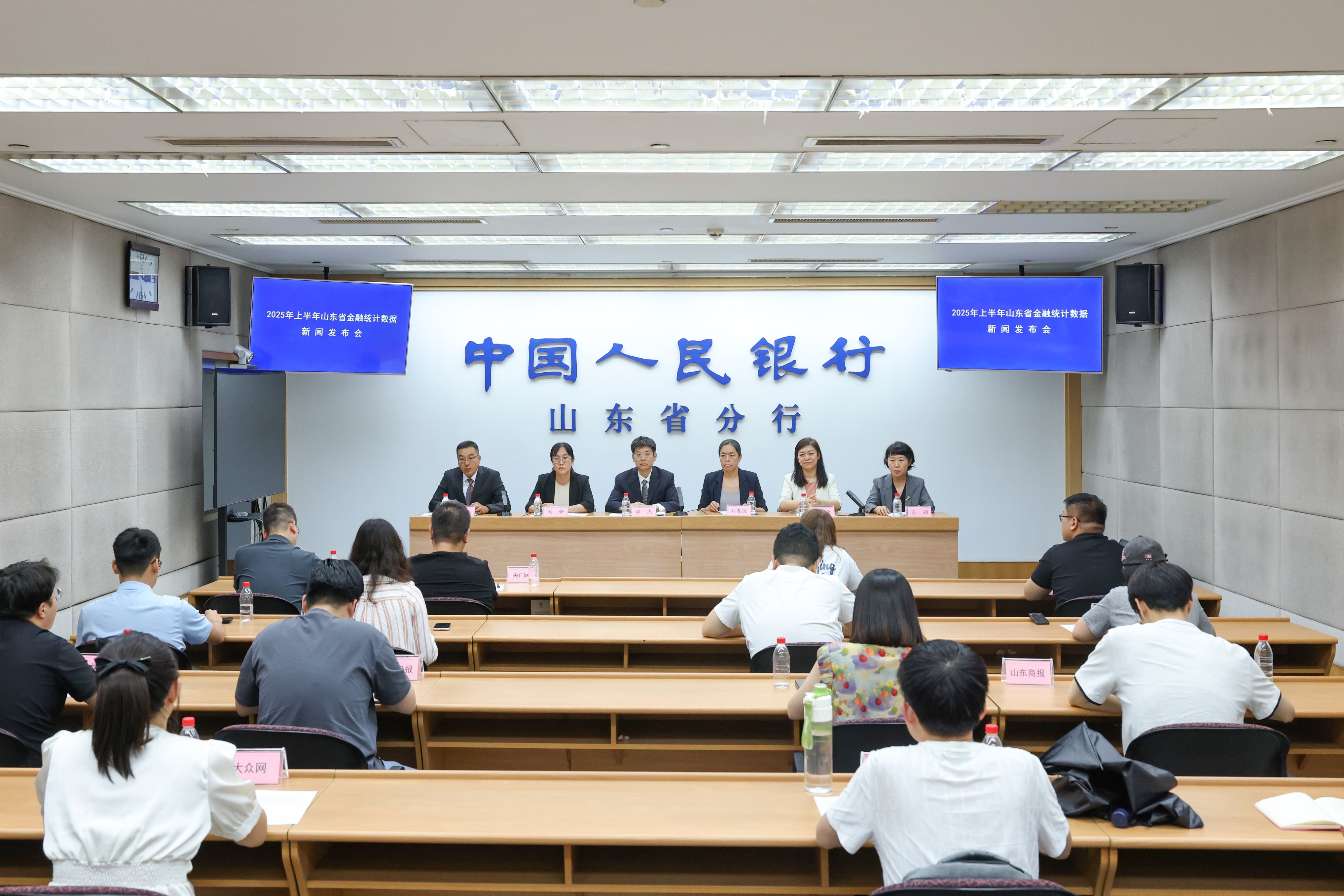
Core Insights - The People's Bank of China Shandong Branch reported a significant expansion in financial metrics for the first half of 2025, indicating a favorable monetary environment for the province's economy [1][4]. Financial Volume Expansion - Shandong's financial total continued to expand, with social financing scale, loans, and deposits reaching CNY 25.2 trillion, CNY 16.1 trillion, and CNY 18.7 trillion respectively, marking year-on-year growth of 10.1%, 9.2%, and 10.2%, all exceeding national averages [4][5]. - The province saw a historical high in financing increments, with social financing increasing by CNY 150.58 billion and loans by CNY 95.15 billion in the first six months [4][5]. Decrease in Financing Costs - The average interest rate for newly issued corporate loans was 3.58%, down by 0.32 percentage points year-on-year, while the rate for inclusive small and micro enterprises was 3.75%, a decrease of 0.5 percentage points [5][6]. Cross-Border Fund Flow - International business income and expenditure totaled USD 283.97 billion, a 14.1% increase year-on-year, with a notable growth in capital and financial projects [6][7]. Credit Structure Optimization - The Shandong branch implemented policies to enhance financial services in consumption and elderly care sectors, resulting in a 12.1% year-on-year increase in consumer loans, outpacing overall loan growth [7][8]. Investment Expansion Efforts - Financial institutions were guided to support key areas such as green development and infrastructure, with manufacturing loans reaching CNY 21 trillion, reflecting a 10.9% year-on-year increase [8][9]. Support for Transformation Measures - The Shandong branch initiated various financing activities, including "bank president visits to enterprises," and introduced specialized financial products, leading to significant growth in loans for technology, green initiatives, and small enterprises [9].

货币政策适度宽松扩内需
Jing Ji Ri Bao· 2025-07-22 22:07
Monetary Policy Overview - The monetary policy has shifted to a stance of "moderate easing" this year, with comprehensive measures including cuts in reserve requirements and interest rates implemented in early May, leading to accelerated social liquidity and reduced financing costs [1] - The stable economic foundation and growth are essential for high-quality development, with monetary policy playing a crucial role in adjusting money supply and influencing economic activities [1] Monetary Supply and Economic Indicators - As of the end of June, the broad money supply (M2) grew by 8.3% year-on-year, while the narrow money supply (M1) increased by 4.6%, indicating a significant rise in the activity level of monetary funds [2] - The new corporate loan weighted average interest rate was approximately 45 basis points lower than the previous year, and personal housing loan rates were about 60 basis points lower, contributing to a GDP growth of 5.3% in the first half of the year [2] Financial Support for Key Areas - The central financial work conference emphasized the importance of supporting five key areas: technology finance, green finance, inclusive finance, pension finance, and digital finance, which are crucial for high-quality economic development [2] - The monetary policy has effectively guided financial resources towards key sectors, with loans in these areas growing significantly, such as a 27.4% increase in green finance loans [3] Price Levels and Monetary Policy Effectiveness - Weak price levels have been a prominent issue in the economy, necessitating a focus on promoting reasonable price recovery as a key consideration for monetary policy [4] - Despite continuous interest rate cuts, low price levels have kept real interest rates relatively high, which may suppress consumption and investment demand, indicating the need for ongoing adjustments in monetary policy [4]
【财经分析】“适度宽松”已实施逾半年 货币政策支持经济成效明显
Xin Hua Cai Jing· 2025-07-16 15:25
Core Viewpoint - The implementation of "moderate easing" monetary policy in China has shown significant effectiveness in supporting the real economy over the past six months, particularly following a comprehensive set of financial measures introduced in May [1][2]. Monetary Policy Measures - In May, a 0.5 percentage point reduction in the reserve requirement ratio (RRR) was implemented, providing approximately 1 trillion yuan in long-term liquidity to the market [2]. - The People's Bank of China (PBOC) conducted two rounds of reverse repos in June, totaling 1.4 trillion yuan, to maintain ample liquidity [2]. - By the end of June, the year-on-year growth rates for social financing scale, broad money supply (M2), and RMB loans were 8.9%, 8.3%, and 7.1% respectively, with nearly 13 trillion yuan in new RMB loans issued in the first half of the year [2]. Interest Rate Adjustments - The PBOC lowered the policy interest rate by 0.1 percentage points in May, which led to a decrease in the Loan Prime Rate (LPR) by 0.1 percentage points [2]. - The average interest rates for newly issued corporate loans and personal housing loans were approximately 3.3% and 3.1%, respectively, both lower than the previous year by about 45 and 60 basis points [2]. Structural Support - The PBOC has increased support for key sectors, including the establishment of re-loan facilities for service consumption and elderly care, and enhanced funding for technological innovation [3]. - By the end of May, loans in the areas of technology, green finance, inclusive finance, elderly care, and digital finance reached 103.3 trillion yuan, accounting for 38.2% of total loans, with a year-on-year growth rate of 14.0% [3]. Future Outlook - Experts anticipate that there is still room for further RRR and interest rate cuts in the second half of the year to alleviate the debt burden on the real economy and promote stable growth [6][7]. - The PBOC is expected to enhance liquidity through various tools, including reverse repos and MLF funding, while also potentially restarting government bond purchases to stabilize market expectations [7][8]. - Structural monetary policy tools may be enriched, with a focus on directing financial resources towards technological innovation and new industrialization [8].
债市日报:7月16日
Xin Hua Cai Jing· 2025-07-16 08:47
Market Overview - The bond market weakened again on July 16, with most government bond futures closing down, while the overall fluctuation remained small [1] - The People's Bank of China (PBOC) indicated a neutral stance on the bond market during the financial statistics press conference, announcing an excess continuation of reverse repos, reflecting a strong demand for moderately loose monetary policy to support growth [1] Bond Futures - The 30-year main contract fell by 0.05% to 120.710, the 10-year main contract fell by 0.05% to 108.835, the 5-year main contract fell by 0.01% to 106.000, and the 2-year main contract rose by 0.01% to 102.424 [2] - The yield on the 2-year "25附息国债06" decreased by 0.75 basis points to 1.385%, while the 10-year "25附息国债11" increased by 0.5 basis points to 1.6595% [2] International Bond Markets - In North America, U.S. Treasury yields rose collectively, with the 2-year yield increasing by 3.79 basis points to 3.934% and the 10-year yield rising by 4.80 basis points to 4.481% [3] - In Asia, the 10-year Japanese government bond yield fell by 1.1 basis points to 1.579% [4] - In the Eurozone, the 10-year French bond yield decreased by 2.6 basis points to 3.404%, while the German 10-year bond yield fell by 1.7 basis points to 2.710% [4] Primary Market - The Ministry of Finance reported weighted average winning yields for 91-day and 182-day government bonds at 1.2069% and 1.2654%, respectively, with bid-to-cover ratios of 3.44 and 2.29 [5] Liquidity Conditions - The PBOC conducted a reverse repo operation of 520.1 billion yuan at a fixed rate of 1.4%, resulting in a net injection of 444.6 billion yuan for the day [6] - The Shibor rates for short-term instruments collectively declined, with the overnight rate down by 6.9 basis points to 1.466% [6] Institutional Insights - Huazhong Securities noted that insufficient supply and strong demand continue to dominate the urban investment bond market, with net repayments in June amounting to 655 billion yuan, a decrease of approximately 590 million yuan compared to the previous month [7] - CITIC Securities observed that government bonds continued to perform well, with credit issuance showing signs of recovery and social financing increasing year-on-year, aligning with expectations [7]
6月和二季度经济数据点评:财政政策加力提效对下半年稳经济很重要
Bank of China Securities· 2025-07-16 06:09
Economic Growth - In the first half of 2025, the actual GDP grew by 5.3% year-on-year, with Q1 growth at 5.4% and Q2 at 5.2%[3] - The nominal GDP growth rate for Q2 was 3.9%, down 0.7 percentage points from Q1[3] - The cumulative year-on-year growth of industrial added value in the first half was 6.4%[40] Industrial Performance - In June, industrial added value increased by 6.8% year-on-year, surpassing expectations of 5.5%[11] - The manufacturing sector's added value grew by 7.0% in the first half, while high-tech industries saw a 9.5% increase[11] - Fixed asset investment in manufacturing rose by 7.5% year-on-year in the first half, while infrastructure investment grew by 4.6%[27] Consumer Spending - Retail sales in June grew by 4.8% year-on-year, a decline of 1.6 percentage points from May[17] - Cumulative retail sales for the first half increased by 5.0% year-on-year, with service consumption rising by 5.3%[40] - The average per capita disposable income in the first half was 21,840 yuan, up 5.3% year-on-year[36] Investment Trends - Fixed asset investment growth for the first half was 2.8%, down 0.9 percentage points from the previous period[24] - Real estate investment fell by 11.2% year-on-year in the first half, with new housing starts down 20.0%[28] - The decline in real estate sales area was 3.5%, and sales revenue decreased by 5.5%[30] Policy Implications - Strengthening fiscal policy is crucial for stabilizing economic growth in the second half of 2025[40] - The uncertainty of external demand, particularly due to U.S. tariff policies, poses risks to economic stability[41] - Monitoring the outcomes of the July Politburo meeting will be essential for understanding future economic strategies[41]
中债策略周报-20250716
Zhe Shang Guo Ji Jin Rong Kong Gu· 2025-07-16 01:25
Group 1 - The bond market experienced a rebound with long-term government bonds (10-year and 30-year) rising by 2.5 basis points to 1.67% and 1.88% respectively, while the 1-year government bond increased by 3.4 basis points to 1.37% [3][12][15] - The CPI for June showed a year-on-year increase of 0.1%, while the PPI decreased by 3.6%, indicating a widening decline primarily due to falling prices in the black series and construction materials [6][42] - The central bank's recent actions included a net withdrawal of 1.7 trillion yuan from the open market, with a focus on reverse repos, and a net payment of 0.3 trillion yuan in government bonds [39][42] Group 2 - The bond market outlook for July suggests limited negative factors, with a preference for high cost-performance varieties, as the fundamental data remains mixed [41][42] - The bond yield curve shows a steepening in the 3-5 year segment and a flattening in the 5-7 year segment, indicating that the 5-year point may serve as a key target for leverage strategies [6][41] - The issuance of local government bonds reached 231.8 billion yuan this week, with a net issuance of 130.3 billion yuan, while national bonds issued amounted to 293.2 billion yuan, netting 193.1 billion yuan [20][39]
下半年货币政策“适度宽松” 专家解读利率走势
Zhong Guo Jing Ying Bao· 2025-07-14 11:57
Monetary Policy Outlook - The People's Bank of China (PBOC) will further implement a moderately loose monetary policy to enhance financial services for the real economy [1][2] - Predictions indicate potential reductions in the reserve requirement ratio (RRR) and interest rates in the second half of the year, with deposit rates expected to decline further [1][3] Banking Sector Adjustments - Several banks have lowered deposit rates and removed five-year large-denomination certificates of deposit, reflecting a market-driven adjustment influenced by the decline in the one-year Loan Prime Rate (LPR) and government bond yields [1][3] - The net interest margin of commercial banks was reported at 1.43% as of the end of Q1 2025, indicating a historical low [3] Financial Institutions' Strategies - Banks are encouraged to optimize asset structures and increase the proportion of medium- to long-term assets while monitoring deposit interest rates dynamically to manage overall funding costs [1][4] - The trend of deposit long-termization continues, and the reduction in deposit rates is expected to alleviate interest expenses and stabilize funding costs, thereby improving banks' profitability [4][5] Regulatory Environment - The regulatory framework aims to standardize the deposit market and enhance the transmission mechanism of monetary policy, which is expected to lower the overall financing costs in society [4][5] - The supervision of high-interest deposit solicitation practices and the encouragement of banks to optimize deposit term structures are part of the efforts to ensure that interest rates reflect supply and demand dynamics [5]
上半年金融数据出炉:M2同比增8.3%,信贷结构亮点纷呈
Di Yi Cai Jing· 2025-07-14 10:38
Core Viewpoint - The current monetary policy in China is characterized as "moderately loose," with financial aggregate indicators growing significantly faster than the economic growth rate [3]. Group 1: Financial Data Overview - As of June 30, 2025, the broad money supply (M2) reached 330.29 trillion yuan, growing by 8.3% year-on-year, which is 0.4 percentage points higher than the previous month and 2.1 percentage points higher than the same period last year [1]. - The narrow money supply (M1) stood at 113.95 trillion yuan, with a year-on-year growth of 4.6%, which is 2.3 percentage points higher than the previous month [1]. - The total social financing stock was 430.22 trillion yuan, increasing by 8.9% year-on-year, with a net increase of 4.20 trillion yuan in June, which is 900.8 billion yuan more than the previous year [2][1]. Group 2: Government Bond Financing - Government bond net financing was a major driver of social financing growth, amounting to 7.66 trillion yuan in the first half of the year, which is an increase of 4.32 trillion yuan year-on-year [2]. - The issuance of government bonds has significantly increased compared to last year, particularly since May, providing substantial support to social financing [2]. Group 3: Credit Demand and Structure - The demand for credit has been bolstered by seasonal consumption, with significant consumer spending during promotional events like the "618" sales and summer travel planning [4]. - By the end of June, the balance of RMB loans was 268.56 trillion yuan, growing by 7.1% year-on-year, with medium to long-term loans for the manufacturing sector reaching 14.84 trillion yuan, up 8.7% [5][4]. - The "Five Major Articles" of finance, which include technology, green, inclusive, elderly, and digital finance, saw a loan balance of 103.3 trillion yuan, representing 38.2% of total loans and a year-on-year growth of 14.0% [5]. Group 4: Monetary Policy Implementation - The People's Bank of China has implemented a series of monetary policy measures, including a 0.5 percentage point reserve requirement ratio cut and various liquidity injections totaling approximately 1.4 trillion yuan [7]. - The focus of future monetary policy will be on maintaining a balance between supporting the real economy and ensuring the health of the financial system, with an emphasis on sectors like technology innovation and small and micro enterprises [8][9].