市场流动性

Search documents
A股减持潮来袭:7月超百家公司发布减持计划,市场流动性承压
Jing Ji Guan Cha Wang· 2025-07-06 08:36
Core Viewpoint - The recent surge in shareholder reduction announcements in the A-share market reflects a complex set of motivations, impacting market liquidity and investor confidence [1][2][4]. Summary by Categories Shareholder Reduction Trends - Over 100 listed companies have issued nearly 150 shareholder reduction announcements as of July 5, with reductions ranging from millions to tens of millions of shares [1]. - Notable cases include shareholders from companies like Wangda Software and Yuanwanggu, with significant cashing out amounts reported [1]. Motivations Behind Reductions - The motivations for reductions are diverse, including personal financial needs, market valuation assessments, strategic adjustments, and indirect reductions through share pledges [2][3]. - Personal financial arrangements are a common reason, particularly among non-controlling shareholders and executives, though they may still exert pressure on stock prices [2]. - Shareholders may also reduce holdings based on their assessment of the company's future growth potential and market valuation [2][3]. Market Impact - The influx of reduction announcements poses challenges to market order, particularly affecting liquidity and investor confidence [4][5]. - Increased stock supply from large-scale reductions can lead to price declines, especially for smaller or less liquid stocks, creating a negative feedback loop [4]. - Investor confidence may wane as reductions by major shareholders are often interpreted as negative signals regarding the company's future prospects [5]. Regulatory and Market Mechanisms - Establishing market-based constraints and improving transparency in information disclosure are essential for balancing investor protection and shareholder rights [6]. - The reduction wave is seen as a natural progression in market development, necessitating a comprehensive understanding of the underlying motivations and impacts [6][7]. - As market maturity increases, the disruptive effects of reduction announcements are expected to diminish, leading to more rational investor responses [7].


瑞穗:解码中国的财政刺激——从补贴到销售
Zhi Tong Cai Jing· 2025-07-04 14:48
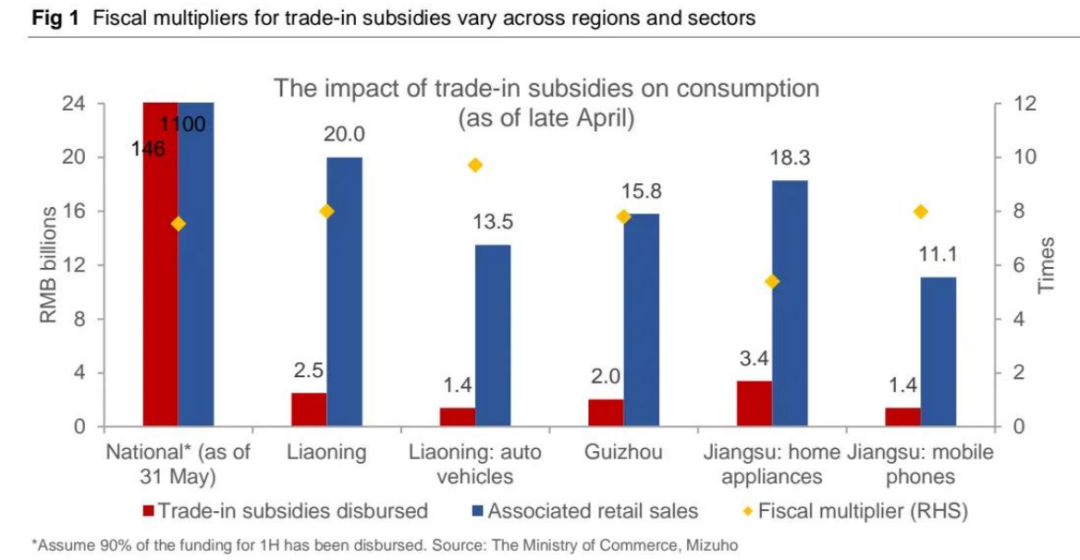
Core Viewpoint - The report from Mizuho Asia Ltd. anticipates that the People's Bank of China will utilize targeted short-term and medium-term tools to supplement liquidity and guide a slight decrease in market repurchase rates in the coming weeks [1][7]. Group 1: Subsidy Program - The Chinese government has confirmed the issuance of the third batch of the "trade-in" subsidy program, expected to allocate approximately 70 billion RMB, which will account for half of the remaining budget for 2025 [2]. - The first two batches of funds released in January and April totaled 162 billion RMB, representing 54% of the annual budget, and have driven consumption of 1.1 trillion RMB, approximately 7 to 8 times the amount of subsidies issued [2][5]. - The upcoming funds are projected to stimulate retail sales exceeding 500 billion RMB in the third quarter of 2025 [2]. Group 2: Market Liquidity - The liquidity tightening observed recently is primarily attributed to a significant issuance of government bonds and typical quarter-end funding pressures, rather than the subsidy program [1][7]. - The net issuance of government bonds in May and June reached approximately 2.9 trillion RMB, which is substantial compared to the 162 billion RMB in subsidies issued [7]. - The People's Bank of China is expected to deploy a series of targeted policy tools, including Medium-term Lending Facility (MLF) and reverse repos, to replenish liquidity and guide interbank repurchase rates back to target levels [7].

宏观专题研究:黄金价格波动的底层逻辑
Guohai Securities· 2025-07-04 09:33
Group 1: Gold Price Trends - Gold prices have shown a significant upward trend, surpassing $1,000 per ounce in March 2008, $2,000 in August 2020, and reaching over $3,000 in March 2025[2][18] - The average production cost of gold increased by 45% from $1,003 per ounce in Q4 2020 to $1,456 in Q3 2024, while gold prices rose by 32% during the same period[6][30] - Investment demand for gold reached 42.1% of total demand in Q1 2025, up from an average of 29.1% from 2010 to 2024[4][22] Group 2: Demand Sources - The four main sources of gold demand are jewelry (43.7%), central bank purchases (23.6%), investment (25.7%), and technology (7.1%) as of 2024[4][19] - Central banks have consistently purchased over 1,000 tons of gold annually from 2022 to 2024, accounting for nearly 30% of global mine production[4][24] - Gold jewelry demand averaged 49.6% of total demand from 2010 to 2024, making it the largest source of gold consumption[4][19] Group 3: Economic Influences - Actual interest rates are a key driver of gold price fluctuations; as rates rise, gold becomes less attractive compared to interest-bearing assets[7][35] - The U.S. Federal Reserve raised interest rates 11 times from March 2022 to July 2023, totaling 525 basis points, which pressured gold prices down from $2,050 to $1,820 per ounce[7][35] - Global debt levels reached approximately $324 trillion in Q1 2025, with a $7.5 trillion increase in just three months, raising concerns about economic stability and boosting gold's appeal as a safe haven[10][50] Group 4: Market Dynamics - Market liquidity significantly impacts gold prices; increased liquidity typically raises gold demand, while tightening liquidity can lead to price declines[8][40] - In August 2020, gold prices exceeded $2,000 per ounce due to the Federal Reserve's quantitative easing measures during the pandemic[8][40] - A survey indicated that 95% of central banks plan to increase their gold reserves in the next 12 months, the highest level since 2019, reflecting a growing trend towards gold accumulation[11][54]
华泰期货流动性日报-20250704
Hua Tai Qi Huo· 2025-07-04 07:07
流动性日报 | 2025-07-04 市场流动性概况 2025-07-03,股指板块成交3899.44亿元,较上一交易日变动-0.43%;持仓金额9958.70亿元,较上一交易日变动 +0.78%;成交持仓比为38.95%。 国债板块成交2876.70亿元,较上一交易日变动+6.71%;持仓金额9042.09亿元,较上一交易日变动+0.18%;成交持 仓比为32.97%。 基本金属板块成交3373.47亿元,较上一交易日变动-12.39%;持仓金额5142.44亿元,较上一交易日变动+0.45%; 成交持仓比为97.76%。 贵金属板块成交3313.89亿元,较上一交易日变动+3.87%;持仓金额4462.82亿元,较上一交易日变动+3.66%;成交 持仓比为88.80%。 能源化工板块成交4775.11亿元,较上一交易日变动-4.57%;持仓金额4316.33亿元,较上一交易日变动+1.07%;成 交持仓比为89.68%。 农产品板块成交2747.87亿元,较上一交易日变动-17.25%;持仓金额5618.28亿元,较上一交易日变动+0.22%;成 交持仓比为44.06%。 黑色建材板块成交2850.84亿 ...
宝城期货国债期货早报-20250704
Bao Cheng Qi Huo· 2025-07-04 01:27
Report Summary 1. Report Industry Investment Rating No information provided. 2. Core Viewpoints - The overall view of Treasury bond futures is to maintain a sideways consolidation trend in the short term. The logic for the upward movement of Treasury bond futures in the medium to long term is relatively solid, and the downside space is limited [1][5]. 3. Summary by Relevant Catalogs 3.1 Variety Viewpoint Reference - Financial Futures Stock Index Sector - For the TL2509 variety, the short - term, medium - term view is sideways, and the intraday view is sideways to the weak side. The core logic is that the manufacturing PMI data is marginally improving, and the probability of an interest rate cut in the short term is not high [1]. 3.2 Main Variety Price Market Driving Logic - Financial Futures Stock Index Sector - The intraday view of varieties such as TL, T, TF, and TS is sideways to the weak side, and the medium - term view is sideways. The reference view is sideways. Yesterday, Treasury bond futures were all in a narrow sideways consolidation. With the gradual disappearance of tax - period factors, market liquidity has shifted from a tight state at the end of June to a loose state. Recently, the central bank has started to conduct net withdrawals of liquidity in the open market. In the overall macro - environment, a relatively loose monetary environment is still needed in the second half of the year to support demand and stabilize expectations. The endogenous growth momentum of domestic demand is insufficient, and external demand is affected by tariff factors. Although the possibility of further interest rate cuts in the short term is not high, the downside space of Treasury bond futures is limited as market interest rates are always anchored by policy interest rates [5].
华泰期货流动性日报-20250702
Hua Tai Qi Huo· 2025-07-02 05:57
流动性日报 | 2025-07-02 市场流动性概况 2025-07-01,股指板块成交4106.63亿元,较上一交易日变动-2.21%;持仓金额10034.62亿元,较上一交易日变动 +0.21%;成交持仓比为40.50%。 国债板块成交3200.69亿元,较上一交易日变动-11.61%;持仓金额8820.22亿元,较上一交易日变动+0.85%;成交 持仓比为36.65%。 基本金属板块成交2443.06亿元,较上一交易日变动-12.17%;持仓金额4165.17亿元,较上一交易日变动+1.71%; 成交持仓比为101.08%。 贵金属板块成交3018.92亿元,较上一交易日变动-29.62%;持仓金额4323.91亿元,较上一交易日变动+1.23%;成 交持仓比为73.66%。 能源化工板块成交3830.54亿元,较上一交易日变动-17.67%;持仓金额3926.70亿元,较上一交易日变动+1.32%; 成交持仓比为81.19%。 农产品板块成交2502.53亿元,较上一交易日变动-16.80%;持仓金额5479.43亿元,较上一交易日变动-0.40%;成交 持仓比为41.71%。 黑色建材板块成交210 ...
国债期货月报:市场情绪偏强-20250701
Guo Jin Qi Huo· 2025-07-01 12:25
Report Summary 1. Report Industry Investment Rating - Not provided in the content 2. Core View - In June 2025, the two - year, five - year, ten - year, and thirty - year Treasury bond futures' main contracts had capital inflows, and the monthly K - lines closed positive. The conflict between Israel and Iran on June 13 and the cease - fire on June 24, along with the central bank's reverse repurchase operations releasing liquidity, provided support for the bond market, showing strong market sentiment [3]. 3. Summary by Directory 3.1 Futures Market Analysis - The two - year Treasury bond futures' main contract closed at 102.498 yuan this month, up 0.10% from last month, with lower trading volume than the previous month and the MACD having a death cross above the zero - axis [8]. - The five - year Treasury bond futures' main contract closed at 106.160 yuan this month, up 0.13% from last month, with the monthly K - line closing positive [10]. - The thirty - year Treasury bond futures' main contract closed at 120.42 yuan this month, up 0.85% from last month, with the monthly K - line closing positive, leaving an upper shadow, and approaching the previous high of 122.28 yuan. The trading volume was less than the previous month, and the MACD continued to converge in a death cross above the zero - axis [15]. 3.2 Spot Market Analysis - On June 19, the central bank conducted 2035 billion yuan of 7 - day reverse repurchase operations at a fixed interest rate of 1.40% [15]. - The overnight Shanghai Interbank Offered Rate (Shibor) dropped 0.3 basis points to 1.366%, and the 7 - day Shibor dropped 0.3 basis points to 1.505% [15]. - On June 24, the central bank conducted 4065 billion yuan of 7 - day reverse repurchase operations, with a net investment of 2092 billion yuan [15]. 3.3 Futures - Spot Combination Analysis - Liquidity support: The central bank's net investment of funds through reverse repurchase maintained abundant inter - bank liquidity, providing short - term support for the bond market. On June 26, the central bank conducted 5093 billion yuan of 7 - day reverse repurchase operations, with a net investment of 3058 billion yuan after deducting the maturing funds [16]. - Geopolitical risk disturbance: The Israel - Iran conflict on June 13 boosted risk - aversion sentiment, causing funds to flow to safe assets like Treasury bonds, especially long - term varieties. The cease - fire was announced on June 24 [17]. 3.4 Outlook for the Future - In June, the main contracts of Treasury bond futures rose, which was related to the market traders' enthusiasm and the geopolitical risks. The central bank's reverse repurchase operations released a signal of loose liquidity in the inter - bank market, and it is uncertain whether it will continuously support market liquidity [18]
逾2万亿元逆回购到期!跨季后资金面怎么走
Bei Jing Shang Bao· 2025-07-01 12:16
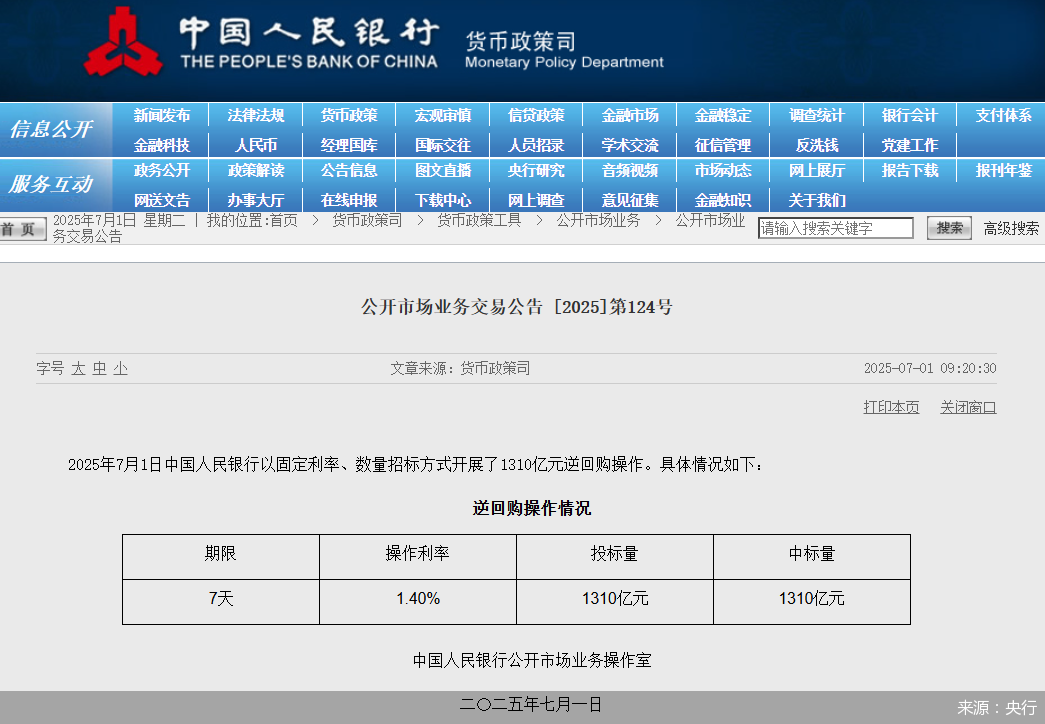
Core Viewpoint - The People's Bank of China (PBOC) has initiated a 7-day reverse repurchase operation of 131 billion yuan at a fixed rate of 1.40%, indicating a seasonal liquidity easing in July, with expectations for a slight decline in funding rates [1][4][5]. Monetary Policy Actions - On July 1, the PBOC conducted a reverse repo operation of 1310 billion yuan, with both bidding and winning amounts matching this figure, and the operation rate set at 1.40% [1][4]. - A total of 4065 billion yuan in reverse repos is set to mature, leading to a net withdrawal of 2755 billion yuan from the open market [1]. Market Conditions - The market is expected to experience seasonal easing in July, with funding rates likely to stabilize and slightly decline [5][6]. - The Shanghai Interbank Offered Rate (Shibor) showed mixed movements, with overnight Shibor rising by 5.1 basis points to 1.422% and 7-day Shibor increasing by 9.5 basis points to 1.763% prior to July 1 [4]. Economic Outlook - The first half of the year showed strong economic performance, reducing the likelihood of significant interest rate cuts or reserve requirement ratio reductions in the short term [7][8]. - The PBOC aims to maintain ample liquidity and guide financial institutions to increase credit supply, aligning the growth of social financing and money supply with economic growth targets [5][9]. Future Expectations - The liquidity easing trend is expected to continue, with the PBOC likely to implement measures to ensure market liquidity remains abundant [6][9]. - The central bank may utilize various tools, including Medium-term Lending Facility (MLF) and reverse repos, to manage liquidity effectively throughout the second half of the year [8][9].
资金压力缓解,七月会开门红吗?
Hu Xiu· 2025-06-30 12:07
如有疑问请以音频内容为准,添加妙妙子微信huxiuvip302,入群有机会与董小姐进一步交流。 本篇评级为★★★,主要围绕以下内容展开: 1、资金压力缓解,科技赛道会再接再厉吗? 2、从人民日报的评论,看下半年的机会 今天是6月份的最后一个交易日。往往在半年末的时候,我们要密切关注市场上资金的流动性是不是突 然变得紧张。今天紧张的情绪有所缓解。这实际上是有利于市场上科技赛道向上发挥的。 我们来看一下,一天期的国债逆回购利率今天下降了30%,回到了一个相对比较安全的区间。三大指数 也随之翻红。其中的领头羊除了军工板块之外,剩下的基本上是来自科技赛道。我们之前在6月下旬也 曾经跟大家聊到过,要重点关注科技赛道当中的表现。到现在为止,包括人工智能、芯片等等,科技赛 道的整体涨幅大概是在6%左右。但即使有了比较明显的战绩,如果我们拿今年2月份的高峰跟现在对比 的话,其实它中间还存在着一个10%到15%的缺口。科技整体或许只是小荷才露尖角而已。 尤其考虑到,科技对市场流动性是非常敏感的。市场流动性比较充沛的时候,它发挥的余地和空间比较 大。那么市场流动性比较紧张的时候,会对它形成压制。就像在今年的4月份和5月份,其实这 ...
市场流动性收紧?
Sou Hu Cai Jing· 2025-06-26 09:41
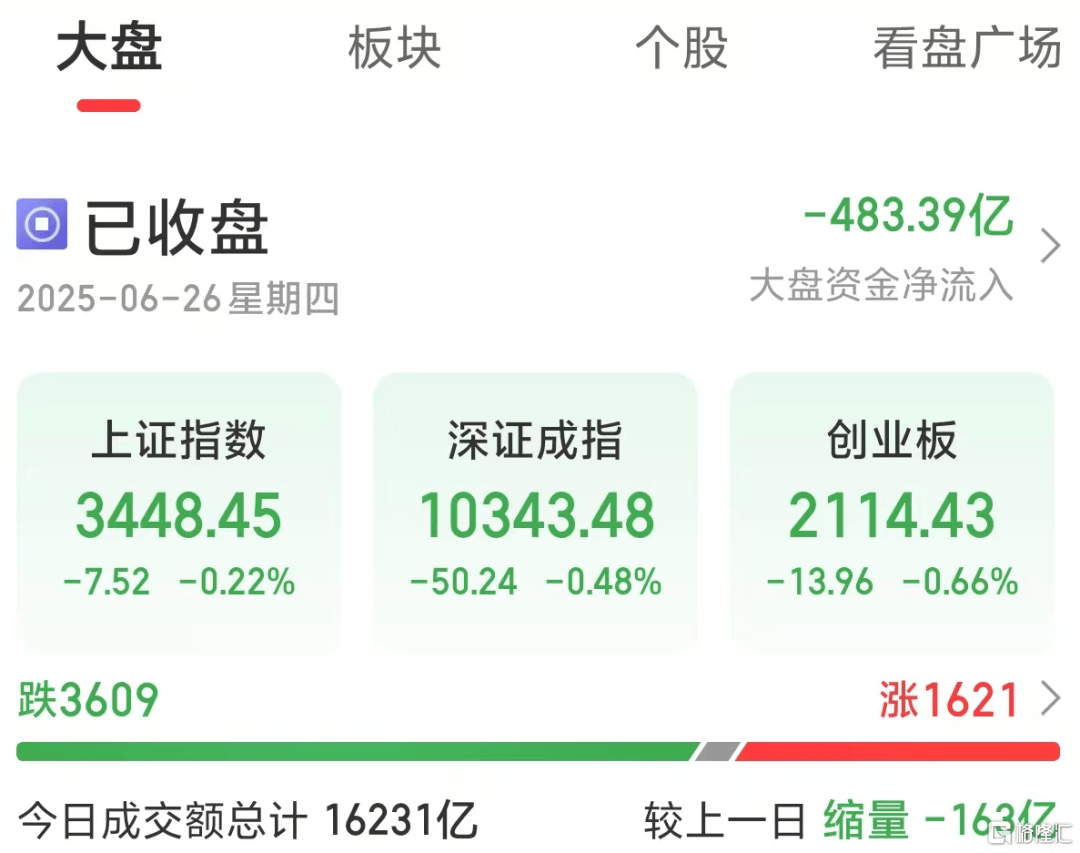
Market Overview - The A-share market experienced a collective decline, with the Shanghai Composite Index down by 0.22%, the Shenzhen Component Index down by 0.48%, and the ChiNext Index down by 0.66%, while the total market turnover was 16,231 billion yuan, a decrease of 163 billion yuan from the previous day [1][17]. Banking Sector Performance - The banking sector reached new highs, with major banks such as ICBC, Agricultural Bank of China, Bank of China, and others continuing to climb. The banking sector has seen a year-to-date increase of 16.94%, leading among 31 primary industries [3]. Hong Kong Monetary Authority Intervention - The Hong Kong Monetary Authority (HKMA) intervened by purchasing 9.42 billion HKD due to the Hong Kong dollar's exchange rate triggering the "weak side convertibility guarantee." This marked the first intervention since May 2023, resulting in a decrease in the banking system's liquidity to 164.098 billion HKD [4][6]. Hibor Rate Movements - Following the HKMA's intervention, the Hong Kong Interbank Offered Rate (Hibor) saw a significant rise, with the overnight Hibor increasing from 0.02071% to 0.03750%, marking a daily increase of 1.688 basis points. The one-month Hibor also rose for the fourth consecutive day, reaching 0.96554% [4][6]. ETF Market Activity - The market saw significant inflows into several ETFs, particularly in the financial sector, with notable net inflows into the China A500 ETF and various Hong Kong financial ETFs. The total net inflow for the week into the China A500 ETF was 78.32 billion yuan [20][22]. U.S. Federal Reserve Interest Rate Outlook - Expectations for a potential interest rate cut by the U.S. Federal Reserve have increased, with several officials indicating support for a rate cut in July. The upcoming economic data for June and July will be crucial in determining the Fed's actions [11][12][16].