
债券市场

Search documents
货币宽松预期或承压
Qi Huo Ri Bao· 2025-07-01 02:14
Group 1 - The recent ceasefire between Iran and Israel has led to an unexpected improvement in geopolitical relations, resulting in a rapid recovery of market risk appetite [1] - The central bank's monetary policy committee meeting indicated a bearish impact on the bond market, with the removal of "timely rate cuts" and the re-emphasis on preventing capital outflow, which may dampen market sentiment [1][2] - The meeting's language changes suggest a reduced necessity for short-term policy intensification, as the acknowledgment of domestic growth policy effectiveness implies a lower probability of further policy easing [2] Group 2 - Recent consumer data for May exceeded market expectations, indicating an improvement in demand, particularly in discretionary spending categories such as home appliances and clothing, although automotive sales growth remains sluggish [3][4] - The strong performance in the real estate sector, particularly in completion cycles, is driven by government subsidy policies, which aligns with the overall consumer spending trends [4] - The bond market is expected to strengthen further, driven by lower funding costs below policy rates and improving fundamental conditions, despite the central bank's recent meeting potentially suppressing expectations for monetary easing [4]
泓德基金:上周主要宽基指数涨幅超3%,上证综指创年内新高
Xin Lang Ji Jin· 2025-07-01 01:28
Group 1: Equity Market Performance - The domestic equity market showed strong performance last week, with major indices rising over 3% and daily trading volume increasing to around 1.5 trillion yuan [1] - The Shanghai Composite Index reached a new high for the year, surpassing the 3400-point mark, which is a significant resistance level [1] - Financial, computer, and military industries performed well, while the oil and petrochemical sectors saw declines due to falling oil prices [1] Group 2: Macroeconomic Observations - Despite significant tariff impacts and a slowdown in the domestic real estate market since April, the overall macroeconomic environment remains stable, supported by a strong industrial chain and manufacturing capabilities [1] - The policy of replacing old consumer goods has also contributed positively to the macroeconomic performance [1] Group 3: Bond Market Analysis - The bond market exhibited a fluctuating pattern last week, influenced by seasonal factors and the stock-bond relationship [2] - The strong performance of the stock market initially suppressed bond market performance, but increased liquidity from the central bank and insurance demand supported the bond market [2] - By the end of the week, the yields on 10-year government bonds and 30-year government bonds rose by 1 basis point, reaching 1.65% and 1.85% respectively [2]
固收 7月利率会破新低吗?
2025-07-01 00:40
Summary of Key Points from Conference Call Industry Overview - The current economic situation shows marginal improvement, but external uncertainties persist, with prices remaining low, posing challenges [1][2] - The monetary policy has shifted from aggressive easing to an observation period, focusing on the transmission of institutional liabilities and financing support [2] Core Insights and Arguments - As of the end of June, institutions have significantly increased their positions, leading to a low volatility in bond yields, with a notable stock-bond effect [1][5] - Market expectations for the third quarter and the second half of the year are optimistic, with opportunities in July likely stemming from previous trading strategies [6][7] - The yield curve for government bonds has steepened, indicating a more relaxed liquidity environment, with potential for funding costs to fall below policy rates [7][8] - The main trading theme for the second half of the year will focus on institutional liabilities and yield recovery, which will take time to digest [9] Important but Overlooked Content - The performance of credit bonds has been weaker compared to interest rate bonds, particularly high-grade 3A credit bonds, which have seen significant adjustments [3][11] - The impact of ETF products on the ultra-long credit bond market is significant, improving liquidity and expected to continue expanding due to policy support [16] - The current yield on 10-year government bonds is approximately 1.6%, with a need for time to digest the decline in funding costs [9] - The performance of ultra-long credit strategies in June was strong, but sustainability is in question due to the unstable liability side of public funds [10][14] - The market for perpetual bonds (二勇) performed poorly in June, with a lack of expected gains despite market synchronization [13] Future Outlook - The trading rhythm for July 2025 is challenging to predict, with key dates being early July and the end of July, which may influence market sentiment [8] - The anticipated issuance of bonds in the second half of the year is expected to be lower, alleviating supply pressure [8] - The ultra-long credit strategy is expected to face challenges due to insufficient yield protection and poor volatility resistance, necessitating careful timing in operations [19]
货币市场日报:6月30日
Xin Hua Cai Jing· 2025-06-30 12:19
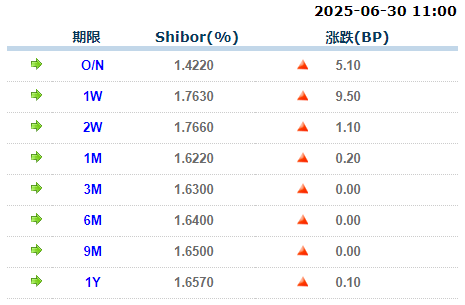
Monetary Policy and Market Operations - The People's Bank of China conducted a 7-day reverse repurchase operation of 331.5 billion yuan, maintaining the operation rate at 1.40% [1] - With 220.5 billion yuan of 7-day reverse repos maturing on the same day, the net injection into the open market was 111.0 billion yuan [1] Interbank Offered Rates - The Shanghai Interbank Offered Rate (Shibor) for short-term products rose across the board, with the 7-day Shibor leading the increase [1] - Specifically, the overnight Shibor increased by 5.10 basis points to 1.4220%, while the 7-day Shibor rose by 9.50 basis points to 1.7630% [2][3] - The 14-day Shibor saw a smaller increase of 1.10 basis points, reaching 1.7660% [2] Repo Market Activity - In the interbank pledged repo market, short-term rates increased significantly, with DR001 and R001 weighted average rates rising by 14.2 basis points and 83.5 basis points, respectively [4] - The transaction volumes for DR001 and R001 decreased by 363.6 billion yuan and 414.6 billion yuan, respectively [4] - The weighted average rates for DR007 and R007 also increased, with DR007 rising by 21.9 basis points to 1.9159% and R007 increasing by 8.5 basis points to 2.0056% [4] Funding Conditions - On June 30, the funding environment was tight in the morning, influenced by the quarter-end [9] - The overnight lending rates ranged from 3.50% to 3.80%, while the 7-day credit lending rate opened around 2.05% [9] - By the afternoon, the funding conditions balanced out but remained slightly tight, with overnight lending rates dropping to around 1.75% by the end of the trading day [9] Interbank Certificate of Deposit Issuance - As of June 30, there were 32 interbank certificates of deposit issued, with a total issuance amount of 16.78 billion yuan [9]

央行:境外机构在中国债券市场的托管余额4.4万亿元,占比2.3%
news flash· 2025-06-30 10:05
Core Insights - The People's Bank of China reported that as of the end of May, the custody balance of foreign institutions in the Chinese bond market reached 4.4 trillion yuan, accounting for 2.3% of the total custody balance in the market [1] Summary by Category - **Custody Balance**: The custody balance of foreign institutions in the Chinese bond market is 4.4 trillion yuan, representing 2.3% of the total [1] - **Interbank Bond Market**: Within this, the custody balance in the interbank bond market is 4.3 trillion yuan [1] - **Bond Types Held by Foreign Institutions**: - Government bonds: 2.1 trillion yuan, accounting for 48.5% - Interbank certificates of deposit: 1.2 trillion yuan, accounting for 28.0% - Policy bank bonds: 0.8 trillion yuan, accounting for 19.3% [1]
十年国债ETF(511260)强势吸金近百亿元,中信建投表示三季度债市或迎行情
Sou Hu Cai Jing· 2025-06-30 05:51
Group 1 - The ten-year government bond ETF (511260) has seen a net inflow of over 4.8 billion yuan for 10 consecutive days as of June 27, with nearly 10 billion yuan in the past month, bringing its current scale to over 13.5 billion yuan, indicating strong liquidity [1] - According to CITIC Securities, the duration of bond funds significantly increased to a new high in mid-June, suggesting potential profit-taking pressure in the short term. However, a bullish outlook is maintained for the medium term, particularly in July, when bond market sentiment may rise again, leading to long-term interest rates approaching previous lows [1] - The ten-year government bond yield is often regarded as a "risk-free return," characterized by high safety, strong liquidity, and stable returns, serving as a pricing anchor for various assets and referred to as the "ballast stone" of the bond market [1] Group 2 - The ten-year government bond ETF has demonstrated stable performance, achieving profits every year since 2018, making it a valuable asset allocation tool across market cycles [2] - The ETF offers three trading advantages: (1) flexible trading with T+0 intraday trading, suitable for swing trading; (2) can be pledged as a standard exchange security, with a current pledge rate of approximately 94%, enhancing capital utilization; (3) consists of CTD bonds, suitable for arbitrage strategies [2] - The fund is classified as a bond fund with expected returns and risk levels lower than equity and mixed funds, but higher than money market funds, utilizing an optimized sampling replication strategy to track the Shanghai 10-year government bond index [3]

牛市旗手券商板块大涨,行情能否持续?| 周度量化观察
申万宏源证券上海北京西路营业部· 2025-06-30 01:37
Market Overview - The A-share market experienced a strong rally this week, with nearly 90% of stocks achieving positive returns, driven by improved global risk appetite due to geopolitical developments and supportive policies in Hong Kong [2][12] - The bond market saw a slight pullback, but overall liquidity remained balanced, aided by the central bank's net injection of over 1 trillion yuan [2][8] Stock Market Insights - The stock market is expected to maintain a favorable risk appetite due to reduced international geopolitical risks and a weaker US dollar, despite the recent rally not being driven by economic fundamentals [6][10] - Structural investment opportunities are anticipated even if market turnover does not continue to increase significantly [6] Bond Market Analysis - The bond market is currently stable with no basis for a significant adjustment, and it is advisable to gradually increase positions during pullbacks [8] - The weak economic fundamentals are providing support for the bond market, making bonds suitable as a stabilizing asset in a diversified portfolio [8] Commodity Market Trends - Gold prices have been in a corrective phase after reaching high levels earlier this year, with COMEX gold failing to break the $3,500 per ounce mark [9][40] - The commodity index saw a weekly decline of 2.00%, with specific sectors like energy and agricultural products experiencing notable drops [40][42] Industry Performance - In the stock market, the computer, defense, and non-bank financial sectors showed strong performance with weekly gains of +7.70%, +6.90%, and +6.66% respectively [22][25] - The banking sector also performed well, with a year-on-year increase of 32.02% [25] Key Events Impacting the Market - The recent ceasefire agreement between Israel and Iran has positively influenced market sentiment [30] - The upcoming summer Davos Forum, attended by Chinese Premier Li Qiang, is expected to draw attention to China's economic policies [29]

流动性与机构行为跟踪:央行延续呵护,资金预计平稳跨月
ZHESHANG SECURITIES· 2025-06-29 09:22
Key Points Summary 1. Report Industry Investment Rating - The report does not provide an overall industry investment rating. However, it gives rating criteria for different types of bonds: - **Interest - rate bonds**: Based on the net price change of interest - rate bonds within 3 months after the report date. "Increase holding" means interest risk decreases and net price has room to rise; "Neutral" means interest risk is stable and net price has minor fluctuations; "Reduce holding" means interest risk increases and net price has room to fall [40]. - **Credit bonds**: Based on the net price change of credit bonds within 3 months after the report date. "Increase holding" means credit risk decreases and net price has room to rise; "Neutral" means credit risk is stable and net price has minor fluctuations; "Reduce holding" means credit risk increases and net price has room to fall [41]. - **Convertible bonds**: Based on the change of convertible bond price relative to the CSI Convertible Bond Index within 3 months after the report date. "Increase holding" means convertible bonds perform better than the index; "Neutral" means performance is the same as the index; "Reduce holding" means performance is worse than the index [42]. 2. Core Viewpoints - **Funds**: In the next week, the net financing scale of government bonds will decline, and the central bank is expected to withdraw funds as usual at the beginning of the month. The funds market is likely to maintain a balanced operation and cross the month smoothly [1]. - **Certificates of Deposit (CDs)**: In the next week, the maturity scale of CDs is about 0.25 trillion yuan, and the supply pressure will decrease. The funds market at the beginning of the month is expected to return to a balanced and loose state, and CD yields may show a volatile trend [1]. - **Institutional Behavior**: Funds, rural commercial banks, and other products are the main buyers of interest - rate bonds, and the net buying power of rural commercial banks has significantly rebounded [1]. 3. Summary by Relevant Catalogs 3.1 Weekly Liquidity Tracking 3.1.1 Funds Review - **Central Bank's Operations**: From June 23 - 27, 2025, the central bank had a net funds injection of 1267.2 billion yuan. This month, the net injection of MLF was 118 billion yuan, and the net injection of outright repurchase was 20 billion yuan. The OMO stock increased to 2027.5 billion yuan [10]. - **Exchange Rate Movement**: During the statistical period, the RMB depreciated by 1.62 basis points against the US dollar due to uncertainties in US tariffs and the increasing expectation of Fed rate cuts [10]. - **Government Bond Progress**: In the past week, the net financing of national bonds was 111 billion yuan, and the net financing since the beginning of the year was 3350.16 billion yuan, completing 50.3% of the annual plan. The issuance of new local bonds was 479.467 billion yuan, and the issuance since the beginning of the year was 2558.12 billion yuan, completing 49.2% of the annual plan. As of June 27, the issuance of special refinancing bonds for replacing implicit debts was 1.8 trillion yuan, completing 89.8% of the annual plan [13]. - **Funds Structure**: During the statistical period, the lending scale of national and joint - stock banks exceeded 5 trillion yuan, the lending scale of money market funds and wealth management products decreased, and the overall borrowing scale of non - bank institutions decreased significantly. Due to the strong demand for cross - month funds, the core funds rate increased marginally, and the R - series and DR - series moved basically in sync, with an obvious increase in liquidity stratification [16]. 3.1.2 CD Review - **Primary Market**: From June 23 - 27, 2025, the net financing of inter - bank CDs was - 411.35 billion yuan, and the issuance totaled 736.46 billion yuan, with a maturity volume of 1137.81 billion yuan. The average primary issuance rate was 1.6409% (previous value: 1.6556%). In the next three weeks, the maturities of inter - bank CDs will be 245.79 billion, 510.52 billion, and 802.81 billion yuan respectively [19]. - **Secondary Market**: During the statistical period, large banks, money market funds, and wealth management products continued to increase their holdings, while insurance companies and other product accounts continued to hold. Joint - stock banks changed from buying to selling. City and rural commercial banks were still the largest counterparties. The secondary market yield of CDs fluctuated slightly upward, the yield curve remained inverted, and the curve above 3M steepened. The yields of 1M/3M/6M/9M/1Y CDs changed by 3.37BP/0.50BP/1.00BP/0.35BP/0.85BP respectively [21]. 3.1.3 Next Week's Focus - **Funds**: The central bank continued to over - renew MLF in June, and has been renewing MLF for 4 consecutive months to inject liquidity, combined with a net injection of 20 billion yuan in outright repurchase. The funds market was in a balanced and loose state. In the next week, the net financing scale of government bonds will decline, and the central bank is expected to withdraw funds as usual at the beginning of the month. The funds market is likely to maintain a balanced operation and cross the month smoothly [25]. - **CDs**: In the past month, the net financing of CDs remained negative. The central bank's increased open - market operations effectively relieved the banks' liability pressure, and the central level of primary CD rates decreased. In the next week, the maturity scale of CDs is about 0.25 trillion yuan, and the supply pressure will decrease. The funds market at the beginning of the month is expected to return to a balanced and loose state, and CD yields may show a volatile trend [26]. 3.2 Weekly Institutional Behavior Tracking - **Long - term Bond Funds' Duration**: On June 27, the median of the 10 - day rolling average duration of long - term bond funds was 3.91 years, a slight increase from the previous period [31]. - **Institutional Bond - Buying Behavior** - **Large Banks' Bond - Buying**: In the past week, large banks bought 28.7 billion yuan of national bonds (previous week: 51.7 billion yuan), a slight decline [31]. - **Interest - rate Bond Buyers**: Funds, rural commercial banks, and other products are the main buyers. Rural commercial banks' net buying power has significantly rebounded. In the past week, funds' net buying of interest - rate bonds was 89 billion yuan (previous week: 141.3 billion yuan), rural commercial banks' net buying was 47.3 billion yuan (previous week: - 127.2 billion yuan), and other products' net buying was 23.6 billion yuan (previous week: 42.8 billion yuan) [31]. - **CD Buyers**: Large banks, money market funds, wealth management products, and insurance companies are the main buyers. The net buying power of large banks and money market funds has significantly increased, while that of wealth management products and other products has decreased. In the past week, large banks' net buying of CDs was 73.2 billion yuan (previous week: 33.7 billion yuan), money market funds' net buying was 57.3 billion yuan (previous week: 41.6 billion yuan), wealth management products' net buying was 48.4 billion yuan (previous week: 80.9 billion yuan), and insurance companies' net buying was 23.5 billion yuan (previous week: 28 billion yuan) [31]. - **Credit Bond Buyers**: The net buying scale of major non - bank buyers of credit bonds has slightly declined. For credit bonds over 5 years, the net buying scale of non - bank buyers remained basically the same. Overall, funds, wealth management products, other products, money market funds, and insurance companies all participated in buying credit bonds, showing a balanced situation. For credit bonds over 5 years, insurance companies, wealth management products, and other products had strong buying power [31]. - **Secondary Bond Buyers**: The overall net buying demand is not strong. The net buying power of secondary bonds within 2 years has declined, and wealth management products are still the main net buyers. The demand for secondary bonds between 2 - 5 years and over 5 years has also declined significantly [31]. - **Institutional Leverage Level**: In the past week, the bond market leverage ratio was 107.93%, a continued increase from the previous period [32]. - **Key Spreads**: On June 27, the 10Y CDB - 10Y national bond term spread was 3.63bp, and the spread was converging; the 1Y CDB - R001 spread was 5.41BP, and the spread between short - term bond yields and funds prices widened slightly [34].
永安期货大类资产早报-20250626
Yong An Qi Huo· 2025-06-26 06:38
Report Overview - Report Title: Big Asset Morning Report - Report Date: June 26, 2025 - Report Team: Macro Team of the Research Center 1. Global Asset Market Performance 1.1 Major Economies' 10 - Year Treasury Yields - On June 25, 2025, yields in the US, UK, France, etc. were 4.293, 4.480, 3.257 respectively [3] - Latest changes ranged from - 0.043 (Japan) to 0.036 (Switzerland), one - week changes from - 0.160 (Japan) to 0.132 (Switzerland), one - month changes from - 0.200 (Japan) to 0.134 (Switzerland), and one - year changes from - 0.984 (Japan) to 0.366 (UK) [3] 1.2 Major Economies' 2 - Year Treasury Yields - On June 25, 2025, yields in the US, UK, Germany, etc. were 3.840, 3.851, 1.840 respectively [3] - Latest changes ranged from - 0.060 (US) to 0.016 (South Korea), one - week changes from - 0.130 (US) to 0.012 (South Korea), one - month changes from - 0.170 (US) to 0.143 (South Korea), and one - year changes from - 0.970 (Germany) to 0.433 (Japan) [3] 1.3 US Dollar vs. Major Emerging Economies' Currencies Exchange Rates - On June 25, 2025, exchange rates against the Brazilian real, Russian ruble, etc. were 5.564, 108.000 respectively [3] - Latest changes ranged from - 1.38% (South African rand) to 1.29% (Brazilian real), one - week changes from - 1.39% (Brazilian real) to 0.00% (Russian ruble), one - month changes from - 11.28% (Thai baht) to 2.65% (Brazilian real) [3] 1.4 Major Economies' Stock Indexes - On June 25, 2025, the Dow Jones was 6092.160, S&P 500 was 42982.430, etc. [3] - Latest changes ranged from - 1.59% (Spanish index) to 2.19% (French CAC), one - week changes from - 3.43% (Mexican index) to 4.03% (French CAC), one - month changes from - 0.18% (Mexican index) to 30.05% (UK index), and one - year changes showed various trends [3] 1.5 Credit Bond Indexes - Latest changes ranged from - 0.09% (Emerging economies' high - yield credit bond index) to 0.13% (Eurozone high - yield credit bond index), one - week changes from - 0.03% (Emerging economies' high - yield credit bond index) to 0.82% (Eurozone high - yield credit bond index), one - month changes from 0.41% (Emerging economies' high - yield credit bond index) to 1.73% (Eurozone high - yield credit bond index), and one - year changes from 5.75% (Emerging economies' investment - grade credit bond index) to 13.70% (Eurozone high - yield credit bond index) [4] 2. Stock Index Futures Trading Data 2.1 Index Performance - On June 25, 2025, the A - share index closed at 3455.97, with a 1.04% increase, the Shanghai - Shenzhen 300 at 3960.07, up 1.44%, etc. [5] 2.2 Valuation - PE(TTM) of the Shanghai - Shenzhen 300 was 13.17, with a 0.14%环比 change, the S&P 500 was 25.85, with a 0.00%环比 change [5] 2.3 Risk Premium - The risk premium of the Shanghai - Shenzhen 300 was 3.70, with a 0.00%环比 change, the S&P 500 was - 0.43, with a 0.00%环比 change [5] 2.4 Fund Flows - The latest value of A - share fund flows was 469.76, the 5 - day average was - 26.39 [5] 2.5 Transaction Amount - The latest transaction amount of the Shanghai and Shenzhen stock markets was 16027.40, with a 1881.58 increase compared to the previous period [5] 2.6 Main Contract Premium/Discount - The basis of IF was - 37.27, with a - 0.94% amplitude, IH was - 25.13, with a - 0.91% amplitude, and IC was - 28.35, with a - 0.48% amplitude [5] 3. Treasury Bond Futures Trading Data 3.1 Futures Prices - On June 25, 2025, the closing prices of T00, TF00, T01, and TF01 were 108.995, 106.190, 109.010, and 106.275 respectively, with - 0.12%, - 0.08%, - 0.12%, and - 0.08% changes [6] 3.2 Fund Rates - The R001 was 1.4402%, with a - 38.00 BP daily change, R007 was 1.8593%, with a 4.00 BP daily change, and SHIBOR - 3M was 1.6300%, with a 0.00 BP daily change [6]
债券市场等待方向明朗,30年国债ETF(511090)盘中飘红,成交额超11亿元
Sou Hu Cai Jing· 2025-06-26 02:24
Group 1 - The 30-year Treasury ETF (511090) has increased by 0.02%, with the latest price at 124.37 yuan as of June 26, 2025 [1] - The trading volume for the 30-year Treasury ETF reached 1.18 billion yuan, with an intraday turnover of 7.28% [1] - The average daily trading volume over the past week was 6.746 billion yuan [1] Group 2 - The latest size of the 30-year Treasury ETF is 16.188 billion yuan [2] - The external environment remains uncertain, while internal policies are clearly hedging, leading to a weak recovery in the fundamentals, which makes it difficult to provide a clear directional trend for the bond market [2] - The bond market is expected to continue a narrow range of fluctuations, with factors such as tariff negotiations, monetary conditions, and institutional behavior potentially triggering small wave trends [2] - The 30-year Treasury ETF closely tracks the China Bond 30-Year Treasury Index, which consists of publicly issued 30-year treasury bonds with a maturity of 25-30 years [2]