
成长风格

Search documents
机构:6月份前半段时间红利相对占优,港股红利ETF博时(513690)涨近1%,中信银行涨超4%
Xin Lang Cai Jing· 2025-06-03 03:28
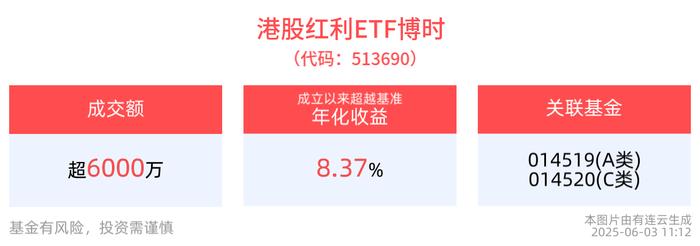
Group 1 - The Hang Seng High Dividend Yield Index (HSSCHKY) has shown a strong increase of 1.54% as of June 3, 2025, with notable gains in stocks such as China CITIC Bank (00998) up 4.88%, Swire Properties (01972) up 3.94%, and Agricultural Bank of China (01288) up 3.41% [2] - The Bosera Hang Seng High Dividend ETF (513690) has risen by 0.72%, with a latest price of 0.99 yuan and a trading volume of 61.74 million yuan [2] - The Bosera Hang Seng High Dividend ETF has a recent scale of 4.005 billion yuan and has seen a net financing amount of 1.201 million yuan in the previous trading day [3] Group 2 - The Bosera Hang Seng High Dividend ETF has achieved a net value increase of 32.41% over the past two years, ranking 120 out of 2187 in the index stock fund category [4] - The ETF has a maximum monthly return of 24.18% since inception, with an average monthly return of 4.99% [4] - The ETF's management fee is 0.50% and the custody fee is 0.10%, with a tracking error of 0.055% over the past six months [4] Group 3 - As of June 2, 2025, the top ten weighted stocks in the Hang Seng High Dividend Yield Index account for 28.55% of the index, including Yanzhou Coal Mining Company (01171) and Cheung Kong Infrastructure Holdings (00008) [5][7] - The weight of the top stock, Yanzhou Coal Mining Company, is 4.39%, while the second, Cheung Kong Infrastructure Holdings, has a weight of 2.66% [7]




量化资产配置月报:经济指标继续转弱,配置风格仍偏成长-20250602
Shenwan Hongyuan Securities· 2025-06-02 14:13
Group 1 - Economic indicators continue to weaken, and the allocation style remains growth-oriented. The quantitative indicators suggest that the economy is declining, liquidity is neutral to loose, and credit indicators are improving. The micro mapping shows that economic (profit expectations) continues to be weak, while credit is improving. The revised direction indicates economic downturn, tight liquidity, and improved credit, consistent with the previous period. Due to the significant divergence between liquidity and credit, the focus is on factors that are insensitive to the economy but sensitive to credit, maintaining a growth-oriented stock pool allocation style [4][7][9] - The macro asset allocation viewpoint suggests increasing bond positions. Given the current indicators, with the economy declining, liquidity tightening, and credit remaining favorable, the outlook for equities is slightly bearish, leading to a minor reduction in A-share positions. The trend for bonds has improved, with an increase in government bond positions and a reduction in US stock positions to zero [4][31] - The economic leading indicators are entering a declining phase. The updated economic leading indicator model indicates that June 2025 is at the beginning of a decline cycle, which is expected to continue [13][15] Group 2 - Liquidity is showing signs of recovery. In May, interest rates remained stable, with short-term rates slightly exceeding the 12-month average, while long-term rates are still significantly distant from the average. The monetary supply data has rebounded, signaling a return to a neutral stance, although the excess reserve ratio remains low, indicating that overall liquidity has returned to a slightly loose state [24][28][26] - Credit indicators are weak across various dimensions. In the second half of 2024, credit indicators are expected to remain low, with the total social financing stock showing a year-on-year increase for five consecutive months, maintaining a high level of comprehensive credit indicators [29] - The market focus remains on liquidity. Since 2023, credit and inflation have garnered significant attention, but recently liquidity has become the most scrutinized variable, particularly following the market rally at the end of September, indicating that the current market is heavily driven by liquidity [33] Group 3 - In terms of industry selection from a macro perspective, the report indicates a preference for industries that are insensitive to economic fluctuations but sensitive to credit conditions. The analysis suggests that these industries possess growth attributes, leading to a higher overall growth characteristic in the selected industries [34] - The report identifies the top industries based on their sensitivity to economic and credit conditions. The industries with the highest scores for being economically insensitive and credit-sensitive include electronics, media, and personal care, among others [34]
权益ETF系列:持续震荡,关注红利和成长风格的转折点
Soochow Securities· 2025-05-31 15:22
Investment Rating - The report maintains an "Overweight" rating for the industry [1] Core Insights - The industry is experiencing continuous fluctuations, with a focus on the turning points of dividend and growth styles [19][20] - The macro model indicates that the market may face adjustment pressure in the near term, with a potential for a slight rebound later in June [19][24] - The report highlights the importance of monitoring event-driven impacts, particularly regarding U.S. tariff policies [20] Market Overview (May 26 - May 30, 2025) - Major broad-based indices showed varied performance, with the top three being North Securities 50 (up 2.82%), Wind Micro-Equity Daily Equal Weight Index (up 2.65%), and CSI 2000 (up 1.09%). The bottom three were ChiNext Index (down 1.40%), Shanghai 50 (down 1.22%), and CSI 300 (down 1.08%) [9][10] - Style indices also varied, with small-cap value (up 0.56%) and large-cap growth (down 2.71%) showing significant differences [10][13] - Among the Shenwan first-level industry indices, Environmental Protection (up 3.42%) and Pharmaceutical Biology (up 2.21%) performed well, while Automotive (down 4.11%) and Electric Equipment (down 2.44%) lagged [14][15] Market Outlook (June 3 - June 6, 2025) - The market is expected to remain volatile, with a focus on the transition between dividend and growth styles [19] - The macro model for June indicates a score of 0, suggesting a generally flat performance for the month, with potential for a slight increase after initial adjustments [24] - The report anticipates that the dividend style may face headwinds while the growth style could perform better in the latter half of June [19][20] Fund Allocation Recommendations - The report suggests a balanced allocation strategy for ETFs, anticipating a period of market adjustment [20]
一图看懂:主动优选基金经理,在2025年1季报里都说了啥?
银行螺丝钉· 2025-05-21 13:56
Core Viewpoints - The article summarizes the insights from fund managers based on their Q1 2025 reports, focusing on their investment strategies and market outlooks [1]. Group 1: Fund Manager Perspectives - Fund managers typically cover two main areas in their reports: a review of past investments and future market outlooks, with the latter being more significant [3]. - Different fund managers exhibit varying levels of detail in their reports, influenced by their investment styles, such as value or growth [3]. - The deep value style emphasizes low valuations and high dividend yields, primarily investing in sectors like finance, real estate, and energy [4][5]. - Growth value style focuses on companies with strong profitability and cash flow, often holding stocks for the long term [10]. Group 2: Deep Value Style Insights - Deep value style has shown strong performance from 2021 to 2024, while it underperformed in 2019-2020 [6]. - Fund managers express confidence in their holdings despite market uncertainties, citing factors like geopolitical changes and technological advancements as influential [7]. - The current market environment is characterized by structural changes, with some sectors facing prolonged competition, while others show clear competitive advantages [7]. Group 3: Growth Value Style Insights - Growth value managers highlight the resilience of high-frequency economic data and improved financing conditions, suggesting a positive outlook for the second quarter [12]. - They emphasize the importance of focusing on domestic economic transformation and internal demand rather than external pressures [12][13]. - Fund managers are adjusting their portfolios to capitalize on sectors like AI and healthcare, anticipating a shift in consumer behavior and market dynamics [15][16]. Group 4: Balanced Style Insights - The balanced style seeks to combine growth potential with valuation, often looking for stocks that offer good value relative to their growth prospects [26]. - Fund managers maintain a diversified approach, focusing on sectors with favorable valuations and growth potential, such as healthcare and technology [29][30]. - They express optimism about domestic consumption policies and liquidity, which may support market performance despite external uncertainties [30]. Group 5: Growth Style Insights - The growth style prioritizes companies with high revenue and profit growth, often accepting higher valuations for strong growth potential [39][40]. - Fund managers are actively seeking opportunities in emerging industries, such as renewable energy and technology, which are expected to drive future growth [41].

风格Smartbeta组合跟踪周报(2025.05.12-2025.05.16):小盘组合超额均超过 1%-20250521
GUOTAI HAITONG SECURITIES· 2025-05-21 11:14
- The report focuses on the performance of Smart Beta portfolios, specifically Value, Growth, and Small-cap styles, constructed based on high beta elasticity and long-term stable excess returns objectives[7][8][10] - Value Smart Beta portfolios include "Value 50 Portfolio" and "Value Balanced 50 Portfolio", with weekly returns of 1.13% and 0.32%, respectively, and annual returns of 5.80% and 1.55%[4][8][10] - Growth Smart Beta portfolios include "Growth 50 Portfolio" and "Growth Balanced 50 Portfolio", with weekly returns of 1.27% and 1.59%, respectively, and annual returns of 0.86% and 6.05%[4][8][16] - Small-cap Smart Beta portfolios include "Small-cap 50 Portfolio" and "Small-cap Balanced 50 Portfolio", with weekly returns of 1.39% and 1.49%, respectively, and annual returns of 8.87% and 10.70%[4][8][22] - Performance metrics for Smart Beta portfolios include absolute returns, excess returns relative to benchmarks, and maximum relative drawdowns, with detailed data provided for each portfolio[8][10][22]
[5月19日]指数估值数据(价值策略指数有哪些;月薪宝发薪日;黄金星级更新)
银行螺丝钉· 2025-05-19 13:45
Core Viewpoint - The article discusses the performance and characteristics of value and growth investment styles in the stock market, highlighting the increasing popularity of value strategies, particularly dividend indices, in the current economic environment. Group 1: Market Overview - The market showed minor fluctuations today, with the Shanghai and Shenzhen 300 indices slightly down while small-cap stocks experienced slight gains [2][6]. - Value style stocks tend to exhibit lower volatility during market fluctuations, making them more resilient [3]. - Growth style stocks have seen a slight decline in performance [5]. Group 2: Value and Growth Investment Styles - Value style stocks are characterized by lower price-to-earnings (P/E) and price-to-book (P/B) ratios, along with higher dividend yields, often found in sectors like finance, energy, and consumer goods [8]. - Growth style stocks are associated with higher revenue and earnings growth rates, leading to higher average valuations [8]. - The dividend index, a prominent value index, has gained traction due to declining interest rates, attracting institutional investors seeking better cash flow assets [8][10]. Group 3: Performance of Value Indices - The Shanghai and Shenzhen 300 index rose from 1000 points to 5601 points, while the 300 value index increased from 1000 points to 9189 points [11]. - The 300 value index reached a historical high in Q4 2024, indicating strong performance during the recent bear market [12]. - The value strategy indices, including 优选300 and 中证价值, have also shown promising results by selecting low-valuation stocks with certain growth criteria [18][22]. Group 4: Investment Strategies and Trends - Despite the positive performance of value investing, the overall scale of value-focused funds remains small, accounting for less than 1% of total A-share stock funds [29][30]. - The article emphasizes the importance of understanding investment cycles and maintaining a long-term perspective in value investing [46][47]. - Upcoming live sessions will address the characteristics of various value strategy indices and current investment opportunities [31].

产业经济周观点:重视核心资产风格-20250518
Huafu Securities· 2025-05-18 13:52
Group 1 - The report emphasizes that the recent public fund regulations are a necessary result of long-term changes in China's capital market structure and economic structure [3] - The market style is shifting from low-volatility strategies to core assets, indicating a potential long-term decline in China's capital intensity [3][24] - In the short to medium term, the core asset style needs to recover, while in the long term, it reflects the cyclical bottoming of the economy [3][24] Group 2 - The report notes that the resilience of the US economy is weakening, with inflation structures continuing to adjust; April's CPI inflation year-on-year was 2.3%, while core CPI remained at 2.8% [8][11] - The US PPI inflation showed a month-on-month decline of -0.47% in April, with service PPI contributing significantly to this decline [9][12] - Retail sales in the US also showed weak growth, with a month-on-month increase of only 0.058% in April, indicating a drag on consumption [11][12] Group 3 - The report highlights the mutual reduction of trade barriers between China and the US, with both countries agreeing to cancel 91% of tariffs and establish a mechanism for ongoing economic negotiations [13][15] - The Hong Kong stock market saw a general increase, with the Hang Seng Index rising by 2.09% [16] - The report indicates a lack of clear main lines in the Hong Kong market, with sectors like security, NFT concepts, and building energy efficiency leading the gains [19][24] Group 4 - The report suggests that the growth style may continue to adjust due to a lack of event catalysts [3][24] - In terms of industry performance, financial and real estate sectors led the gains, while technology sectors faced declines [32][24] - The report also notes a divergence in foreign capital index futures holdings, with net short positions expanding in some indices [44]
策略周专题(2025年5月第2期):大小盘风格分化或将收敛
EBSCN· 2025-05-18 13:14
Group 1 - The report indicates that the A-share market has shown an upward trend, with major indices such as the ChiNext Index, SSE 50, and CSI 300 leading in gains, while the STAR 50 and CSI 500 experienced slight declines [1][15][17] - Since early April, there has been a significant outperformance of small-cap indices compared to large and mid-cap indices, with the CSI 2000 and Wind Micro-cap Index rising by 16.4% and 22.1% respectively from April 8 to May 16 [2][20][26] - The report highlights that the small-cap indices have benefited from a rebound after a prior decline, as well as from improved market sentiment following substantial progress in US-China trade talks [2][26][27] Group 2 - Historical patterns suggest that the divergence between small and large-cap stocks may converge in the future, as market sentiment shifts from riskier small-cap stocks to more stable large-cap stocks during prolonged market rallies [3][34][36] - The report emphasizes that mid to long-term capital inflows into the A-share market are likely to favor large-cap stocks, as these are typically preferred by institutional investors seeking stability and predictable performance [3][35] - The report also notes that the profitability of large-cap stocks is currently stronger, with the ROE (TTM) for the CSI 300 and CSI 500 at 9.8% and 6.0% respectively, compared to lower figures for small-cap indices [3][37] Group 3 - The report suggests a potential rotation between defensive and growth styles in the market, with defensive sectors focusing on stable or high-dividend industries, while growth sectors emphasize thematic growth and independent cyclical industries [4][58][59] - It identifies specific industries to watch under different market sentiment scenarios, with utilities, banks, and construction being favored in a declining sentiment environment, while media, defense, and technology sectors may perform better if sentiment improves [4][59][60] - The report provides a scoring framework for industry allocation, indicating that public utilities and banks score highly under current conditions, suggesting a preference for these sectors in the near term [4][65]
风格轮动策略周报:当下价值、成长的赔率和胜率几何?-20250517
CMS· 2025-05-17 13:49
Group 1 - The report introduces a quantitative model solution for addressing the issue of value and growth style switching, based on the combination of odds and win rates [1][8] - The recent performance of the growth style portfolio was 0.82%, while the value style portfolio achieved a return of 1.15% [1][8] Group 2 - The estimated odds for the growth style is 1.09, and for the value style, it is 1.08, indicating a negative correlation between relative valuation levels and expected odds [2][14] - The current win rates indicate that 4 out of 7 indicators favor growth, resulting in a win rate of 58.26% for growth and 41.74% for value [3][18] Group 3 - The latest investment expectation for the growth style is calculated to be 0.22, while the value style has an investment expectation of -0.13, leading to a recommendation for the growth style [4][19] - Since 2013, the annualized return of the style rotation model based on investment expectations is 27.18%, with a Sharpe ratio of 0.98 [4][20]
A500早参丨高盛再度上调中国股市目标价,A500ETF基金(512050)近一周规模增长5.79亿元
Mei Ri Jing Ji Xin Wen· 2025-05-16 02:17
Group 1 - The A-share market opened lower on May 15, with the three major indices experiencing fluctuations and closing down, specifically the CSI A500 index fell by 1.04% [1] - Despite the overall market decline, sectors such as beauty care, agriculture, and food and beverage saw gains [1] - The A500 ETF fund (512050) recorded a decrease of 0.94% in a single day, with a trading volume exceeding 3.7 billion yuan, ranking first among its peers [1] Group 2 - In the past week, the A500 ETF fund (512050) saw an increase in scale by 579 million yuan and an increase in shares by 40.5 million, both leading in its category [1] - Goldman Sachs raised its 12-month target points for the MSCI China Index and the CSI 300 Index to 84 points and 4600 points respectively, indicating an upside potential of 11% and 17% from current levels [1] - Goldman Sachs maintained an "overweight" rating on the Chinese stock market, favoring domestic-oriented industries and recommending increased holdings in consumer goods, technology, and banking sectors [1] Group 3 - According to the latest report from Cinda Securities, there is a preference for large-cap value stocks in the current quarter, with an expectation to increase flexibility in Q3 [1] - The report suggests focusing on new directions with positive fundamental changes expected due to policy catalysts, including military industry growth, benefiting metals from price increases, and value themes related to stable growth in financial real estate [1]