股债跷跷板

Search documents
2025Q3产业债策略:挖掘“反内卷”下的行业配置机会
Orient Securities· 2025-07-24 09:42
Group 1: Q3 Super Long Credit Bond Strategy - The report suggests gradually taking profits on super long credit bonds and switching to shorter-term, more liquid varieties while waiting for the next investment opportunity [6][10][26] - In Q2, the issuance of super long credit bonds increased significantly, with a total of 539.8 billion yuan, marking a 63% increase from the previous quarter [10][12] - The report indicates that the current market conditions do not support further exploration of super long credit bonds due to declining odds of capital gains and limited arbitrage opportunities [26][27] Group 2: Q3 Industry Bond Strategy - The strategy focuses on identifying investment opportunities under the "anti-involution" initiative across various industries [6][10] - In the construction sector, while there is a marginal improvement expected due to funding acceleration and the "anti-involution" initiative, the overall industry remains under pressure [6][10] - The steel industry shows strong expectations for marginal improvement, with opportunities for continued compression of spreads among mid-tier players like Hebei Steel and Shandong Steel [6][10] - The coal sector anticipates a rebound in prices, with a focus on major players like Jin Energy, while cash flow improvements may exceed expectations [6][10] - The real estate sector faces increasing downward pressure, but state-owned enterprises still present attractive absolute returns [6][10] - In the non-ferrous metals sector, the report highlights a divergence in market conditions, with opportunities for compression in spreads among quality private enterprises [6][10] - The cement industry is under significant pressure, with risks of losses and limited opportunities for excess returns [6][10] - The overall strategy recommends focusing on medium-quality entities across industries, particularly in steel, coal, real estate, and construction, while keeping an eye on the "anti-involution" initiative and the commencement of the Yajiang Hydropower Station [6][10]
宁证期货今日早评-20250724
Ning Zheng Qi Huo· 2025-07-24 01:38
Report Summary 1. Investment Ratings - The report does not provide an overall industry investment rating. 2. Core Views - The market is influenced by policy expectations, with the black - chain having a good atmosphere but facing high - valuation callback risks. Different commodities have their own supply - demand situations and price trends, and many are recommended for a wait - and - see approach [2]. 3. Summary by Commodity Coal and Related Products - **Coking Coal**: The current market is policy - expected dominated. The black - chain has a good atmosphere, but high - valuation risks exist. Attention should be paid to rhythm and risk control [2]. - **Methanol**: Domestic methanol开工 is expected to rise at a high level, downstream demand is expected to be weak. The 09 contract is expected to fluctuate in the short term, with a pressure level at 2510. It is recommended to wait and see or short on rebounds [3]. - **Crude Oil**: OPEC+ maintains its production - increasing stance, and actual production release is slow. It is recommended to wait and see [5]. Chemical Products - **PTA**: PTA device maintenance is average, with new production expectations. Downstream polyester factories are likely to cut production in July, and terminal demand is weak. It is recommended to wait and see [5]. - **Manganese Silicon**: Coke prices may rise, and power costs are hard to reduce. However, port inventories are rising, and ore prices lack support. The supply - demand relationship may become looser. It is expected to fluctuate in the short term [10]. Agricultural Products - **Pig**: The national pig price is weak in the short term due to increased supply and weak demand. There is a short - term bullish expectation from the Ministry of Agriculture and Rural Affairs. It is recommended to wait and see and short at appropriate times [6]. - **Palm Oil**: Indonesian fundamentals are positive, and Malaysian production increased in the first 20 days of July. The price is expected to fluctuate at a high level [7]. - **Rubber**: Raw material prices are firm due to weather, and inventory has slightly decreased. Tire开工 has rebounded, but there is still pressure on the price. It may correct in the short term. It is recommended to wait and see or short [8]. - **Soybean Meal**: There is a game between "weak reality" and "strong expectation". There is an inventory - accumulation expectation with a large amount of soybeans arriving. It is recommended to take profit on long positions and wait and see [9]. Metals - **Silver**: The struggle between the Fed and the White House over interest - rate cuts continues. Before the end - of - July interest - rate meeting, silver is mainly bullish and may fluctuate at a high level [13]. - **Gold**: US tariff negotiations increase global economic pressure. The dollar's downward momentum weakens, and gold may enter a slightly bearish oscillation trend [14]. - **Soda Ash**: The domestic soda - ash market is stable and slightly bullish. The 09 contract is expected to fluctuate in the short term, with a pressure level at 1350. It is recommended to wait and see or short [15]. Construction Materials - **Rebar**: Steel prices are driven up by cost increases but face a callback risk in the second half of the week due to weak demand in the high - temperature off - season [10]. Bonds - **Long - and Medium - Term Treasury Bonds**: Before the July Politburo meeting, policies are expected to increase fiscal support, which is bearish for bonds. The main logic of the bond market is unclear, and the stock - bond seesaw effect should be noted [11]. - **Short - Term Treasury Bonds**: Market expectations of a short - term interest - rate decline are positive for short - term bonds. However, the bond market is still affected by the stock - bond seesaw, and the overall fundamentals are bearish [11]. Plastics - **Plastic**: LLDPE supply has pressure, and downstream demand is in the off - season. The L 09 contract is expected to fluctuate in the short term, with a pressure level at 7400. It is recommended to wait and see [13].
利率债收益率全线上行
Guo Ji Jin Rong Bao· 2025-07-23 13:10
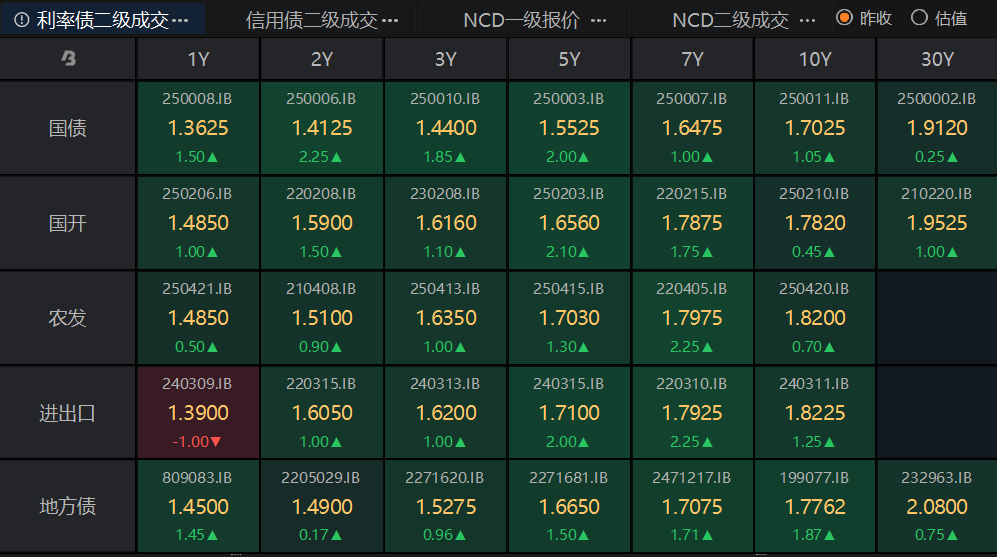
今日,沪指一度站上3600点,随后快速跳水。与此同时,国债期货从全线大跌转而跌幅收窄。 截至下午收盘,国债期货30年期主力合约跌0.21%,10年期主力合约跌0.11%,5年期主力合约跌0.09%,2年期主力合约跌0.03%。 "风险偏好和市场拥挤度是债市调整的主要原因。"南华期货权益与固收研究分析师高翔向记者分析称,近期风险资产强势,不仅A股内部 呈现"大盘红利—科技—大基建"的接力上涨,权益与大宗商品亦先后发力,对债市资金形成虹吸。与此同时,尽管银行间流动性充裕、资金 利率已回落至低位,为债市多头提供支撑,但长端收益率久盘不下,机构只能通过拉长久期来博取收益,导致债基久期不断抬升、头寸拥 挤。 "股债跷跷板"效应明显。 与此同时,今日银行间主要利率债收益率普遍上行。截至下午4:30,10年期国债活跃券250011收益率上行1.05个基点,报1.7025%;30年 期国债活跃券2500002收益率上行0.25基点,报1.9120%;10年期国开活跃券250210收益率上行0.45个基点,报1.782%。 | ① 利率债二级成交 … | | 信用债二级成交 … | | NCD一级报价 ··· | | NCD二 ...

债市日报:7月23日
Xin Hua Cai Jing· 2025-07-23 09:47
Core Viewpoint - The bond market is experiencing adjustments with government bond futures declining across the board, while interbank bond yields are rising slightly. The market is influenced by short-term emotional shocks, but the fundamental economic data remains under various influences, indicating that the logic of monetary easing is still intact for the long term [1][6]. Market Performance - Government bond futures closed lower, with the 30-year main contract down 0.21% to 119.27, the 10-year main contract down 0.11% to 108.52, the 5-year main contract down 0.09% to 105.79, and the 2-year main contract down 0.03% to 102.38 [2]. - Interbank bond yields generally increased, with the 30-year government bond yield rising 0.25 basis points to 1.911%, the 10-year policy bank bond yield up 0.5 basis points to 1.7825%, and the 10-year government bond yield up 0.75 basis points to 1.7% [2]. Overseas Bond Market - In North America, U.S. Treasury yields fell across the board, with the 2-year yield down 2.31 basis points to 3.8292% and the 10-year yield down 3.17 basis points to 4.344% [3]. - In Asia, Japanese bond yields mostly rose, with the 10-year yield increasing 8.5 basis points to 1.588% [3]. - In the Eurozone, yields on 10-year bonds also decreased, with the UK yield down 3.3 basis points to 4.568% [3]. Primary Market - Agricultural Development Bank's financial bonds had winning yields of 1.3695%, 1.6649%, and 1.7888% for 1.074-year, 3-year, and 10-year terms, respectively, with bid-to-cover ratios of 2.54, 3.26, and 3.76 [4]. - The Ministry of Finance's 91-day and 182-day treasury bonds had weighted winning yields of 1.2231% and 1.3243%, with bid-to-cover ratios of 3.28 and 2.3 [4]. Funding Conditions - The central bank conducted a 7-day reverse repurchase operation of 150.5 billion yuan at a rate of 1.40%, resulting in a net withdrawal of 369.6 billion yuan for the day [5]. - Shibor rates for short-term products mostly increased, with the overnight rate rising 5.0 basis points to 1.367% [5]. Institutional Perspectives - Citic Securities noted that the recent bond market adjustment reflects various factors, including "anti-involution" and water conservancy projects, suggesting that while short-term concerns exist, long-term opportunities may arise [6]. - Huatai Fixed Income highlighted that the bond market adjustment is driven by changes in three core logics, including strong performance of risk assets and marginal corrections in fundamental expectations [6]. - Hongze Fixed Income pointed out that despite the ongoing adjustments, there are still structural opportunities in the bond market, with a shift in focus from extremes to the middle ground [6].


瑞达期货国债期货日报-20250723
Rui Da Qi Huo· 2025-07-23 09:25
国债期货日报 2025/7/23 | 项目类别 | 数据指标 最新 | 最新 | 环比 项目 | | 环比 | | --- | --- | --- | --- | --- | --- | | 期货盘面 | T主力收盘价 | 108.520 | -0.11% T主力成交量 | 115034 | 3580↑ | | | TF主力收盘价 | 105.790 | -0.09% TF主力成交量 | 87176 | 2731↑ | | | TS主力收盘价 | 102.380 | -0.03% TS主力成交量 | 46570 | 1732↑ | | | TL主力收盘价 | 119.270 | -0.21% TL主力成交量 | 154682 | 2262↑ | | 期货价差 | TL2512-2509价差 | -0.17 | +0.03↑ T09-TL09价差 | -10.75 | 0.06↑ | | | T2512-2509价差 | 0.08 | +0.02↑ TF09-T09价差 | -2.73 | 0.02↑ | | | TF2512-2509价差 | 0.08 | +0.00↑ TS09-T09价差 | -6.14 ...

刚刚,全线下跌!
证券时报· 2025-07-23 08:17
近期,A股市场持续走强,上证指数连续多日站稳3500点关键心理关口,并在7月23日突破了3600点关口,而债市却因"股债跷跷板"效应遭遇显 著调整。 7月以来,国债期货各品种持续走弱,信用债市场波动有所加剧,多家基金公司紧急调整债基净值精度以应对赎回压力,市场情绪趋于谨慎。 债市接连调整 7月23日,在A股市场突破3600点关口之际,债市再次出现回调走势。 截至发稿,30年期国债期货跌0.44%,报118.99元。自7月初以来,该国债期货累计跌幅接近2%。 | F9 前复权 超级蓉加 画线 丁具 © > | | | CFFEX30年期国债期货 | | | 立即 | | --- | --- | --- | --- | --- | --- | --- | | 0.42% 2025/01/08-2025/07/23(130日)▼ n | | 118.99 | | -0.53 -0.44% | | 交易 | | | | CFFEX CNY 11:28:18 | | | | 1 . . + | | | | 型一 | 119.00 | 13 | | -2 | | | | 画一 | 118.99 | 27 | | -13 ...

延续股强债弱格局
Zhong Xin Qi Huo· 2025-07-23 05:20
Report Industry Investment Rating - The investment rating for stock index futures is "oscillating upward with a positive bias"; for stock index options is "oscillating"; for treasury bond futures is "oscillating with a cautious bias" [6][7][8] Core Viewpoints - The market continues the pattern of strong stocks and weak bonds. Stock index futures saw the Shanghai Composite Index reach a new high, with sector rotation and potential for change based on policy and commodity sentiment. Stock index options had increased trading volume due to high intraday volatility, and a bullish sentiment. Treasury bond futures were affected by the stock - bond seesaw effect, with a weak performance and more short - term negative factors, especially for the long - end [1][2][6] Summary by Directory Market Views Stock Index Futures - The Shanghai Composite Index reached a new high. The basis, spread, and total positions of IF, IH, IC, and IM contracts changed. The market was bullish, with the CSI Dividend Index rising 1.65%, and sectors like coal and building materials leading. The trading volume was close to 2 trillion, and there were over a hundred limit - up stocks. Potential change points are the July Politburo meeting and the commodity sentiment. The recommended operation is to hold IM [6] Stock Index Options - High intraday volatility drove short - term trading. The trading volume was 7.028 billion yuan, up 30.20% from the previous day. Bullish sentiment was strong, and the recommended operations are bull spreads and covered calls [6] Treasury Bond Futures - The stock - bond seesaw continued. The trading volume, positions, spreads, and basis of T, TF, TS, and TL contracts changed. The bond market was weak due to risk preference and the strong stock market. The money market loosened, but it didn't boost the bond market. The long - end was more affected, and recommended strategies are trend trading with caution, short - hedging at low basis, basis widening, and curve steepening [7][8] Economic Calendar - On July 21, 2025, China's one - year and five - year loan prime rates remained unchanged at 3% and 3.5% respectively. China's June全社会用电量 annual rate was 5.4%, higher than the previous value of 4.4% [10] Important Information and News Tracking - Bond: Foreign investment in RMB bonds has increased, with the total amount exceeding 600 billion US dollars. Foreign investment in domestic stocks has also improved, with a net increase of 10.1 billion US dollars in the first half of the year and 18.8 billion US dollars in May and June [10] - Current Account: China's current account surplus has increased steadily this year, and the non - reserve financial account shows a deficit, achieving a self - balanced international payment pattern. From January to May, equity - based direct investment inflows were 31.1 billion US dollars, up 16% year - on - year, and securities investment inflows were about 33 billion US dollars [11] - Reform: Shenzhen is expected to have a series of reform results this year, including Hong Kong - listed Greater Bay Area enterprises returning to the Shenzhen Stock Exchange [11] Derivatives Market Monitoring - The report separately lists data on stock index futures, stock index options, and treasury bond futures, but specific data content is not fully summarized here due to space limitations. The data mainly includes contract basis, spread, trading volume, and positions [12][16][28]
今日早评-20250723
Ning Zheng Qi Huo· 2025-07-23 01:12
Report Summary 1. Report Industry Investment Ratings - Not provided in the content. 2. Core Views - The market sentiment for various commodities and financial products shows different trends due to a combination of supply - demand factors, policy expectations, and macro - economic conditions. Some products are expected to be strong in the short - term, while others face downward pressure or uncertainty [1][2][4][5][6][8][9]. 3. Summary by Commodity **Energy and Chemicals** - **Crude Oil**: OPEC+ maintains an increasing production stance, causing concerns about demand slowdown and supply increase, leading to a weak and volatile market. High - level short - selling operations are recommended [4]. - **PTA**: With average device maintenance, expected new production, strong downstream polyester factory reduction expectations in July, and weak terminal demand, the supply - demand outlook is weak, and the driving force is also weak [4]. - **Rubber**: Weather disturbances in production areas keep raw material prices firm, and the demand side is improving. However, due to difficult inventory reduction, there is still upward pressure on prices in the short - term. A cautious short - long approach is recommended [5]. **Metals** - **Silver**: The conflict between the Trump administration and the Fed over interest rate cuts creates uncertainty. The decline of the US dollar index drives gold up, and silver follows. A bullish outlook is maintained before the end - of - July interest rate meeting [8]. - **Gold**: US trade negotiations with other countries increase global economic downward pressure and volatility in tariffs, increasing risk - aversion sentiment. The decline of the US dollar index is beneficial to gold. Attention should be paid to the US dollar - gold seesaw effect [8]. **Industrial Goods** - **Coking Coal**: The supply is expected to increase, and downstream replenishment is active. With the fermentation of anti - involution policy expectations, the short - term futures market is strong. The reference support level for the 2509 contract is 980 yuan/ton [1]. - **Silicon Iron**: Steel production remains high, and the demand for silicon iron is resilient. The supply - demand gap is narrowing, and the price is expected to be strong in the short - term [2]. **Agricultural Products** - Not covered in the provided content. **Financial Products** - **Short - term Treasury Bonds**: The capital market becomes more liquid, and short - term interest rates are expected to decline, which is beneficial to short - term bonds. However, the bond market is still affected by the stock - bond seesaw [6]. - **Medium - and Long - term Treasury Bonds**: Policy support for infrastructure construction is expected to increase in the second half of the year, which is negative for the bond market. The main logic of the bond market is the stock - bond seesaw [6].
宁证期货今日早评-20250722
Ning Zheng Qi Huo· 2025-07-22 12:16
Report Investment Ratings No investment ratings for the industries are provided in the report. Core Views - The short - term trends of various commodities are diverse. For example, coke and steel prices may be strong in the short - term, while asphalt may be weak, and some commodities like PX and iron ore are expected to be in a high - level oscillation state. For financial products, the bond market is affected by multiple factors such as infrastructure investment and the stock - bond seesaw effect, and precious metals like gold are influenced by tariff and trade factors [2][3][5]. Summary by Commodity Metals - **Coke**: On July 21, the market price was strong. Mainstream market coke prices planned to increase, with wet - quenched coke up 50 yuan/ton and dry - quenched coke up 55 yuan/ton from July 22. With smooth shipments, low inventories at coke enterprises, rising coking coal prices, and high iron - water production at steel mills, coke is expected to be strong in the short - term [2]. - **Steel (Thread Steel)**: On July 21, domestic steel prices rose significantly. With improved steel mill benefits, increased blast - furnace iron - water production, and rising coking coal prices, but considering coal production resumption and weak downstream demand in the off - season, steel prices may oscillate strongly in the short - term [3]. - **Iron Ore**: Global iron ore shipments are rising, iron - water production is fluctuating at a high level, and port inventories may decline slightly. Short - term prices are expected to oscillate at a high level [6]. - **Silver**: There is a struggle between the Fed and the White House over interest rate cuts. With the dollar index falling, silver follows gold and is expected to be bullish before the end - of - July interest - rate meeting [10]. - **Gold**: Due to tariff fluctuations, possible EU - US trade frictions, and a falling dollar index, gold prices are rising. Attention should be paid to the dollar - gold seesaw effect [12]. - **Alkali (Soda Ash)**: The mainstream price of heavy - quality soda ash is in a downward oscillation. With increased production and inventory, stable float - glass production, and falling glass inventory, the soda ash market is expected to oscillate in the short - term, with an upper pressure at 1330 [13]. Energy - **Crude Oil**: Iran will hold nuclear negotiations, and the EU has imposed new sanctions on Russia. The impact on supply is expected to be small. Oil prices are in a multi - empty stalemate, with OPEC+ maintaining an increase in production but limited actual supply growth. Short - term observation is recommended [5]. - **Asphalt**: Domestic asphalt production has increased, with inventory rising and demand weak. It is expected to oscillate weakly [5]. - **Methanol**: With stable coal prices, expected high - level increase in domestic methanol production, weak downstream demand, and possible port inventory accumulation, the methanol market is expected to oscillate in the short - term, with a lower support at 2390 [12]. Agricultural Products - **Pig**: On July 21, the pork price rose. With some areas' price support and increasing second - fattening, but weak terminal demand, short - term prices will oscillate. Short - term long trading is recommended, and farmers can choose to hedge [7]. - **Palm Oil**: The inventory of major oils has increased. With the digestion of positive news and weak demand, palm oil prices are expected to oscillate at a high level [7][8]. - **Soybean Meal**: The inventory of imported soybeans and soybean meal has increased. With sufficient downstream inventory, prices are expected to oscillate strongly in the short - term [8]. Chemicals - **PX**: The supply of PX has changed slightly, with weak demand support and limited oil - price support. It is expected to oscillate, with some pressure on spot prices but cost - side support [6]. - **Polypropylene**: With falling production, sufficient supply, and stable inventory, under policy support, the PP 09 contract is expected to oscillate in the short - term, with a lower support at 7070 [10]. Bonds - **Long - Term Treasury Bonds**: Infrastructure investment increases economic expectations, which is negative for the bond market. Whether the ten - year Treasury bond can break through the high - level oscillation range needs further observation. Attention should be paid to the Politburo meeting in July and the stock - bond seesaw effect [9]. - **Short - Term Treasury Bonds**: With the central bank's net investment, the tight money situation has improved. Short - term bond prices are expected to rise more strongly than long - term bonds, but the bond market is still affected by the stock - bond seesaw effect [9].
沪指上3500点!股债“跷跷板”,投资者守理财还是买股?
Nan Fang Du Shi Bao· 2025-07-22 07:28
Core Viewpoint - The A-share market is experiencing a resurgence, with the Shanghai Composite Index surpassing 3500 points, leading to a shift in wealth management dynamics as deposit rates decline and investors seek alternative investment opportunities [2][3]. Group 1: Market Trends - The balance of existing wealth management products at China Merchants Bank reached 1.62 trillion yuan by the end of 2024, marking a year-on-year growth of 31.4%, the highest among the six major state-owned bank wealth management subsidiaries [3]. - The wealth management market is projected to reach 30.97 trillion yuan by June 2025, an increase of 1.3 trillion yuan from the end of the previous year, indicating a significant shift in domestic wealth management logic [2]. Group 2: Investment Preferences - Investors are increasingly favoring low-risk fixed-income products due to low interest rates and heightened market volatility, leading to a surge in demand for deposit alternatives [3][5]. - The average annualized yield of fixed-income wealth management products reached 2.79% in the first half of the year, significantly exceeding the one-year deposit rate of major state-owned banks, which has fallen below 1% [3][5]. Group 3: Product Innovation - China Merchants Bank has launched three fixed-income, five-year closed-end pension wealth management products, with a total scale exceeding 4 billion yuan and an annualized average yield of 4.88%, ranking second in the market [6]. - The issuance of ESG-themed wealth management products has also seen growth, with 11 such products existing by June 2025, and a 54.59% increase in the scale of these products compared to the previous year [6]. Group 4: Challenges in Distribution - The promotion of wealth management products through internet channels faces challenges, including regulatory restrictions and the lack of direct sales qualifications for many platforms, limiting their ability to convert traffic into sales [9]. - Competition for customer attention is intense, with major traffic concentrated in third-party channels like Ant Group and Tian Tian Fund, making it difficult for wealth management companies to compete [9]. Group 5: Strategic Recommendations - To address these challenges, companies are advised to build a "content + companionship" system for investor education, leverage technology for precise user engagement, and utilize the advantages of third-party distribution channels [9][10].