
新旧动能转换

Search documents
【招银研究|宏观点评】结构性修复延续——中国经济数据点评(2025年三季度及9月)
招商银行研究· 2025-10-20 10:47
Overview - China's economy showed resilience in Q3, with actual GDP growing by 4.8% year-on-year, a slight decline of 0.4 percentage points from Q2. Cumulatively, GDP growth for the first three quarters reached 5.2%, indicating that the annual growth target is achievable [1]. Economic Structure - The supply-demand structure continues to deepen, with external demand showing unexpected resilience while internal demand is slowing down. In Q3, external demand growth outpaced production and internal demand, with non-US exports supporting external demand [3][6]. - Price governance has made initial progress, with the gap between nominal and actual GDP growth narrowing slightly. Actual GDP growth exceeded nominal growth by 1.1 percentage points, while nominal GDP growth fell to its lowest level in 2023 at 3.7% [6]. - Economic data for September showed a continuous slowdown in growth rates for four months, with production accelerating but investment and consumption declining more significantly [9]. Consumption - Retail sales growth in September was 3%, slightly below market expectations, marking the fourth consecutive month of decline. Restaurant consumption saw a more significant drop than goods consumption, with restaurant service growth falling to 0.9% [12]. - Goods consumption growth decreased by 0.3 percentage points to 3.3%, with subsidized categories experiencing a more substantial decline than non-subsidized ones. The contribution of final consumption expenditure to GDP growth in Q3 was 56.6%, driving GDP growth by 2.7 percentage points [12]. Fixed Asset Investment - Fixed asset investment fell by 0.5% in September, with infrastructure investment down by 2.1 percentage points, manufacturing investment down by 0.9 percentage points, and real estate investment down by 13.9% [17]. - Real estate sales growth was affected by base disturbances, with both sales area and amount declining by 10.5% and 11.8%, respectively. Real estate investment growth hit a record low of -21.3% in September [17][19]. Trade - September saw a significant increase in import and export growth, with exports growing by 8.3% year-on-year in USD terms, supported by low base effects and recovery in global economic conditions. Trade surplus continued to expand [25]. - Imports also saw a notable increase, driven by demand recovery from major projects, although sustainability remains uncertain [25]. Supply - Industrial production growth accelerated in September, with the industrial added value growing by 6.5%, significantly exceeding market expectations. The production and sales rate improved slightly to 96.7% [27][28]. - The manufacturing sector is experiencing a mixed impact from "anti-involution" policies, with some industries facing production slowdowns [28]. Inflation - CPI inflation showed signs of improvement, with the decline narrowing to -0.3%. Core CPI inflation rose to 1.0%, the highest in 19 months, supported by rising gold prices and improvements in some durable goods prices [29]. Outlook - The economic outlook for Q4 remains challenging, with pressures from insufficient effective demand and low price levels. The upcoming policies from the recent party meeting may provide additional support [31].

三季度GDP同比增长4.8%,民间投资同比下降3.1%
Sou Hu Cai Jing· 2025-10-20 10:35
Economic Overview - In the first three quarters, China's GDP reached 10,150.36 billion yuan, growing by 5.2% year-on-year, with a quarterly decline in growth rate from 5.4% in Q1 to 4.8% in Q3 [3][5] - The slowdown in GDP growth is attributed to weakening consumption, investment, and real estate market data [3][5] Consumption and Investment Trends - From January to September, the total retail sales of consumer goods amounted to 3,658.77 billion yuan, increasing by 4.5%, a decline from 5.0% in the first half of the year [3][7] - Fixed asset investment (excluding rural households) decreased by 0.5% year-on-year, marking the first negative growth this year, with significant declines in real estate investment by 13.9% [3][19] - Private fixed asset investment also saw a decline of 3.1%, reflecting ongoing issues with private sector confidence [19][20] Industrial Performance - The industrial added value for large-scale enterprises grew by 6.2% year-on-year from January to September, with a slight increase to 6.5% in September compared to August [4] - The construction activity index for the building industry remained below the threshold, indicating weak growth in investment-related activities [14] Real Estate Sector - Real estate development investment fell by 13.9% from January to September, with new construction areas declining significantly [18] - The sales area of new commercial housing decreased by 5.5%, indicating ongoing challenges in the real estate market [18] Policy Outlook - The fourth quarter is seen as a critical period for policy intervention, with expectations for increased fiscal and monetary support to stimulate demand and stabilize the economy [21][22] - Recommendations include enhancing consumer demand through various policies, supporting the real estate market, and maintaining a stable monetary policy [22][23]

4.8%增速好于需求:三季度GDP释放何种信号?
Jing Ji Guan Cha Wang· 2025-10-20 10:33
Economic Performance Overview - China's GDP growth for Q3 2025 is reported at 4.8% year-on-year, with a cumulative growth of 5.2% for the first three quarters of the year, indicating a steady economic performance despite external pressures [1][2] - The economic growth rate has accelerated by 0.2 and 0.4 percentage points compared to the previous year and the same period last year, respectively, with a total economic increment of 39,679 billion yuan, which is 1,368 billion yuan more than the previous year [1] High-Quality Development - The focus remains on high-quality development to counteract external uncertainties, with advancements in new production capabilities and structural adjustments in the economy [2] - The integration of innovation and industry chains is highlighted, with sectors such as artificial intelligence, robotics, aerospace, and autonomous driving showing significant growth [2] - The per capita disposable income of residents has increased in line with economic growth, indicating a reduction in income disparity between urban and rural areas [2] Economic Resilience and Potential - Despite global economic challenges, including trade protectionism and geopolitical conflicts, China has managed to achieve a 5.2% economic growth, showcasing its resilience and adaptability [2] - The underlying strengths of the Chinese economy are attributed to systemic advantages in governance, supply, demand, and talent [2] GDP and Demand Dynamics - In Q3, GDP growth outpaced demand, with industrial value-added growth decreasing from 6.2% in Q2 to 5.8% in Q3, and the service production index dropping from 6.1% to 5.7% [3] - The actual GDP growth rate for Q3 was 4.8%, while nominal GDP growth was 3.7%, leading to a GDP deflator index of -1.1%, indicating downward price pressures [3] Structural Changes and Income Trends - Traditional growth engines like real estate and infrastructure are underperforming, while high-tech industries and manufacturing investments are leading in growth [4] - The growth rate of residents' income has aligned with economic growth for the first time since Q2 2023, suggesting challenges in domestic demand recovery [4] Policy Implications and Future Outlook - Continued policy support is necessary to stabilize domestic demand and ensure price recovery, especially as previous successful policies show signs of weakening [5] - The central government has allocated 500 billion yuan to support local finances and major economic projects, indicating a focus on stabilizing expectations and promoting infrastructure investment [5] - Infrastructure investment is expected to play a crucial role in the economy for Q4, aiding in the transition between old and new growth drivers [5]
2025年9月经济数据点评:4.8%的新旧之辩
Minsheng Securities· 2025-10-20 07:08
Economic Overview - In the first three quarters of 2025, China's GDP reached 10,150.36 billion yuan, with a year-on-year growth of 5.2%[4] - The GDP for Q3 2025 was 3,545 billion yuan, showing a year-on-year growth of 4.8% and a quarter-on-quarter increase of 1.1% after seasonal adjustments[4] New vs. Old Growth Drivers - Traditional growth engines like real estate and infrastructure are underperforming, while high-tech industries and manufacturing investments are leading with higher growth rates[5] - The acceleration in the transformation of economic drivers sets a strategic foundation for future industrial development discussions at the Fourth Plenary Session[5] Consumer Income and Demand - Resident income growth has slowed to match economic growth for the first time since Q2 2023, necessitating policies to boost domestic demand and consumption recovery[5] - The need for short-term counter-cyclical adjustments and long-term planning for income distribution reform and consumption incentives is emphasized[5] Industrial Production Insights - Industrial production saw a year-on-year increase of 6.5% in September, up from 5.2% in August, indicating a recovery in industrial activity[6] - The industrial capacity utilization rate rose from 74.0% to 74.6%, marking the highest level this year[6] Infrastructure and Investment Trends - Narrowly defined infrastructure investment growth improved from -5.9% in August to -4.6% in September, signaling marginal recovery[8] - Broader infrastructure investment continues to decline, highlighting a divergence in performance across sectors[8] Consumer Spending Challenges - Retail sales growth fell to 3% in September, primarily due to reduced government subsidies and preemptive demand for durable goods[10] - The decline in consumer spending is exacerbated by a drop in restaurant revenue growth to 0.9% after two months of recovery[10] Real Estate Market Dynamics - Real estate investment growth continued to decline, reaching -13.9% for the first nine months of 2025, with significant pressure expected in Q4 due to high base effects from previous policy support[10] - The need for enhanced policies to stabilize the real estate market is critical to prevent further declines[10] Policy Implications - The recent allocation of 500 billion yuan by the Ministry of Finance to support local projects indicates a focus on stabilizing expectations and facilitating the transition between old and new economic drivers[6] - The upcoming Fourth Plenary Session is anticipated to reassess the economic situation and signal potential policy easing measures[6] Risks and Considerations - Potential risks include policies falling short of expectations, unexpected changes in the domestic economic landscape, and fluctuations in export performance[11]
前三季度消费支出对经济增长贡献率为53.5%|快讯
Hua Xia Shi Bao· 2025-10-20 05:14
Core Insights - The data released by the National Bureau of Statistics indicates that China's consumption potential is being continuously released, with consumption policies effectively boosting service consumption and stabilizing the overall consumption market [2] Group 1: Economic Contribution - In the first three quarters, final consumption expenditure contributed 53.5% to economic growth, driving GDP growth by 2.8 percentage points [2] - In the third quarter, final consumption expenditure's contribution to economic growth increased to 56.6%, contributing 2.7 percentage points to GDP growth [2] - The contribution rate of final consumption expenditure in the first three quarters increased by 9.0 percentage points compared to the entire previous year, reinforcing its role as the main engine of economic growth [2] Group 2: Policy Impact - The government has allocated 300 billion yuan in special long-term bonds in four batches to support the consumption of new goods through trade-in programs, directly aiding the release of consumer demand [2] - Retail sales of household appliances, audio-visual equipment, cultural office supplies, furniture, and communication equipment involved in the trade-in policy have all maintained double-digit growth [2] - As of September 10, over 8.3 million applications for vehicle trade-ins have been submitted nationwide, averaging more than 30,000 applications per day [2] Group 3: Industry Development - The "Two New" and "Two Heavy" policies are continuously transmitting effects to the production side, driving the manufacturing of equipment and consumer goods [3] - These policies are promoting production expansion and technological iteration in smart manufacturing, green manufacturing, and digital technology sectors [3] - The initiatives are accelerating the optimization of industrial structure and the transition from old to new growth drivers [3]

国家统计局:宏观政策主动作为和精准发力 主要宏观经济指标总体平稳
Sou Hu Cai Jing· 2025-10-20 05:06
Group 1 - The core viewpoint of the article emphasizes that China's economy has shown resilience and steady progress in 2023, supported by proactive macroeconomic policies and effective implementation of various initiatives aimed at expanding domestic demand and revitalizing the capital market [1][2][3][4] Group 2 - The release of consumption potential is being facilitated through the issuance of 300 billion yuan in special long-term bonds to support consumer goods replacement, contributing to a 53.5% growth in final consumption expenditure's contribution to economic growth, an increase of 9.0 percentage points from the previous year [2] - The optimization and upgrading of industries are being promoted through a combination of fiscal and financial policies, resulting in a 14.0% year-on-year increase in investment in equipment and tools, which has significantly driven overall investment growth [2] - New growth drivers are steadily emerging, with significant increases in the value added of industries such as lithium-ion battery manufacturing (29.8%), shipbuilding (22.9%), and electric motor manufacturing (17.1%) in the first three quarters [3] - The orderly flow of the economic cycle is being enhanced by focusing on expanding domestic demand and improving market competition, leading to a 106.8% year-on-year increase in stock trading volume in the Shanghai and Shenzhen markets [4]
济水之南新满目 大河万里入胸怀
Da Zhong Ri Bao· 2025-10-20 03:23
Core Insights - Jinan has experienced significant transformation and development over the past five years, particularly during the "14th Five-Year Plan" period, focusing on ecological protection and high-quality development in the Yellow River basin [1][2] - The establishment of the New and Old Kinetic Energy Conversion Pilot Zone has facilitated Jinan's growth in various industries, including new energy vehicles, aviation, and new materials, contributing to the city's economic strength [2][6] - Jinan's GDP is projected to reach 1.35 trillion yuan in 2024, marking a significant increase from previous years and positioning the city as a key center in the Yellow River basin [2][3] Economic Development - The New and Old Kinetic Energy Conversion Pilot Zone has developed three major industrial chains, contributing to the emergence of a trillion-yuan industry [2] - Jinan's industrial enterprises are expected to achieve over 1 trillion yuan in revenue for the first time in 2024, with significant growth in both deposits and loans [2] - The city has seen a 6.7% annual growth in industrial revenue and a 6.8% increase in profits from 2022 to 2024, outpacing national and provincial growth rates [6][7] Infrastructure and Transportation - Jinan has invested 3.7255 billion yuan in 235 key transportation projects during the "14th Five-Year Plan," significantly enhancing its transportation network [3][4] - The city is developing a comprehensive transportation hub, integrating rail, road, air, and water transport to improve connectivity and logistics [4] - The expansion of Jinan Airport is expected to accommodate 55 million passengers and 520,000 tons of cargo annually, further enhancing the city's logistical capabilities [3][4] Industrial Innovation - Jinan's high-tech manufacturing sector has seen an annual growth rate of 10.5% from 2022 to 2024, with high-tech industries accounting for 59.2% of the total industrial output [7][8] - The city has doubled its number of high-tech enterprises since 2020, with significant advancements in sectors such as artificial intelligence and biotechnology [8] - Jinan's software industry has also grown, with a 13.5% annual increase in revenue, ranking 7th nationally in software city evaluations [7][8] Quality of Life and Urban Development - Jinan has improved its urban environment, with a significant increase in green spaces and a reduction in air pollution, achieving a PM2.5 concentration of 36 micrograms per cubic meter in 2024 [11] - The city has invested in education and healthcare, with numerous new schools and healthcare facilities established, enhancing public services [10][11] - Jinan's population has grown by 270,000 from 2020 to 2024, with a focus on attracting talent and improving living conditions [11][12]
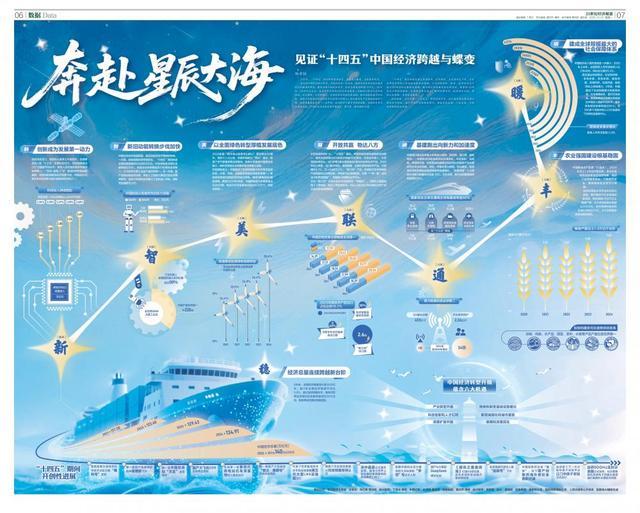
奔赴星辰大海,见证“十四五”中国经济跨越与蝶变
21世纪经济报道· 2025-10-18 13:08
Core Viewpoint - The article highlights the achievements and progress made during China's "14th Five-Year Plan" period, emphasizing economic resilience, innovation, and sustainable development as key drivers for future growth [1][2]. Economic Growth - China's economic increment over the past five years is expected to exceed 35 trillion yuan, with an average growth rate of 5.5%, surpassing the global average and contributing approximately 30% to global economic growth [5]. Innovation - Innovation has become the primary driving force for development, with national R&D investment increasing by nearly 50% compared to the end of the "13th Five-Year Plan." R&D intensity is approaching the OECD average, and China ranks 10th in the global innovation index [7]. Industrial Transformation - The transition from old to new economic drivers is progressing smoothly, with manufacturing value added expected to increase by 8 trillion yuan during the "14th Five-Year Plan," contributing over 30% to global manufacturing growth [9]. Green Development - China has established the world's largest renewable energy system, with installed capacities for hydropower, wind, and solar energy leading globally. By mid-2025, the number of electric vehicles reached 36.89 million, with charging infrastructure also ranking first worldwide [11]. Trade and Global Cooperation - During the "14th Five-Year Plan," China's goods trade volume remained the largest globally, with service trade expected to surpass 1 trillion USD for the first time in 2024. High-tech products accounted for nearly 20% of exports [13][14]. Infrastructure Development - China has built the largest highway, high-speed rail, and port networks globally, with significant growth in new infrastructure sectors such as computing networks and smart cities, achieving a 30% annual growth rate in computing capacity over the past five years [16]. Agricultural Strength - China's grain production has achieved 21 consecutive years of growth, reaching a new milestone of 1.4 trillion jin in 2024, ensuring food security and advancing agricultural technology [18]. Social Welfare - The income gap between urban and rural areas has narrowed, with per capita disposable income reaching 21,840 yuan in the first half of 2025, reflecting ongoing improvements in social welfare systems [20].

奔赴星辰大海 见证“十四五”中国经济跨越与蝶变
2 1 Shi Ji Jing Ji Bao Dao· 2025-10-17 22:48
Core Insights - The article highlights the significant achievements of China's economy during the "14th Five-Year Plan" period, emphasizing its resilience and contributions to global economic growth [1][3]. Economic Growth - Over the past five years, China's economic increment is expected to exceed 35 trillion yuan, with an average annual growth rate of 5.5%, surpassing the global average [3]. - China's contribution to global economic growth has remained around 30% annually, establishing it as a stable anchor for the world economy [3]. Innovation - National R&D investment has increased by nearly 50% compared to the end of the "13th Five-Year Plan," with R&D intensity approaching the OECD average [4]. - China ranks 10th in the global innovation index and has maintained the largest number of R&D personnel in the world for several years [4]. Industrial Transformation - The manufacturing sector is projected to contribute an additional 8 trillion yuan during the "14th Five-Year Plan," maintaining over 30% of global manufacturing growth [5]. - China continues to lead in the production of over 220 major industrial products, with significant advancements in AI and innovative pharmaceuticals [5]. Green Development - China has made substantial progress in environmental quality, with the fastest improvement in air quality and the largest increase in forest resources globally [6]. - By mid-2025, the installed capacity of renewable energy has surpassed that of coal, with 368.9 million new energy vehicles and nearly 16.7 million charging facilities, both ranking first in the world [6]. Trade and Global Cooperation - During the "14th Five-Year Plan," China's goods trade volume has remained the largest globally, with service trade expected to exceed 1 trillion USD for the first time in 2024 [8]. - High-tech products account for nearly 20% of exports, with significant growth in electronic information and high-end equipment sectors [8]. Infrastructure Development - China has established the world's largest networks of highways, high-speed rail, and ports, while also rapidly expanding new infrastructure in computing and smart cities [9]. - The computing power scale has grown at an annual rate of 30% over the past five years, with major nodes accounting for about 70% of the national total [9]. Agricultural Strength - China has achieved 21 consecutive years of grain production growth, with a target of 1.4 trillion jin by 2024, ensuring food security [10]. - The country has built over 1 billion mu of high-standard farmland, with a mechanization rate exceeding 74% for major crops [10]. Social Welfare - By mid-2025, the per capita disposable income reached 21,840 yuan, reflecting a nominal growth of 5.3% [11]. - China has developed the largest education, social security, and healthcare systems globally, with a basic pension insurance coverage exceeding 95% [11].
10月经济展望:投资下方有底,转机或在明年
Orient Securities· 2025-10-17 12:40
Investment Trends - The core contradiction in investment this year is a significant decline in "expansion" investment, which has decreased by 40 percentage points compared to the end of last year, dropping from 33.6% to -6.2% in the first eight months of this year[10] - "New construction" investment has a larger weight (estimated at about 70%) and is projected to show a small increase, reflecting changes in the real estate sector[7] - The total amount of "two重" funds from special long-term bonds is estimated at 700 billion yuan, accounting for 1.4 percentage points of the total fixed asset investment of over 50 trillion yuan in 2023[19] Economic Outlook - The expected support from special long-term bonds in 2024 and 2025 is likely to exceed this year's impact, alleviating growth pressure on expansion investments[7] - The decline in investment is not necessarily negative; it reflects a more rational allocation of resources and the ongoing transition between old and new growth drivers[23] - The overall investment growth rate is expected to stabilize, with a potential slight negative growth this year, but a rebound is anticipated next year[7] Risks and Challenges - Risks include the potential for export growth to exceed expectations due to year-end demand, geopolitical tensions affecting global industrial patterns, and the impact of "anti-involution" policies on domestic demand[43] - Data calculation errors may affect the accuracy of conclusions drawn from investment statistics, particularly in fixed asset investment[43]